Cinch Back Plier
Written & reviewed by the Equate Technical Team · Updated
A cinch back plier bends the end of an archwire sharply down behind the last molar tube so the wire cannot slide forward or poke the cheek. It is used at archwire placement, on stainless steel and, with suitable pliers, on NiTi wire, to keep arch length and protect soft tissue.
What a cinch back does
A cinch back is a bend placed in the distal end of an archwire, just behind the most distal bracket or tube, usually on both sides. A Pocket Dentistry textbook excerpt on archwire shift advises placing it bilaterally distal to the most distal bracket or tube to secure the archwire's position, and notes that a protruding wire end can irritate soft tissue.
The bend serves two purposes: it stops the wire shifting forward (which would let one side lose length and the midline move), and it removes a sharp free end from the cheek. It is not a cure-all. The same source stresses that it does not correct biomechanics produced by a wrongly chosen or poorly activated wire, and says evidence for cinching to increase intrusion is limited.
Stainless steel and NiTi
Stainless steel wire accepts a distal bend directly. NiTi is harder because of its elastic and superelastic behaviour. Historically, clinicians annealed the end with heat, but sources report that annealing can damage the wire's elasticity and, when done intraorally, risk debonding. This is why dedicated NiTi cinch-back designs exist. Manufacturers claim they form a permanent bend without annealing; those are vendor claims, and results may vary with wire type and size.
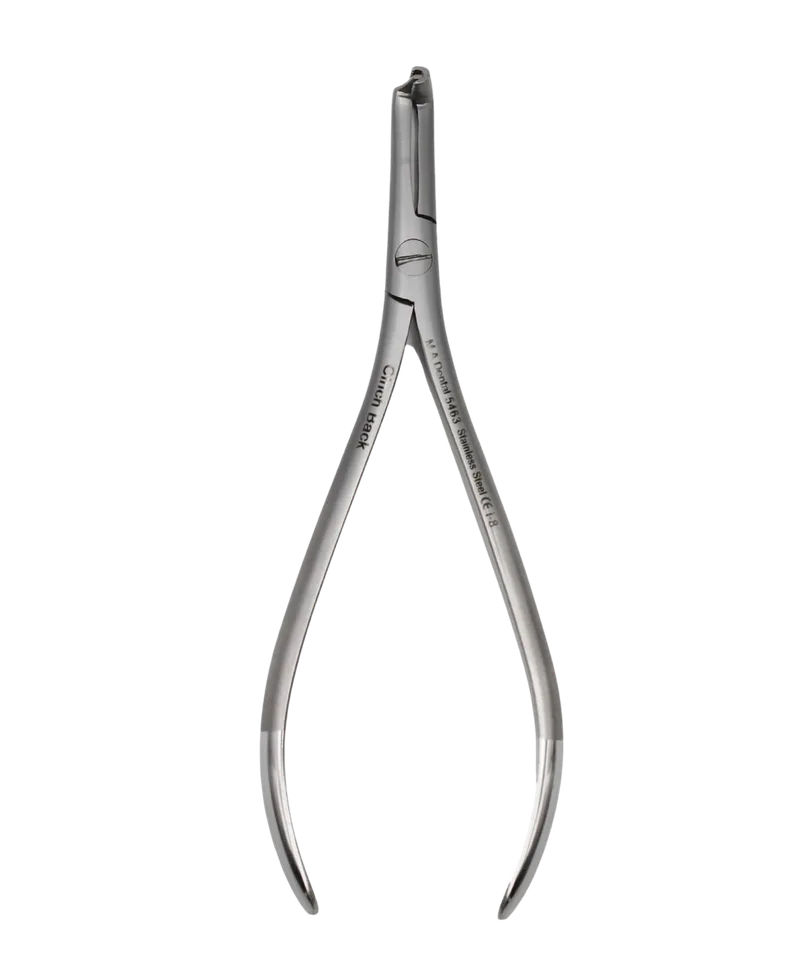
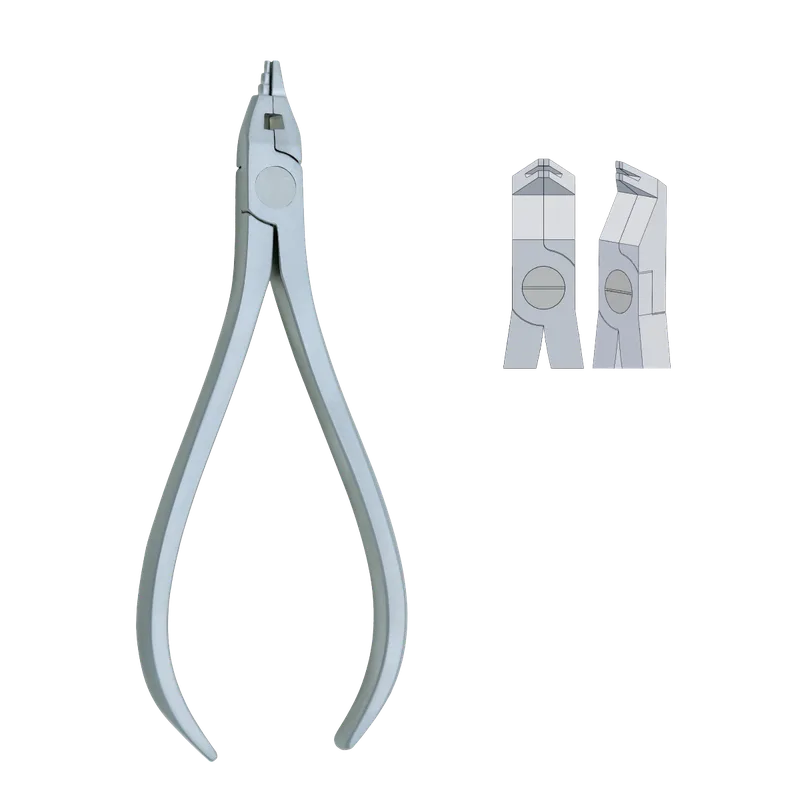
The Equate Hammerhead NiTi Cinch Back Pliers are specified for .025 in wire. Check the wire size range before use.
Cinch back plier vs crimping plier
| Feature | Cinch back plier | Crimping plier |
|---|---|---|
| Main job | Bend the wire end down behind the tube | Squeeze a crimpable hook or stop onto the wire |
| Result | Permanent bend in the wire | Fixed accessory on the wire |
| Equate example | Hammerhead NiTi Cinch Back Pliers 0.64 mm (.025 in) | Ball Hook Crimping Pliers Angled |
| Common wire | Stainless steel, NiTi | Round and rectangular |
Design and handling
- Slim hammerhead working end that reaches the terminal molar area.
- Tapered arms with a smooth box joint and balanced spring return.
- Forged stainless steel body with passivated finish, individually packed.
- Right-angled bend placed close to the tube to resist sliding.
Removing a cinched wire
A cinched end cannot slide forward freely through the tube, so removal means sweeping the plier handles gently forward along the wire's long axis to straighten the bend, then withdrawing the wire. Do this slowly to avoid stress on the bonded tube.
Alternatives such as crimpable stops, which a 2007 Orthodontic Products article describes as working better on rectangular wire than small round wire, are another way to prevent shift.
Pricing context
Equate lists the cinch back plier at EUR 64.90 ex-VAT, about 52% below the EUR 134.80 median premium European RRP for orthodontic wire-forming pliers.
The Equate difference
Equate lists the Hammerhead NiTi Cinch Back Pliers for 0.64 mm (.025 in) wire (EI-0699) and the Ball Hook Crimping Pliers Angled (EI-2620), at a list price of EUR 64.90 each.
Equate Cinch Back Plier options
Frequently asked questions
What is a cinch back in orthodontics?
A bend in the distal end of an archwire behind the molar tube that stops the wire sliding and protects the cheek.
What does a cinch back plier do?
It forms the cinch back bend neatly and close to the tube, instead of using a generic plier.
Can you cinch back NiTi wire?
Yes, with suitable pliers, though NiTi's superelasticity makes bends harder to hold; annealing has been reported to harm elasticity.
What is the difference between a cinch back plier and a distal end cutter?
A cinch back plier bends the wire end; a distal end cutter cuts it and holds the cut piece.
Where is a cinch back placed?
Distal to the most distal bracket or tube, on both sides, according to a textbook excerpt on archwire shift.
What does a crimping plier do?
It crimps ball hooks or stops onto the wire; it is a different instrument.
References
- Archwire Shift chapter on cinch-back bends, Pocket Dentistry
- Specialized Pliers for Specialized Wires, Orthodontic Products (2007)
- ISO 13485:2016 Medical devices quality management systems
I am a…