Dividing Gauge
Written & reviewed by the Equate Technical Team · Updated
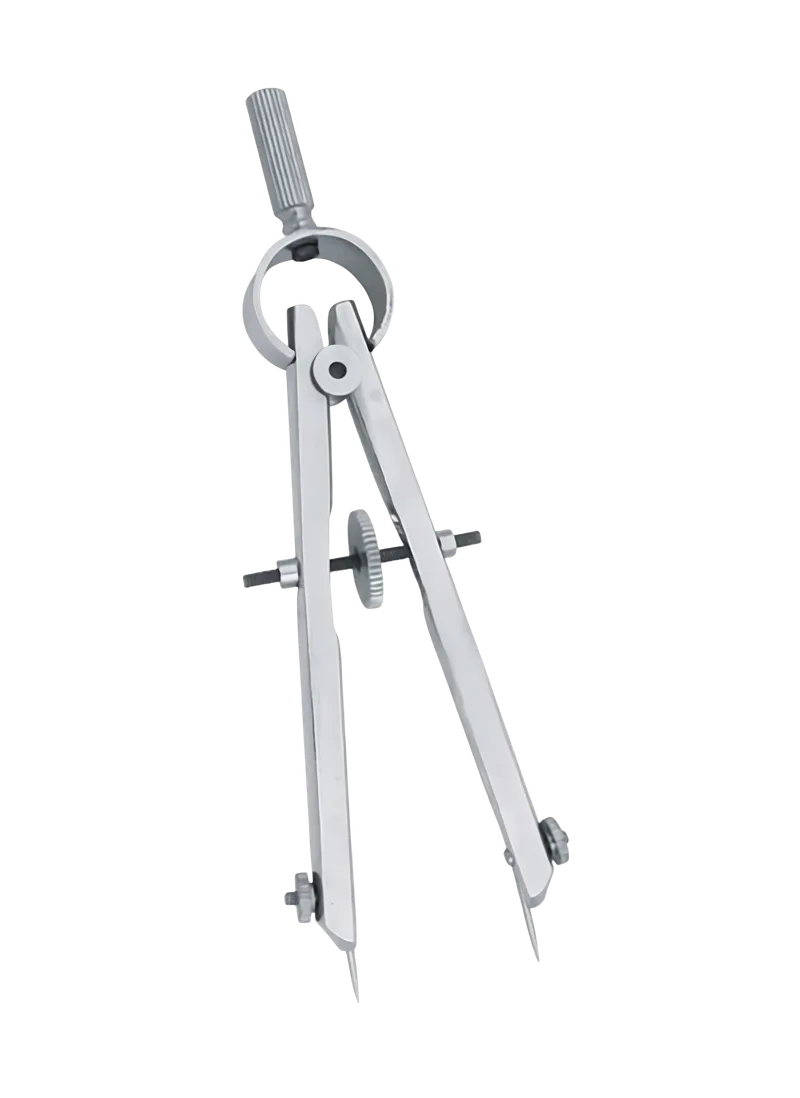
A dividing gauge is a spring-loaded divider with two pointed arms that can be locked at a set distance, used to transfer and compare linear measurements between models, wax-ups and set-ups. Unlike a sliding caliper it carries a distance from one place to another rather than reading it off a scale.
What a dividing gauge does
A divider is one of the oldest measuring tools: two pointed legs on a pivot, set to a distance and then used to step that distance from one place to another. In dentistry the same idea is used on study models and wax set-ups. Rather than reading a number, the operator sets the points on one landmark pair, locks the spacing, and checks whether another pair of landmarks matches. It is useful for comparing left and right sides, transferring a tooth width or space from model to set-up, and checking symmetry.
The measurement of tooth widths on casts has long been done with pointed dividers. A review of Bolton analysis notes that Bolton's original work used a needle-point divider on plaster casts, and that a sliding caliper (Boley gauge) is now the usual instrument, with digital and 3D-model methods yielding comparable results when calibrated properly.
Features of the Equate dividing gauge
- Two rigid arms pivot around a knurled upper head.
- The arms close against a calibrated micrometre wheel on a central threaded bar, so a distance can be set precisely and locked.
- Brass body for rigidity and comfortable handling, with stainless-steel working points that stay sharp.
- Spring loading that keeps the arms steady when adjusting and prevents drift during repeated transfers.
- Reusable and autoclavable, supplied non-sterile and individually packed.
Dividing gauge, Boley gauge and caliper compass
| Instrument | How it works | Result | Best for |
|---|---|---|---|
| Dividing gauge | Pointed arms locked at a set distance | Transfers a distance, can be compared repeatedly | Symmetry checks and measurement transfer |
| Boley gauge | Sliding jaws with a millimetre scale | Direct numeric reading | Tooth width and arch dimensions |
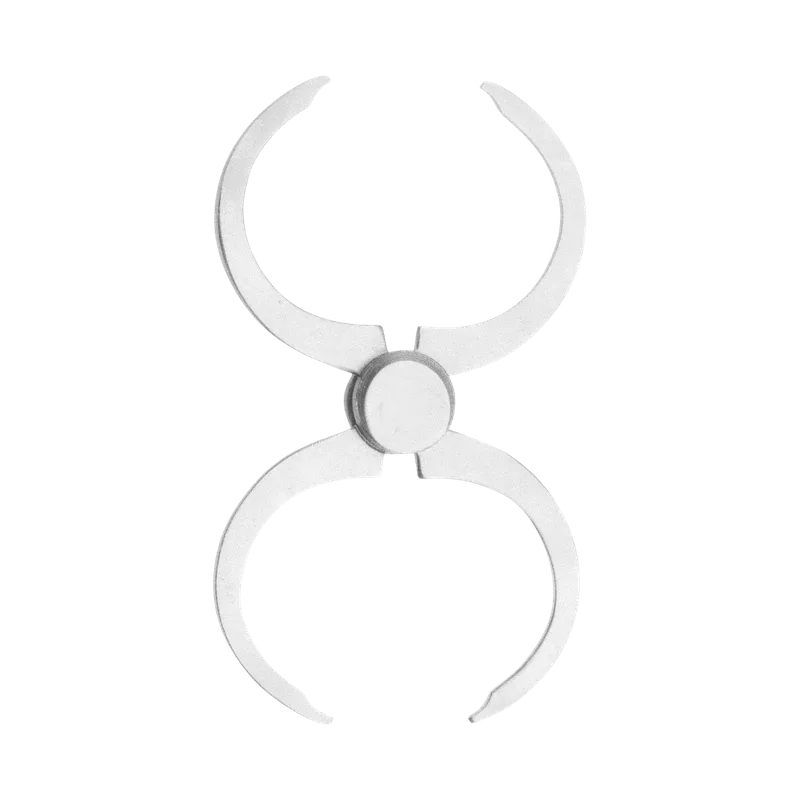
| Caliper compass (dual C-arm) | Mirrored C-shaped arms on a central screw | Transfers interior or exterior dimensions | Reaching inside crowns or between abutments |
| Iwanson caliper | Spring arms with arc scale | Thickness 0 to 10 mm | Wax and ceramic wall thickness |
The Dental Caliper Compass
The Dental Caliper Compass in the same measurement family has two mirrored C-shaped arms pivoting around a central knurled screw. This lets a technician reach inside a crown or between abutments while the outer tips reference the opposing landmark. It is made from stainless steel with a hollow frame, and complements the dividing gauge when the landmarks are not accessible with straight arms.
Choosing and using a divider
Check that the points meet exactly when closed and that the setting does not creep when the locking wheel is tightened. Use the points on definite landmarks, such as contact points or cusp tips, rather than on soft wax edges, and avoid pressing into stone because a deformed point changes every later transfer. When a number is needed, use the divider to carry the distance to a ruler or Boley gauge and read it there; this adds one step but avoids relying on the wheel as an absolute scale.
Clean after use, keep the threaded bar free of plaster dust, and lubricate lightly. Brass instruments should be dried after cleaning and inspected for wear on the tips.
The Equate difference
Equate lists a Dividing Gauge (EI-3315) with a brass body and stainless-steel working tips, a knurled head and a micrometre wheel on a central threaded bar, alongside a Dental Caliper Compass with dual C-arms (EI-2458).
Equate Dividing Gauge options
Frequently asked questions
What is a dividing gauge used for in dentistry?
It transfers and compares linear distances between models, wax-ups and set-ups, for example checking symmetry or carrying a tooth width from one place to another.
What is the difference between a divider and a Boley gauge?
A divider carries a distance between landmarks, whereas a Boley gauge reads the distance directly on a millimetre scale.
Were dividers used for Bolton analysis?
Yes. Reviews of Bolton analysis note the original measurements used a needle-point divider on casts; sliding calipers and digital methods are now more common.
What is a dental caliper compass?
A measuring instrument with two mirrored C-shaped arms on a central screw, used to transfer interior or exterior dimensions between models, dies and impressions.
Is a brass dividing gauge autoclavable?
The Equate dividing gauge is autoclavable, with stainless-steel points. Dry it thoroughly after cleaning.
How do I keep a dividing gauge accurate?
Keep points sharp and aligned, avoid pressing into stone, and check against a ruler or Boley gauge periodically.
References
- Bolton analysis (Wikipedia overview)
- Comparison of Bolton analysis and tooth size measurements using conventional and three-dimensional orthodontic models (PMC)
- ISO 13485:2016 medical devices quality management systems
I am a…