Periodontal Depth Gauge
Written & reviewed by the Equate Technical Team · Updated
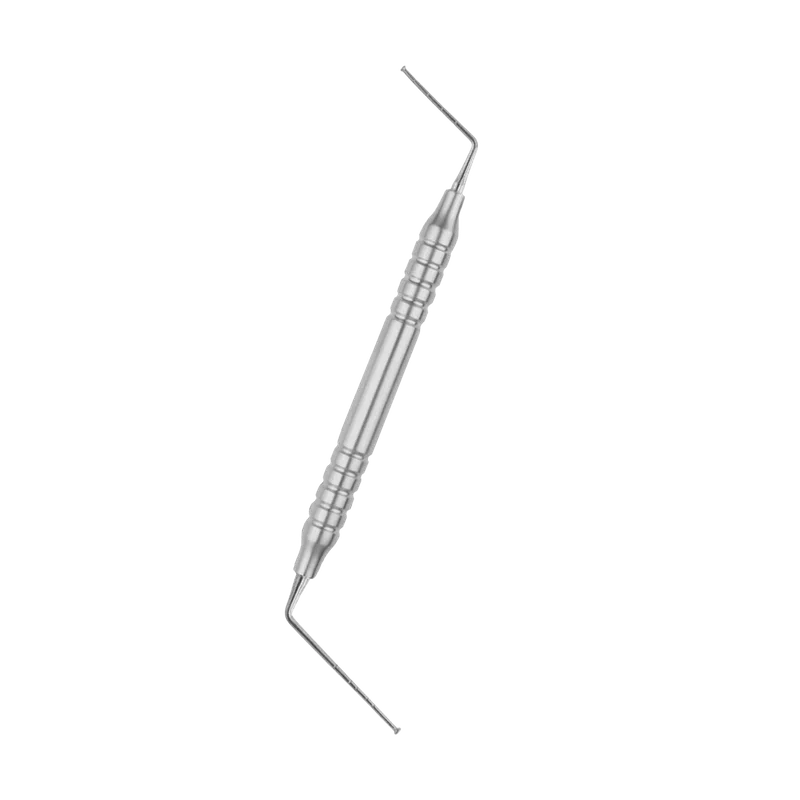
A periodontal depth gauge is a double-ended instrument with thin, graduated right-angle probes used to measure pocket depth, osteotomy depth during implant placement and soft-tissue thickness. Banded markings along the shaft are read directly at common clinical intervals, and the knurled handle gives a controlled grip while charting.
What it measures
A graduated depth gauge answers three clinical questions with one tool: how deep is the pocket, how deep is the prepared bone site, and how thick is the soft tissue. Periodontal charting uses the gauge's probe to record pocket depth at defined sites around each tooth. In implant dentistry the same style of instrument checks osteotomy depth against the planned length. Soft-tissue thickness is assessed during site evaluation before grafting or implants.
The right-angle probe tips and banded markings let the clinician read depth without a separate reference ruler. The Equate 10 mm anatomical hollow handle reduces weight and its knurling gives a secure wet grip.
Graduation and accuracy
Probe graduations matter because pocket depth is recorded in whole millimetres and small errors change diagnosis. In vitro studies show real variation between probe designs. A 2014 study using predrilled aluminium blocks reported that the Chapple UB-CF-15 probe was more accurate and reproducible than the Vivacare TPS and Williams 14W probes. A typodont study found the UNC-15 most accurate of the probes compared, and a study of probe forces found the Williams probe the least accurate and reproducible against a 25 g reference force.
These are mostly in vitro studies with small samples and different designs, and none isolates the effect of a particular graduation pattern. One pressure-sensitive probe study also noted no standardisation of millimetre marks and tip diameters across manufacturers. The practical conclusion is to use a consistent probe, consistent force and calibrated examiners.
Features to compare
| Feature | Why it matters | What to look for |
|---|---|---|
| Tip diameter | Thicker tips give shallower readings through tissue | Thin, uniform probe diameter |
| Graduation bands | Readability at common intervals | Clear, etched or banded markings |
| Probe angle | Access around molars and implant sites | Right-angle, double-ended probes |
| Handle | Grip and balance | Hollow, knurled handle |
| Material | Cleaning and wear | Passivated stainless steel |
Technique that protects accuracy
- Use light, consistent force; a probing force reference of 25 g is commonly used in studies.
- Keep the probe parallel to the long axis of the tooth.
- Read at the margin, not the probe tip, and round consistently.
- Calibrate examiners if more than one person records depths.
- Retire a probe whose markings are worn or tip is bent.
Beyond periodontal charting
For implant osteotomies, the gauge confirms that the prepared site reaches the planned depth before the fixture is placed. Because the clinical tolerance is small, the graduations should be checked against a known length, such as a calibrated scale, when the instrument is new and after any suspected damage. The same reference check supports the ruler and caliper pages of this group, and the measuring ruler page describes how etched graduations are read.
Care
The instrument is passivated stainless steel, ultrasonically cleaned, reusable, latex free and supplied non-sterile, so it can be cleaned and autoclaved. Wipe tissue and blood from the graduations before cleaning, since residue obscures the bands, and store the probe tips protected to avoid bending.
The Equate difference
Equate lists one stainless steel depth gauge, the Depth Gauge Anatomical Hollow Handle 10 mm, a double-ended instrument with a knurled, hollow anatomical handle and graduated probes for periodontal, implant and soft-tissue measurement.
Equate Periodontal Depth Gauge options
Frequently asked questions
What is a periodontal depth gauge used for?
It measures periodontal pocket depth, implant osteotomy depth and soft-tissue thickness using graduated, right-angle probe tips.
How accurate are periodontal probes?
In vitro studies show differences between probe designs, with the UNC-15 and Chapple probes more accurate than the Williams in several studies. Results come from small studies and depend on probing force and technique.
What probing force is used for pocket depth?
Studies of probe force commonly use a reference force of about 25 g, and a 2014 study found the Williams probe the least accurate against it.
Can a depth gauge be used for implant sites?
Yes. Double-ended graduated gauges are used to confirm osteotomy depth against the planned implant length, as well as for soft-tissue thickness.
What does the 10 mm in the Equate gauge name mean?
It refers to the 10 mm anatomical hollow handle design of the Equate depth gauge, which is knurled for grip.
How do I keep a probe accurate over time?
Check graduations against a known scale, replace probes with worn markings or bent tips, and calibrate examiners if several people chart.
References
- In-vitro accuracy and reproducibility evaluation of probing depth measurements of selected periodontal probes, PubMed
- Accuracy and reproducibility of probe forces during simulated periodontal pocket depth measurements, PMC
- Accuracy and reproducibility of two manual periodontal probes, in vitro study, PubMed
- Analyzing equivalency and accuracy of three different periodontal probes, Journal of the California Dental Association
I am a…