Dental Curettes
Written by the Equate Instruments Technical Team · Reviewed by the Medical & Dental Board, Equate Instruments · Updated ·
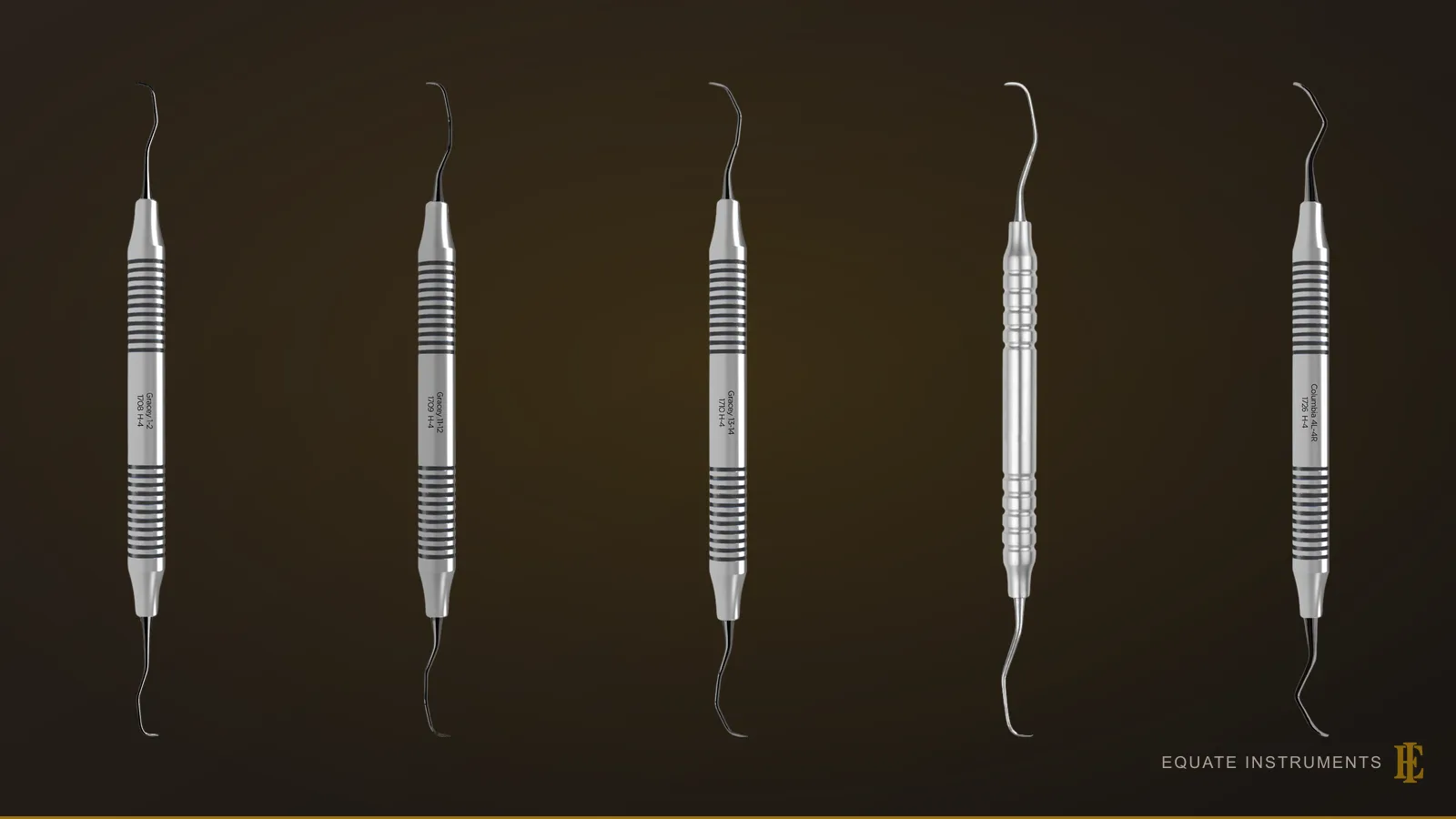
A dental curette is a hand instrument with a rounded toe and back, used to remove calculus and biofilm from root surfaces below the gumline. Universal curettes have two cutting edges and work on most teeth. Gracey curettes are area-specific, with one cutting edge and a shank angled for a particular group of teeth.
Key points
- Curettes remove calculus and biofilm from root surfaces below the gumline.
- Universal curettes have two cutting edges; Gracey curettes have one and are area-specific.
- After Five and Mini Graceys reach deeper and narrower pockets.
What is a dental curette used for?
Curettes are the main hand instruments for subgingival debridement, removing calculus and biofilm from the root surface inside a periodontal pocket. Their rounded toe and back let them go below the gumline without tearing the tissue, which a pointed sickle scaler can't do safely.
They are typically used where probing has found pockets, especially those deeper than 5 mm on a periodontal probe. Newman and Carranza's Clinical Periodontology and Gehrig's Fundamentals of Periodontal Instrumentation both treat the curette as the core instrument for root debridement.
Bone and socket curettes such as the Lucas, Miller and Williger patterns are a different instrument with a different job; they're covered in the guide to surgical curettes.
What is the difference between a Gracey and a universal curette?
The area-specific curette is named after Dr Clayton H. Gracey, the American dentist who designed the series in the 1940s so that each instrument fits one group of tooth surfaces.
- Universal curettes (Columbia, McCall and Barnhart): two cutting edges, with the face at 90° to the lower shank, so one instrument adapts to most surfaces.
- Gracey curettes: one cutting edge per end, with the face offset at about 70° to the lower shank, so each number fits particular teeth and surfaces and adapts closely in deep pockets.
Which Gracey curette is used where?
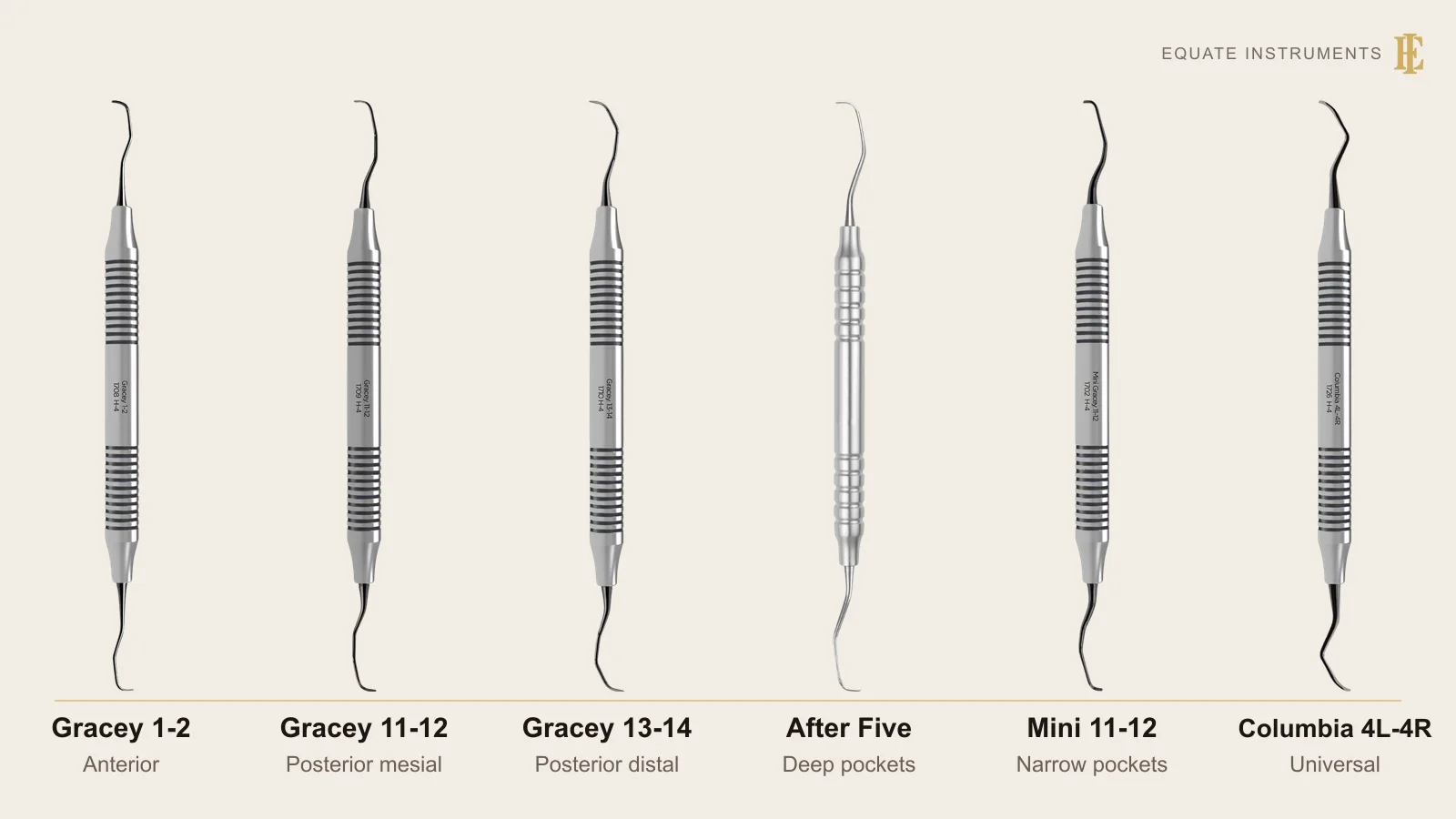
After Five Graceys have a terminal shank about 3 mm longer and a thinner blade for pockets deeper than 5 mm. Mini Graceys add a blade half the length for narrow, deep pockets and furcations, and rigid Graceys have a stiffer shank for heavier deposits.
| Gracey number | Area |
|---|---|
| 1-2, 3-4 | Anterior teeth |
| 5-6 | Anterior teeth and premolars |
| 7-8, 9-10 | Posterior facial and lingual surfaces |
| 11-12 | Posterior mesial surfaces |
| 13-14 | Posterior distal surfaces |
Which specifications matter?
| Specification | What to look for | Why it matters |
|---|---|---|
| Design | Gracey for area-specific work, universal for general use | Adaptation to the root |
| Shank | Standard, After Five (longer) or Mini | Reach into deep and narrow pockets |
| Shank stiffness | Standard, or rigid for heavy calculus | Control versus tactile feel |
| Handle | Hollow, solid or silicone | Fatigue over long sessions |
| Finish | Passivated stainless steel | Holds up to sharpening and sterilisation |
How do you choose a set of curettes?
Many hygienists work with a universal curette plus the Gracey 11-12 and 13-14 for posterior teeth, adding the 1-2 or 5-6 for anterior teeth. Add After Five and Mini versions for patients with deep pockets.
Equate's scaler and curette kits combine the common patterns in a cassette, which keeps the set together through reprocessing.
How do you care for and sharpen curettes?
Sharpen often and lightly, keeping the original 70° (Gracey) or 90° (universal) face angle. Store curettes in a cassette so the blades don't touch, and reprocess them in line with the CDC's dental infection-control guidelines.
The Equate difference
Equate lists 263 curette references, 155 of them Graceys, from the standard pairs to After Five, Mini, rigid and duplex designs, alongside Columbia, McCall, Barnhart, Langer and Lucas universal and specialty curettes and Hemmingway, Miller and Williger surgical curettes.
Equate Dental Curettes options

Gracey Curette 11-14 - Hollow Handle
EI-0010
Gracey Curette 12-13 - Hollow Handle
EI-0012
Lucas 86 Surgical Curette 2.5 mm - Blue Plasma Hollow Handle
EI-0026
Lucas 87 Surgical Curette 3.0 mm - Blue Plasma Hollow Handle
EI-0027
Lucas 88 Surgical Curette 3.5 mm - Blue Plasma Hollow Handle
EI-0028
Lucas Bone Curette 1.5mm - Hollow Ergonomic Handle
EI-0061
Lucas 85 Bone Curette 2 mm Hollow Handle
EI-0062
Lucas Bone Curette 2.5mm - Anatomical Hollow Handle
EI-0063
Lucas 87 Bone Curette 3.0mm - Hollow Ergonomic Handle
EI-0064
Lucas 88 Bone Curette 3.5 mm Hollow Handle
EI-0065
Universal Implant-Maintenance Curette M23 - Titanium-Coated
EI-0074
Universal Curette Fig. 413/414 - Solid Knurled Handle
EI-0092Browse all periodontal & hygiene instruments
Buying in your market
Frequently asked questions
What is the difference between a Gracey and a universal curette?
A Gracey has one cutting edge and an angled shank designed for specific teeth; a universal has two cutting edges and adapts to most surfaces. Graceys fit better in deep pockets, while universals are more versatile.
Which Gracey curette is used where?
1-2 and 3-4 are for anterior teeth, 5-6 for anterior teeth and premolars, 7-8 and 9-10 for posterior facial and lingual surfaces, 11-12 for posterior mesial surfaces and 13-14 for posterior distal surfaces.
What are After Five and Mini Gracey curettes?
After Five curettes have a terminal shank about 3 mm longer for pockets deeper than 5 mm. Minis also have that longer shank, plus a half-length blade for narrow pockets and furcations.
Can curettes be used above the gumline?
Yes. Universal curettes are often used for light supragingival deposits too, but sickle scalers are more efficient for heavy calculus above the gumline.
References
- Gehrig JS, et al. Fundamentals of Periodontal Instrumentation & Advanced Root Instrumentation. Wolters Kluwer
- Newman MG, Takei HH, Klokkevold PR, Carranza FA. Newman and Carranza's Clinical Periodontology. Elsevier (periodontal instruments)
- Kohn WG, et al. Guidelines for Infection Control in Dental Health-Care Settings, 2003. MMWR 52(RR-17), Centers for Disease Control and Prevention
I am a…