Periodontal Probes
Written by the Equate Instruments Technical Team · Reviewed by the Medical & Dental Board, Equate Instruments · Updated ·
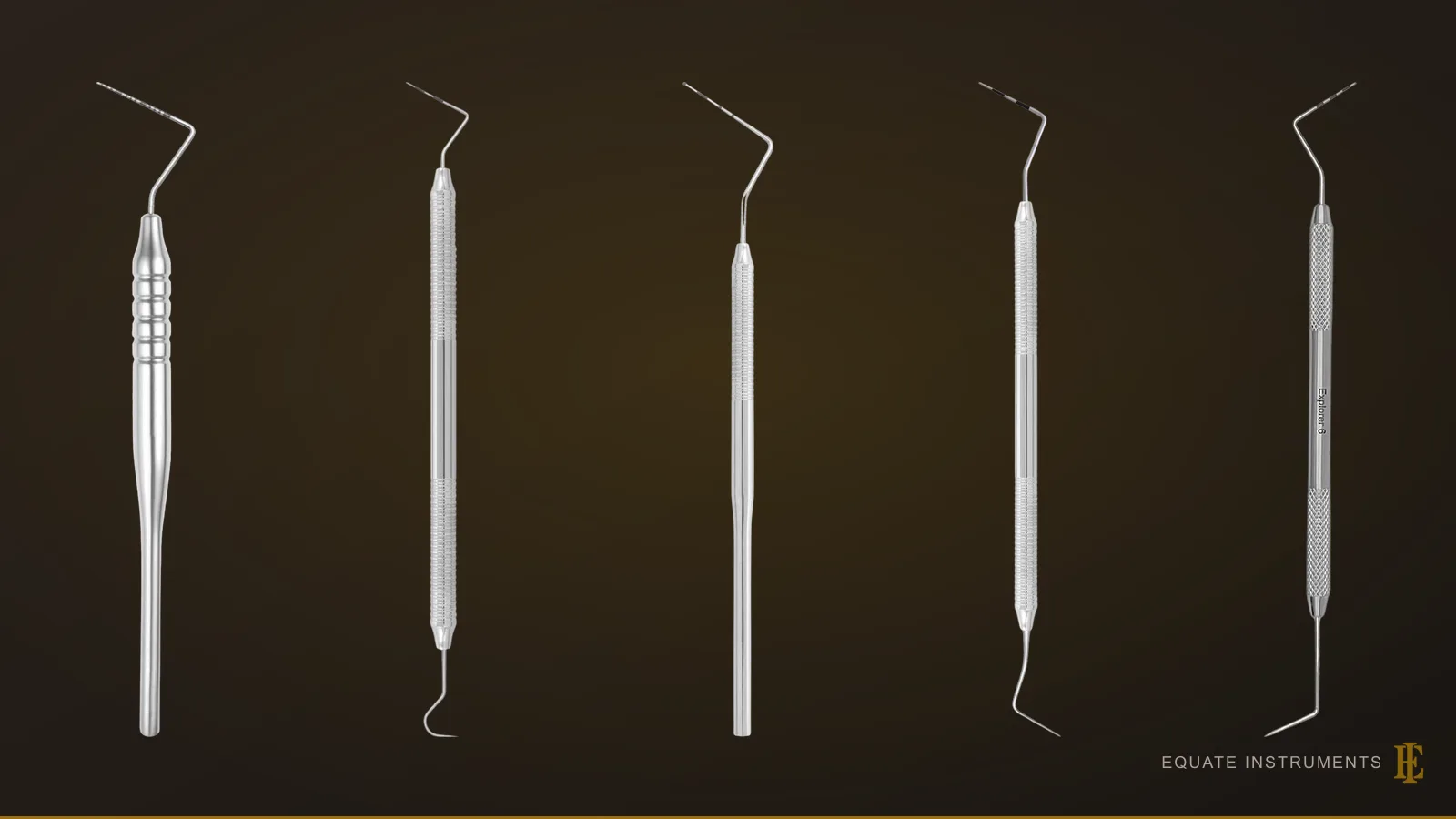
A periodontal probe is a slim, blunt-ended hand instrument with millimetre markings, used to measure the depth of the pocket between gum and tooth. Gently inserted along the root, it shows how far the gum has detached. Readings, usually taken at six points per tooth, are the basis of periodontal charting and diagnosis.
Key points
- A probe measures pocket depth in millimetres, usually at six sites per tooth.
- The marking scheme matters: Williams, UNC-15, CP-12 and WHO probes read differently.
- WHO ball-end probes are for screening (CPI and BPE); fully marked probes are for charting.
What is a periodontal probe used for?
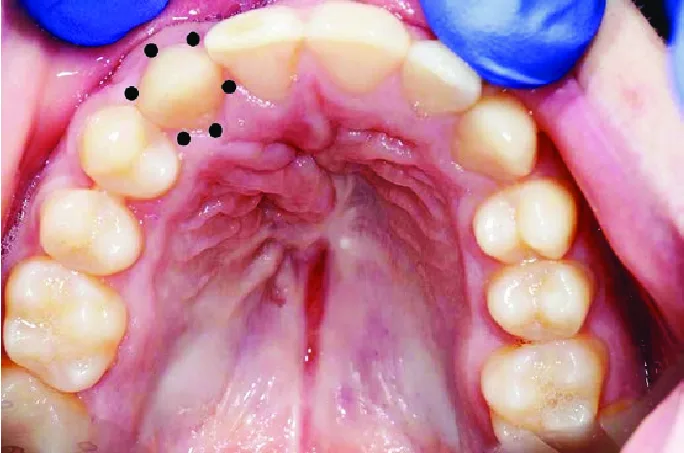
Probing measures pocket depth, from the gum margin to the base of the pocket, and helps work out clinical attachment loss. Clinicians also note bleeding on probing, recession and furcation involvement, and consistent probing with the same type of probe is what makes charts comparable from one visit to the next.
Probing depths and attachment loss also feed the staging and grading of periodontitis in the 2017 World Workshop classification of the American Academy of Periodontology (AAP) and the European Federation of Periodontology (EFP), introduced by Caton and colleagues in 2018. Once the pockets are charted, calculus is removed with scalers above the gumline and curettes below it.
What do the markings on a periodontal probe mean?
- Williams: marks at 1, 2, 3, 5, 7, 8, 9 and 10 mm; the gaps at 4 and 6 mm make readings easier to judge.
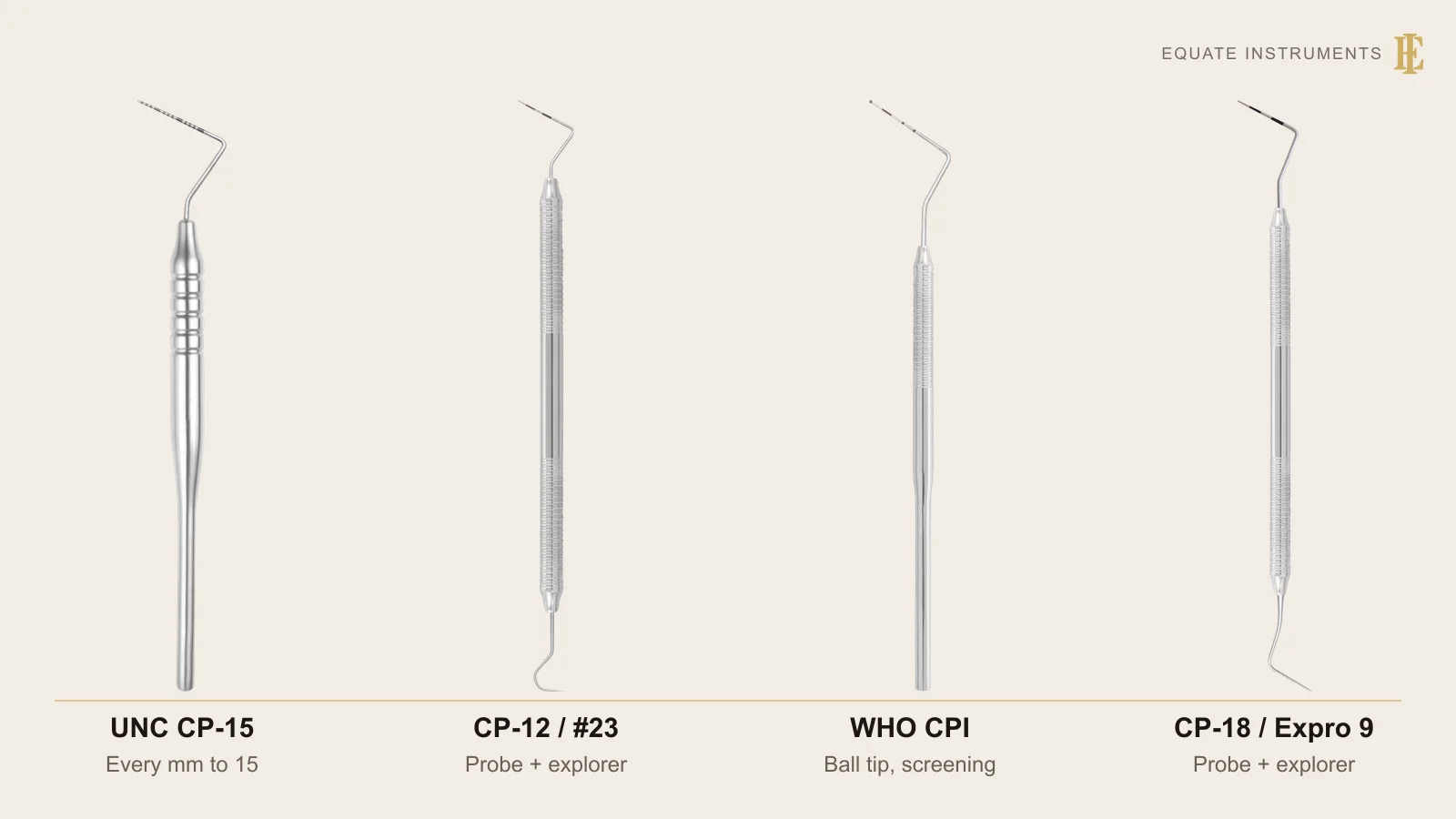
- UNC-15: developed at the University of North Carolina, with a mark at every millimetre to 15 mm and colour bands at 4–5, 9–10 and 14–15 mm, suited to detailed charting and research.
- CP-12 and CP-11: colour-coded bands, for example 3–6 and 9–12 mm on the CP-12, for fast reading.
- WHO CPI probe: a 0.5 mm ball tip and a band from 3.5 to 5.5 mm, introduced by the World Health Organization for the Community Periodontal Index of Treatment Needs (Ainamo and colleagues, 1982). It is the probe used for the Basic Periodontal Examination recommended by the British Society of Periodontology, so it is for screening rather than full charting.
- Nabers furcation probe: curved, to enter and measure furcations between the roots of multi-rooted teeth.
Which specifications matter?
| Specification | What to look for | Why it matters |
|---|---|---|
| Marking scheme | Match it to your charting system | Mixed schemes give inconsistent records |
| Tip | Rounded; ball-ended for screening | Patient comfort and accurate placement |
| Markings | Laser-etched or colour bands, easy to read | Misread bands mean wrong pocket depths |
| Working end | Straight, or curved (Nabers) for furcations | Access to every site |
| Finish | Passivated stainless steel | Markings and tip survive sterilisation |
How do you choose a periodontal probe?
Choose the marking scheme your team charts with and use it in every surgery. A general practice often keeps a colour-coded CP-12 or a Williams probe for charting, a WHO probe for screening and a Nabers probe for furcations.
Explorer-probe combinations save a tray position in routine examinations, because the explorer end checks for caries and calculus while the probe end measures the pocket.
How hard should you press when probing?
Gently. A light force, commonly given as about 0.25 N (roughly 25 g), is usually recommended, because heavier pressure pushes the tip past the base of the pocket and overstates the depth. Gehrig and colleagues teach walking the probe along the pocket in small steps, keeping the tip against the tooth.
How do you care for periodontal probes?
Check the markings regularly, because faded bands lead to misread pockets. A bent tip gives false readings, so replace it rather than straightening it.
Reprocess probes with the rest of the examination set in line with the CDC's dental infection-control guidelines.
The Equate difference
Equate lists 90 probe references, including CP-11 and CP-12 colour-coded probes, Williams probes, WHO CPI ball-end probes, the UNC-15 and Nabers furcation probes, plus explorer-probe combinations that put a probe and an explorer on one instrument, with hollow, solid or silicone handles.
Equate Periodontal Probes options

ExPro Explorer 23 / CP-12 Probe - Solid Stainless Handle
EI-0024
ExPro Holst Explorer / CP 18 Probe - Combination
EI-0045
ExPro Explorer / CP 18 Probe - Combination
EI-0046
ExPro Explorer 6 / CP 18 Probe - Combination
EI-0047
ExPro Williams Probe and Holst Explorer - Hollow Handle 10mm
EI-0109
ExPro CP-18 Probe and Holst Explorer - Hollow Handle 10mm
EI-0124
ExPro CP-15 Probe and 6L Explorer - Hollow Handle
EI-0134
ExPro CP-2 Probe and Explorer 6 - Hollow Handle
EI-0136
Holst Explorer and Williams Probe Combination - 6 mm Solid Handle
EI-0177
Expro 9 Explorer and CP-18 Probe Combination - 6 mm Solid Handle
EI-0205
Probe CP-2 and Explorer #6 - Double-Ended Diagnostic Instrument
EI-0206
ExPro Explorer 23 / CP-12 Ball-End Probe - Blue Silicone Handle
EI-0884Browse all periodontal & hygiene instruments Browse all diagnostic instruments
Buying in your market
Frequently asked questions
What do the markings on a periodontal probe mean?
They show depth in millimetres from the tip. Williams probes are marked at 1, 2, 3, 5, 7, 8, 9 and 10 mm, the UNC-15 at every millimetre to 15, and colour-coded probes in bands.
What is the difference between a WHO probe and a Williams probe?
A WHO (CPI) probe has a ball tip and a single band used for screening. A Williams probe has more marks and is used for full pocket charting.
What is a Nabers probe for?
It is curved to reach and measure furcations, the area between the roots of molars and some premolars, where a straight probe can't go.
How hard should you press when probing?
Gently. A light force of about 0.25 N (roughly 25 g) is commonly recommended, because heavier pressure pushes the tip past the base of the pocket.
References
- World Health Organization. Oral Health Surveys: Basic Methods, 5th edition. WHO, 2013 (the CPI probe)
- Ainamo J, Barmes D, Beagrie G, Cutress T, Martin J, Sardo-Infirri J. Development of the World Health Organization (WHO) Community Periodontal Index of Treatment Needs (CPITN). International Dental Journal 1982;32(3):281–291
- Caton JG, Armitage G, Berglundh T, et al. A new classification scheme for periodontal and peri-implant diseases and conditions. Journal of Clinical Periodontology 2018;45(Suppl 20):S1–S8
- British Society of Periodontology. Basic Periodontal Examination (BPE) guidance
- Gehrig JS, et al. Fundamentals of Periodontal Instrumentation & Advanced Root Instrumentation. Wolters Kluwer
- Kohn WG, et al. Guidelines for Infection Control in Dental Health-Care Settings, 2003. MMWR 52(RR-17), Centers for Disease Control and Prevention
I am a…