Dental Scalers (Hand Scalers)
Written by the Equate Instruments Technical Team · Reviewed by the Medical & Dental Board, Equate Instruments · Updated ·
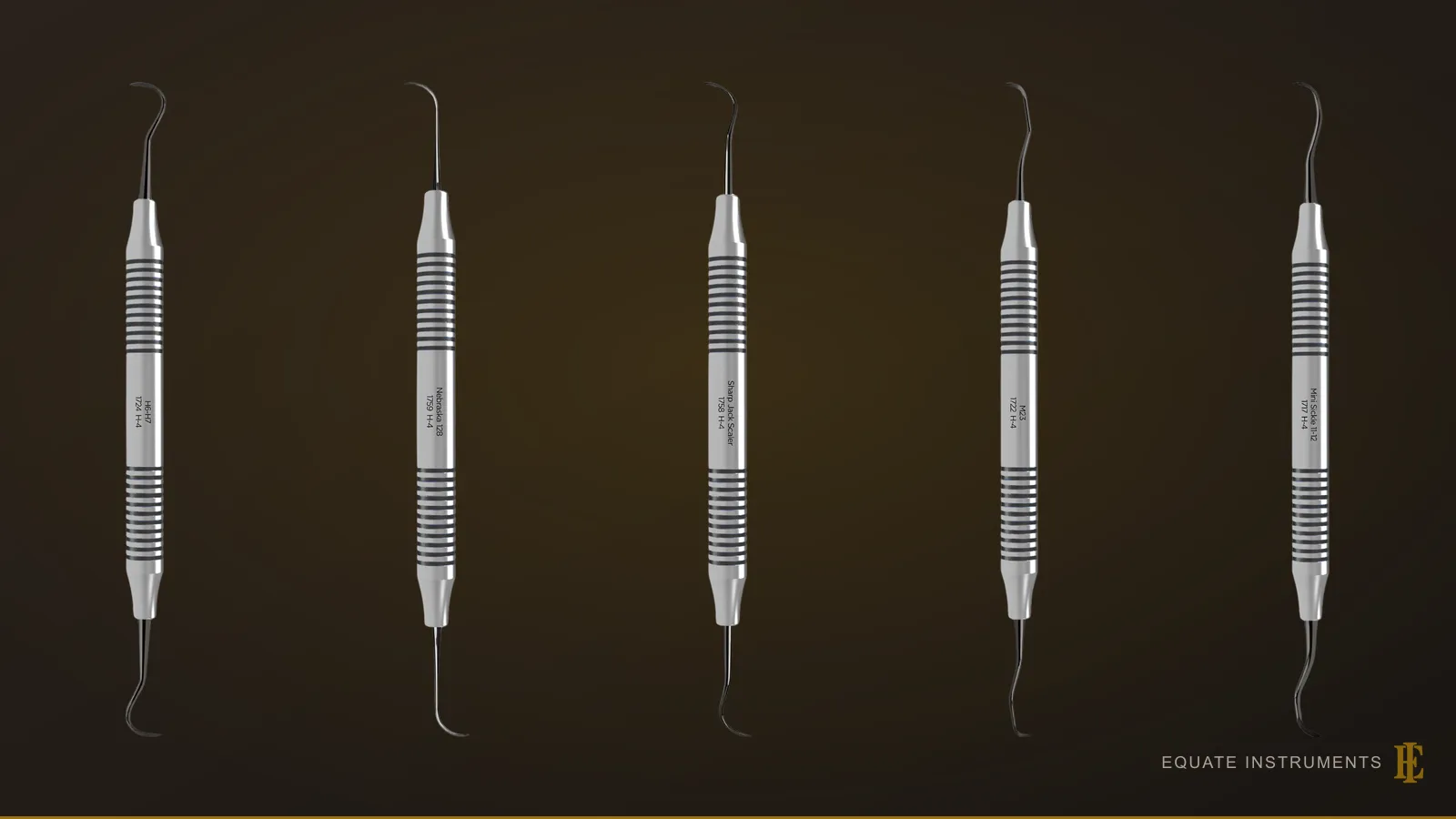
A dental scaler is a hand instrument for removing calculus (tartar) from tooth surfaces above the gumline. The common sickle scaler has a pointed tip, a triangular cross-section and two cutting edges. That makes it strong enough for heavy supragingival deposits, but it isn't designed to go deep below the gumline, which is a curette's job.
Key points
- A hand scaler removes calculus above the gumline; a curette works below it.
- Sickle scalers have a pointed tip, a triangular cross-section and two cutting edges.
- The shank follows the teeth: straight for anterior teeth, contra-angled for posterior teeth.
What is a dental scaler used for?
Hand scalers remove supragingival calculus, the hard mineralised deposit that forms above the gumline, usually after the pockets have been charted with a periodontal probe. They're used in routine hygiene appointments alongside ultrasonic instruments, and to finish areas a powered tip can't reach.
Their two cutting edges and pointed tip make them efficient at breaking off ledges of calculus, especially on the lingual surfaces of lower incisors and in contact areas. Gehrig and colleagues, in Fundamentals of Periodontal Instrumentation, teach the sickle as the instrument of choice for heavy supragingival deposits for exactly this reason.
What is the difference between a scaler and a curette?
A scaler's tip is pointed and its back is sharp, so it can injure the gum if it's forced deep into a pocket. A curette has a rounded toe and back and is designed for subgingival work, removing deposits from the root surface below the gumline.
Most hygienists use both: a sickle scaler for supragingival deposits and a curette for subgingival debridement. Newman and Carranza's Clinical Periodontology describes the same division of work between the two instrument families.
What types of hand scalers are there?
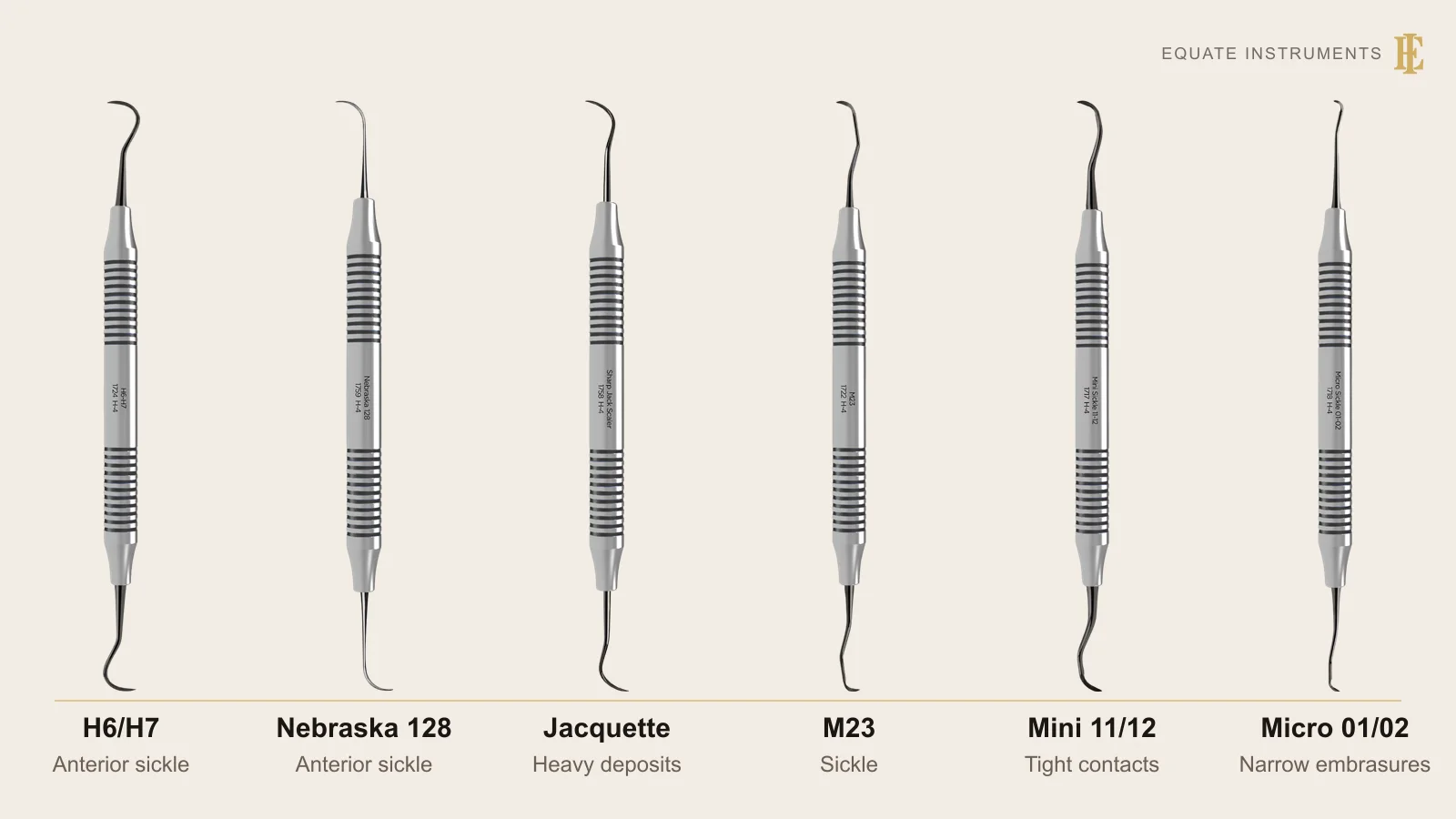
- Anterior sickle scalers: a straight shank for incisors and canines (for example the H6/H7 and Nebraska 128).
- Posterior sickle scalers: a contra-angled shank to reach premolars and molars; the 204S and 204SD are common paired designs.
- Jacquette scalers: a sickle variant with a straighter, more triangular blade for heavy anterior and premolar deposits.
- Mini and micro sickles: smaller, thinner blades for tight contacts, crowded teeth and narrow embrasures.
- Hoe scalers: a single straight cutting edge used with a pull stroke on heavy supragingival ledges.
Which specifications matter?
| Specification | What to look for | Why it matters |
|---|---|---|
| Shank | Straight for anterior teeth, contra-angled for posterior teeth | Access without straining the wrist |
| Blade size | Standard for heavy deposits, mini or micro for tight areas | Adaptation to the tooth |
| Handle | Hollow (light), solid (rigid) or silicone (wider grip) | Fatigue and tactile feedback |
| Edge | Sharp, without a wire edge | A dull scaler burnishes calculus rather than removing it |
| Finish | Passivated stainless steel | Holds up to repeated sharpening and sterilisation |
How do you choose a dental scaler?
Most practices keep one anterior sickle, one posterior pair such as the 204S, and a mini sickle for crowded lower incisors. Choose a handle diameter that suits the clinician's hand: larger silicone and hollow handles reduce pinch force over a full day of hygiene appointments.
Plan to sharpen regularly. A scaler that slides over calculus instead of engaging it is dull, and it costs time on every patient.
How do you care for and sharpen scalers?
Clean scalers in a cassette so the tips don't touch each other, then autoclave them in line with the CDC's dental infection-control guidelines.
Sharpen with a stone while keeping the original blade angle. Over-sharpening thins the tip and can lead to breakage, so light and frequent sharpening keeps the blade's shape longer than occasional heavy sharpening.
The Equate difference
Equate lists 85 periodontal hand scaler references, from anterior and posterior sickles such as the 204S and 204SD to Jacquette, mini and micro sickles and hoe scalers, with hollow 10 mm, solid 6 mm or colour-coded silicone handles, all in passivated stainless steel and individually packed.
Equate Dental Scalers (Hand Scalers) options

Sickle Scaler 204S
EI-0009
Crane-Kaplan Sickle Scaler - Hollow Handle
EI-0054
Sickle Scaler Fig. 204SD - Solid Knurled Handle
EI-0073
M23 Sickle Scaler
EI-0075
Kaplan 9-10 Sickle Scaler - Hollow Handle
EI-0122
Kaplan 9-10 Sickle Scaler - Solid Handle
EI-0190
Basic Perio Set - 5 Gracey and Scaler Instruments with Stainless Cassette
EI-0244
Mini Sickle Scaler 11/12
EI-0248
Micro Sickle Scaler 01/02
EI-0249
M23 Sickle Scaler - Sharpen-Free
EI-0250
H6-H7 Anterior Sickle Scaler
EI-0251
Sharp Jacquette J-Scaler
EI-0253Browse all periodontal & hygiene instruments
Buying in your market
Frequently asked questions
What is the difference between a scaler and a curette?
A scaler has a pointed tip and is meant for calculus above the gumline. A curette has a rounded toe and back and can be used below the gumline on the root surface.
Can a sickle scaler be used below the gumline?
It isn't designed for it. The pointed tip and sharp back can injure the gum and the root surface, so a curette is used for subgingival work.
How often should hand scalers be sharpened?
As soon as they stop engaging calculus cleanly, which in a busy hygiene practice is often after every few uses. Regular light sharpening keeps the blade's shape longer than infrequent heavy sharpening.
Are ultrasonic scalers the same as hand scalers?
No. Ultrasonic scalers are powered tips that vibrate to break up calculus, while hand scalers rely on the clinician's stroke. Many practices use an ultrasonic first and hand instruments to finish.
References
- Gehrig JS, et al. Fundamentals of Periodontal Instrumentation & Advanced Root Instrumentation. Wolters Kluwer
- Newman MG, Takei HH, Klokkevold PR, Carranza FA. Newman and Carranza's Clinical Periodontology. Elsevier (periodontal instruments)
- Kohn WG, et al. Guidelines for Infection Control in Dental Health-Care Settings, 2003. MMWR 52(RR-17), Centers for Disease Control and Prevention
I am a…