Surgical Curettes (Bone Curettes) for Oral Surgery
Written by the Equate Instruments Technical Team · Reviewed by the Medical & Dental Board, Equate Instruments · Updated ·
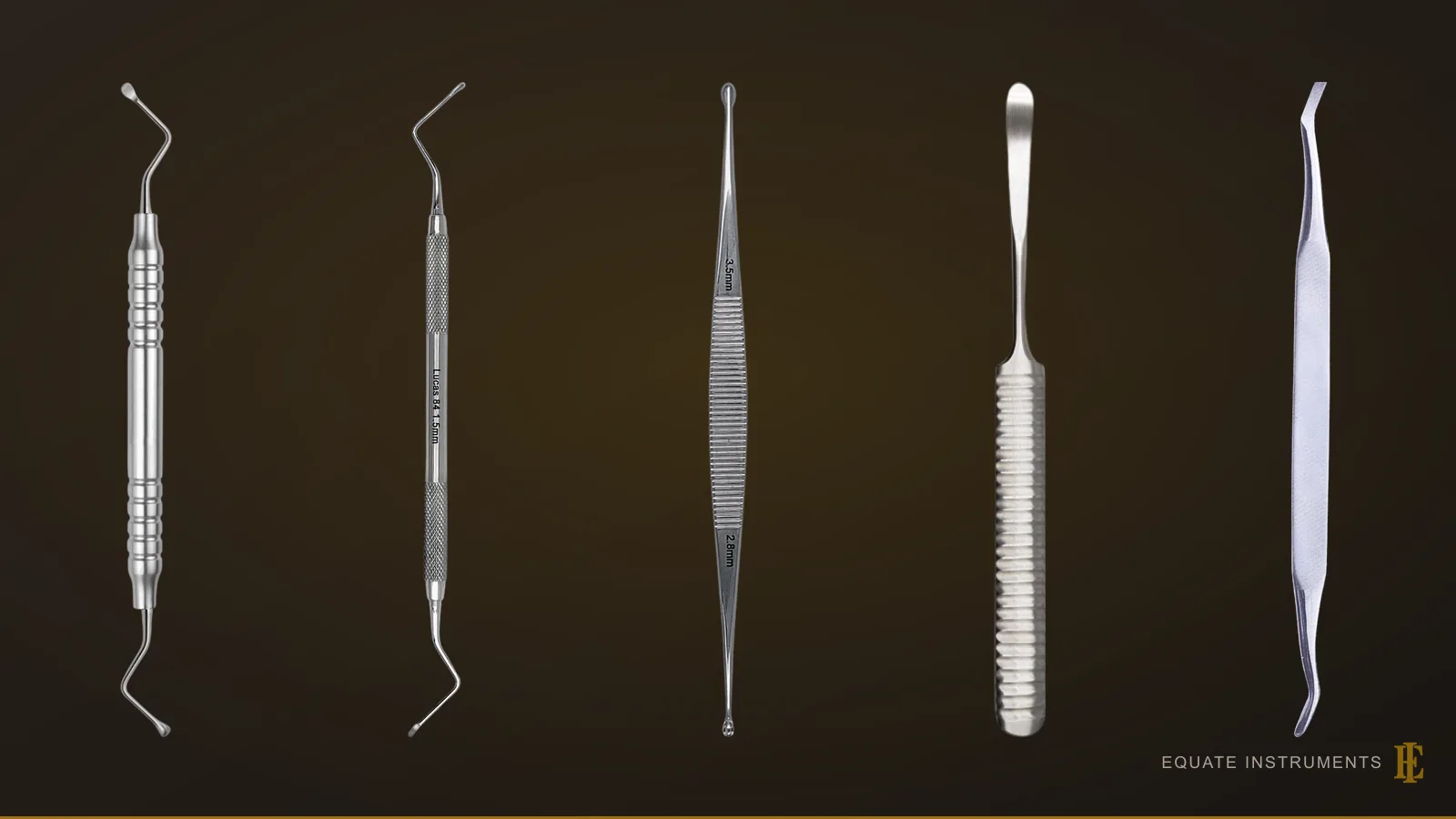
A surgical curette, or bone curette, is a hand instrument with a small, sharp-edged spoon at an angle to the shank, used to scrape soft tissue out of bone. In oral surgery it removes granulation tissue and debris from extraction sockets, enucleates small cysts and periapical lesions, and collects bone chips. Lucas, Miller, Hemmingway and Williger are the common patterns, usually 1.5–4 mm wide.
Key points
- Surgical curettes have a spoon-shaped bowl with an edge all round; periodontal curettes such as Graceys have a narrow blade for root surfaces.
- In a socket they remove soft tissue and debris, but healthy socket walls and the clot that forms are left alone.
- Choose the bowl size to fit the socket or defect: small Lucas sizes for single roots and apices, larger Miller and Williger bowls for molar sockets and cysts.
What is a surgical curette used for?
A surgical curette removes soft tissue from bony cavities. After an extraction it lifts out granulation tissue, small fragments of bone or tooth and remnants of a periapical lesion from the socket; in cyst and apical surgery it separates the lining from the bony wall so the lesion comes out whole; and in implant and graft work it collects bone chips and places graft material.
The curette usually follows the extraction forceps and elevators on the surgical extraction tray, with a surgical suction tip to keep the socket visible. The oral surgery and extraction instruments guide shows the whole extraction sequence it belongs to.
What is the difference between a surgical curette and a periodontal curette?
Surgical curettes work on bone and soft tissue; periodontal curettes work on root surfaces. Gracey and universal curettes, which remove subgingival calculus and plane roots, are covered in the guide to dental curettes.
| Surgical (bone) curette | Periodontal curette | |
|---|---|---|
| Working end | Round or oval spoon with a cutting edge all round | Narrow, half-moon blade with a rounded toe |
| Works on | Sockets, cysts, granulation tissue and bone | Root surfaces and pocket walls |
| Typical sizes | Bowls of about 1.5–4 mm | Blades under 1 mm wide |
| Patterns | Lucas, Miller, Hemmingway, Williger | Gracey, Columbia, McCall, Barnhart |
| Tray | Oral surgery and implant | Hygiene and periodontal |
What types of surgical curette are there?
| Pattern | Shape | Typical use |
|---|---|---|
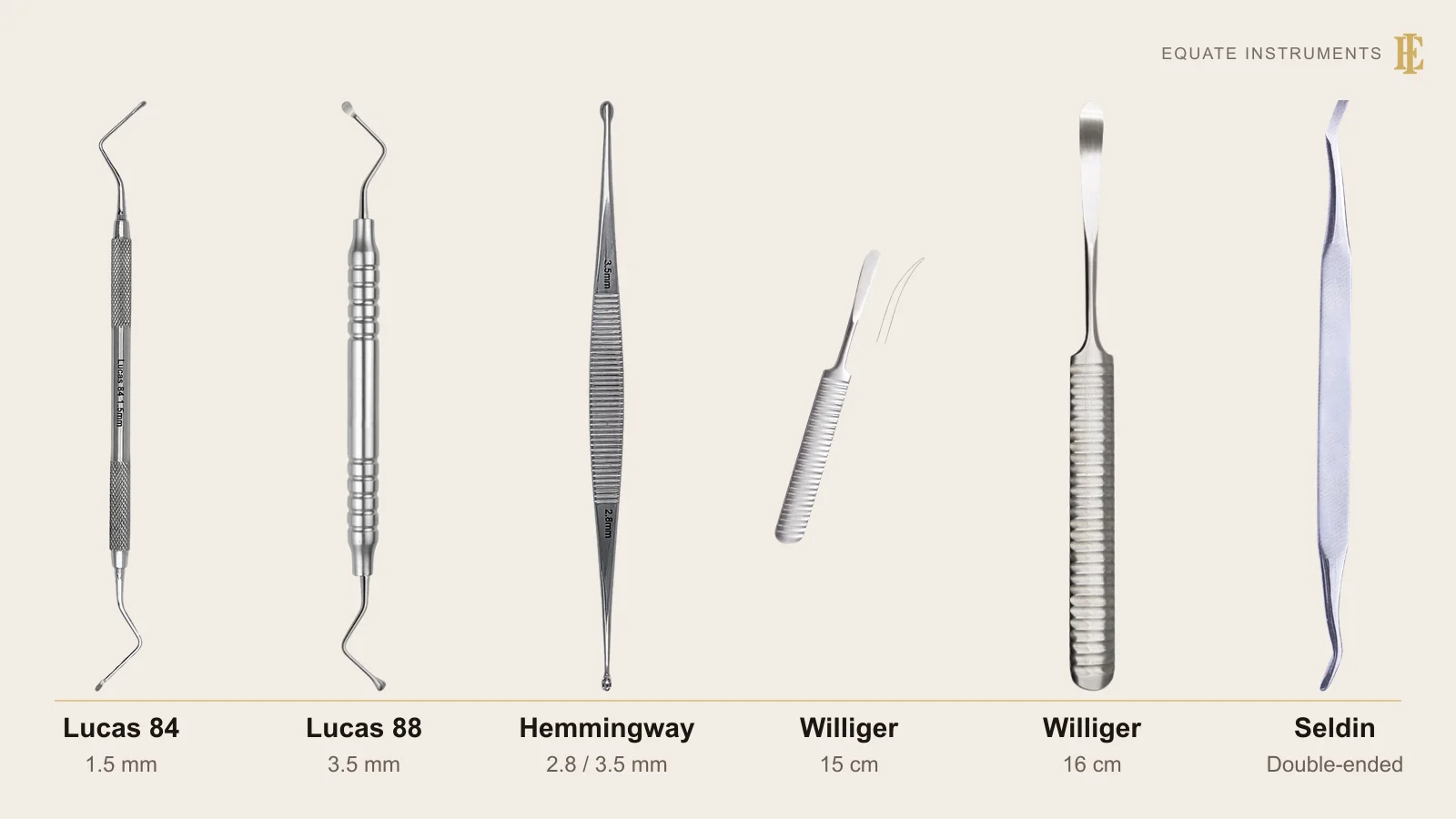
| Lucas | Double-ended, angled oval bowls; the number rises with the bowl size (for example 84 to 88), though widths for the same number vary between makers | Extraction sockets, apical lesions and bone collection |
| Miller | Double-ended, larger bowls (for example Miller 8 and 21) | Molar sockets and larger defects |
| Hemmingway | Fine, straight or slightly angled bowls of about 2.5–3.5 mm | Narrow sockets, apices and small cavities |
| Williger | Straight, deep oval bowl on a flat handle, graded sizes | Cysts and larger bony cavities |
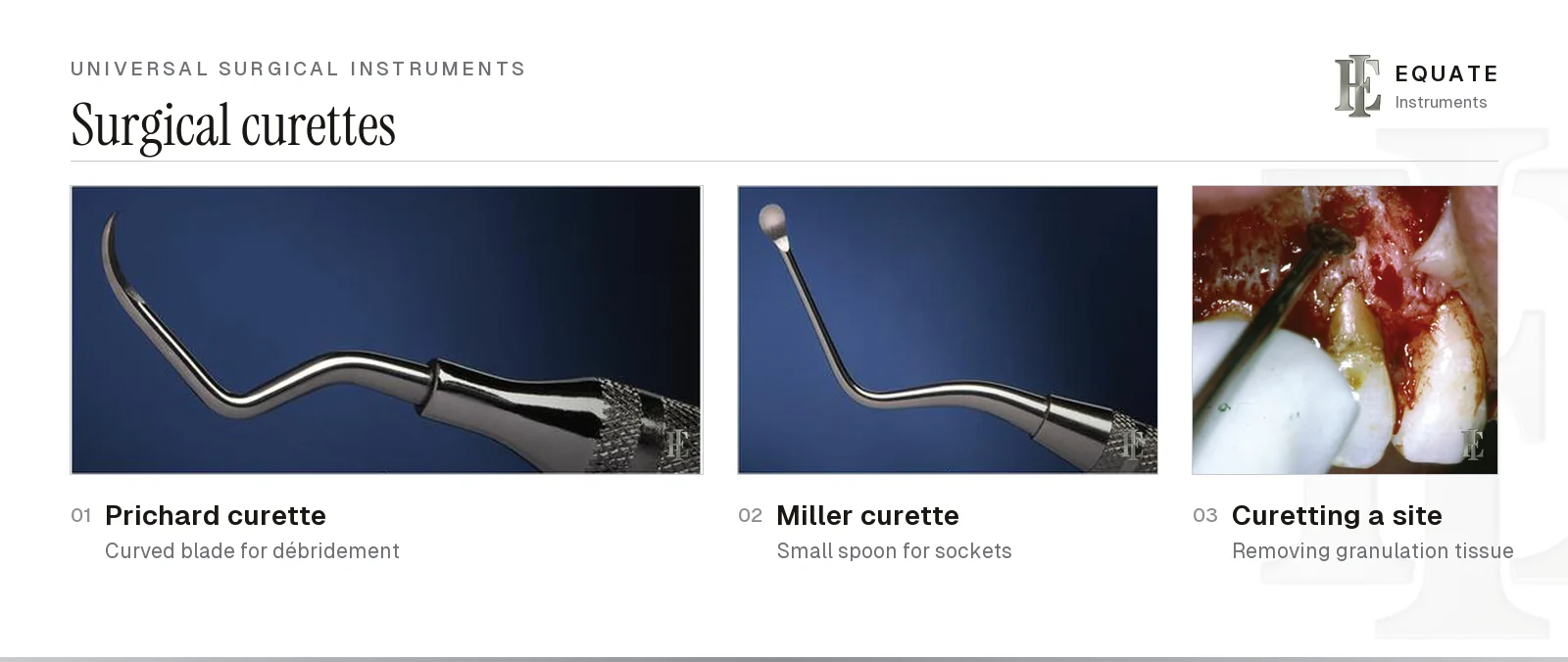
| Soft-tissue curettes | Thin, curved or sharply angled blades, such as the Prichard, often in left and right pairs | Removing epithelium and granulation tissue from defects in flap surgery |
How do you use a surgical curette in a socket?
Hold the curette in a modified pen grasp with a firm finger rest, and place the bowl against the socket wall with the concave side facing the tissue to be removed. Work from the apex towards the opening with short scraping strokes, lifting the tissue out rather than pushing it deeper, and wipe the bowl on gauze between strokes.
Curette only where there is something to remove. A healthy socket after a simple extraction is usually left alone so a clot can form, while a socket with a periapical lesion, granulation tissue or debris is cleaned out. Chrcanovic and colleagues, reviewing immediate implants placed into infected sites, found that good outcomes depended on preparation that included socket curettage and debridement. Take care near the inferior alveolar canal, the mental foramen and the maxillary sinus, where an apex can lie very close to the nerve or sinus lining.
Which curette for which procedure?
- Single-rooted sockets and apices: a Lucas 84 to 86 (1.5–2.5 mm in Equate's range) or a fine Hemmingway.
- Molar sockets and larger defects: a Lucas 87 or 88, Miller or a small Williger.
- Cyst enucleation: a Williger or large Miller to separate the lining from the bony wall, after a flap raised with a periosteal elevator.
- Periodontal and regenerative surgery: soft-tissue curettes for degranulation on the periodontal surgery tray.
- Bone collection: a Lucas or Hemmingway to scoop chips for the bone graft instruments trimmed with a rongeur or scraped from the surgical site.
Which specifications matter?
- Bowl size: 1.5 mm to 4 mm covers most sockets; a set of two or three sizes is typical.
- Edge: sharp all round, so the curette lifts tissue instead of smearing it.
- Shank angle: angled Lucas and Miller shanks reach posterior sockets; straight Williger and Hemmingway designs suit direct access.
- Handle: a 10 mm hollow or silicone handle reduces grip force; a 6 mm solid handle gives finer feel.
- Finish: plasma-coated blue tips are easier to see against tissue and blood.
What does the Equate range include?
Equate lists 44 surgical curettes. The 19 Lucas curettes cover the 84 (1.5 mm), 85 (2 mm), 86 (2.5 mm), 87 (3 mm) and 88 (3.5 mm) sizes plus a 4 mm curette, on 6 mm solid, 10 mm hollow and anatomical handles, three with blue plasma-coated tips. There are 8 Hemmingway curettes from 2.5 mm to 3.5 mm, including a double-ended 2.8/3.5 mm and two on yellow silicone handles, 6 Williger curettes (13, 15 and 17 cm, and 00/0, 0/1 and 1/2), and 4 Miller curettes in the 8 and 21 patterns. A further 7 surgical curettes include a Miller 8 of 3.5 mm, a Williger 16 cm, a Seldin and four left and right soft-tissue curettes.
Each is made of passivated stainless steel, ultrasonically cleaned, shape-, boil- and performance-tested and individually packed. Equate instruments are designed in Finland, and clinics can request samples and a quote through the oral surgery range.
How do you clean, sharpen and maintain surgical curettes?
Surgical curettes enter bone and soft tissue, so they are critical items: clean them promptly, process them in an ultrasonic bath or washer-disinfector and heat-sterilise them after every patient, as the CDC's dental guidelines require. Tissue dries quickly inside the bowl, so wipe it during surgery and brush it out before cleaning, and follow the manufacturer's reprocessing instructions under ISO 17664-1.
Check the edge under magnification. A dull bowl can be lightly honed on the outer surface with a fine stone, keeping its round shape; a bowl that is thin, cracked or bent out of line should be retired.
The Equate difference
Equate lists 44 surgical curettes: 19 Lucas curettes from 1.5 mm to 4 mm, 8 Hemmingway, 6 Williger, 4 Miller and 7 further surgical curettes, including Miller 8, Williger 16 cm, Seldin and left and right soft-tissue curettes, on 6 mm solid, 10 mm hollow, anatomical and silicone handles.
Equate Surgical Curettes (Bone Curettes) for Oral Surgery options

Lucas 86 Surgical Curette 2.5 mm - Blue Plasma Hollow Handle
EI-0026
Lucas 87 Surgical Curette 3.0 mm - Blue Plasma Hollow Handle
EI-0027
Lucas 88 Surgical Curette 3.5 mm - Blue Plasma Hollow Handle
EI-0028
Lucas Bone Curette 1.5mm - Hollow Ergonomic Handle
EI-0061
Lucas 85 Bone Curette 2 mm Hollow Handle
EI-0062
Lucas Bone Curette 2.5mm - Anatomical Hollow Handle
EI-0063
Lucas 87 Bone Curette 3.0mm - Hollow Ergonomic Handle
EI-0064
Lucas 88 Bone Curette 3.5 mm Hollow Handle
EI-0065
Lucas 85 Surgical Bone Curette
EI-0129
Lucas 84 Surgical Bone Curette 1.5 mm - 6 mm Solid Handle
EI-0196
Lucas 85 Surgical Bone Curette 2.0 mm - 6 mm Solid Handle
EI-0197
Lucas Surgical Bone Curette 2.5 mm - 6 mm Solid Handle
EI-0198Browse all oral surgery instruments Browse all periodontal & hygiene instruments
Buying in your market
Frequently asked questions
What is a surgical curette used for in dentistry?
It removes granulation tissue, debris and small lesions from extraction sockets and bony cavities, separates cyst linings from bone and collects bone chips. It is an oral surgery instrument, not a scaling instrument.
What is a Lucas curette?
A double-ended surgical bone curette with angled oval bowls. The number rises with the bowl size: in Equate's range the 84 is 1.5 mm and the 88 is 3.5 mm, but other makers give the same numbers different widths, so check the size in millimetres. It is the most common curette for cleaning extraction sockets.
What is the difference between a surgical curette and a Gracey curette?
A surgical curette has a spoon-shaped bowl for scraping soft tissue out of bone. A Gracey is a periodontal curette with a narrow, offset blade for root surfaces.
Should every extraction socket be curetted?
No. A healthy socket is usually left so a clot can form; curettage is used when there is granulation tissue, a periapical lesion or debris to remove.
What size surgical curette should I use?
Match the bowl to the socket: about 1.5–2.5 mm for single-rooted teeth and apices, and 3–4 mm or a Miller or Williger for molar sockets and cysts.
Should a dry socket be curetted?
No. Rohe and Schlam's StatPearls review advises against curetting a dry socket (alveolar osteitis), because it exposes more bone; gentle irrigation of the socket is the first step. Pain typically starts one to five days after the extraction.
References
- Hupp JR, Tucker MR, Ellis E. Contemporary Oral and Maxillofacial Surgery, 7th edition. Elsevier, 2018 (socket management after exodontia; management of cysts of the jaws)
- Chrcanovic BR, Martins MD, Wennerberg A. Immediate placement of implants into infected sites: a systematic review. Clinical Implant Dentistry and Related Research 2015;17(Suppl 1):e1–e16
- Newman MG, Takei HH, Klokkevold PR, Carranza FA. Newman and Carranza's Clinical Periodontology. Elsevier (periodontal and surgical instruments)
- Kohn WG, Collins AS, Cleveland JL, et al. Guidelines for Infection Control in Dental Health-Care Settings, 2003. MMWR 52(RR-17), Centers for Disease Control and Prevention
- Centers for Disease Control and Prevention. Best Practices for Sterilization in Dental Settings
- ISO 17664-1:2021 Processing of health care products: information to be provided by the medical device manufacturer for the processing of medical devices, Part 1: critical and semi-critical medical devices
- Boyd LB. Dental Instruments: A Pocket Guide, 7th edition. Saunders/Elsevier, 2020. Chapter 15, Universal Surgical Instruments (photographs used under licence)
- Rohe C, Schlam M. Alveolar Osteitis. StatPearls, StatPearls Publishing, updated 29 May 2023
I am a…