Dental Extraction Forceps
Written by the Equate Instruments Technical Team · Reviewed by the Medical & Dental Board, Equate Instruments · Updated ·
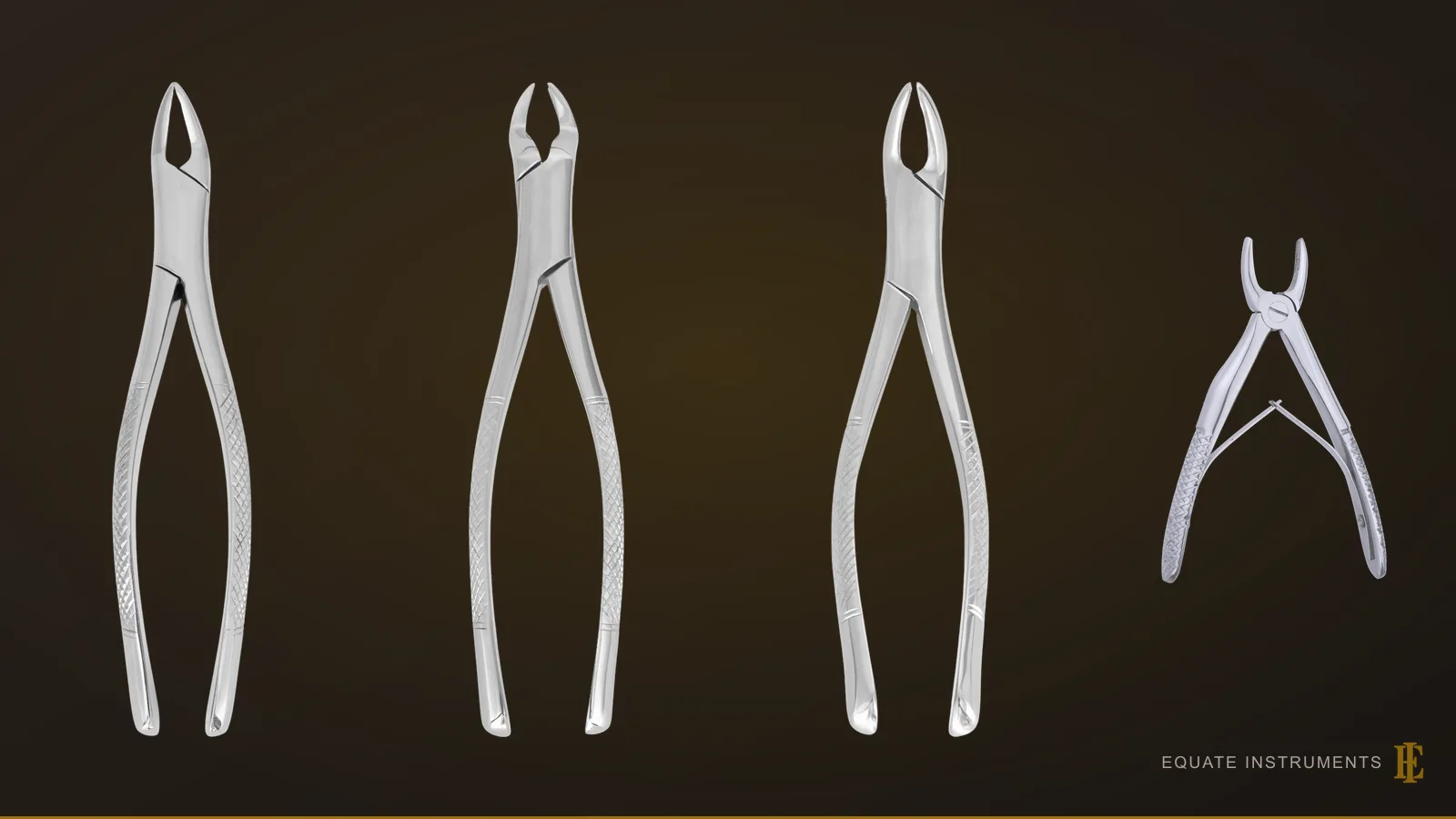
Dental extraction forceps are hinged hand instruments for grasping a tooth's root below the crown and removing it from its socket. Each pattern has beaks shaped for one tooth group, such as upper molars, lower premolars or roots. The clinician seats the beaks along the root and uses controlled pressure and rotation to widen the socket and deliver the tooth.
Key points
- Forceps deliver a tooth by gripping the root, not the crown, after it has been loosened with a dental elevator.
- Each pattern fits one tooth group: upper or lower, anterior, premolar, molar, root or children's.
- Upper molar forceps come in right and left pairs; cowhorn forceps engage the furcation of lower molars.
What are dental extraction forceps used for?
Forceps deliver a tooth once it has been loosened, usually after a dental elevator or luxator has started to widen the periodontal ligament space. As Hupp, Ellis and Tucker describe in Contemporary Oral and Maxillofacial Surgery, the beaks are placed on the root surface as far apically as possible, below the cemento-enamel junction, rather than on the crown. That keeps the tooth from fracturing and gives the beaks a secure grip.
Steady apical, buccal and lingual or palatal pressure then expands the socket. Single conical roots, such as upper incisors, can be rotated, while multi-rooted teeth are delivered with a figure-of-eight or buccal movement. The right pattern makes each of these movements controlled instead of forced.
What is the difference between upper and lower forceps?
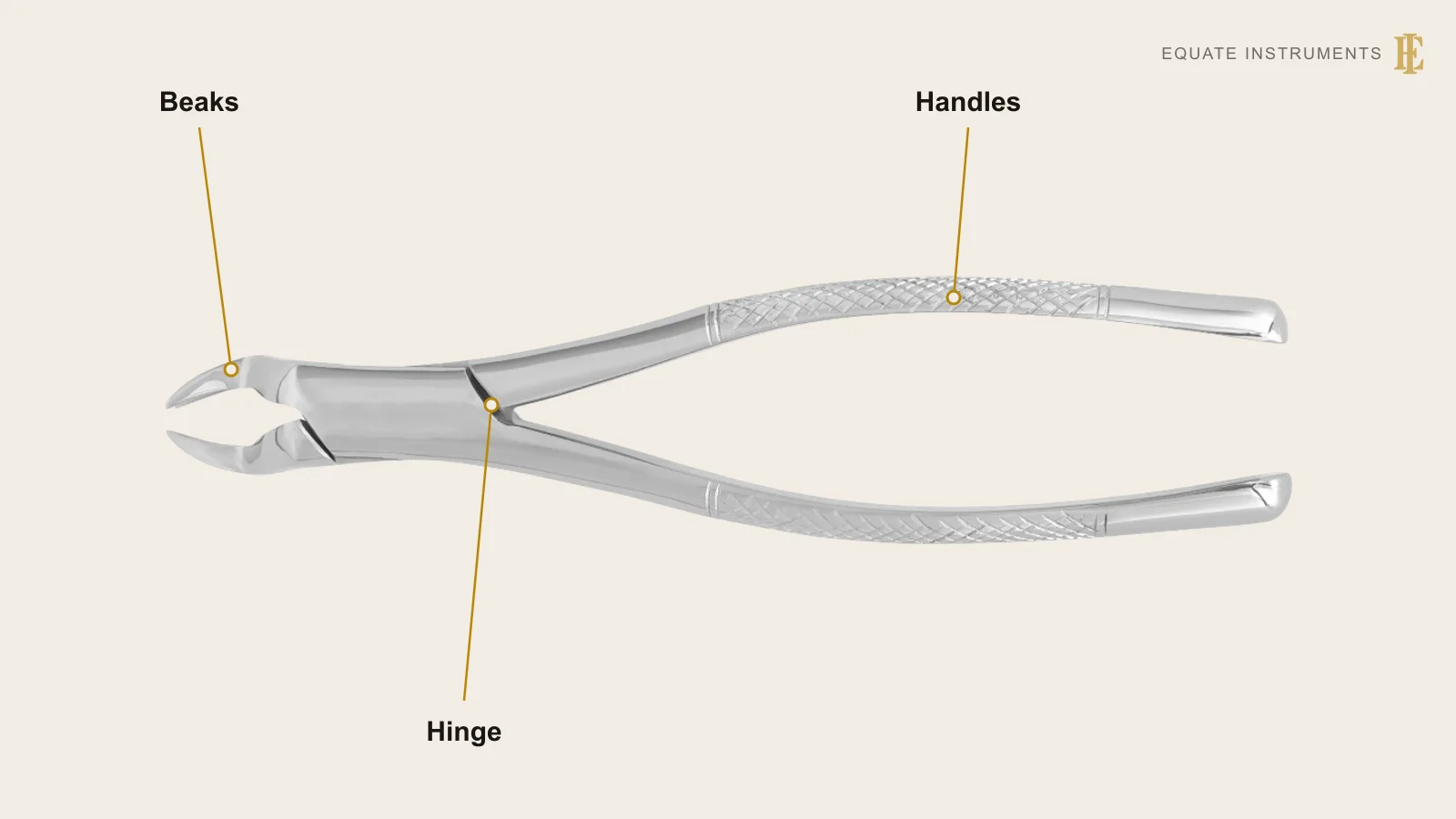
Upper forceps are straight or gently curved so the beaks line up with the long axis of maxillary teeth. Upper molar patterns come in right and left pairs, because the buccal beak has a point that fits the furcation between the two buccal roots while the palatal beak is rounded.
Lower forceps have beaks set at roughly a right angle to the handles, so the clinician can reach mandibular teeth with the hand outside the mouth. Lower molar patterns have two pointed beaks that engage the buccal and lingual furcations. Teeth are usually identified with the FDI two-digit system set out in ISO 3950, which is also how most extraction notes record which pattern was used.
What types of extraction forceps are there?
Anatomically shaped extraction forceps, with beaks made to fit the roots of each tooth group, go back to the English dental surgeon Sir John Tomes, who published his designs in the 1840s. The figure numbers used today, such as Fig. 150 and Fig. 151, descend from that system of one pattern per tooth group.
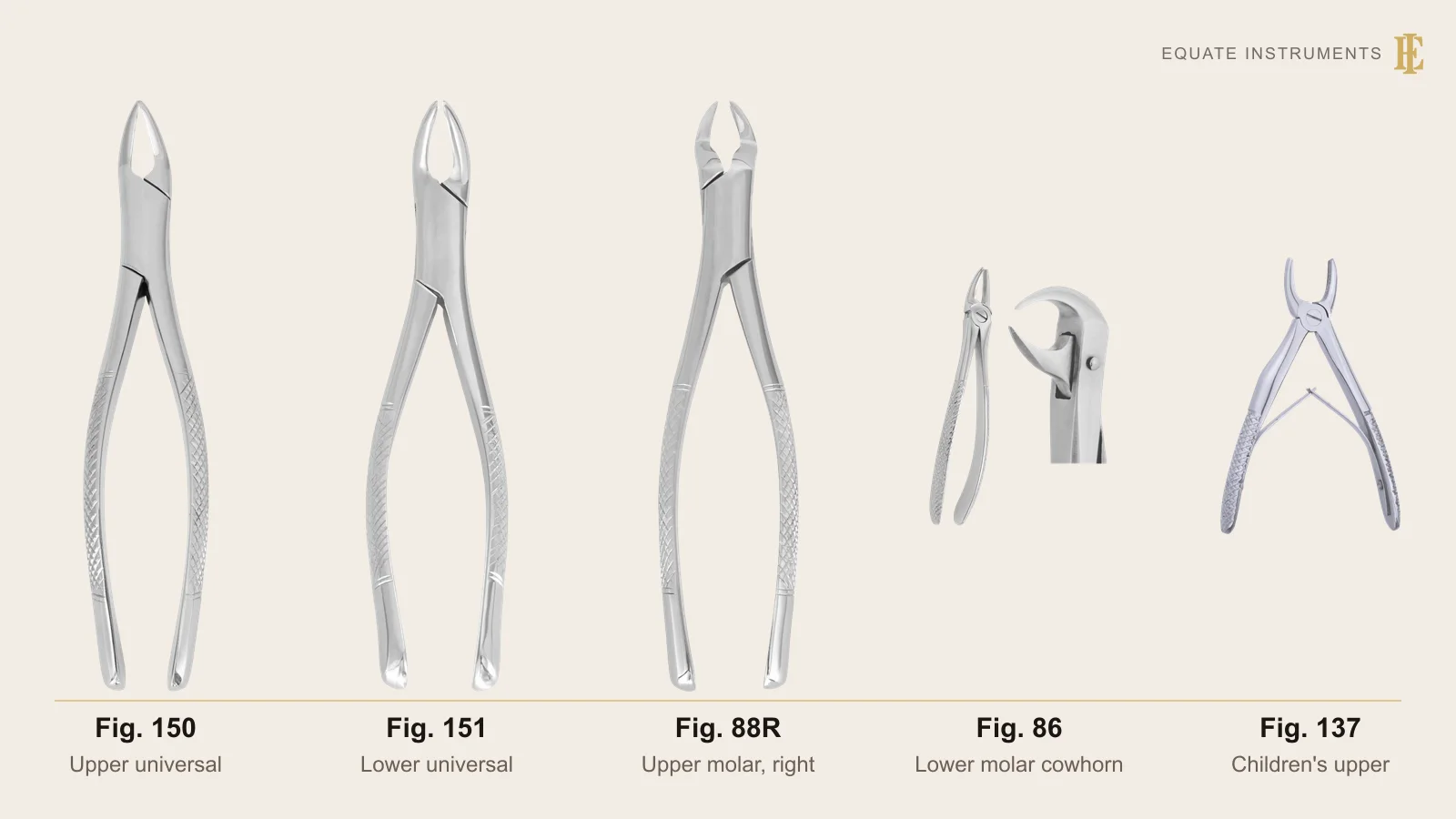
- Universal upper (Fig. 150) and universal lower (Fig. 151): incisors, premolars and roots when a practice wants one pair per arch.
- Upper and lower anterior forceps: narrow, straight beaks for incisors and canines.
- Premolar forceps: slightly wider beaks for single- or two-rooted premolars.
- Molar forceps: upper right and left (Fig. 88R and 88L and similar) and lower molar patterns.
- Cowhorn forceps: sharply pointed, horn-shaped beaks that sit in the furcation of lower molars and lift the tooth as the handles close (Fig. 16, 23 and 86).
- Wisdom tooth (third molar) forceps: angled for access at the back of the arch.
- Root forceps: fine, narrow beaks for retained roots and fragments.
- Children's (paediatric) forceps: around 10 cm, with smaller beaks for primary teeth.
- American and European patterns: American patterns use a horizontal hinge and an overhand grip; European patterns are hinged for a palm grip. Equate makes both.
Which specifications matter?
| Specification | What to look for | Why it matters |
|---|---|---|
| Beak design | Pattern matched to the tooth group, with fine serrations | A precise fit grips the root without crushing it |
| Beak alignment | Beaks meet evenly along their length | Gaps let the tooth slip and can fracture the root |
| Joint | Smooth, without side play | A loose joint makes the beaks wander under force |
| Length | Adult 16–18 cm; children's about 10 cm | Leverage and access |
| Finish | Passivated stainless steel | Corrosion resistance through repeated sterilisation |
How do you choose extraction forceps?
Build the kit around the teeth you remove most often. A general practice usually starts with universal upper and lower forceps, a pair each of upper molar (right and left) and lower molar forceps, root forceps for fragments, and a lower cowhorn for molars that resist. Practices that see children add a short set of paediatric patterns.
Choose the grip pattern, American or European, that matches how you were trained, and keep at least two sets so one can be reprocessed while the other is in use.
How do you care for extraction forceps?
Clean forceps open, so the joint and serrations are flushed, then lubricate the joint and autoclave them in line with the CDC's Guidelines for Infection Control in Dental Health-Care Settings. ISO 13402 sets out how the resistance of surgical and dental hand instruments to autoclaving, corrosion and heat is tested.
Check that the beaks still meet evenly after reprocessing. Worn or sprung beaks are the most common reason forceps start to slip on a root.
The Equate difference
Equate lists 268 forceps references, 206 of them extraction patterns, including the universal Fig. 150 and Fig. 151, cowhorn lower molar patterns (Fig. 16, 23 and 86), the paired Fig. 88R and 88L upper molars and 48 children's references, all in passivated stainless steel, ultrasonically cleaned and individually packed.
Equate Dental Extraction Forceps options

Children's Extraction Forceps - Upper Incisors 10cm (Fig. 137)
EI-0609
Children's Extraction Forceps - Upper Premolars 10cm (Fig. 139)
EI-0610
Children's Extraction Forceps - Upper Molars 10cm (Fig. 3)
EI-0611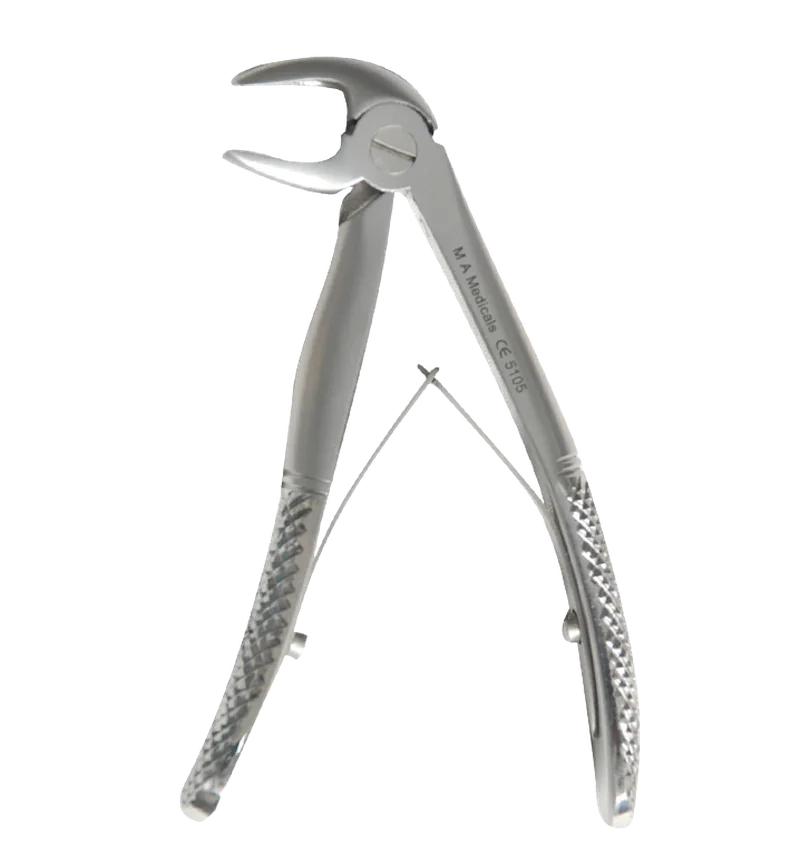
Children's Extraction Forceps - Lower Incisors 10cm (Fig. 5)
EI-0612
Children's Extraction Forceps - Upper Roots 10cm (Fig. 51S)
EI-0613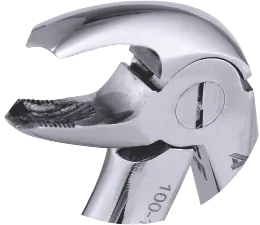
Children's Extraction Forceps - Lower Molars 10cm (Fig. 6)
EI-0614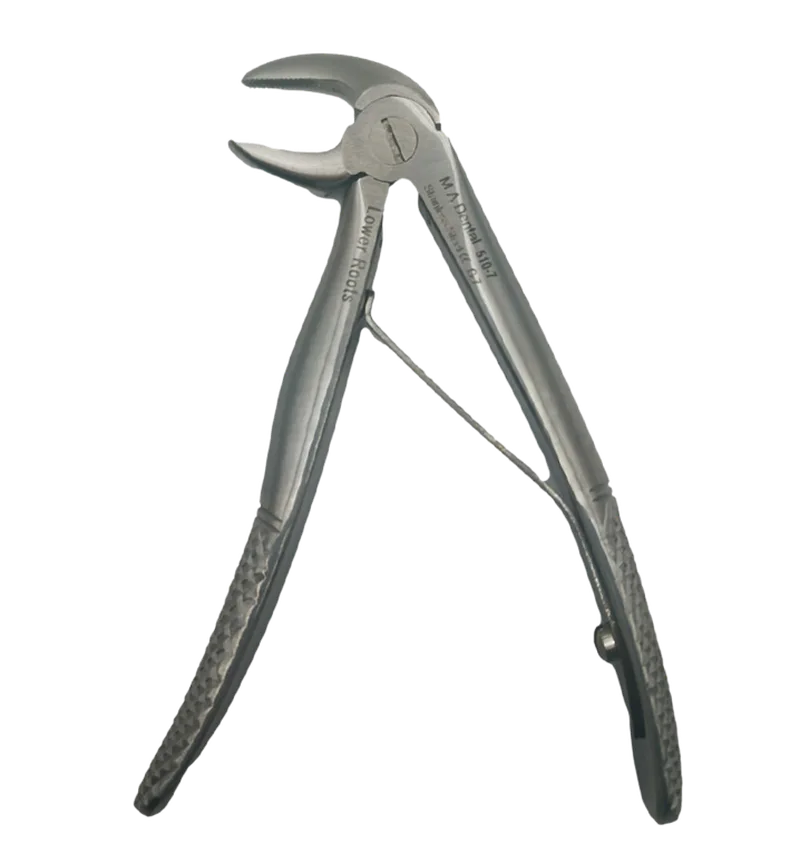
Children's Extraction Forceps - Lower Roots 10cm (Fig. 7)
EI-0615
Children's Extraction Forceps - Upper Incisors 10cm Diamond Tip (Fig. 137)
EI-0617
Children's Extraction Forceps - Upper Premolars 10cm Diamond Tip (Fig. 139)
EI-0618
Children's Extraction Forceps - Upper Molars 10cm Diamond Tip (Fig. 3)
EI-0619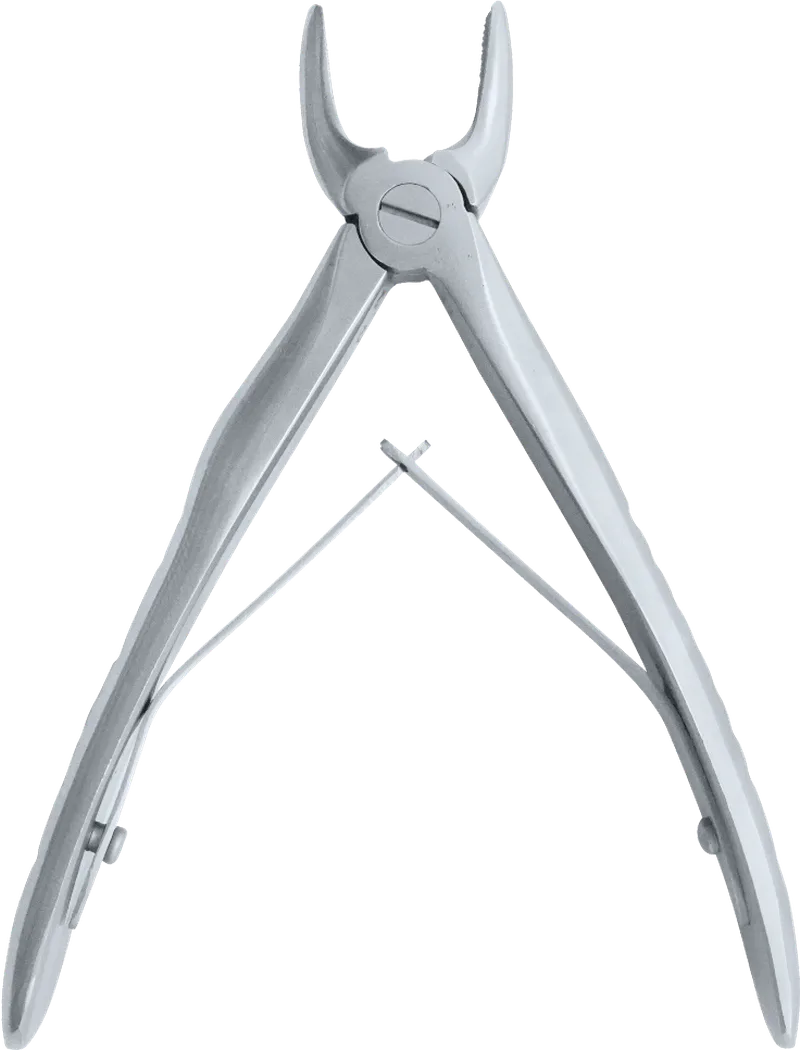
Children's Extraction Forceps - Lower Incisors 10cm Diamond Tip (Fig. 5)
EI-0620
Children's Extraction Forceps - Upper Roots 10cm Diamond Tip (Fig. 51S)
EI-0621Browse all oral surgery instruments
Buying in your market
Frequently asked questions
What is the difference between upper and lower extraction forceps?
Upper forceps are straight or slightly curved so they follow the long axis of maxillary teeth. Lower forceps have beaks at about a right angle to the handles, to reach mandibular teeth with the hand outside the mouth.
What are cowhorn forceps used for?
Cowhorn forceps have pointed beaks that fit into the furcation of a lower molar. As the handles close, the beaks wedge between the roots and lift the tooth, which helps when the crown is weak or the tooth is firmly held.
What do the numbers on extraction forceps mean?
Patterns are identified by figure numbers, for example Fig. 150 for universal upper and Fig. 151 for universal lower. A figure number describes a standard beak shape, so the same figure from different makers is intended for the same teeth.
Why do upper molar forceps come in left and right?
The buccal beak has a point that fits between the two buccal roots of an upper molar, while the palatal beak is rounded, so the right and left sides need mirror-image instruments.
References
- Hupp JR, Ellis E, Tucker MR. Contemporary Oral and Maxillofacial Surgery. Elsevier (principles of routine exodontia)
- Tomes J. A System of Dental Surgery. London: John Churchill (anatomical extraction forceps)
- Kohn WG, et al. Guidelines for Infection Control in Dental Health-Care Settings, 2003. MMWR 52(RR-17), Centers for Disease Control and Prevention
- ISO 13402:1995 Surgical and dental hand instruments: determination of resistance against autoclaving, corrosion and thermal exposure
- ISO 3950 Dentistry: designation system for teeth and areas of the oral cavity (FDI tooth numbering)
I am a…