Tooth Extraction Instruments
Written by the Equate Instruments Technical Team · Reviewed by the Medical & Dental Board, Equate Instruments · Updated ·
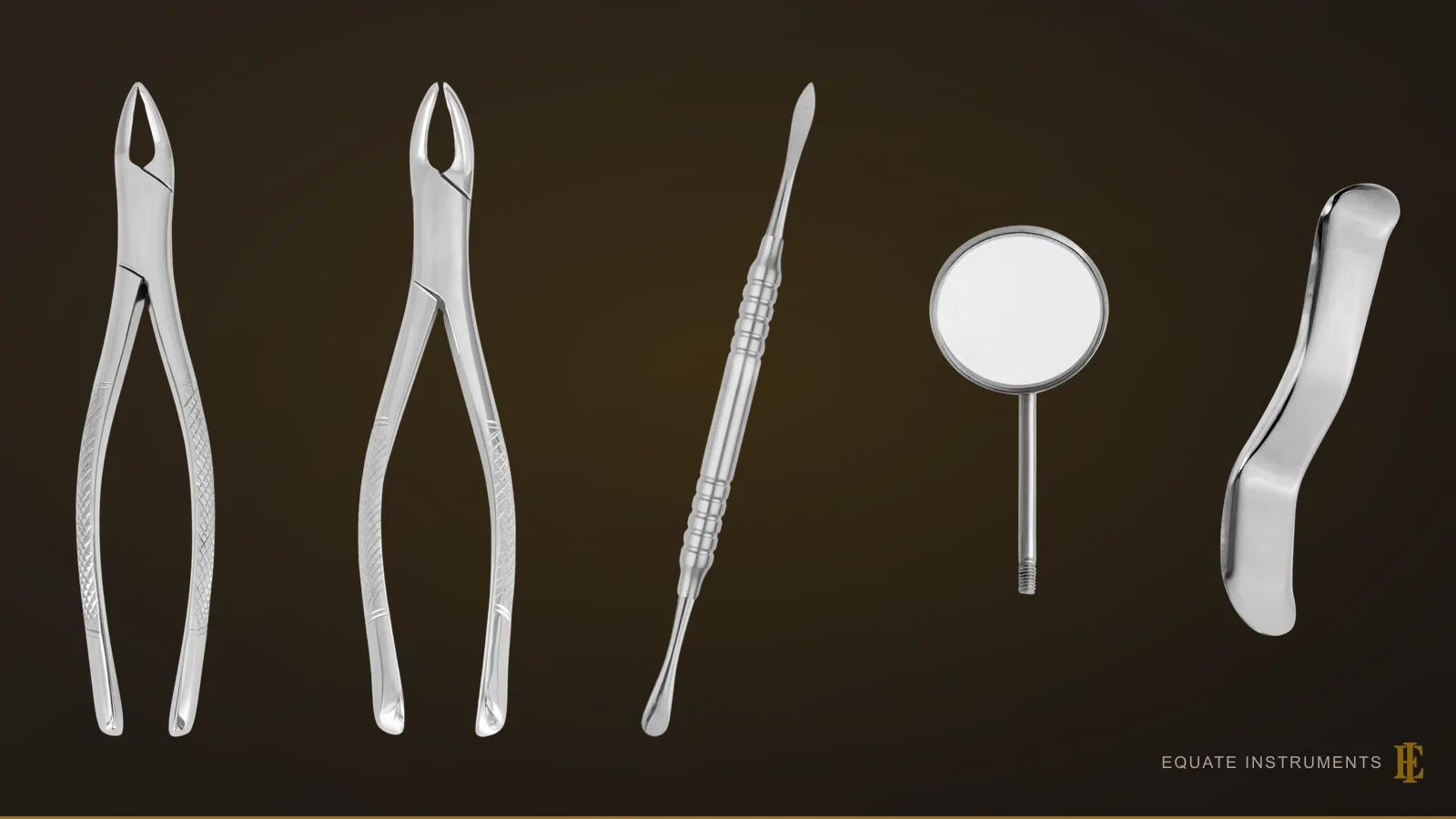
A tooth extraction uses a small set of instruments in a fixed order. After local anaesthesia, a mirror and probe confirm the tooth, a periosteal elevator or periotome frees the gum, luxators and elevators loosen the tooth, and forceps deliver it. A surgical curette cleans the socket, and a needle holder, sutures and scissors close it when needed.
Key points
- Order of use: examine, free the gum, luxate and elevate, deliver with forceps, clean the socket, then close.
- Elevators and luxators do most of the work; extraction forceps finish it.
- One complete kit per patient, in its own cassette, keeps the set together and simplifies reprocessing.
Which instruments do you need for a tooth extraction?
Most routine extractions use the same short list, laid out in the order it's used. James Hupp, Edward Ellis and Myron Tucker's Contemporary Oral and Maxillofacial Surgery sets out the principles: detach the soft tissue, luxate the tooth to expand the socket, deliver it with controlled force, then clean and close the socket. Each step has its own instrument.
Each instrument on the tray has its own guide: periosteal elevators, periotomes, rongeurs and bone files, needle holders, surgical scissors and surgical suction tips. The surgical extraction tray setup shows the tray laid out step by step.
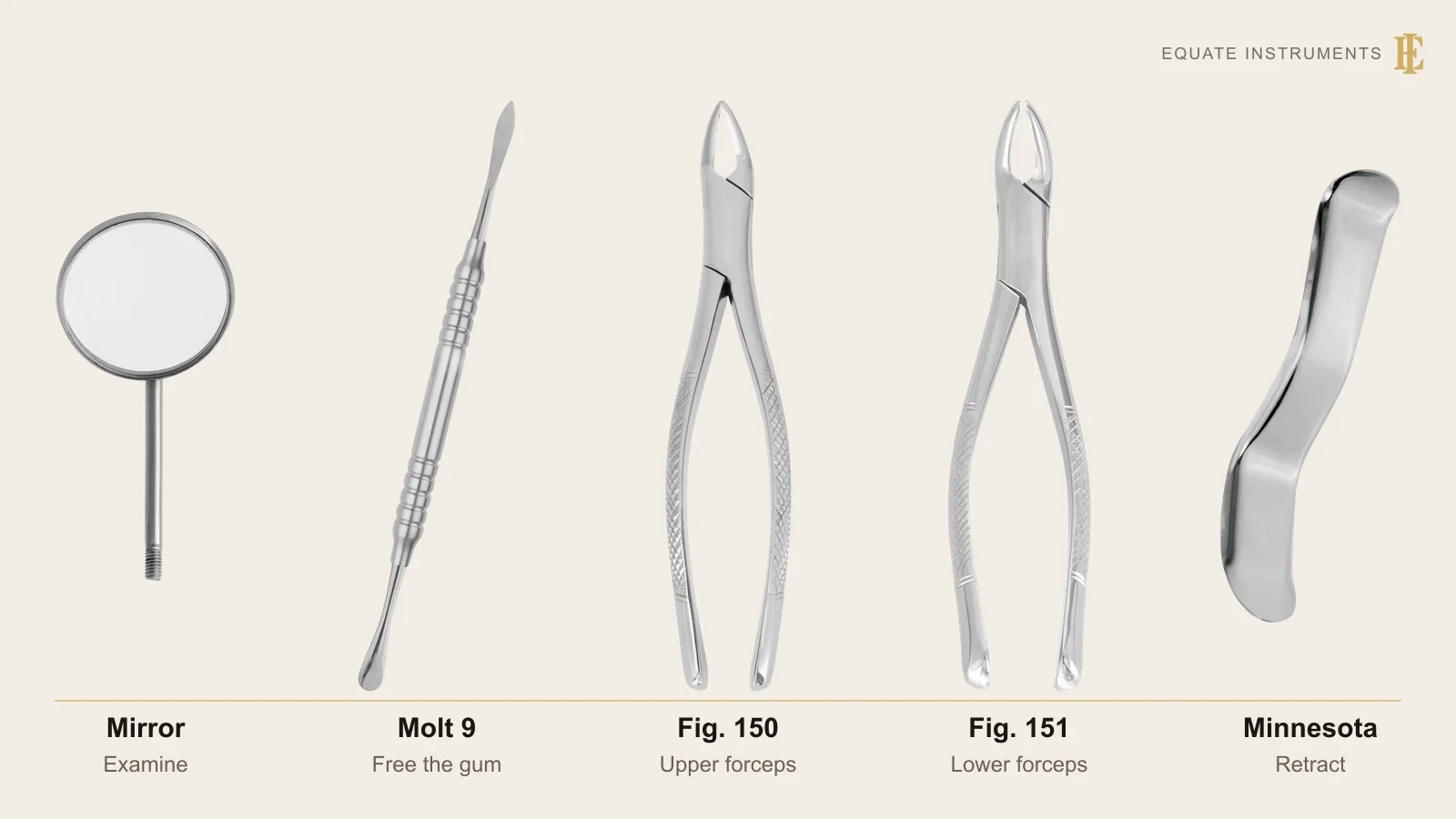
- Mouth mirror, probe and tweezers: to confirm the tooth and check the anaesthesia. See mouth mirrors.
- Aspirating syringe and needles: for local anaesthesia.
- Periosteal elevator or periotome: to detach the gingiva and the fibres around the neck of the tooth.
- Luxators and elevators: to cut the periodontal ligament and loosen the tooth. See dental elevators.
- Extraction forceps: matched to the tooth, to deliver it. See dental extraction forceps.
- Surgical curette: to remove granulation tissue and debris from the socket.
- Retractors: to protect the cheek and tongue. See dental retractors.
- Needle holder, sutures, scissors and tissue forceps: to close the socket when needed.
- Gauze and suction: to control bleeding and keep the field clear.
What is the difference between a simple and a surgical extraction kit?
A simple extraction removes a tooth that's visible in the mouth with elevators and forceps alone, so the kit is short: examination instruments, a periosteal elevator, two or three elevators or luxators, the forceps for that tooth and a curette.
A surgical extraction, such as an impacted wisdom tooth or a broken-down root, adds a scalpel handle and blades, a Minnesota or Austin retractor, a surgical handpiece and burs for bone removal, root elevators, a bone file or rongeur, irrigation and a suture kit.
What is in an atraumatic extraction kit?
Atraumatic extraction aims to keep the socket walls, especially the thin buccal bone, intact, usually because an implant or ridge preservation is planned. The kit relies on periotomes and luxators with thin blades that cut the periodontal ligament instead of levering against bone, along with fine root forceps. Less force on the buccal plate leaves more bone for the implant.
Which ready-made extraction set do you need?
| Set | Typical contents | Best for |
|---|---|---|
| Adult forceps set (5–11 pieces) | Upper and lower anterior, premolar, molar and root forceps | Practices building a complete forceps range |
| Children's forceps set (7 pieces) | Smaller forceps for primary teeth | Paediatric and family practices |
| Luxating elevator kit (7–13 pieces) | Straight and curved luxators in graded widths | Atraumatic and implant-site extractions |
| Root elevator kit | Fine root-tip elevators, such as Heidbrink patterns | Retained roots and fractured apices |
| Oral surgery set in a cassette (4–21 pieces) | Elevators, forceps, retractors, curettes, needle holder and scissors | A complete surgical tray per patient |
How should extraction instruments be set up and reprocessed?
Lay the instruments out left to right in the order of use, so the assistant can anticipate the next step, and keep one complete set per patient in its own cassette or tray.
After the procedure, clean the instruments in the cassette, ideally in a washer-disinfector, inspect beaks, tips and joints, and steam-sterilise the set as a unit, in line with the CDC's Guidelines for Infection Control in Dental Health-Care Settings or, in UK practices, HTM 01-05. ISO 13402 sets out how surgical and dental hand instruments are tested for resistance to autoclaving, corrosion and heat.
The Equate difference
Equate lists 27 extraction and surgery sets, including 5- to 11-piece adult forceps sets, 7-piece children's sets, luxating and root elevator kits, an atraumatic extraction kit and oral surgery sets of 4 to 21 instruments, several in sterilisation cassettes, alongside more than 200 individual extraction forceps.
Equate Tooth Extraction Instruments options

Luxating Elevator Kit - 10 Pieces
EI-0255
Luxating Elevator Set of 7
EI-0267
Heidbrink Root-Tip Elevator Set
EI-0309
Luxating Elevator Kit - 7 Pieces with Sterilization Cassette
EI-0393
Children's Extraction Forceps Set - 7 Piece Klein Pattern
EI-0608
Children's Extraction Forceps Set Diamond-Coated Tips - 7 Piece
EI-0616
Adult Extraction Forceps Set - 11 Piece in Zipped Case
EI-0638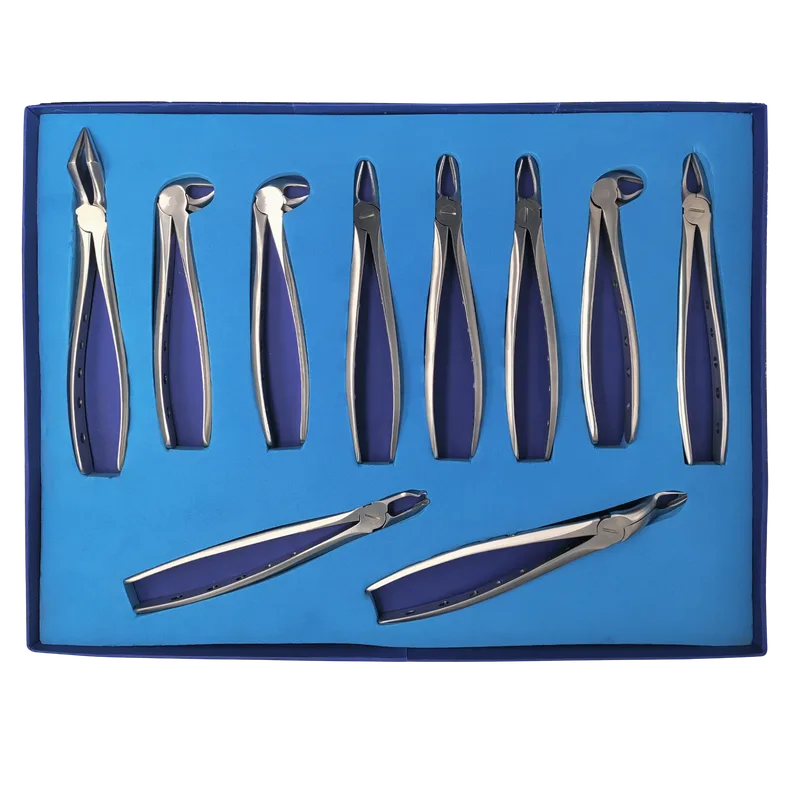
Adult Extraction Forceps Set - 10 Pieces, Diamond-Coated Tips
EI-0656
All-Round Dental Surgery Kit with Sterilization Cassette
EI-0845
Dental Micro Surgery Kit with Sterilization Cassette
EI-0846
Luxating Elevator Set of 13 - Plastic Handle
EI-1795
Extraction Instruments Set of 9 - Forceps, Elevators and Needle Holders
EI-2490Browse all oral surgery instruments
Buying in your market
Frequently asked questions
What tools are used to pull a tooth?
The tooth is loosened with elevators or luxators and then removed with extraction forceps matched to that tooth. A periosteal elevator or periotome frees the gum first, and a curette cleans the socket afterwards.
What is the difference between a luxator and an elevator?
A luxator has a thin, sharp blade that cuts the periodontal ligament and is used with a gentle wedging movement. An elevator has a stronger blade and is used as a lever to loosen the tooth.
What is an atraumatic extraction kit?
A set of thin-bladed periotomes, luxators and fine forceps designed to remove a tooth while keeping the socket walls intact, usually before an implant or ridge preservation.
How many instruments are in a basic extraction kit?
A simple extraction kit is usually eight to twelve instruments: a mirror, probe and tweezers, a periosteal elevator, two or three elevators or luxators, the forceps for the tooth, a curette, and a needle holder and scissors.
References
- Hupp JR, Ellis E, Tucker MR. Contemporary Oral and Maxillofacial Surgery. Elsevier (instrumentation for basic oral surgery; principles of routine exodontia)
- Kohn WG, et al. Guidelines for Infection Control in Dental Health-Care Settings, 2003. MMWR 52(RR-17), Centers for Disease Control and Prevention
- Department of Health and Social Care. Health Technical Memorandum 01-05: Decontamination in primary care dental practices
- ISO 13402:1995 Surgical and dental hand instruments: determination of resistance against autoclaving, corrosion and thermal exposure
- Boyd LRB. Dental Instruments: A Pocket Guide. Elsevier
I am a…