Dental Elevators and Luxators
Written by the Equate Instruments Technical Team · Reviewed by the Medical & Dental Board, Equate Instruments · Updated ·
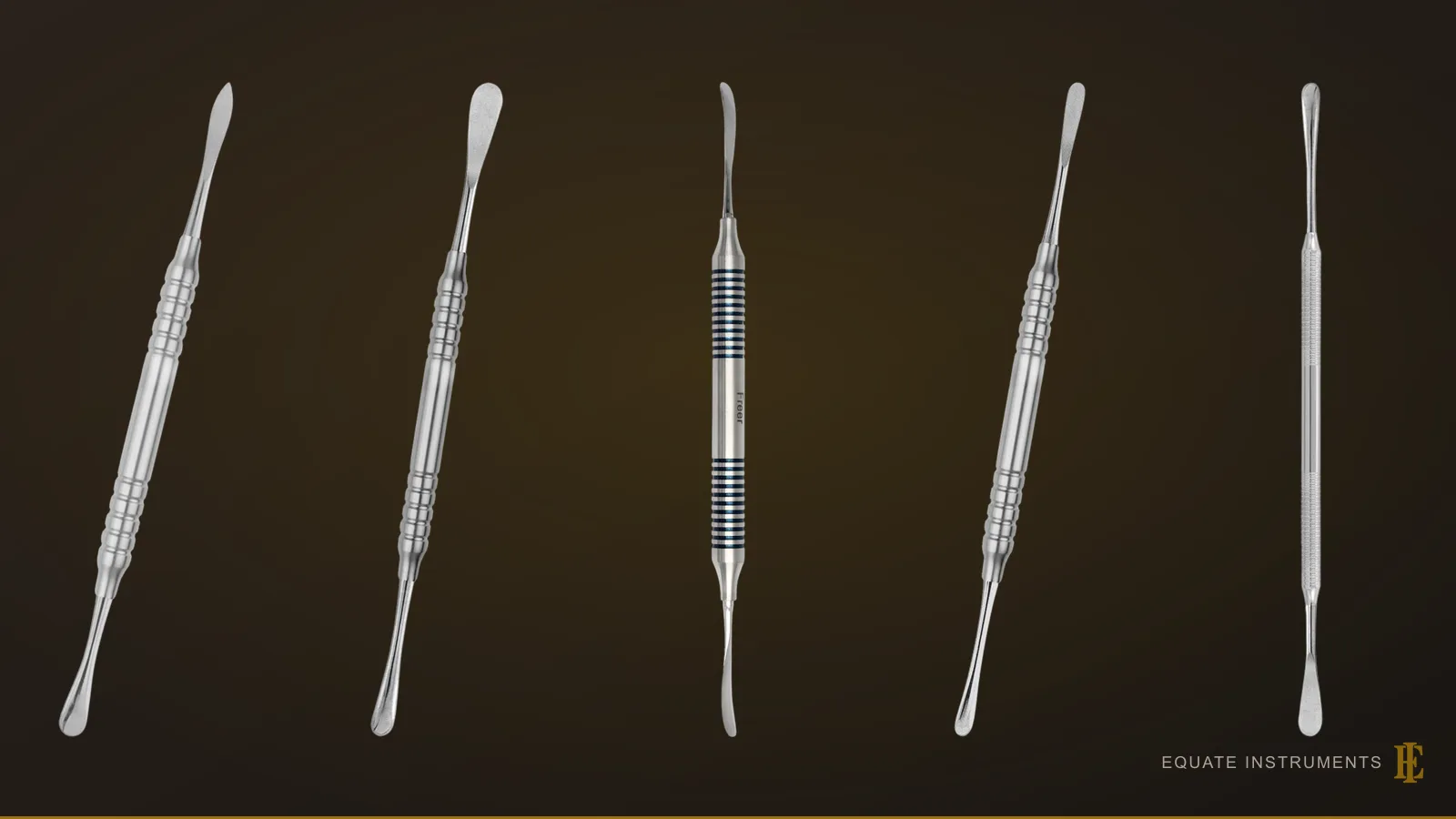
A dental elevator is a hand instrument that loosens a tooth or root in its socket before extraction. Its blade is worked into the space between root and bone, and gentle rotation or leverage widens the socket. Luxators are thinner elevators that cut the periodontal ligament. Periosteal elevators are different instruments that lift the gum and periosteum from bone.
Key points
- Elevators loosen a tooth or root before extraction forceps deliver it; luxators cut the periodontal ligament.
- Periosteal elevators lift the gum and periosteum from bone and are never used on the tooth.
- Use luxators only for luxation: levering with them bends or chips the thin blade.
What is a dental elevator used for?
Elevators prepare a tooth for extraction and remove roots that forceps can't grip. The blade is placed in the space between the root and the alveolar bone, usually at a mesial or distal line angle, and controlled rotation or wedging expands the socket and breaks the periodontal ligament fibres.
Hupp, Ellis and Tucker teach elevation as the step that comes before forceps: loosening the tooth first lowers the force needed when the extraction forceps deliver it, and with it the risk of fracturing the root or the surrounding bone.
What is the difference between an elevator, a luxator and a periosteal elevator?
Elevators and luxators move the tooth; periosteal elevators move the soft tissue over the bone. Flap instruments have their own guide, periosteal elevators, and the thin-bladed periotome is covered separately for atraumatic extraction.
- Elevators (straight, Cryer, Coupland and others) work by wedging, rotation or leverage.
- Luxating elevators have a thin, sharp blade that is pushed apically along the root to sever the ligament. They aren't designed for levering or twisting, which can bend or chip the blade.
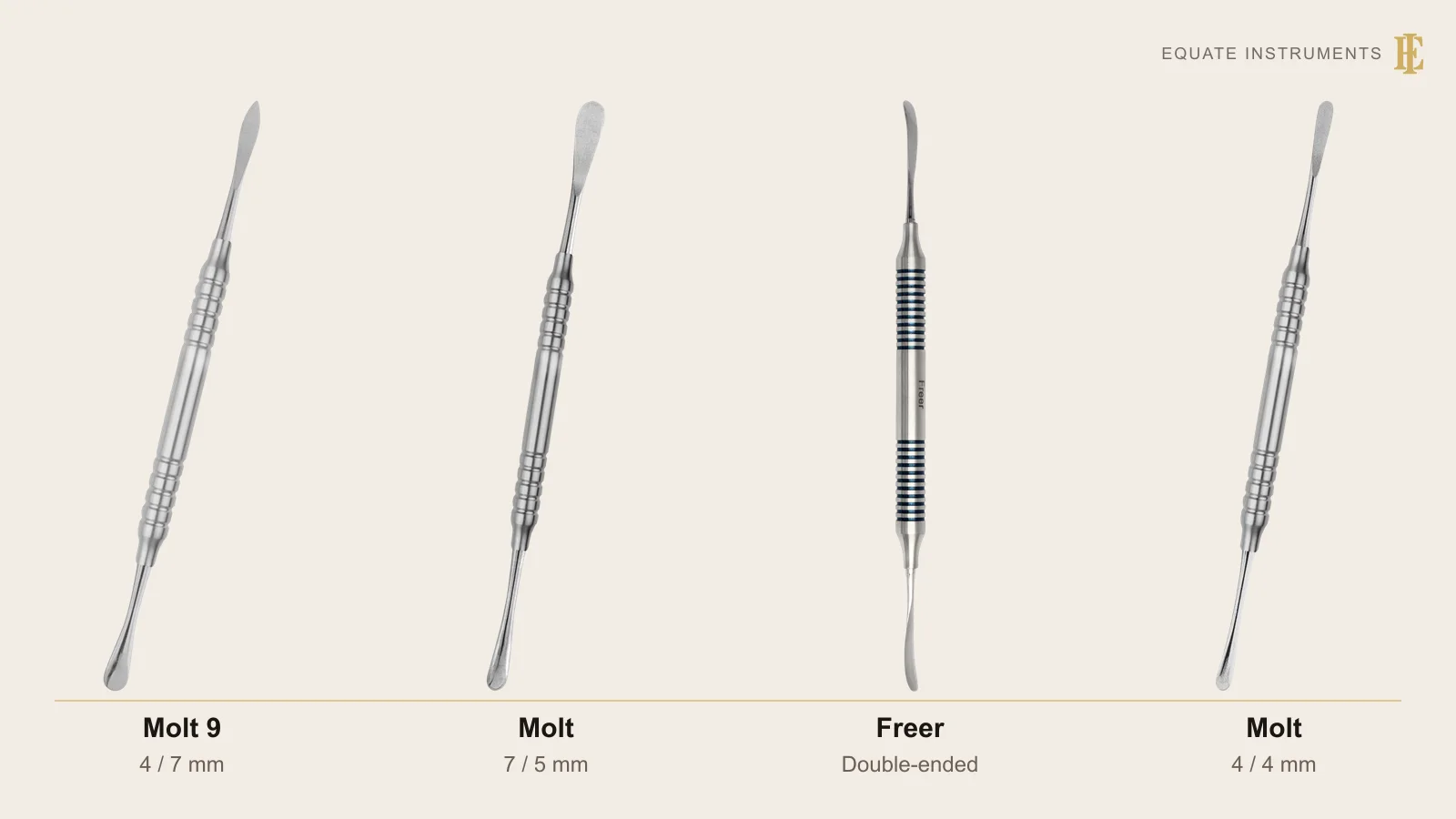
- Periosteal elevators (Molt, Freer, Buser and others) aren't used on the tooth at all. They reflect a mucoperiosteal flap, lifting the gum and periosteum from bone so the surgeon can see and reach the site, which makes them as common in implant and periodontal surgery as in extraction.
What types of dental elevators are there?
Many patterns carry the name of the clinician who designed them: the Cryer elevator after the Philadelphia oral surgeon Dr Matthew H. Cryer, the Freer periosteal elevator after the Chicago surgeon Dr Otto T. Freer, and the Buser periosteal elevator after Prof. Daniel Buser of the University of Bern, whose work on guided bone regeneration shaped modern implant surgery.
- Straight elevators (Bein): a concave blade for wedging and the first stage of luxation; the most widely used design.
- Cryer elevators: triangular blades in left and right pairs, for the roots of lower molars when one root has been removed.
- Coupland elevators: gouge-shaped, graded blades used to widen the socket.
- Root and apical elevators (Heidbrink and root tip picks): fine tips for small root fragments in the apical third.
- Luxating elevators: straight and curved, in graded widths such as 2, 3 and 5 mm.
- Periosteal elevators: double-ended designs such as the Molt 4 mm/4 mm, Freer and Buser.
- Sinus lift elevators: curved designs for lifting the sinus membrane in implant surgery.
Which specifications matter?
| Specification | What to look for | Why it matters |
|---|---|---|
| Blade width | Graded sizes, for example 2–5 mm | Matches the root and the space available |
| Blade edge | Thin and sharp for luxators, sturdier for elevators | A luxator used as a lever will bend |
| Tip | Plain, gold-tone or titanium-coated | Coated tips are easier to see and resist wear |
| Handle | Large, palm-filling grip | Control with low force |
| Finish | Passivated stainless steel | Corrosion resistance |
How do you choose dental elevators?
A basic extraction set usually includes a straight elevator (a Bein 3 or 4 mm), a pair of Cryers, a fine root tip elevator and one or two luxators. For surgical extractions and implant work, add a Molt periosteal elevator for flap reflection.
Use luxators only as luxators. A practice that uses them to lever will replace them often, and a bent luxator blade can slip under load.
How do you care for elevators?
Inspect the tips after every procedure, because a turned or chipped tip slips under load. Clean elevators in a cassette and autoclave them; ISO 13402 describes how hand instruments are tested for resistance to autoclaving and corrosion.
Luxator blades can be lightly honed if the manufacturer allows it; elevators with damaged tips should be replaced rather than reground.
The Equate difference
Equate lists 504 elevator references across 39 patterns, including 71 straight Bein elevators, curved and straight luxating elevators, Cryer, Coupland, Heidbrink and Seldin elevators, sinus lift elevators and Molt, Freer, Buser, Goldman-Fox and Pritchard periosteal elevators, many with gold-tone or titanium-coated tips.
Equate Dental Elevators and Luxators options

Molt 9 Periosteal Elevator, 4mm/7mm Ends, Hollow Handle
EI-0066
Periosteal Elevator 24G 4mm/4mm 17.5cm Hollow Handle Blue
EI-0067
Freer Periosteal Elevator - Titanium-Coated Hollow Handle
EI-0068
Freer Double-Ended Periosteal Elevator - Titanium Coated
EI-0069
Heidbrink Root Elevator Fig. 13/14 - 1.8mm Titanium-Coated Tips
EI-0077
Buser Periosteal Elevator 17.5cm - Anatomical Hollow Handle
EI-0138
Periosteal Molt 3.3/2.8mm
EI-0139
Periosteal Molt 7/5mm 18.5cm Hollow Handle 10mm
EI-0140
Periosteal Elevator 24G 4mm/4mm
EI-0201
Freer Periosteal Elevator 5mm/5mm - 19cm Hollow Handle
EI-0202
Molt Periosteal Elevator, 7mm/5mm Ends, Solid Handle
EI-0214
Luxating Elevator Kit - 10 Pieces
EI-0255Browse all oral surgery instruments
Buying in your market
Frequently asked questions
What is the difference between an elevator and a luxator?
An elevator loosens the tooth by wedging and rotation. A luxator has a thinner, sharper blade that cuts the periodontal ligament as it's pushed along the root, and it shouldn't be used to lever.
What is a periosteal elevator used for?
A periosteal elevator lifts the gum and periosteum away from the bone to expose the surgical site. It's used in surgical extractions, implant placement and periodontal surgery, and it isn't used to move the tooth.
Why do Cryer elevators come in pairs?
Their triangular blades point in opposite directions, so the right and left versions reach roots on either side of the mouth or on either side of an empty root socket.
What size of straight elevator should I start with?
A 3 mm or 4 mm Bein-type straight elevator covers most routine extractions; finer sizes are added for roots and narrow spaces.
References
- Hupp JR, Ellis E, Tucker MR. Contemporary Oral and Maxillofacial Surgery. Elsevier (principles of routine exodontia)
- Buser D (ed.). 20 Years of Guided Bone Regeneration in Implant Dentistry. Quintessence (flap reflection)
- ISO 13402:1995 Surgical and dental hand instruments: determination of resistance against autoclaving, corrosion and thermal exposure
I am a…