Dental Explorers
Written by the Equate Instruments Technical Team · Reviewed by the Medical & Dental Board, Equate Instruments · Updated ·
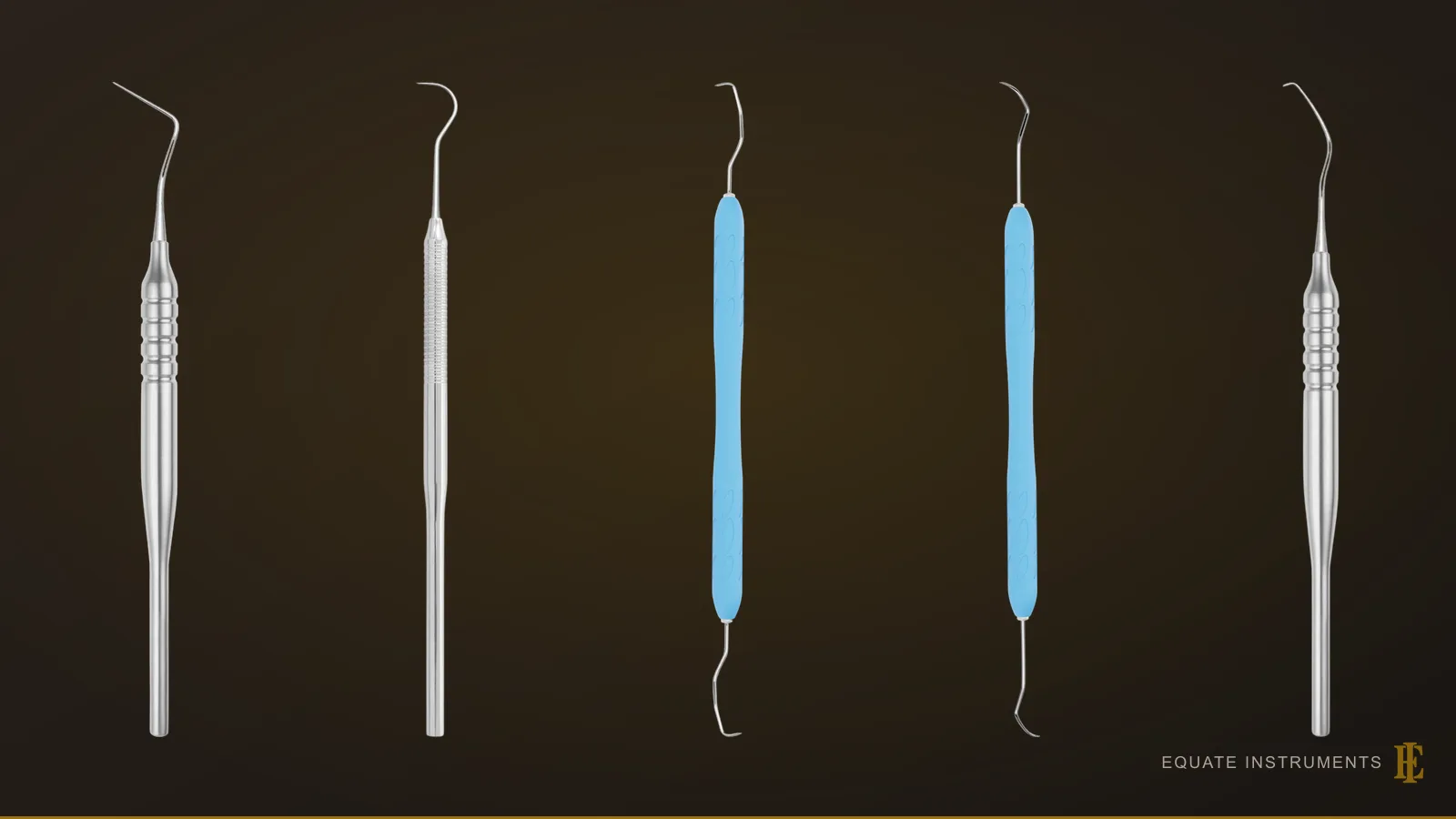
A dental explorer is a slender hand instrument with a fine, sharp, flexible tip that the clinician uses to feel the tooth surface. It detects calculus, rough or overhanging restoration margins and defects that are hard to see. In the UK it's often called a sickle probe. Explorers come in patterns such as the shepherd's hook, the pigtail and the 11/12.
Key points
- An explorer works by touch: vibrations through the thin tip tell the clinician what it's resting on.
- It's used with a mouth mirror in the other hand for vision and retraction.
- For caries, systems such as ICDAS favour visual examination and a ball-ended probe over pressing a sharp tip into fissures.
What is a dental explorer used for?
Explorers are tactile instruments. The working end is a thin, flexible wire that ends in a sharp point, and the vibrations it carries through the shank and handle tell the clinician whether the tip is on smooth enamel, a rough deposit or the edge of a restoration. Jill Gehrig's Fundamentals of Periodontal Instrumentation teaches the explorer for detecting subgingival calculus and checking root surfaces before and after scaling, alongside a periodontal probe for pocket depths.
In restorative dentistry the explorer checks margins: whether a crown, inlay or filling meets the tooth without a ledge, gap or overhang. It's also used to check that a fissure sealant is fully retained.
What types of dental explorer are there?
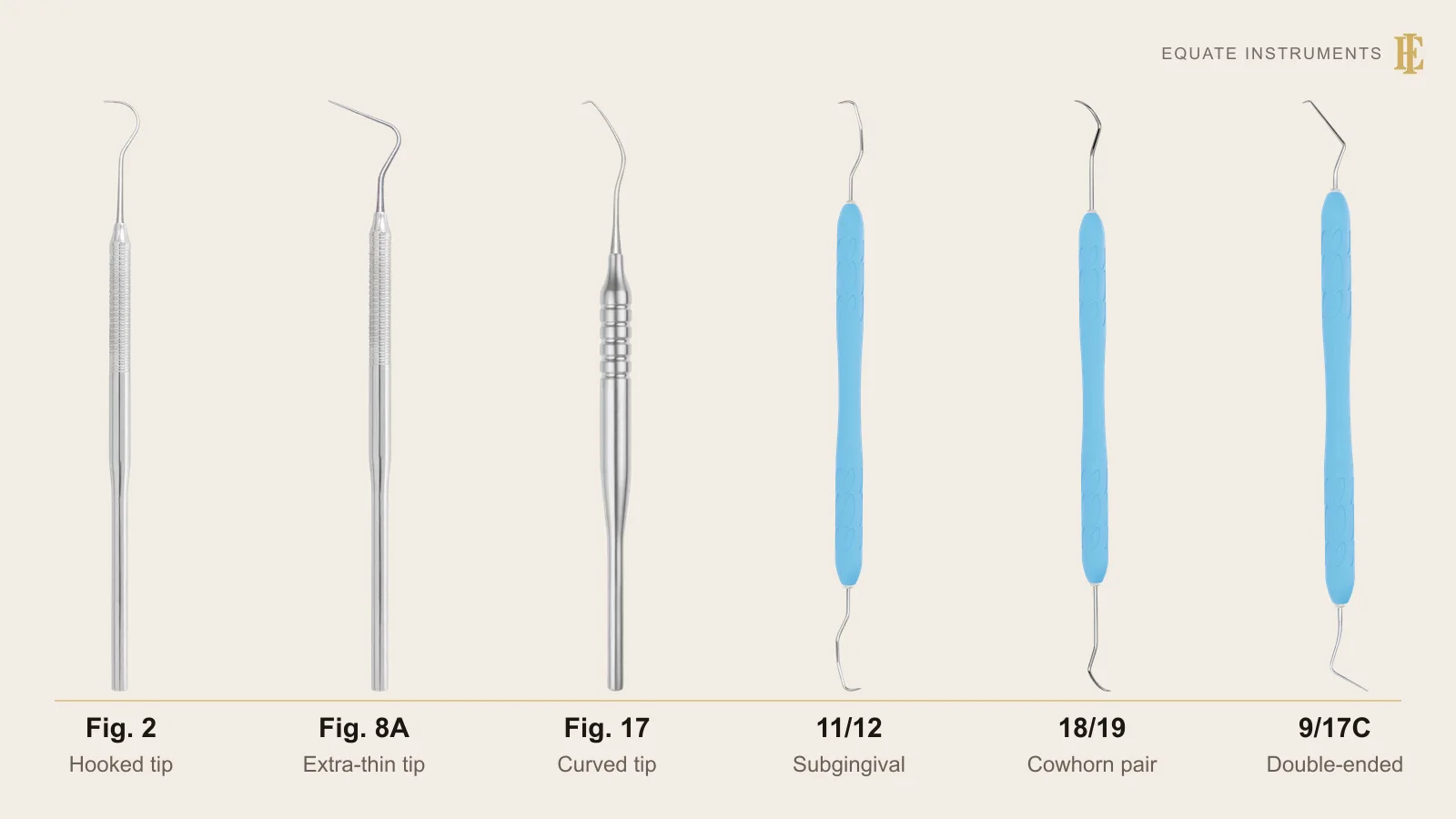
- Shepherd's hook (No. 23): a curved hook that reaches occlusal, smooth and proximal surfaces; the most common general explorer.
- Straight and angled explorers (such as the Fig. 8A, 9 and 17 patterns): short tips for occlusal surfaces and restoration margins.
- Pigtail and cowhorn explorers: short, curved tips in mirror-image pairs that wrap around proximal surfaces, one end for each side.
- 11/12 explorers: a long, multi-angled shank for detecting subgingival calculus on posterior root surfaces. The best-known version, the ODU 11/12, was developed at Old Dominion University's dental hygiene school.
- Explorer-probe combinations: an explorer on one end and a periodontal probe on the other, which saves an instrument change during an examination.
Should you use an explorer to detect caries?
Not by pressing it into fissures. Kim Ekstrand, Vibeke Qvist and Anders Thylstrup showed in Caries Research in 1987 that probing occlusal surfaces with a sharp explorer can break through the surface of early, demineralised lesions, turning a lesion that could have been arrested into a cavity. A 'sticky' catch adds little to a careful visual examination.
The International Caries Detection and Assessment System (ICDAS), described by Amid Ismail and colleagues in 2007, grades lesions visually on clean, dried teeth and uses a ball-ended probe, such as the WHO probe, only gently, to feel surface texture. Explorers remain the instrument of choice for calculus, margins and restorations.
Which specifications matter?
| Specification | What to look for | Why it matters |
|---|---|---|
| Tip | Fine, sharp and undamaged | A blunt or bent tip loses tactile detail |
| Shank | Thin and flexible for calculus; firmer for margins | Flexibility carries vibration to the fingers |
| Pattern | Matched to the surfaces you check most | Each curve reaches different surfaces |
| Handle | Lightweight and textured, 6–10 mm | Hollow handles transmit vibration well |
| Ends | Single- or double-ended | Paired ends cover both sides of a tooth |
How do you choose a dental explorer?
Most practices put a shepherd's hook explorer in every examination tray, paired with a mirror. Hygienists who do a lot of root debridement add an 11/12 explorer for posterior root surfaces, and clinicians who check many crown and filling margins often keep a straight or angled explorer to hand. Keep spares, because explorer tips are fine and bend if they're dropped.
How do you care for dental explorers?
Clean explorers tip-down in a cassette or tray so the points don't catch, and sterilise them with the rest of the examination set, in line with the CDC's Guidelines for Infection Control in Dental Health-Care Settings or, in UK practices, HTM 01-05.
Check the tip under magnification. Explorers aren't sharpened, so a bent, blunt or broken tip means the instrument should be replaced.
The Equate difference
Equate lists 64 explorer references: 46 shepherd's hook and related patterns, 16 pigtail and curved patterns and 2 cowhorn patterns, including the Fig. 2, 8A, 9 and 17, the 11/12 and the flexible 11F/12F, single- and double-ended, on solid 6 mm, hollow 10 mm and colour-coded silicone handles.
Equate Dental Explorers options

Explorer 3A - Single-Ended Curved Hook
EI-0033
Shepherd's Hook Explorer No.23
EI-0035
Holst-Style Explorer - Double-Ended Hollow Handle
EI-0041
Explorer 2H - Double-Ended Shepherd Hook
EI-0042
Double-Ended Explorer with 6 mm Solid Knurled Handle
EI-0043
Explorer 5 - Double-Ended Diagnostic Explorer
EI-0044
Explorer Fig. 9 Extra Thin - Hollow Handle 10mm
EI-0110
Weston Explorer - Solid Handle 6mm
EI-0111
Explorer Fig. 2 Extra Thin - Solid Handle 6mm
EI-0132
Explorer Fig. 2 - Hollow Handle 10mm
EI-0133
Fig. 9 Extra Thin Dental Explorer - 6 mm Solid Handle
EI-0178
Weston Dental Explorer - 6 mm Solid Handle
EI-0179Browse all diagnostic instruments
Buying in your market
Frequently asked questions
What is a shepherd's hook explorer used for?
The shepherd's hook (No. 23) is a general-purpose explorer. Its curved tip reaches occlusal, smooth and proximal surfaces, so it's used to check for calculus, rough margins and defects during an examination.
Is a dental explorer the same as a periodontal probe?
No. An explorer has a sharp, flexible tip for feeling the tooth surface. A periodontal probe has a blunt, marked tip for measuring pocket depth in millimetres. Many double-ended instruments combine the two.
What is a sickle probe in dentistry?
In the UK, 'sickle probe' is a common name for a dental explorer, usually the curved shepherd's hook pattern. It isn't the same as a sickle scaler, which has a cutting blade for removing calculus.
What is an 11/12 explorer?
The 11/12, often called the ODU 11/12, is an explorer with a long, angled shank for detecting subgingival calculus on posterior root surfaces, including in deeper pockets.
References
- Gehrig JS, et al. Fundamentals of Periodontal Instrumentation & Advanced Root Instrumentation. Wolters Kluwer (instrument design and explorers)
- Ekstrand K, Qvist V, Thylstrup A. Light microscope study of the effect of probing in occlusal surfaces. Caries Research 1987;21(4):368–374
- Ismail AI, Sohn W, Tellez M, et al. The International Caries Detection and Assessment System (ICDAS): an integrated system for measuring dental caries. Community Dentistry and Oral Epidemiology 2007;35(3):170–178
- Boyd LRB. Dental Instruments: A Pocket Guide. Elsevier
- Kohn WG, et al. Guidelines for Infection Control in Dental Health-Care Settings, 2003. MMWR 52(RR-17), Centers for Disease Control and Prevention
I am a…