Dental Mouth Mirrors
Written by the Equate Instruments Technical Team · Reviewed by the Medical & Dental Board, Equate Instruments · Updated ·
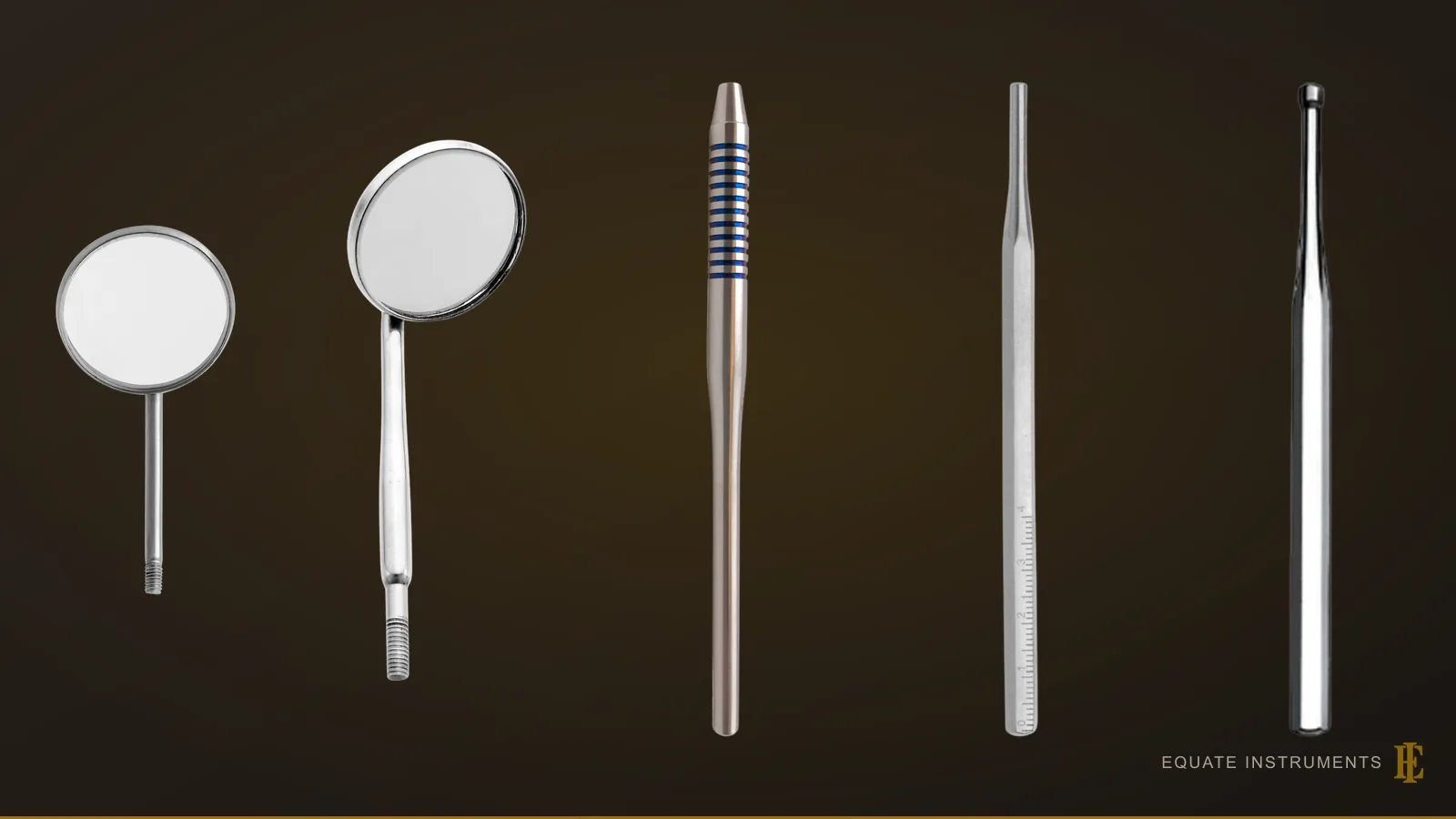
A dental mouth mirror is a small round mirror on a slim handle that lets the clinician see surfaces that can't be viewed directly. It is also used to hold back the cheek and tongue, reflect light onto the working area and transilluminate teeth. Mirrors come in sizes such as No. 4 (22 mm) and No. 5 (24 mm), with plain, front-surface or magnifying glass.
Key points
- A mouth mirror has four jobs: indirect vision, retraction, illumination and transillumination.
- Front-surface mirrors, including rhodium-coated ones, give one sharp image; plain mirrors give a faint double image.
- Heads screw onto handles with either a cone-socket or a simple-stem (universal) thread, so heads and handles must match.
What is a dental mouth mirror used for?
The mouth mirror is usually the first instrument picked up at an examination and the last one put down. Standard references such as Linda Bartolomucci Boyd's Dental Instruments: A Pocket Guide describe four uses: indirect vision of surfaces the clinician can't see directly, such as the palatal surfaces of upper teeth; retraction of the cheek, lips and tongue; illumination, by reflecting the operating light onto the area; and transillumination, shining light through anterior teeth to show shadows between them.
The mirror is held in a modified pen grasp in the non-dominant hand, which leaves the other hand free for a dental explorer or a periodontal probe. Mirror and explorer, or mirror and probe, is the core of every basic examination set.
What types of mouth mirror are there?
Mirrors differ in their glass as much as their size. The reflective layer can sit behind the glass or on its front surface, and that changes how sharp the image is.
- Plain (rear-surface) mirrors: the coating is behind the glass, so light reflects twice and a faint second image appears. They're the most durable choice for general use.
- Front-surface mirrors: the coating is on the front, so there's a single, sharp image with no ghosting. Preferred for detailed work, magnification and intraoral photography, but the surface needs gentle cleaning.
- Rhodium front-surface mirrors: a front-surface mirror with a hard rhodium coating, chosen for a bright image and resistance to wear.
- Magnifying (concave) mirrors: a concave surface enlarges the image, which helps detailed inspection but narrows the field of view.
What size mouth mirror do you need?
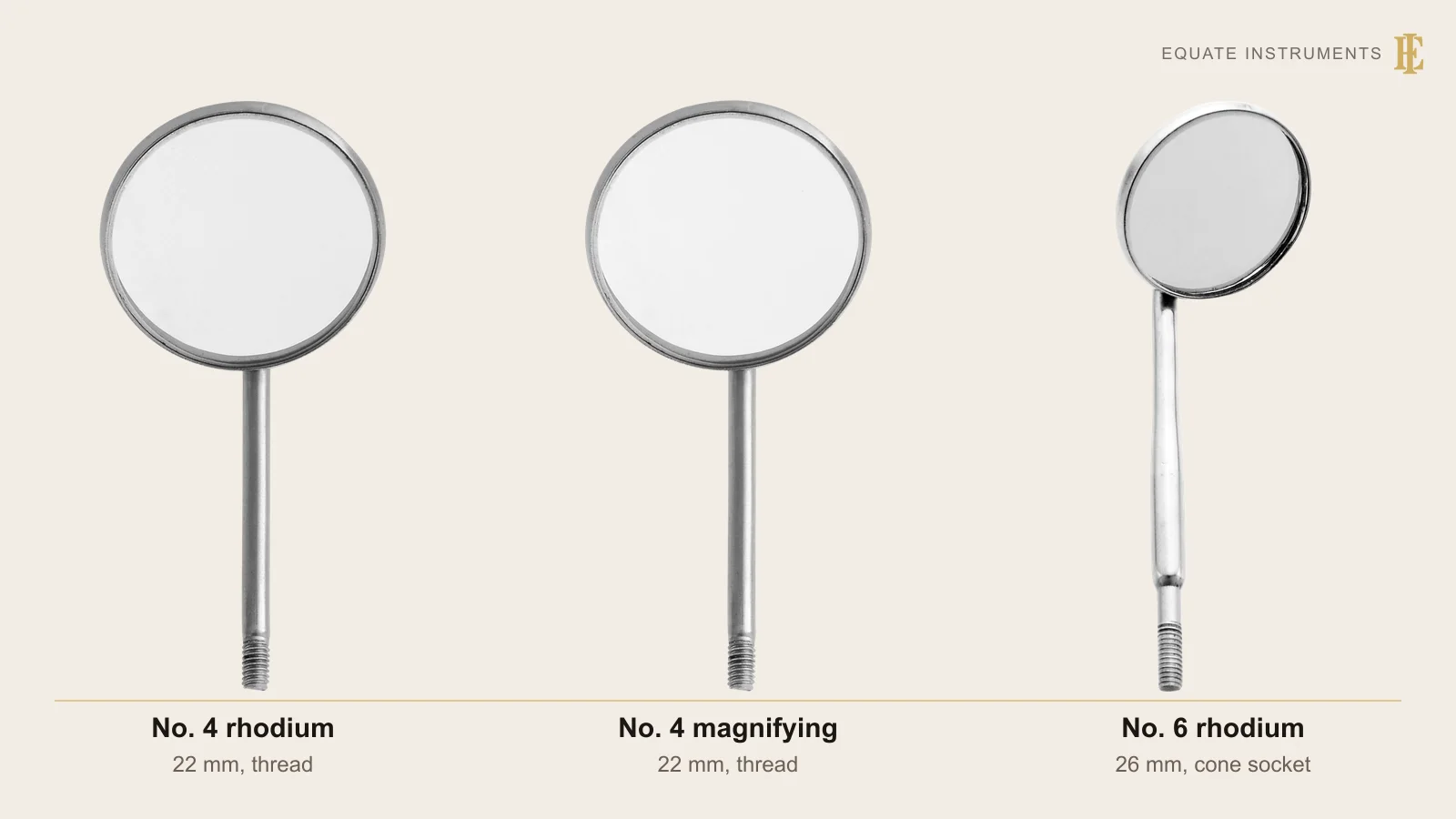
Mirror sizes are numbered, and the number goes up with the diameter. Most practices standardise on one examination size and keep a larger size for retraction.
| Size | Diameter | Typical use |
|---|---|---|
| No. 3 | About 20 mm | Children and small mouths |
| No. 4 | 22 mm | General examination; the most common size |
| No. 5 | 24 mm | Examination with a wider view and more surface for retraction |
| No. 6 | 26 mm | Retraction and a large field, for example in orthodontics |
Cone socket or universal thread: which fitting?
Mirror heads aren't fixed to the handle. They screw in, so a scratched or cloudy head can be replaced without replacing the handle. There are two common fittings: the cone socket, a tapered seat that pulls the head tight against the handle and leaves a smooth joint, and the simple stem or universal thread, a straight threaded stem. The two aren't interchangeable, so a practice should use one fitting across all its heads and handles.
ISO 9873 is the international standard that sets requirements and test methods for intra-oral mirrors.
Which mirror handle should you choose?
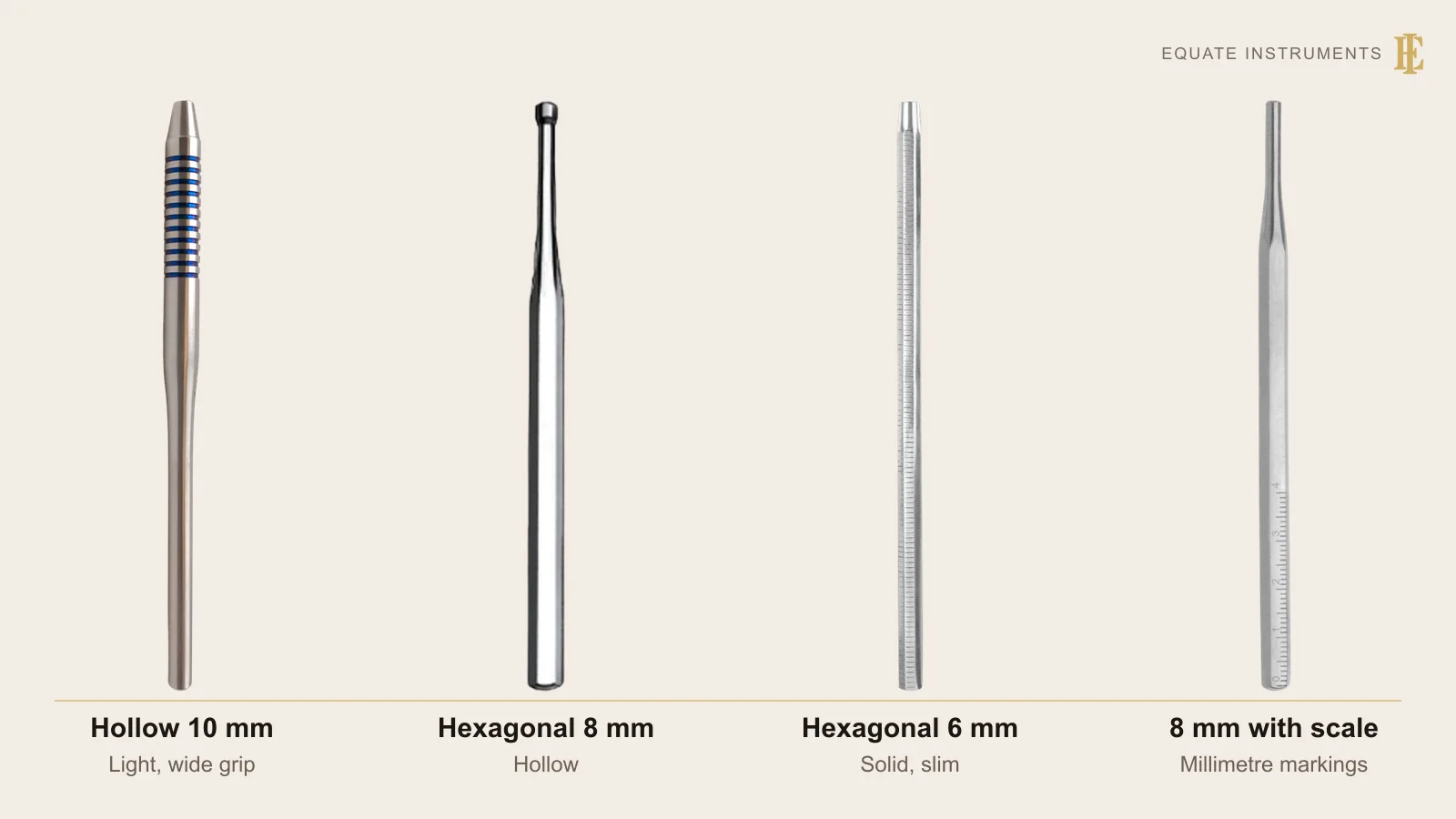
Handles vary in diameter, weight and surface. Jill Gehrig's Fundamentals of Periodontal Instrumentation recommends lightweight, larger-diameter handles with a textured grip to reduce muscle strain over a working day. Hollow 8–10 mm handles follow that advice; solid 6 mm handles are slimmer and heavier, and some clinicians prefer how they feel.
Hexagonal handles don't roll off a tray, and handles engraved with a millimetre scale double as a quick measuring tool.
How do you care for mouth mirrors?
Clean mirrors before sterilising them and avoid abrasive pads on front-surface glass, which scratches easily. Steam sterilisation is the standard route, in line with the CDC's Guidelines for Infection Control in Dental Health-Care Settings or, in UK practices, HTM 01-05.
Replace the head as soon as the image clouds or the coating starts to lift. A dull mirror makes the clinician lean in to see, which costs posture and time.
The Equate difference
Equate lists 35 mouth mirror references: 23 mirror heads, mostly No. 4 (22 mm), No. 5 (24 mm) and No. 6 (26 mm), in plain, magnifying and rhodium front-surface glass with cone-socket or universal-thread fittings, plus 12 handles from 6 mm solid to 10 mm hollow, including handles with an engraved measuring scale.
Equate Dental Mouth Mirrors options

Front Surface Mouth Mirror (SS) - No. 3
EI-0001
Standard Mouth Mirror (SS) - No. 3 (12 pcs)
EI-0002
Mouth Mirror No. 4 - Rhodium Front Surface, 22 mm, Universal Thread
EI-0003
Mouth Mirror No.4 Plain 22mm Universal (10 pcs)
EI-0004
Mouth Mirror No.4 Plain 22mm Universal (12 pcs)
EI-0005
Mouth Mirror No. 5 - Rhodium Front Surface, 24 mm, Universal Thread
EI-0006
Mouth Mirror No.5 Plain 24mm Universal (10 pcs)
EI-0007
Mouth Mirror No.5 Plain 24mm Universal (12 pcs)
EI-0008
Mouth Mirror Handle - Hollow 10 mm
EI-0037
Mouth Mirror Handle - Hollow Hexagonal 8 mm
EI-0108
Round Solid Mirror Handle 6 mm
EI-0176
Ortho Mirror Handle 25 mm with Measurement Scale
EI-0903Browse all diagnostic instruments
Buying in your market
Frequently asked questions
What is the difference between a front-surface and a plain mouth mirror?
A front-surface mirror has its reflective coating on the front of the glass, so it gives a single sharp image. A plain mirror has the coating behind the glass, so light reflects twice and a faint double image appears. Plain mirrors are tougher; front-surface mirrors are sharper.
What size is a No. 4 mouth mirror?
A No. 4 mirror is 22 mm across and a No. 5 is 24 mm. No. 4 is the most common size for general examination; No. 5 gives a wider view and more surface for retraction.
Are mouth mirror heads interchangeable?
Only within the same fitting. Cone-socket heads fit cone-socket handles, and simple-stem (universal thread) heads fit simple-stem handles. Check the fitting before ordering replacement heads.
How do you stop a dental mirror fogging?
Fogging is warm, moist breath condensing on cooler glass. Warming the mirror against the cheek or tongue first, or asking the patient to breathe through the nose, usually prevents it.
References
- Boyd LRB. Dental Instruments: A Pocket Guide. Elsevier
- ISO 9873 Dentistry: intra-oral mirrors
- Gehrig JS, et al. Fundamentals of Periodontal Instrumentation & Advanced Root Instrumentation. Wolters Kluwer (instrument design and explorers)
- Kohn WG, et al. Guidelines for Infection Control in Dental Health-Care Settings, 2003. MMWR 52(RR-17), Centers for Disease Control and Prevention
- Department of Health and Social Care. Health Technical Memorandum 01-05: Decontamination in primary care dental practices
I am a…