Endodontic Hand Instruments
Written by the Equate Instruments Technical Team · Reviewed by the Medical & Dental Board, Equate Instruments · Updated ·
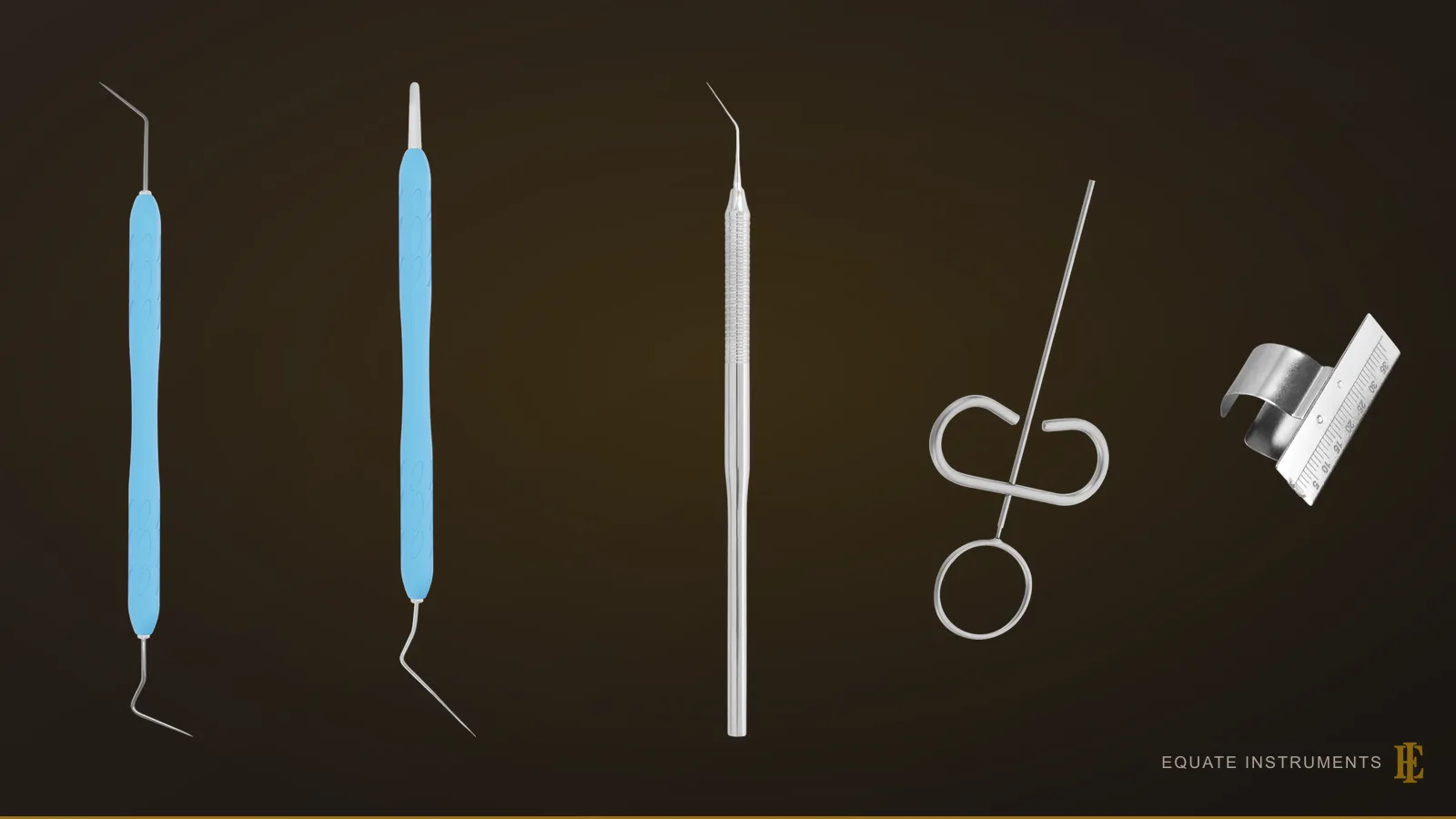
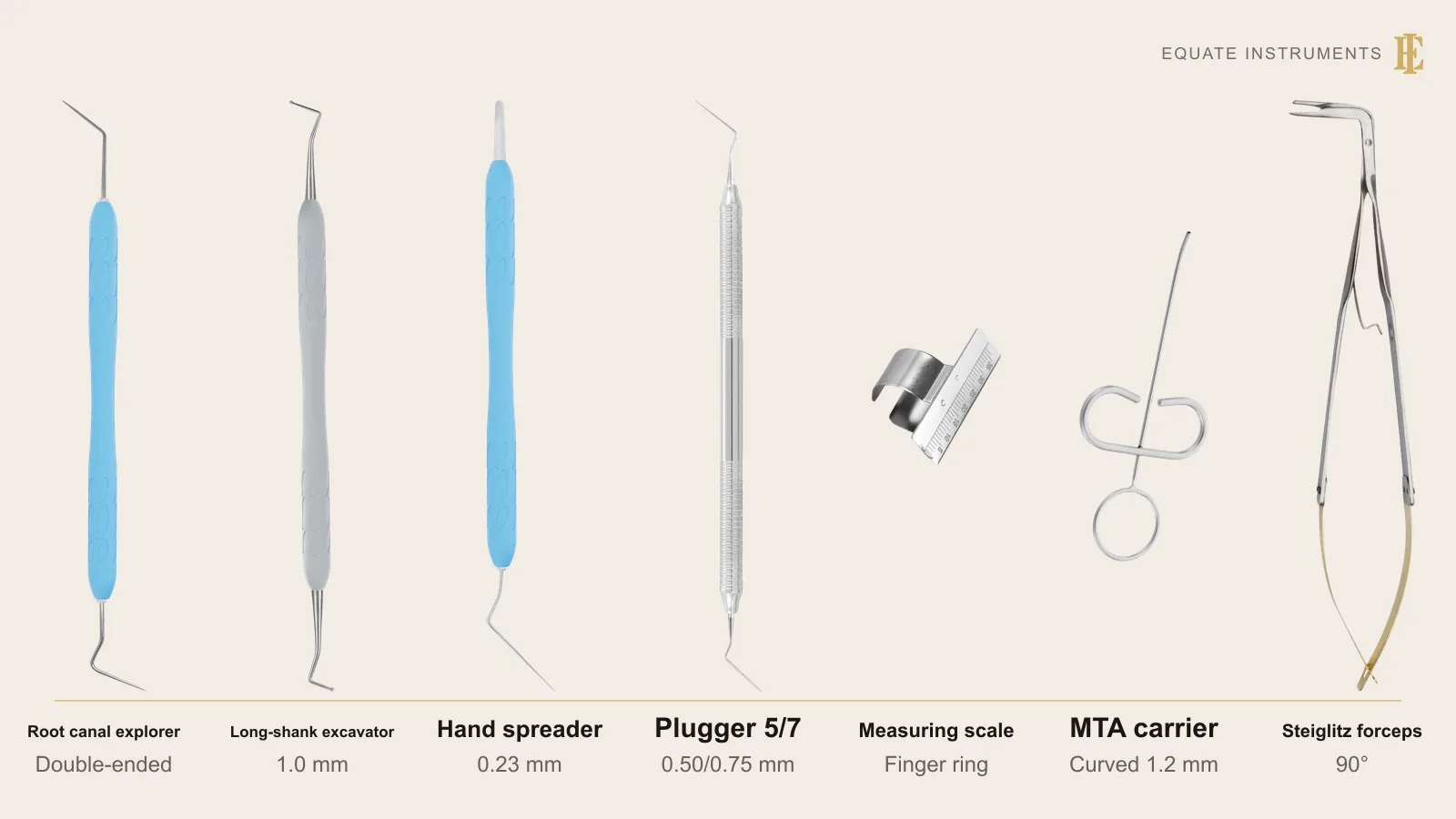
Endodontic hand instruments are the non-rotary tools used through root canal treatment: an endodontic explorer such as the DG16 to find canal orifices, a long-shank excavator to clear the pulp chamber, a millimetre ruler and stops to set working length, spreaders and pluggers to compact gutta-percha, and carriers to place MTA. Files do the shaping and are single-use consumables bought separately.
Key points
- The European Society of Endodontology's 2006 quality guidelines (since replaced by its 2023 S3-level guideline) put the working length close to the apical constriction, which usually lies 0.5–2 mm from the radiographic apex.
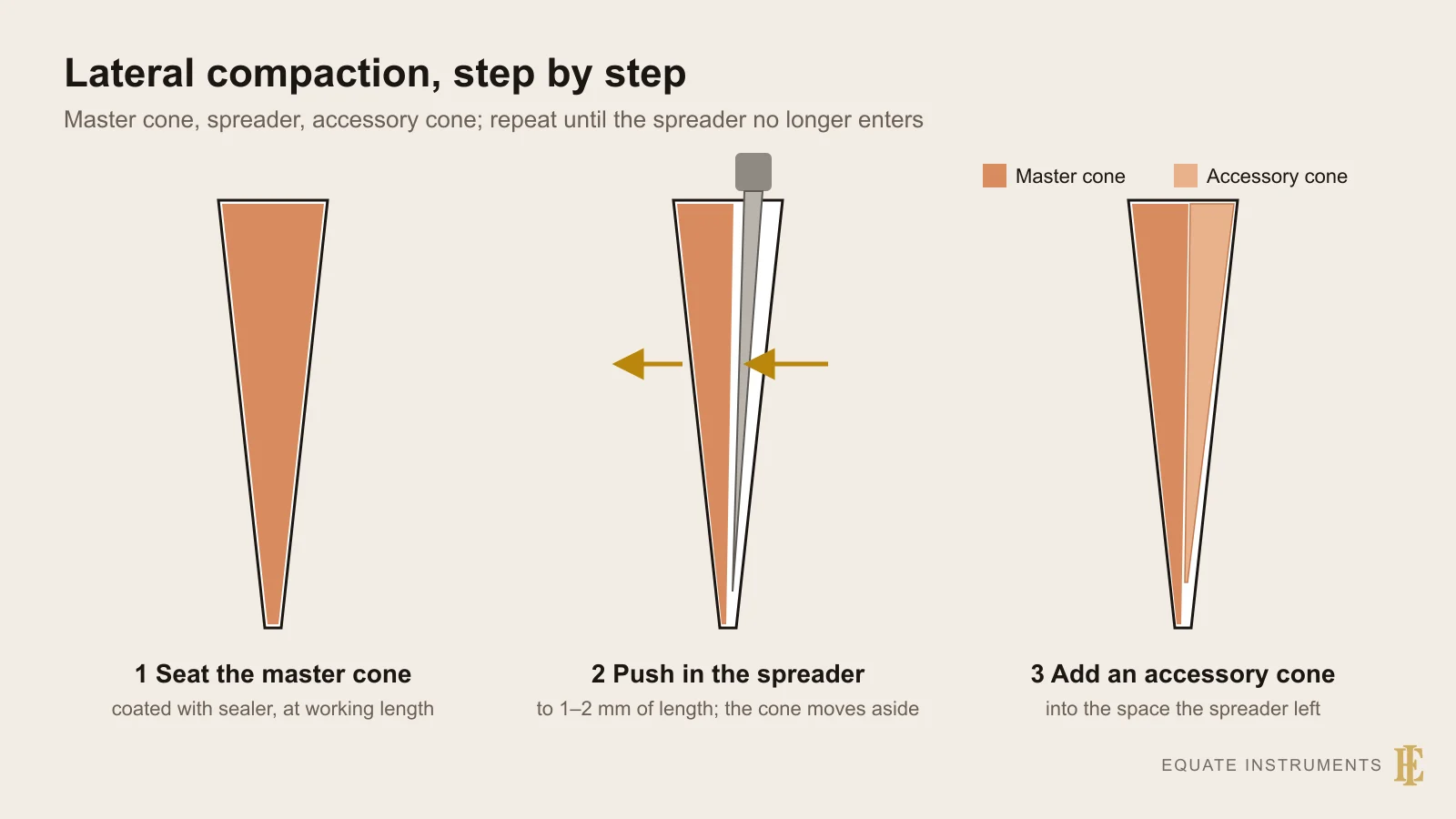
- Spreaders are pointed and press gutta-percha sideways in lateral compaction; pluggers are flat-ended and press it apically in vertical compaction.
- Fine endodontic tips bend and fatigue, so inspect them under magnification and retire any that are kinked or blunt.
What are endodontic hand instruments used for?
Endodontic hand instruments are used at every stage of root canal treatment that a file or a motor doesn't do: opening and exploring the pulp chamber, measuring and recording length, filling the canal, and repair or retreatment. Rotary and reciprocating files shape the canal, but the clinician still finds the orifices, checks the length and compacts the filling by hand. Files, broaches and apex locators are covered in the endodontic instruments guide.
The endodontic tray starts with the basics, a mouth mirror and locking tweezers, and runs under rubber dam from the first cut to the temporary seal. The full layout, from access to seal, is on the endodontic tray setup page.
How is the DG16 endodontic explorer used during access?
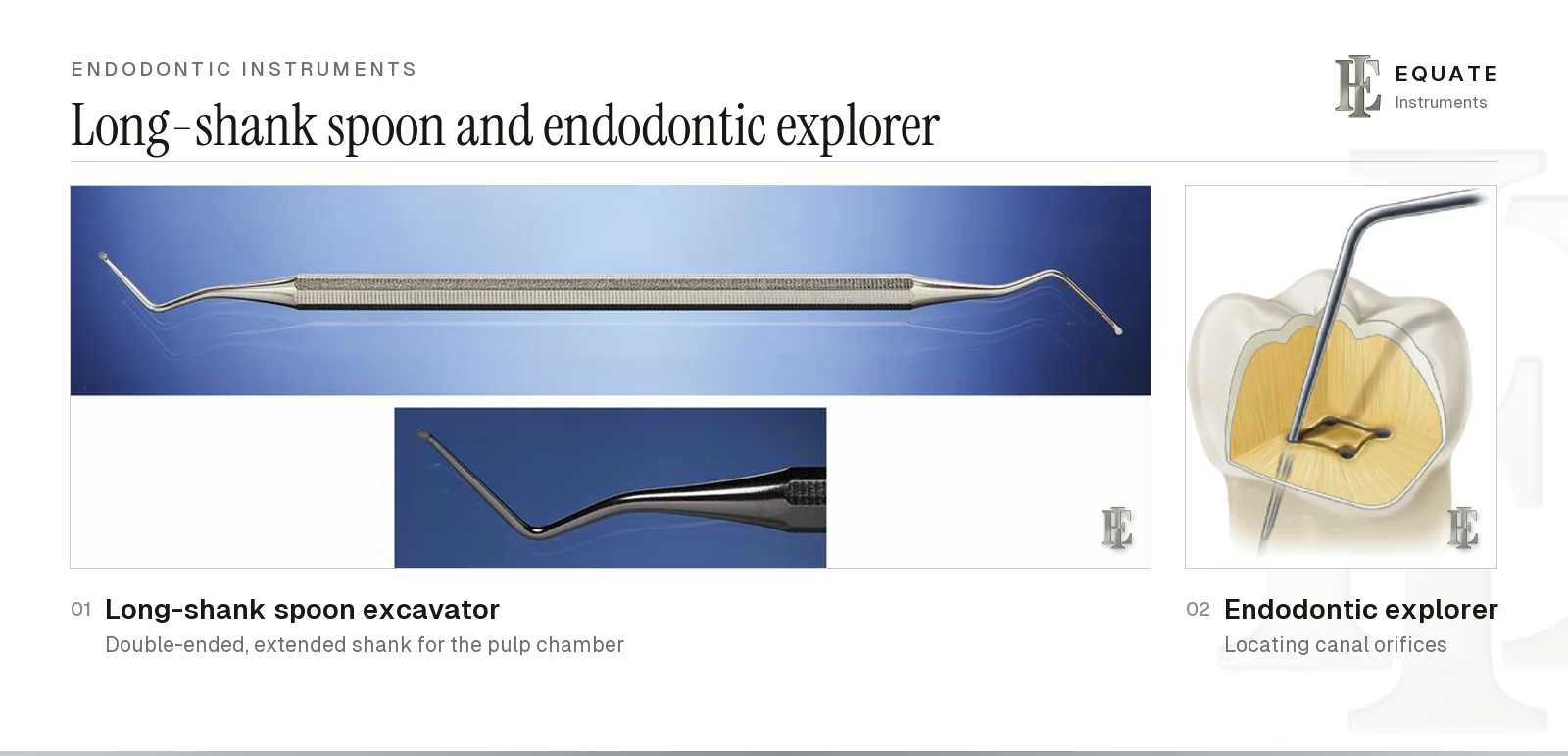
The DG16 is a double-ended endodontic explorer with long, straight, sharp tips set at different angles, used to find canal orifices on the floor of the pulp chamber. Once the roof of the chamber is off, the tip is drawn along the dark developmental grooves of the floor; at an orifice it catches and sticks, which is the signal that a canal starts there. It also probes for calcified orifices and checks whether the access walls give straight-line entry.
It's a different instrument from the shepherd's hook and other dental explorers used to examine caries and margins, which have shorter, curved tips. A long-shank endodontic excavator works beside it: the extra shank length reaches into the chamber to lift out coronal pulp, debris and old dressing that a standard spoon excavator can't reach.
Which instruments set and record working length?
Working length is the distance from a fixed reference point on the crown to the place where shaping and filling should stop. It is found with an electronic apex locator, with the reading normally checked on a radiograph, but it is held and carried through treatment by hand instruments: a measuring scale, a silicone stop on every file and gutta-percha cone, and root canal stoppers during filling. The European Society of Endodontology's 2006 quality guidelines (since replaced by its 2023 S3-level guideline) placed the end point at the apical constriction, normally 0.5–2 mm from the radiographic apex, recommended electronic and radiographic methods together, and asked for a stable, flat cusp tip or incisal edge to be noted as the reference point with each canal length. The chairside order is on the endodontic tray setup page.
Pick a finger-ring scale when stops are set at the chair without putting files down, and a flat ruler when a run of files is set to one length before treatment. Silicone file stops are disposable; root canal stoppers are not the same thing. They are fine, tapered steel hand instruments that carry a rubber stop at the recorded length, used to pre-set and check working length while sealer, paste or gutta-percha goes in. Clinicians comparing general-purpose rulers can see designs on the dental measuring ruler page.
What is the difference between a spreader and a plugger?
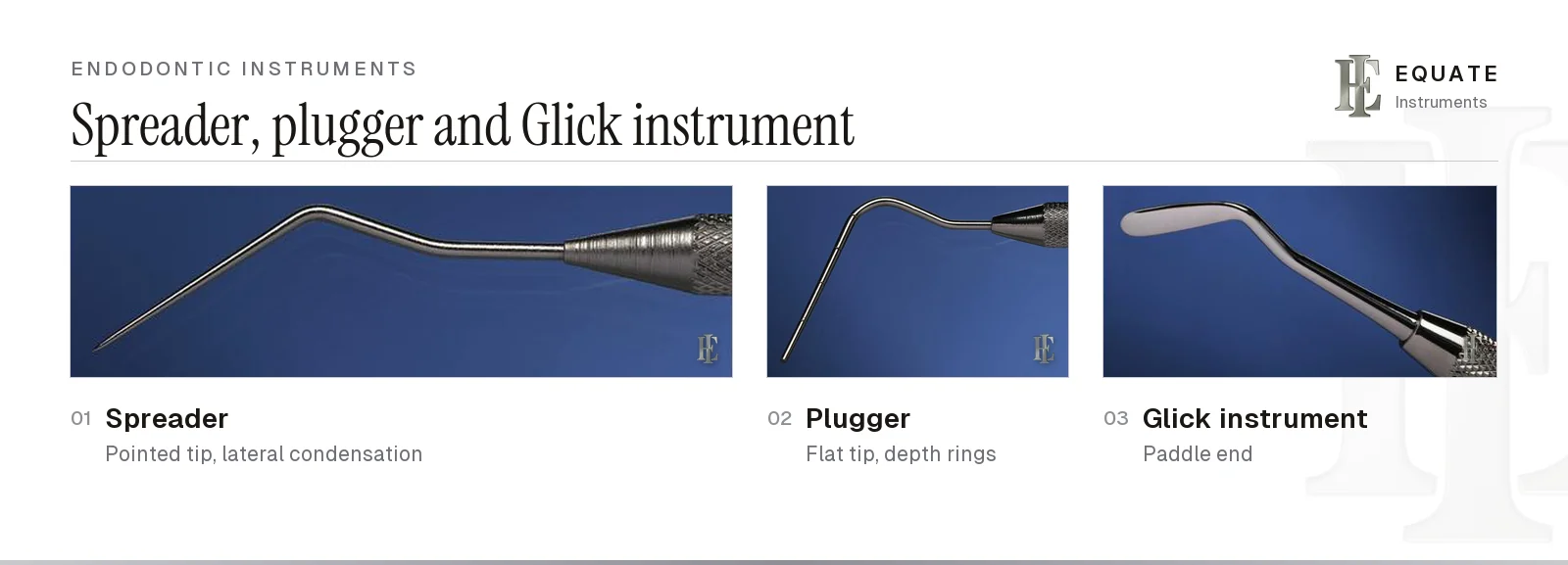
A spreader has a pointed, tapered tip and pushes gutta-percha sideways against the canal wall; a plugger has a flat, blunt tip and pushes it towards the apex. They belong to two different filling techniques, and both come as long-handled hand instruments or short finger instruments that are turned between the fingers.
Endodontic pluggers are far finer than restorative condensers, which pack amalgam into a cavity rather than gutta-percha into a root. Many spreaders and pluggers carry depth rings at millimetre intervals so penetration can be read against working length, and finger versions give more tactile feel in narrow canals than long-handled ones. The Glick instrument pairs a paddle for temporary material with a narrow plugger end that, heated, sears gutta-percha off at the orifice; the endodontic instruments guide shows it with the rest of the obturation set.
| Spreader | Plugger | |
|---|---|---|
| Tip | Pointed, tapered | Flat-ended, cylindrical |
| Technique | Cold lateral compaction | Vertical compaction, usually of warmed gutta-percha |
| How it's used | Inserted beside the master cone to near working length, then withdrawn to leave a space for an accessory cone; repeated until the canal is full | Pre-fitted to reach a few millimetres short of working length without binding, then pressed apically to condense softened gutta-percha in the down-pack and back-fill |
| Main risk | Excess wedging force can crack the root; in a 1999 study by Lertchirakarn and colleagues, finger spreaders produced lower loads and root strain than a D11T hand spreader | Binding against the canal wall wastes force and can strip the filling |
| Sizing | Graded by taper and tip, often numbered in series | Graded by tip diameter, often in fractions of a millimetre |
How do spreader and plugger sizes match the files?
Spreaders and pluggers are sized to the canal a file has already cut. Files follow ISO 3630-1, in which the size number is the tip diameter in hundredths of a millimetre, so a canal finished to size 25 is about 0.25 mm across at its end and widens by 0.02 mm per millimetre with a standard taper. ISO 3630-1 also ties each file size to a handle colour, so sizes can be read at a glance; the table below gives the sequence, and the endodontic instruments guide covers the files themselves. Equate sells no files. What matters here is the fit: a spreader should slide beside the master cone to within a millimetre or two of working length, and each plugger should reach a few millimetres short of length without binding.
The plugger's place on the tray goes back to Herbert Schilder, who introduced warm vertical compaction in his 1967 paper Filling root canals in three dimensions, condensing heat-softened gutta-percha with a series of pluggers. A 2024 systematic review by Jaha found warm vertical compaction and single-cone filling achieve comparable success, with warm compaction adapting better to the canal wall in complex anatomy, so many practices keep both spreaders and pluggers.
| Handle colour | ISO file sizes |
|---|---|
| Pink, grey, purple | 06, 08, 10 |
| White | 15, 45, 90 |
| Yellow | 20, 50, 100 |
| Red | 25, 55, 110 |
| Blue | 30, 60, 120 |
| Green | 35, 70, 130 |
| Black | 40, 80, 140 |
How is MTA placed with a carrier?
An MTA carrier is a small syringe-like instrument with a fine metal cannula that picks up mixed mineral trioxide aggregate and expresses it into a perforation, an open apex or a pulp exposure. In their 2010 review, M. Parirokh and M. Torabinejad list MTA's uses as pulp capping, pulpotomy, apical barriers in teeth with open apices, repair of root perforations and root canal filling, and describe it as slow-setting with a high pH.
Load the cannula from the mixing pad, place it at the site, express the material, then pat it into place with a small plugger or a moist paper point. Straight cannulas suit anterior teeth and single straight canals; curved cannulas reach offset orifices and posterior perforations. Because MTA sets in the cannula, flush the carrier with water straight after use, before it goes for cleaning.
How do you choose and reprocess endodontic hand instruments?
Build the set around the canals you treat: one or two DG16-type explorers, a long-shank excavator, a graded run of spreaders or a set of pluggers matched to your master cone sizes, a measuring scale, and file forceps for handling files and lifting out fragments that are coronal and in view. A 2026 meta-analysis by Zhao and colleagues put the pooled success of removing a separated instrument at 66%, with failure more likely in posterior and mandibular teeth, in the apical third, on the apical side of a curve and in canals curved more than 30°. File forceps only help with fragments that sit coronally and can be seen. The hooked gutta-percha removers lift old or softened filling out of the coronal canal in retreatment and when a post space is cleared. Colour-coded handles make sizes easy to tell apart on a busy tray, and a file box keeps loose instruments upright and sorted through the procedure.
Clean the fine tips with care: soak or rinse off sealer and gutta-percha before it hardens, clean ultrasonically, then inspect every tip under magnification. Retire a spreader or plugger whose tip is bent, kinked or blunt, because a fatigued tip can break inside the canal. Then pack them in a cassette or pouch and sterilise them in line with the CDC guidelines or England's HTM 01-05 and the manufacturer's ISO 17664 processing instructions; the full reprocessing workflow is on the endodontic tray setup page.
What does the Equate endodontic range include?
Equate lists 66 endodontic hand instruments. There are five explorers: three double-ended root canal explorers of the DG16 type and two single-ended explorers, No. 8 and No. 9, with titanium working ends. There are three long-shank root canal excavators in 1.0, 1.5 and 2.0 mm, nine spreaders (the 1S–7S series on C6 handles plus 0.23 mm and 0.4 mm on silicone handles), and 16 pluggers from 0.3 mm to 1.2 mm, including Luks Fig. 1–4 and the double-ended 1/3, 5/7 and 9/11. Ten root canal stoppers from 0.5 to 1.2 mm, fine tapered instruments that carry a rubber stop set to working length during filling, come on solid C6 or hollow C8 handles.
For length and handling there are four measuring scales, six file boxes, a file holder, Steiglitz file forceps at 45°, 75° and 90°, a curved fragment forceps and two gutta-percha removers with 0.4 mm hooks. The six MTA carriers come straight or curved in 0.8, 1.2 and 1.8 mm. The instruments are designed in Finland; browse the endodontic family or request samples and a quote.
The Equate difference
Equate lists 66 endodontic hand instruments: 5 endodontic explorers, 3 long-shank root canal excavators (1.0–2.0 mm), 9 hand spreaders (1S–7S, 0.23 and 0.4 mm), 16 pluggers from 0.3 mm to 1.2 mm, 10 root canal stoppers (0.5–1.2 mm), 4 measuring scales, 6 file boxes, 5 file and fragment forceps, 2 gutta-percha removers and 6 MTA carriers.
Equate Endodontic Hand Instruments options

Endo Plugger 0.5-1.0mm
EI-0894
Endo Plugger 0.5-1.0mm - Premium Textured Silicone Handle
EI-1109
Endo Plugger 0.5-1.0mm Light Blue
EI-1195
Luks Endodontic Plugger Fig.1 (ø0.4mm), Solid Handle
EI-2040
Luks Endodontic Plugger Fig.2 (ø0.5mm), Solid Handle
EI-2041
Luks Endodontic Plugger Fig.3 (ø0.7mm), Solid Handle
EI-2042
Luks Endodontic Plugger Fig.4 (ø1.0mm), Solid Handle
EI-2044
Endodontic Plugger 1/3 - 0.40/0.45mm Solid Handle 6mm
EI-2045
Endodontic Plugger 5/7 - 0.50/0.75mm Solid Handle 6mm
EI-2046
Endodontic Plugger 9/11 - 1.00/1.15mm Solid Handle 6mm
EI-2047
Endodontic Plugger 0.3mm - Solid Handle 6mm
EI-2048
Endodontic Plugger 0.4mm - Solid Handle 6mm
EI-2049Browse all endodontic instruments Browse all restorative & operative instruments
Buying in your market
Frequently asked questions
What is an endodontic explorer used for?
It finds canal orifices on the floor of the pulp chamber. Its long, sharp, straight tips catch in an orifice and probe calcified entrances, which a curved diagnostic explorer can't reach.
What is the difference between a spreader and a plugger in endodontics?
A spreader is pointed and makes room for accessory cones in lateral compaction. A plugger is flat-ended and condenses gutta-percha towards the apex in vertical compaction.
What size plugger should I use?
Pre-fit the plugger in the shaped canal before filling. It should reach a few millimetres short of working length without binding, so most clinicians use two or three sizes per canal, from narrow apical to wider coronal.
Are nickel-titanium or stainless steel finger spreaders better in curved canals?
Nickel-titanium went deeper in one laboratory study. Berry and colleagues (1998) tested size-matched finger spreaders in 70 mandibular molar canals curved up to 51° and found the nickel-titanium spreaders reached significantly closer to the apex than stainless steel ones.
Can a spreader crack the root?
Excess force can, but the risk is lower with finger spreaders. Lertchirakarn and colleagues (1999) measured lower loads and root strain with finger spreaders than with a D11T hand spreader, and concluded that lateral condensation alone should not directly cause a vertical root fracture.
What is an MTA carrier?
A small instrument with a fine cannula that carries mixed mineral trioxide aggregate to a perforation, open apex or pulp exposure and expresses it there. It's flushed with water straight after use so the material can't set inside.
Does Equate sell endodontic files?
No. Files are single-use consumables bought separately; Equate makes the reusable hand instruments around them, from explorers and spreaders to pluggers, scales and MTA carriers.
References
- European Society of Endodontology. Quality guidelines for endodontic treatment: consensus report of the European Society of Endodontology. International Endodontic Journal 2006;39(12):921–930 (since replaced by the ESE 2023 S3-level guideline)
- Schilder H. Filling root canals in three dimensions. Dental Clinics of North America 1967;11:723–744 (reprinted in Journal of Endodontics 2006;32(4):281–290)
- Parirokh M, Torabinejad M. Mineral trioxide aggregate: a comprehensive literature review. Part I: chemical, physical, and antibacterial properties. Journal of Endodontics 2010;36(1):16–27
- Jaha HS. Hydraulic (single cone) versus thermogenic (warm vertical compaction) obturation techniques: a systematic review. Cureus 2024;16(6):e62925
- ISO 3630-1:2019. Dentistry: endodontic instruments. Part 1: General requirements. International Organization for Standardization
- Berman LH, Hargreaves KM (eds). Cohen's Pathways of the Pulp. Elsevier (access, working length and obturation techniques)
- Boyd LRB. Dental Instruments: A Pocket Guide, 7th edition. St. Louis: Elsevier, 2020. Chapter 11, Endodontic Instruments (photographs used under licence)
- Duncan HF, Kirkevang LL, Peters OA, et al. Treatment of pulpal and apical disease: the European Society of Endodontology (ESE) S3-level clinical practice guideline. International Endodontic Journal 2023;56(Suppl 3):238–295
- Lertchirakarn V, Palamara JE, Messer HH. Load and strain during lateral condensation and vertical root fracture. Journal of Endodontics 1999;25(2):99–104
- Berry KA, Loushine RJ, Primack PD, Runyan DA. Nickel-titanium versus stainless-steel finger spreaders in curved canals. Journal of Endodontics 1998;24(11):752–754
- Zhao L, Luo W, Shen Y, Yu W, Yang L, Zhang X. Risk factors for failure of separated instrument removal: a systematic review and meta-analysis. Australian Endodontic Journal 2026;52(1):331–338
- Kohn WG, et al. Guidelines for Infection Control in Dental Health-Care Settings, 2003. MMWR 52(RR-17), Centers for Disease Control and Prevention
I am a…
Related
- Endodontic Tray Setup: Opening and Sealing a Tooth
- Rubber Dam Clamps, Forceps, Punches and Frames: Which to Choose
- Dental Explorers
- Spoon Excavators (Dental Excavators)
- Dental Measuring Ruler
- Restorative Dental Hand Instruments
- Endodontic Instruments for Root Canal Treatment
- Dental Pluggers and Condensers (Amalgam Condensers)
- Dental Cotton Pliers (Dental Tweezers)
- Dental Dam Instruments Explained, from Sheet to Frame