Dental Cotton Pliers (Dental Tweezers)
Written by the Equate Instruments Technical Team · Reviewed by the Medical & Dental Board, Equate Instruments · Updated ·
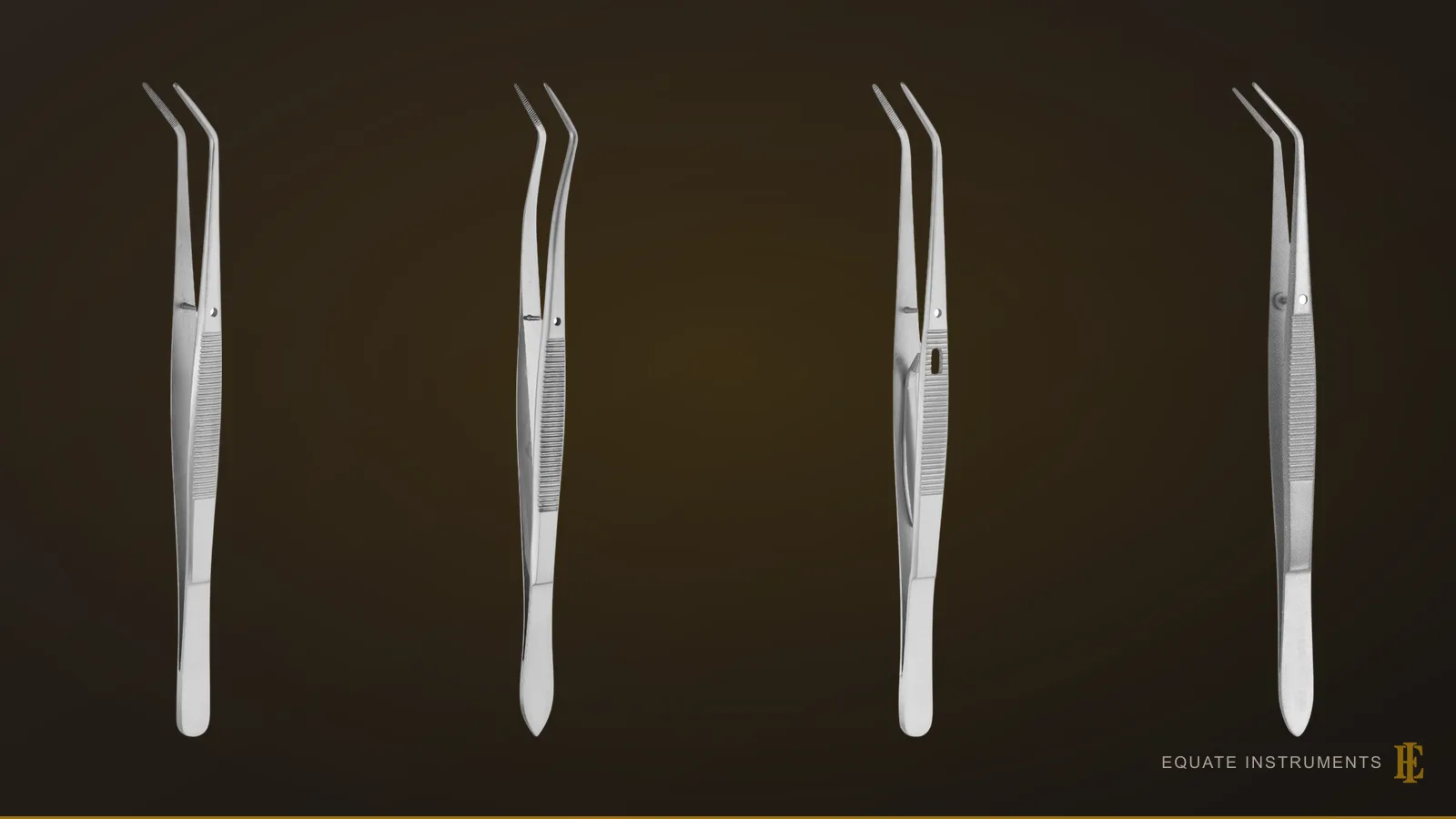
Cotton pliers, also called cotton forceps or dental tweezers, are spring-action tweezers with angled tips used to carry small items into and out of the mouth: cotton pellets and rolls, gauze, wedges, matrix bands, articulating paper and small debris. Patterns such as the London College and Meriam differ in length and tip shape, and locking versions hold an item without constant finger pressure.
Key points
- Cotton pliers are part of the basic examination set with a mirror and explorer, so they are on almost every tray.
- Angled tips reach posterior teeth without the hand blocking the view; serrated tips grip cotton and small items securely.
- Locking pliers hold an item on their own, which helps when passing small objects that could be dropped into the mouth.
What are cotton pliers used for?
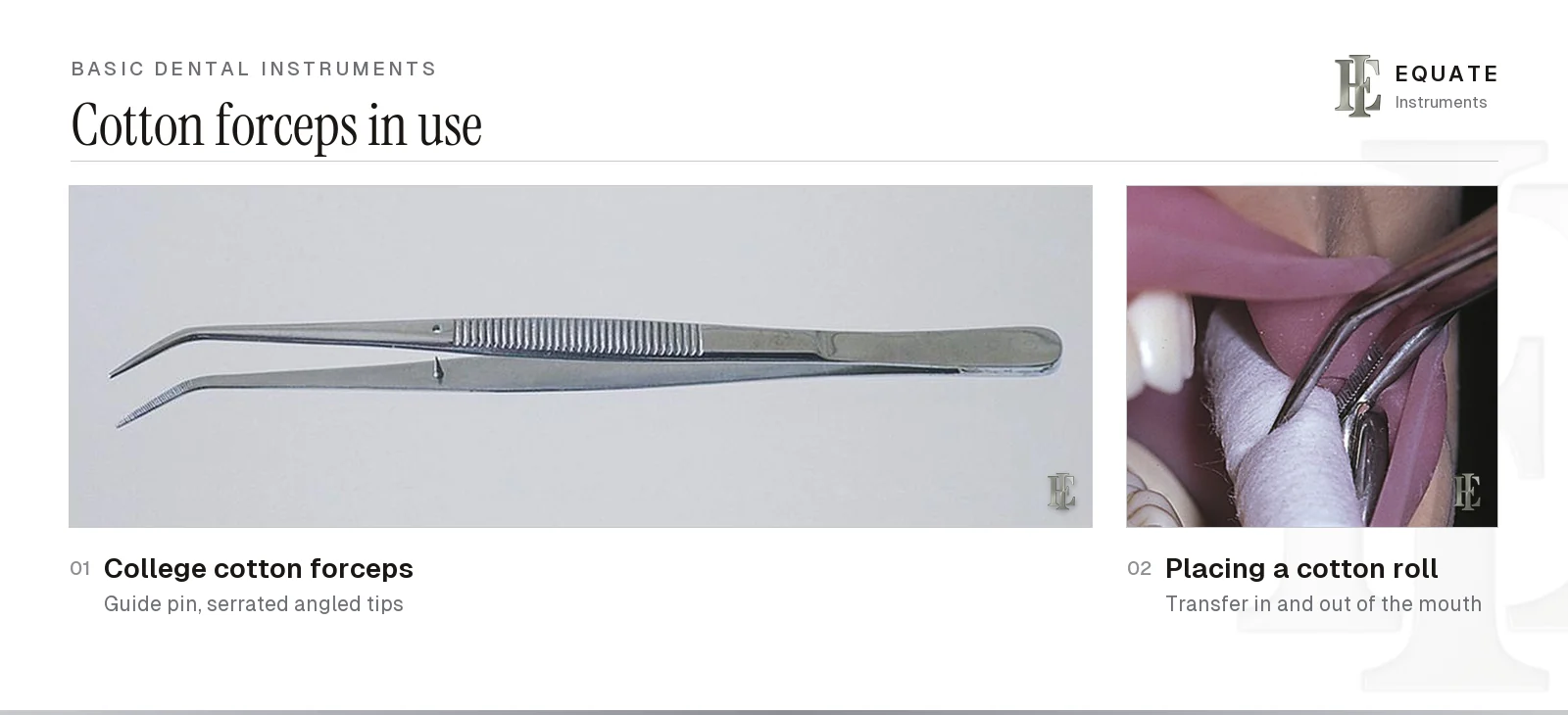
Cotton pliers pick up, place and remove small items in the mouth so fingers stay out of the field. They carry cotton pellets for drying or placing medicaments, cotton rolls for isolation, wedges, matrix bands and retraction cord, and they lift out loose debris, provisional material and old dressings. With a mouth mirror and a dental explorer they make up the basic dental instruments set on the basic dental tray setup.
They are also the usual way to pass small items between the dental nurse and the clinician. Tissue forceps for handling gingiva and flaps, such as the Adson and the Semken, are covered in the dental tissue forceps guide.
What types of tweezers are used in dentistry?
| Type | Tips | Typical use |
|---|---|---|
| College (London College) pliers | Angled, serrated, with a guide pin | General chairside use |
| Meriam pliers | Angled, serrated; also a smooth lining version | General use and placing liners |
| Perry and short tweezers | Straight, curved or bent, about 13 cm | Anterior work and small items |
| Locking cotton pliers | Angled, with a catch or self-locking spring | Holding pellets, paper points and small items |
| Endodontic tweezers | Fine angled tips, often locking or with a groove | Paper points, gutta-percha cones |
| Articulating paper forceps | Flat, wide jaws that lock | Holding marking paper to check the bite |
| Titanium pin and abutment tweezers | Fine non-scratching tips | Implant pins, screws and abutments |
What is the difference between London College and Meriam cotton pliers?
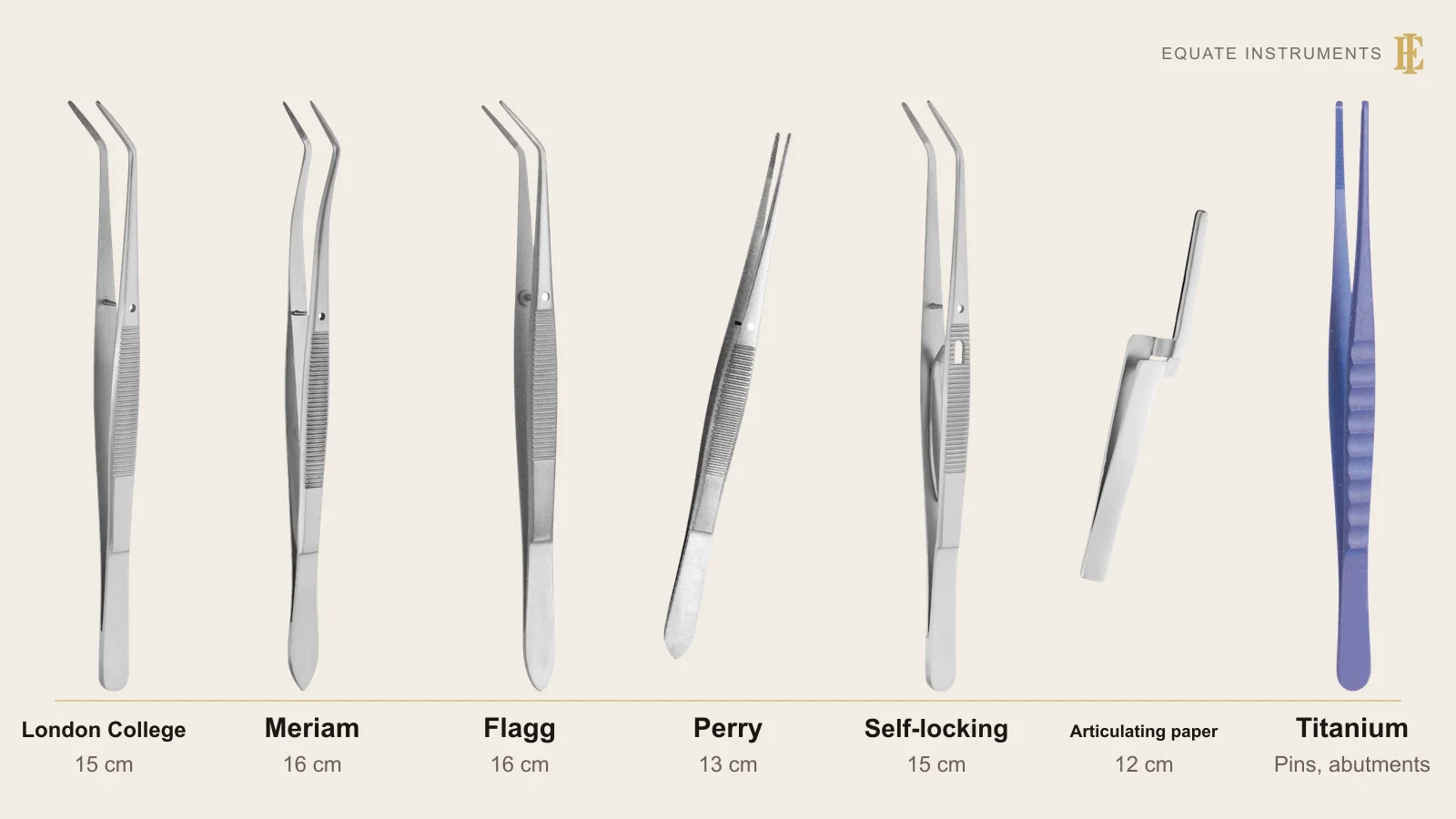
Both are angled, serrated cotton pliers; the London College is usually the shorter, sturdier pattern with a guide pin that keeps the beaks aligned, while Meriam pliers are typically a little longer, at about 16 cm, with finer tapering tips. In Equate's catalogue the London College patterns are 15 cm and the Meriam patterns 16 cm, and the Meriam also comes as a lining tweezer for handling lining materials. The choice is largely preference: clinicians with larger hands or who work mostly on molars often prefer the longer pattern, and the shorter pattern feels more controlled for anterior work.
What is the difference between locking and non-locking cotton pliers?
Non-locking pliers open as soon as finger pressure is released, while locking pliers hold the tips closed on their own, either with a sliding catch near the tips or a self-locking spring action. Locking pliers make it easier to pass a cotton pellet, a paper point or a small component without dropping it, and the operator's hand can relax while the item stays held. The trade-off is speed: non-locking pliers are quicker for repeated pick-up and release.
| Feature | Non-locking | Locking or self-locking |
|---|---|---|
| Hold without pressure | No | Yes |
| Speed of pick-up and release | Fast | Slower |
| Passing small items | Needs care | Safer |
| Typical use | Cotton rolls, general chairside work | Endodontics, implant parts, medicated pellets |
Which tip suits which job: serrated or smooth, angled or straight?
- Serrated tips: fine grooves grip cotton, gauze and small instruments without slipping; the standard choice.
- Smooth tips: release soft materials such as liners cleanly and don't mark delicate items.
- Angled tips: reach posterior teeth and the palatal and lingual surfaces while keeping the hand out of the line of sight.
- Straight and curved tips: anterior work, the laboratory and handling items outside the mouth.
- Non-magnetic stainless: avoids small metal items sticking to the tips, which matters with tiny components.
How do you use cotton pliers safely?
Hold cotton pliers in a pen grasp near the serrated grip, with a finger rest on a tooth when working in the mouth, and close the tips only as firmly as needed. Pass small items in the transfer zone below the patient's chin, tips pointing away from the patient, with the item held securely or the pliers locked. When something drops into the mouth, sit the patient up and look before they swallow: Hill and Rubel advise that any missing item should be treated as possibly aspirated or swallowed. Their review puts prevention first, with a rubber dam, ligatures or a throat pack where possible. If an item is lost, check the airway, tell the patient, and refer them at once, with an escort, for radiographs, however well they seem: all aspirated objects and about a third of swallowed ones need hospital care.
Common mistakes are squeezing so hard that the tips cross and flick the item away, using bent pliers whose tips no longer meet, and carrying sharp or tiny items without locking pliers or a rubber dam.
What does the Equate range include?
Equate lists 23 cotton pliers and college tweezers: London College patterns at 15 cm, Meriam serrated and lining patterns at 16 cm, Perry tweezers at 13 cm with straight, curved and bent tips, Flagg cotton pliers at 16 cm, Krane-Kaplan angled tweezers, a heavy-pattern college tweezer, college cotton pliers with a lock and an angled endodontic tweezer. Eight are non-magnetic. Another nine are locking designs, including self-locking college tweezers (one of them non-magnetic), cross-action locking tweezers, endodontic locking tweezers and articulating paper forceps, and two titanium tweezers handle implant pins and abutments.
They are designed in Finland. For the stainless steel patterns, BS EN ISO 7153-1 is the standard that sets out the metals used for surgical instruments. Clinics can request samples and a quote through the accessories and supplies family.
How do you clean and sterilise cotton pliers?
Clean cotton pliers with the rest of the examination set, ideally in an instrument cassette, open, with any lock released, so the inner faces and serrations are reached, and sterilise them following the manufacturer's processing instructions (ISO 17664-1) and the CDC's 2003 guidelines or HTM 01-05. Check after each cycle that the tips meet evenly along their length and that the guide pin still lines them up; pliers whose tips cross or gap should be retired, because they drop items. Clean articulating paper forceps of ink and locking catches of debris before sterilising. The CDC asks for a chemical indicator inside every package and a label showing the steriliser, the cycle or load number and the date.
The Equate difference
Equate lists 34 dental tweezers: 23 cotton pliers and college tweezers in London College, Meriam, Perry, Flagg and Krane-Kaplan patterns from 13 to 16 cm, 8 of them non-magnetic; 9 self-locking, cross-action and articulating paper tweezers, one of them non-magnetic; and 2 titanium tweezers for pins and abutments.
Equate Dental Cotton Pliers (Dental Tweezers) options

Crane-Kaplan Angled Dental Tweezers 15cm
EI-0333
Crane-Kaplan Dental Tweezer 15cm
EI-0334
Meriam Dental Tweezer Serrated 16cm
EI-0353
London College Serrated Tweezer 15cm
EI-0355
Self-Locking College Tweezer Serrated 15cm
EI-0356
London College Short Serrated Tweezer 15cm
EI-0357
Perry Serrated Dental Tweezers 13 cm
EI-0358
Articulating Paper Forceps Straight 12cm
EI-0359
Articulating Paper Forceps Curved 12cm
EI-0360
Endodontic Cross-Hold Tweezer
EI-0361
Flagg Dental Cotton Pliers 16cm
EI-0369
Endodontic Tweezer - Angled Tip
EI-0588Browse all accessories & supplies instruments Browse all implantology instruments
Buying in your market
Frequently asked questions
What are cotton pliers used for in dentistry?
They carry small items into and out of the mouth, such as cotton pellets and rolls, gauze, wedges and articulating paper, and they remove loose debris. They are part of the basic examination set.
Are cotton pliers and cotton forceps the same thing?
Yes. Cotton pliers, cotton forceps, college pliers and dental tweezers are all names for the same spring-action instrument with angled tips.
What are the types of tweezers in dentistry?
The main types are college and Meriam cotton pliers, short straight or curved tweezers, locking cotton pliers, endodontic tweezers, articulating paper forceps and titanium tweezers for implant parts. Tissue forceps for surgery are a separate group.
Why are cotton plier tips angled?
The angle lets the tips reach posterior and lingual surfaces while the hand stays outside the line of sight. Straight tweezers are easier for anterior and laboratory work.
When should you use locking cotton pliers?
Use them when an item must not be dropped, such as paper points, medicated pellets or small implant parts, or when you need to hold an item for a while without keeping pressure on the instrument.
Which cotton pliers are used in endodontics?
Locking cotton pliers or fine-tipped endodontic tweezers. The lock holds a paper point or gutta-percha cone without finger pressure, so it can be carried to the canal and passed between clinician and nurse without being dropped.
References
- Hill EE, Rubel B. A practical review of prevention and management of ingested/aspirated dental items. General Dentistry 2008;56(7):691–694
- Boyd LB. Dental Instruments: A Pocket Guide, 7th edition. Saunders/Elsevier, 2020. Chapter 1, Basic Dental Instruments (photographs used under licence)
- Ritter AV, Boushell LW, Walter R (eds). Sturdevant's Art and Science of Operative Dentistry. Elsevier (instrument grasps and the basic set)
- Kohn WG, et al. Guidelines for Infection Control in Dental Health-Care Settings, 2003. MMWR 52(RR-17), Centers for Disease Control and Prevention
- Department of Health. Health Technical Memorandum 01-05: Decontamination in primary care dental practices, 2013 edition. NHS England
- ISO 17664-1:2021 Processing of health care products: information to be provided by the medical device manufacturer for the processing of medical devices, part 1: critical and semi-critical medical devices
- Centers for Disease Control and Prevention. Summary of infection prevention practices in dental settings: sterilization and disinfection of patient-care items
- BS EN ISO 7153-1:2016 Surgical instruments. Materials. Metals. BSI
I am a…
Related
- Dental Mouth Mirrors
- Dental Explorers
- Dental Tissue Forceps (Toothed and Non-Toothed)
- Basic Dental Tray Setup (Dental Exam Tray)
- Crown and Bridge Scissors, Contouring and Holding Pliers
- Basic Dental Instruments: Mirror, Explorer, Cotton Forceps and Handles
- Endodontic Instruments for Root Canal Treatment