Dental Crown Removers
Written by the Equate Instruments Technical Team · Reviewed by the Medical & Dental Board, Equate Instruments · Updated ·
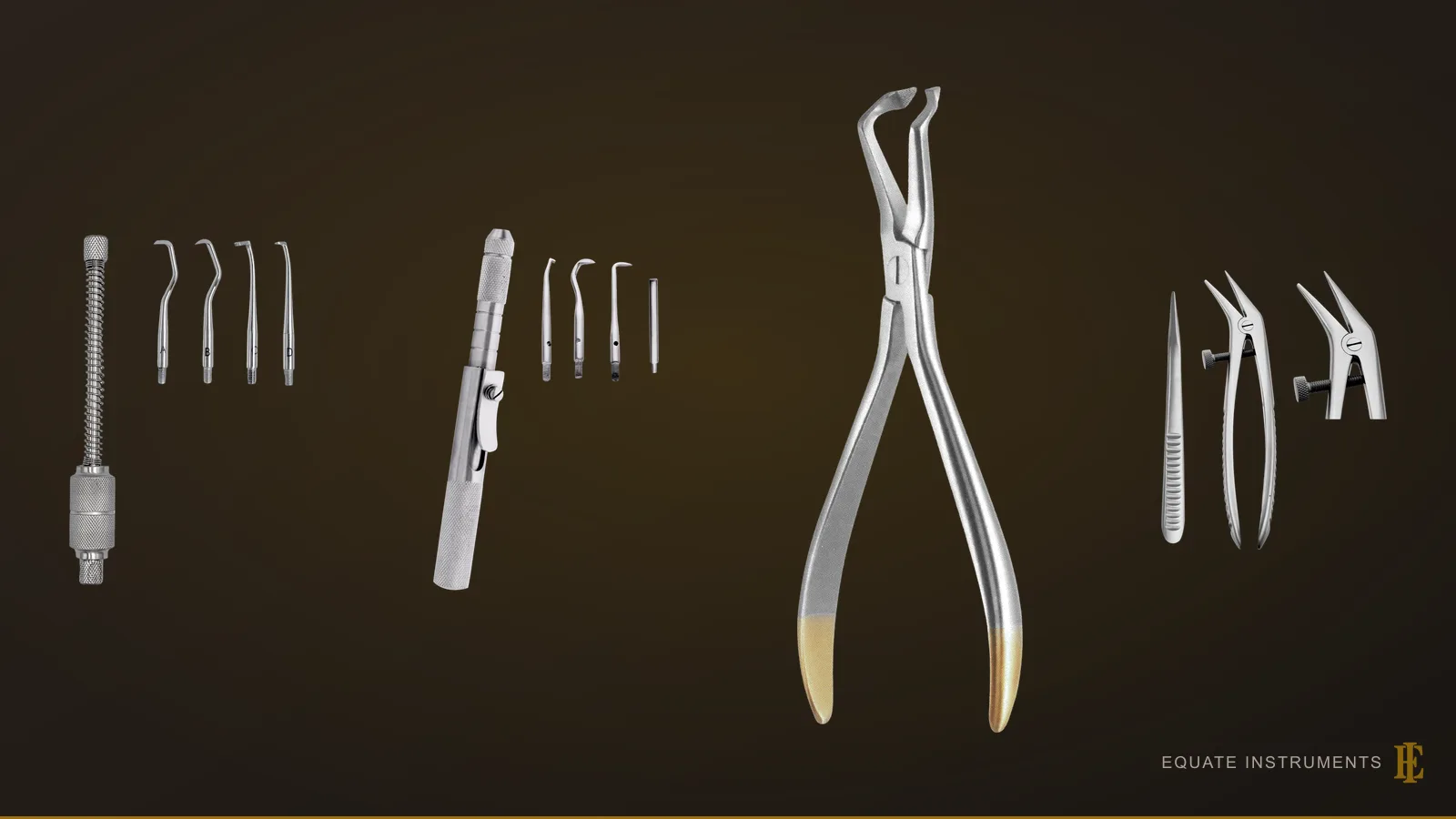
A crown remover is a dental instrument that breaks the cement seal under a crown or bridge so it can be lifted off the tooth, ideally in one piece. Types include hooked hand removers, crown remover pliers with silicone pads, slide-hammer and spring-loaded impact removers, and crown spreaders. Temporary crowns come off easily; permanent crowns on strong cement often have to be cut off instead.
Key points
- Provisional crowns on temporary cement usually lift off with pliers or a hand instrument pulled along the long axis of the tooth.
- Impact removers can loosen a definitive crown, but they risk fracturing the core, chipping porcelain and loosening periodontally weak teeth.
- When the crown will be replaced anyway, or is bonded with adhesive cement, sectioning it is often safer than repeated tapping.
What is a crown remover used for?
A crown remover takes off a provisional crown before the definitive one is fitted, retrieves a permanent crown or bridge at the try-in stage, and removes a failed restoration so the tooth can be retreated. Crowns and bridges have a long but finite life: a 2004 systematic review by Tan, Pjetursson, Lang and Chan, cited by Sharma and colleagues in their 2012 review of crown and bridge removal, put the ten-year survival of fixed partial dentures at about 89%. The same review names caries as the most common cause of failure; others include loss of retention, endodontic and periodontal problems, and fractured porcelain.
Removing a restoration intact can save the patient a new one, for example when a bridge abutment has decemented or when root canal treatment is easier without the crown in the way. Crown removers sit on the crown and bridge tray next to the crown and bridge instruments used to seat the replacement.
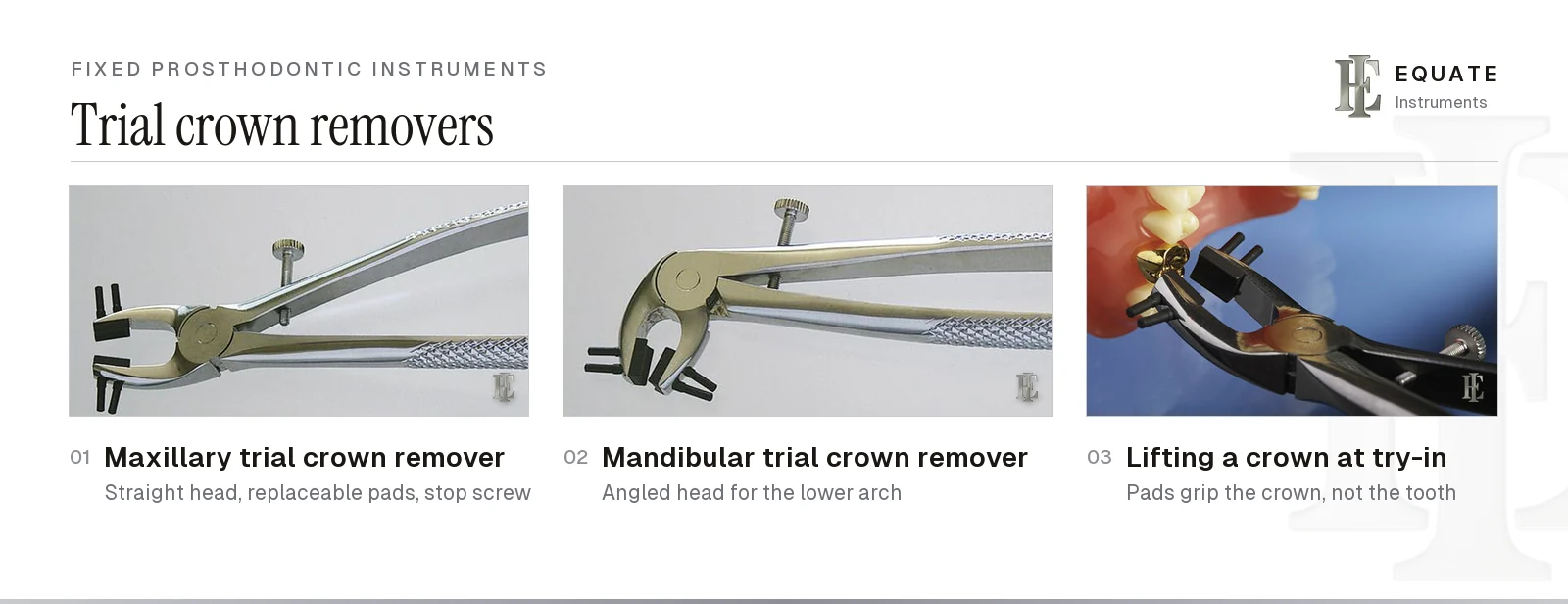
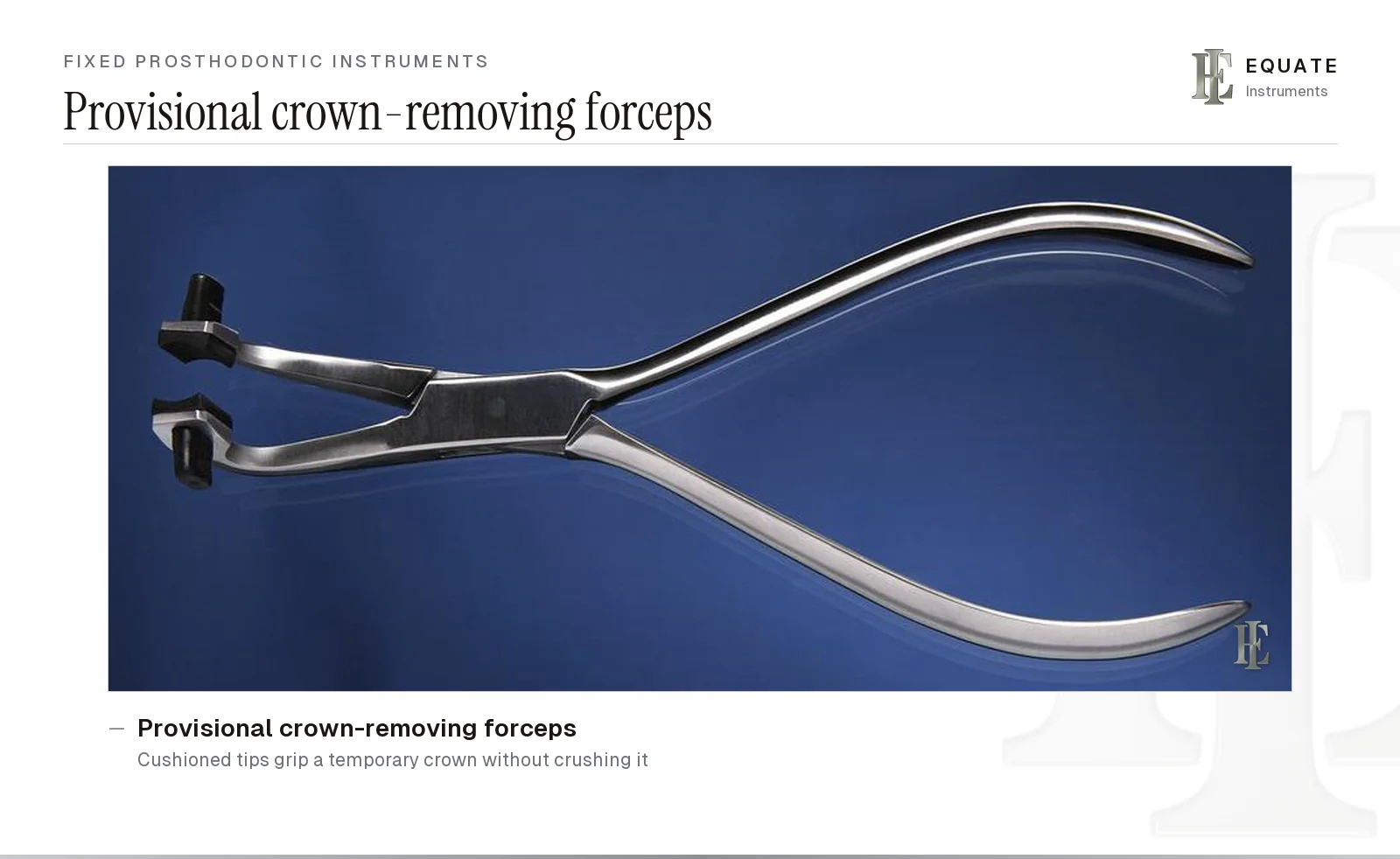
The fixed prosthodontic instruments guide explains how provisional crown-removing forceps differ from a trial crown remover. The forceps have cushioned tips that hold a temporary at its margins so it can be reused; the trial remover has replaceable non-slip pads and a stop screw, in upper and lower patterns, for lifting the final crown after an uncemented try-in. Neither is built for a crown on permanent cement.
What types of crown remover are there?
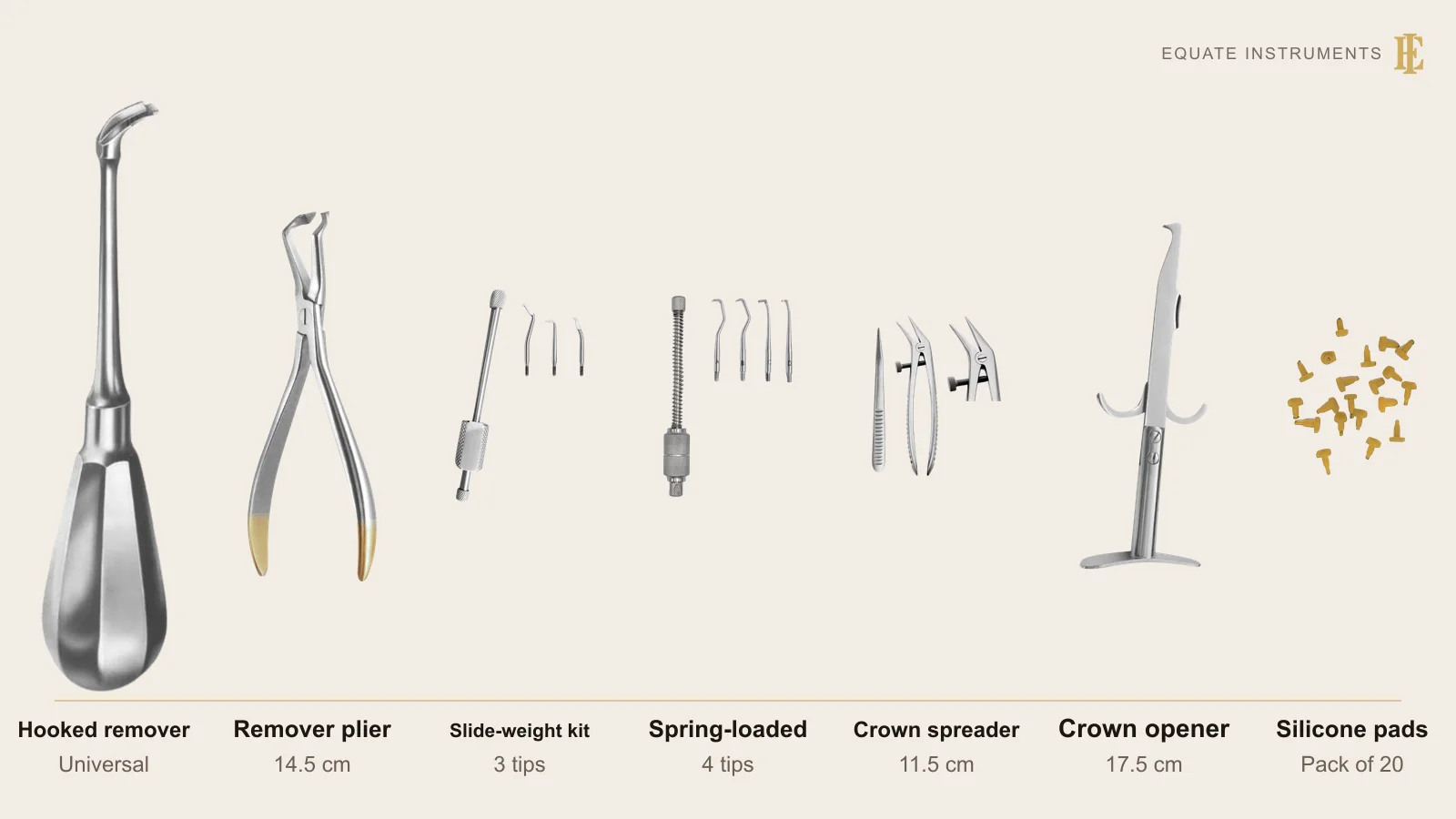
Sharma and colleagues group removal methods as conservative, where the restoration stays intact; semi-conservative, where a small access hole is cut so force can be applied between crown and core; and destructive, where the crown is sectioned. The table covers examples from all three groups.
| Type | How it works | Best for | Main risk |
|---|---|---|---|
| Hooked hand remover | A hooked tip engages the margin and is levered or rocked | Provisional crowns, loose crowns | Tip slips and damages the margin or gingiva |
| Crown remover pliers and forceps, and the trial crown remover | Padded jaws grip the crown and pull along the path of withdrawal | Provisionals and crowns at try-in | Crushing a thin ceramic crown |
| Slide-hammer remover | A sliding weight delivers short axial taps through a hooked tip | Cast metal and metal-ceramic crowns on conventional cement | Discomfort, core fracture, porcelain chipping |
| Spring-loaded or trigger remover | A spring releases a controlled impulse through the tip | Crowns and bridges where single, measured impacts are wanted | As for slide hammers, though easier to control |
| Adhesive resin bite-block | A softened thermoplastic block is bitten onto the crown and hardened; the patient then opens sharply | Provisional crowns and bridges on temporary cement | Sudden force on opposing teeth; check periodontal support first |
| Access-hole (semi-conservative) system | A small hole is cut through the casting so a key or screw can push the crown off the core | Cast or metal-ceramic crowns worth reusing | The hole must be repaired before recementation |
| Crown spreader | Beaks enter a slot and are opened by a thumbscrew | Splitting a sectioned crown apart | Stress on the core if the cut is incomplete |
How do you remove a temporary crown versus a permanent crown?
A provisional crown on temporary cement usually comes off with crown remover pliers, a large spoon excavator or a scaler that rocks it gently along the long axis until the weak cement seal breaks. Pliers with silicone or rubber pads are particularly useful at the try-in stage, because the soft grip reduces the risk of marking a porcelain margin. Protect the airway with gauze or a throat screen, since a crown that suddenly lets go can drop into the mouth.
A definitive cast crown on unknown cement is harder. Start with the gentlest method that might work: padded pliers, then ultrasonic energy to disrupt the cement, then controlled impacts from a slide-hammer or spring-loaded remover, always directed along the path of withdrawal. Sharma and colleagues note that slide hammers can be uncomfortable and less reliable, and advise against them on periodontally involved teeth because of the risk of extracting the tooth. In a 1990 laboratory study in the Journal of Prosthetic Dentistry, Olin tested cast crowns on zinc phosphate and glass ionomer cement and found vibration a useful adjunct to removal devices, with the lowest retention in zinc phosphate crowns vibrated for 12 minutes; Sharma and colleagues note that ultrasonics are contraindicated in patients with cardiac pacemakers. Crowns on adhesive or resin cement usually still have to be sectioned.
What are the risks of removing a crown?
The main risks are fracture of the root or core, damage to the crown, loosening of the tooth and loss of the crown into the airway. Before choosing a method, Sharma and colleagues advise checking the medical history, periodontal support and mobility, restorability, access, the core material, the likely cement and the crown material, because misdirected force can break the abutment.
| Risk | Why it happens | How to reduce it |
|---|---|---|
| Root, post or core fracture | Force applied off the path of withdrawal, or a thin root-filled tooth | Direct every pull or tap along the long axis; section instead on weak teeth |
| Chipped porcelain margin | A hooked tip bearing on ceramic | Use padded pliers first and seat hooks on metal where possible |
| Tooth loosened or extracted | Impacts on a tooth with reduced bone support | Check mobility and radiographs; avoid impact removers on these teeth |
| One bridge retainer decements | The cement lets go on one abutment only | Work on the retainer that is still bonded; consider sectioning the bridge |
| Crown aspirated or swallowed | The crown lets go suddenly | Gauze screen and suction; Hill and Rubel advise prompt referral for radiographs if it is lost |
When should you section a crown instead of removing it whole?
Section the crown when it will be replaced anyway, when it is bonded with resin or adhesive cement, when the tooth is periodontally weak, or when conservative attempts have failed. Destructive removal means cutting a slot through the crown with a tungsten carbide or diamond bur, usually on the buccal surface and down to the cement, then using an ultrasonic tip or an instrument in the slot to spread the crown and lift it off. Bonded crowns often need a second cut through the lingual surface.
A crown spreader or crown opener placed in the slot spreads the two sides evenly, which puts less stress on the core than levering with an excavator. Once the tooth is cleaned up, the margin is re-exposed with a gingival cord packer for the new impression. Sharma and colleagues recommend telling patients at the outset that a conservative attempt may not succeed and that sectioning is always a possibility.
What does the Equate range include?
Equate lists 19 hand instruments for crown removal: universal hooked removers, crown remover pliers and forceps from 14 to 17.5 cm (including angled pliers with rubber-retentive jaws, incisor pliers and left and right forceps), crown spreaders, a tungsten-carbide crown gripper, telescope crown forceps and a 17.5 cm crown opener. Seven kits combine a slide-hammer, spring or trigger-action handle with three to five interchangeable tips, two spring-loaded removers carry their own tips, and replacement silicone pads come in packs of 10 and 20.
The instruments are designed in Finland, and clinics can request samples and a quote for the prosthodontic and laboratory family.
How do you clean and maintain crown removers?
Unscrew the tips from slide-hammer and spring-loaded removers before cleaning, because cement, blood and saliva collect in the threads and around the sliding weight. Clean pliers and forceps open, remove the silicone pads where the instructions allow, and sterilise the parts in line with the manufacturer's processing instructions (ISO 17664-1) and the CDC's 2003 guidelines or HTM 01-05.
Replace silicone pads when they harden, crack or stop gripping, check that hooked tips are not bent, and lightly lubricate hinges and sliding shafts after processing if the instructions recommend it.
The Equate difference
Equate lists 32 crown-removal references: 19 hand instruments, including crown remover pliers and forceps from 14 to 17.5 cm, crown spreaders and a crown opener; 7 slide-hammer, spring and trigger-action kits with 3 to 5 tips; 2 spring-loaded removers; and 4 packs of replacement tips and silicone pads.
Equate Dental Crown Removers options
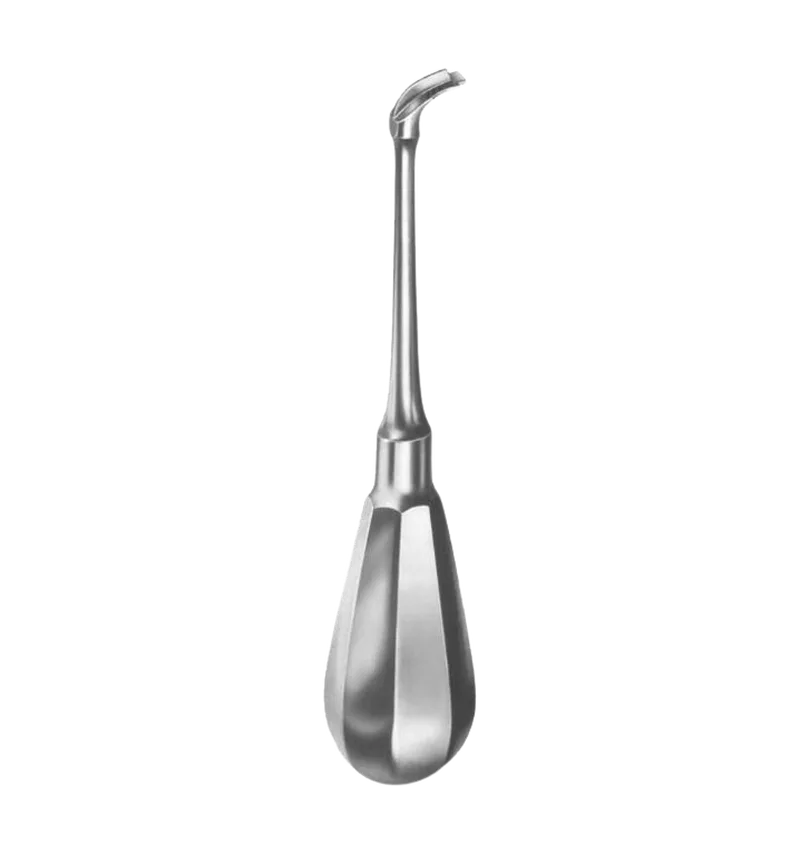
Universal Crown Remover
EI-0706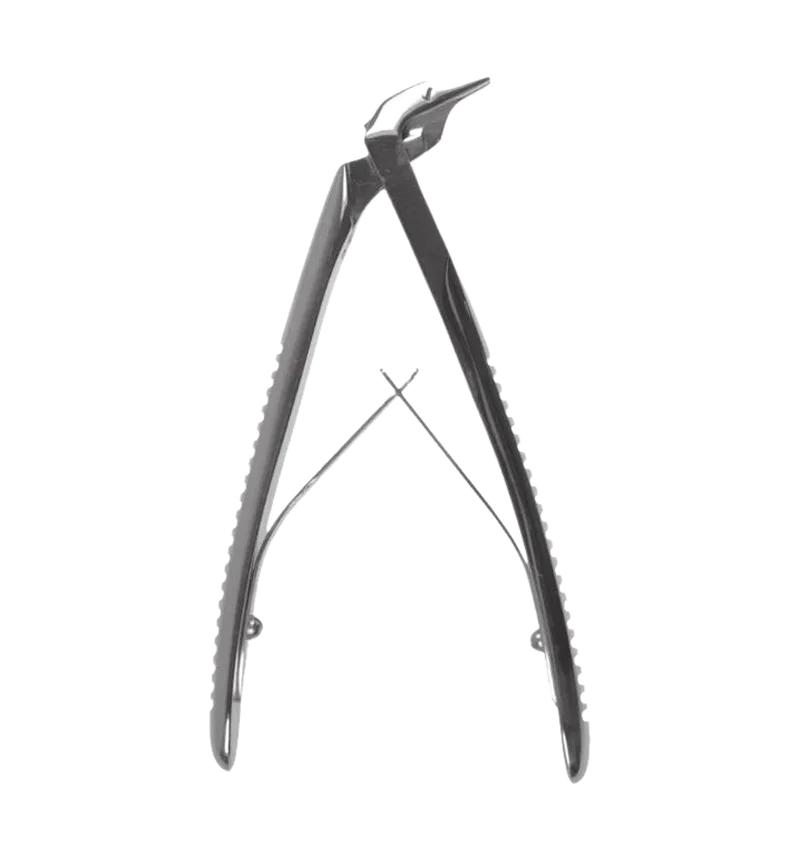
Crown Spreader Pliers 17 cm
EI-0707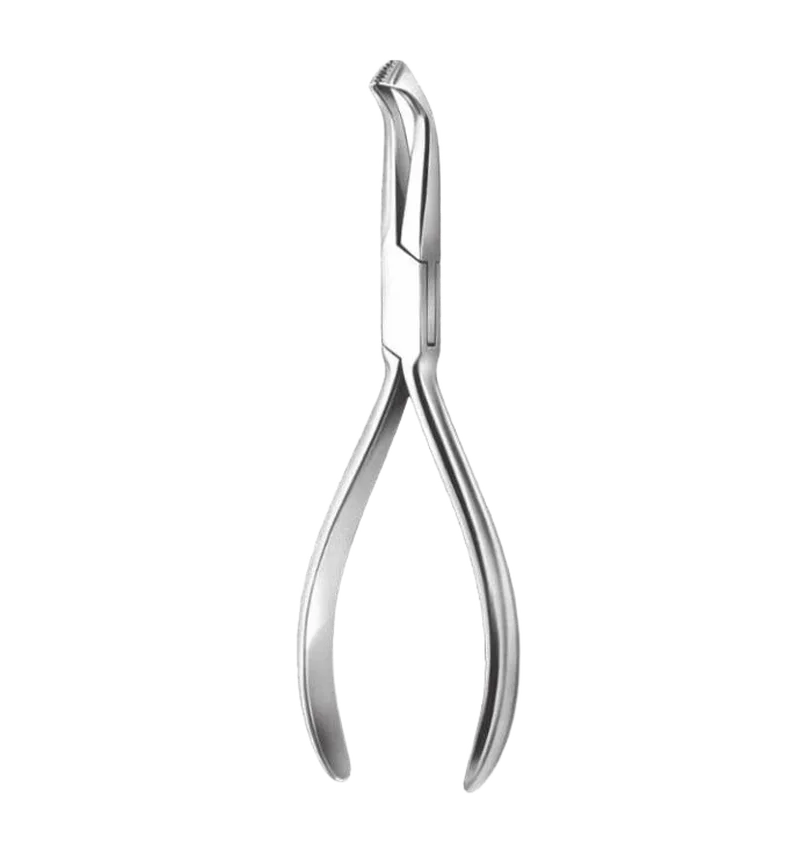
Crown Removing Pliers
EI-0708
Crown Gripper 16 cm (TC, Gold Rings)
EI-0709
Incisor Crown Remover Pliers with Rubber Tips 14 cm
EI-0710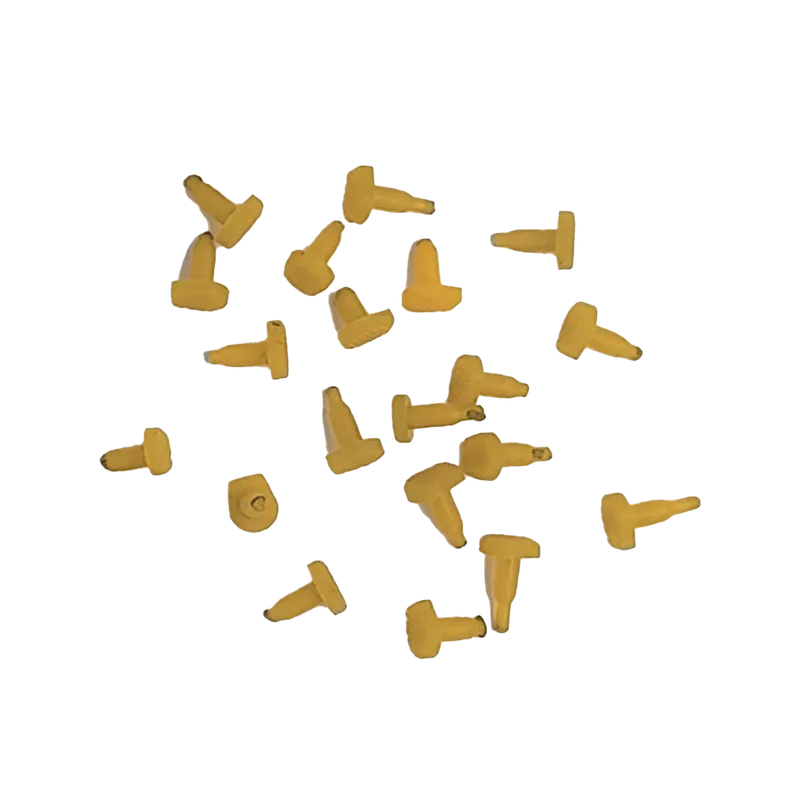
Silicone Rubber Retentive Pads for Crown Remover Pliers - Pack of 20
EI-0711
Furrer Copper Ring Removing Forceps, Straight 16 cm
EI-0712
Telescope Crown Forceps
EI-0713
Automatic Crown Remover Set with 3 Tips and Mounting Tool
EI-0716
Miller Crown Remover with Four Interchangeable Tips
EI-0717
Replacement Tips for Miller Crown Remover (A, B, C, D)
EI-0718
Crown Remover Pliers - Angled with Rubber-Retentive Jaws, 15.5 cm
EI-1495Browse all prosthodontic & laboratory instruments
Buying in your market
Frequently asked questions
What is a crown remover tool?
It is an instrument that breaks the cement seal under a crown or bridge so it can be taken off. Common types are padded crown remover pliers, hooked hand removers and slide-hammer or spring-loaded impact removers.
How do you remove a temporary crown?
Grip it with crown remover pliers or engage the margin with a spoon excavator or scaler, then rock it gently along the long axis of the tooth until the temporary cement lets go. Keep gauze in place so the crown can't be swallowed.
Can a permanent crown be removed without damaging it?
Sometimes, particularly a cast metal or metal-ceramic crown on conventional cement. Crowns on adhesive cement, and many all-ceramic crowns, usually have to be sectioned.
What is the difference between a slide-hammer and a spring-loaded crown remover?
With a slide hammer the clinician drives a weight along the shaft to tap the crown; a spring-loaded remover stores energy in a spring and releases it as a single impulse. Spring and trigger designs make each impact more repeatable.
Can a crown remover pull out a tooth?
Yes, an impact remover can loosen or extract a tooth with poor periodontal support. Check mobility and bone levels first, and section the crown if the tooth is weak.
What is a trial crown remover?
A plier with replaceable non-slip pads and a stop screw that lifts a definitive crown off after an uncemented try-in, and can also take off a provisional. It comes in maxillary and mandibular patterns and is not meant for permanently cemented crowns.
References
- Sharma A, Rahul GR, Poduval ST, Shetty K. Removal of failed crown and bridge. Journal of Clinical and Experimental Dentistry 2012;4(3):e167–e172
- Addy LD, Bartley A, Hayes SJ. Crown and bridge disassembly: when, why and how. Dental Update 2007;34(3):140–150
- Tan K, Pjetursson BE, Lang NP, Chan ES. A systematic review of the survival and complication rates of fixed partial dentures after an observation period of at least 5 years. Clinical Oral Implants Research 2004;15:654–666 (as cited by Sharma et al. 2012)
- Hill EE, Rubel B. A practical review of prevention and management of ingested/aspirated dental items. General Dentistry 2008;56(7):691–694
- Rosenstiel SF, Land MF, Walter R (eds). Contemporary Fixed Prosthodontics, 6th edition. Elsevier, 2022
- Boyd LB. Dental Instruments: A Pocket Guide, 7th edition. Saunders/Elsevier, 2020. Chapter 10, Fixed Prosthodontics Restorative Instruments (photographs used under licence)
- Kohn WG, et al. Guidelines for Infection Control in Dental Health-Care Settings, 2003. MMWR 52(RR-17), Centers for Disease Control and Prevention
- Olin PS. Effect of prolonged ultrasonic instrumentation on the retention of cemented cast crowns. Journal of Prosthetic Dentistry 1990;64(5):563–565
I am a…