Crown and Bridge Scissors, Contouring and Holding Pliers
Written by the Equate Instruments Technical Team · Reviewed by the Medical & Dental Board, Equate Instruments · Updated ·
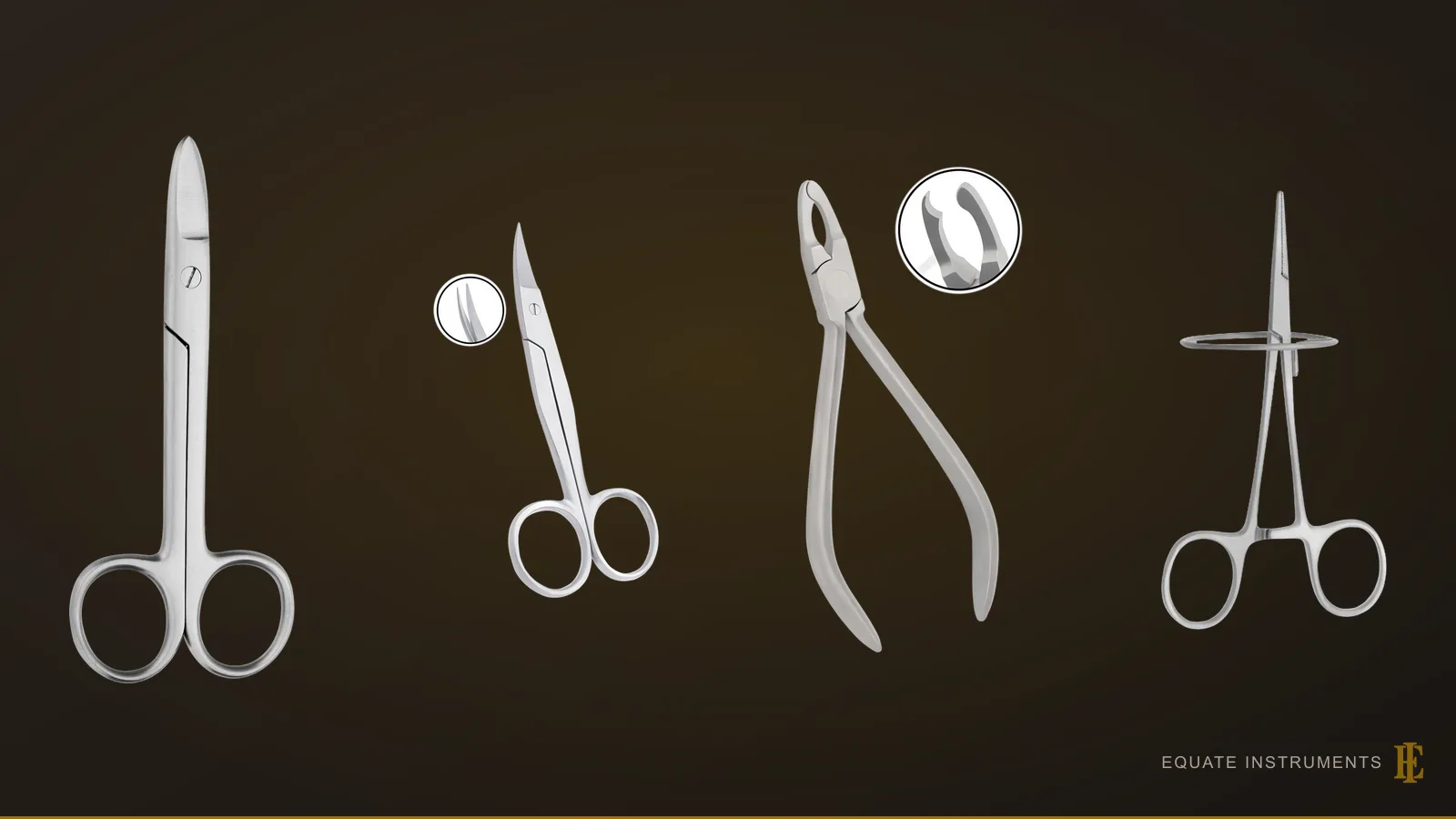
Crown and bridge scissors and pliers are the hand instruments that shape and handle crowns outside the mouth. Short-bladed crown scissors trim provisional and preformed crowns, cord and matrix bands; Johnson and crown band contouring pliers curve a margin inwards; holding pliers grip a crown during adjustment; and a crown sitter seats it. The rest of the tray is in the fixed prosthodontic instruments guide.
Key points
- Crown and bridge scissors have short, stout blades, straight, curved or angled, that cut thin metal and acrylic without twisting.
- Contouring pliers crimp the margin of a provisional or preformed crown inwards so it hugs the tooth at the gingival edge.
- Cord packers, crown removers and the other tray instruments have their own pages, and the fixed prosthodontic instruments guide maps every instrument to its stage.
Where do crown scissors and pliers fit in crown and bridge treatment?
Crown and bridge work keeps the basic examination set on the tray from start to finish and adds instruments for retraction and impressions, for making the provisional, and for try-in and cementation. The table runs in appointment order and links to the page for each group.
Scissors and contouring pliers do most of their work on the provisional crown at the preparation visit, while holding pliers and the crown sitter come into play at try-in and cementation. The fixed prosthodontic instruments guide covers every instrument by stage, including the facebow, shade guides and bite stick, and the crown and bridge tray setup lists them in order of use.
| Stage | Hand instruments | Where to read more |
|---|---|---|
| Examination and preparation | Mouth mirror, explorer, periodontal probe and cotton pliers | Mouth mirrors |
| Retraction and impression | Cord packer, impression trays and a mixing spatula | Cord packers |
| Provisional crown | Crown and bridge scissors, contouring pliers and a plastic instrument | This page |
| Taking off the provisional and try-in | Crown remover pliers, holding pliers and articulating paper forceps | Crown removers |
| Cementation | Cement spatula, a seating instrument such as the crown sitter, and an explorer or scaler to clear excess cement | Dental spatulas |
What are crown and bridge scissors used for?
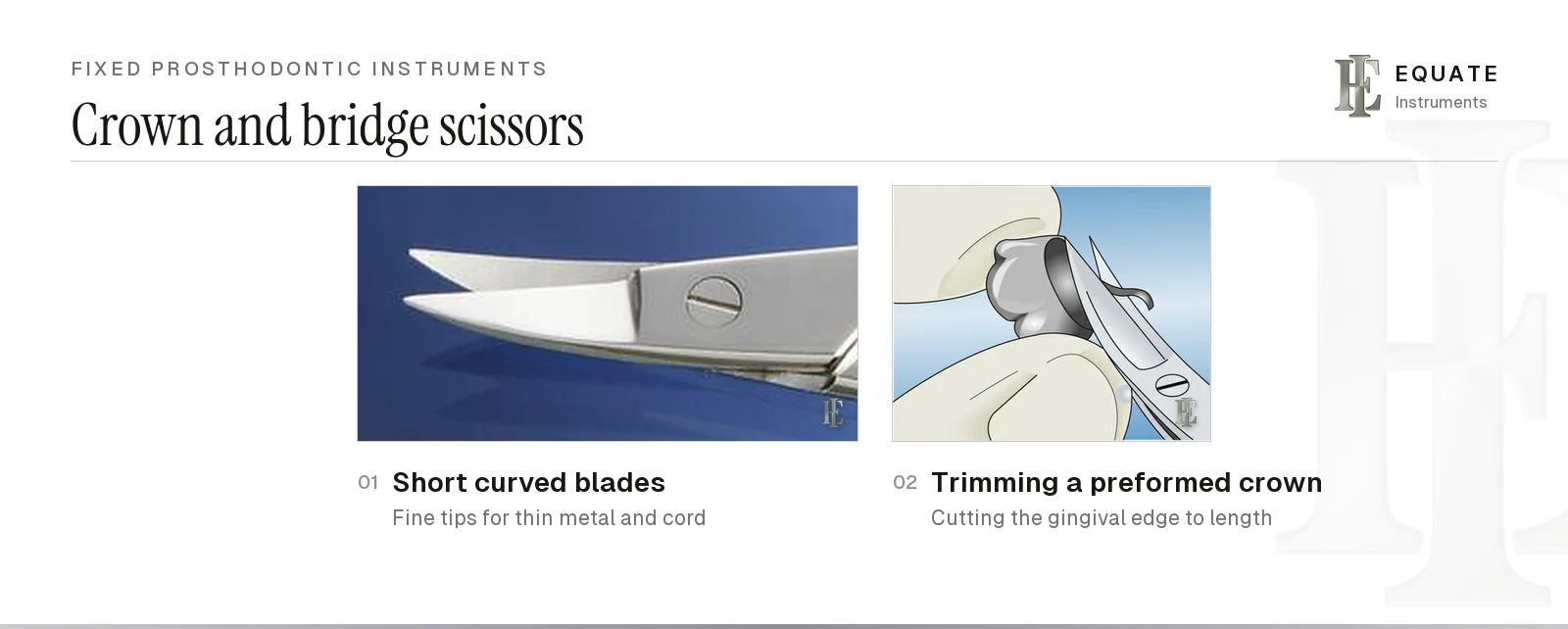
Crown and bridge scissors, often called prostho scissors or crown scissors, trim the collar of provisional and preformed crowns, cut matrix bands and retraction cord, and snip the septum of a rubber dam. Their blades are short and thick so they cut thin stainless steel, aluminium and acrylic close to the pivot, where the leverage is greatest, without the blades springing apart.
Many patterns have one finely serrated or saw-edge blade, which grips smooth metal so it doesn't slide out of the cut. Tungsten-carbide inserts keep the edges sharp for longer and are usually marked by gold-coloured rings. They are not wire cutters: hard orthodontic wire can nick the blades, so leave that to a hard wire cutter.
What is the difference between straight, curved and angled crown scissors?
Straight crown scissors cut long, even lines; curved scissors follow the rounded outline of a crown collar; angled scissors keep the hand clear of the work when trimming at the chair. Most clinics keep one curved pair for provisionals and one straight pair for bands and cord.
| Blade | Cut it suits | Typical job |
|---|---|---|
| Straight | Straight lines and long cuts | Matrix bands, retraction cord, dam septum |
| Curved | Following a rounded outline | Trimming the gingival collar of a preformed or provisional crown |
| Angled | Cutting with the hand offset from the work | Adjusting a crown or band held in the other hand |
| Saw-edge or serrated | Gripping smooth metal during the cut | Stainless and aluminium crown forms |
| Tungsten-carbide insert | Longer-lasting edge | High-use clinics and laboratory work |
What do crown contouring pliers do?
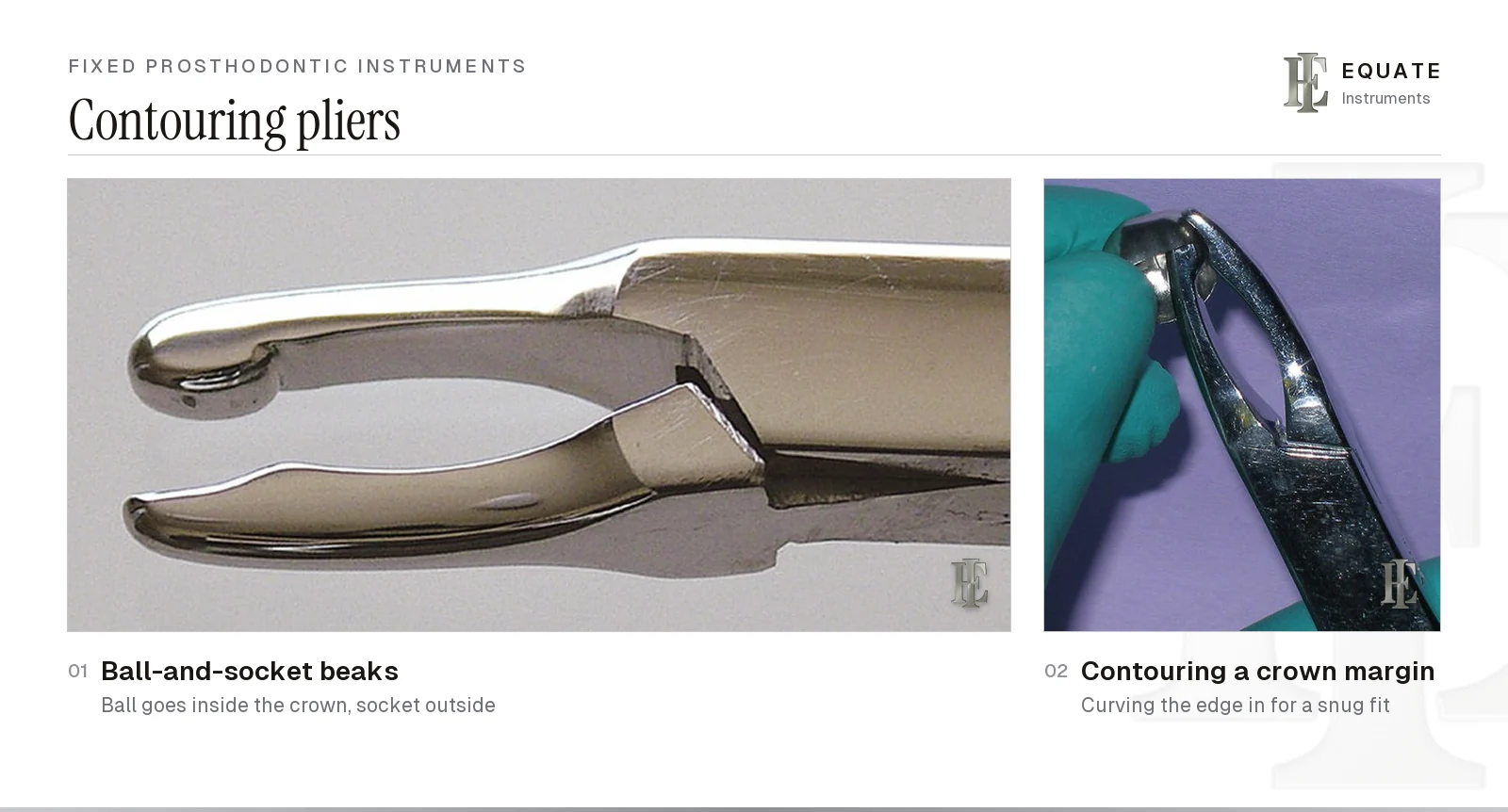
Contouring pliers bend the margin of a preformed or provisional crown, or an orthodontic band, inwards so it fits closely at the gingival edge. The Johnson pattern is the usual crown contouring plier: one beak is rounded and the other concave, so squeezing them together stretches and curves the metal into a bell shape rather than crimping a sharp fold.
Work around the gingival third in small steps, checking the fit on the tooth or die each time. A well-contoured margin snaps into place, retains the crown and leaves less cement for the gingiva to sit against. Crown band contouring pliers do the same for bands and crown forms, and they also turn up on the orthodontic banding tray for adjusting band margins.
Which instruments hold and seat a crown at try-in and cementation?
- Crown and bridge holding pliers grip a crown or bridge outside the mouth while it is adjusted or loaded with cement, so fingers stay clear of the fitting surface.
- A crown seating instrument such as the crown sitter, whose short beaks rest on the biting surface, or the patient biting on a cotton roll or a bite stick, presses the crown fully home while the cement flows out.
- Articulating paper forceps, a locking pattern of cotton pliers, hold marking paper to check the occlusion before and after cementation.
- An explorer or scaler and dental floss remove excess cement from the margins and contacts once it reaches the right stage of set.
- Crown remover pliers lift off a provisional, or a definitive crown at try-in, without damaging it.
What does the Equate range include?
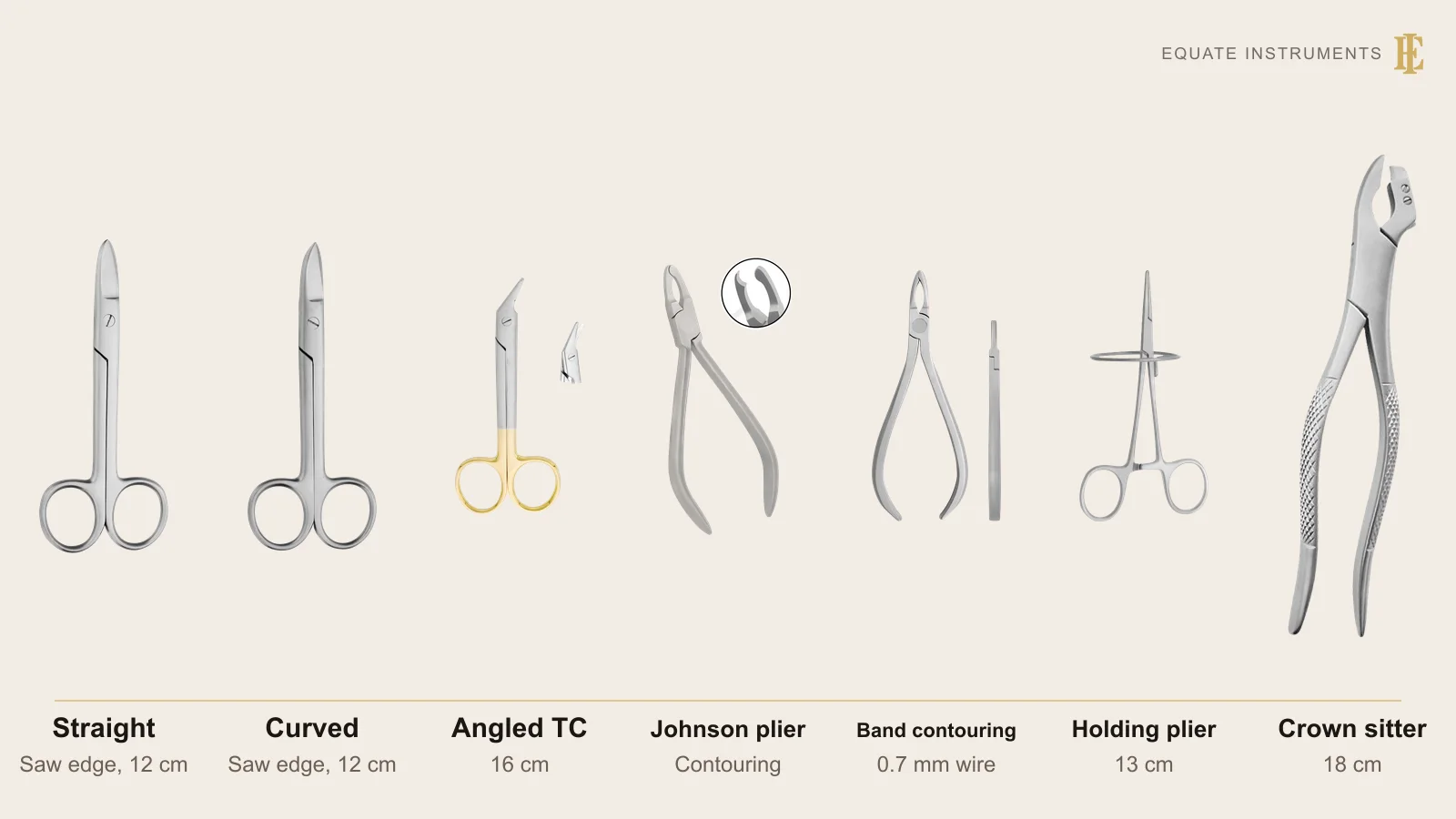
Equate's crown and bridge range has nine crown scissors: Beebee (also spelt Beebe) pattern scissors straight and curved at 12 cm with a saw edge, a 10 cm pattern, plain straight and curved crown scissors, and tungsten-carbide versions with gold rings, including a 16 cm angled pair. It adds a Johnson contouring plier, a crown band contouring plier for wire up to 0.7 mm (.028 in), a 13 cm crown and bridge holding plier and an 18 cm crown sitter.
All are passivated stainless steel, ultrasonically cleaned, shape-, boil- and performance-tested and individually packed, and designed in Finland. Clinics can request samples and a quote through the prosthodontic and laboratory family.
How do you look after crown and bridge instruments?
Wipe cement and acrylic off scissors and pliers before they set, then clean the instruments open, so the joint and the serrations are exposed, and sterilise them in line with the manufacturer's processing instructions (ISO 17664-1), the CDC's 2003 guidelines or HTM 01-05. HTM 01-05 prefers a washer-disinfector for cleaning because it gives the most control and reproducibility.
Lubricate the joint after cleaning if the instructions recommend it, check that scissor blades meet along their length, and send them for sharpening when they fold metal instead of cutting it. Retire contouring pliers whose beaks are scored, because scratches transfer to every crown they shape.
The Equate difference
Equate lists 13 crown and bridge references: 9 crown scissors, straight, curved and angled from 10 to 16 cm, including saw-edge and tungsten-carbide versions; a Johnson contouring plier; a crown band contouring plier; a 13 cm crown and bridge holding plier; and an 18 cm crown sitter for seating.
Equate Crown and Bridge Scissors, Contouring and Holding Pliers options

Beebee Crown Scissor Straight 12 cm Saw Edge
EI-0511
Beebee Crown Scissor Curved 12 cm Saw Edge
EI-0512
Crown Scissors
EI-0714
Beebee TC Angled Scissors 16cm Gold
EI-2288
Beebee TC Saw-Edge Curved Scissors 12cm Gold
EI-2289
Beebee TC Saw-Edge Straight Scissors 12cm Gold
EI-2290
Beebee Crown Scissors 10 cm
EI-3300
Crown Scissors Straight
EI-3301
Crown Scissors Curved
EI-3302
Crown Setter, 18 cm
EI-2367
Crown & Bridge Holding Plier 13cm
EI-2454
Crown Band Contouring Pliers - 0.7 mm (.028 in) Wire
EI-2631Browse all prosthodontic & laboratory instruments Browse all oral surgery instruments Browse all orthodontic instruments
Buying in your market
Frequently asked questions
What are prostho scissors?
Prostho scissors is another name for crown and bridge scissors: short, sturdy scissors with straight, curved or angled blades for trimming provisional crowns, matrix bands and retraction cord.
What are Johnson contouring pliers used for?
They curve the gingival margin of a preformed or provisional crown, or a band, inwards so it fits snugly around the tooth. One beak is rounded and the other concave, which shapes the metal rather than kinking it.
Can crown and bridge scissors cut wire?
They trim thin crown forms, band material, cord and dam, and will snip soft ligature wire. Keep them off hard orthodontic wire, which can nick the blades, and use a wire cutter for anything stiffer.
Can crown and bridge scissors be autoclaved?
Yes. Clean them open and unlocked, pouch or wrap them in the open position with an internal chemical indicator, and steam sterilise them. Check the outside indicator when the load comes out and the inside one when the pack is opened.
What is a crown sitter (crown seater)?
A plier-type seating instrument with short beaks that rest on the biting surface of a freshly cemented crown, so the clinician can press it fully home with controlled force while the cement flows out. A bite stick or cotton roll does the same job with the patient's own bite.
References
- Rosenstiel SF, Land MF, Walter R (eds). Contemporary Fixed Prosthodontics, 6th edition. Elsevier, 2022
- Boyd LB. Dental Instruments: A Pocket Guide, 7th edition. Saunders/Elsevier, 2020. Chapter 10, Fixed Prosthodontics Restorative Instruments (photographs used under licence)
- Sharma A, Rahul GR, Poduval ST, Shetty K. Removal of failed crown and bridge. Journal of Clinical and Experimental Dentistry 2012;4(3):e167–e172
- Donovan TE, Chee WWL. Current concepts in gingival displacement. Dental Clinics of North America 2004;48(2):433–444
- Department of Health. Health Technical Memorandum 01-05: Decontamination in primary care dental practices, 2013 edition. NHS England
- Kohn WG, et al. Guidelines for Infection Control in Dental Health-Care Settings, 2003. MMWR 52(RR-17), Centers for Disease Control and Prevention
- ISO 17664-1:2021 Processing of health care products: information to be provided by the medical device manufacturer for the processing of medical devices, part 1: critical and semi-critical medical devices
I am a…
Related
- Dental Crown Removers
- Gingival Cord Packers (Retraction Cord Instruments)
- Dental Spatulas (Cement, Plaster, Wax and Laboratory)
- Dental Impression Trays
- Crown and Bridge Tray Setup: Preparation and Cementation
- Dental Cotton Pliers (Dental Tweezers)
- Fixed Prosthodontic Instruments for Crown and Bridge Work