Fixed Prosthodontic Instruments for Crown and Bridge Work
Written by the Equate Instruments Technical Team · Reviewed by the Medical & Dental Board, Equate Instruments · Updated ·
Fixed prosthodontic instruments are the tools used to make and fit crowns, bridges and veneers. They include the facebow and bite fork for recording the bite, shade guides for colour matching, cord packers for gingival retraction, crown and bridge scissors and contouring pliers for shaping provisional crowns, provisional crown-removing forceps to lift off the temporary, a trial crown remover for try-in, and bite sticks for seating the final restoration.
Key points
- Conventional crown and bridge work has two visits, preparation and cementation, each with its own tray built on the basic mirror, explorer and cotton forceps; chairside CAD/CAM can combine them into one.
- Several instruments exist only to handle the provisional crown: scissors trim it, contouring pliers adapt its margin and padded forceps lift it off again.
- Hinged instruments are cleaned and sterilised open; the facebow bow, shade guides and scanners are disinfected to their makers' instructions.
What are fixed prosthodontic instruments?
Fixed prosthodontics covers restorations that are cemented or bonded in place and can't be taken out by the patient: crowns, bridges, inlays, onlays and veneers. The instruments for this work are less about cutting tooth, which is done with burs in a high-speed handpiece, and more about recording, isolating, adjusting and seating. Linda Bartolomucci Boyd's Dental Instruments: A Pocket Guide (Elsevier) groups them into a single chapter alongside the two tray setups they're laid out on.
Most of these instruments belong to one of three moments: taking records so the laboratory or milling unit can make an accurate restoration, managing the provisional (temporary) crown between visits, and trying in and seating the final crown. The table below maps each instrument to its moment.
| Instrument | Stage | What it does | Reprocessing |
|---|---|---|---|
| Facebow and bite fork | Records | Transfers the position of the upper arch to an articulator | Bow disinfected; bite fork heat sterilised |
| Shade guide or digital shade device | Records | Matches the colour of the new crown to the natural teeth | Disinfected to the maker's instructions |
| Gingival retraction cord instrument | Preparation | Packs cord into the sulcus to expose the finish line | Heat sterilised |
| Crown and bridge scissors | Provisional | Trims provisional crowns, cord, matrix bands and dam | Sterilised open |
| Contouring pliers | Provisional | Stretches and curves the margin of a metal crown so it hugs the tooth | Sterilised open |
| Provisional crown-removing forceps | Preparation and cementation | Lifts the temporary crown off the prepared tooth | Sterilised open |
| Trial crown remover | Try-in | Removes the final crown after a try-in, before it is cemented | Sterilised open; pads replaced when worn |
| Bite stick | Cementation | Lets the patient bite the crown fully into place | Wooden: discard; plastic or metal: reprocess |
Facebow and bite fork: transferring the bite to the articulator
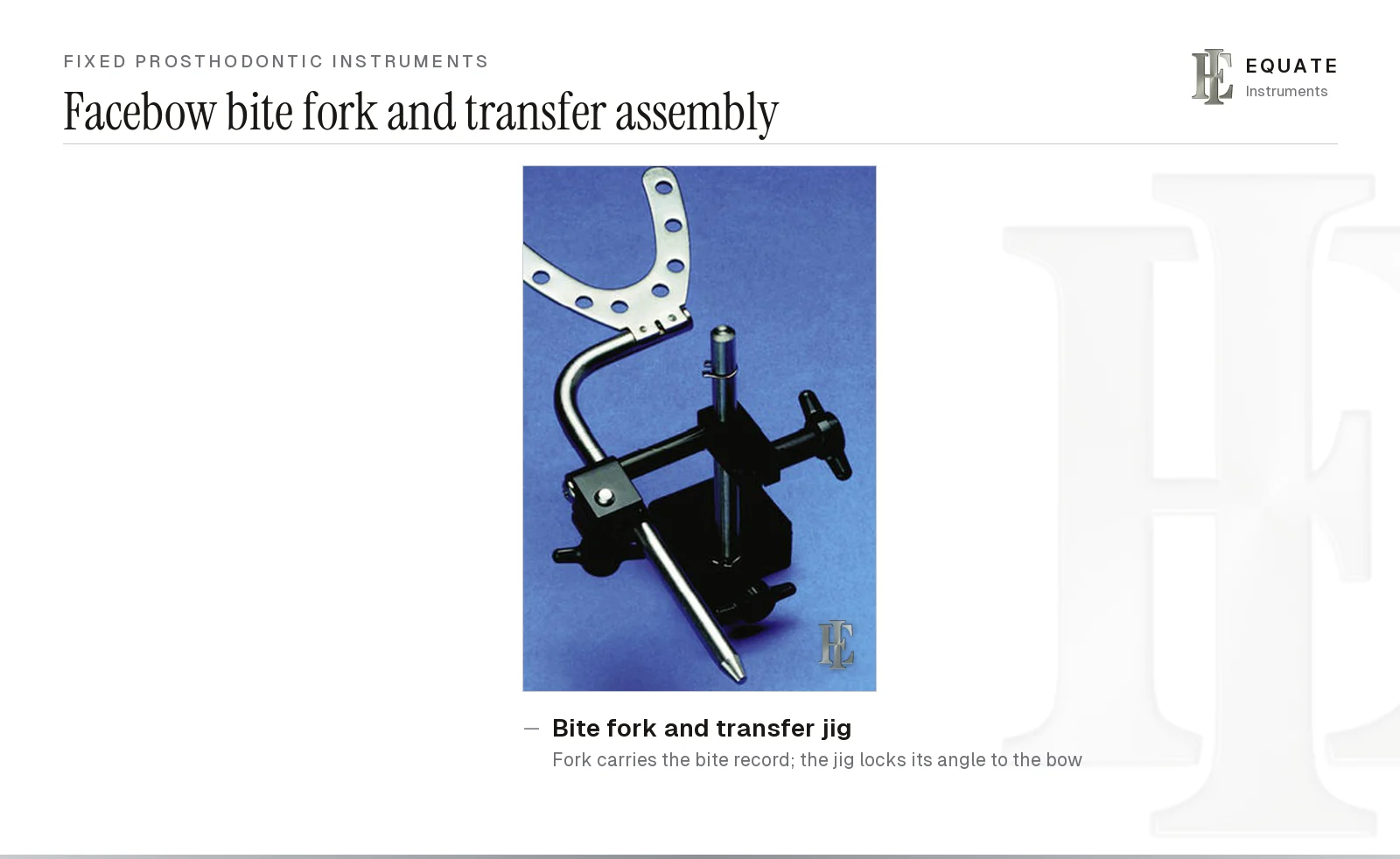
A facebow records where the upper arch sits relative to the temporomandibular joints and a reference plane on the face. The bow rests on the head, usually with ear pieces in the external ear canals and a pointer or rest at the bridge of the nose, while the bite fork is held against the upper teeth in a layer of registration material such as softened impression compound or a bite registration paste. A transfer jig locks the angle of the fork to the bow.
In the laboratory, the locked assembly is used to mount the upper cast on a semi-adjustable articulator in the same relationship to the hinge axis as in the patient. Without it, a cast mounted at an arbitrary angle opens and closes on the wrong arc, and the crown's cusps may need heavy adjustment in the mouth. The Glossary of Prosthodontic Terms describes facebows that locate the hinge axis precisely as well as simpler average-axis types that estimate it from anatomical landmarks. Equate's articulators are simple hinge and finishing types for checking contacts and occlusion on models; a facebow transfer needs a semi-adjustable articulator with condylar elements.
Facebow records are used for crowns and bridges, for removable partial and complete dentures, and in orthodontic and occlusal work where casts must be mounted accurately. The bow itself isn't designed for autoclaving, so it is wiped down with a disinfectant its manufacturer approves; the bite fork goes into the mouth and is cleaned and heat sterilised like any other semi-critical instrument.
How much a facebow adds is debated. A 2013 systematic review in the Journal of Oral Rehabilitation by Farias-Neto and colleagues found eight randomised trials and concluded that facebow transfer was not essential for better clinical results, with simpler methods giving acceptable complete dentures and occlusal splints. It found no clinical study at all of facebows for fixed or removable partial prostheses, so for a single crown the evidence is missing rather than negative.
Shade guides and digital shade matching
A shade guide is a set of tabs made to look like teeth in a range of colours, arranged by hue, chroma and value. The clinician holds tabs beside the natural teeth to choose the shade of the crown, veneer or bridge, and the same guides are used when choosing denture teeth. Digital shade-matching devices (spectrophotometers or colorimeters) measure the tooth with a small probe and report the nearest tab, which helps with consistency between clinicians and gives the laboratory an objective record.
A natural tooth isn't one colour. The cervical third is often darker and more saturated, the body carries the main shade and the incisal edge of a front tooth can be more translucent, so the prescription may give a separate shade for each zone, sometimes with a photograph.
- Choose the shade at the start of the visit, before isolation and preparation. Teeth dry out quickly under a dam or cotton rolls and look lighter than they really are.
- Use consistent, colour-corrected light rather than the operating light alone, and look briefly rather than staring, which tires the eye. In a 2016 study in the Journal of Prosthetic Dentistry, Wee and colleagues took 5500 K and a colour rendering index above 90 as the standard for visual shade matching; the 32 private practices they measured averaged about 4150 K and fell short of that index.
- Make sure the laboratory uses the same shade system as the guide the clinic used.
- Disinfect tabs and digital probes between patients as their makers direct, since many tabs and devices don't tolerate steam.
Gingival retraction cord instruments
Once a tooth is prepared for a crown, the finish line often sits at or just below the gum. Gingival retraction cord is a thin braided or knitted thread that is packed into the sulcus to push the gum sideways and slightly away from the tooth (gingival displacement, in the Glossary of Prosthodontic Terms), so that an impression or an intraoral scan can capture the margin clearly. Some cords are supplied impregnated with a haemostatic solution to control seepage. Donovan, Gandara and Nemetz's 1985 review in the Journal of Prosthetic Dentistry warned that epinephrine in cord is absorbed into the bloodstream, more so with longer cords, stronger solutions, longer contact and torn tissue, and described aluminium-salt astringents as equally effective without those systemic effects.
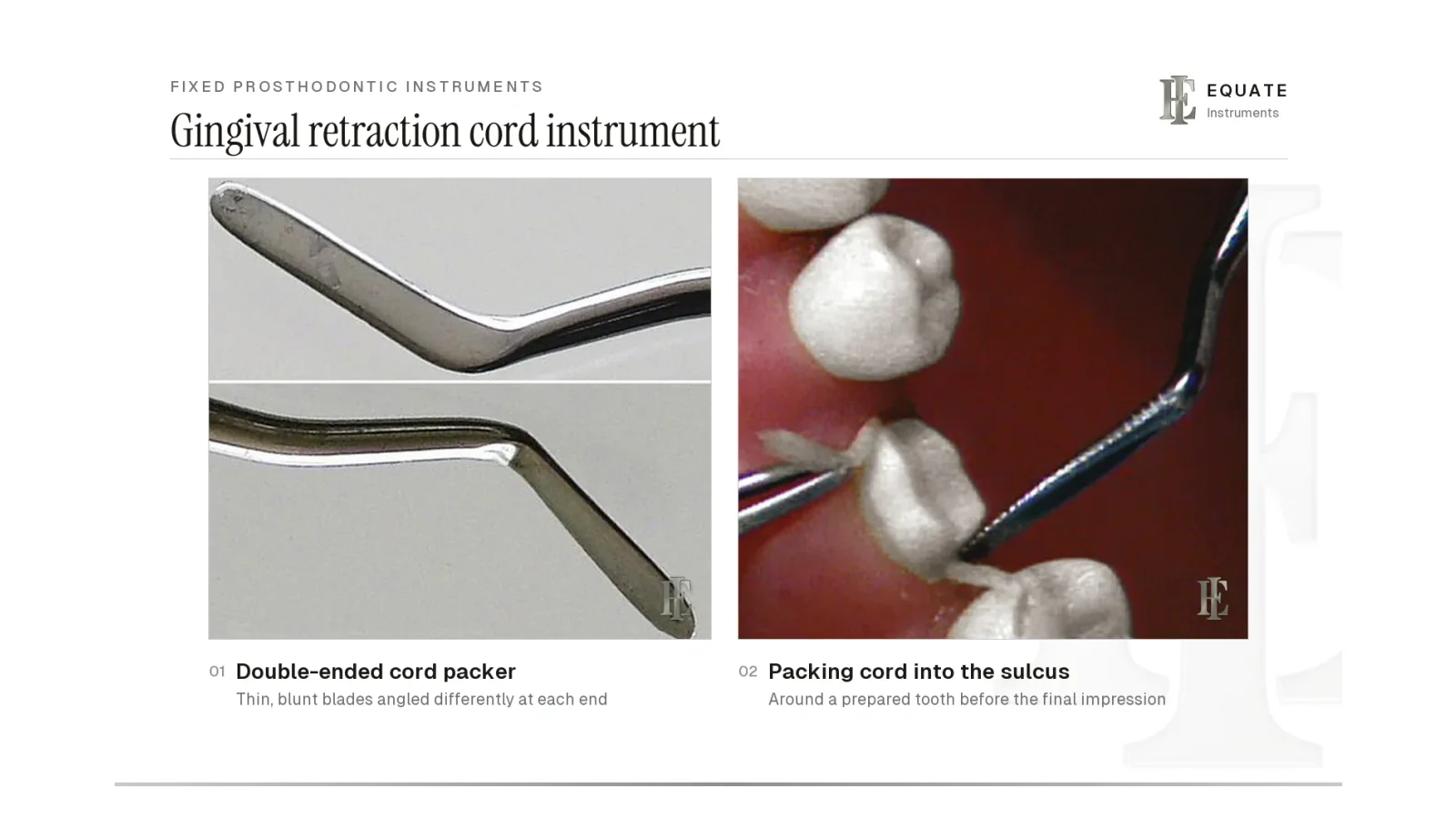
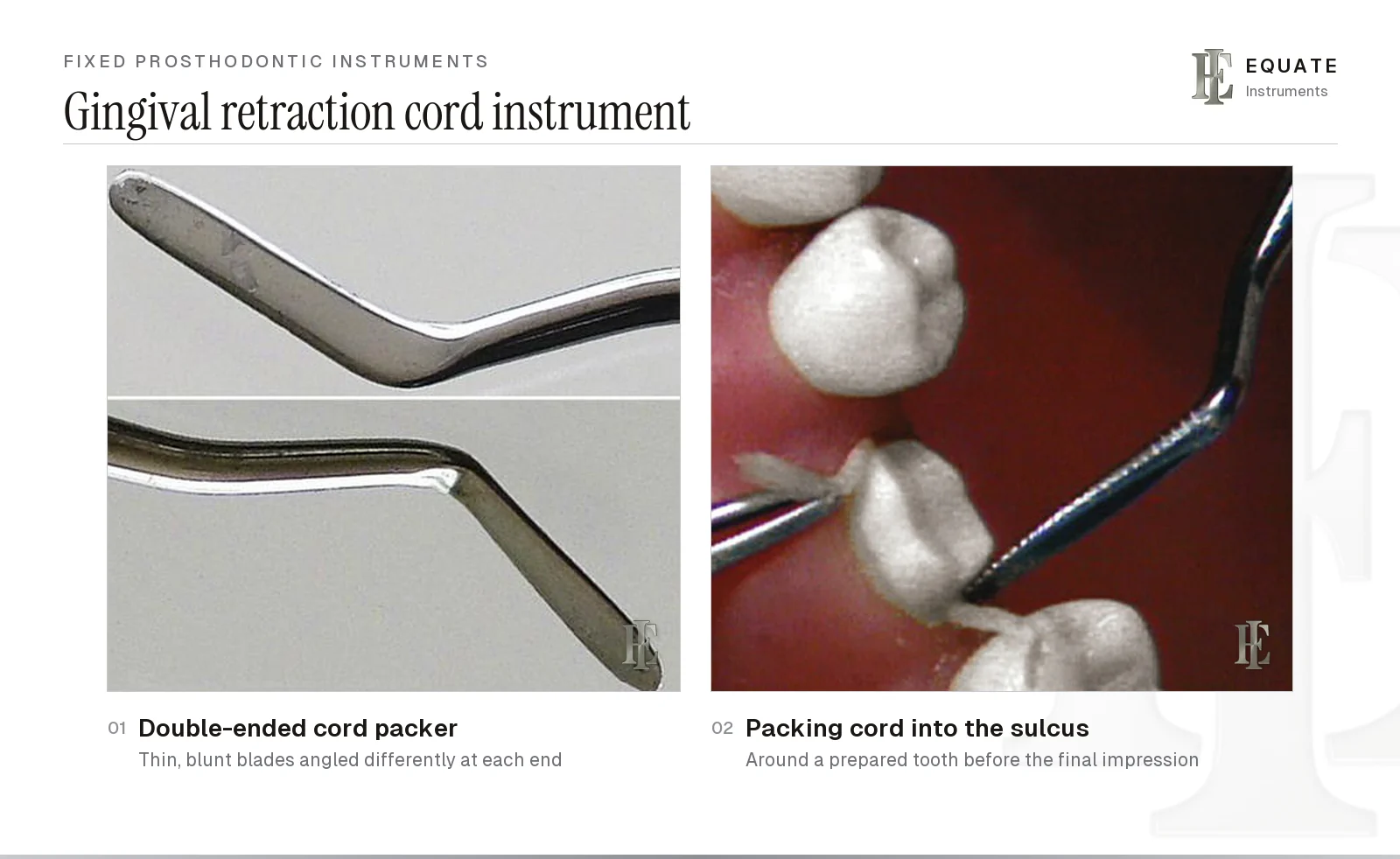
The retraction cord instrument, also called a cord packer, is a thin blunt blade set at an angle on the shank. It is usually double-ended with a different angle at each end so it can reach mesial, distal, buccal and lingual surfaces. Serrated blades grip the cord and stop it riding back out of the sulcus; smooth blades slide along the cord and are less likely to snag it. Equate's packers come in round and square profiles with both finishes, alongside a universal pattern.
The cord is laid around the tooth, often held in place with cotton forceps, and the packer is angled towards the tooth rather than the gum, working the cord in a little at a time. Pressing too hard or pointing the blade at the soft tissue can tear the attachment and cause bleeding or recession. In a two-cord technique a fine cord stays in the sulcus while a thicker cord on top is removed just before the impression. Thin ends of about 2 mm suit anterior teeth and the first cord, wider ends of 2.6 to 3 mm posterior teeth and the second; Donovan and Chee's 2004 review found no technique proven better than the others on healthy tissue. Cord is single-use; the packer is cleaned and steam sterilised. The instrument is used mainly on crown and bridge trays, and occasionally in composite or amalgam work when a cervical margin needs exposing.
Trimming and contouring provisional crowns: scissors and pliers
A provisional crown protects the prepared tooth, keeps it from drifting and keeps the gum healthy until the final crown is fitted. Preformed provisionals made of metal (aluminium or stainless steel) or polycarbonate come too long and have to be cut to length and adapted. Custom provisionals made chairside from acrylic or bis-acryl resin also need their excess trimmed.
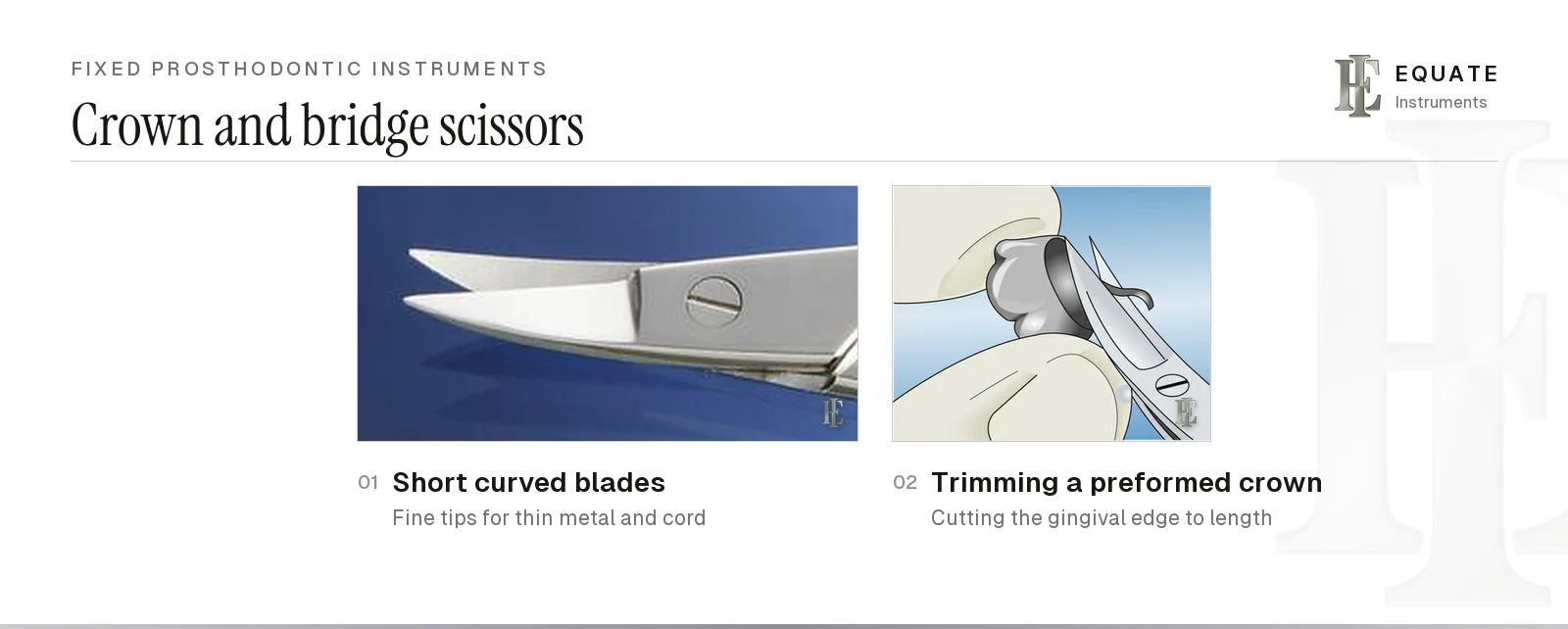
Crown and bridge scissors have short blades, straight or curved, that give fine control when trimming the thin gingival edge of a preformed crown to follow the gum line. The same scissors are used to cut retraction cord, trim matrix bands and cut the septum of a dental dam, so they turn up on many restorative trays. Curved blades follow the round outline of a crown more easily; serrated (saw-edge) blades stop thin metal slipping out of the bite, and tungsten carbide inserts keep their edge longer. Keeping a separate pair for this work protects the blade edges: keep them off hard or orthodontic wire, which belongs to a wire cutter.
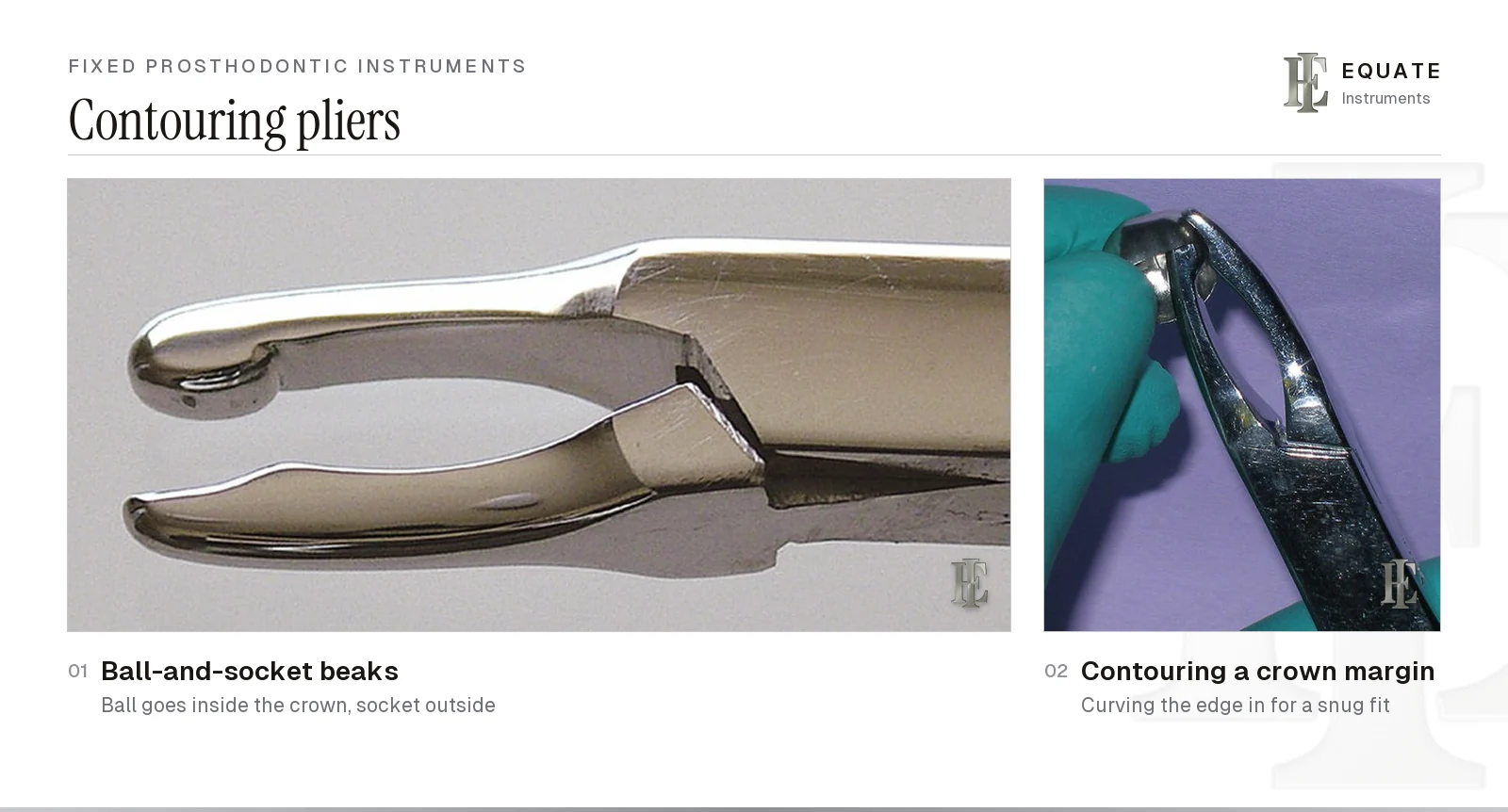
Contouring pliers shape the margin once it has been cut. The Johnson-pattern contouring plier is the commonly used type: one beak ends in a ball and the other in a matching concave socket. With the ball inside the crown and the socket outside, squeezing stretches the metal into a curve so the margin turns in and hugs the neck of the tooth, which helps a stainless steel or aluminium crown stay on and avoids an overhang that would trap plaque. Working gradually around the margin gives a smooth curve rather than creases. Related crown band contouring pliers are used on orthodontic bands, as covered in the band seating plier page and on the orthodontic banding tray. A crown and bridge holding plier grips the restoration outside the mouth while it is adjusted or loaded with cement; the scissors and pliers page compares the blade types and covers holding pliers and the crown sitter in more depth.
Removing provisional and trial crowns
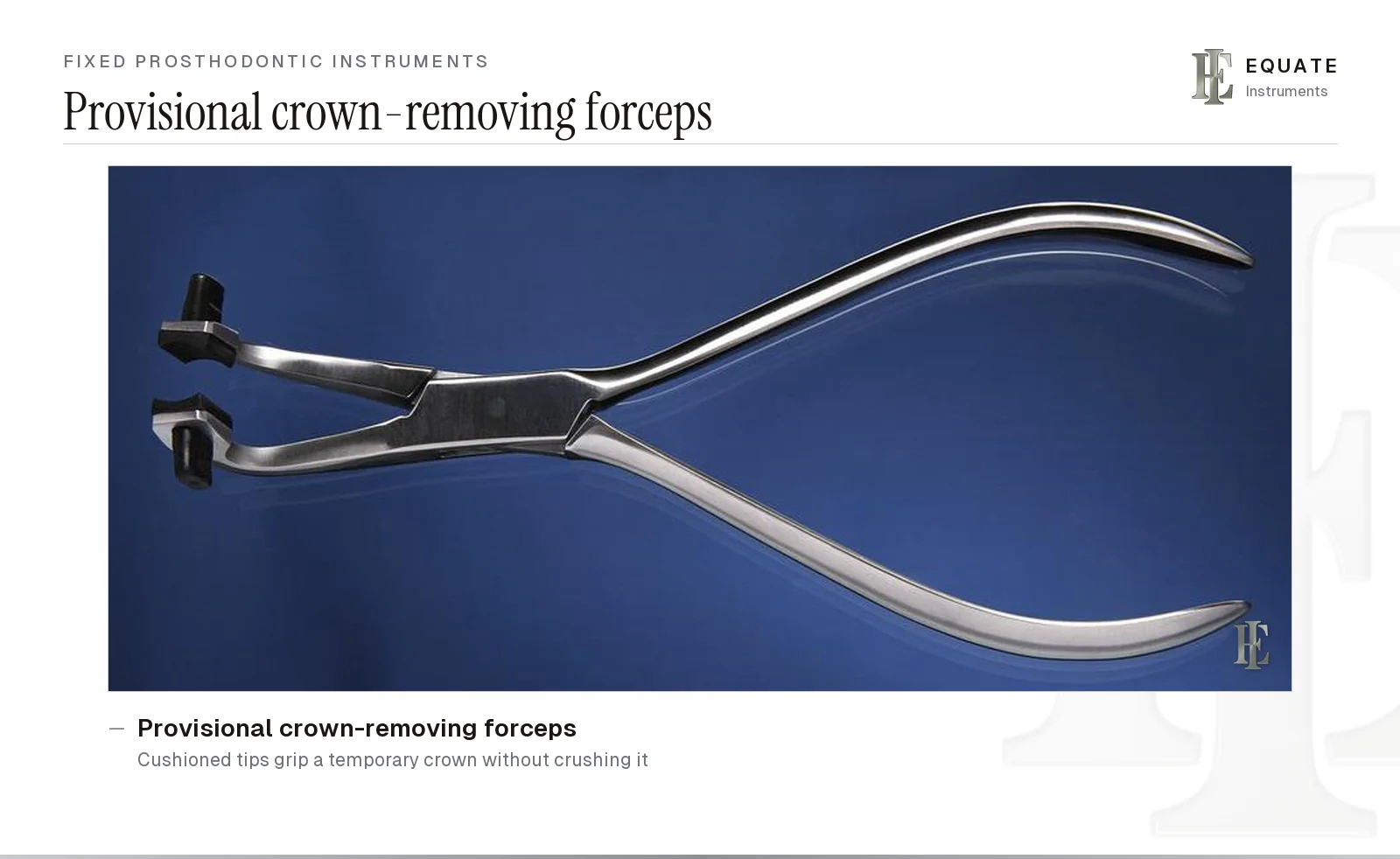
At the cementation visit the provisional crown has to come off. Provisional crown-removing forceps have short beaks tipped with cushioned or rubber-faced jaws that grip the temporary at its margins without crushing it, so it can be eased off the tooth, set aside and recemented if needed. They come in several sizes.
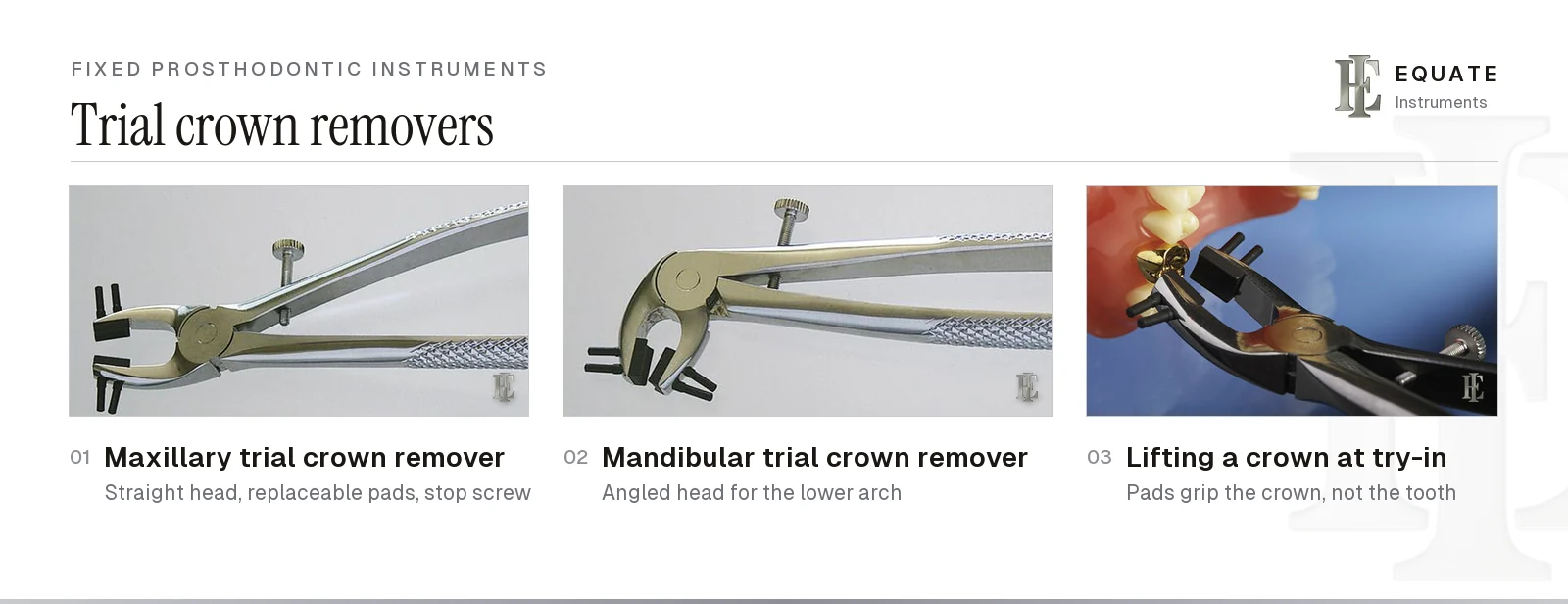
A trial crown remover is used during the try-in of the final crown or bridge, when it is seated without cement to check its fit, contacts and bite. Because a well-fitting crown can grip the preparation tightly, the remover has replaceable non-slip pads on its jaws and a screw stop that limits how far the handles close, so the clinician can get a firm hold without squeezing the restoration hard. Boyd lists separate maxillary and mandibular patterns; in practice these differ mainly in how the head is angled for each arch. The same instrument can also lift off a provisional crown.
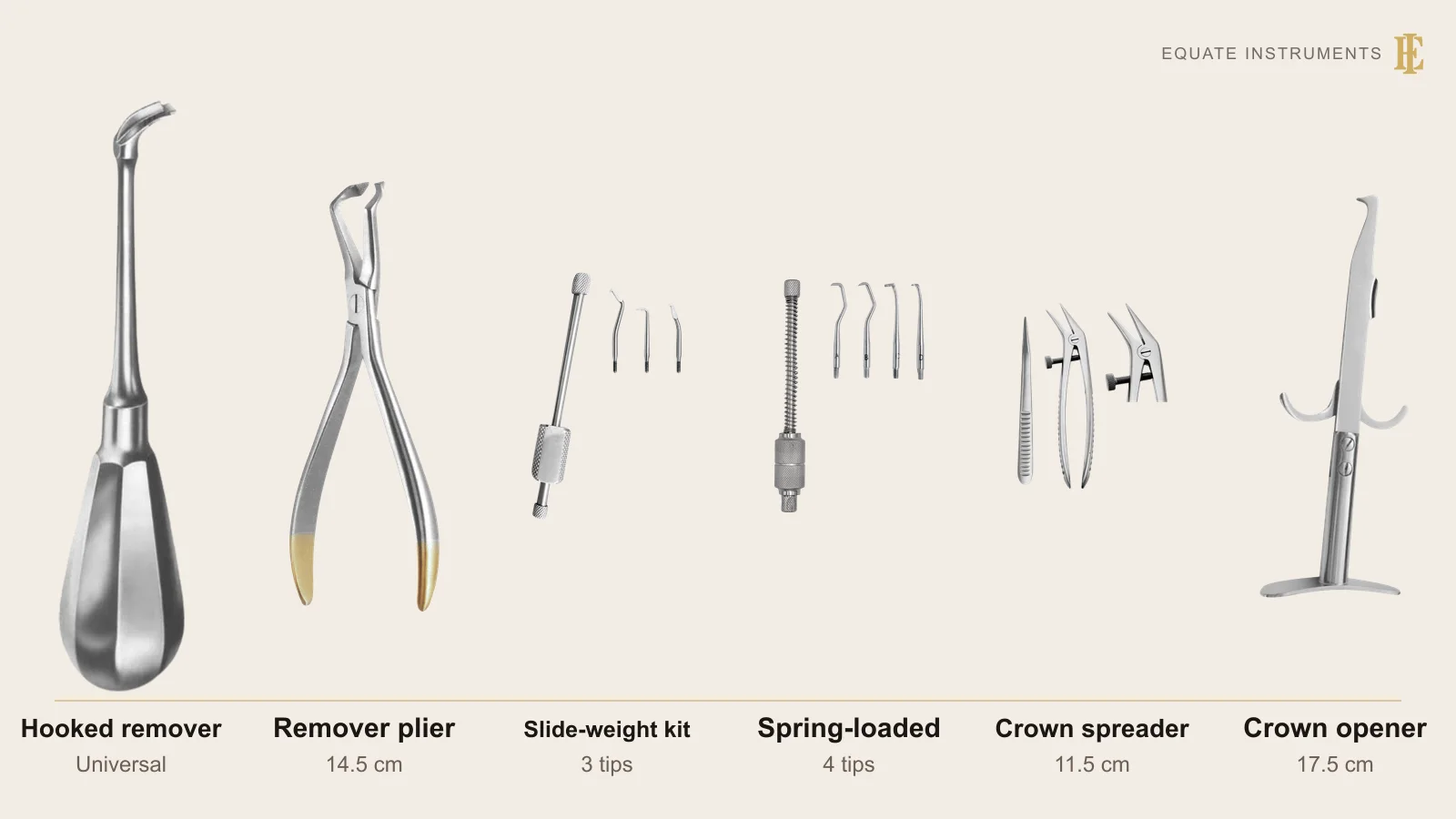
Neither instrument is meant for cemented crowns. Removing a permanently cemented crown calls for a different family, such as slide-hammer, spring-loaded or wedge-type crown removers and crown spreaders, used with care because the impact or leverage can chip porcelain or damage the tooth. Impacts can also fracture a weak core or loosen a tooth with little bone support, so a failed crown that will be replaced anyway is often sectioned instead. Equate lists these alongside its crown-removing pliers and replacement pads.
Chairside CAD/CAM: scanning, design and milling
A chairside CAD/CAM system lets a clinic make a ceramic crown in the same appointment as the preparation. An intraoral scanner wand captures a three-dimensional image of the prepared tooth, its neighbours and the opposing teeth, replacing a conventional impression. Design software builds the crown's anatomy, margins, contacts and bite on screen, and the design is sent to a milling unit.
The milling unit carves the crown from a pre-made block of ceramic or composite resin. Blocks are supplied in a range of shades and sizes, so shade selection still matters. After milling, the crown is tried in, adjusted, glazed or polished and cemented or bonded. The scanner wand is covered with a single-use barrier or fitted with a tip that is reprocessed according to its maker's instructions, and the keyboard or touchscreen is covered or touched with overgloves to avoid contaminating it.
Crown preparation and cementation tray setups, and the bite stick
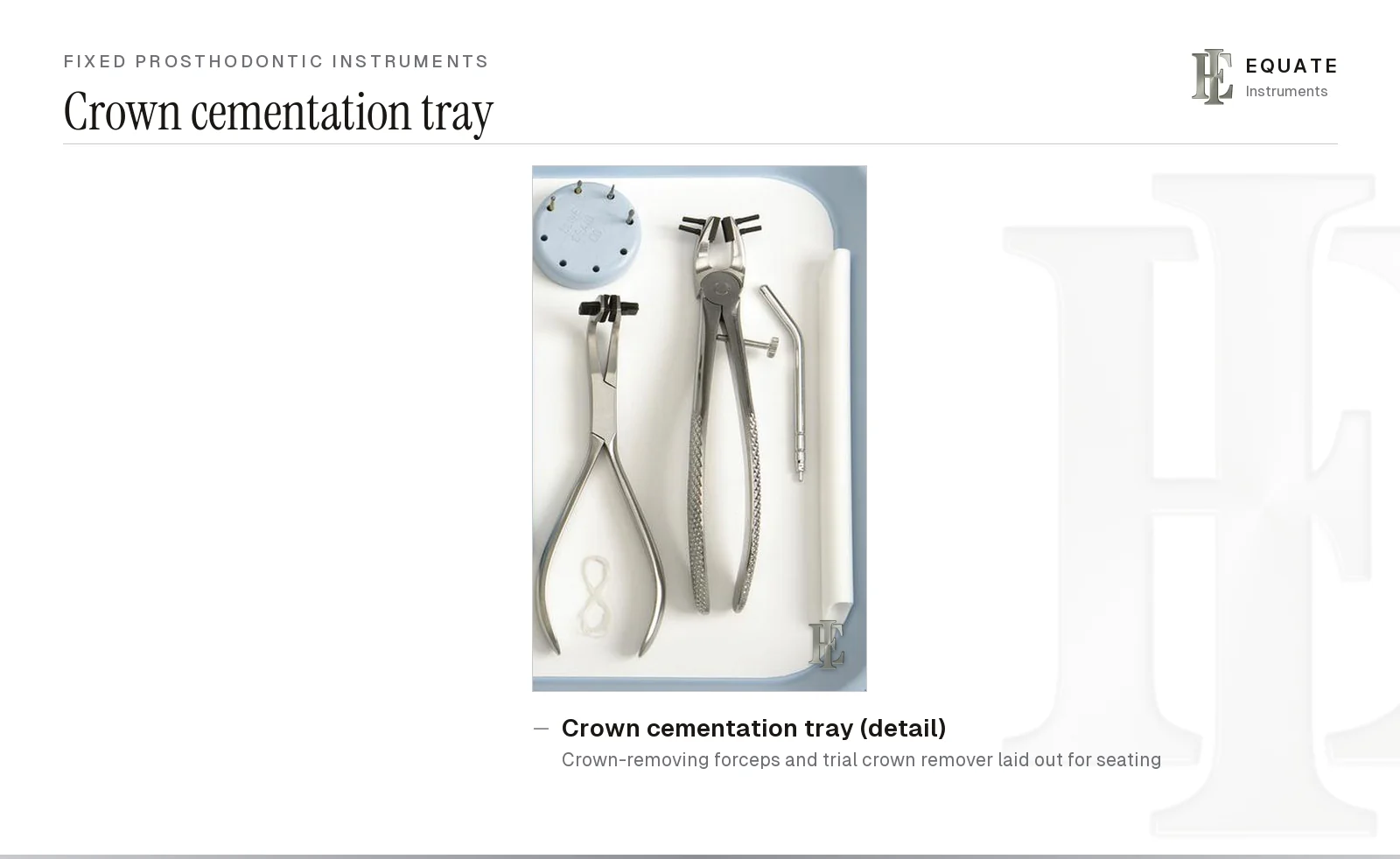
Both trays start with the basic setup and add instruments in the order they'll be used. The crown and bridge tray setup walks through both visits step by step. A spoon excavator removes old cement and softened dentine, and a curette or scaler clears cement from below the margin after seating. Local anaesthetic equipment is covered in the anaesthetic guide, and the air/water syringe and high-volume evacuation tip in the evacuation guide.
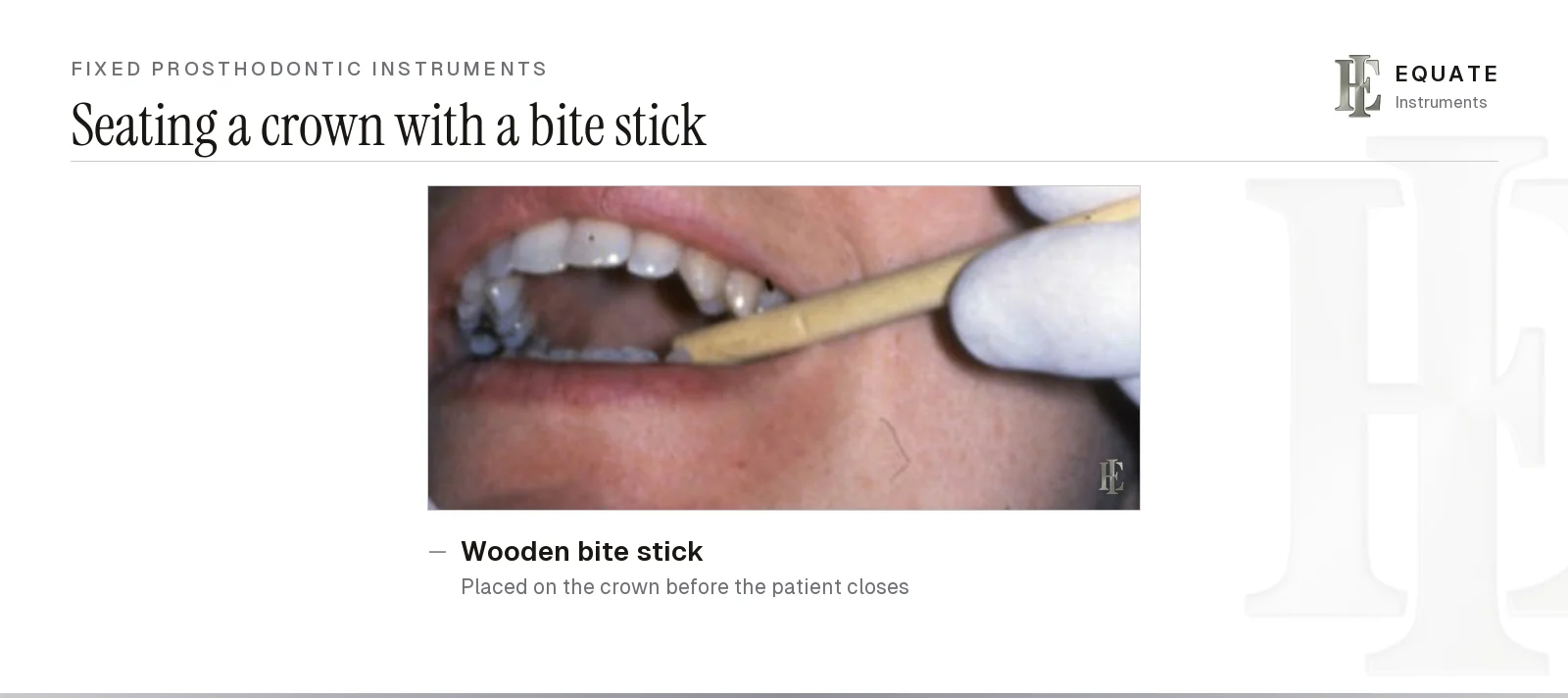
A wooden bite stick is a short rod of soft wood that the patient bites on, in their normal closed position, to press the crown fully into place while the cement sets. The soft wood spreads the force across the crown and is less likely to chip it than a hard instrument. Plastic and disposable biting devices do the same job. Because wood is porous and hard to clean, wooden bite sticks are best treated as single-use; reusable plastic or metal seating devices are reprocessed like other instruments. A plier-type crown seater, with short beaks that rest on the biting surface, is another way to apply controlled seating force.
- Preparation tray, in order of use: mouth mirror, explorer and cotton forceps for the examination; anaesthetic syringe; spoon excavator and curette to clear old restorative material; burs in a bur block; dental floss and retraction cord with its cord instrument to expose the finish line; crown and bridge scissors and a plastic instrument such as a Woodson for the provisional; flexible spatula for the provisional or temporary cement; articulating paper in its holder for the bite check; provisional crown-removing forceps; air/water syringe and evacuation tips throughout.
- Cementation tray, in order of use: the basic setup; provisional crown-removing forceps to lift off the temporary; spoon excavator and curette to clean the preparation; trial crown remover for the uncemented try-in; articulating paper and holder to check the bite; burs for any adjustment; cotton rolls for isolation; cement spatula and Woodson; wooden bite stick to seat the crown; floss to clear cement from the contacts; air/water syringe and evacuation tips.
- Order matters: provisional off, preparation cleaned, final crown tried in and checked, then cemented, seated with the bite stick and cleaned of excess cement.
Cleaning, sterilising and disinfecting crown and bridge instruments
The CDC's 2003 Guidelines for Infection Control in Dental Health-Care Settings (Kohn and colleagues), summarised in its 2016 Basic Expectations for Safe Care, and HTM 01-05 for dental practices in England both expect heat-tolerant instruments that touch mucous membranes to be cleaned and heat sterilised between patients. Equipment that can't be heat sterilised, such as a facebow bow, a shade guide or a scanner, is protected with barriers or disinfected as its manufacturer instructs. In the EU, follow the manufacturer's reprocessing instructions (supplied under the Medical Device Regulation, in the format set out in ISO 17664-1) together with your national regulations and guidance.
- Hinged instruments (scissors, contouring pliers, crown-removing forceps, trial crown removers) are cleaned and sterilised in the open, unlocked position so steam reaches the joint.
- Pre-clean by ultrasonic or washer-disinfector cleaning. Seal pouches (heat or self-seal) or secure wraps with indicator tape, and put an internal indicator inside each pack.
- Wrapped or pouched loads and hollow items need a vacuum (type B) or validated type S steriliser; with a type N steriliser, process instruments unwrapped and follow national rules on storage.
- Check the external indicator when the load comes out of the steriliser and the internal one when the pack is opened at the chair.
- Replace worn rubber pads on crown removers rather than sterilising them past their useful life, and check that replacement pads are rated for steam.
- Discard retraction cord, wooden bite sticks and single-use barriers after each patient.
- Oil hinged instruments with a steam-penetrable lubricant if the manufacturer recommends it, and check scissor blades for nicks.
Buying crown and bridge instruments: what to check
- Cord packers: a thin blade, with a serrated or smooth finish and round or square tip to suit the clinic's cord; many clinicians keep one of each.
- Crown scissors: short blades that meet cleanly to the tips, curved for crowns and straight for general cutting; tungsten carbide if they will be used heavily.
- Contouring pliers: a ball and socket that align exactly, with polished faces that won't mark thin metal.
- Crown removers: easy-to-buy replacement pads, a positive stop screw on trial removers and the right head angle for each arch.
- Supporting items: a cement spatula, impression trays that match the clinic's workflow and an articulator. Equate's articulators are simple hinge and finishing types for checking contacts on models; a facebow transfer needs a semi-adjustable articulator.
- Material: passivated stainless steel that tolerates repeated steam sterilisation without pitting or staining.
The Equate difference
Equate's catalogue lists 13 gingival cord packers (serrated and smooth, round and square tips), 9 crown scissors including 3 with tungsten carbide blades, 19 manual crown removers and spreaders, 7 crown remover kits, 2 spring-loaded crown removers, 4 packs or sets of replacement pads and tips, Johnson and crown band contouring pliers, a crown and bridge holding plier, 4 simple hinge and finishing articulators, 19 cement spatulas and 116 impression trays. It does not list facebows, shade guides, CAD/CAM equipment or wooden bite sticks, but it does list a crown sitter plier for seating cemented crowns.
Equate Fixed Prosthodontic Instruments for Crown and Bridge Work options

Cement Spatula 6 mm
EI-0078
Cement Spatula 6mm - Double-Ended Knurled Handle
EI-0079
Cement Spatula - Double-Ended Titanium-Coated Blades
EI-0080
Retraction Cord Packer UP1 - Knurled Handle
EI-0099
Cement Spatula 5.0mm Hollow Handle 10mm
EI-0126
Cement Spatula 6.0mm - Double-Ended
EI-0127
Cement Spatula 7mm - Solid Handle 6mm
EI-0128
Gingival Cord Packer Universal - 6 mm Solid Handle
EI-0168
Cement Spatula 5 mm - 6 mm Solid Handle
EI-0194
Cord Packer 2.0 mm
EI-0920
Cement Spatula
EI-0930
Cord Packer 2.6mm
EI-0941Browse all prosthodontic & laboratory instruments Browse all restorative & operative instruments
Buying in your market
Frequently asked questions
What instruments are on a crown and bridge tray?
Both trays start with the mirror, explorer and cotton forceps. The preparation tray adds the cord instrument, crown and bridge scissors and anaesthetic syringe, and the cementation tray swaps them for a trial crown remover, cotton rolls and a bite stick; the crown and bridge tray setup page lists both in order of use.
What is a gingival retraction cord packer used for?
It pushes retraction cord into the gingival sulcus around a prepared tooth, moving the gum away from the finish line so an impression or scan records the margin accurately. Serrated tips grip the cord; smooth tips slide over it.
What is the difference between a provisional crown remover and a trial crown remover?
Provisional crown-removing forceps lift off a temporary crown with cushioned tips. A trial crown remover takes off the final crown after an uncemented try-in, using replaceable non-slip pads and a stop screw. Neither is meant for permanently cemented crowns.
Why is a facebow used for crowns and bridges?
It records how the upper arch relates to the jaw joints so the upper cast can be mounted on an articulator at the right angle. The crown's cusps then fit the patient's real opening and closing movement, so less adjustment is needed in the mouth.
Is a facebow needed for every crown?
Not usually. A 2013 systematic review found no clinical study of facebows for fixed partial prostheses, and the trials it did find did not show the facebow was essential. For complete dentures and occlusal splints, simpler methods gave acceptable results.
What are contouring pliers used for in dentistry?
They shape the margin of a stainless steel or other metal provisional crown. Johnson-pattern pliers have a ball beak and a socket beak: with the ball inside the crown, squeezing stretches the edge into a curve so the crown fits closely around the neck of the tooth.
Can crown and bridge instruments be autoclaved?
Stainless steel instruments such as cord packers, scissors, contouring pliers, crown removers and bite forks are steam sterilised, with hinged ones open. The facebow bow, shade guides and CAD/CAM scanners are disinfected or protected with barriers as their manufacturers direct.
References
- Boyd LB. Dental Instruments: A Pocket Guide, 7th edition. Saunders/Elsevier, 2020 (photographs used under licence)
- Rosenstiel SF, Land MF, Walter R (eds). Contemporary Fixed Prosthodontics, 6th edition. Elsevier, 2022
- Ferro KJ (ed). The Glossary of Prosthodontic Terms, ninth edition (GPT-9). Journal of Prosthetic Dentistry 2017;117(5S)
- Kohn WG, et al. Guidelines for Infection Control in Dental Health-Care Settings, 2003. MMWR 52(RR-17), Centers for Disease Control and Prevention
- Centers for Disease Control and Prevention. Summary of Infection Prevention Practices in Dental Settings: Basic Expectations for Safe Care, 2016
- Department of Health (England). Health Technical Memorandum 01-05: Decontamination in primary care dental practices, 2013 edition
- ISO 17664-1:2021 Processing of health care products — Information to be provided by the medical device manufacturer for the processing of medical devices — Part 1: Critical and semi-critical medical devices
- Farias-Neto A, Dias AHM, de Miranda BFS, de Oliveira AR. Face-bow transfer in prosthodontics: a systematic review of the literature. Journal of Oral Rehabilitation 2013;40(9):686–692
- Wee AG, Meyer A, Wu W, Wichman CS. Lighting conditions used during visual shade matching in private dental offices. Journal of Prosthetic Dentistry 2016;115(4):469–474
- Donovan TE, Gandara BK, Nemetz H. Review and survey of medicaments used with gingival retraction cords. Journal of Prosthetic Dentistry 1985;53(4):525–531
- Donovan TE, Chee WWL. Current concepts in gingival displacement. Dental Clinics of North America 2004;48(2):433–444
- Sharma A, Rahul GR, Poduval ST, Shetty K. Removal of failed crown and bridge. Journal of Clinical and Experimental Dentistry 2012;4(3):e167–e172
I am a…
Related
- Basic Dental Instruments: Mirror, Explorer, Cotton Forceps and Handles
- Dental Articulator
- Dental Burs and Rotary Instruments: Types, Shanks and Uses
- Dental Dam Instruments Explained, from Sheet to Frame
- Composite Restorative Instruments, from Matrix Band to Finishing Strip
- Dental Materials Equipment: From Impression to Finished Model
- Crown and Bridge Scissors, Contouring and Holding Pliers
- Gingival Cord Packers (Retraction Cord Instruments)
- Dental Crown Removers
- Crown and Bridge Tray Setup: Preparation and Cementation
- Dental Spatulas (Cement, Plaster, Wax and Laboratory)
- Dental Impression Trays