Gingival Cord Packers (Retraction Cord Instruments)
Written by the Equate Instruments Technical Team · Reviewed by the Medical & Dental Board, Equate Instruments · Updated ·
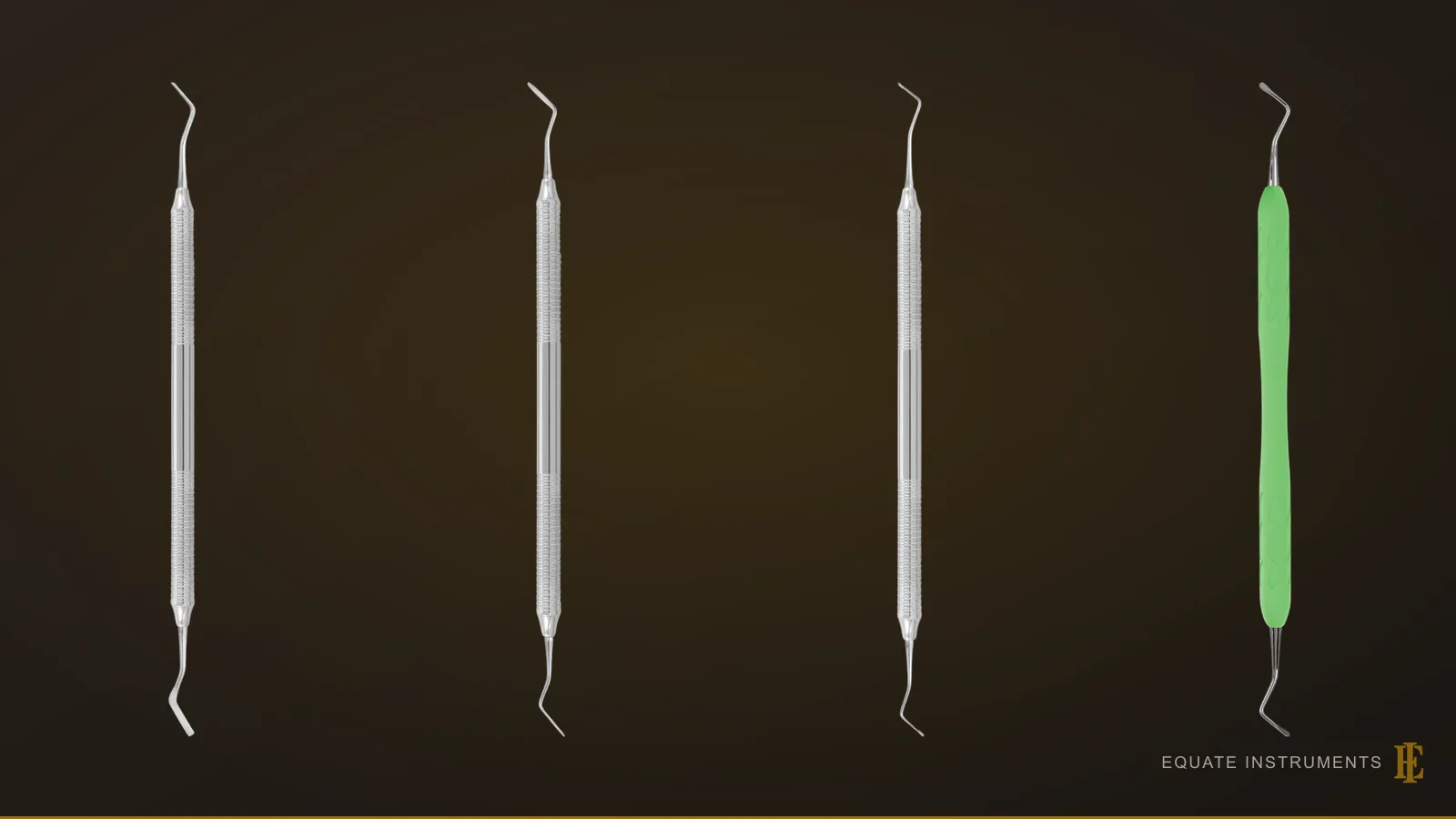
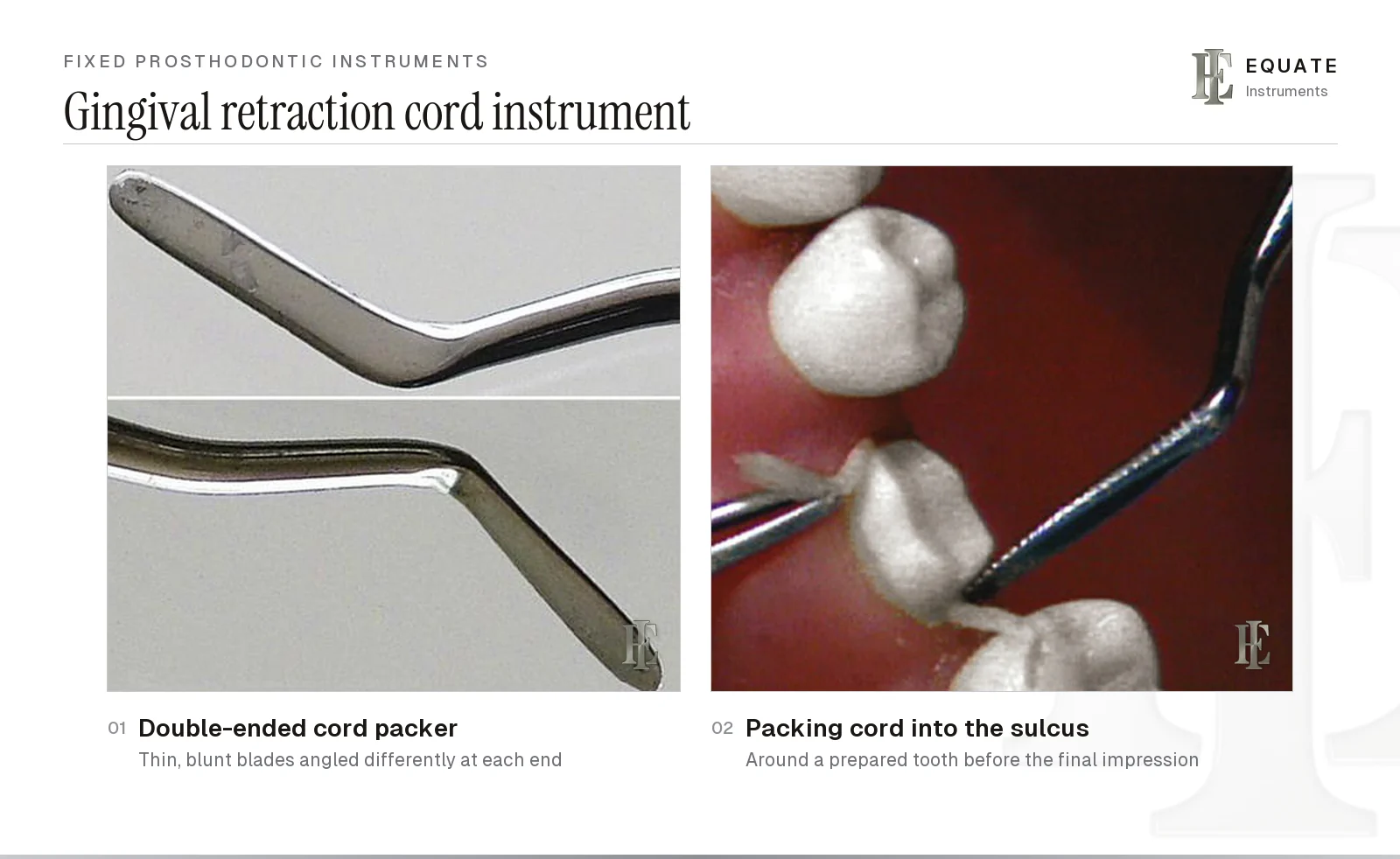
A gingival cord packer is a thin, blunt hand instrument that presses retraction cord into the gingival sulcus around a prepared tooth, so the finish line is exposed and dry for the impression or scan. Packers have small round, square or blade-shaped working ends, serrated or smooth, angled to reach every surface, and they are used with light, controlled pressure so the gingival attachment is not torn.
Key points
- A cord packer displaces the gingiva sideways and slightly apically so the impression material or scanner can capture the margin.
- Serrated ends grip the cord and stop it sliding; smooth ends glide over it and are kinder to thin tissue.
- Retraction works best on healthy gingiva, and no single technique has been shown to be better than the others.
What is a gingival cord packer used for?
A cord packer places gingival retraction cord into the sulcus after a crown, bridge, inlay or veneer preparation, so the margin can be recorded accurately. The cord pushes the free gingiva away from the tooth for a few minutes, opens a space for the impression material in the impression tray and, when it carries a haemostatic solution, controls bleeding and crevicular fluid. Without that space and a dry field, the material or the intraoral scanner can't see a subgingival margin, and the laboratory has to guess where the restoration ends. The space has to be real: in a laboratory study on a metal model with simulated sulci, Laufer, Baharav and Cardash found that impressions of narrower sulci were more distorted, and that half to nine in ten impressions of sulci only 0.08 to 0.13 mm wide had defects.
The packer is one of the fixed prosthodontic instruments used between preparation and impression. Packers also tuck cord around Class V restorations and hold the gingiva back while a margin is finished. They sit on the crown and bridge tray with a mouth mirror, a dental explorer and the crown and bridge instruments used for provisionals and cementation.
What is the difference between the single-cord and double-cord techniques?
In the single-cord technique one cord is packed and removed just before the impression; in the double-cord technique a thin cord stays at the base of the sulcus during the impression while a thicker cord on top is removed. In their 2004 review in Dental Clinics of North America, Terry Donovan and Winston Chee of the University of Southern California found several displacement methods predictable and safe on healthy tissue, but no evidence that one is better than another, so the choice comes down to the case and the operator. Describing the double-cord method in 1999, Cloyd and Puri of the University of Tennessee stressed healthy gingiva, supragingival margins where possible and never forcing cord into the sulcus.
Pastes are the main alternative. A 2015 systematic review in the Journal of Prosthodontics by Huang and colleagues found that retraction pastes gave a drier field and less tissue injury, and the authors judged cord better at displacing tissue, though the studies disagreed and were too varied to pool. The authors saw a place for both.
| Technique | How it works | Usually chosen for |
|---|---|---|
| Single cord | One cord is packed, left for a few minutes, then removed before the material is syringed in | Shallow sulcus, margins at or just below the gingiva, single units |
| Double cord | A thin cord goes in first and stays; a larger cord is packed over it and removed before the impression | Deeper margins, thick tissue that tends to collapse back, multiple units |
| Cord with a haemostatic agent | Cord is soaked in or wetted with a haemostatic solution before packing | Sites that bleed or weep crevicular fluid |
| Cordless pastes and matrices | Material is syringed into the sulcus instead of cord | Supragingival or slightly subgingival margins, digital scans; drier field, less displacement |
What is the difference between serrated and smooth cord packers?
A serrated packer has fine grooves cut into its working end that grip the cord fibres, while a smooth packer has a polished end that slides along the cord. Serrations stop braided or knitted cord rolling away from the tip and make it easier to push a cord home in one controlled movement. Smooth ends are less likely to snag and pull the cord back out as the instrument is lifted away, and some clinicians prefer them on thin, scalloped anterior gingiva.
| Working end | Behaviour with the cord | Typical use |
|---|---|---|
| Serrated round | Grips well and turns easily around line angles | Posterior teeth and general use |
| Serrated square or blade | Broad, even push along a straight surface | Buccal and lingual surfaces, thicker cord |
| Smooth round | Glides over the cord without catching | Thin anterior tissue, the second cord |
| Smooth square or blade | Flat contact that seats cord evenly | Final tuck of cord along a margin |
Which cord packer angle and size suit which tooth?
- Angled working ends: the tip bends away from the shank, usually with a different angle on each end, so the packer can reach mesial, distal, buccal and lingual surfaces without changing grasp.
- Universal double-ended packers: opposite angles on the two ends cover most of the arch with one instrument.
- Thin ends of about 2.0 mm: anterior teeth, narrow sulci and the first, thinner cord.
- Wider ends of about 2.6 to 3.0 mm: posterior teeth, thick tissue and the second, larger cord.
- Packers with a flat blade: long straight runs of cord on molars and bridge abutments.
How do you pack retraction cord with a packer?
Hold the packer in a modified pen grasp with a firm finger rest on an adjacent tooth, and angle the tip slightly back towards the cord already placed so each stroke pushes cord in rather than pulling it out. Isolate and dry the tooth, cut a length of cord a little longer than the circumference, with the free end held in cotton pliers, and start in an interproximal area where the sulcus is deepest. Work round the tooth in short overlapping steps, keeping the cord at the level of the finish line rather than forcing it to the base of the sulcus.
Common mistakes are using too much force, which tears the epithelial attachment and can cause recession, packing a cord too thick for the sulcus, and letting a dry cord stick to the tissue so it bleeds when it is pulled out. Wet the cord before removal if it has dried, and count the pieces so none is left behind in the sulcus.
What does the Equate range include?
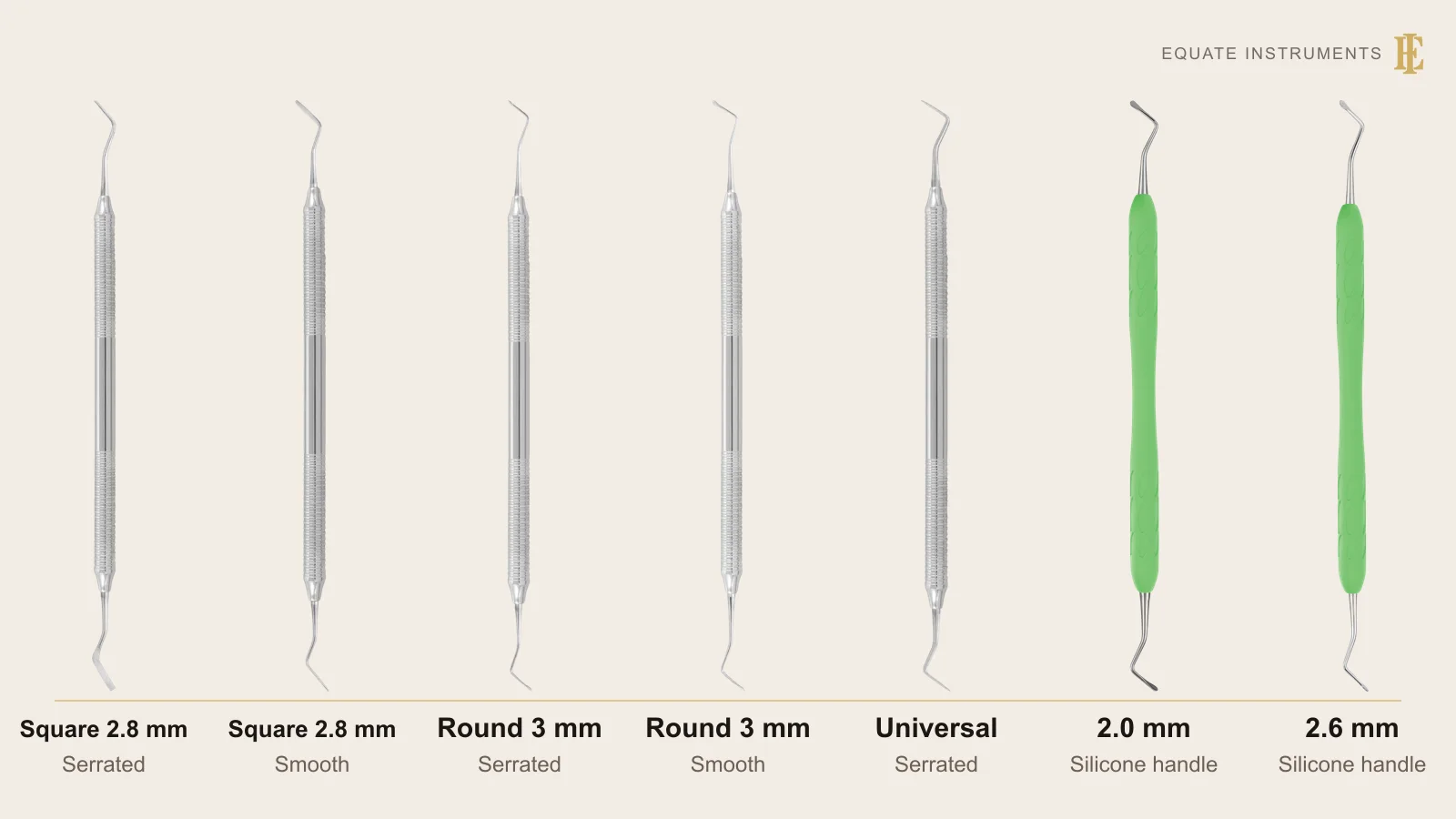
Equate's 13 cord packers cover the round, square and universal patterns most clinicians use. The 2.8 mm square and 3 mm round packers come in serrated and smooth versions, the universal pattern comes plain or serrated, and the range adds a UP1 pattern and 2.0 mm and 2.6 mm packers, two of them on light-green silicone handles. Seven are on solid 6 mm stainless handles.
Every packer is designed in Finland and made from passivated stainless steel, ultrasonically cleaned, shape-, boil- and performance-tested and individually packed. Clinics can request samples and a quote for the restorative family.
How do you clean and sterilise cord packers?
Clean cord packers straight after use, before haemostatic solution and blood dry in the serrations, and then sterilise them with the restorative set. Follow the manufacturer's processing instructions, which ISO 17664-1 requires for reusable critical and semi-critical devices, and the CDC's Guidelines for Infection Control in Dental Health-Care Settings or, in UK practices, HTM 01-05.
Inspect the serrations under magnification for trapped cord fibres, which an ultrasonic bath or washer-disinfector usually clears. Retire a packer whose tip has a burr, a bend or worn serrations, because a rough edge cuts the gingiva and a blunted one lets the cord slip.
The Equate difference
Equate lists 13 gingival cord packers, including 2.8 mm square and 3 mm round patterns in serrated and smooth versions, universal and UP1 patterns and 2.0 mm and 2.6 mm packers, 7 of them on solid 6 mm stainless handles and others on knurled or light-green silicone handles.
Equate Gingival Cord Packers (Retraction Cord Instruments) options

Retraction Cord Packer UP1 - Knurled Handle
EI-0099
Gingival Cord Packer Universal - 6 mm Solid Handle
EI-0168
Cord Packer 2.0 mm
EI-0920
Cord Packer 2.6mm
EI-0941
Cord Packer 2.0 mm - Premium Textured Silicone Handle
EI-1121
Cord Packer 2.0mm Light Green
EI-1227
Cord Packer 2.6mm Light Green
EI-1240
Fischer Serrated Cord Packer - Solid Handle 6mm
EI-1906
Gingival Cord Packer Square 2.8 mm Serrated Solid Handle
EI-1909
Universal Gingival Cord Packer Serrated - Solid Handle 6mm
EI-1910
Gingival Cord Packer Round 3 mm Serrated Solid Handle
EI-1911
Gingival Cord Packer Square 2.8 mm Smooth Solid Handle
EI-1912Browse all restorative & operative instruments
Buying in your market
Frequently asked questions
What is a cord packer used for in dentistry?
It presses gingival retraction cord into the sulcus around a prepared tooth. That exposes the margin and keeps it dry so the impression or scan records it accurately.
Should I use a serrated or a smooth cord packer?
Serrated packers grip the cord and stop it sliding, which helps with the first cord and on posterior teeth. Smooth packers glide over the cord and are often preferred for the second cord and thin anterior tissue; many clinicians keep one of each.
What is the double-cord technique?
A thin cord is packed first and left in the sulcus during the impression, then a thicker cord is packed on top and removed just before the material goes in. The lower cord keeps the sulcus open and controls fluid while the material sets.
Can a cord packer damage the gums?
Yes, if it is pushed too hard or too deep it can tear the epithelial attachment and cause bleeding or recession. Use light pressure, a cord sized to the sulcus and a tip angled towards the cord already placed.
Is retraction cord needed for digital impressions?
Usually, when the margin is subgingival, because the scanner can only record what it can see. Cordless pastes are an alternative for shallow margins, and chairside CAD/CAM is covered in the fixed prosthodontic instruments guide.
Are epinephrine retraction cords safe?
Use them with care. Epinephrine is absorbed from the cord, more so with longer cords, higher concentrations, longer contact and damaged tissue, so check the medical history for heart disease. Aluminium-salt astringents control fluid without those systemic effects.
Cord or retraction paste?
Both work. A 2015 systematic review found pastes gave a drier field with less tissue trauma; its authors judged cord better at displacing tissue, though the individual studies disagreed.
References
- Donovan TE, Chee WWL. Current concepts in gingival displacement. Dental Clinics of North America 2004;48(2):433–444
- Cloyd S, Puri S. Using the double-cord packing technique of tissue retraction for making crown impressions. Dentistry Today 1999;18(1):54–59
- Bennani V, Schwass D, Chandler N. Gingival retraction techniques for implants versus teeth: current status. Journal of the American Dental Association 2008;139(10):1354–1363
- Rosenstiel SF, Land MF, Walter R (eds). Contemporary Fixed Prosthodontics, 6th edition. Elsevier, 2022
- Boyd LB. Dental Instruments: A Pocket Guide, 7th edition. Saunders/Elsevier, 2020. Chapter 10, Fixed Prosthodontics Restorative Instruments (photographs used under licence)
- Kohn WG, et al. Guidelines for Infection Control in Dental Health-Care Settings, 2003. MMWR 52(RR-17), Centers for Disease Control and Prevention
- ISO 17664-1:2021 Processing of health care products: information to be provided by the medical device manufacturer for the processing of medical devices, part 1: critical and semi-critical medical devices
- Donovan TE, Gandara BK, Nemetz H. Review and survey of medicaments used with gingival retraction cords. Journal of Prosthetic Dentistry 1985;53(4):525–531
- Laufer BZ, Baharav H, Cardash HS. The linear accuracy of impressions and stone dies as affected by the thickness of the impression margin. International Journal of Prosthodontics 1994;7(3):247–252
- Huang C, Somar M, Li K, Mohadeb JVN. Efficiency of cordless versus cord techniques of gingival retraction: a systematic review. Journal of Prosthodontics 2017;26(3):177–185 (epub 2015)
I am a…