Dental Aspirating Syringes (Dental Anaesthetic Syringes)
Written by the Equate Instruments Technical Team · Reviewed by the Medical & Dental Board, Equate Instruments · Updated ·
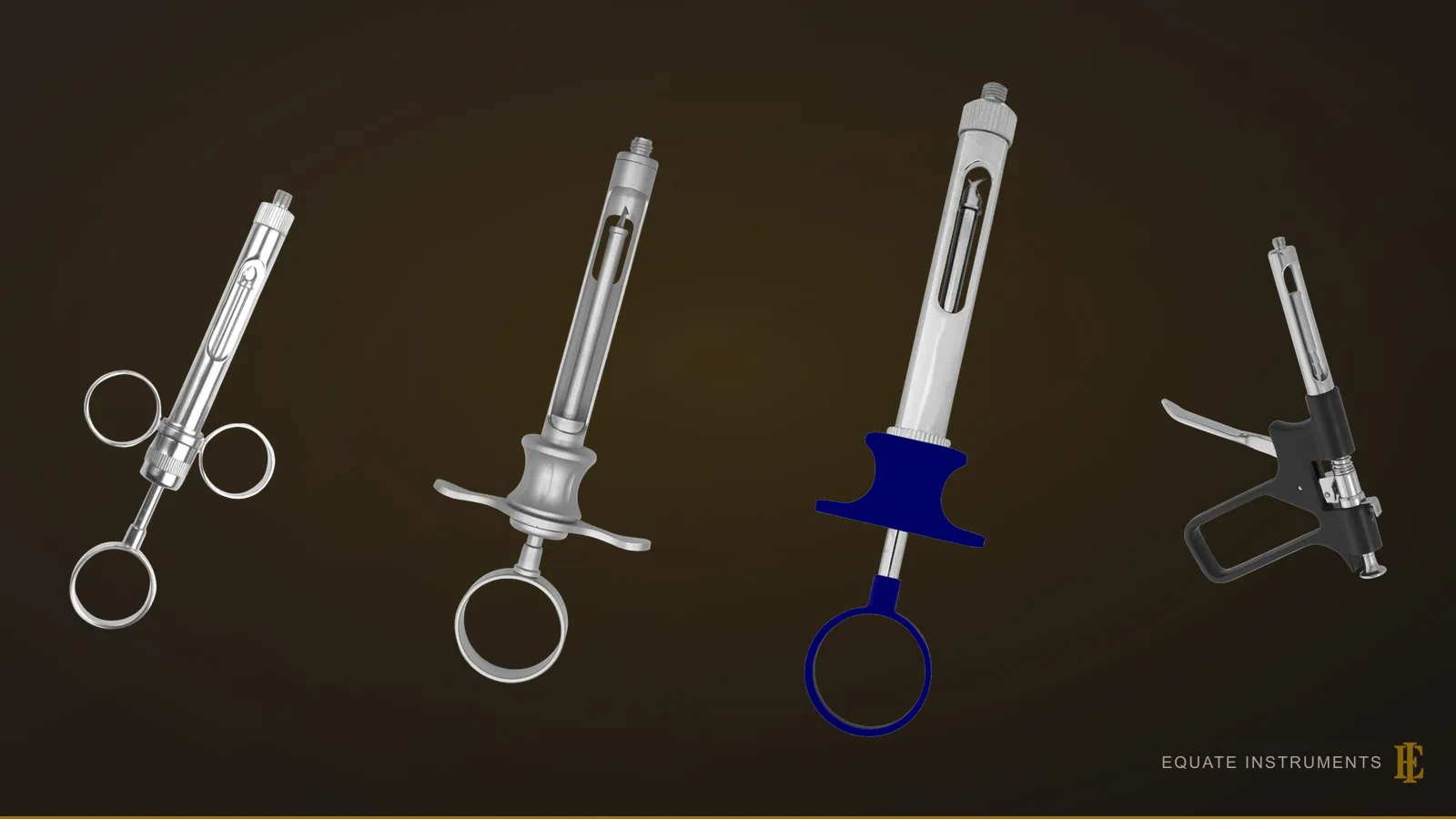
A dental aspirating syringe is the reusable metal syringe that holds a glass cartridge of local anaesthetic and a disposable needle. Before depositing solution, the operator draws back slightly, or the syringe does it automatically, to check the needle tip isn't in a blood vessel. Most syringes take 1.8 ml or 2.2 ml cartridges, and the needle and cartridge are single-use items bought separately.
Key points
- Aspirating before each deposit guards against intravascular injection, which one study found in about 15% of inferior alveolar nerve blocks.
- Each barrel is made for one cartridge length, so match the syringe to the 1.8 ml or 2.2 ml cartridges your practice stocks.
- The syringe is cleaned and heat-sterilised between patients, while the needle and cartridge go into the sharps container after one use.
What is a dental aspirating syringe used for?
A dental aspirating syringe delivers local anaesthetic from a sealed glass cartridge through a fine needle, and lets the operator check by aspiration that the needle tip is outside a blood vessel before the solution goes in. It is one part of the local anaesthetic setup, alongside the needle, cartridge and recapping aid, and it sits on almost every tray, from the restorative instruments to the tooth extraction instruments.
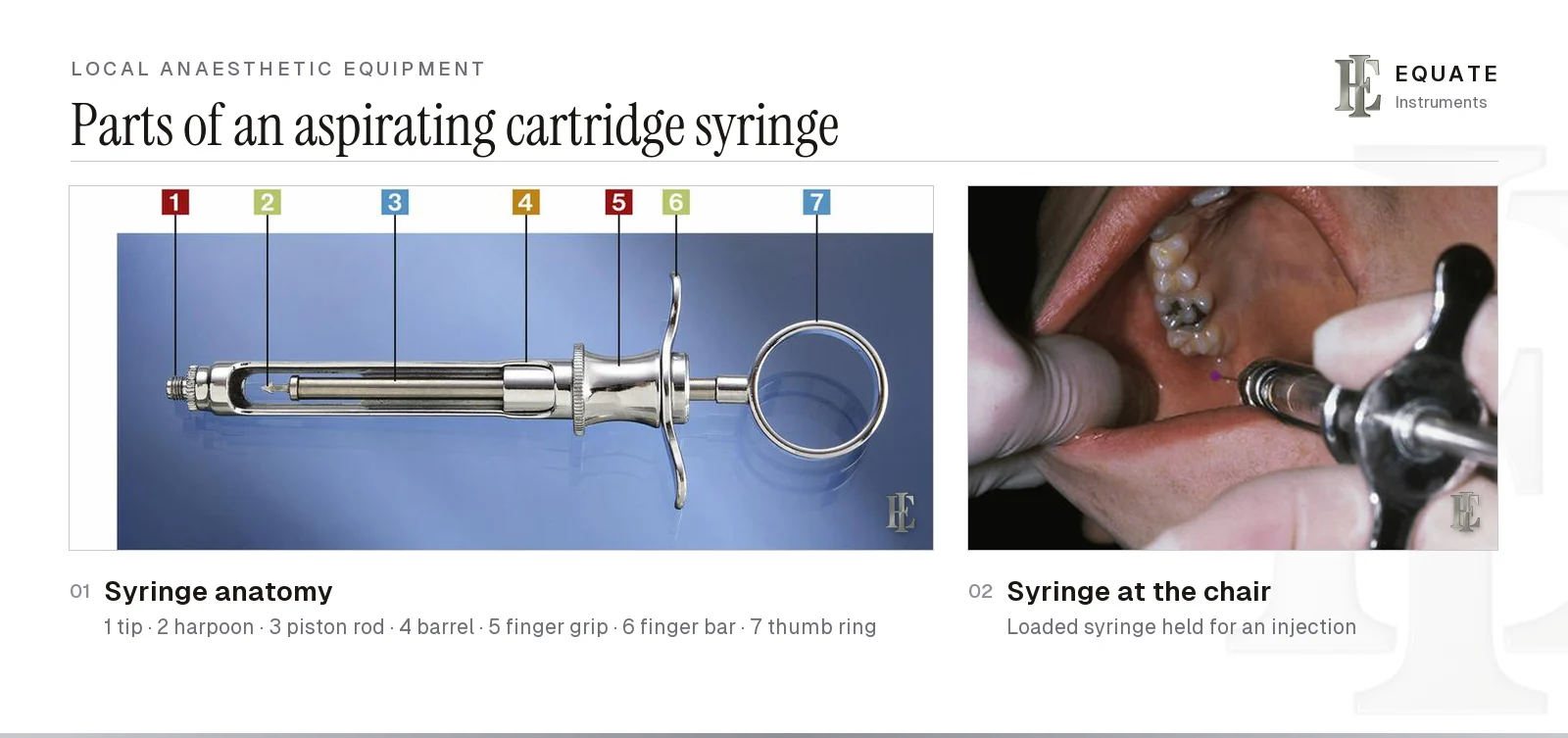
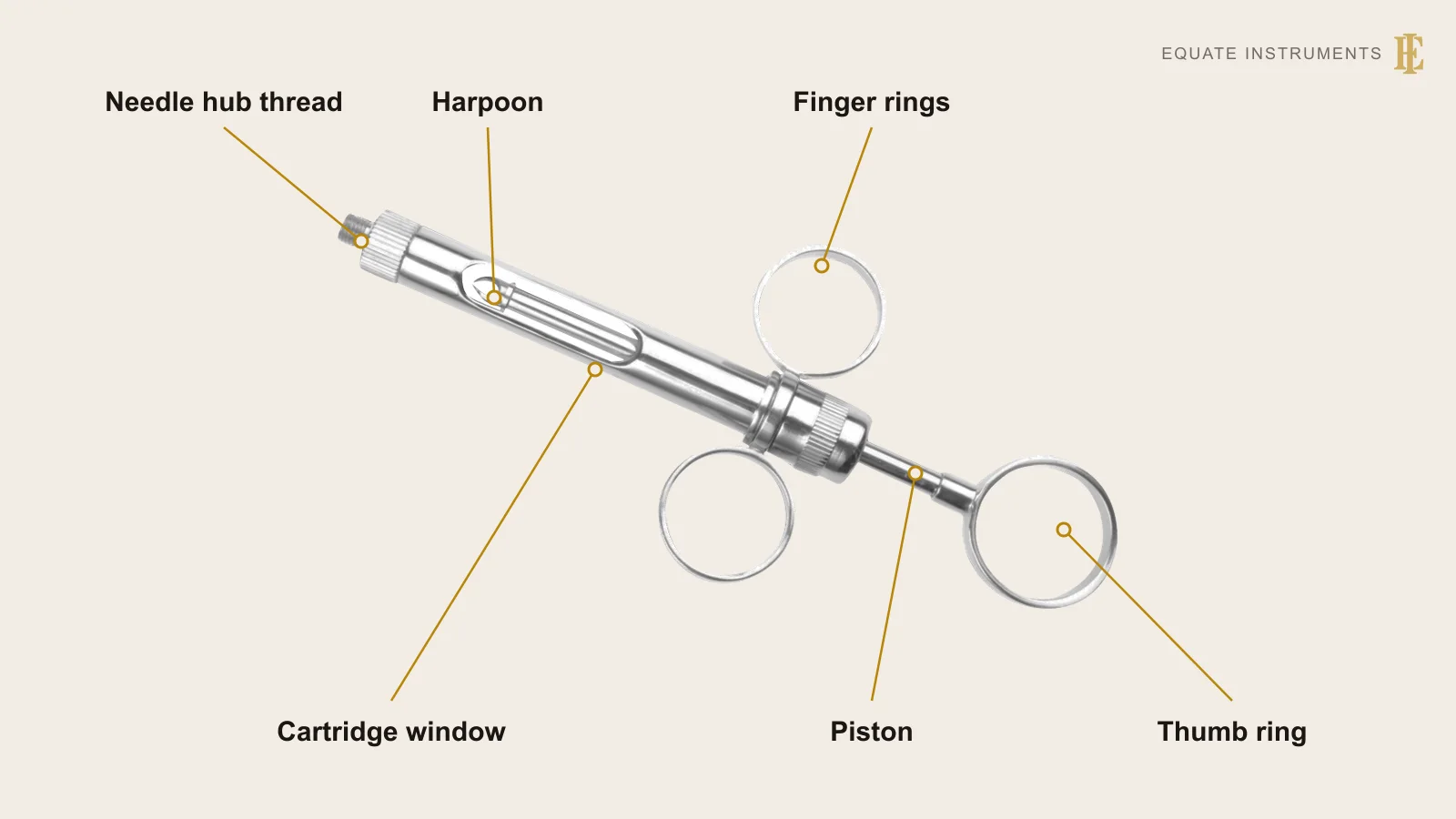
The parts are the same on nearly every model. A thumb ring or thumb disc drives a piston rod; on a harpoon syringe the rod ends in a small barbed harpoon that bites into the cartridge's rubber stopper. The barrel holds the cartridge and has a window so you can see the solution and any blood. A finger grip or flange gives the two fingers something to push against, and a threaded tip at the front takes the needle hub. The full tray, in the order the nurse lays it out, is on the local anaesthetic tray setup page.
Why does aspiration matter?
Aspiration matters because a deposit of anaesthetic straight into a vein or artery can cause a toxic or cardiovascular reaction and usually fails to numb the tooth. Stanley Malamed's Handbook of Local Anesthesia, the standard text on dental anaesthesia, teaches aspiration before every deposit and a slow injection, about one cartridge a minute, so that a missed positive aspiration does less harm.
Positive aspirations are common. In a study of 359 inferior alveolar nerve blocks by Taghavi Zenouz and colleagues (2008), 15.3% were aspiration-positive: 14.2% with the direct technique and 23.3% with the indirect technique, a difference that wasn't statistically significant. A negative aspiration isn't a guarantee, because the bevel can lie against a vessel wall and close it off. Many clinicians therefore aspirate in two planes, turning the syringe slightly and aspirating again. If blood appears, withdraw slightly, reposition and aspirate again; replace the cartridge if the solution is too stained to see a second result.
What types of dental syringe are there?
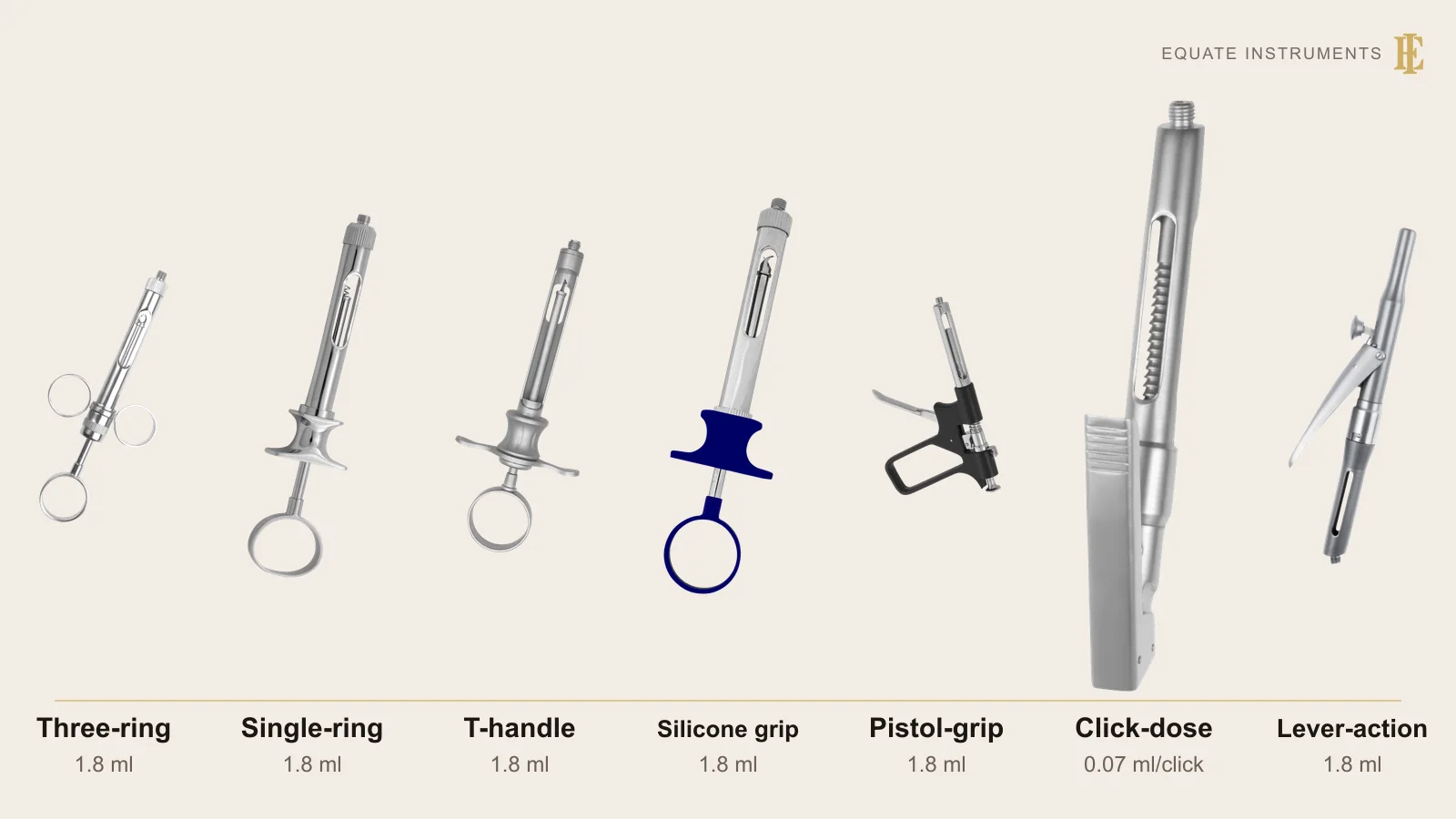
Dental syringes differ in how they aspirate and how the hand holds them: harpoon syringes aspirate when you pull back the thumb ring, self-aspirating syringes aspirate when you release thumb pressure, and pressure syringes trade aspiration feel for mechanical force.
“T-handle” names the grip, not the mechanism: T-handle syringes are made in aspirating and non-aspirating versions, so check for a harpoon before buying. Push-only syringes without a harpoon still exist, and ISO 9997 covers non-aspirating, aspirating and self-aspirating designs. Disposable plastic syringes that come preloaded with anaesthetic are used once and discarded whole.
| Type | How it aspirates | Where it suits |
|---|---|---|
| Single-ring harpoon syringe | Harpoon engages the stopper; a firm pull on the thumb ring creates negative pressure | General use; the most common chairside design |
| Three-ring harpoon syringe | As above, with two finger rings on the flange so the operator can pull back without changing grip | Operators who want a positive two-way grip, and smaller hands |
| T-handle syringe | Thumb ring plus a flat cross-shaped finger rest; aspirating versions have a harpoon | A balanced three-finger hold for infiltrations and blocks |
| Self-aspirating syringe | No harpoon; pressing the cartridge onto a projection in the needle end deforms the diaphragm, which springs back and aspirates when thumb pressure is released | Repeated aspiration during long blocks without moving the grip |
| Pistol-grip, lever-action or click-action syringe | A lever or ratchet drives the piston in fixed steps, giving the force needed against dense tissue | Intraligamental (periodontal ligament) injections, where the tissue resists a thumb-driven piston |
| Non-aspirating (push only) | No harpoon and no rebound feature; the piston only pushes, so blood cannot be drawn back into the cartridge | Rarely chosen where national guidance expects aspiration before each deposit |
Which cartridge and needle go with which syringe?
A syringe takes one cartridge size and one needle thread, so the cartridge, the needle and the barrel have to match. ISO 11499:2014 lists nominal cartridge sizes of 1.0, 1.7, 1.8 and 2.2 ml, and it caps the overall length at 65.0 mm for a 1.7 or 1.8 ml cartridge and 77.5 mm for a 2.2 ml one, with a 9.0 mm maximum diameter for both. The gap between those maxima is 12.5 mm, so a 1.8 ml cartridge in a 2.2 ml barrel can sit well short of the harpoon or needle: a barrel built for one size won't hold the other securely. ISO 11499 cartridges are made to fit syringes that meet ISO 9997, the standard for dental cartridge syringes, and ISO 7885 covers the sterile single-use needles. Needle hubs are made for a particular thread, so check whether the syringe takes a European (metric) or imperial thread before ordering needles. Needle and cartridge anatomy is covered in the local anaesthetic and nitrous oxide equipment guide.
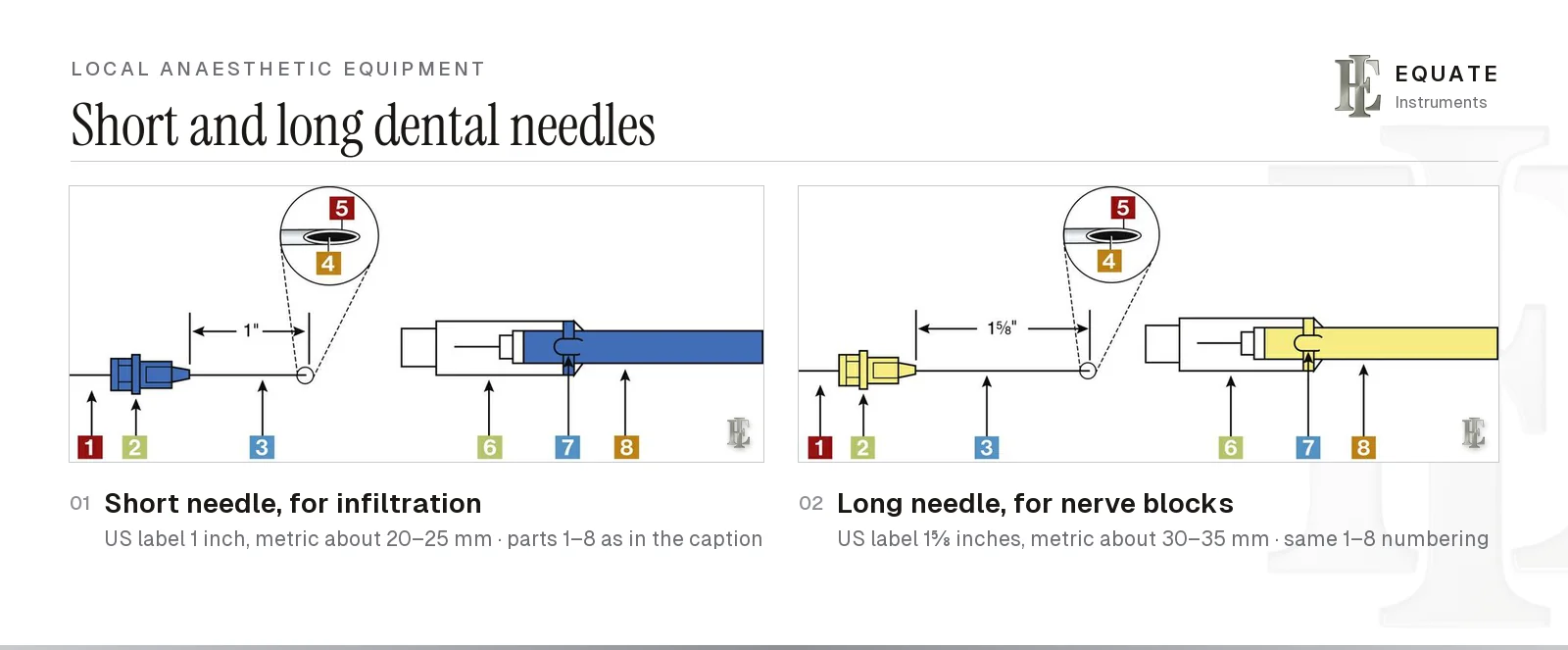
Needle length follows the injection. Short needles are used where the target is shallow, long needles where the tissue to be crossed is deep, as in the inferior alveolar nerve block. A higher gauge number means a thinner needle: Malamed recommends 25 or 27 gauge for deep blocks, because thicker needles deflect less and give a more reliable aspiration, and advises never inserting a needle to its hub, so that a broken needle can still be retrieved. Needle breakage is rare but has a clear pattern. Pogrel's case series in the Journal of the American Dental Association (2009) reviewed 16 broken needles seen at one academic institution over 25 years: 15 broke during inferior alveolar blocks and 13 were 30 gauge. He advised against 30-gauge needles for that block, against inserting a needle to the hub and against bending it before insertion.
| Needle | Typical gauge and length | Typical injections |
|---|---|---|
| Extra-short | 30 gauge, about 10–12 mm | Intraligamental, intrapapillary and small children |
| Short | 27 or 30 gauge, about 20–25 mm | Buccal and palatal infiltrations, posterior superior alveolar, mental and incisive blocks |
| Long | 25 or 27 gauge, about 32–35 mm | Inferior alveolar, Gow-Gates and closed-mouth mandibular blocks |
How do you load the syringe and recap the needle safely?
The needle goes on last, after the cartridge is seated and the harpoon engaged, and the thumb ring is pressed, never struck, to set the harpoon. A self-aspirating syringe has no harpoon to set, and pistol or lever syringes load through a hinged or open barrel, so follow the instructions for that model. The full loading and unloading sequence is on the local anaesthetic tray setup.
The CDC's Guidelines for Infection Control in Dental Health-Care Settings (2003) say used needles should never be recapped with both hands. Where recapping between injections is allowed, use a one-handed scoop, sliding the needle into a cap lying on the tray, or a device that holds the cap upright. In the United States, OSHA's bloodborne pathogens standard allows recapping only when there's no feasible alternative or a dental procedure requires it, and then only with a mechanical device or a one-handed technique. In the European Union, Council Directive 2010/32/EU lists a prohibition of recapping among its sharps-injury measures, and the UK's 2013 sharps regulations (SI 2013/645, regulation 5) allow a used needle to be capped only where the employer's risk assessment requires it and a suitable device controls the risk. Never pass the syringe with the needle uncovered, and keep a sharps container within reach of the chair.
How do you choose a dental syringe?
Choose the syringe around your cartridges, your needles and your hand. Start with the cartridge size the practice buys, then the needle thread, then the grip: a single-ring syringe is the familiar default, three rings or a T-handle suit operators who want a two-way hold, a self-aspirating design helps when you aspirate repeatedly during a block, and a lever or click-dose syringe makes intraligamental injections less tiring. Coloured grips or thumb rings help a team tell 1.8 ml and 2.2 ml syringes apart at a glance.
Check the details that affect aspiration. The harpoon should be sharp and straight, the thumb ring should rotate freely so the needle bevel can be turned without moving the hand, and the window should be large enough to see a faint flash of blood.
How do you clean and sterilise a dental syringe?
Clean the syringe as soon as possible after use, then heat-sterilise it. With the needle capped and removed into the sharps container and the cartridge discarded, in the unloading order the tray setup page gives, rinse off blood and anaesthetic, take the syringe apart if its design allows, and brush the thread, harpoon and piston before ultrasonic cleaning or a washer-disinfector cycle. Dry it, then pouch it or process it in a cassette with the rest of the tray, and steam-sterilise it in line with the CDC guidelines or, in UK practices, HTM 01-05, following the processing instructions the manufacturer supplies under ISO 17664.
Inspect each syringe as it comes out of the sterilisation cycle. Retire it if the harpoon is blunt or bent, if the needle thread is worn, or if the piston binds, because each of these stops reliable aspiration.
What does the Equate dental syringe range include?
Equate lists 42 dental cartridge syringes across single-ring, three-ring and T-handle harpoon designs, coloured-grip versions, a self-aspirating syringe, pistol-grip and lever-action syringes, and two click-action syringes, one intraligamental and one offset, each delivering 0.07 ml per click. 23 take 1.8 ml cartridges and 19 take 2.2 ml, and 34 have a European needle thread. 41 are stainless steel and one T-handle syringe is brass, and every syringe is supplied non-sterile for sterilisation in the practice before first use.
Equate also makes a weighted conical holder for dental syringes (EI-0817), machined from solid stainless steel and autoclavable with the syringe.
Equate makes the syringes only: needles and cartridges are single-use consumables bought from your usual supplier. Designed in Finland, the range can be sampled before a clinic or group standardises on one model, and you can browse the prosthodontic and laboratory family or request samples and a quote.
The Equate difference
Equate lists 42 dental cartridge syringes, 23 for 1.8 ml and 19 for 2.2 ml cartridges: 14 single-ring, 10 T-handle (one of them self-aspirating, one metric-thread) and 8 three-ring designs, 4 with blue grips or thumb rings, and 2 each of pistol-grip, lever-action and click-action syringes (one click-action syringe intraligamental, one offset), 34 of them with a European needle thread.
Equate Dental Aspirating Syringes (Dental Anaesthetic Syringes) options

Dental Aspirating Syringe 2.2 ml, EU Needle
EI-0808
Offset Dental Cartridge Syringe 1.8 ml, EU Needle
EI-0809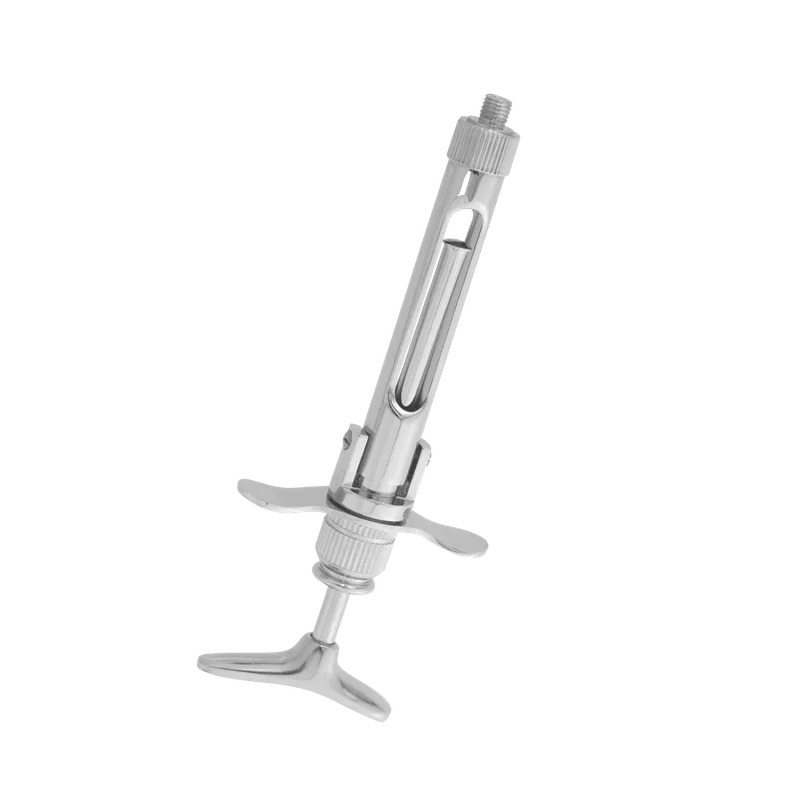
T-Handle Type Syringe 1.8ml EU Needle Brass
EI-0810
T-Handle Type Syringe 2.2ml EU Needle
EI-0811
Self-Aspirating Dental Syringe 1.8 ml
EI-0812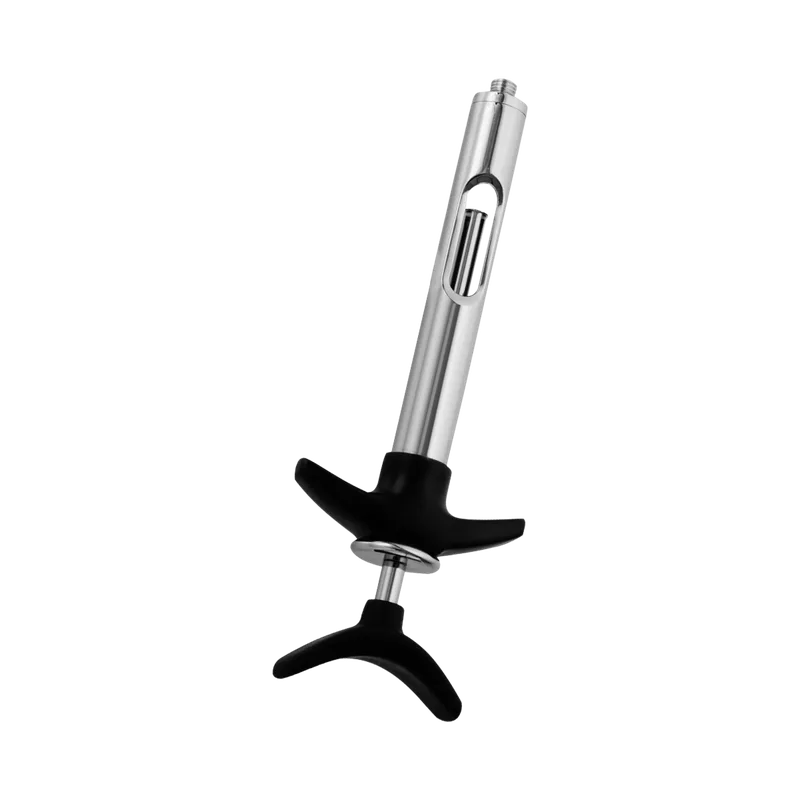
T-Handle Type Syringe 1.8ml EU Needle
EI-0813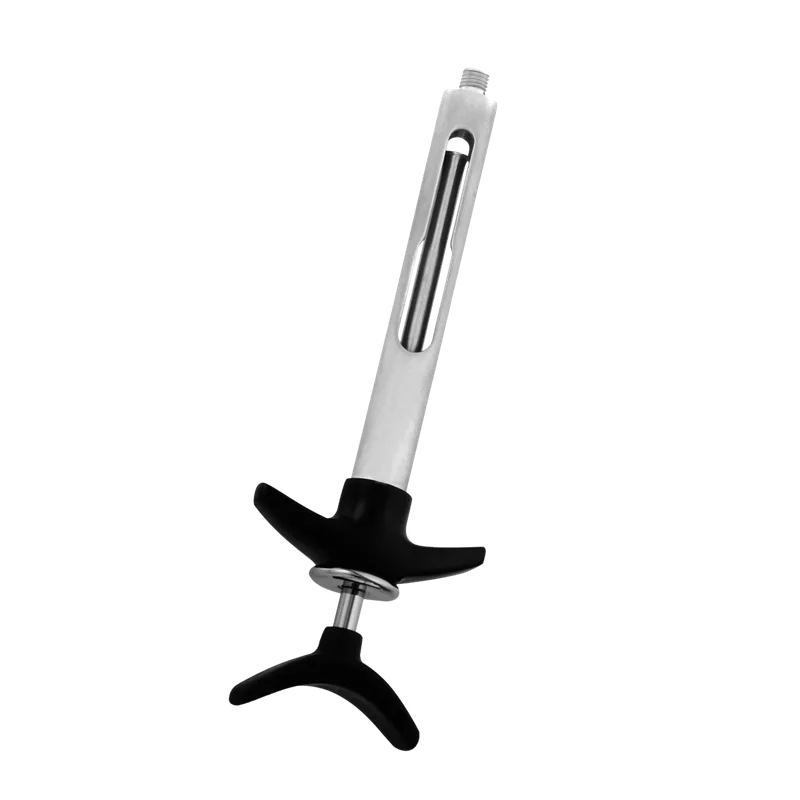
T-Handle Type Syringe 2.2ml EU Needle
EI-0814
Metric Cartridge Dental Syringe
EI-0815
Single-Ring Aspirating Dental Syringe 2.2ml EU Needle
EI-0816
Pistol-Grip Aspirating Syringe 1.8 ml - EU Needle
EI-1464
Click-Dose Intraligamental Syringe 2.2 ml (0.07 ml/click) - EU Needle
EI-1465
Single-Ring Aspirating Syringe - 1.8 ml Cartridge
EI-1466Browse all prosthodontic & laboratory instruments
Buying in your market
Frequently asked questions
What is the difference between an aspirating and a self-aspirating dental syringe?
An aspirating (harpoon) syringe aspirates when you pull back on the thumb ring, because the harpoon is hooked into the cartridge stopper. A self-aspirating syringe has no harpoon and aspirates when you release thumb pressure and the cartridge diaphragm springs back.
Can you use a 1.8 ml cartridge in a 2.2 ml syringe?
Not reliably. ISO 11499:2014 allows a 1.8 ml cartridge up to 65.0 mm long and a 2.2 ml cartridge up to 77.5 mm, so the standard allows a 2.2 ml cartridge to be up to 12.5 mm longer. A barrel is built for one length, so a 1.8 ml cartridge in a 2.2 ml syringe can sit well short of the harpoon and may not seat on the needle or engage the harpoon properly.
What gauge needle is used for an inferior alveolar nerve block?
A long 25 or 27 gauge needle is the usual choice. Thicker needles deflect less in deep tissue and give a clearer aspiration result than 30 gauge needles.
Can a dental needle break, and how is that prevented?
It can, though rarely. In Pogrel's 2009 series of 16 broken needles, 15 broke during inferior alveolar blocks and 13 were 30 gauge. His advice: use a sturdier gauge than 30 for that block, never insert the needle to the hub so a broken end can be gripped, and don't bend the needle before use.
Are dental syringes reusable?
Metal cartridge syringes are reusable and are cleaned and heat-sterilised between patients. The needle and the anaesthetic cartridge are single-use and go into the sharps container.
Should you recap a dental needle?
Only where the rules allow, and only with one hand. CDC guidance rules out two-handed recapping, EU Directive 2010/32/EU calls for a prohibition of recapping, and the UK's 2013 regulations allow it only where a risk assessment requires it and a device controls the risk. Where it is allowed, use a one-handed scoop or a cap-holding device.
Does Equate sell needles and anaesthetic cartridges?
No. Equate makes reusable syringes; needles and cartridges are single-use consumables bought separately, matched to the syringe's thread and barrel size.
References
- Malamed SF. Handbook of Local Anesthesia. Elsevier (syringe types, aspiration, needle gauge and length, injection rate)
- Taghavi Zenouz A, Ebrahimi H, Mahdipour M, Pourshahidi S, Amini P, Vatankhah M. The incidence of intravascular needle entrance during inferior alveolar nerve block injection. Journal of Dental Research, Dental Clinics, Dental Prospects 2008;2(1):38–41
- Kohn WG, Collins AS, Cleveland JL, Harte JA, Eklund KJ, Malvitz DM. Guidelines for Infection Control in Dental Health-Care Settings, 2003. MMWR 52(RR-17), Centers for Disease Control and Prevention
- Occupational Safety and Health Administration. Bloodborne pathogens standard, 29 CFR 1910.1030(d)(2)(vii): recapping of contaminated needles
- ISO 9997:2020. Dentistry: cartridge syringes. International Organization for Standardization
- ISO 11499:2014 Dentistry: Single-use cartridges for local anaesthetics
- ISO 7885:2010. Dentistry: sterile injection needles for single use. International Organization for Standardization
- Department of Health (England). Health Technical Memorandum 01-05: Decontamination in primary care dental practices, 2013 edition
- Boyd LB. Dental Instruments: A Pocket Guide, 7th edition. Saunders/Elsevier, 2020. Chapter 3, Local Anesthetic Syringe/Components and Nitrous Oxide Sedation (photographs used under licence)
- Pogrel MA. Broken local anesthetic needles: a case series of 16 patients, with recommendations. J Am Dent Assoc 2009;140(12):1517–1522
- Council Directive 2010/32/EU on the prevention of sharp injuries in the hospital and healthcare sector (EU-OSHA summary)
- The Health and Safety (Sharp Instruments in Healthcare) Regulations 2013 (SI 2013/645), regulation 5
I am a…
Related
- Dental Local Anaesthetic and Nitrous Oxide Sedation Equipment: What Each Part Does
- Local Anaesthetic (Anesthetic) Tray Setup and How to Load a Dental Syringe
- Tooth Extraction Instruments
- Restorative Dental Hand Instruments
- Rubber Dam Clamps, Forceps, Punches and Frames: Which to Choose
- Basic Dental Tray Setup (Dental Exam Tray)
- Dental Instrument Cassettes, Trays and Boxes