Rubber Dam Clamps, Forceps, Punches and Frames: Which to Choose
Written by the Equate Instruments Technical Team · Reviewed by the Medical & Dental Board, Equate Instruments · Updated ·
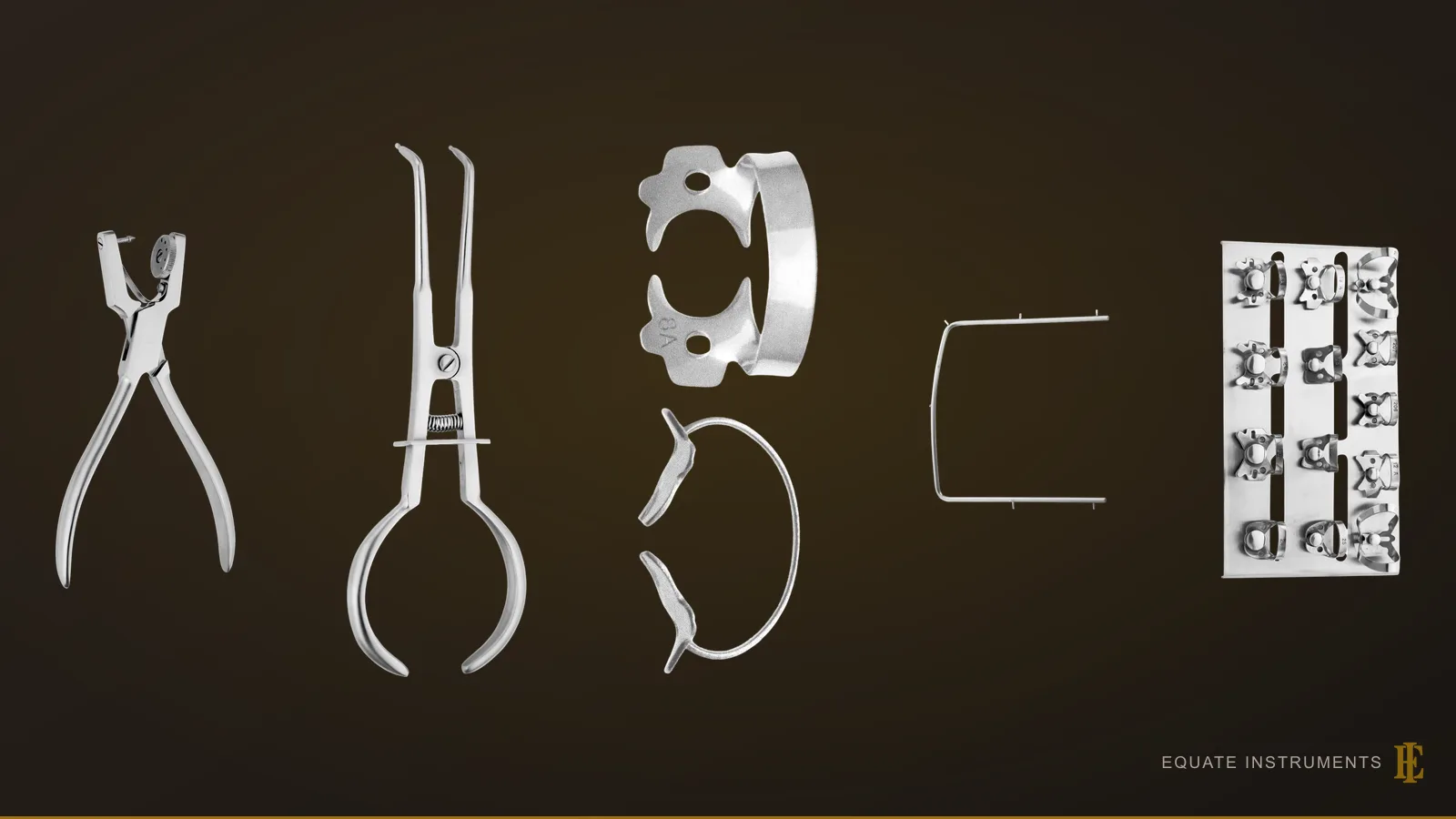
Rubber dam instruments are chosen by pattern. Clamps go by figure number for the tooth: 9 or 212 for front teeth, 1 or 2 for premolars, 8 for upper and 7 for lower molars, and 14 or 14A for partly erupted molars. Clamp forceps are chosen for beak fit (Brewer, Stocks), punches by pattern (Ainsworth or Ivory), and frames for size and material.
Key points
- The European Society of Endodontology and the American Association of Endodontists both treat rubber dam isolation as essential for root canal treatment.
- Clamps are chosen by tooth: anterior, premolar and molar patterns differ in jaw shape, and wingless clamps carry a W in their number.
- Tie floss to every clamp before it goes in the mouth, so a clamp that breaks or slips can be pulled out rather than swallowed or inhaled.
What are rubber dam instruments used for?
Rubber dam instruments isolate the tooth being treated, so the field stays dry and clean and small instruments, irrigants and debris can't reach the patient's throat. The technique is old: the dental dam was designed in the United States in 1864 by Sanford Christie Barnum, and the punch, clamp, forceps and frame used today are refinements of the same idea.
A typical setup has a latex or non-latex sheet, a punch, a clamp with a floss ligature, clamp forceps, a frame, and a flat plastic instrument or beavertail burnisher to tuck the dam edge into the sulcus, either one borrowed from the restorative instruments. For what each item does, with photographs of sheets, stamps, templates and preframed dams, see the dental dam instruments guide. Rubber dam goes on before the first cut in endodontic treatment and is used for many composite restorations. The step-by-step placement is on the rubber dam tray setup page.
What is the evidence for rubber dam in endodontics?
The evidence and the professional bodies agree that root canal treatment should be done under rubber dam. The European Society of Endodontology's 2006 quality guidelines say root canal procedures should be carried out only when the tooth is isolated by rubber dam, to prevent salivary and bacterial contamination, inhalation and ingestion of instruments, and the escape of irrigants into the mouth. They also ask for the tooth and dam to be disinfected before the pulp is entered and for the isolation method to be recorded.
The American Association of Endodontists' position statement calls dental dam isolation the standard of care and integral and essential for any nonsurgical endodontic treatment, and says a patient's consent to treatment without it doesn't make that acceptable. In a Taiwanese national cohort of 517,234 teeth, Lin and colleagues (2014) found that teeth treated under rubber dam had a 90.3% survival at a mean of 3.43 years against 88.8% without, an adjusted hazard ratio for extraction of 0.81. It was an observational study, but it points the same way as the guidelines.
In the UK, the British Endodontic Society's A Guide to Good Endodontic Practice (2022, edited by Phillip L Tomson) lists rubber dam isolation among the details to record in the clinical notes for root canal treatment. It also warns that leaving the dam out to save time, even in an emergency, is not advisable and leaves the operator open to medico-legal challenge if something goes wrong.
What are the parts of a rubber dam clamp?
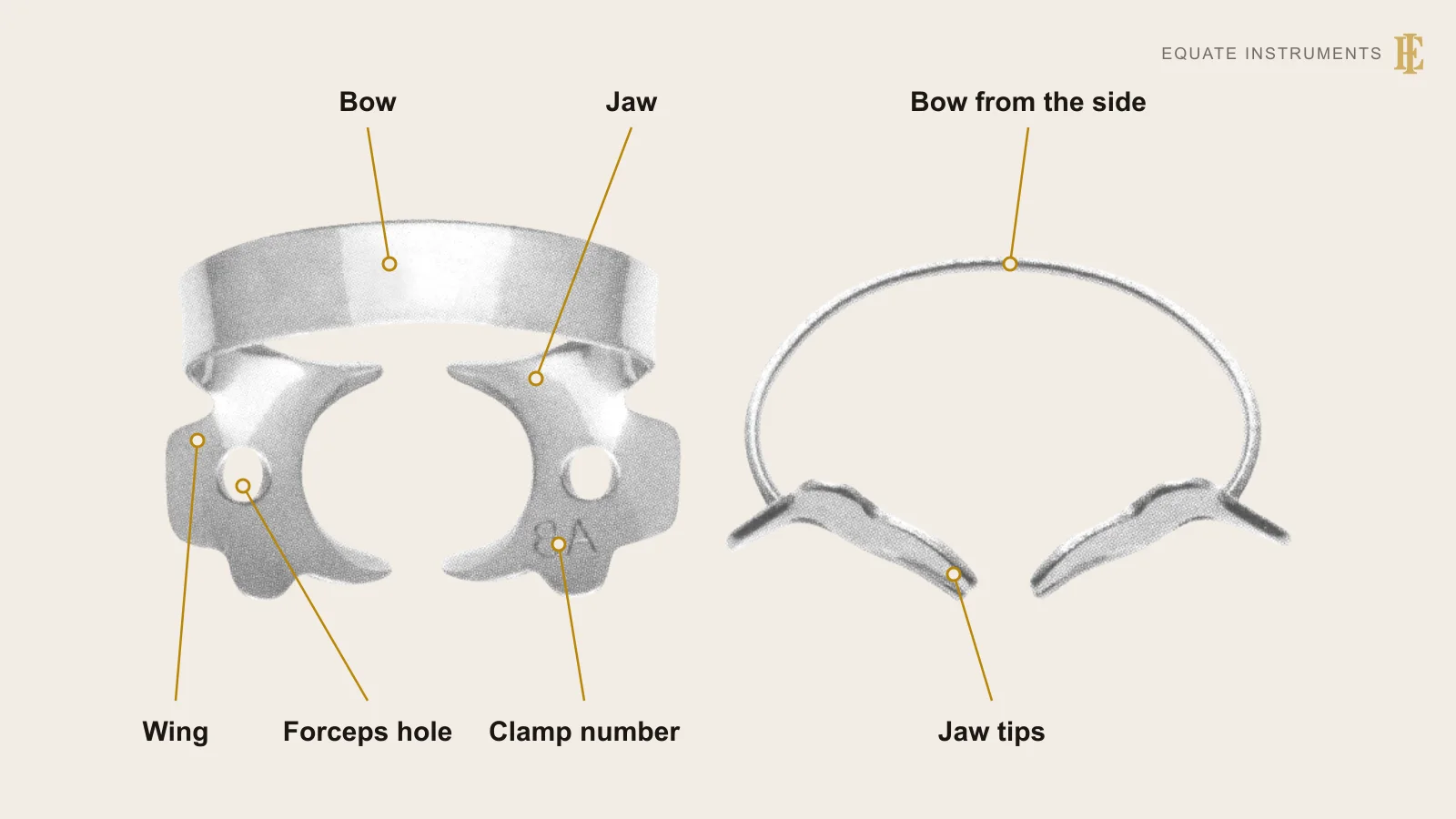
A rubber dam clamp has a spring bow and two jaws, and the jaws are shaped to grip the tooth below its height of contour at four points. The bow is the arched spring that joins the jaws, and it normally faces distally so it stays out of the way. Each jaw has a hole for the forceps beaks. The jaws can be flat, for teeth with a clear cervical bulge, or festooned (scalloped) to reach down onto roots and partly erupted or broken-down teeth; serrated jaws add grip on conical crowns.
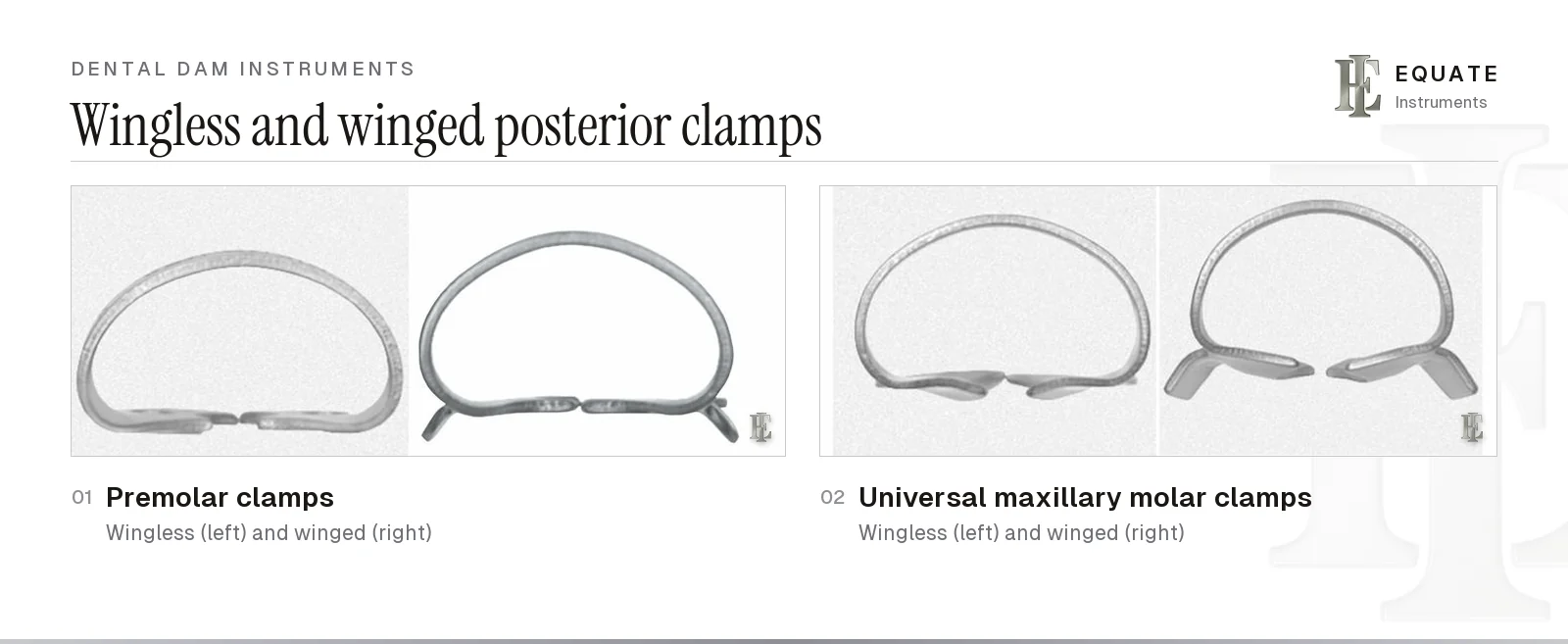
Wings are flat extensions on the jaws. A winged clamp holds the dam away from the tooth for visibility and lets the clamp and sheet go on together, with the dam stretched over the wings and flicked off them once seated. A wingless clamp, usually marked with a W, is smaller and suits placing the clamp first and stretching the dam over it, or tight access at the back of the mouth. The dam can also be stretched over a wingless clamp's bow before it goes in, so both are carried to the tooth together (one maker calls this the modified winged technique).
Which clamp number fits which tooth?
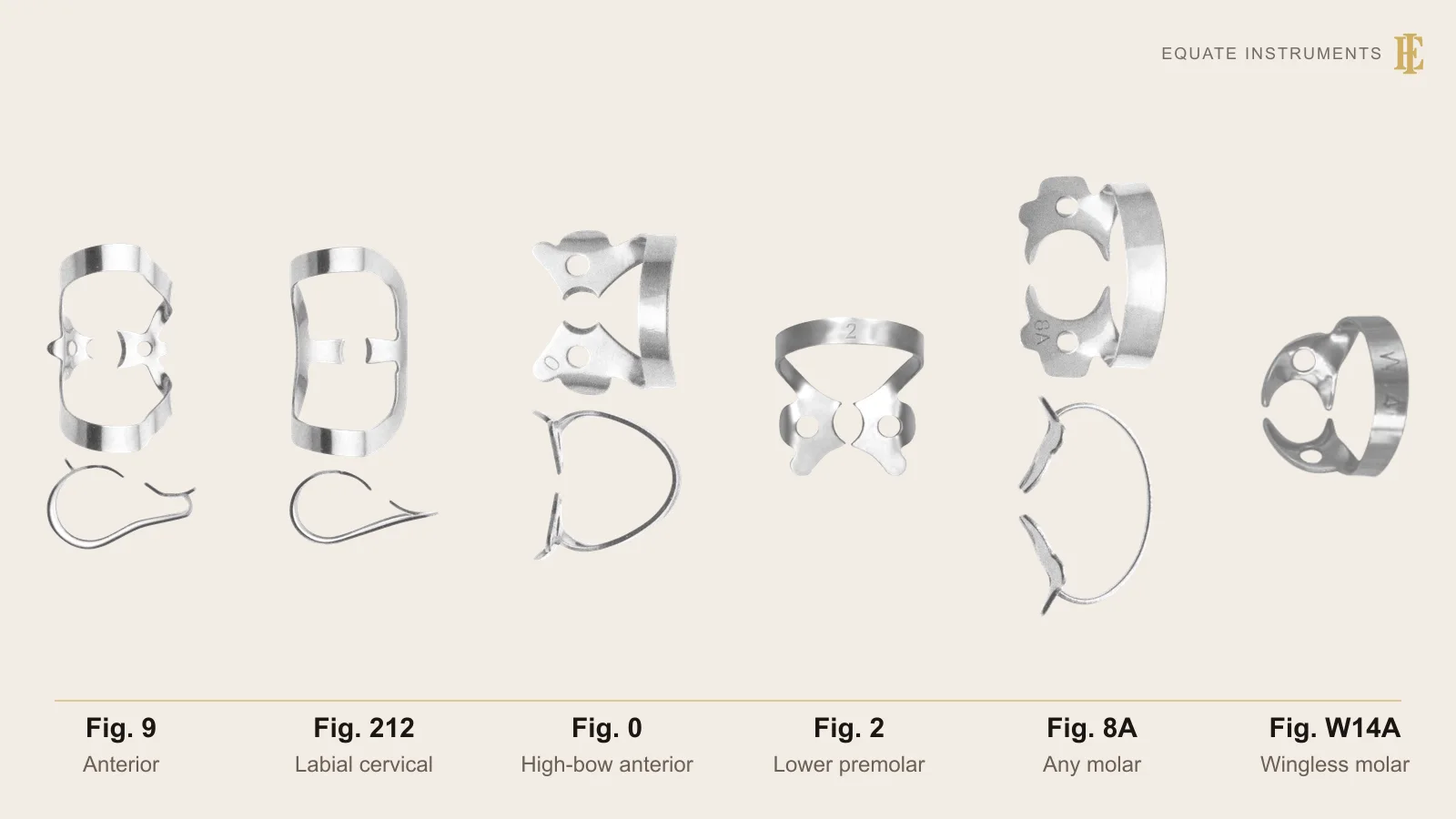
Clamp numbers follow long-established pattern series, so the figure number tells you which tooth group the clamp was designed for. Numbering isn't fully standardised between makers, so always try the clamp on the tooth before the dam goes on.
| Tooth group | Common clamp patterns | Notes |
|---|---|---|
| Incisors and canines | 9, 212, 6, 29, 210 | 9 is a double-bow butterfly clamp; 212 retracts the gingiva for cervical (Class V) work |
| Small anteriors and narrow premolars | 0, 00 | Makers disagree: in the Ivory chart 00 is the small lower anterior clamp and 0 a premolar clamp for small necks, while some catalogues, Equate's included, list them the other way round |
| Upper premolars | 1, 1A, 27N, 206, 208, 209 | 1A has deeply festooned jaws for premolar roots; in the Ivory chart 27N is the universal premolar clamp, while a plain 27 is a distal-access molar clamp |
| Lower premolars | 2, 2A, 2AS, W2 | Flat jaws for the rounder lower premolar crown |
| Upper molars | 8, 4, 5, 26N, 201, 205, W4 | 30 and 31 have offset jaws for right and left upper molars |
| Lower molars | 7, 7A, 3, 202, W7, W3 | 12A and 13A are serrated for lower right and lower left molars |
| Any molar | 8A, W8A, 14, 14A, W14A, 18, 56 | 14 and 14A, festooned, suit partly erupted or undersized molars; 56 suits large molars of either arch |
What is the difference between Ivory and Ainsworth punches?
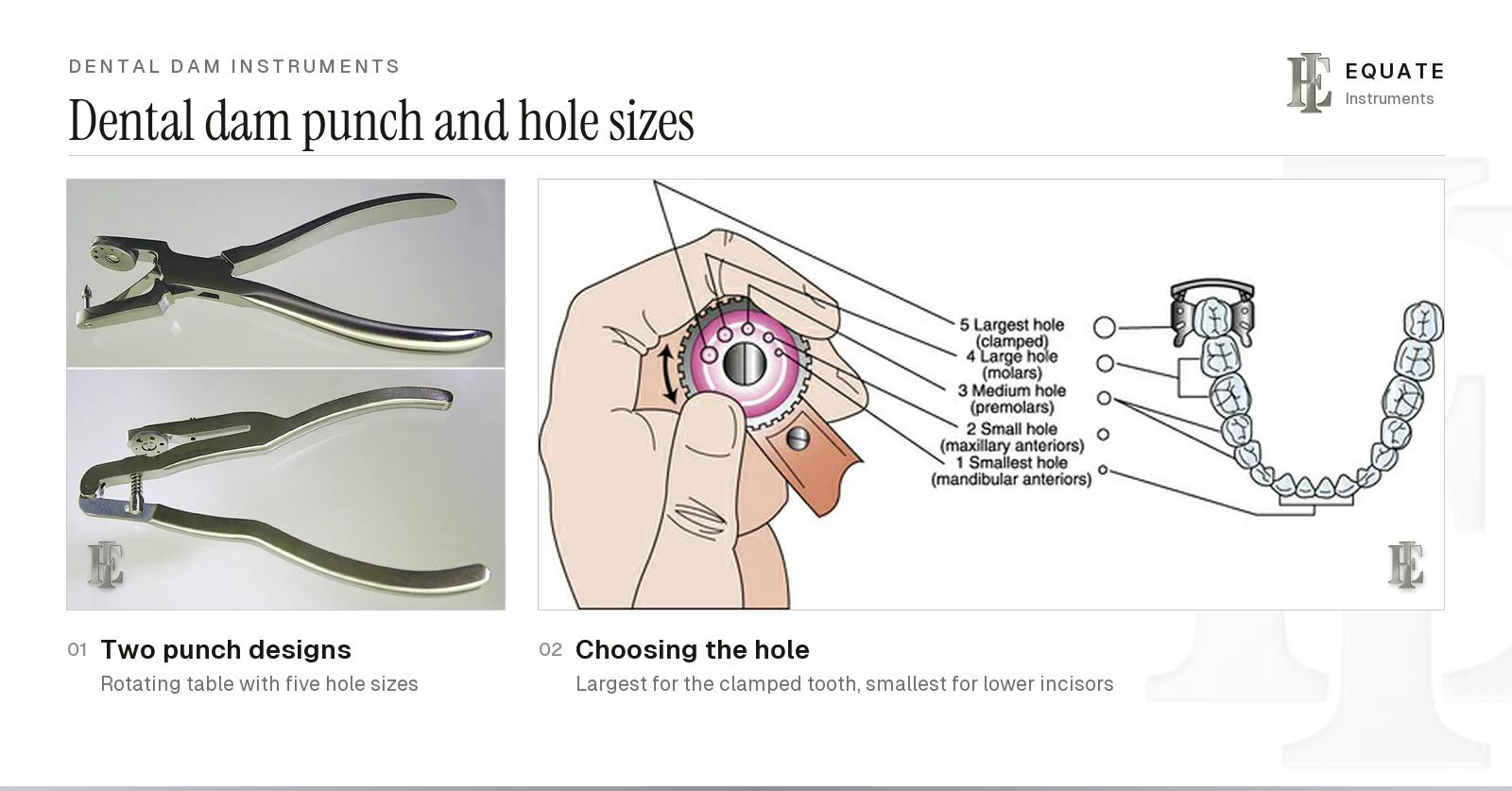
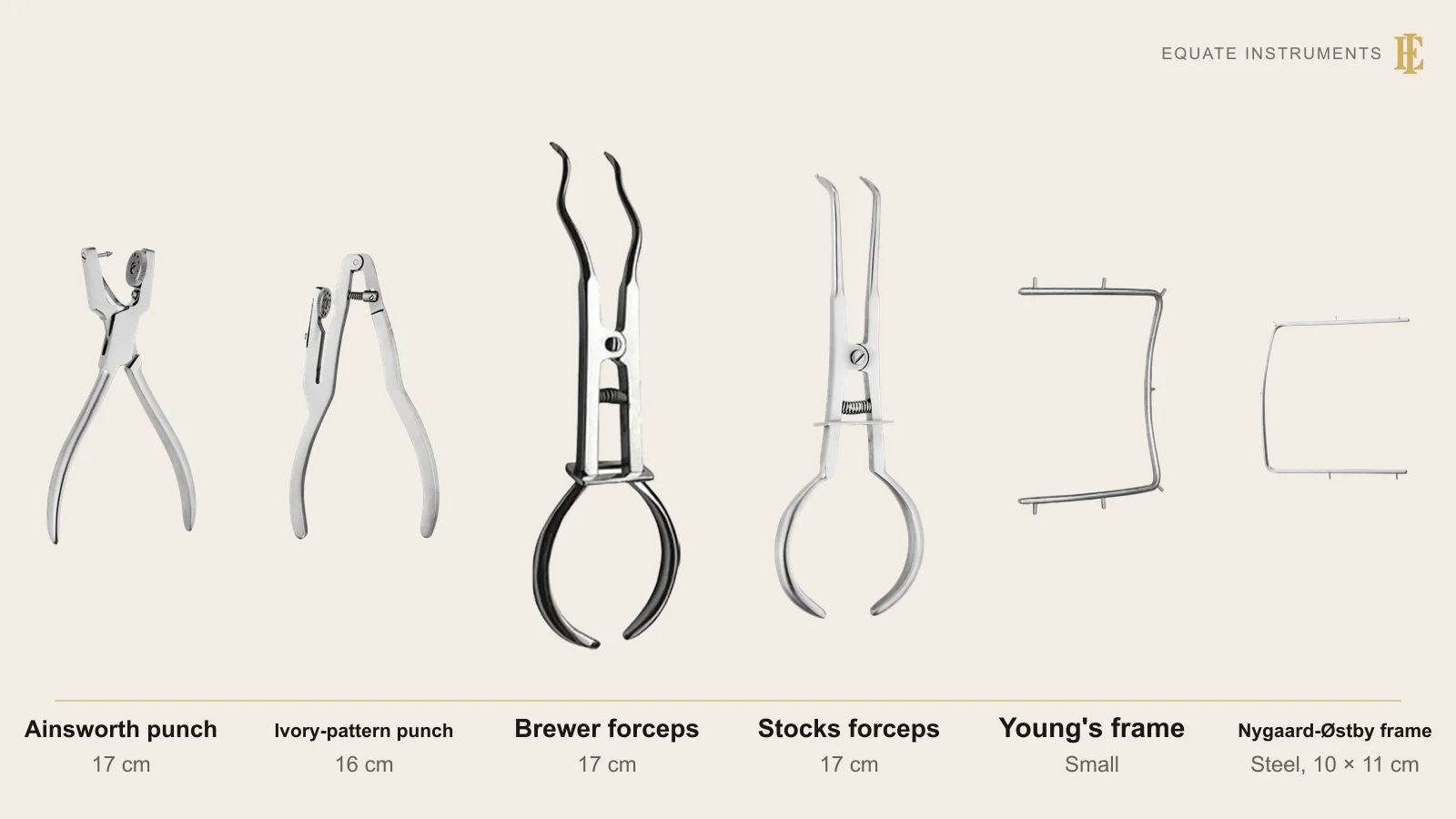
Ivory and Ainsworth rubber dam punches both cut clean round holes with a pointed punch pin that drives into a rotating table of graduated holes; they differ mainly in size, handle shape and how the table and pin are serviced. The Ainsworth pattern is the classic long-handled punch, 17 cm in Equate's range; the Ivory pattern is more compact, 16 cm, and its pin, table, pad and springs can be replaced as a spare-parts kit. Hole diameters and the number of holes vary by maker, so check the table against the thickness of dam you use.
Whatever the punch, the rule is the same: the smallest hole for the smallest tooth, and the largest for the tooth carrying the clamp, as in the hole-by-hole chart. Leave about 3 to 3.5 mm of dam between neighbouring holes, matched to the width of the interdental papilla: holes too close together tear and holes too far apart leave dam bunched between the teeth. Manufacturer charts vary, and one maker puts the canines with the premolars at No. 3. If the pin stops cutting cleanly, replace it from the spare-parts kit rather than forcing it.
| Hole (smallest to largest) | Teeth |
|---|---|
| Smallest | Lower incisors |
| Small | Upper incisors, upper and lower canines |
| Medium | Premolars |
| Large | Molars |
| Largest | The clamped anchor tooth |
What is the difference between Young's and Ostby frames, and which forceps?
A Young's frame is a flat, U-shaped metal frame that sits outside the dam, while an Ostby (Nygaard-Ostby) frame is curved to follow the face and is often made in radiolucent plastic so it can stay on for a working-length radiograph. Both have small pins round the edge that hold the sheet taut. Metal frames are more durable and are autoclaved with the kit; a small Young's frame suits children and anterior isolation. Preframed dams combine sheet and frame in one single-use unit, and a dam can be held with floss or elastic ligatures instead of a clamp; both are shown in the dental dam instruments guide.
Clamp forceps have beaks that fit the holes in the clamp jaws, a spring that opens the jaws when the handles are squeezed, and a sliding bar or rail that holds the clamp spread while it's carried to the tooth. Brewer and Stocks are two long-standing patterns; choose by how the handles sit in your hand and whether the beaks hold both winged and wingless clamps securely without slipping out of the holes. Some clamp forceps also open sectional-matrix rings, though not every pattern spreads a ring far enough; see matrix band retainers.
How do you place a clamp safely and reprocess the kit?
Tie a length of floss round the bow of the clamp before it goes into the mouth and keep the end outside the dam, so a clamp that breaks or springs off can be retrieved at once. Spread the clamp only as far as it needs to clear the crown, because overspreading fatigues the bow and makes fracture more likely. Seat the lingual jaw first, then the buccal, check that all four points touch the tooth below its bulge and that the gingiva isn't trapped, and avoid seating jaws on porcelain or thin enamel margins that may chip. Use a non-latex dam for patients with latex allergy. The full placement sequence is on the tray setup page.
After the procedure, clean clamps, forceps, punch and frame before heat sterilisation. Brush the forceps holes and the punch table, clean hinged instruments open, dry the forceps spring, and lubricate the punch and forceps joints if the manufacturer's ISO 17664 instructions say so. Inspect clamps after every cycle and discard any with a crack, a sprung bow or prongs that no longer meet evenly, rather than straightening them. The CDC's 2003 guidelines and, in the UK, HTM 01-05 set the cleaning and sterilisation steps.
What does the Equate rubber dam range include?
Equate lists 99 rubber dam instruments. There are 71 single clamps: 9 anterior, including the 9, 212 and 0 patterns; 13 premolar, including 1, 1A, 2 and 2A; 12 universal molar, including 8A, W8A and W14A; and 37 molar clamps for the upper and lower arches, including side-specific 12A, 13A, 30 and 31 patterns. Nine are wingless. Three 13-piece clamp sets come on trays or in kits, and there are 11 clamp forceps, including Brewer and Stocks patterns.
The four punches are an Ainsworth pattern, an Ivory pattern and two new-design punch pliers, one spring-loaded. The five frames are a small Young's pattern and adult frames of 9 × 9, 9 × 10, 10 × 7.5 and 10 × 11 cm, and there are five complete kits of 4 to 17 pieces, from a punch-and-clamp-forceps kit of 4 to 12- and 17-piece sets. Designed in Finland; browse the prosthodontic and laboratory family or request samples and a quote.
The Equate difference
Equate's rubber dam range includes side-specific molar clamps (12A and 13A for lower right and left, 30 and 31 for upper right and left, 24 and 25 for opposite-quadrant pairs), 9 wingless clamps including the B4, Brewer and Stocks clamp forceps, and both Ainsworth (17 cm) and Ivory-pattern (16 cm) punches, with a spare-parts kit for the Ivory pattern.
Equate Rubber Dam Clamps, Forceps, Punches and Frames: Which to Choose options

Ainsworth Rubber Dam Punch 17cm
EI-0724
Ivory-Pattern Rubber Dam Punch 16cm
EI-0725
Rubber Dam Clamp Forceps 17cm
EI-0727
Rubber Dam Clamp Forceps, Stocks Pattern - 17 cm
EI-0728
Brewer Rubber Dam Clamp Forceps 17cm
EI-0729
Brewer Rubber Dam Forceps
EI-0730
Rubber Dam Clamp Forceps, Stocks Pattern - 17 cm
EI-0731
Rubber Dam Clamp Forceps - Straight Beaks
EI-1504
Rubber Dam Punch Plier, New Design, 17 cm
EI-2372
Rubber Dam Punch Plier, New Design, Spring-Loaded, 17 cm
EI-2373
Rubber Dam Clamp Forceps - Angled Beaks
EI-2374
Rubber Dam Clamp Forceps, Serrated, Color-Coded Handles
EI-2375Browse all prosthodontic & laboratory instruments Browse all oral surgery instruments
Buying in your market
Frequently asked questions
What are rubber dam forceps used for?
Rubber dam forceps, also called dental dam or clamp forceps, spread a rubber dam clamp so it can be carried over the crown and seated on the tooth, then spread it again for removal. A sliding bar holds the clamp open while it's moved.
What is the difference between a winged and a wingless rubber dam clamp?
A winged clamp has flat extensions that hold the dam back and let the clamp and dam go on together. A wingless clamp, usually numbered with a W, is smaller and is usually placed first with the dam stretched over it, although the dam can also be stretched over its bow before it goes in.
Why do you tie floss to a rubber dam clamp?
The floss ligature lets you pull the clamp straight out if it fractures or springs off the tooth. A loose clamp with no ligature can be swallowed or inhaled, so tie the floss round the bow before the clamp goes into the mouth.
What do the letters W, A and T in a rubber dam clamp number mean?
In the common Ivory-style series a leading W marks a wingless clamp, and a trailing A a slightly larger version, which one maker describes as having subgingival jaws. A T (or S in some catalogues) marks serrated jaws, and DT distal access with serrated jaws. Letters are not standard across makers: Equate's B4, for example, is wingless without a W.
Which rubber dam clamp is used for a lower molar?
The 7 is the general-purpose lower molar clamp, with 3 for small and 7A for large lower molars, 202 as a large flat-jawed option and 56 for large molars of either arch. The 12A and 13A suit lower right and left molars, and a festooned 14 or 14A partly erupted ones. Try the clamp on the tooth before placing the dam.
Which rubber dam clamp is used for an upper molar?
In the Ivory chart the 8 is the general-purpose upper molar clamp, the 4 suits small upper molars with round necks, the 5 large upper molars and the 26N is a universal upper clamp. The 14 and 14A grip partly erupted molars, and the 8A or wingless W8A molar roots. Equate stocks all of these patterns.
Is rubber dam required for root canal treatment?
The European Society of Endodontology's quality guidelines say root canal treatment should be done only under rubber dam, and the American Association of Endodontists calls it the standard of care. In the UK, the British Endodontic Society's 2022 guide says omitting it to save time is not advisable and exposes the operator to medico-legal challenge.
Can a rubber dam frame stay on for radiographs?
A radiolucent plastic frame can usually stay on. A metal frame shows on the image, so it's removed or moved aside for the exposure.
References
- European Society of Endodontology. Quality guidelines for endodontic treatment: consensus report of the European Society of Endodontology. International Endodontic Journal 2006;39(12):921–930
- American Association of Endodontists. AAE Position Statement: Dental Dams. AAE, 2024
- Lin PY, Huang SH, Chang HJ, Chi LY. The effect of rubber dam usage on the survival rate of teeth receiving initial root canal treatment: a nationwide population-based study. Journal of Endodontics 2014;40(11):1733–1737
- Ahmad IA. Rubber dam usage for endodontic treatment: a review. International Endodontic Journal 2009;42(11):963–972
- Berman LH, Hargreaves KM (eds). Cohen's Pathways of the Pulp. Elsevier (tooth isolation)
- Boyd LB. Dental Instruments: A Pocket Guide, 7th edition. Saunders/Elsevier, 2020 (photographs used under licence)
- Kohn WG, et al. Guidelines for Infection Control in Dental Health-Care Settings, 2003. MMWR 52(RR-17), Centers for Disease Control and Prevention
- British Endodontic Society. A Guide to Good Endodontic Practice, 1st edition (ed. Tomson PL), 2022
- Kulzer. Ivory Rubber Dam Clamps: product overview and clamp selection chart
- Coltene/Hygenic. Dental Dam Procedures: Basic Techniques (technique booklet 40002739H)
I am a…
Related
- Dental Dam Instruments Explained, from Sheet to Frame
- Rubber Dam (Dental Dam) Tray Setup and Placement
- Endodontic Hand Instruments
- Restorative Dental Hand Instruments
- Dental Composite Instruments: Placement, Sculpting and the Composite Gun
- Endodontic Tray Setup: Opening and Sealing a Tooth
- Dental Burnishers: Ball, Football, Acorn, T-Ball and Beavertail
- Tofflemire and Other Matrix Band Retainers
- Endodontic Instruments for Root Canal Treatment