Dental Local Anaesthetic and Nitrous Oxide Sedation Equipment: What Each Part Does
Written by the Equate Instruments Technical Team · Reviewed by the Medical & Dental Board, Equate Instruments · Updated ·
Dental local anaesthetic equipment is the reusable aspirating cartridge syringe plus the single-use parts loaded into it: a sterile needle, short or long, and a glass cartridge of anaesthetic solution. A recapping aid protects staff from needlestick injuries. Nitrous oxide sedation adds gas cylinders, a flowmeter that mixes nitrous oxide with oxygen, and a nasal mask linked to a scavenging system.
Key points
- The syringe is the only reusable, sterilisable part of the anaesthetic setup; needles and cartridges are single use and go straight into a sharps container.
- A harpoon on the piston lets the clinician pull back on the cartridge plunger and check for blood before injecting, which is why most dental syringes are aspirating designs.
- Nitrous oxide units mix gas from separate cylinders, cut the nitrous oxide flow if oxygen fails, and scavenge exhaled gas to protect the dental team.
What equipment is used for dental local anaesthesia and sedation?
Almost every operative appointment, from amalgam and composite restorations to extractions with forceps, and many hygiene visits start with local anaesthesia, so the anaesthetic setup sits beside the basic dental instruments on most trays. Boyd's Dental Instruments: A Pocket Guide groups it with nitrous oxide inhalation sedation, the other common way of making treatment more comfortable for anxious patients in general practice.
The two systems have different jobs. Local anaesthesia blocks sensation in one area of the mouth; nitrous oxide–oxygen sedation relaxes the patient while they stay awake and responsive. This guide describes the equipment and what each part is for. It is not clinical instruction: drug choice, technique and patient selection belong to the clinician's training and national guidance.
| Item | What it does | Reusable or single use |
|---|---|---|
| Aspirating cartridge syringe | Holds the cartridge and needle; lets the clinician aspirate before injecting | Reusable; cleaned and heat sterilised after every patient |
| Short and long needles | Carry solution from the cartridge to the tissue; short for infiltration, long for nerve blocks | Single use, sterile; sharps container |
| Anaesthetic cartridge | Glass tube of anaesthetic solution sealed by a diaphragm and a rubber plunger | Single use; sharps or pharmaceutical waste as national rules require |
| Recapping aid | Holds the needle cap so the needle can be covered with one hand | Reusable metal holders are sterilised; plastic ones as the maker instructs |
| Computer-controlled delivery unit | Motor-driven unit that injects at a programmed, steady rate through a pen-like handpiece | Unit disinfected; handpiece, tubing and needle single use |
| Nitrous oxide and oxygen cylinders, flowmeter, nasal mask | Supply, mix and deliver the sedation gases, and remove the excess | Equipment disinfected; masks reprocessed or discarded as the maker instructs |
The aspirating syringe: parts and how it works
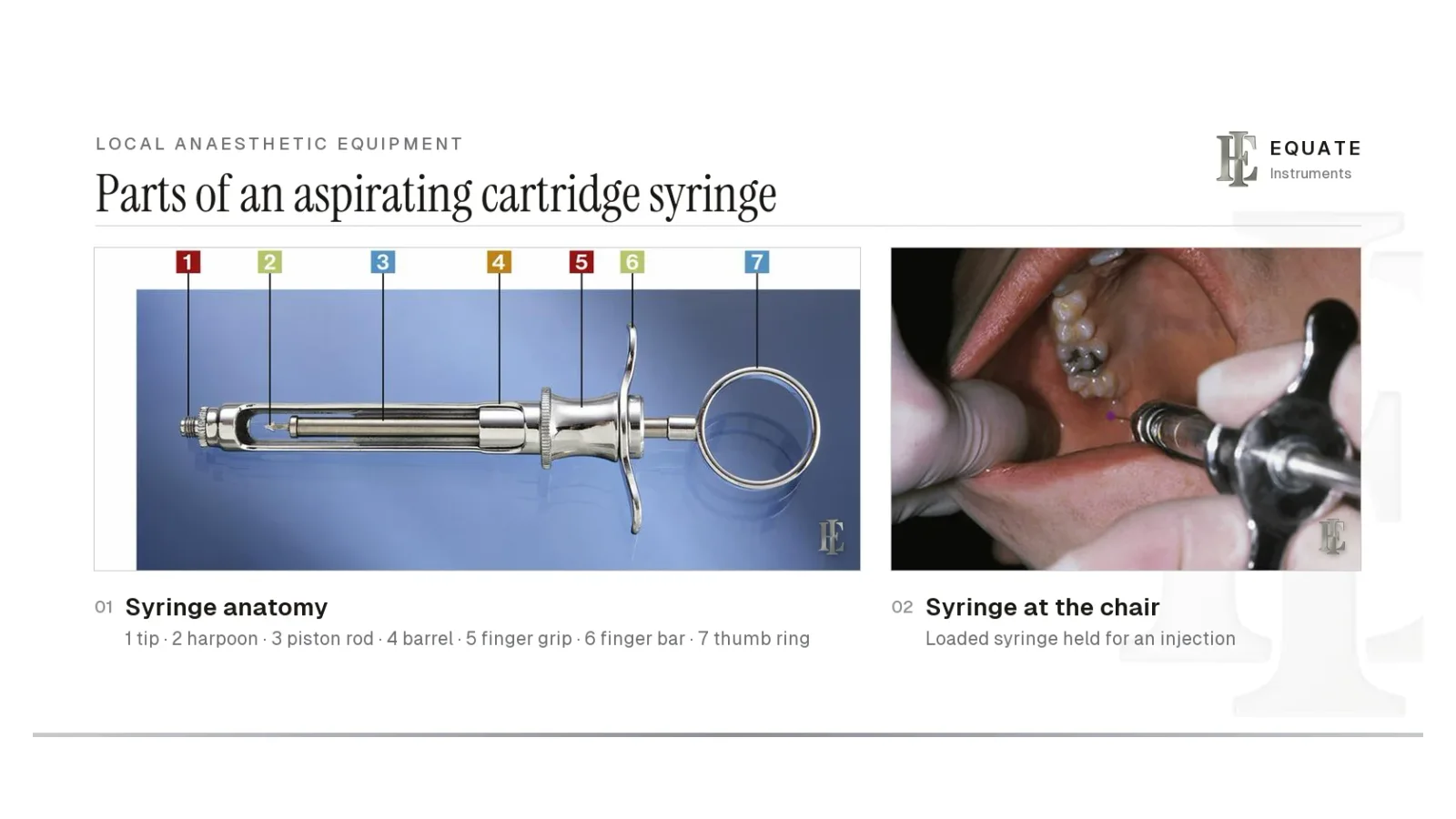
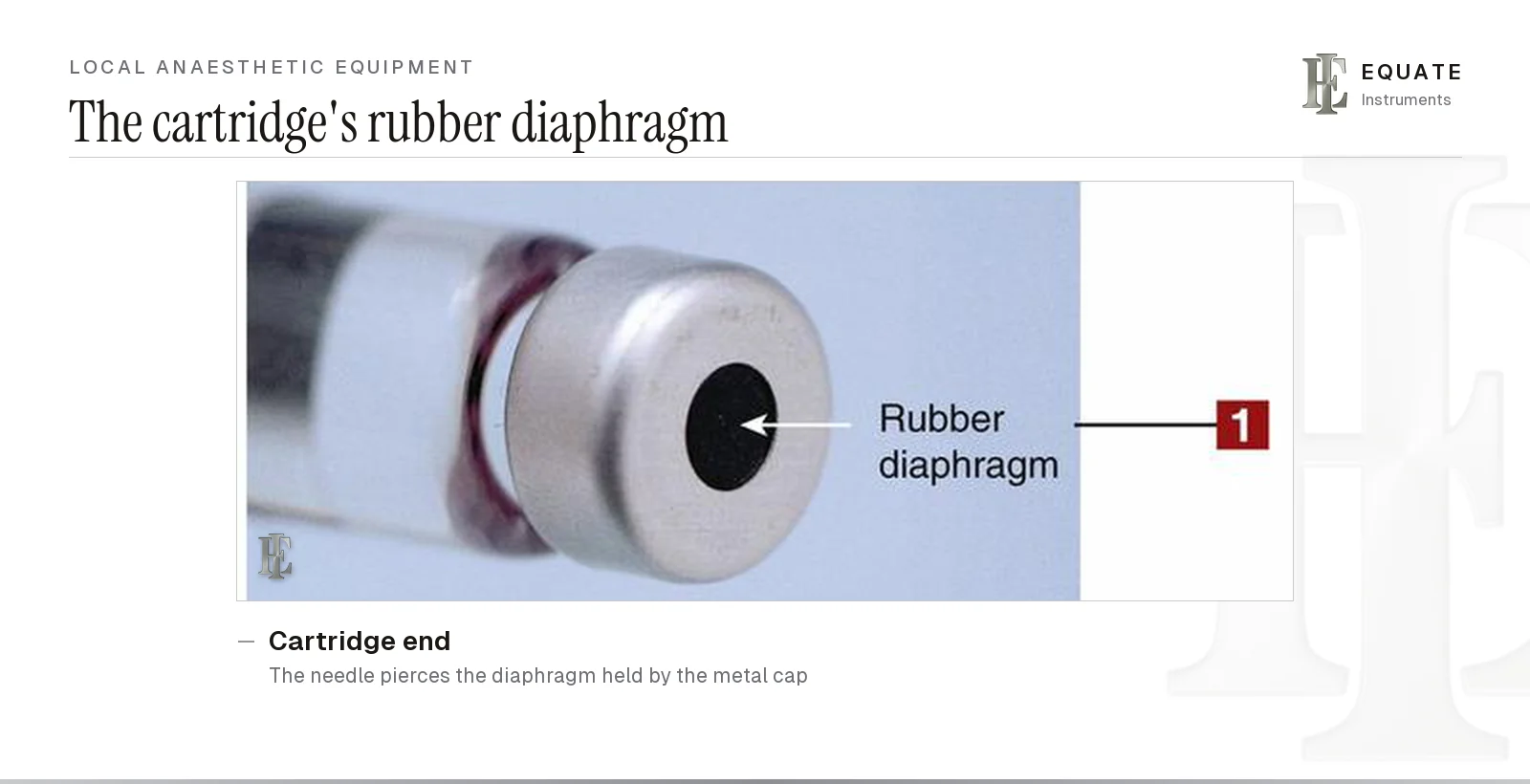
A dental cartridge syringe is a metal frame that a glass cartridge drops into from the side. At the front, a threaded tip accepts the needle hub, and the back end of the needle pierces the cartridge's rubber diaphragm as it is screwed on. Behind the cartridge, a piston rod runs through the barrel to the finger grip, finger bar and thumb ring that the clinician holds.
The small barbed point on the front of the piston is the harpoon. Pushed firmly into the cartridge's rubber plunger, it locks piston and plunger together, so pulling back on the thumb ring draws the plunger back too. That creates a slight negative pressure in the cartridge, and if the needle tip lies in a blood vessel, blood shows in the solution. Checking this before injecting is called aspiration, and a syringe built to do it is an aspirating syringe. Positive results turn up often enough in nerve blocks that clinicians aspirate before every deposit; the incidence data and the habit of aspirating in two planes are covered on the syringe page.
Self-aspirating syringes have no harpoon. They rely on the elastic rebound of the cartridge diaphragm: when the clinician eases thumb pressure, the rubber springs back and draws a small negative pressure without pulling. Non-aspirating syringes simply push the plunger. Disposable plastic syringes preloaded with anaesthetic and fitted with a needle also exist; they're used once and discarded whole.
Dental needles: short, long and gauge
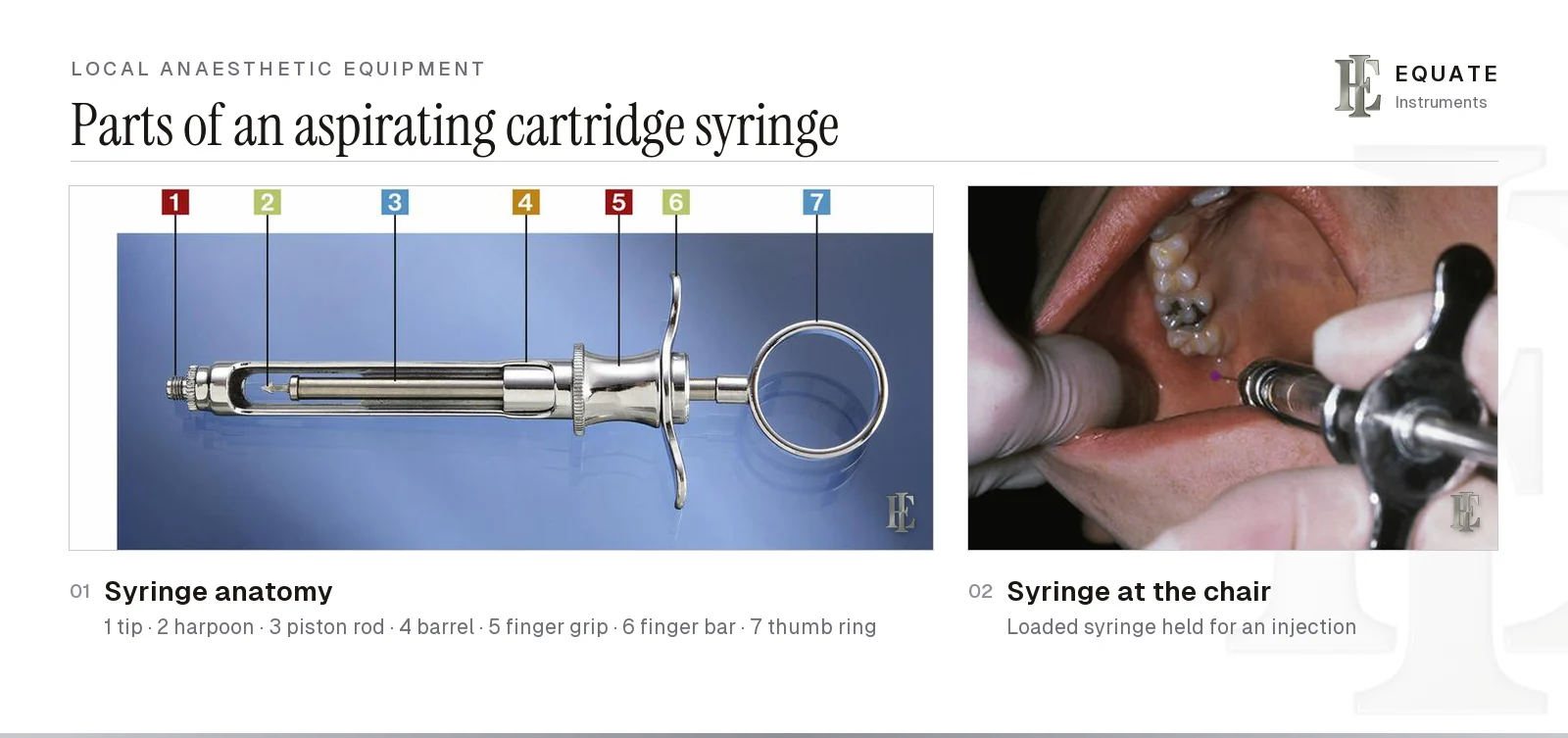
Dental needles are double-ended. The shorter cartridge end goes through the cartridge diaphragm; the longer injection end goes into the tissue. Between them sits a plastic hub that screws onto the syringe tip. The hollow centre of the needle is the lumen, and the angled cut at its point is the bevel. A protective cap with a seal covers the needle until use, and a guard covers the cartridge end.
Needles come in two common lengths. Short needles, typically about 20–25 mm, suit infiltration injections, which in the book's description are typical in the upper arch. Long needles, typically about 30–35 mm, are used for nerve block injections, most often in the lower jaw. Boyd quotes the US labels of about 1 inch and 1⅝ inches; metric lengths vary by maker, and extra-short needles are also sold. Standard teaching is never to insert a needle right up to its hub, because the junction with the hub is where a needle is most likely to break.
Gauge describes the diameter, and the scale runs backwards: the higher the gauge number, the thinner the needle, so a 30-gauge needle is finer than a 27 or 25 gauge. Thinner needles are not reliably less painful, and they bend more easily in tissue, so many clinicians prefer a sturdier gauge for deep blocks. Dental injection needles are sterile, single use and covered by the international standard ISO 7885 (adopted in Europe as EN ISO 7885); a needle is never reused between patients, and because the tip blunts with each penetration, many clinicians change it during long appointments.
Anaesthetic cartridges and how to check them
An anaesthetic cartridge, sometimes called a carpule, is a glass cylinder with a metal cap at one end holding a thin rubber diaphragm, and a rubber plunger at the other. The needle passes through the diaphragm; the syringe's harpoon engages the plunger. ISO 11499 covers single-use dental anaesthetic cartridges in nominal sizes of 1.0, 1.7, 1.8 and 2.2 ml, and the syringe must match the cartridge size it is designed for.
Each cartridge is printed with the drug, its concentration, any vasoconstrictor, batch number and expiry. In the US, the American Dental Association adopted a uniform colour band for each drug in 2003, which Boyd describes. ISO 11499:2014 also defines a two-band code, with Band 1 for the anaesthetic and its strength and Band 2 for the vasoconstrictor (white means none), but leaves its use to the manufacturer, so a cartridge may carry no bands or a maker's own colours. The printed label is what counts. Which solution to use, with or without a vasoconstrictor, is a clinical decision based on the patient's medical history and the procedure.
Before loading, check that the glass isn't cracked or chipped, the cap isn't corroded, the solution is clear and in date, and the plunger sits just inside the rim of the glass rather than pushed out. Keep cartridges in their blister pack until needed, take out only what the procedure requires, and discard any cartridge that has been used, even partly, on another patient. The order in which the cartridge and needle go into the syringe is set out on the local anaesthetic tray setup page.
| Band 1 colour | Anaesthetic and strength (ISO 11499:2014, Table 1) |
|---|---|
| Red | 2% lidocaine |
| Purple | 3% lidocaine |
| Brown | 2% mepivacaine |
| Tan | 3% mepivacaine |
| Orange | 3% prilocaine |
| Yellow | 4% prilocaine |
| Gold | 4% articaine |
| Blue | 0.5% bupivacaine |
Needle recapping and sharps safety
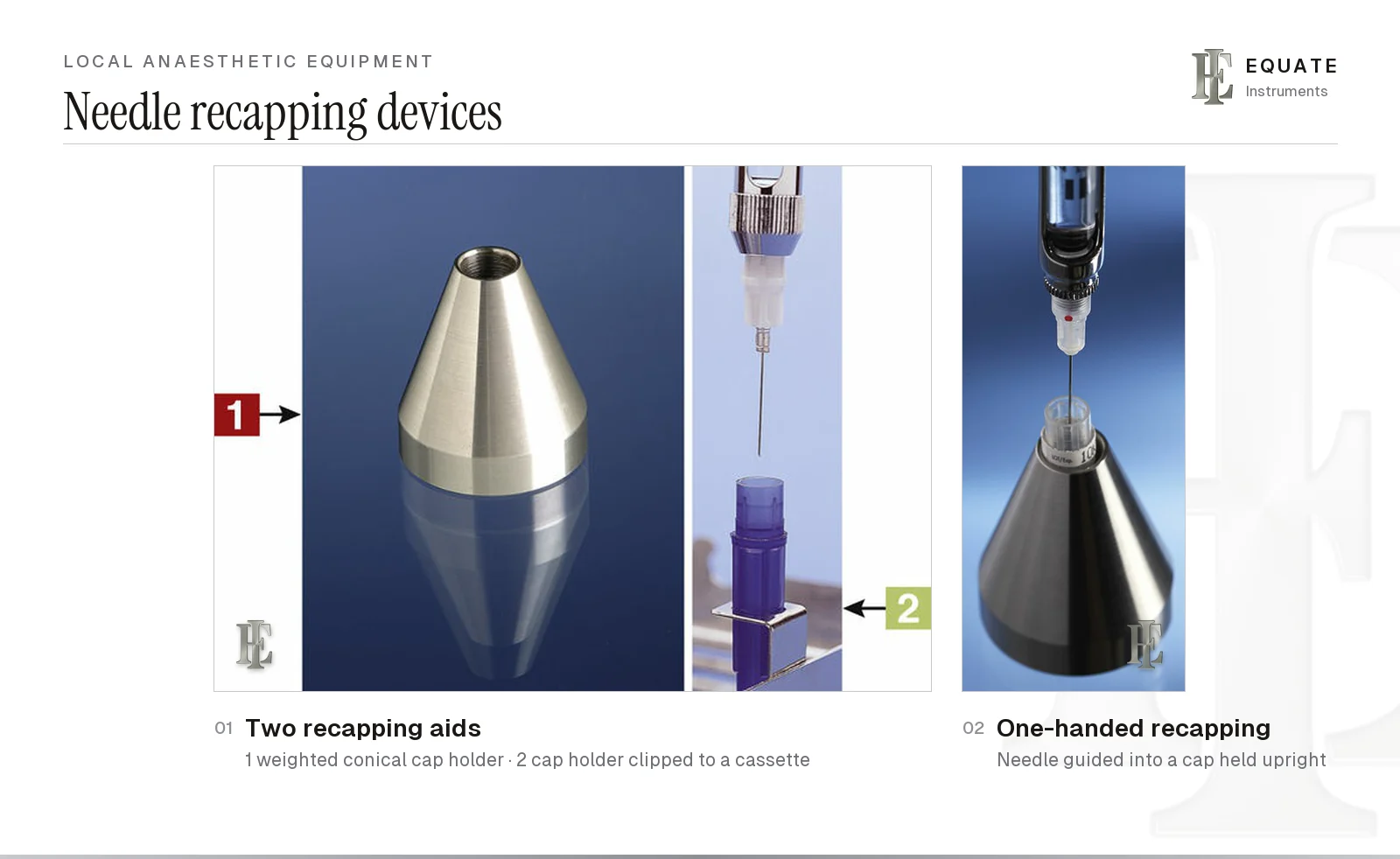
CDC guidance notes that most sharps injuries among dental staff happen outside the patient's mouth, and many of them come after an injection, while the needle is being covered, removed or cleared away. Recapping aids keep the hand away from the point. A weighted conical cap holder stands the cap upright on the tray so the clinician can slide the needle into it with one hand, and a clip-on holder does the same job from the edge of an instrument cassette.
Rules differ by country. CDC guidance in the US says used needles must never be recapped with two hands and that a one-handed scoop technique or a cap-holding device should be used. In the European Union, Council Directive 2010/32/EU on sharps injuries bans recapping as a general practice, and the UK's 2013 sharps regulations allow it only where the employer's risk assessment requires it and a device makes it safe. Where a reusable dental syringe has to be capped between injections, a recapping device or a safety syringe system is the usual answer. Follow your national rules and the practice's sharps policy.
Used needles, cartridges and disposable syringes go into a puncture-resistant sharps container at the point of use; containers and the rest of the practice's protective kit are covered in the sterilisation and protective equipment guide. Never bend or break a needle by hand, and unscrew it from the syringe with the cap on, using the hub. How to recap and unload during a procedure is set out step by step on the tray setup page.
Computer-controlled local anaesthetic delivery
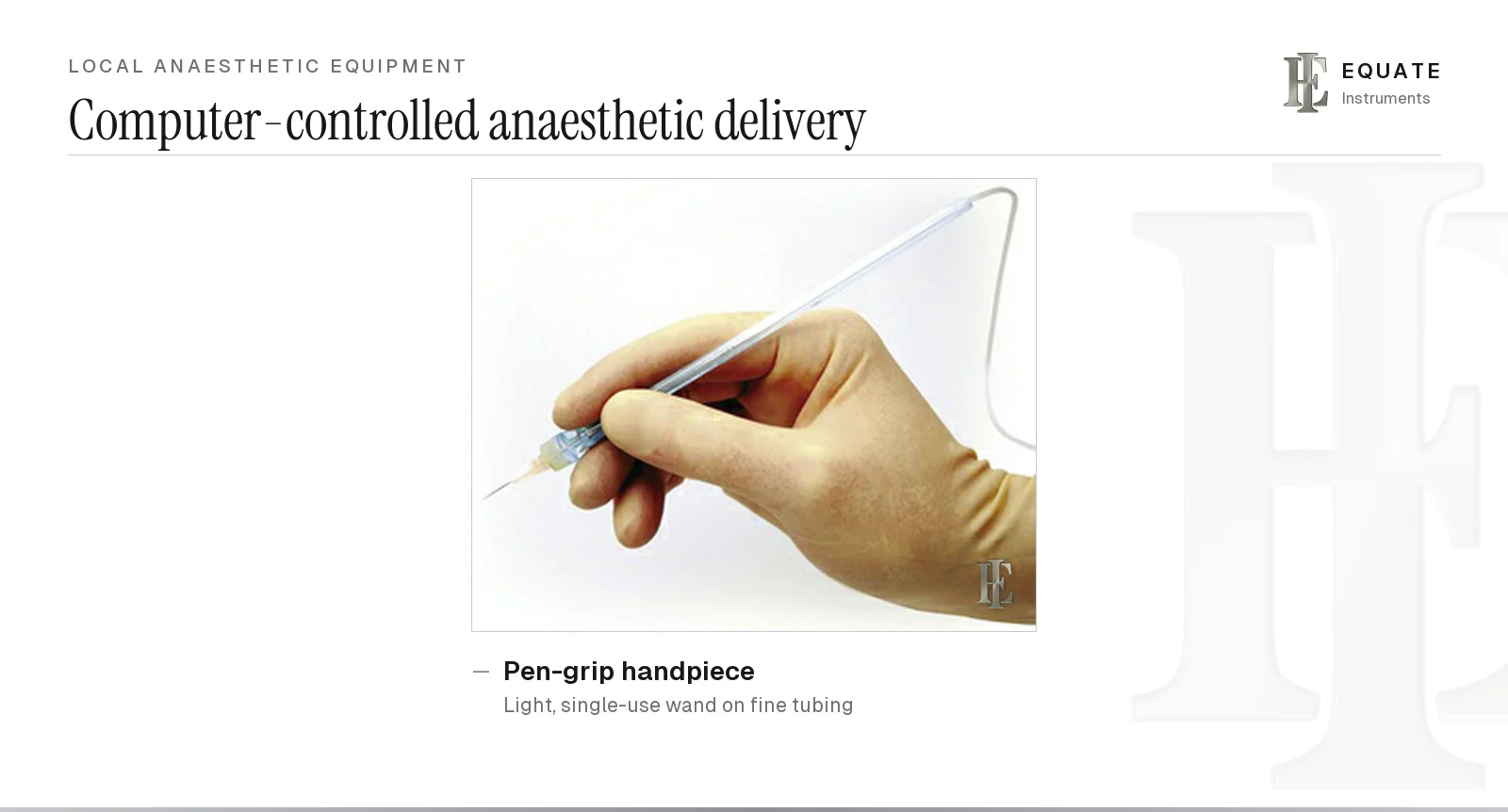
Computer-controlled anaesthetic delivery systems replace the hand-driven syringe with a small electric unit. The cartridge sits in the unit, and fine tubing runs to a light, single-use handpiece that the clinician holds like a pen. A foot control starts and stops the flow, and the unit pushes the solution at a steady, preset rate instead of relying on thumb pressure.
Because the motor handles the injection, the clinician can concentrate on needle placement, and the pen grip gives fine control. Evidence on comfort is mixed. A 2020 meta-analysis of 20 studies in children by Smolarek and colleagues found no difference in pain once only the trials at low risk of bias were analysed, while a 2025 review of 20 randomised trials in children by Shirani and colleagues found lower Wong-Baker pain scores with computer-controlled delivery, with the certainty of evidence rated very low to moderate. The units can be used for standard injections and for intraligamentary (periodontal ligament) injections, where the tissue resists flow. Aspiration is performed through the foot control. The handpiece, tubing and needle are single use; the unit itself is cleaned and disinfected as its manufacturer instructs.
Nitrous oxide sedation: cylinders, flowmeter and fail-safe
Nitrous oxide (N₂O) is a colourless, non-flammable gas with a faintly sweet smell. In dentistry it's always given mixed with oxygen, as inhalation sedation for anxious patients. Gas comes from separate cylinders, either mounted on a mobile stand or piped from a central store. Nitrous oxide cylinders are coded blue; oxygen cylinders are green in the US, as in Boyd's illustrations, but carry a white shoulder under the European and ISO colour code for medical gases, so staff should read the label rather than rely on colour.
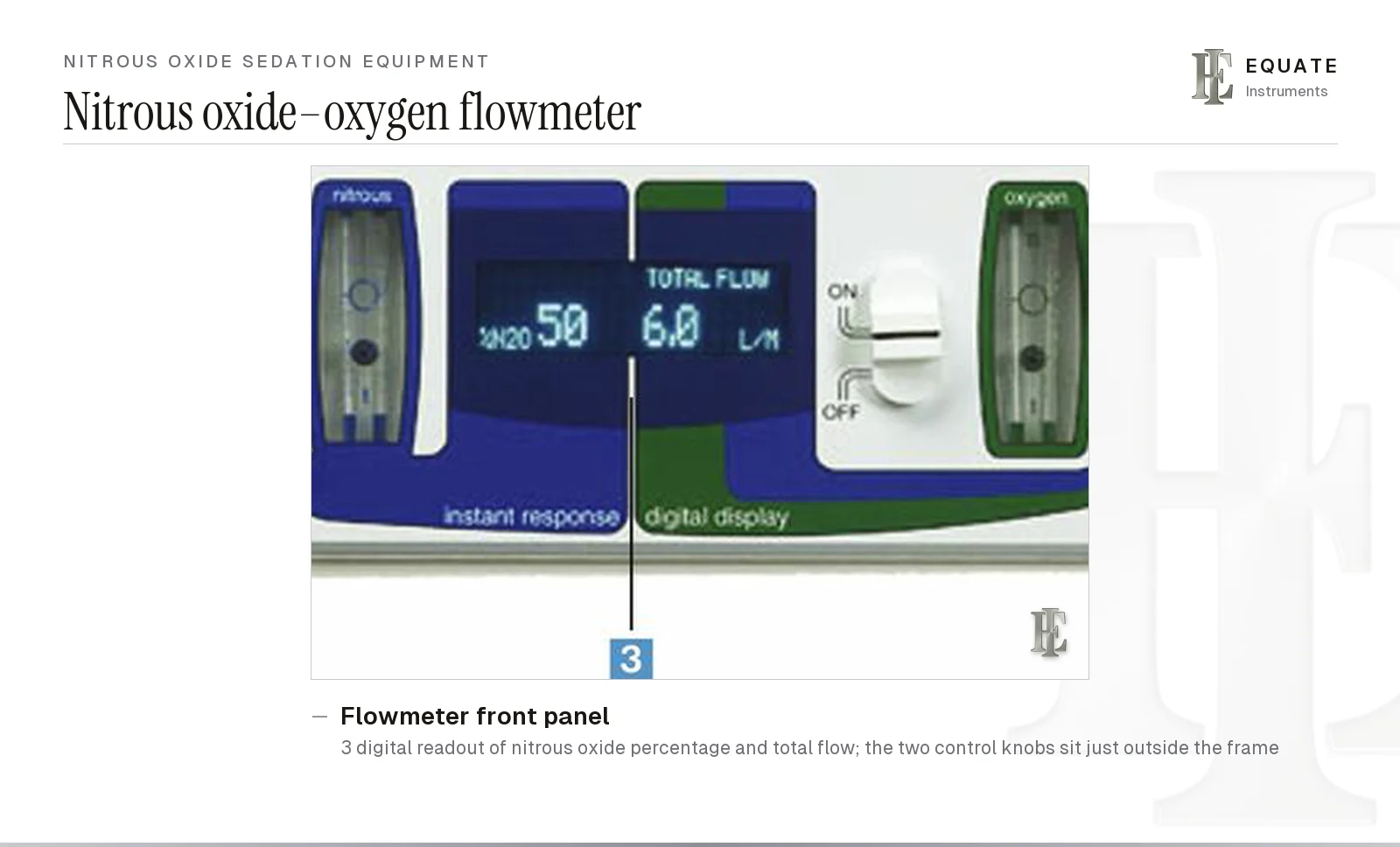
The flowmeter, or mixer, sits between the cylinders and the patient. One control sets the percentage of nitrous oxide, another sets the total flow of mixed gas in litres per minute, and many units show both on a digital readout alongside flow tubes for each gas. With the nitrous oxide control at zero, the patient receives oxygen alone, and an oxygen flush button delivers a burst of pure oxygen.
Dental sedation units have a fail-safe: if oxygen pressure falls, the nitrous oxide supply shuts off, so the patient can never receive nitrous oxide alone. The ADA describes units that are typically capped at 70% nitrous oxide and 30% oxygen, so the oxygen share never drops below 30%, with at least 2.5 to 3.0 litres of oxygen a minute, and an oxygen flush that gives pure oxygen in an emergency. At the end of the procedure the ADA recommends 100% oxygen for 5 minutes before the mask is removed; Boyd likewise notes that oxygen is given before the patient leaves the chair.
For UK practices, the Scottish Dental Clinical Effectiveness Programme's Conscious Sedation in Dentistry guidance (third edition, 2017) asks for dedicated, purpose-built inhalation sedation machines, which will not deliver a hypoxic mix, maintained to the manufacturer's instructions with regular, documented servicing. It also asks for cylinders to be stored safely and securely, and for room ventilation and active scavenging good enough to meet COSHH standards.
Nasal masks and scavenging
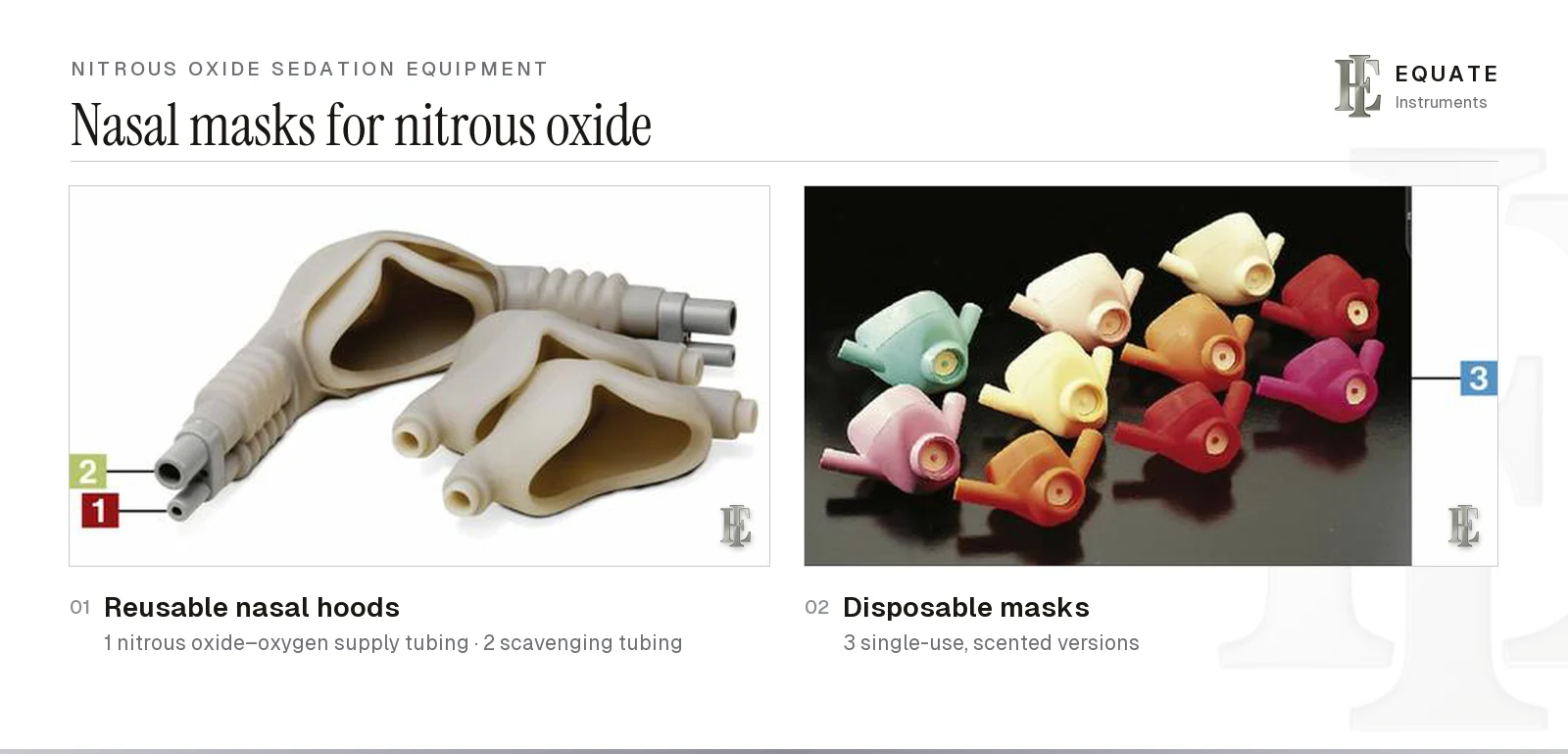
The gas mixture reaches the patient through a nasal mask (nasal hood). Masks come in child and adult sizes, as reusable hoods or disposable, often scented, single-use versions; a gauze square under the mask can make it more comfortable on the nose. A good seal matters more than the material, because a mask that leaks lets gas into the room.
Each mask has two sets of tubing. One brings fresh gas from the flowmeter; the other is connected to a scavenging system that draws exhaled and excess gas away through the practice's evacuation system. NIOSH found that leakage around the mask was the main source of nitrous oxide in dental operatories, and recommends that staff exposure be kept to about 25 parts per million, as a time-weighted average during administration. Scavenging, a well-fitted mask, good room ventilation, leak checks and asking the patient to talk as little as possible all help keep levels down. NIOSH's engineering-control guidance sets the mask's scavenging exhaust at 45 litres a minute, checked with a calibrated flow meter and vented outdoors. The ADA recommends inspecting the whole system, including hoses, mask and reservoir bag, before the first use each day, leak-testing the connections when the unit is switched on and whenever a cylinder is changed, and monitoring staff exposure periodically, about every six months.
Reusable masks and tubing are reprocessed exactly as the manufacturer instructs, and disposable masks are discarded after one patient. The cylinders, flowmeter and stand are surface disinfected between patients.
The local anaesthetic tray setup and reprocessing
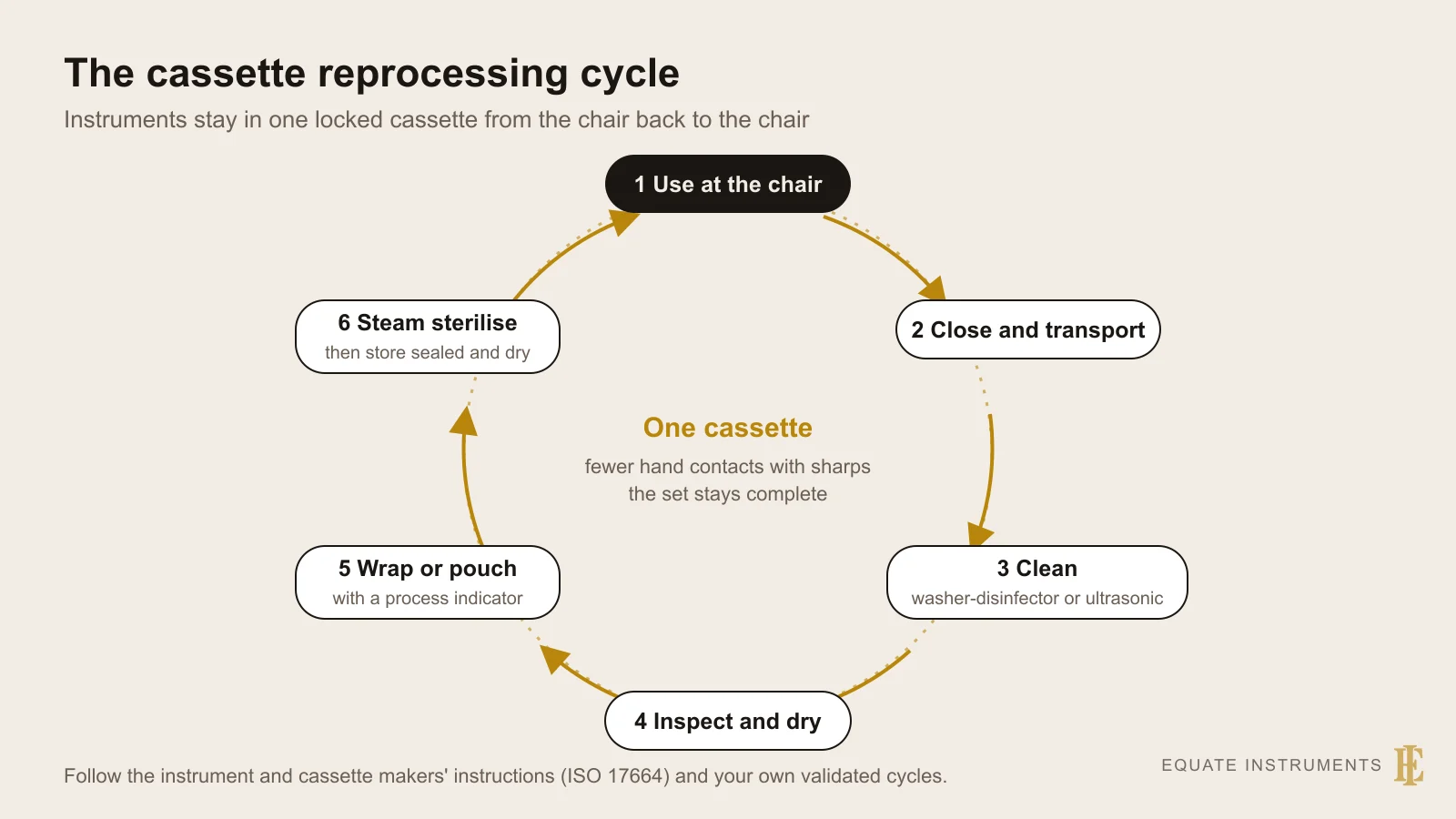
On a typical anaesthetic setup, laid out from left to right, Boyd shows the aspirating syringe, a long needle, a short needle, the cartridges, a needle cap holder and a unit-dose topical anaesthetic; the loading order and checklist are on the local anaesthetic tray setup page. Many practices place the syringe and holder in the same instrument cassette as the restorative or extraction instruments for the procedure, alongside items such as retractors or a dental dam kit, so that everything is reprocessed together.
The syringe and any metal recapping holder are reusable, heat-tolerant items. US CDC guidance and England's HTM 01-05 both require them to be cleaned and steam sterilised between patients. Packing them in a pouch or wrapped cassette with process indicators before a vacuum (type B) cycle is one common method; HTM 01-05 also allows unwrapped instruments to go through a non-vacuum (type N) steriliser and be wrapped afterwards for storage, with each cycle verified by routine tests and records. National rules and the steriliser type decide which applies. Take the syringe apart for cleaning if its design allows, check the harpoon is sharp and straight, and replace worn harpoons or thumb rings, because a blunt harpoon stops aspiration working. The tray setup page also gives the unloading order, from capping the needle to freeing the harpoon, that comes before cleaning.
Choosing a dental anaesthetic syringe
A syringe lasts for years, so the choice is mostly about fit: the cartridge size used in the practice, the needle thread, and how the syringe feels in the hand. ISO 9997 covers aspirating, self-aspirating and non-aspirating cartridge syringes, and lever syringes for intraligamentary injection form a separate group. You can compare every design, with a type-by-type table, on the dental aspirating syringe page; the checklist below covers what to look for in the hand.
- Cartridge size: 1.8 ml or 2.2 ml (or 1.7 ml); the barrel must match the cartridges your supplier provides.
- Needle thread: European (metric) and imperial threads are not interchangeable; match the syringe to the needles you buy.
- Harpoon: sharp, well-centred and replaceable.
- Grip: finger bar and thumb ring sized for the clinician's hand; silicone-coated or coloured grips help with control and identification.
- Viewing window: wide enough to see the whole cartridge label and watch for blood on aspiration.
- Material: stainless steel that takes repeated steam sterilisation, with parts that come apart for cleaning.
The Equate difference
Equate makes only the reusable part of the dental anaesthetic setup: 42 cartridge syringes and the EI-0817 conical holder for dental syringes, a weighted, autoclavable stainless steel cone. Needles, anaesthetic cartridges, topical anaesthetic and nitrous oxide sedation equipment are not in the catalogue and come from other suppliers.
Equate Dental Local Anaesthetic and Nitrous Oxide Sedation Equipment: What Each Part Does options

Dental Aspirating Syringe 2.2 ml, EU Needle
EI-0808
Offset Dental Cartridge Syringe 1.8 ml, EU Needle
EI-0809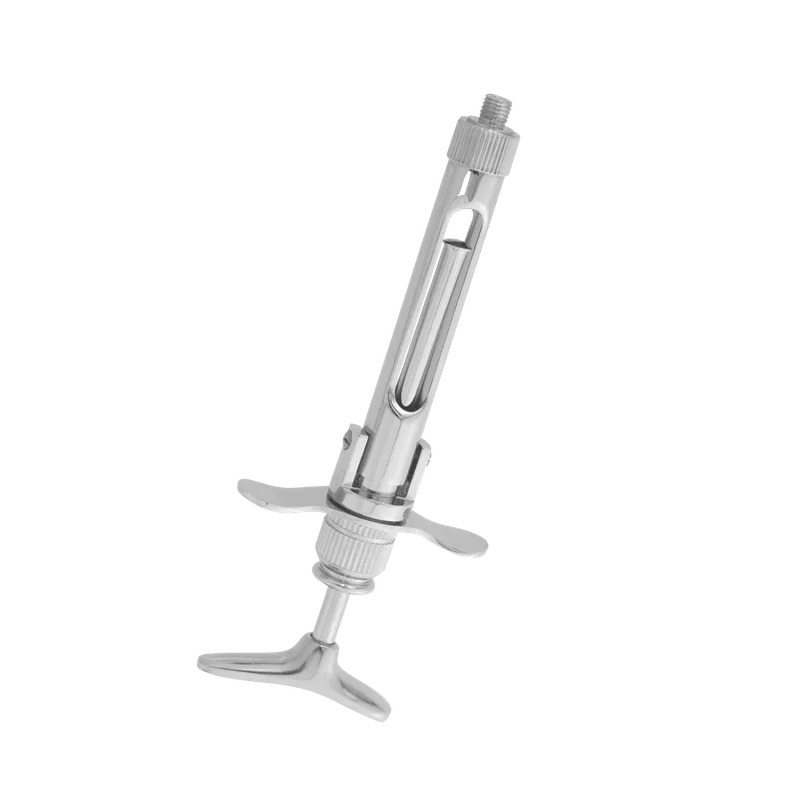
T-Handle Type Syringe 1.8ml EU Needle Brass
EI-0810
T-Handle Type Syringe 2.2ml EU Needle
EI-0811
Self-Aspirating Dental Syringe 1.8 ml
EI-0812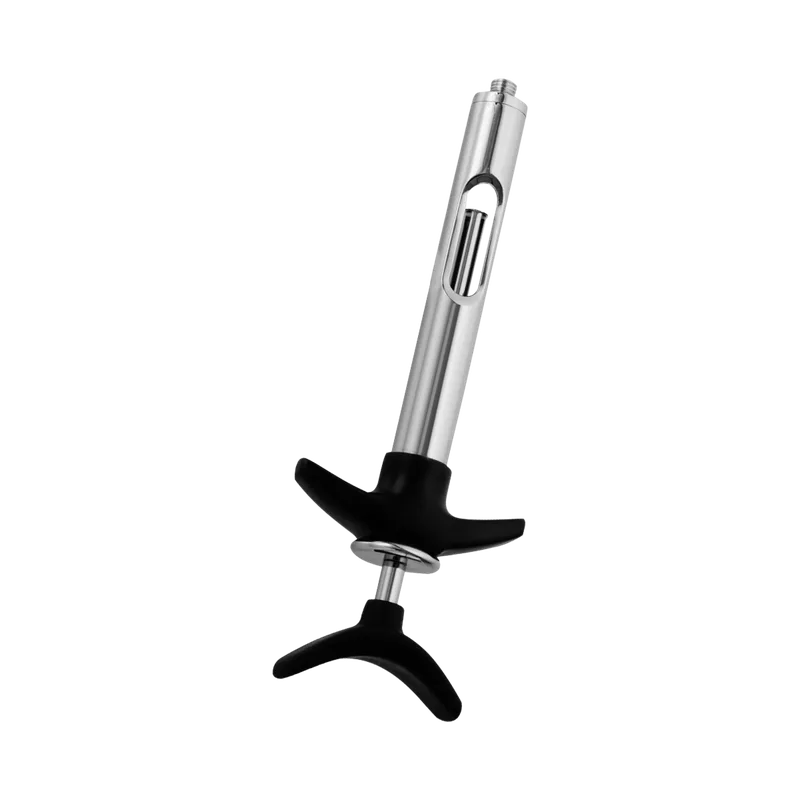
T-Handle Type Syringe 1.8ml EU Needle
EI-0813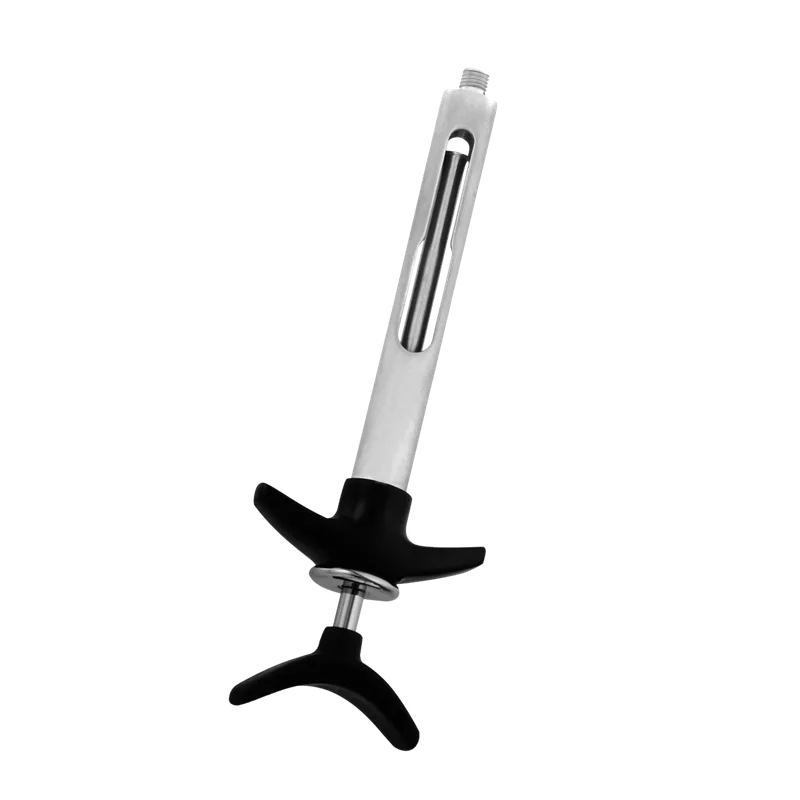
T-Handle Type Syringe 2.2ml EU Needle
EI-0814
Metric Cartridge Dental Syringe
EI-0815
Single-Ring Aspirating Dental Syringe 2.2ml EU Needle
EI-0816
Pistol-Grip Aspirating Syringe 1.8 ml - EU Needle
EI-1464
Click-Dose Intraligamental Syringe 2.2 ml (0.07 ml/click) - EU Needle
EI-1465
Single-Ring Aspirating Syringe - 1.8 ml Cartridge
EI-1466Browse all prosthodontic & laboratory instruments Browse all sterilization & organization instruments
Buying in your market
Frequently asked questions
What is the difference between an aspirating and a non-aspirating dental syringe?
An aspirating syringe has a harpoon that grips the cartridge plunger, so pulling back on the thumb ring draws the plunger back and shows whether the needle tip is in a blood vessel. A non-aspirating syringe can only push. Self-aspirating syringes achieve aspiration through the rebound of the cartridge rubber instead of a harpoon.
When is a long dental needle used instead of a short one?
Long needles, typically about 30–35 mm (labelled about 1⅝ inches in the US), are used for nerve block injections that have to reach deeper tissue, most often in the lower jaw. Short needles, typically about 20–25 mm (about 1 inch), are used for infiltration injections. The choice is part of the clinician's technique.
What does needle gauge mean?
Gauge is the needle's diameter. The higher the number, the thinner the needle, so 30 gauge is finer than 27 or 25 gauge. Thicker needles bend less in tissue.
What is the difference between 1.8 ml and 2.2 ml dental syringes?
The size refers to the anaesthetic cartridge the barrel is built to hold. ISO 11499 lists nominal cartridge sizes of 1.0, 1.7, 1.8 and 2.2 ml, and cartridges of different sizes are not interchangeable, so the syringe must match the cartridges the practice buys.
Can a dental anaesthetic syringe be sterilised?
Yes. CDC guidance and HTM 01-05 both require reusable metal syringes to be cleaned and steam sterilised after every patient, either wrapped with process indicators in a vacuum cycle or, where national rules allow, unwrapped in a type N steriliser and wrapped afterwards. Needles, cartridges and preloaded disposable syringes are single use and go into a sharps container.
Is it safe to recap a dental needle?
Never with two hands. US CDC guidance allows a one-handed scoop or a cap-holding device, while EU Directive 2010/32/EU bans recapping as a general practice and national rules may allow it only with a safety device after a risk assessment. Follow your national rules and practice policy.
What is the most nitrous oxide a dental sedation unit can deliver?
Dental units are typically capped at 70% nitrous oxide with 30% oxygen, so the oxygen share never falls below 30%, and a fail-safe cuts the nitrous oxide if the oxygen supply fails. The ADA also describes an oxygen flush for emergencies and recommends 100% oxygen for 5 minutes at the end, before the mask comes off.
Why does a nitrous oxide mask need scavenging?
The mask's scavenging tubing removes excess and exhaled gas so it doesn't build up in the room. NIOSH found leakage around the mask to be the main source of staff exposure and recommends keeping it to about 25 parts per million, averaged over the time the gas is being given.
References
- Boyd LB. Dental Instruments: A Pocket Guide, 7th edition. Saunders/Elsevier, 2020 (photographs used under licence)
- Kohn WG, et al. Guidelines for Infection Control in Dental Health-Care Settings, 2003. MMWR 52(RR-17), Centers for Disease Control and Prevention
- Department of Health / NHS England. Health Technical Memorandum 01-05: Decontamination in primary care dental practices (2013 edition)
- Council Directive 2010/32/EU of 10 May 2010 implementing the Framework Agreement on prevention from sharp injuries in the hospital and healthcare sector
- Crouch KG, McGlothlin JD, Mickelsen RL. Control of Nitrous Oxide in Dental Operatories. DHHS (NIOSH) Publication No. 94-129, 1994
- ISO 9997:2020 Dentistry: Cartridge syringes
- ISO 11499:2014 Dentistry: Single-use cartridges for local anaesthetics
- American Dental Association. Oral Health Topics: Nitrous Oxide (delivery limits, fail-safe, scavenging and work practices)
- Scottish Dental Clinical Effectiveness Programme. Conscious Sedation in Dentistry: Dental Clinical Guidance, 3rd edition, June 2017
- NIOSH Engineering Controls Database: Control of nitrous oxide in dental operatories (scavenging exhaust 45 L/min; REL 25 ppm)
- Smolarek PC, Wambier LM, Siqueira Silva L, Chibinski ACR. Does computerized anaesthesia reduce pain during local anaesthesia in paediatric patients for dental treatment? A systematic review and meta-analysis. Int J Paediatr Dent 2020;30(2):118–135
- Shirani M, Azizmohammad Looha M, Emami M. Comparison of injection pain levels using conventional and computer-controlled local anesthetic delivery systems in pediatric dentistry: a systematic review and meta-analysis. J Dent 2025;157:105770
I am a…
Related
- Dental Aspirating Syringes (Dental Anaesthetic Syringes)
- Local Anaesthetic (Anesthetic) Tray Setup and How to Load a Dental Syringe
- Basic Dental Instruments: Mirror, Explorer, Cotton Forceps and Handles
- Dental Evacuation Devices, the Air/Water Syringe and the Dental Unit
- Amalgam Restorative Instruments: What Each One Does
- Dental Extraction Forceps
- Tooth Extraction Instruments
- Restorative Dental Hand Instruments
- Oral Surgery and Extraction Instruments
- Vital Signs and Monitoring Equipment in the Dental Practice
- Dental Instrument Cassettes, Trays and Boxes
- Dental Sterilisation and Protective Equipment
- Basic Dental Tray Setup (Dental Exam Tray)
- Crown and Bridge Tray Setup: Preparation and Cementation