Dental Instrument Cassettes, Trays and Boxes
Written by the Equate Instruments Technical Team · Reviewed by the Medical & Dental Board, Equate Instruments · Updated ·
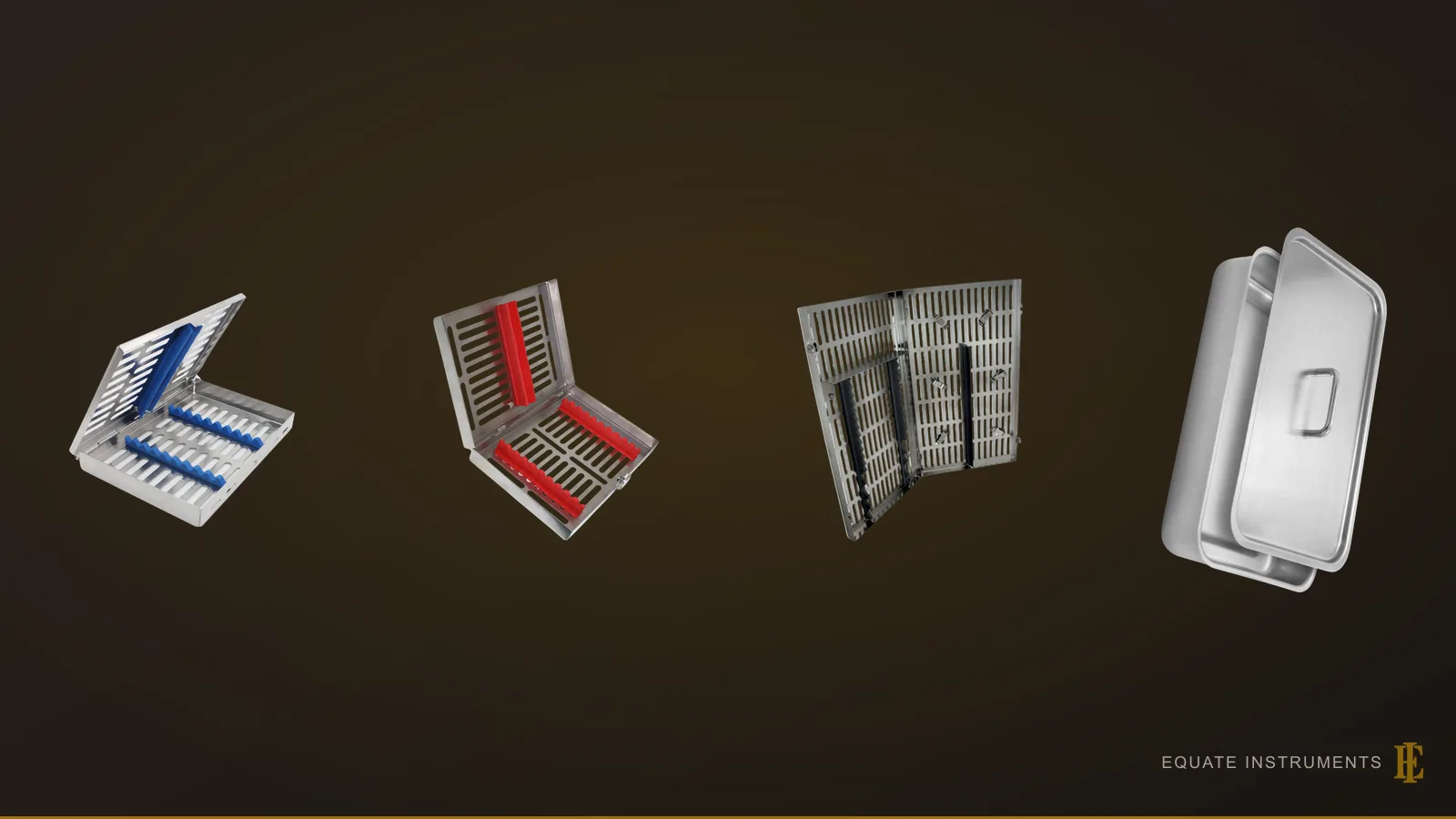
A dental instrument cassette is a perforated, hinged box with racks that holds one procedure's instruments through use, cleaning, sterilisation and storage, so they are handled as a set rather than one by one. Alongside cassettes, practices use open and lidded instrument trays, instrument boxes, dressing drums and colour-coding rings to organise sets, and wrap or pouch them before or after sterilisation.
Key points
- Keeping instruments in a closed cassette from chair to storage cuts the number of times contaminated sharps are handled.
- Whether a set is wrapped, pouched or unwrapped decides how long it may be stored: HTM 01-05 allows up to a year wrapped and one day unwrapped in the clinical area.
- Each cassette must be processed to its manufacturer's instructions for use and the clinic's own validated cleaning and sterilisation cycles.
What is a dental instrument cassette?
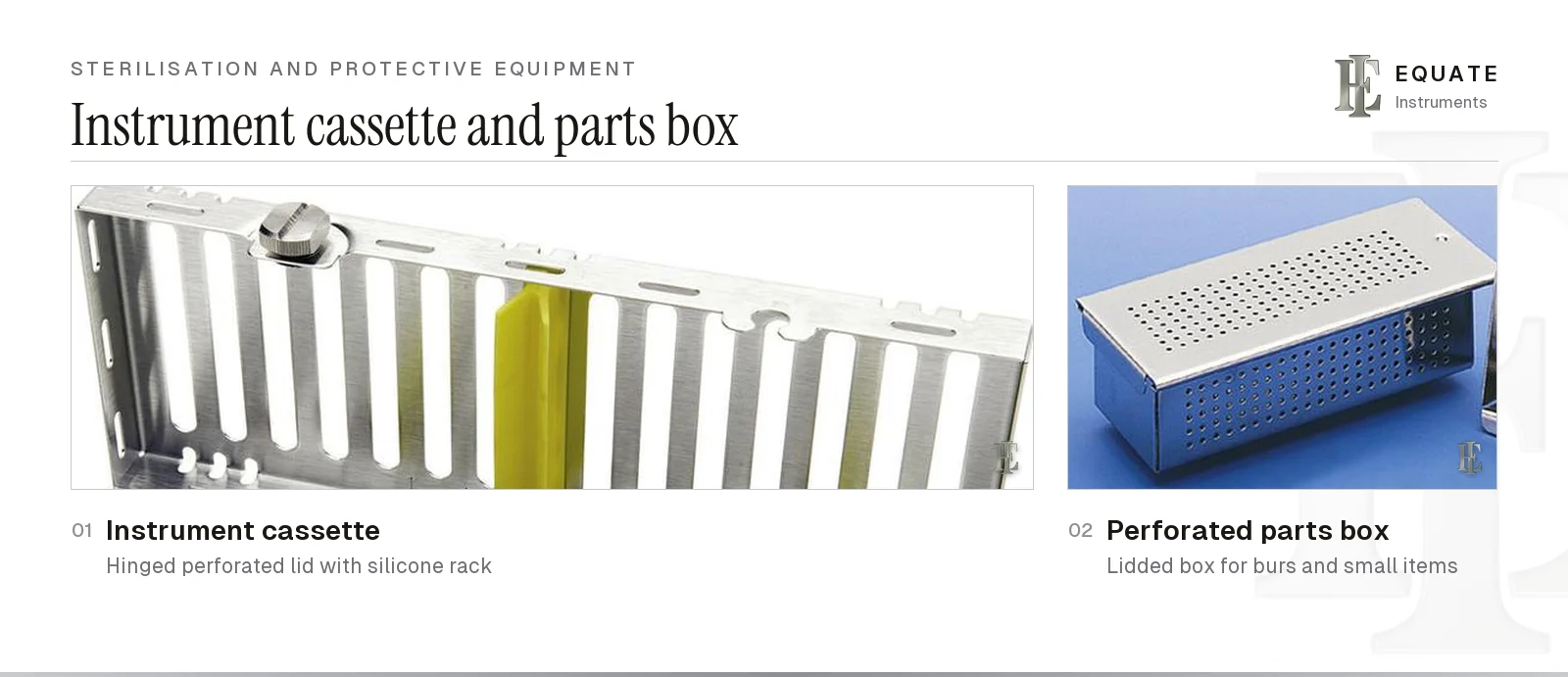
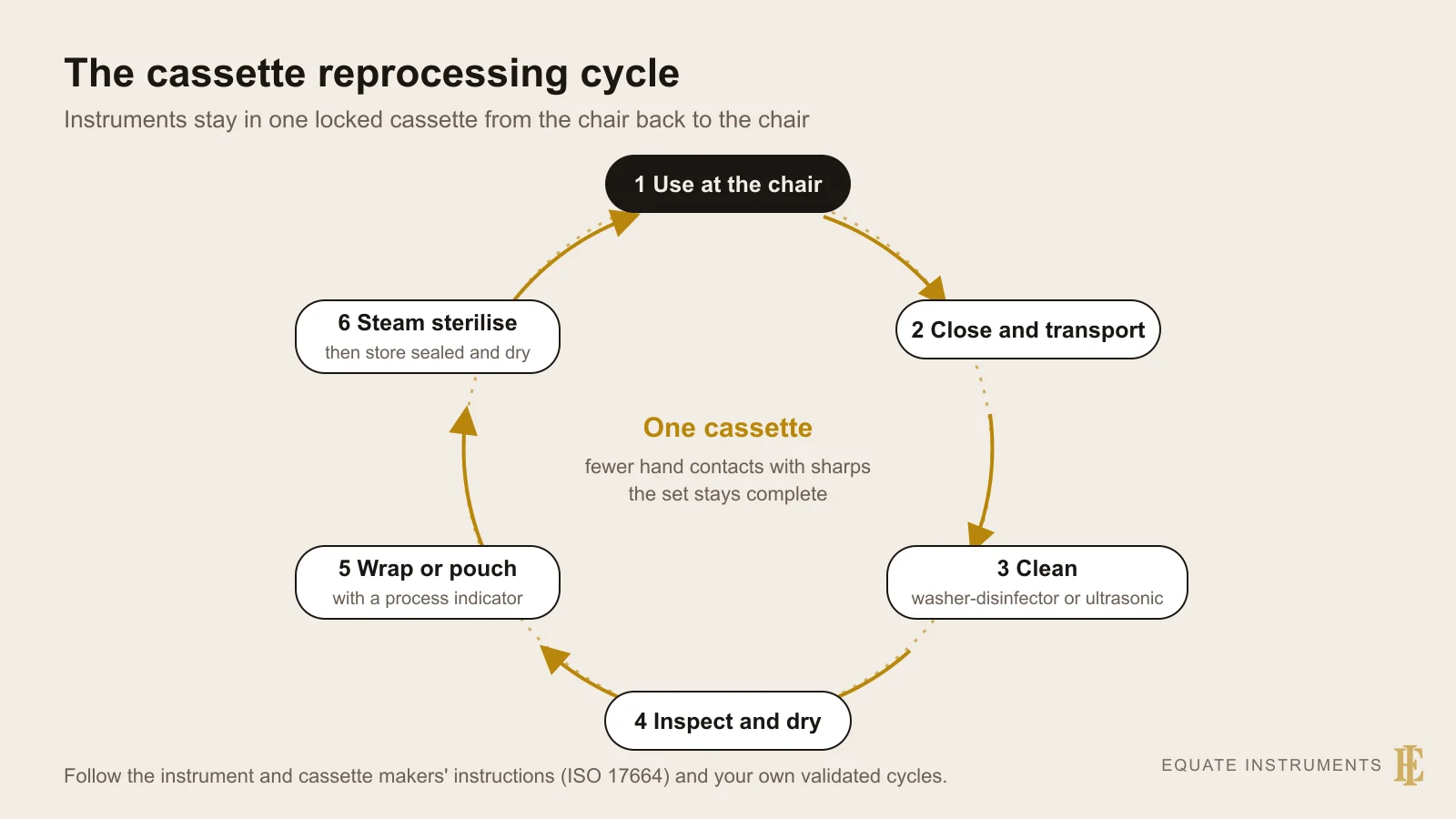
An instrument cassette is a stainless-steel or plastic box with perforated walls, a hinged lid and silicone racks that hold each instrument apart. The set for one procedure goes into the cassette when it is packed, stays there on the bracket table, goes back closed to the decontamination room, carried by staff in heavy-duty utility gloves, through the ultrasonic bath or washer-disinfector and the steriliser, and is stored until the next patient. Because the perforations let water, detergent and steam reach every surface, the cassette doesn't have to be unloaded for cleaning.
A cassette for a basic examination might hold a mouth mirror, an explorer, cotton pliers and a probe; larger cassettes hold a crown and bridge or surgical set.
Burs, rubber dam clamps and matrix bands are too small for the racks and slip through, so they go in a perforated parts box or bur block that travels with the cassette. The sterilisation and protective equipment guide covers these small-parts holders and the rest of the reprocessing chain, from PPE to spore testing.
Why use cassette-based reprocessing?
- Fewer handling steps: instruments are not picked out, sorted and repacked one by one between the chair and the steriliser.
- Sharps safety: the CDC asks for used instruments to be placed in a container at the point of use and favours automated cleaning, which reduces staff contact with contaminated sharps; a closed cassette does both.
- Evidence on handling: in a 2025 survey of 1,942 instrument reprocessing staff in 130 dental facilities in China, 21.7% reported a needlestick or sharps injury in the previous year, and staff handling more than 1,000 instruments a day had about 5.7 times the adjusted odds of injury of those handling 100 or fewer (Hong et al., 2025). The study did not test cassettes, but it shows why cutting loose handling of sharps matters.
- Complete sets: every instrument has a place, so a missing or damaged instrument is seen before the next patient.
- Protection: racks stop tips knocking together in the bath and the washer-disinfector, which helps protect cutting edges and fine points.
- Faster set-up: the sterile cassette is opened on the tray and the instruments are already in order of use.
- Sterile storage: the CDC's 2003 guidelines name cassettes and organising trays among the containers designed to keep packaged instruments sterile until use.
What types of dental instrument trays and boxes are there?
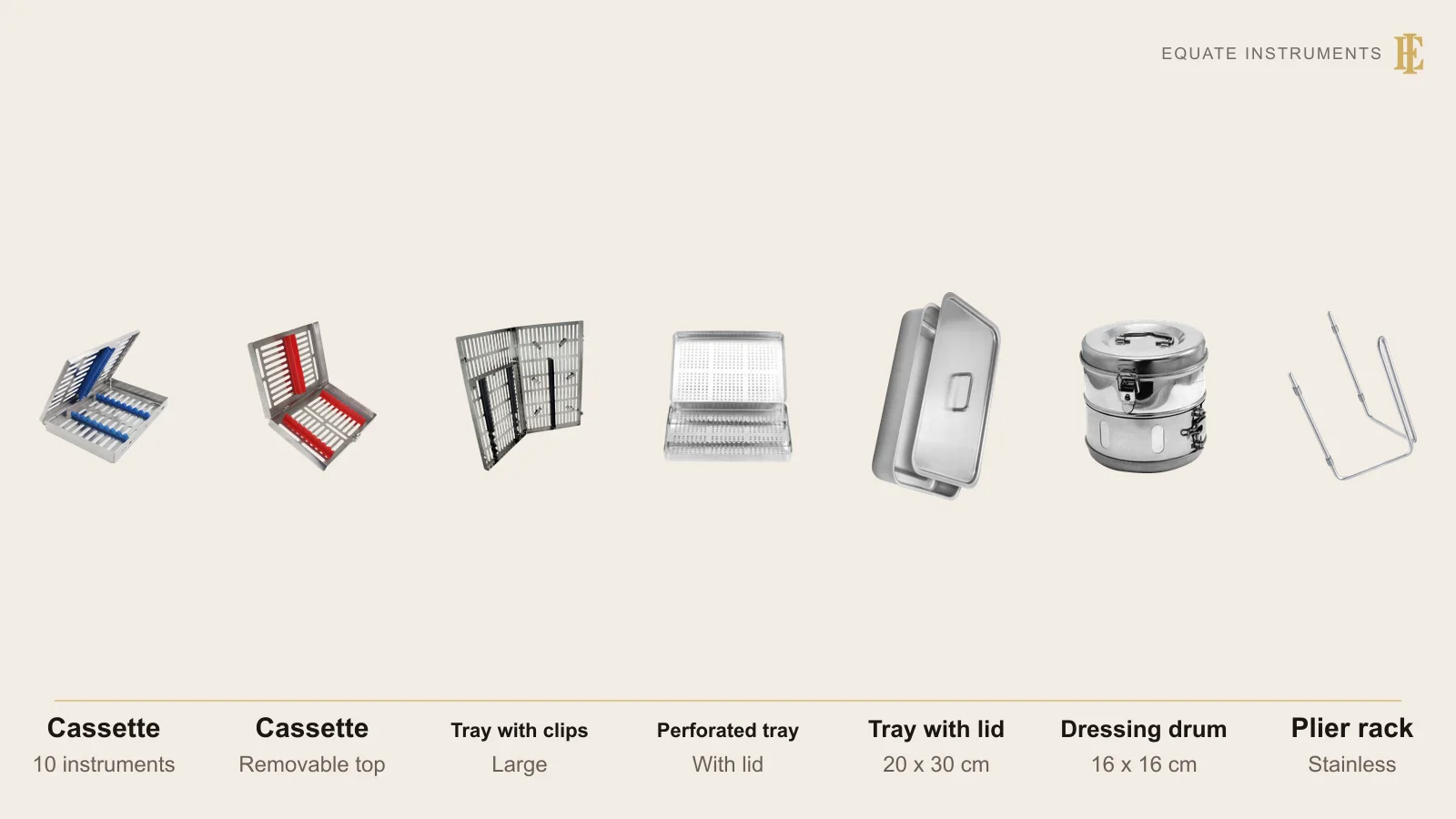
Most practices use more than one kind of container: cassettes for complete procedure sets, open or lidded trays for loose items and chairside set-out, and small boxes or bur blocks for burs and other parts that would fall through a rack.
| Type | What it is | Typical use |
|---|---|---|
| Hinged cassette | Perforated box with racks and a locking lid | Complete procedure sets through cleaning, sterilisation and storage |
| Perforated tray | Open or lidded tray with perforated base | Loose instruments in the washer-disinfector and steriliser |
| Procedure (Mayo) tray | Flat, solid stainless tray | Setting out instruments at the chair |
| Tray with lid | Solid tray with a close-fitting cover | Covered transport and storage of clean sets |
| Instrument box | Small rectangular stainless box | Burs, files and a few small instruments |
| Dressing drum | Round stainless drum with vents and a lid | Gauze, cotton and dressings |
| Plier rack and holders | Racks and stands that keep pliers and tweezers upright | Orthodontic pliers, tweezers and burs between uses |
Should instruments be wrapped, pouched or left unwrapped?
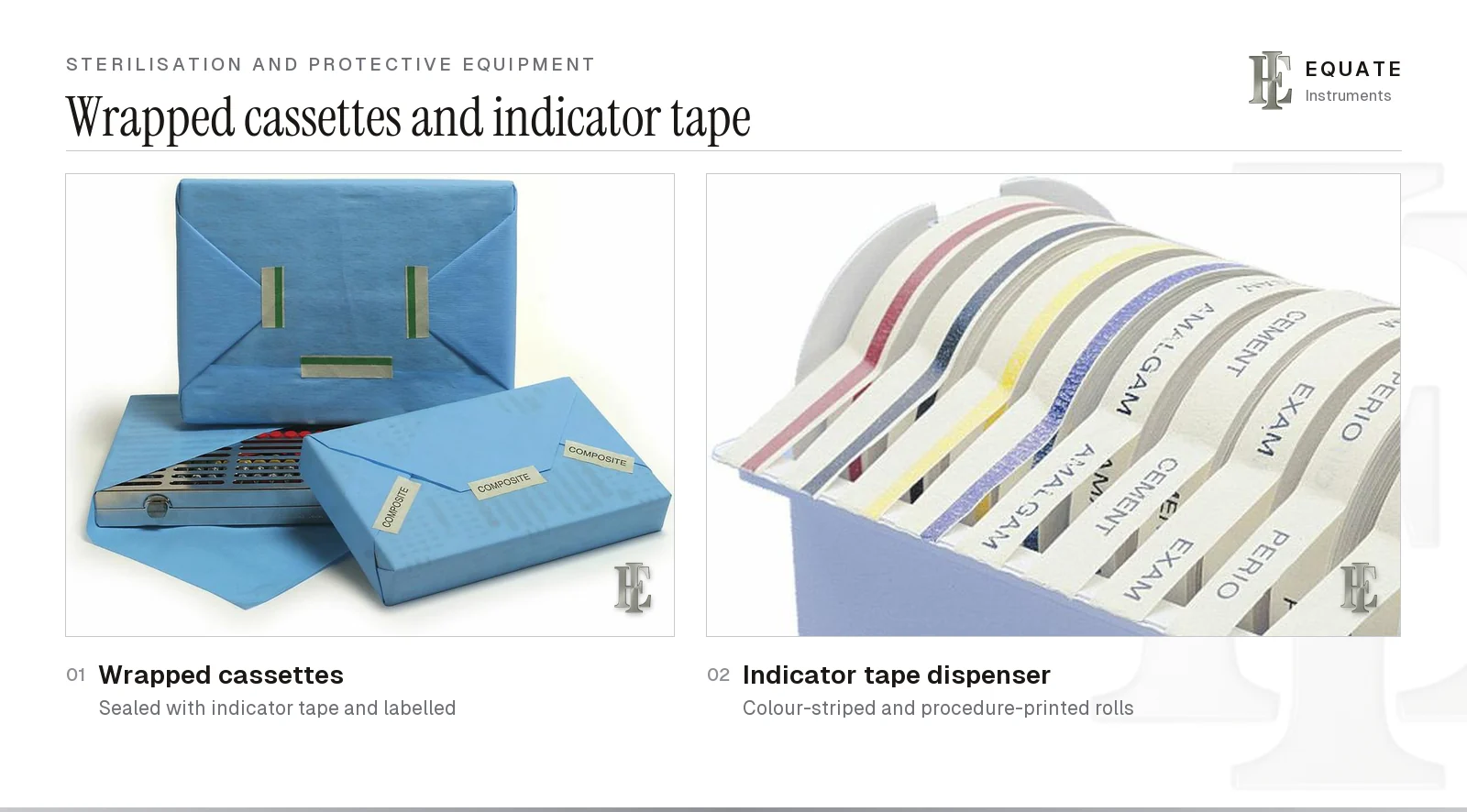
Wrap or pouch instruments that will be stored, and keep unwrapped sterilisation for sets used the same day. HTM 01-05 allows wrapped instruments to be stored for up to one year, wrapped before sterilisation in a vacuum (type B) or type S steriliser or aseptically after a non-vacuum (type N) cycle, in packaging that conforms to BS EN ISO 11607-1. Unwrapped instruments may be kept for a day in the clinical area, or a week in a non-clinical area, and are then reprocessed whether or not they were used. US practice is different: the CDC accepts either date-related shelf life or event-related shelf life, under which a pack stays sterile until something such as a tear, wetting or a puncture compromises it, and any pack found wet, torn or punctured is cleaned, repacked and heat sterilised again before use. Under either system, a wrapped cassette is left to dry inside the steriliser chamber before it is handled, since a hot, damp pack can draw in moisture and bacteria from the hands.
The CDC's 2003 guidelines ask for an internal chemical indicator in every package, an external indicator when the internal one can't be seen, and at least an internal indicator in the tray or cassette of an unwrapped load. The CDC also asks for each package to be labelled with the steriliser, the cycle or load number and the date. Tape or a pouch strip only shows the pack went through a cycle; the internal indicator is checked when the cassette is opened at the chair, and a pack whose indicator has not changed goes back for reprocessing. Steriliser classes, indicators and weekly spore tests are compared in the guide to steriliser monitoring and spore testing.
| Option | How it is done | Storage (HTM 01-05) |
|---|---|---|
| Cassette wrap | Cassette wrapped in sterilisation wrap before a vacuum cycle | Up to 1 year if the wrap is intact |
| Pouch | Instruments sealed in a peel pouch | Up to 1 year if the pouch is intact |
| Unwrapped, clinical area | Dry, covered, protected from contamination | 1 day, then reprocess |
| Unwrapped, non-clinical area | Dry, covered, in a clean area | 1 week, then reprocess |
How does colour coding of dental instruments work?
Colour coding uses coloured rings on instrument handles, or coloured cassettes, to show which set, procedure, surgery or operator an instrument belongs to. A practice might use blue for examination, red for restorative and green for hygiene, so a dental nurse can rebuild a set after cleaning and spot an instrument in the wrong cassette. Keep a written colour key in the decontamination room so everyone uses the same scheme.
Rings are small and can trap debris underneath, so check them at every inspection, replace any that are cracked, loose or faded, and fit only rings the instrument manufacturer allows for its handles.
Which standards apply to cassettes and instrument packaging?
- CDC 2003 dental infection-control guidelines (Kohn et al., MMWR 52, RR-17): cleaning, packaging, chemical indicators, storage and reprocessing of dental instruments in the United States.
- NHS England HTM 01-05, Decontamination in primary care dental practices (2013 edition): essential quality requirements and best practice in UK dental practices, including the preference for washer-disinfectors and storage times.
- SHTM 01-05 (NHS National Services Scotland, April 2024): the decontamination guidance for dental practices in Scotland, in three parts, replacing SDCEP's withdrawn Decontamination into Practice.
- ISO 11607-1 Packaging for terminally sterilized medical devices: requirements for materials, sterile barrier systems and packaging systems, which covers wraps and pouches.
- ISO 17664-1 Processing of health care products: the information a manufacturer must give for cleaning, disinfecting, packaging and sterilising a reusable device.
- EN 13060 Small steam sterilizers: sets the type B, N and S cycle classes; a cassette wrapped before sterilisation needs a type B or S cycle.
How do you choose a cassette and validate its use in your practice?
Choose cassettes by the number of instruments in each procedure set, by whether they fit your washer-disinfector baskets and steriliser chamber, and by how they will be wrapped. HTM 01-05 asks for a separate sterilised tray for each patient, sized to fit the steriliser. A basic examination set fits a 5-instrument cassette, restorative sets usually need 10, and surgical or crown and bridge sets 15 or 20. If cassettes will be wrapped before sterilisation, the steriliser must be a vacuum (type B) or type S unit, and its chamber has to take your largest cassette.
A cassette adds load and shields instruments, so its effect on cleaning, drying and steam penetration depends on your equipment. Follow the cassette manufacturer's instructions for use, which ISO 17664-1 says must describe how it is processed, and run it in the cleaning and sterilisation cycles your practice has validated for that load. This page makes no claim about which steam or washer-disinfector cycles suit Equate cassettes: that comes from the instructions for use and the practice's own validation.
What does the Equate range include?
Equate lists 19 stainless-steel sterilisation cassettes and cassette trays for 5, 7, 10, 15 and 20 instruments, from 182 x 72 mm to 192 x 287 mm, including a cassette with a removable top, a solid-base tray and one for 15 luxating elevators, and 8 plastic mini (5-instrument) and large (9-instrument) cassettes in blue, yellow, red and black. Alongside them are 23 procedure, perforated and lidded trays, including Mayo, kidney and scaler trays, 5 dressing drums, 3 rectangular instrument boxes, colour-coding rings in 12 colours, 4 plier stands and racks, and 10 tweezer, bur and syringe holders.
The range is designed in Finland. Clinics can request samples and a quote through the sterilisation and organisation family.
The Equate difference
Equate lists 84 sterilisation and organisation references: 19 stainless-steel cassettes and cassette trays for 5 to 20 instruments, 8 plastic mini and large cassettes in blue, yellow, red and black, 23 procedure, perforated and lidded trays, 5 dressing drums, 3 instrument boxes, 12 colours of coding rings, and 14 plier racks and instrument holders.
Equate Dental Instrument Cassettes, Trays and Boxes options

Sterilization Cassette for 5 Instruments - 182 x 72 x 34 mm
EI-0229
Medium Sterilization Cassette with Removable Top - 10 Instruments, 192 x 144 x 34 mm
EI-0230
Sterilization Cassette for 20 Instruments - 288 x 182 x 34 mm
EI-0231
Sterilization Cassette for 5 Instruments
EI-0232
Sterilization Cassette for 7 Instruments
EI-0233
Sterilization Cassette for 10 Instruments
EI-0234
Sterilization Cassette for 20 Instruments
EI-0235
Multi-Instrument Sterilization Tray with Clips - Small
EI-0236
Multi-Instrument Sterilization Tray with Clips - Large
EI-0237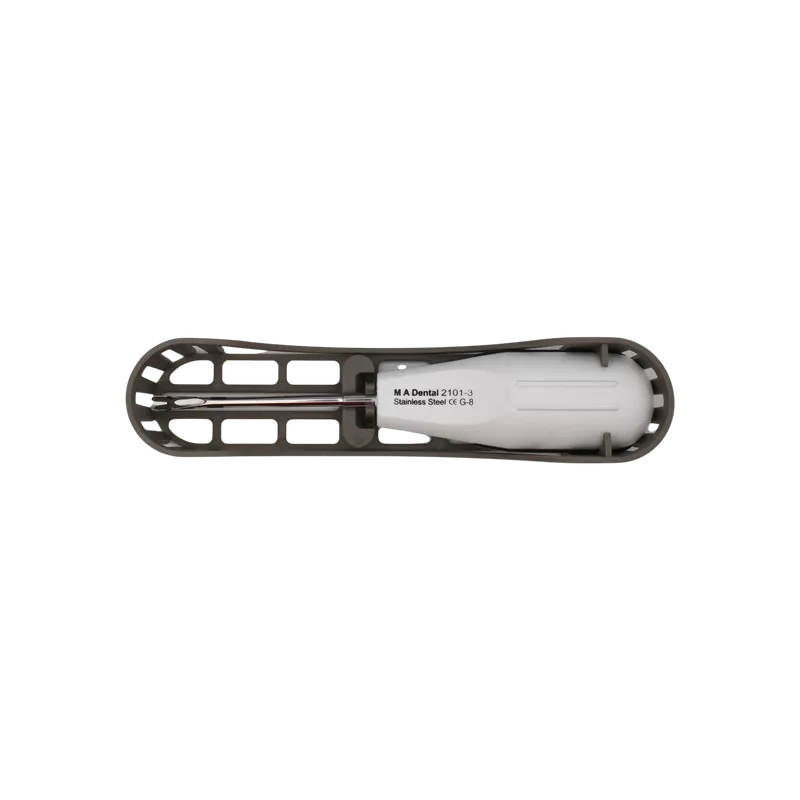
Autoclavable Plastic Tray for Luxating Elevators
EI-0266
Kidney Tray 20 cm
EI-0513
Instrument Tray with Lid 23 x 15 x 5 cm
EI-0514Browse all sterilization & organization instruments Browse all accessories & supplies instruments
Buying in your market
Frequently asked questions
What is a dental instrument cassette?
It is a perforated, hinged box with racks that keeps one procedure's instruments together through use, cleaning, sterilisation and storage. Instruments are handled as a set instead of one at a time.
What is the difference between a cassette and an instrument tray?
A cassette is closed, holds each instrument in a rack and goes through cleaning and sterilisation with the instruments inside. A procedure tray is an open tray for setting instruments out at the chair.
Do instrument cassettes need to be wrapped?
Only if the instruments will be stored. HTM 01-05 allows wrapped sets to be stored for up to a year, but unwrapped sets only for a day in the clinical area.
Can any cassette go in any steriliser?
No. Process it only as its manufacturer's instructions for use describe, and in cycles your practice has validated for that load, because cassettes affect cleaning, drying and steam penetration.
What are dental instrument trays with lids used for?
They keep clean or sterilised instruments covered during transport and short-term storage, and hold sets ready for a procedure.
Should hinged instruments be open in a cassette?
Yes. CDC 2003 asks for hinged instruments to be processed open and unlocked so detergent and steam reach the joint. Place them in the cassette open and unlocked, using a rack or clip made for them where the cassette has one.
How long does a sterilised cassette stay sterile?
Under HTM 01-05 in England, a wrapped cassette may be stored for up to a year, but an unwrapped one for only a day in the clinical area or a week in a non-clinical area. The CDC also allows event-related shelf life: the pack is inspected before opening, and one that is wet, torn or punctured is reprocessed.
References
- Kohn WG, Collins AS, Cleveland JL, Harte JA, Eklund KJ, Malvitz DM. Guidelines for Infection Control in Dental Health-Care Settings, 2003. MMWR Recommendations and Reports 52(RR-17), Centers for Disease Control and Prevention
- Centers for Disease Control and Prevention. Dental infection prevention and control FAQs: sterilization
- Department of Health. Health Technical Memorandum 01-05: Decontamination in primary care dental practices, 2013 edition. NHS England
- NHS National Services Scotland. SHTM 01-05: Management, equipment and process of the decontamination of dental instruments in a Local Decontamination Unit (LDU) in NHSScotland, version 1, April 2024
- ISO 11607-1:2019 Packaging for terminally sterilized medical devices, part 1: requirements for materials, sterile barrier systems and packaging systems
- ISO 17664-1:2021 Processing of health care products: information to be provided by the medical device manufacturer for the processing of medical devices, part 1: critical and semi-critical medical devices
- EN 13060:2014+A1:2018 Small steam sterilizers (CEN)
- Hong F, Zeng J, Ma J, Wang X, Yu X. Needlestick and Sharp Injury Among Dental Instrument Reprocessing Personnel: Incidence and Reporting Practices in China. International Dental Journal 2025;75(5):100944
- Boyd LB. Dental Instruments: A Pocket Guide, 7th edition. Saunders/Elsevier, 2020. Chapter 18, Sterilization and Protective Equipment (photographs used under licence)
I am a…