Restorative Dental Hand Instruments
Written by the Equate Instruments Technical Team · Reviewed by the Medical & Dental Board, Equate Instruments · Updated ·
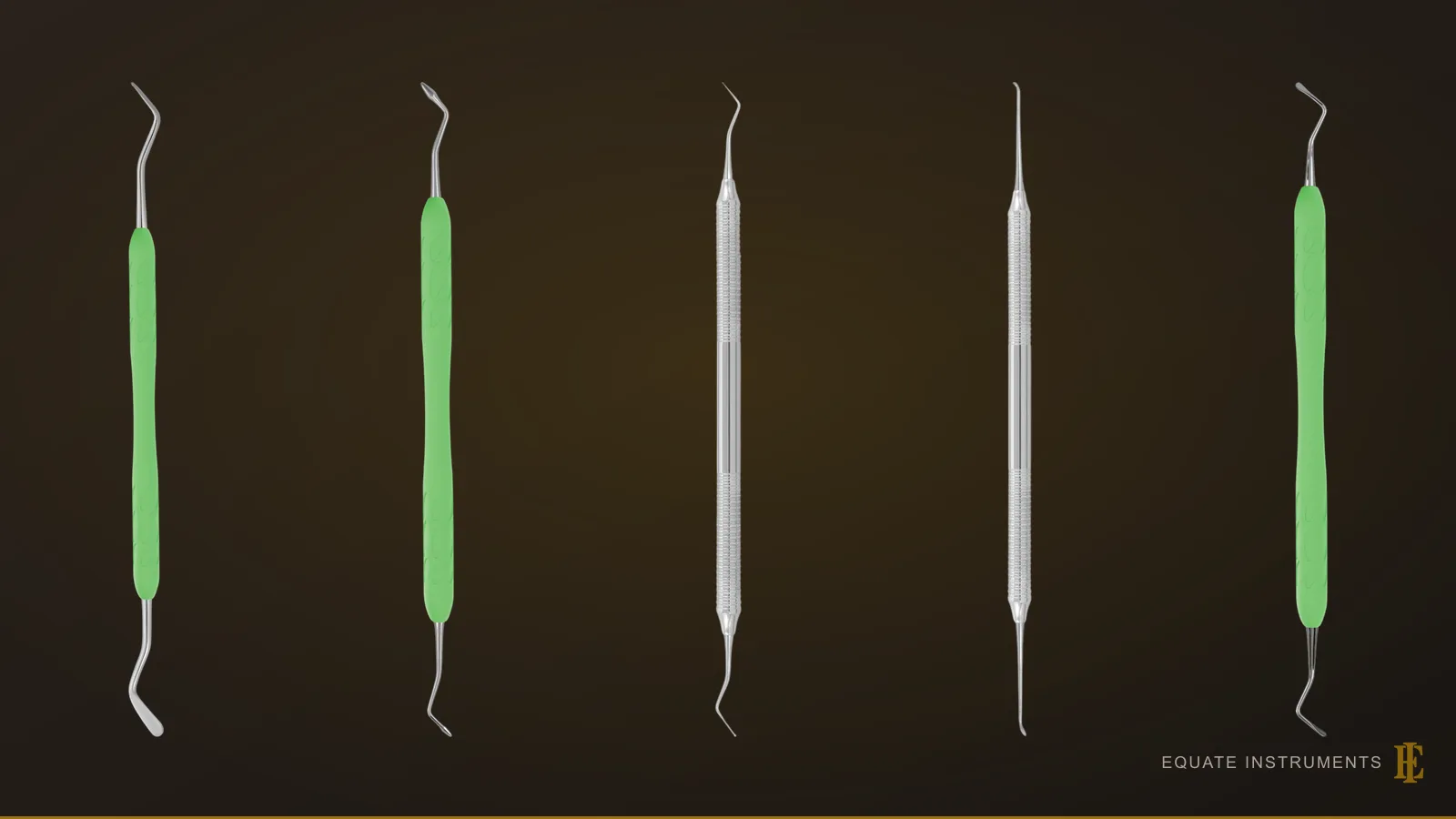
Restorative dental hand instruments place, shape and finish filling materials in a prepared tooth. Plastic filling instruments and composite spatulas carry and shape composite, pluggers and condensers pack it, burnishers smooth it and carvers sculpt its anatomy. Cord packers press retraction cord into the gingival sulcus before an impression. Most are double-ended, with a different working end on each side.
Key points
- 'Plastic' in plastic filling instrument refers to the material, which is plastic (mouldable) when it's placed, not to the instrument.
- Non-stick coatings such as titanium nitride stop composite pulling away from the instrument as it's shaped.
- Cord packers belong in the restorative tray too: they place retraction cord before crown and bridge impressions.
What are restorative dental instruments used for?
Once a cavity has been prepared and cleared of soft dentine with a spoon excavator, restorative hand instruments take over. They carry the filling material to the tooth, pack it against the cavity walls, shape it to the tooth's anatomy and smooth its surface before it sets or is cured. Sturdevant's Art and Science of Operative Dentistry, edited by André Ritter, Lee Boushell and Ricardo Walter, groups them as non-cutting hand instruments, as distinct from the cutting instruments that prepare the tooth.
Most restorative instruments are double-ended, and many carry two different working ends, such as a plugger on one end and a spatula on the other, so one instrument can place and shape the material without a change.
What types of restorative instrument are there?
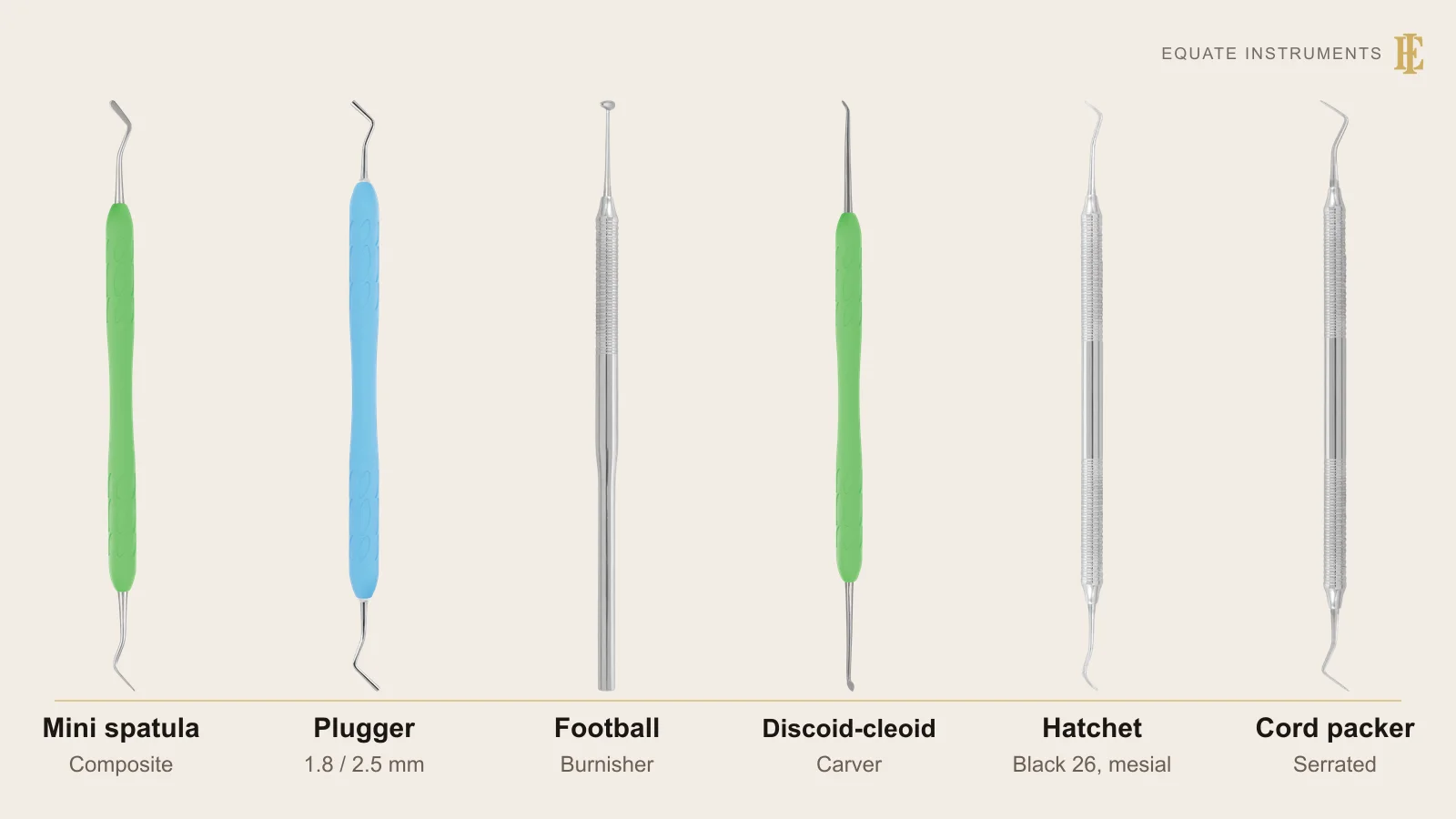
- Plastic filling instruments (PFIs): flat, paddle-shaped blades for carrying and shaping restorative material. Patterns such as the PFI 6 and the UP1 are general-purpose.
- Composite spatulas and placement instruments: thin, flexible blades for placing and sculpting composite, including mini and flow patterns for small anterior restorations.
- Pluggers and condensers: flat or cylindrical ends for packing material into the cavity, from about 1 mm for small cavities to 2.5 mm or more for larger ones.
- Burnishers: ball, football (egg-shaped) and beavertail ends for smoothing a restoration surface, shaping matrix bands and adapting margins.
- Carvers: sharp blades for sculpting occlusal anatomy and trimming excess, including the discoid-cleoid (a disc on one end and a claw-shaped blade on the other), the Hollenback and the Ward patterns.
- Enamel hatchets and gingival margin trimmers: cutting instruments that plane and bevel the cavity margins before the material goes in.
- Cord packers: thin, blunt or serrated blades that press retraction cord into the gingival sulcus, so the margin of a crown preparation shows clearly in the impression. Terry Donovan and Winston Chee reviewed cord and the other gingival displacement methods in the Dental Clinics of North America in 2004.
Why do non-stick coatings matter for composite?
Uncured composite resin is tacky. Shaped with bare stainless steel, it tends to stick to the blade and pull away from the cavity wall, leaving voids or a rough surface. Instruments with a titanium-nitride or similar non-stick coating release the material cleanly, which is why many composite spatulas, pluggers and burnishers are coated. Some clinicians also wet the blade lightly with a modelling resin. Either way, the aim is a smooth, void-free layer.
What about amalgam instruments?
Condensers, carvers and burnishers were designed for amalgam, and many are still used with composite and glass-ionomer. Amalgam itself is being phased down under the Minamata Convention on Mercury, the United Nations treaty agreed in 2013. Regulation (EU) 2024/1849 bans the use of dental amalgam in the European Union from 1 January 2025, except where a dentist considers it strictly necessary for a patient's specific medical needs.
Practices that no longer place amalgam still use the same instrument shapes to pack, shape and finish other materials.
Which restorative instrument guide do you need?
Each family of restorative hand instrument has its own detailed guide, with patterns, sizes, technique and the matching Equate references.
| Instrument | What it does | Guide |
|---|---|---|
| Hatchets, chisels and margin trimmers | Plane enamel walls and bevel cavity margins | Hand cutting instruments |
| Composite spatulas and pluggers | Place, adapt and sculpt resin composite | Composite instruments |
| Condensers and pluggers | Compact amalgam and other restorative materials | Condensers and pluggers |
| Amalgam and base carriers | Carry material to the cavity | Amalgam carriers |
| Burnishers | Smooth and adapt margins and contours | Burnishers |
| Carvers | Shape occlusal anatomy and remove excess | Carvers |
| Matrix retainers | Hold the band that replaces a missing wall | Matrix band retainers |
| Cord packers | Place gingival retraction cord before impressions | Gingival cord packers |
Which specifications matter?
| Specification | What to look for | Why it matters |
|---|---|---|
| Working end | Matched to the material and cavity size | A plugger that's too large can't reach the corners |
| Surface | Non-stick coating for composite | Composite releases cleanly instead of pulling away |
| Blade | Thin and flexible for shaping; rigid for packing | Flexibility helps sculpting; rigidity transmits packing force |
| Edges | Sharp on carvers and trimmers, smooth on burnishers | Carvers cut; burnishers must not scratch the surface |
| Handle | Lightweight, textured or colour-coded silicone | Comfort over long procedures and quick identification on the tray |
How do you choose and care for restorative instruments?
A general practice tray usually holds a PFI or composite spatula, a plugger, a ball burnisher, a discoid-cleoid carver and a cord packer, with a mouth mirror and a dental explorer to check the margins.
Wipe composite and cement off before they harden, avoid abrasive cleaning on coated tips and sterilise the set in line with the CDC's Guidelines for Infection Control in Dental Health-Care Settings or, in UK practices, HTM 01-05. Replace a coated instrument when the coating wears through, because bare patches start to stick again.
The Equate difference
Equate lists 287 restorative hand instrument references, including 67 plastic filling instruments, 34 composite spatulas, 59 burnishers, 59 carvers, 34 pluggers and condensers and 13 cord packers, in plain stainless steel or with titanium-nitride and other non-stick coatings, on solid, hollow and colour-coded silicone handles.
Equate Restorative Dental Hand Instruments options

Filling Instrument C49
EI-0011
Filling Instrument PFI 8A
EI-0013
Filling Instrument UP1 - Titanium-Nitride Hollow Handle
EI-0014
Plastic Filling Instrument PFI 6 - Titanium-Nitride Hollow Handle
EI-0015
Dental Plugger 1.8 / 2.5 mm Titanium
EI-0016
Double-Ended Filling Plugger 2.5 mm / 3.8 mm - Hollow Handle
EI-0017
Dental Plugger 1.3 / 1.8 mm Titanium
EI-0018
Dental Plugger 1.0 / 1.3 mm Titanium
EI-0019
Composite Knife / Carver - Non-Stick Double-Ended
EI-0022
Plastic Filling Instrument PFI UP1 - Titanium-Nitride Hollow Handle
EI-0023
Plugger 1.0mm/2.0mm - Double-Ended Knurled Handle
EI-0089
Carver 5 - Double-Ended 2.0/2.5mm with Knurled Handle
EI-0091Browse all restorative & operative instruments
Buying in your market
Frequently asked questions
What is a plastic filling instrument?
A double-ended hand instrument with flat blades for carrying, placing and shaping restorative material. 'Plastic' refers to the material, which is mouldable while it's placed; the instrument itself is usually stainless steel.
What is a plugger used for in dentistry?
In restorative dentistry a plugger, or condenser, packs filling material into the prepared cavity so it fills the corners without voids. Endodontic pluggers are a separate group that compact gutta-percha in root canals.
What is a discoid-cleoid carver?
A double-ended carver with a disc-shaped blade on one end and a claw-shaped (cleoid) blade on the other. It's used to carve occlusal anatomy and remove excess material from a restoration.
What is a cord packer used for?
A cord packer presses retraction cord into the gingival sulcus around a prepared tooth. That moves the gum away from the margin so the impression or scan records it clearly.
References
- Ritter AV, Boushell LW, Walter R (eds). Sturdevant's Art and Science of Operative Dentistry. Elsevier (hand instruments for operative dentistry)
- Donovan TE, Chee WWL. Current concepts in gingival displacement. Dental Clinics of North America 2004;48(2):433–444
- United Nations Environment Programme. Minamata Convention on Mercury, 2013 (Annex A: phase-down of dental amalgam)
- Regulation (EU) 2024/1849 of the European Parliament and of the Council amending Regulation (EU) 2017/852 on mercury (dental amalgam)
- Boyd LRB. Dental Instruments: A Pocket Guide. Elsevier
- Kohn WG, et al. Guidelines for Infection Control in Dental Health-Care Settings, 2003. MMWR 52(RR-17), Centers for Disease Control and Prevention
I am a…
Related
- Spoon Excavators (Dental Excavators)
- Dental Explorers
- Dental Mouth Mirrors
- Dental Composite Instruments: Placement, Sculpting and the Composite Gun
- Dental Carvers: Types of Carvers in Dentistry and the Lab
- Dental Burnishers: Ball, Football, Acorn, T-Ball and Beavertail
- Dental Pluggers and Condensers (Amalgam Condensers)
- Dental Hand Cutting Instruments: How Hatchets, Hoes, Chisels and Trimmers Differ and How to Use Them
- Composite Restoration Tray Setup (Class I to V)