Dental Impression Trays
Written by the Equate Instruments Technical Team · Reviewed by the Medical & Dental Board, Equate Instruments · Updated ·
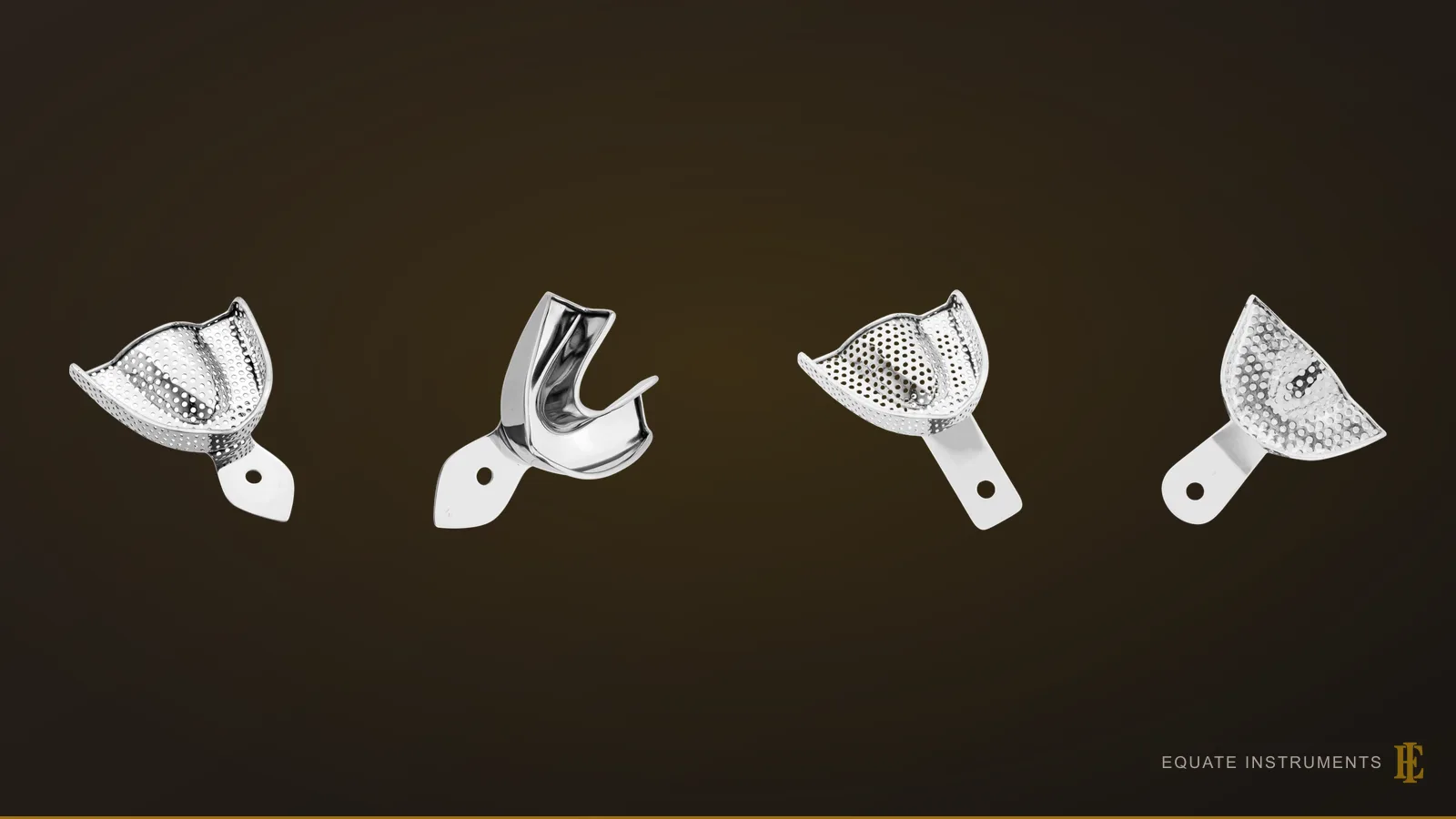
An impression tray is a U-shaped or partial holder that carries impression material into the mouth and supports it while it sets against the teeth and tissues. Stock trays come in sizes for upper and lower arches, full arch, quadrant and anterior; custom trays are made for one patient. Perforations, a rim-lock bead or tray adhesive hold the material, and metal trays are rigid and reusable.
Key points
- A rigid tray gives a more accurate impression: in one in vitro study metal stock trays outperformed plastic ones with putty.
- Retention comes from perforations, a rim-lock bead, tray adhesive, or a combination; the material decides which you need.
- Rinse and disinfect every impression before it goes to the laboratory, and heat-sterilise metal trays before the next patient.
What is an impression tray used for?
An impression tray holds impression material against the teeth and soft tissues until it sets, then carries the set impression out of the mouth without distorting it. The impression becomes the mould for a study model, a working cast for crowns and bridges, a denture, an orthodontic appliance or a night guard. If the tray flexes, rocks or lets the material pull away as it comes out, the cast is wrong however good the material.
Trays are loaded with material mixed with a dental spatula or an automix cartridge gun. For crowns and bridges they go in after the margin has been exposed with a gingival cord packer, as part of the crown and bridge tray setup.
What types of impression trays are there in dentistry?
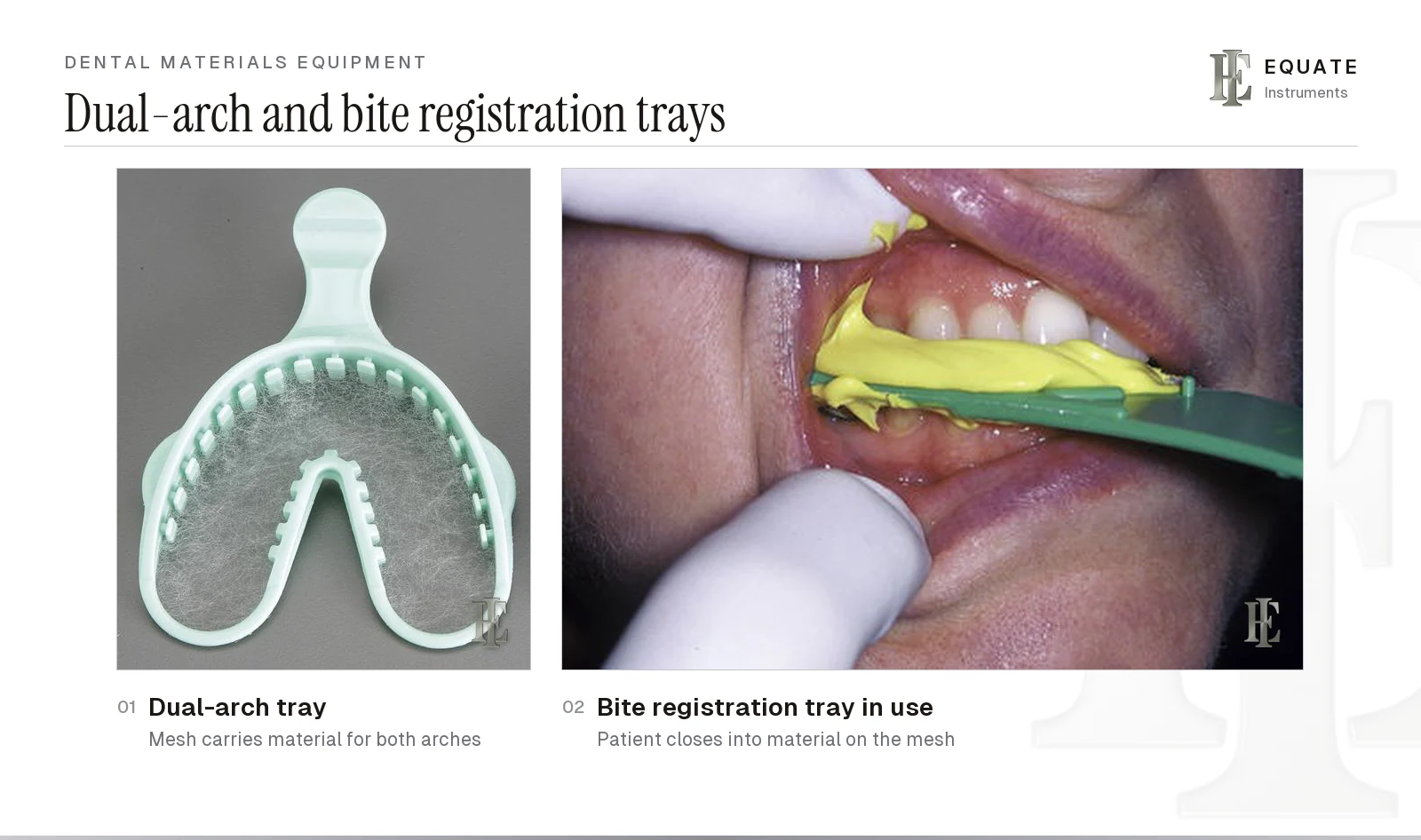
A quadrant tray is usually reversible: turned over, one tray serves the upper right and lower left, or the upper left and lower right. Full-arch upper trays carry a palatal section, while lower trays are horseshoe-shaped to leave room for the tongue. Dual-arch trays, bite registration frames and the water-cooled trays and hose that agar needs are not part of the Equate range; the dental materials equipment guide shows them with the cartridge guns and conditioning units they work with. A bite record lets the laboratory mount the casts on an articulator.
| Type | What it is | Typical use |
|---|---|---|
| Full-arch stock tray | Upper or lower tray in a range of sizes | Study models, opposing arches, most routine impressions |
| Partial and quadrant tray | Covers one side or a few teeth | Single crowns, short bridges, inlays |
| Anterior tray | Short tray for the front teeth | Anterior crowns and veneers |
| Edentulous (full-denture) tray | Shallow, wide tray shaped for ridges without teeth | Primary impressions for complete dentures |
| Custom (special) tray | Made on the patient's model with an even space for material | Secondary denture impressions, long-span bridges, implants |
| Dual-arch (triple) tray | Disposable tray recording both arches and the bite at once | Single posterior crowns |
| Bite registration tray | Light frame with a mesh, single use | Recording the bite to send with crown and bridge impressions |
| Water-cooled (agar) tray | Metal tray with water channels and a hose | Reversible hydrocolloid crown and bridge impressions |
What is the difference between stock and custom impression trays?
Stock trays are ready-made in standard sizes and reused or discarded; custom trays are made for one patient so the material sits in an even, controlled thickness. Stock trays are quicker and cheaper and are fine for study models, opposing arches and many single-unit impressions. Custom trays are used where accuracy over a long span matters, such as multi-unit bridges and implant cases, and for the secondary impression of a complete denture after a primary impression in a stock edentulous tray.
Rigidity is the deciding property. In a 2012 study in the International Journal of Oral and Maxillofacial Implants, Del'acqua and colleagues found that metal stock trays gave implant casts that were not significantly different from the master cast with putty, while plastic stock trays produced much larger gaps.
What is the difference between perforated, solid and rim-lock trays?
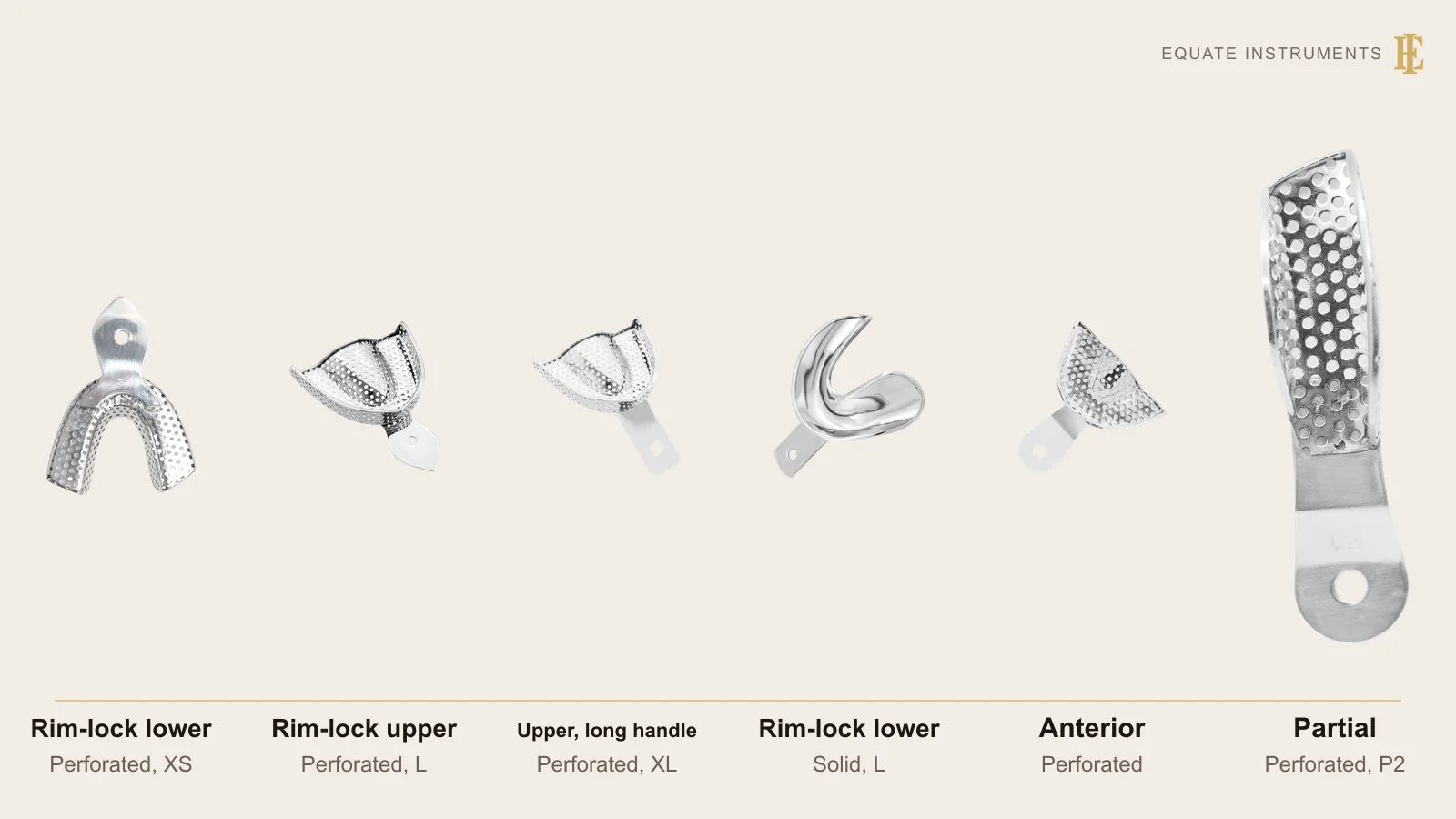
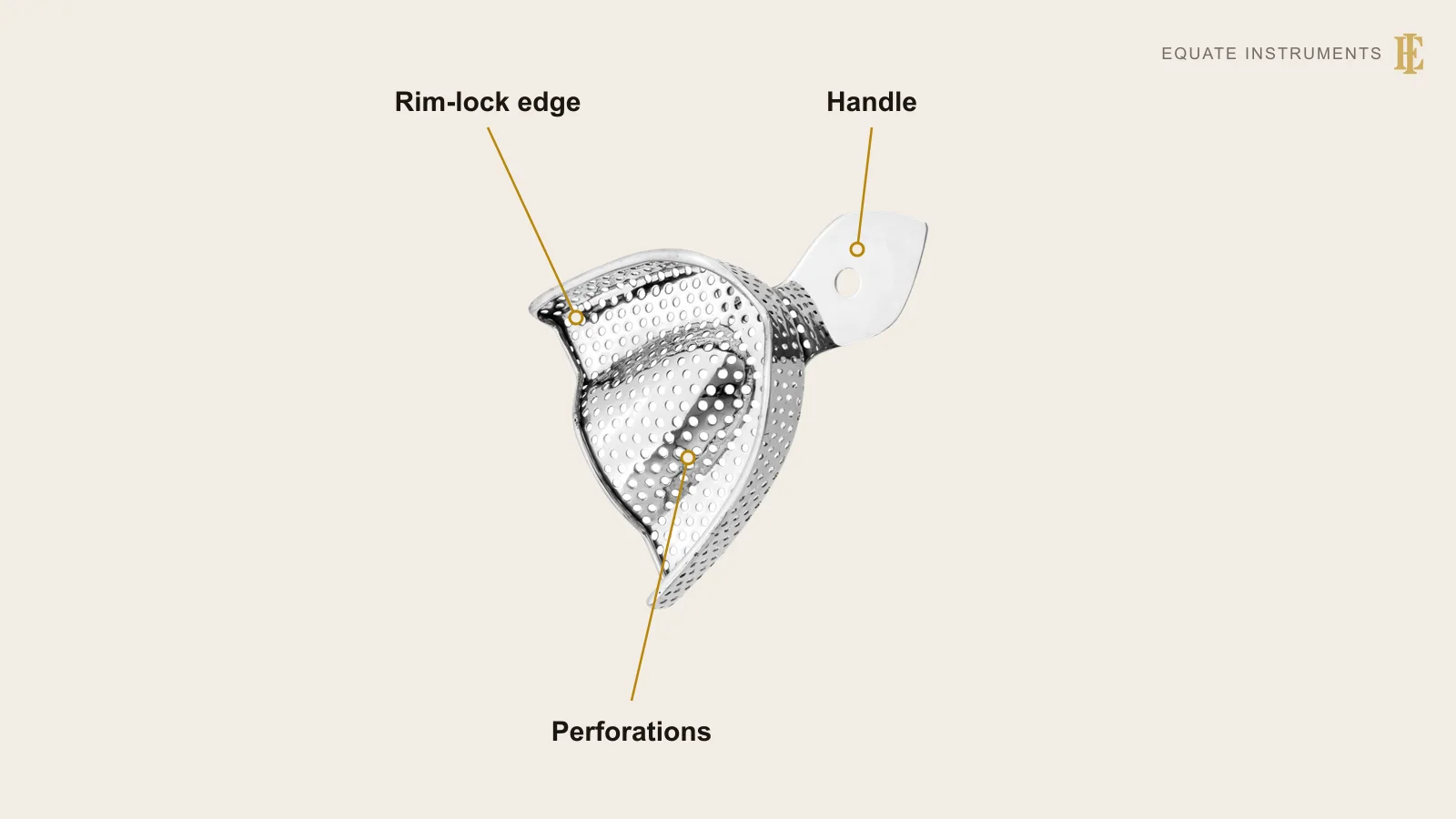
Perforated trays hold the material mechanically through the holes, solid trays rely on tray adhesive, and rim-lock trays add a raised bead around the border that locks the material in as the tray is withdrawn. Alginate does not bond to metal, so it is normally used in a perforated or rim-lock tray. Elastomers such as polyvinyl siloxane and polyether need tray adhesive, with perforations as extra retention. In a 2021 study in custom-tray resins, Patil and colleagues found perforation alone the least retentive method and perforation plus adhesive the strongest.
| Tray | How it retains material | Best with |
|---|---|---|
| Perforated | Material flows through the holes and locks on the outside | Alginate; elastomers with adhesive |
| Solid (non-perforated) | Tray adhesive, plus the rim-lock bead on rim-lock versions | Elastomers, where bleed-through is unwanted |
| Rim-lock | A retentive bead around the edge, with or without perforations | Alginate and hydrocolloids |
| Perforated rim-lock | Holes and a bead together | Heavy alginate impressions and difficult withdrawals |
How do you choose the right impression tray size?
- Try the empty tray in first: it should cover all the teeth and extend over the retromolar pads in the lower arch and the tuberosities in the upper arch.
- Leave an even space for material between tray and teeth, as the material's instructions specify; a tray touching the teeth creates thin, tearing spots.
- Check the handle clears the lips and lines up with the midline.
- Extend a short tray or support a high palate with wax rather than choosing a size that is too big everywhere else.
- Seat the tray from the back forward to push excess material out at the front, then hold it still until the material has set.
Should you use metal or disposable plastic impression trays?
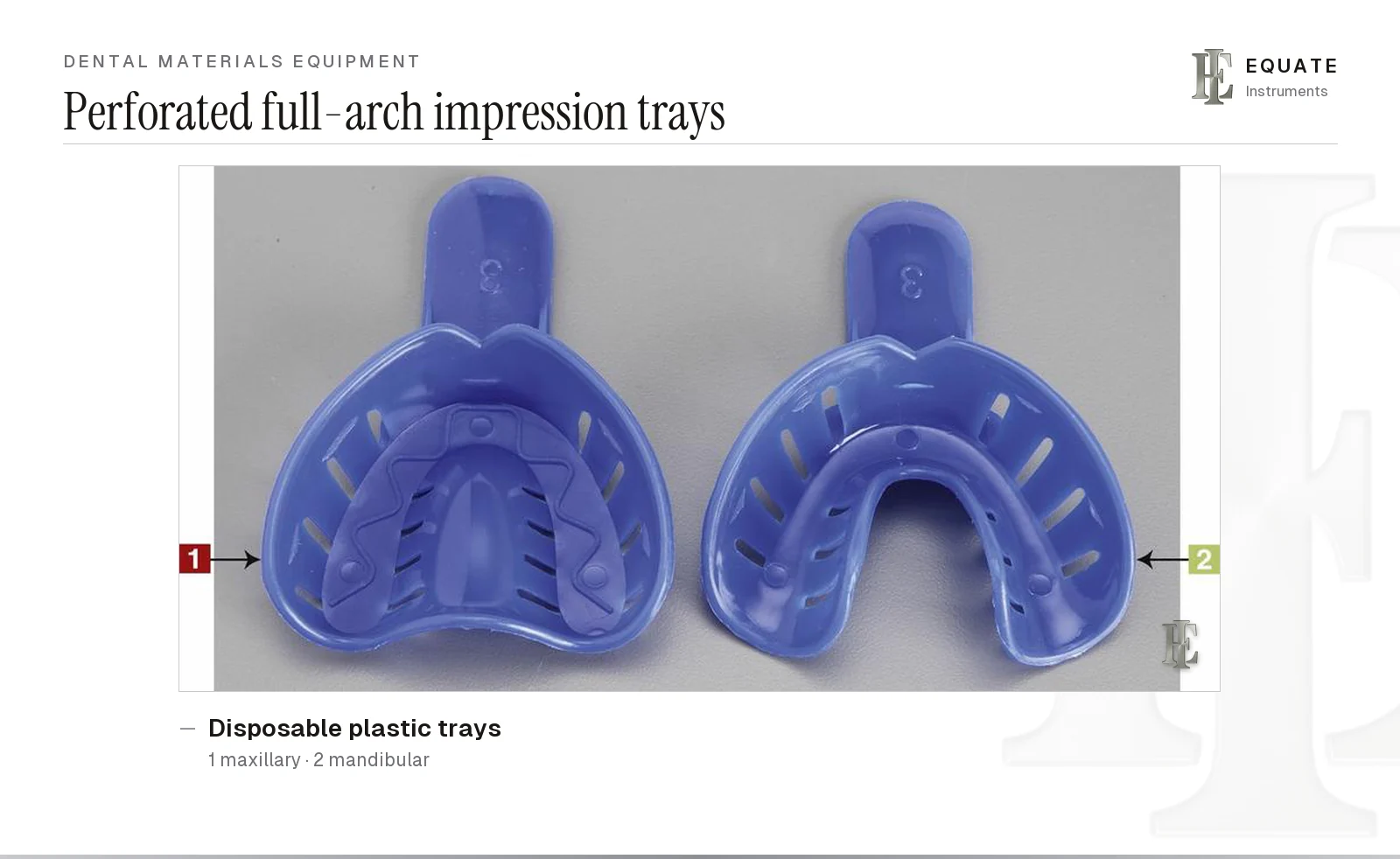
Metal trays are rigid and reusable; disposable plastic trays are single-use and save reprocessing time but can flex. Stainless steel holds its shape when a heavy-bodied material is pressed into it and when a stiff set impression is levered out, which is why rigid trays give more accurate casts. Disposable trays suit high-volume study models and dual-arch impressions, and they remove the risk of a reprocessing failure, but they add to clinical waste. Many practices keep a set of metal trays for definitive impressions and disposables for the rest.
How do you disinfect impressions and reprocess metal trays?
Rinse every impression under running water as soon as it leaves the mouth, disinfect it with a product the material manufacturer approves, rinse again and label the package to show it has been disinfected. That is the sequence in HTM 01-05 and in the CDC's 2003 guidelines, which also ask practices to tell the laboratory which disinfectant and contact time were used. A 2025 review by Masih and colleagues found short spray disinfection the gentler option for alginate and other hydrocolloids, which distort with long immersion, while silicones tolerated both spray and immersion. Pour a conventional alginate promptly, ideally within about 30 minutes, because Walker and colleagues (2010) found it most accurate then and shrinking afterwards; the pouring and trimming steps are in the dental materials equipment guide.
The CDC says heat-tolerant items used in the mouth, such as metal impression trays, should be heat-sterilised before use on another patient. Remove the set material, strip tray adhesive with the remover its manufacturer recommends, clean the tray, inspect it for bent borders and then sterilise it following the instructions for use (ISO 17664-1) and your own validated process, packed or in a cassette as your system requires.
What does the Equate range include?
Equate's 116 tray references are all stainless steel. There are 70 perforated and 33 solid trays, 43 of them rim-lock, in full-arch upper and lower sizes from XXS to XL with bent or long handles, plus left and right partial trays, quadrant trays and anterior trays. Thirteen sets group 6, 8 or 10 trays across the size range, including perforated and solid full-denture sets for edentulous patients.
The trays are designed in Finland and listed as reusable, so they can be reprocessed between patients instead of discarded. Clinics can request samples and a quote through the prosthodontic and laboratory family.
The Equate difference
Equate lists 116 stainless-steel impression tray references: 70 perforated and 33 solid trays, 43 of them rim-lock, in full-arch sizes from XXS to XL plus partial, quadrant and anterior trays, and 13 sets of 6, 8 or 10 trays, including full-denture sets.
Equate Dental Impression Trays options
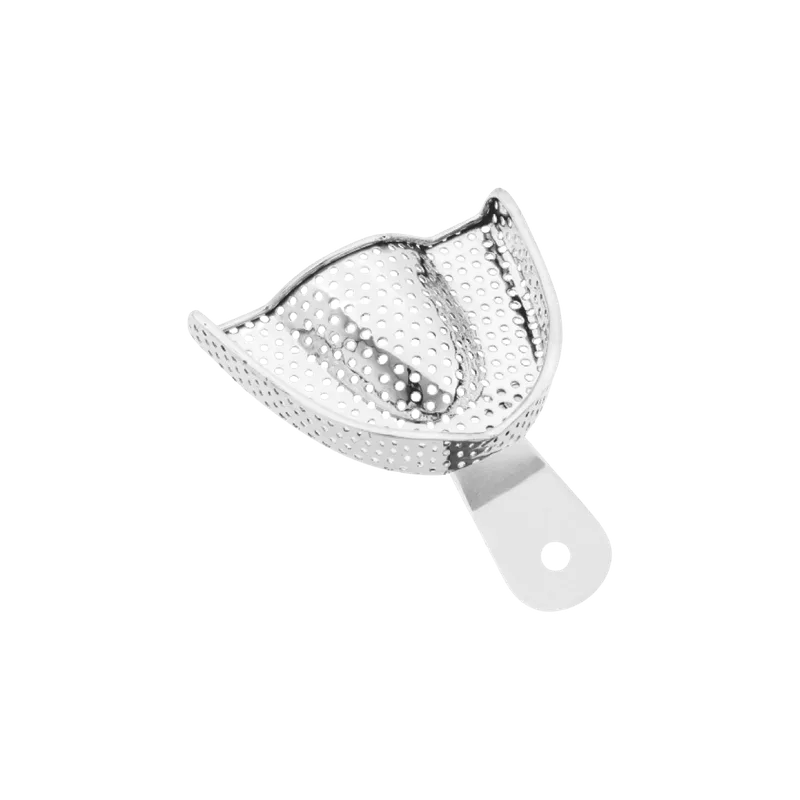
Perforated Upper Impression Tray No. 5
EI-0191
Rimlock Perforated Impression Tray Set of 10 (XS-XL Upper and Lower)
EI-0819
Rimlock Perforated Impression Tray - Lower Jaw, Extra Small (Fig.0)
EI-0820
Rimlock Perforated Impression Tray - Lower Jaw, Small (Fig.1)
EI-0821
Rimlock Perforated Impression Tray - Lower Jaw, Medium (Fig.2)
EI-0822
Rimlock Perforated Impression Tray - Lower Jaw, Large (Fig.3)
EI-0823
Rimlock Perforated Impression Tray - Lower Jaw, Extra Large (Fig.4)
EI-0824
Rimlock Perforated Impression Tray - Upper Jaw, Extra Small (Fig.0)
EI-0825
Rimlock Perforated Impression Tray - Upper Jaw, Small (Fig.1)
EI-0826
Rimlock Perforated Impression Tray - Upper Jaw, Medium (Fig.2)
EI-0827
Rimlock Perforated Impression Tray - Upper Jaw, Large (Fig.3)
EI-0828
Rimlock Perforated Impression Tray - Upper Jaw, Extra Large (Fig.4)
EI-0829Browse all prosthodontic & laboratory instruments
Buying in your market
Frequently asked questions
What are the types of impression trays in dentistry?
Stock trays (full-arch, partial, quadrant, anterior and edentulous), custom trays made for one patient, and disposable dual-arch trays. Each can be perforated, solid or rim-lock, in metal or plastic.
What is a rim-lock impression tray?
It is a tray with a raised bead around its border that locks the impression material in place as the tray is removed. It is mostly used with alginate.
Do you need tray adhesive with a perforated tray?
For alginate, perforations are usually enough. For silicones and polyethers, use the adhesive made for that material as well, because the material does not bond to the tray on its own.
What tray is used for an edentulous impression?
A stock edentulous tray, shallower and wider than a dentate tray, for the primary impression, followed by a custom tray made on the primary model for the secondary impression.
Can metal impression trays be reused?
Yes. Clean them, then heat-sterilise them before the next patient, as the CDC recommends for heat-tolerant items used in the mouth, following the manufacturer's processing instructions.
How long should tray adhesive dry before the impression?
Let it dry in the open air for the time its maker states. In a 2019 study by Kothari and colleagues, drying with compressed air or a blower weakened the bond, and drying longer than the stated 5 minutes added nothing. Yi and colleagues (2009) found adhesive and silicone from the same maker bonded more strongly, and some pairings needed 10 to 15 minutes.
Are dual-arch (triple) tray impressions accurate?
They can be. In a small in vitro pilot by Larson and colleagues (2002), dual-arch impressions seated without strain matched custom-tray impressions, but dies became less accurate when the tray flexed as the patient closed. Check that the tray clears the tissues and that the patient closes fully without bending it.
References
- Del'acqua MA, de Avila ÉD, Amaral ÂLC, Pinelli LAP, Mollo FA Jr. Comparison of the accuracy of plastic and metal stock trays for implant impressions. International Journal of Oral and Maxillofacial Implants 2012;27(3):544–550
- Patil RV, Vijayraghavan V, Jadhav M, et al. Comparison of tensile bond strength of addition silicone with different custom tray materials using different retentive methods. Journal of Contemporary Dental Practice 2021;22(3):278–283
- Masih A, Gandagule RR, Tiwari A, et al. Evaluating the influence of spray and immersion disinfection on the dimensional accuracy of impression materials: a comprehensive review. Cureus 2025;17(7):e88921
- Kohn WG, et al. Guidelines for Infection Control in Dental Health-Care Settings, 2003 (dental laboratory section). MMWR 52(RR-17), Centers for Disease Control and Prevention
- Department of Health. Health Technical Memorandum 01-05: Decontamination in primary care dental practices, 2013 edition, chapter 7: impressions, prostheses and orthodontic appliances. NHS England
- Rosenstiel SF, Land MF, Walter R. Contemporary Fixed Prosthodontics. Elsevier (impression trays and materials)
- Sakaguchi RL, Ferracane JL, Powers JM (eds). Craig's Restorative Dental Materials. Elsevier (impression materials)
- Boyd LB. Dental Instruments: A Pocket Guide, 7th edition. Saunders/Elsevier, 2020. Chapter 19, Dental Materials Equipment (photographs used under licence)
- Walker MP, Burckhard J, Mitts DA, Williams KB. Dimensional change over time of extended-storage alginate impression materials. Angle Orthodontist 2010;80(6):1110–1115
- Kothari RN, Arpudaswamy S, Nandini Y, Dhole RI, Shivram D, Shetty R. Effect of time and method of drying on bond strength of tray adhesives with vinyl polysiloxanes. Journal of Contemporary Dental Practice 2019;20(1):108–112
- Yi MH, Shim JS, Lee KW, Chung MK. Drying time of tray adhesive for adequate tensile bond strength between polyvinylsiloxane impression and tray resin material. Journal of Advanced Prosthodontics 2009;1(2):63–67
- Larson TD, Nielsen MA, Brackett WW. The accuracy of dual-arch impressions: a pilot study. Journal of Prosthetic Dentistry 2002;87(6):625–627
I am a…
Related
- Dental Spatulas (Cement, Plaster, Wax and Laboratory)
- Gingival Cord Packers (Retraction Cord Instruments)
- Crown and Bridge Scissors, Contouring and Holding Pliers
- Crown and Bridge Tray Setup: Preparation and Cementation
- Dental Instrument Cassettes, Trays and Boxes
- Dental Materials Equipment: From Impression to Finished Model
- Fixed Prosthodontic Instruments for Crown and Bridge Work