Dental Spatulas (Cement, Plaster, Wax and Laboratory)
Written by the Equate Instruments Technical Team · Reviewed by the Medical & Dental Board, Equate Instruments · Updated ·
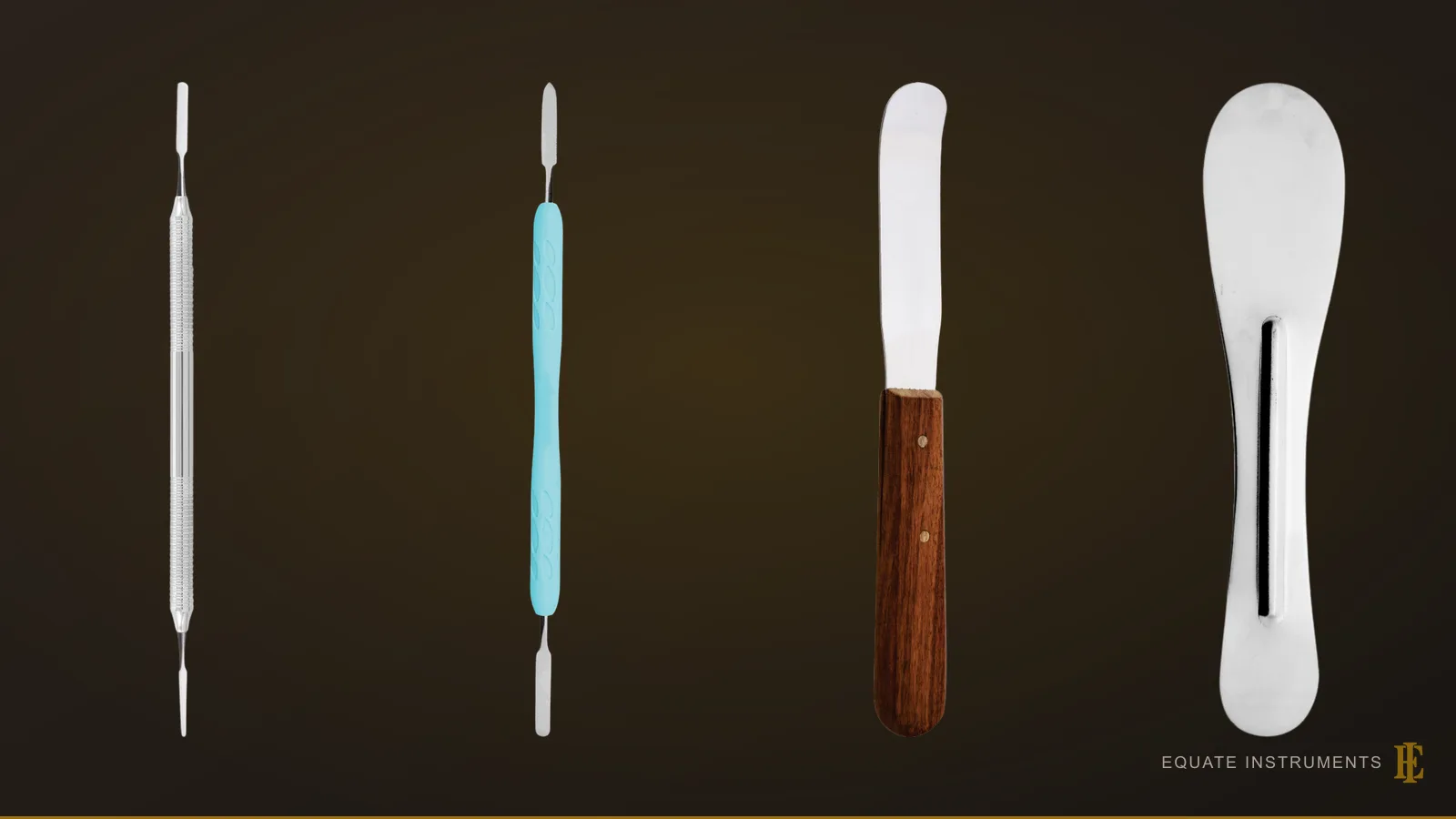
A dental spatula is a flat-bladed hand instrument for mixing, spreading or carving dental materials. Short, narrow, flexible cement spatulas mix luting and lining cements on a glass slab or paper pad; wider spatulas mix alginate, plaster and stone in a rubber bowl; heated wax knives shape wax; and plaster knives trim set models. The right blade depends on the volume, the material and the mixing surface.
Key points
- Blade size sets the job: short, narrow blades mix small amounts of cement on a slab or pad, while wider, longer blades mix alginate, plaster and stone in a bowl.
- Spatulate against the slab, pad or bowl wall to wet all the powder and press out air, and follow each material's mixing time.
- Clean cement off the blade before it sets, and reprocess chairside spatulas with the restorative set.
What is a dental spatula used for?
Dental spatulas mix powders with liquids, or two pastes together, into a smooth, uniform material, and then gather it into a mass that can be loaded into a crown, onto an instrument or into an impression tray. Chairside, a cement spatula mixes luting cement for crowns and bridges, liners and bases under fillings, and temporary cements. In the surgery or laboratory, larger spatulas mix alginate for an impression tray, and plaster or stone for study models, while wax knives build up and carve wax patterns and bite rims.
A good mix depends on the spatula as much as the technique: a blade that is too small for the volume leaves dry powder at the edges of the mix. The cement spatula belongs on the crown and bridge tray, the orthodontic banding setup and the restorative trays, next to the restorative instruments that carry the material to the tooth.
What types of dental spatula are there?
Composite resin is placed and shaped with composite spatulas such as the Heidemann pattern rather than mixed, so those belong with the composite instruments.
Wax knives work alongside wax carvers, which shape the pattern once the wax has been added.
| Type | Blade | Used for |
|---|---|---|
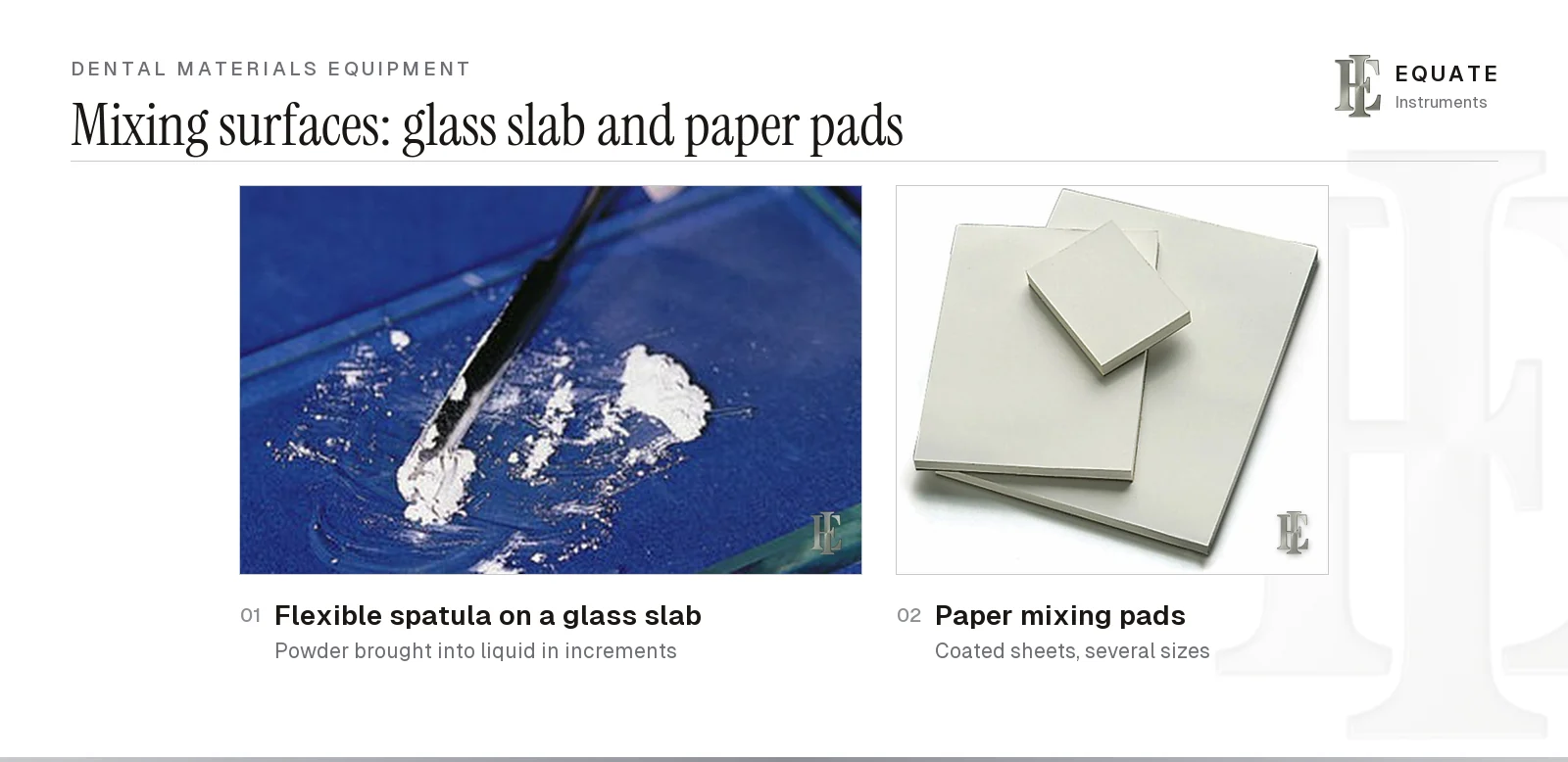
| Cement spatula | Short, narrow, flexible stainless blade, often double-ended in two widths | Luting cements, liners and bases on a glass slab or paper pad |
| Alginate spatula | Wide, flexible blade, rounded at the tip | Mixing alginate against the wall of a rubber bowl |
| Plaster spatula | Wide blade, flexible or firm, on a wooden, plastic or steel handle | Mixing plaster, stone and alginate, scraping the bowl |
| Plaster knife | Short, rigid knife blade, often on a green handle | Separating models from impressions and trimming casts by hand |
| Wax knife or wax spatula | Blade and spatula ends that hold heat | Heating, adding and carving wax for patterns and bite rims |
| Laboratory spatula (gypsum) | Straight blade | Mixing and shaping plaster, stone and die stone with the vibrator |
| Very flexible mixing spatula | Long, narrow, very flexible blade | Cements, lining pastes and small-volume mixes on a slab |
What is the difference between a stiff and a flexible spatula?
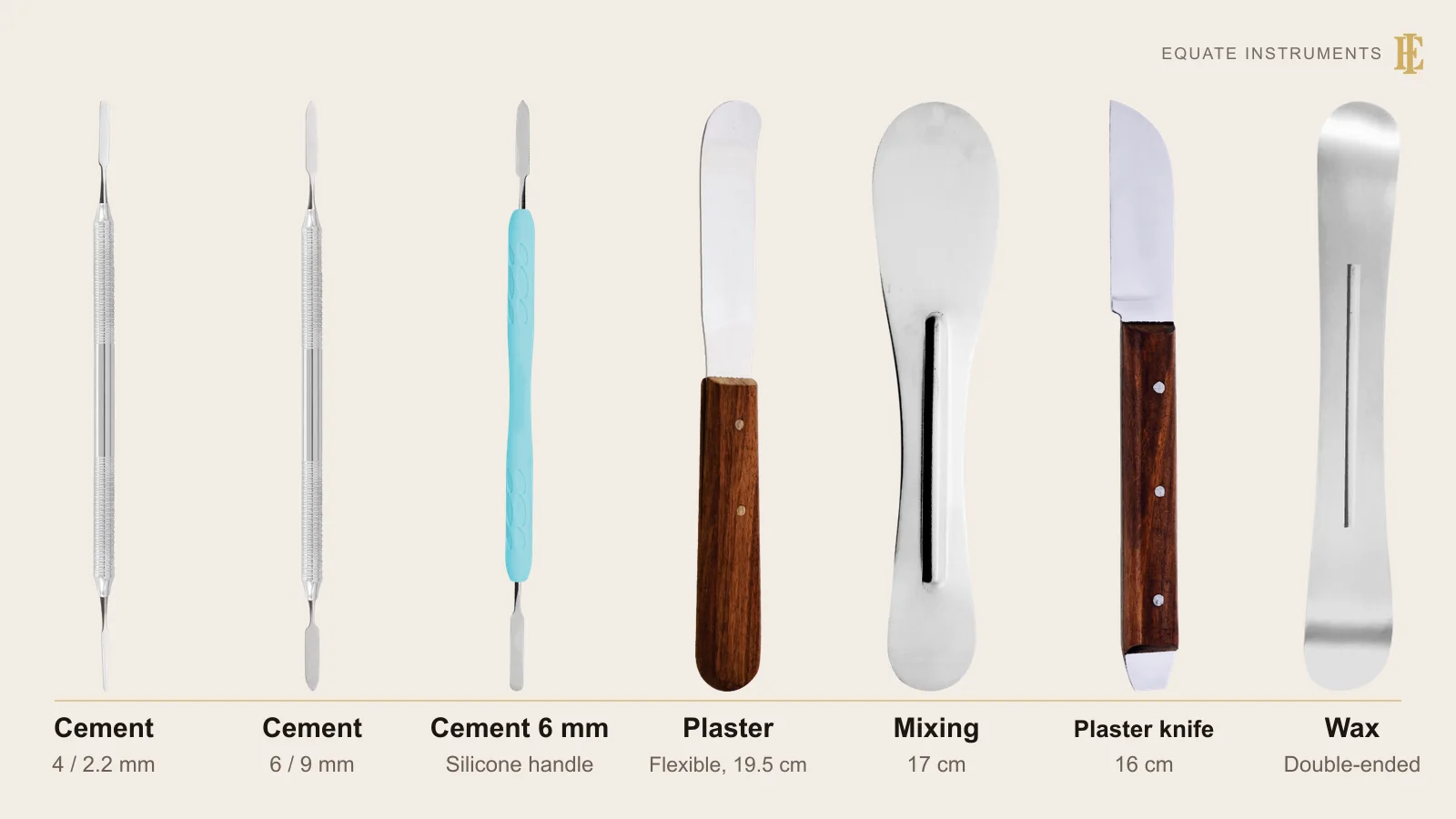
Most cement and alginate spatulas are flexible, and what separates them is the size and length of the blade. One-piece double-ended laboratory spatulas such as the No. 3 and No. 8 are stiffer, and the rigid cutting blades belong to plaster knives and trimmers. A cement spatula is short and narrow but still springy, so it can lie flat on the slab, spread the cement thin and gather it back. The classic zinc phosphate method uses a thin, flexible spatula of the Weston type, adds the powder in small portions and works each one in with a figure-of-eight over the whole slab. Alginate and plaster spatulas are wider and longer so the blade can follow the curve of the bowl as the mix is pressed and wiped against the wall. Plaster knives and trimmers cut and pare set gypsum rather than mix it.
Which spatula and mixing surface suit each material?
| Material | Mixing surface | Spatula | Point to watch |
|---|---|---|---|
| Zinc phosphate cement | Cool, thick glass slab, kept above the dew point unless you use the frozen-slab method | Narrow, flexible cement spatula | Add powder in small portions and mix in a figure-of-eight over the whole slab to spread the heat of reaction |
| Glass-ionomer and polycarboxylate cements | Paper pad or glass slab | Cement spatula | Mix quickly, within the time on the instructions, while the surface is still glossy |
| Zinc oxide-eugenol and temporary cements | Paper pad | Cement spatula | Peel off the used sheet at once; separate a sheet before the procedure or wear overgloves so contaminated gloves never touch the sheets below |
| Alginate | Flexible rubber bowl | Wide flexible spatula | Press the mix against the bowl wall to remove air |
| Plaster and stone | Rubber bowl, then vibrator | Plaster spatula | Measure water and powder; vibrate to release bubbles |
| Wax | Flame or wax heater | Wax knife | Heat the instrument, not the wax, to avoid burning it |
How do you mix alginate by hand?
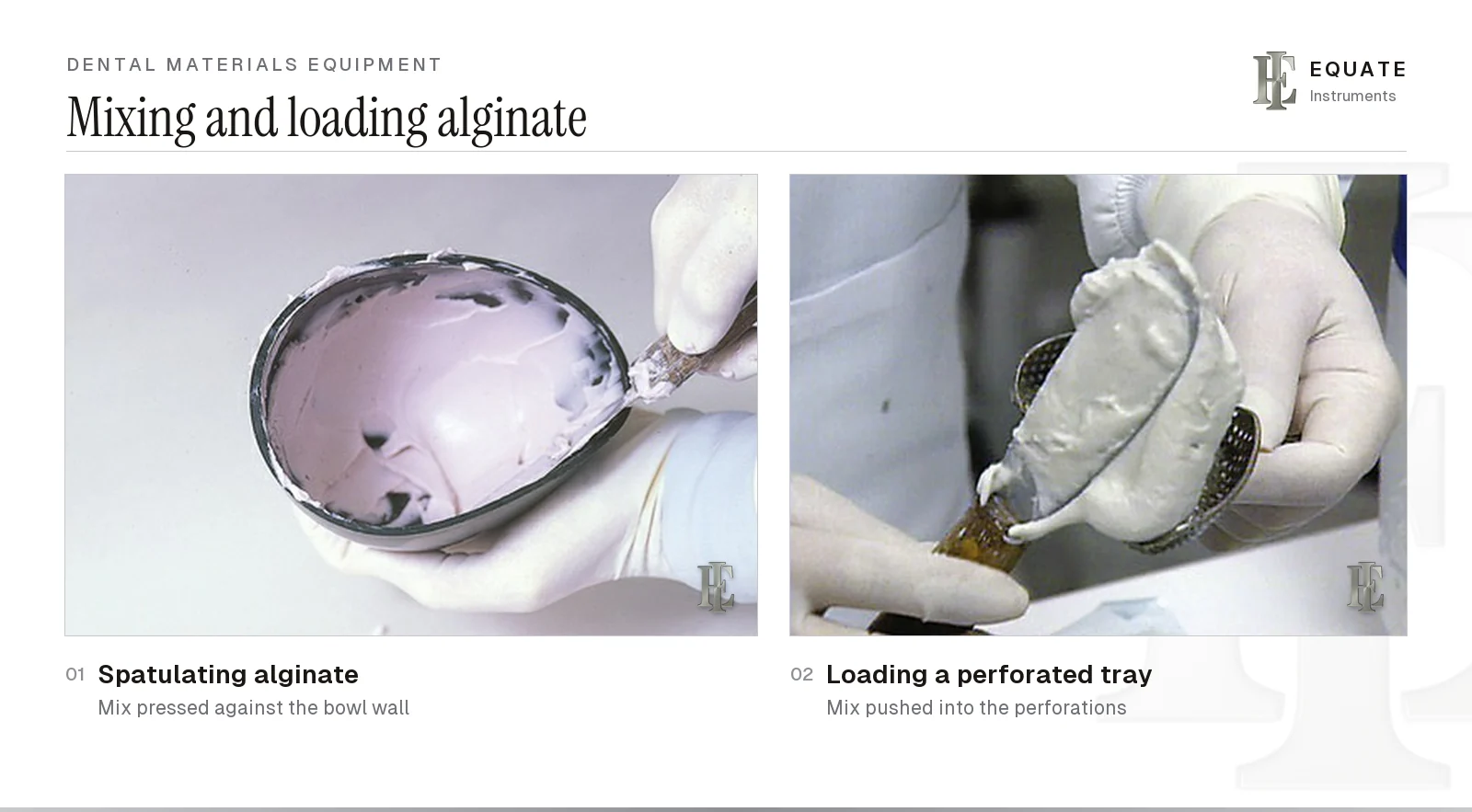
Measure the powder and water as the manufacturer specifies, add them to a clean flexible rubber bowl, and spatulate firmly with a figure-of-eight stroke, pressing the material against the side of the bowl until it is smooth and creamy. In a 2013 study in General Dentistry, McDaniel and colleagues found that for hand spatulation, adding the powder first produced significantly less porosity than adding the water first, and that centrifugal and vacuum mixers produced less surface porosity than hand mixing. A spinning-bowl mixer was not reported to do better than the hand, so it is mainly a way to save effort.
Gather the mix into one mass, wipe it into the tray in one movement to avoid folding air in, and seat the tray within the working time. A sticky or grainy mix usually means the wrong water ratio or water at the wrong temperature, which changes the setting time.
Which specifications matter when choosing a spatula?
- Blade width: about 2 to 4 mm for small amounts of liner or temporary cement, 5 to 7 mm for luting cement, and wider blades for bulk mixes.
- Double-ended designs: two blade widths on one instrument cover more materials with fewer spatulas on the tray.
- Blade size and flexibility: short and narrow for cements, wider and longer for alginate and gypsum, long and very flexible for small laboratory mixes; stiffer one-piece double-ended No. 3 and No. 8 laboratory spatulas; rigid cutting blades on plaster knives and trimmers.
- Material and coating: stainless steel is standard; titanium-coated blades release sticky materials more easily, and some materials' instructions ask for a plastic or non-metal spatula.
- Handle: solid or hollow stainless handles take repeated reprocessing; silicone handles add grip and colour coding; wooden handles suit laboratory knives and plaster spatulas.
What does the Equate range include?
Equate lists 19 cement spatulas, from double-ended 4 mm / 2.2 mm and 4 mm / 5.5 mm blades to 5, 6 and 7 mm single blades and a ribbed 6 mm / 9 mm pattern, on solid 6 mm, hollow 10 mm, knurled and light-blue silicone handles, plus titanium-coated and textured-blade versions. The laboratory side has 17 plaster spatulas and knives, including the Gritmann plaster knives, a Gritman plaster trimmer (the catalogue uses both spellings), a Lichtenstein mixing spatula and flexible spatulas from 16 to 21.5 cm. There are 9 wax instruments, eight Fahnenstock wax knives and one Gritman double-ended wax carver, and 6 laboratory mixing spatulas: very flexible 19 cm blades for cements and liners, an 18.5 cm lab mixing spatula and double-ended No. 3 and No. 8 patterns.
The 16 cm and 18 cm plaster knives with green wood-textured handles are the green-handle laboratory knife used to ease models out of impressions and trim them by hand; model trimming is covered in the dental materials equipment guide.
All are designed in Finland and made from passivated stainless steel, ultrasonically cleaned, shape-, boil- and performance-tested and individually packed. Clinics can request samples and a quote for the restorative family.
How do you clean and sterilise dental spatulas?
Wipe cement off the blade with gauze before it sets, because set zinc phosphate and glass-ionomer have to be chipped off and scratch the surface. Let plaster and stone set on a laboratory spatula and flex it off, and rinse alginate away before it dries. Chairside spatulas are then cleaned and sterilised with the restorative set, following the manufacturer's processing instructions (ISO 17664-1) and the CDC's 2003 guidelines or HTM 01-05; laboratory spatulas need cleaning and disinfection between cases.
The two kinds of spatula are reprocessed differently. The alginate spatula and its bowl are cleaned and disinfected before and after every use, whereas the flexible chairside mixing spatula is cleaned, pouched with a process indicator and steam sterilised. A glass slab is cleaned and then disinfected or sterilised, and used paper pad sheets are discarded.
Replace a spatula when the blade is nicked, bent or no longer flat, because a damaged edge leaves streaks of unmixed material.
The Equate difference
Equate lists 51 dental spatulas: 19 cement spatulas with blades from 2.2 mm to 9 mm on solid 6 mm, hollow 10 mm, knurled and light-blue silicone handles; 17 plaster spatulas and plaster knives from 16 to 21.5 cm; 9 wax knives and carvers; and 6 laboratory mixing spatulas, from very flexible 19 cm blades to double-ended No. 3 and No. 8 patterns.
Equate Dental Spatulas (Cement, Plaster, Wax and Laboratory) options

Cement Spatula 6 mm
EI-0078
Cement Spatula 6mm - Double-Ended Knurled Handle
EI-0079
Cement Spatula - Double-Ended Titanium-Coated Blades
EI-0080
Cement Spatula 5.0mm Hollow Handle 10mm
EI-0126
Cement Spatula 6.0mm - Double-Ended
EI-0127
Cement Spatula 7mm - Solid Handle 6mm
EI-0128
Cement Spatula 5 mm - 6 mm Solid Handle
EI-0194
Cement Spatula
EI-0930
Cement Spatula 6mm Light Blue Silicone Handle
EI-1328
Cement Spatula 5.0mm - Light Blue Silicone Handle
EI-1329
Cement Spatula 7mm Light Blue Silicone Handle
EI-1330
Cement Spatula 4/2.2mm Light Blue Silicone Handle
EI-1331Browse all restorative & operative instruments
Buying in your market
Frequently asked questions
What is a cement spatula used for?
It mixes dental cements, liners and bases on a glass slab or paper pad and gathers the mix for loading into a crown or onto an instrument. Its short, narrow, flexible blade lies flat on the slab to spread the cement thin and fold it back.
What is the difference between a cement spatula and an alginate spatula?
A cement spatula is short and narrow, for small amounts mixed on a slab or pad. An alginate spatula is wider and longer, so it can press the mix against the side of a rubber bowl and squeeze the air out. Both are flexible; the difference is mainly size.
Why is zinc phosphate mixed on a cool glass slab?
The setting reaction gives off heat, which speeds up the set. A cool, thick slab and small increments spread over a wide area absorb that heat and give more working time.
Can zinc phosphate be mixed on a frozen slab?
Yes, if you add more powder. Kendzior and colleagues (Angle Orthodontist, 1976) mixed zinc phosphate on slabs at 6 °C and −10 °C: it needed more powder to reach the same consistency, kept its strength and solubility, and gave a longer working time on the slab.
Can a dental spatula be autoclaved?
Stainless-steel spatulas are generally reprocessed by heat with the restorative set, but always follow the manufacturer's instructions for the specific instrument, especially for coated blades and wooden or silicone handles.
What spatula is used for plaster?
A plaster spatula with a wide blade, flexible or firm, used in a rubber bowl; many clinics use the alginate spatula for plaster and stone too. A plaster knife with a short rigid blade then separates the set cast from the impression and trims it.
References
- McDaniel TF, Kramer RT, Im F, Snow D. Effects of mixing technique on bubble formation in alginate impression material. General Dentistry 2013;61(6):35–39
- Sakaguchi RL, Ferracane JL, Powers JM (eds). Craig's Restorative Dental Materials. Elsevier (cements, impression and gypsum materials)
- Powers JM, Wataha JC. Dental Materials: Foundations and Applications. Elsevier (manipulation of cements and impression materials)
- Boyd LB. Dental Instruments: A Pocket Guide, 7th edition. Saunders/Elsevier, 2020. Chapter 19, Dental Materials Equipment (photographs used under licence)
- Kohn WG, et al. Guidelines for Infection Control in Dental Health-Care Settings, 2003. MMWR 52(RR-17), Centers for Disease Control and Prevention
- ISO 17664-1:2021 Processing of health care products: information to be provided by the medical device manufacturer for the processing of medical devices, part 1: critical and semi-critical medical devices
- Kendzior GM, Leinfelder KF, Hershey HG. The effect of cold temperature mixing on the properties of zinc phosphate cement. Angle Orthodontist 1976;46(4):345–350
- Scheller-Sheridan C. Basic Guide to Dental Materials. Wiley-Blackwell, 2010 (dental cements chapter: zinc phosphate mixing technique)
I am a…
Related
- Dental Impression Trays
- Crown and Bridge Scissors, Contouring and Holding Pliers
- Restorative Dental Hand Instruments
- Dental Composite Instruments: Placement, Sculpting and the Composite Gun
- Crown and Bridge Tray Setup: Preparation and Cementation
- Dental Materials Equipment: From Impression to Finished Model
- Orthodontic Separator and Banding Setup