Dental Tissue Forceps (Toothed and Non-Toothed)
Written by the Equate Instruments Technical Team · Reviewed by the Medical & Dental Board, Equate Instruments · Updated ·
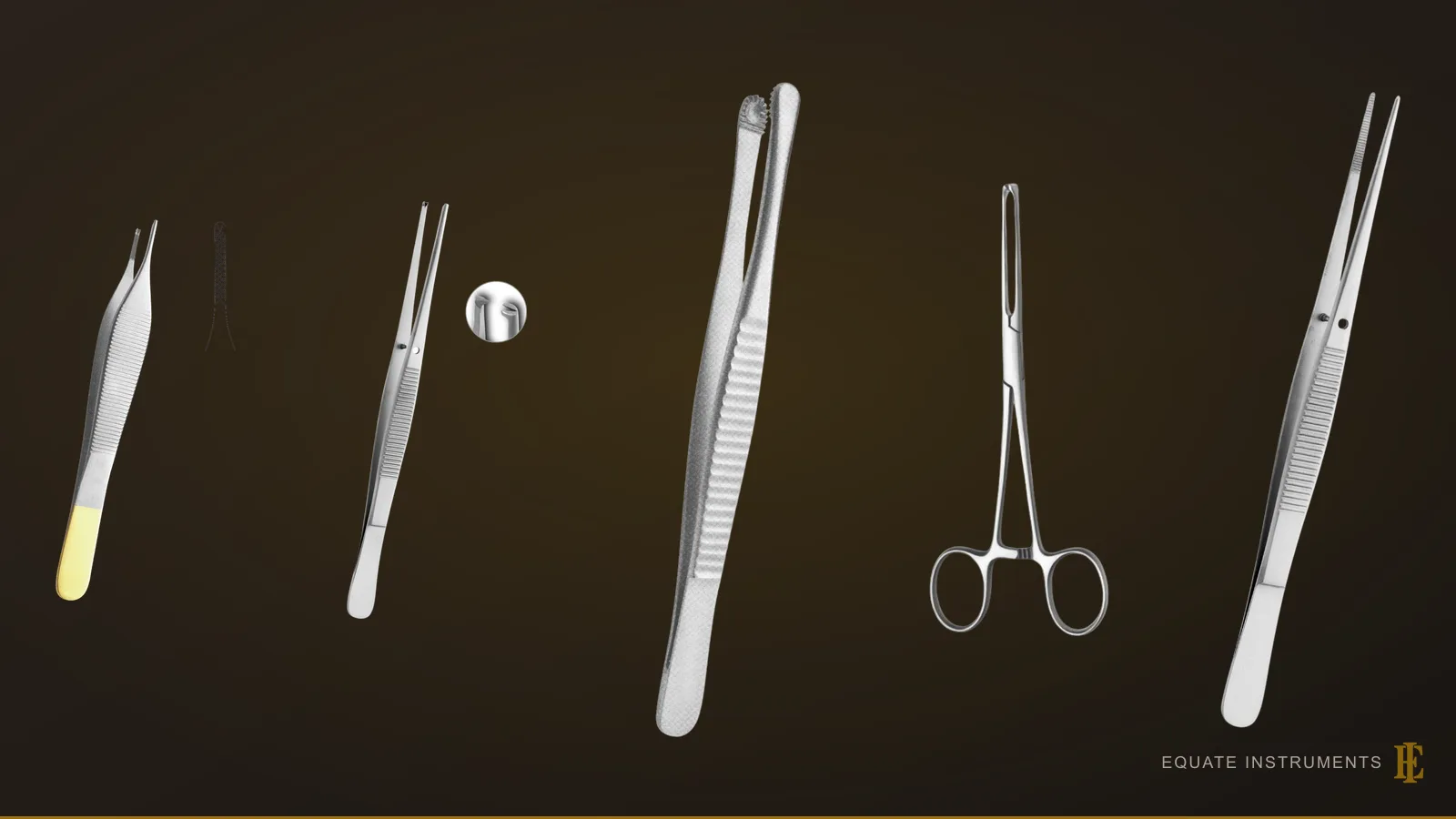
Tissue forceps are spring-handled grasping instruments, held like a pen, that steady a gum flap or soft tissue while it is cut, lifted or sutured. Toothed or rat tooth forceps, usually with a 1×2 tip, hold tissue securely with light pressure. Non-toothed dressing forceps, with serrated or smooth tips, handle sutures, dressings and delicate tissue. The Adson is the standard short pattern in oral surgery.
Key points
- Opinion is divided on which tip is gentler: a 1×2 rat tooth holds tough mucoperiosteum with a lighter grip, while non-toothed tips suit delicate tissue, grafts and membranes.
- Use smooth or serrated dressing forceps for sutures, membranes and dressings, which teeth would tear.
- Cotton pliers and college tweezers for carrying cotton rolls are general-purpose instruments with their own guide, dental cotton pliers.
What are tissue forceps used for in dental surgery?
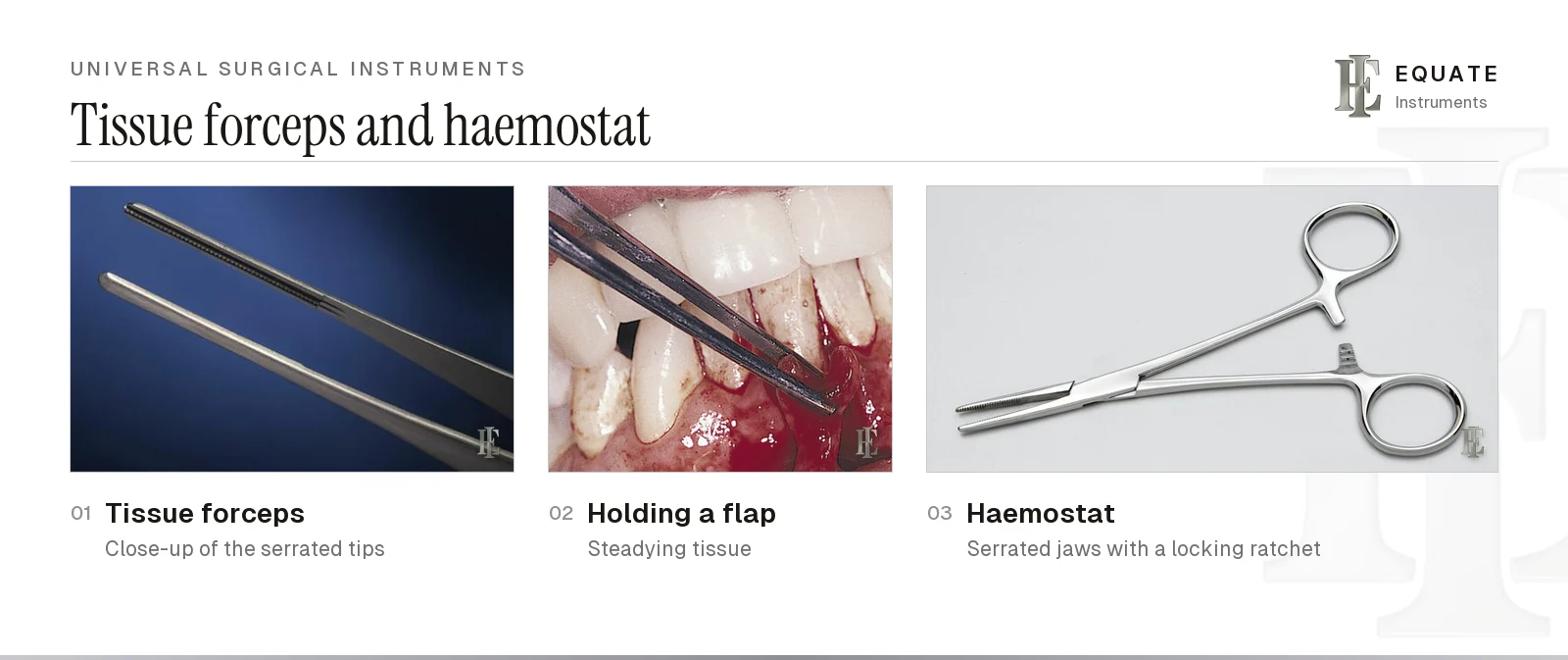
Tissue forceps hold soft tissue still while the other hand works. In oral surgery they steady a flap as the needle passes through it, lift the edge of a flap so it can be trimmed, pick up tissue tags and biopsy specimens, and hold the knot when sutures are removed. Without them the clinician ends up pinching tissue with the fingers or chasing a mobile flap with the needle.
They are used on almost every surgical tray, beside the needle holder, the surgical scissors and the periosteal elevator that raises the flap. See the oral surgery tray setup for where they sit in the order of use. Ring-handled locking patterns such as the Allis work more like a haemostat, and all of them belong to the universal surgical instruments.
What is the difference between toothed and non-toothed forceps?
Toothed forceps have small interlocking teeth at the tip. The classic rat tooth pattern is 1×2: a single tooth on one side closes between two on the other. The teeth catch the tissue, so it can be held with a light grip, which is why many surgeons prefer toothed forceps for gingiva and mucoperiosteal flaps, which are tougher than they look. Non-toothed forceps have cross-serrated or smooth tips and must be squeezed harder to hold tissue, so they can crush a thin flap; they're the right choice for sutures, dressings, membranes and grafts, which teeth would puncture.
Not everyone agrees. Crumplin, reviewing dissecting and tissue forceps in the British Journal of Surgery (2023), judges non-toothed forceps less likely to injure tissue and warns that forceps which slip or are clamped too tightly damage delicate structures. For microsurgical knot tying, Yadav and colleagues (2018) favour flat-surfaced microforceps tips, which stop fine thread slipping.
| Tip | Grip | Best for |
|---|---|---|
| 1×2 teeth (rat tooth) | Secure with light pressure | Gingiva, flap margins, suturing |
| Fine multi-tooth rows (Adson-Brown 9×9) | Spreads grip along the tip | Delicate flaps, less risk of tearing |
| Cross-serrated (dressing) | Needs firmer pressure | Sutures, gauze, dressings, tissue removal |
| Atraumatic (DeBakey) | Fine longitudinal grooves | Delicate tissue and vessels |
| Smooth, TC or diamond-coated micro tips | Precise, slip-resistant | Fine sutures, membranes, connective tissue grafts |
What types of tissue forceps are there?
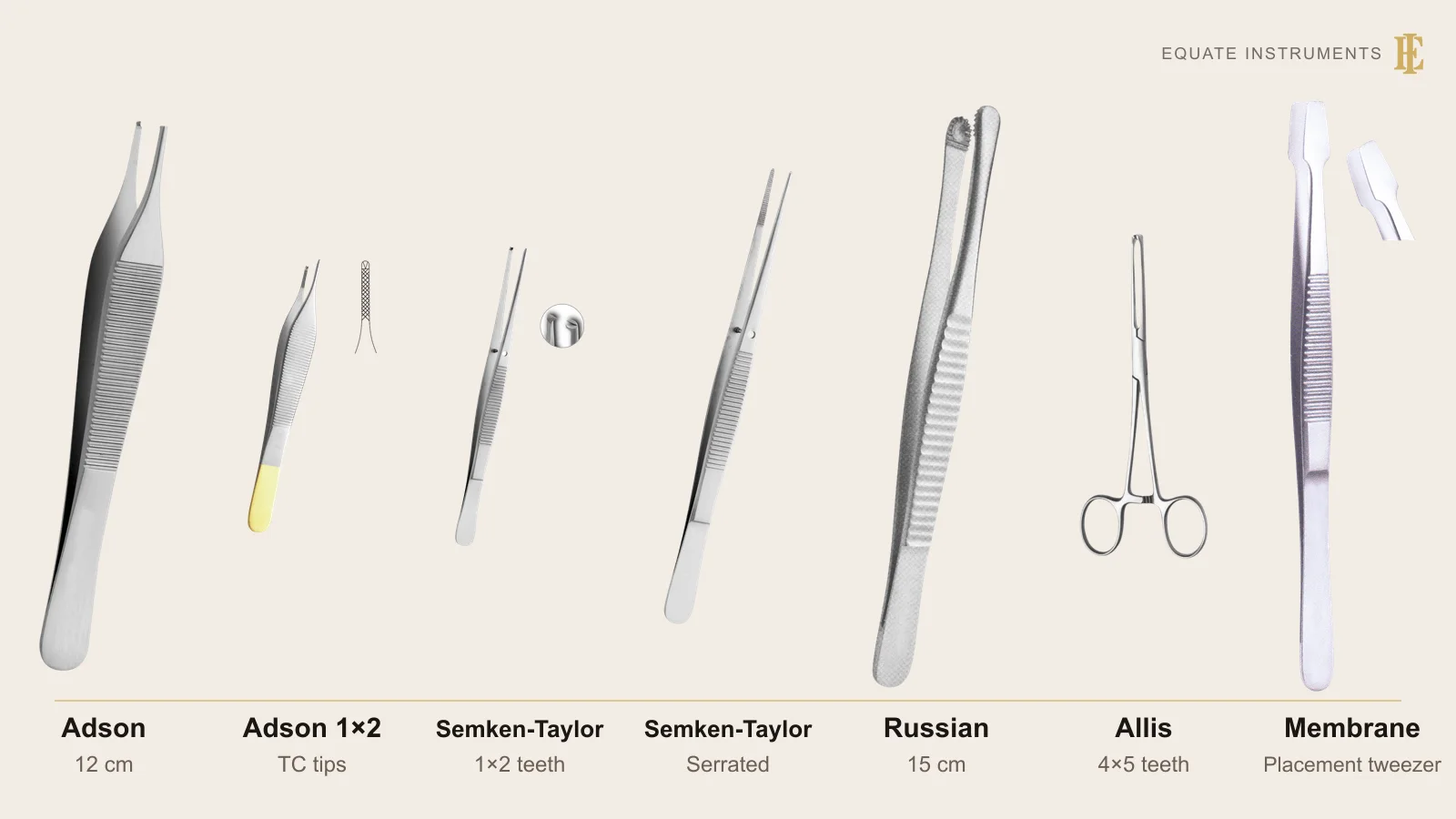
- Adson: a short forceps, about 12 cm, with a broad grip and fine tips, toothed or serrated; named after Alfred Washington Adson (1887–1951), a neurosurgeon at the Mayo Clinic.
- Adson-Brown: an Adson with rows of fine teeth along each tip, which spread the grip and tear less.
- Semken and Semken-Taylor: slim, light forceps with fine serrated or 1×2 tips, straight, curved or angled, a common choice in dentistry.
- Gerald: long, slender forceps (around 18 cm) with fine tips, for deeper sites.
- DeBakey: atraumatic forceps with fine grooves for delicate tissue.
- Russian: rounded, cup-shaped serrated tips that hold a broad bite of tissue.
- Allis: ring-handled, locking forceps with 4×5 teeth that hold tissue to be excised.
- Bonney: a heavy toothed forceps used for tough tissue in general surgery; Equate doesn't list it, and its closest equivalents in the range are the 18 cm Gerald 1×2 and the Semken-Taylor 1×2.
- Microsurgical tweezers: fine tungsten carbide, diamond-coated or serrated tips, straight or curved, for implant, graft and periodontal plastic surgery.
Which tissue forceps for which procedure?
| Procedure | Usual forceps | Why |
|---|---|---|
| Extraction and flap closure | Adson or Semken-Taylor 1×2 | Holds the flap edge for the needle |
| Third molar and deep posterior sites | Gerald 1×2, 18 cm | Long, fine tips keep the hand out of the view |
| Biopsy and excision of a soft-tissue lesion | Allis or Adson-Brown | Holds the specimen firmly without crushing the margins |
| Implant, graft and membrane handling | Microsurgical or membrane tweezers | Fine smooth tips don't tear grafts and membranes |
| Suture removal and dressings | Serrated dressing forceps | Picks up the knot or gauze without snagging |
How do you hold and use tissue forceps?
Hold tissue forceps like a pen, between the thumb and the index and middle fingers, with the handle resting in the web of the thumb. Close them only as far as needed. Grasp a flap by its connective tissue or periosteal side, or just at the margin, rather than pinching the full thickness in the middle, and let go between needle passes so the tissue isn't clamped for minutes.
Common mistakes are squeezing smooth forceps hard enough to bruise a thin flap, using toothed forceps on a membrane or graft, and grasping the needle with tissue forceps, which bends their tips out of alignment. Use the needle holder to retrieve the needle instead.
What does the Equate range include?
Equate's 69 tissue and dressing forceps span oral surgery, implantology and general use. They include Adson forceps with 1×2 teeth, serrated tips and tungsten carbide inserts, and an Adson-Brown with 9×9 teeth; Semken, Semken-Taylor and Taylor patterns at 12 to 15 cm; 18 cm Gerald forceps; DeBakey, Russian and Bishop Harman patterns; 4×5 Allis forceps from 13 to 20 cm; 20 and 25 cm Gross-Maier dressing forceps with eyed tips; and microsurgical tweezers with tungsten carbide, diamond-coated or ultra-fine tips.
For regenerative work there are straight and curved membrane placement tweezers, a membrane placer and a suture plier. The tissue forceps are part of the oral surgery range, the dressing tweezers of the accessories range and the implant tweezers of the implantology range. Clinics can request samples and a quote.
How do you clean and look after tissue forceps?
Clean the inner faces of the tips and the teeth with a soft brush or in an ultrasonic bath, because blood and tissue dry into the serrations. Then sterilise them as set out in the CDC's Guidelines for Infection Control in Dental Health-Care Settings or, in UK practices, HTM 01-05, following the manufacturer's processing instructions under ISO 17664-1. Ring-handled locking patterns such as the Allis should be processed open and unlocked.
Inspect the tips each time: they should meet evenly along their length, the teeth should mesh without overlapping, and the guide pin, where there is one, should keep the jaws aligned. Retire forceps with bent tips, broken teeth or a spring that no longer opens them fully; a misaligned toothed tip tears tissue.
The Equate difference
Equate lists 69 tissue and dressing forceps from 9 to 25 cm: 10 Adson and Adson-Brown, 6 Semken and Semken-Taylor, 4 Gerald, 4 Gross-Maier, 3 Allis, 2 DeBakey, 2 Russian and 2 Bishop Harman patterns, 14 with 1×2 teeth, 13 microsurgical tweezers, 9 with tungsten carbide tips, 4 diamond-coated, a suture plier and 3 membrane placement instruments.
Equate Dental Tissue Forceps (Toothed and Non-Toothed) options

Tissue Forceps 1x2 Teeth 15 cm
EI-0331
Kocher Forceps Curved 13 cm
EI-0443
Tohoku Tissue-Holding Forceps - 10 cm
EI-0454
Allis Tissue Forceps 4x5 - 15 cm
EI-0455
Young Tongue-Seizing Forceps - 16 cm
EI-2262
Gross-Maier Dressing Forceps Straight 20 cm - Eyed Tips
EI-2328
Gross-Maier Dressing Forceps Curved 20 cm - Eyed Tips
EI-2329
Gross-Maier Dressing Forceps Curved 25 cm - Eyed Tips
EI-2330
Gross-Maier Dressing Forceps Straight 25 cm - Eyed Tips
EI-2331
Bishop Harman Tissue Forceps 1x2 Teeth 9 cm
EI-2677
Bishop Harman Serrated Tissue Forceps 9 cm
EI-2678
Gerald Tissue Forceps Straight 1x2 Teeth 18 cm
EI-2679Browse all accessories & supplies instruments Browse all oral surgery instruments Browse all implantology instruments
Buying in your market
Frequently asked questions
What are rat tooth forceps?
Rat tooth forceps are tissue forceps with interlocking teeth at the tip, usually in a 1×2 pattern. The teeth hold tissue securely with light pressure, which suits gingiva and surgical flaps.
What are Adson tissue forceps with teeth used for?
Adson forceps with 1×2 teeth hold the edge of a flap during suturing and trimming. Their short length and broad grip give fine control in the mouth.
What is the difference between tissue forceps and dressing forceps?
Tissue forceps usually have teeth for holding tissue. Dressing forceps have serrated or smooth tips for gauze, dressings and sutures, and need a firmer grip to hold tissue.
What does 1×2 mean on tissue forceps?
It describes the teeth: one tooth on one tip closes between two teeth on the other. Larger counts such as 4×5 on an Allis give a broader bite.
Are tissue forceps the same as cotton pliers?
No. Cotton pliers, or college tweezers, have angled tips for carrying cotton rolls and small items in general dentistry. Tissue forceps are surgical instruments for holding soft tissue.
Toothed or non-toothed forceps for a gum flap?
Either can work. Toothed 1×2 forceps hold thick mucoperiosteum with a light grip at the flap margin; non-toothed forceps, which a 2023 British Journal of Surgery review judges less likely to injure tissue, are the safer choice for thin flaps, grafts and membranes. Whichever you use, grip the margin and let go between needle passes.
References
- Hupp JR, Tucker MR, Ellis E. Contemporary Oral and Maxillofacial Surgery, 7th edition. Elsevier, 2018 (instrumentation for basic oral surgery; flap design and suturing)
- Newman MG, Takei HH, Klokkevold PR, Carranza FA (eds). Newman and Carranza's Clinical Periodontology. Elsevier (periodontal surgical instruments)
- Kohn WG, et al. Guidelines for Infection Control in Dental Health-Care Settings, 2003. MMWR 52(RR-17), Centers for Disease Control and Prevention
- NHS England. Health Technical Memorandum 01-05: Decontamination in primary care dental practices (2013 edition)
- ISO 17664-1:2021 Processing of health care products: information to be provided by the medical device manufacturer for the processing of medical devices
- Boyd LRB. Dental Instruments: A Pocket Guide, 7th edition. Saunders/Elsevier, 2020. Chapter 15, Universal Surgical Instruments (photographs used under licence)
- Crumplin MKH. Dissecting, tissue, and grasping forceps. BJS 2023;110(3):310–312
- Yadav VS, Salaria SK, Bhatia A, Yadav R. Periodontal microsurgery: reaching new heights of precision. J Indian Soc Periodontol 2018;22(1):5–11
I am a…