Universal Surgical Instruments for Oral and Periodontal Surgery
Written by the Equate Instruments Technical Team · Reviewed by the Medical & Dental Board, Equate Instruments · Updated ·
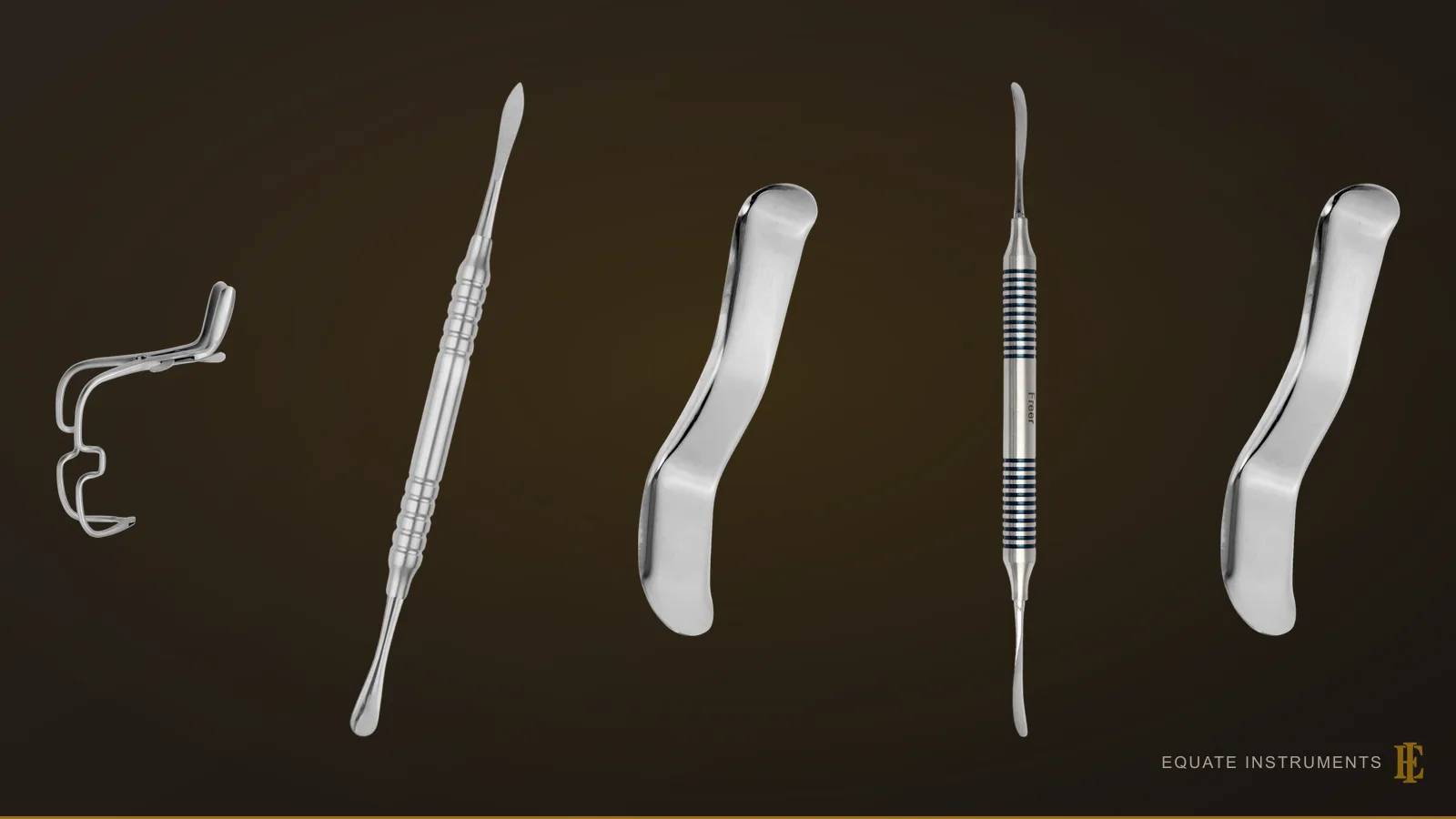
Universal surgical instruments are the shared hand instruments of oral and periodontal surgery. A scalpel incises, a periosteal elevator raises the flap, a surgical curette cleans the site, tissue forceps and a haemostat grasp, scissors trim tissue and cut sutures, and a needle holder closes the wound, while mouth props and retractors keep the field open. Procedure-specific instruments are added on top.
Key points
- One core kit covers incision, flap elevation, débridement, retraction and closure; extraction forceps, elevators and bone instruments are added for the specific procedure.
- Scalpel blades, suture needles and disposable mouth props are single-use; handles, forceps, scissors, elevators and needle holders are reusable steel instruments.
- Surgical instruments enter tissue and touch bone, so they're critical items: cleaned, sterilised in a sealed pack, and hinged instruments processed open and unlocked.
What are universal surgical instruments?
Every surgical tray in a dental clinic shares a core. Whether the procedure is a surgical extraction, a periodontal flap, an apicectomy (see endodontic instruments) or a biopsy, the team needs a way to keep the mouth open, make an incision, lift and hold the soft tissue, clean the site and stitch it closed. In Boyd's Dental Instruments: A Pocket Guide (Elsevier) these shared instruments form their own chapter, the universal surgical instruments, because they appear on oral surgery and periodontal surgery trays alike.
Procedure-specific instruments sit on top of this core: extraction forceps and elevators for removing teeth (see tooth extraction instruments), rongeurs, chisels and bone files for bone work, and periodontal knives for gingival surgery. Local anaesthesia comes first, using the syringes and cartridges described in the local anaesthetic equipment guide. The tray also starts with the basic setup of mirror, explorer and cotton forceps, and uses a surgical suction tip, described with the rest of the suction system in the evacuation guide.
On the tray the instruments sit roughly in the order they will be picked up, so the assistant can pass them without searching; see the oral surgery tray setup for the order of use. The table summarises what each universal instrument does and whether it is reused.
| Instrument | What it does | Reusable or single-use |
|---|---|---|
| Mouth prop / mouth gag | Keeps the jaws apart so the patient doesn't have to hold the mouth open | Props: reusable rubber or disposable; gags: reusable steel |
| Scalpel handle and blade | Incises soft tissue; No. 12 and No. 15 blades are the usual intra-oral shapes | Handle reusable; blade single-use |
| Periosteal elevator | Lifts the gum and periosteum off bone as a flap and holds it back | Reusable |
| Surgical curette | Scoops granulation tissue, debris and cyst lining out of sockets and defects | Reusable |
| Tissue forceps | Grip and steady soft tissue while it's cut or sutured | Reusable |
| Haemostat | Locks onto tissue, root fragments or small items and holds them | Reusable |
| Tongue and cheek retractor | Holds the cheek, lip or tongue away from the surgical field | Reusable |
| Tissue scissors / suture scissors | Trim tissue tags; cut suture ends after knotting or at removal | Reusable |
| Needle holder | Clamps the curved suture needle and drives it through tissue | Reusable |
| Suture with needle | Closes the wound; resorbable or non-resorbable material | Single-use, supplied sterile |
Mouth props, mouth gags and retractors
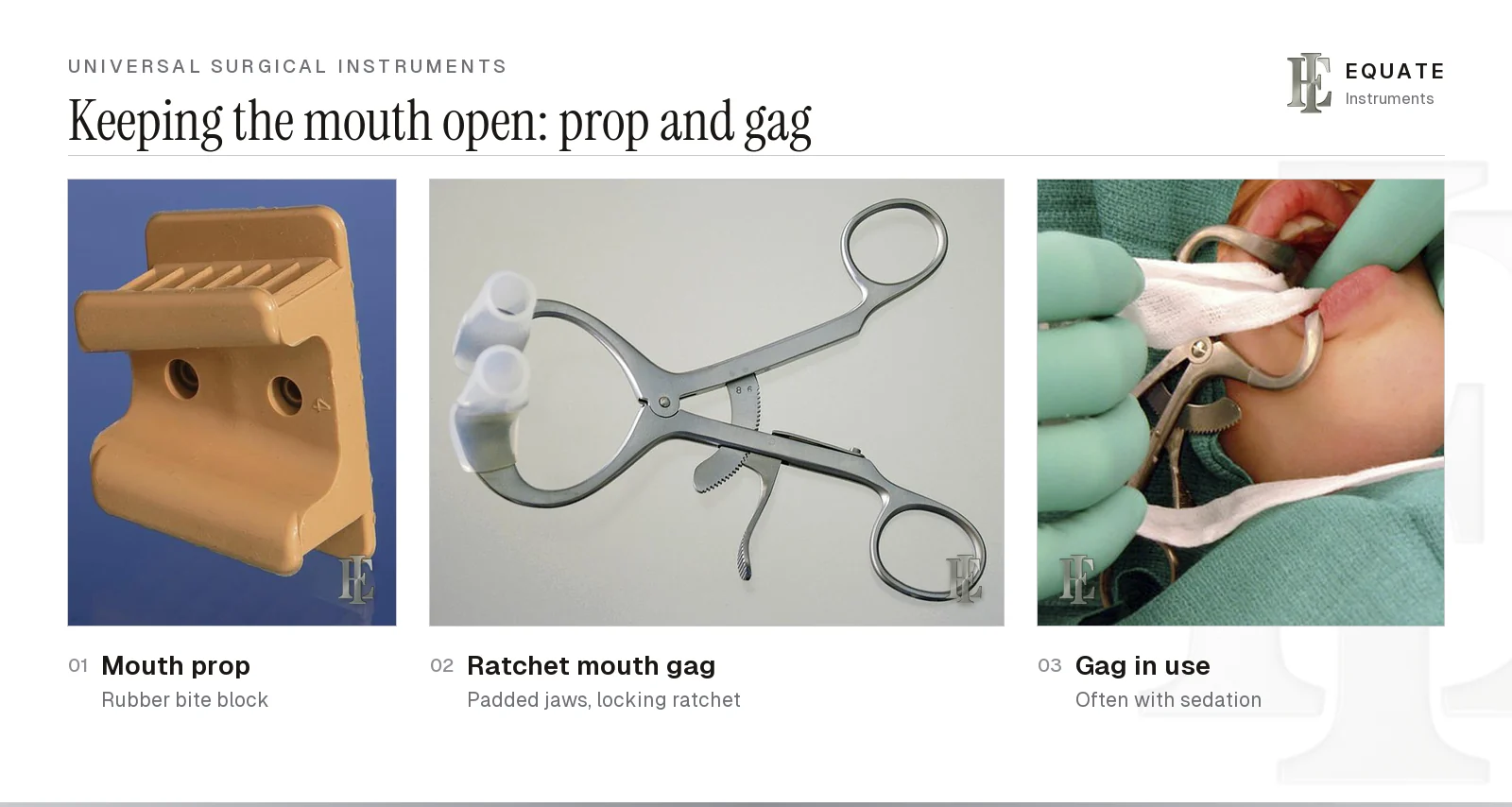
A mouth prop, also called a bite block, is a ridged rubber or silicone block placed between the back teeth on one side. The patient rests on it instead of holding the jaw open with their own muscles, which makes long or sedated procedures far more comfortable. Props come in paediatric to large adult sizes, and disposable versions are made for single use. A length of floss tied through the prop lets it be pulled out quickly if it slips, so it can't be swallowed or inhaled.
A mouth gag is a steel instrument that holds the jaws apart mechanically. Molt-pattern gags open when the finger rings are squeezed and are held at the chosen opening by a ratchet; frame gags such as the Jennings pattern sit around the front of the mouth. Gags are used mainly in oral and periodontal surgery on sedated patients, where the patient can't keep the mouth open voluntarily. Open a gag gradually and pad the jaws, because the force is applied directly to the teeth and joints.
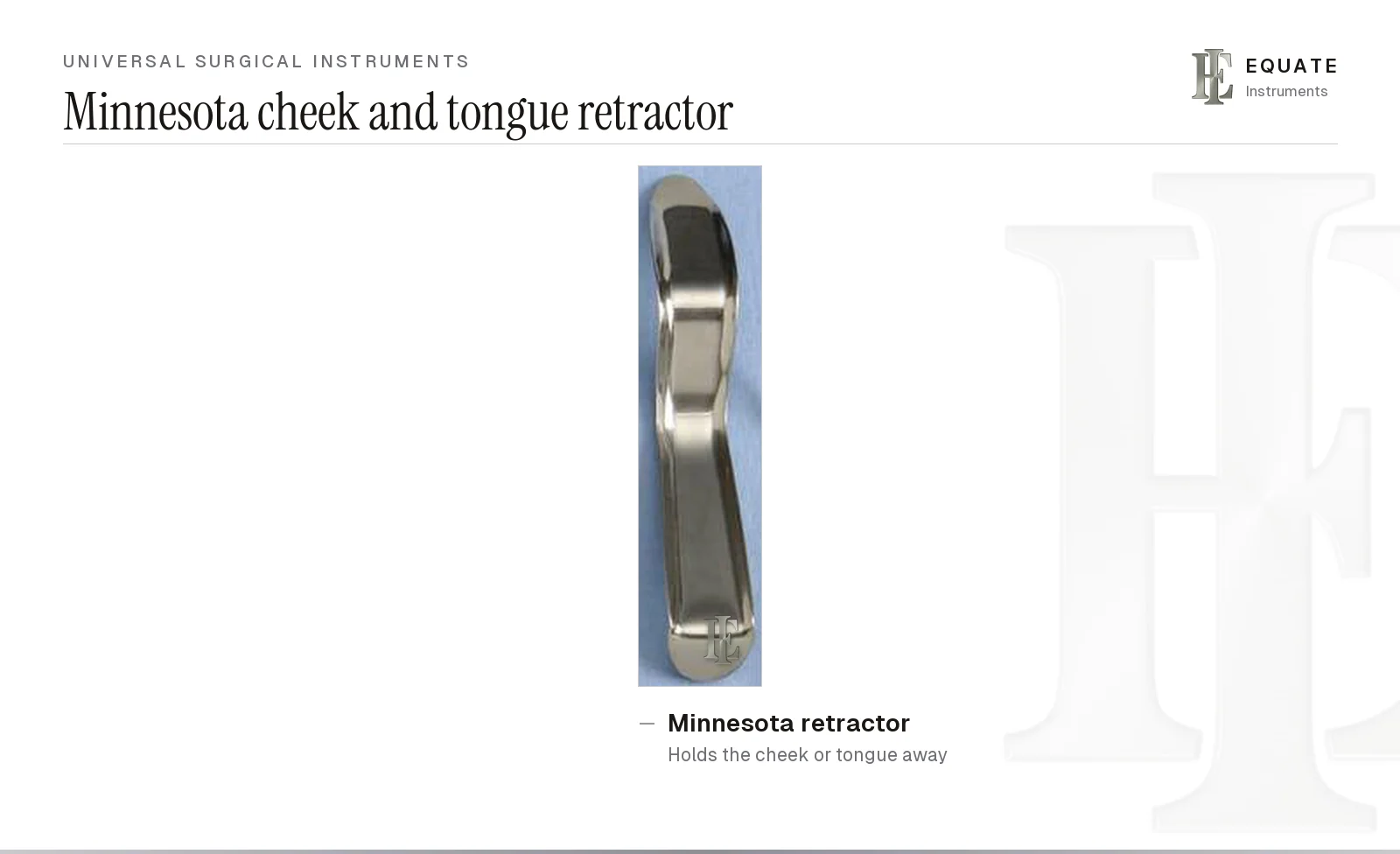
Retractors hold soft tissue out of the way. The Minnesota retractor, a bent, offset blade, retracts the cheek or tongue and protects them from burs and blades; the Austin and Langenbeck patterns hold back flaps and lips, and tongue retractors keep the tongue clear of lingual surgery. The dental retractors guide compares the patterns.
Scalpels, blades and blade removers
A scalpel is a reusable handle with a replaceable single-use blade, or a disposable one-piece unit with the blade already fixed in a plastic handle. Most dental scalpel handles are the flat No. 3 pattern, which takes the small blade fitting (sizes 10 to 15) that ISO 7740 standardises so blades and handles from different makers interchange; round handles roll between the fingers for curved incisions, and longer, slimmer handles reach further back in the mouth. The No. 4 handle takes the larger 20-series blades used in general surgery rather than inside the mouth; compare handles and blade fittings in the scalpel handles guide.
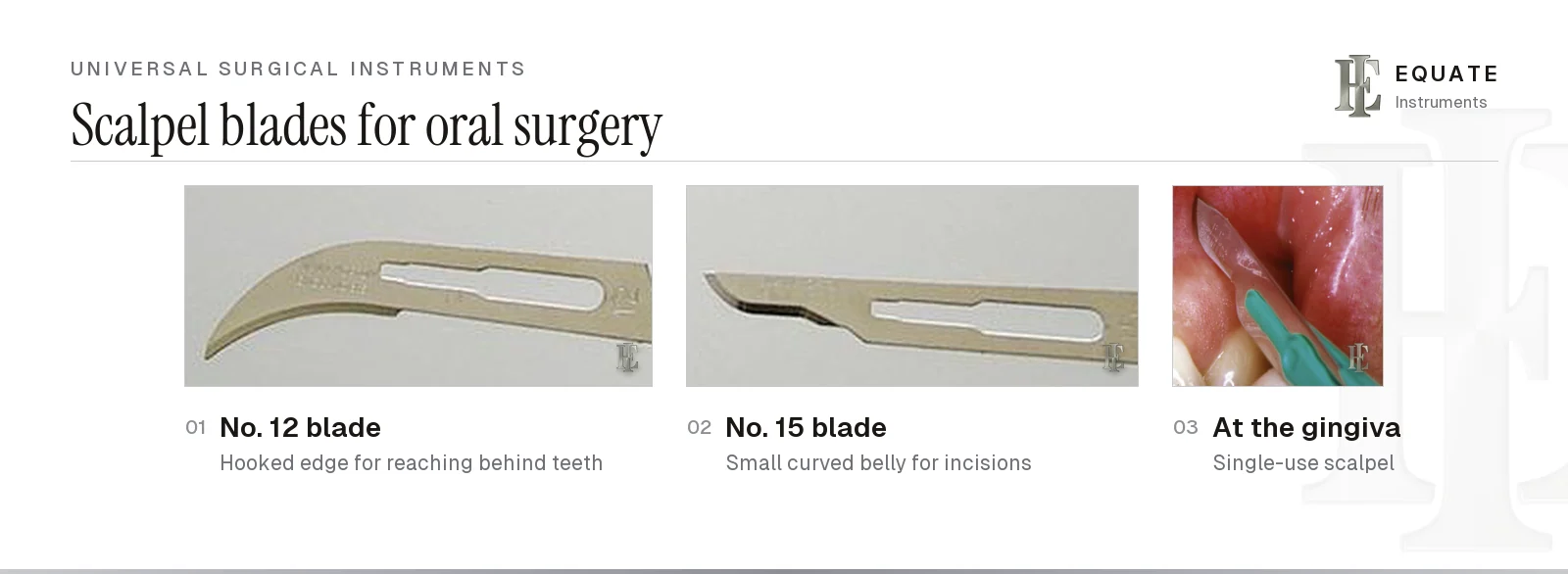
Two blade shapes dominate dentistry. The No. 15 has a small curved cutting edge and is the workhorse for flap incisions and releasing incisions. The No. 12 is hooked, with its edge on the inside of the curve, so it can cut around the distal surfaces of molars and in the gingival sulcus of teeth that are hard to reach. A narrower No. 15C is used for papillae and tight anterior work, the pointed No. 11 for stab incisions such as draining an abscess, and the 12b has a cutting edge on both sides of its hook. In restorative dentistry a blade is occasionally used to trim excess composite at interproximal margins (see composite instruments).
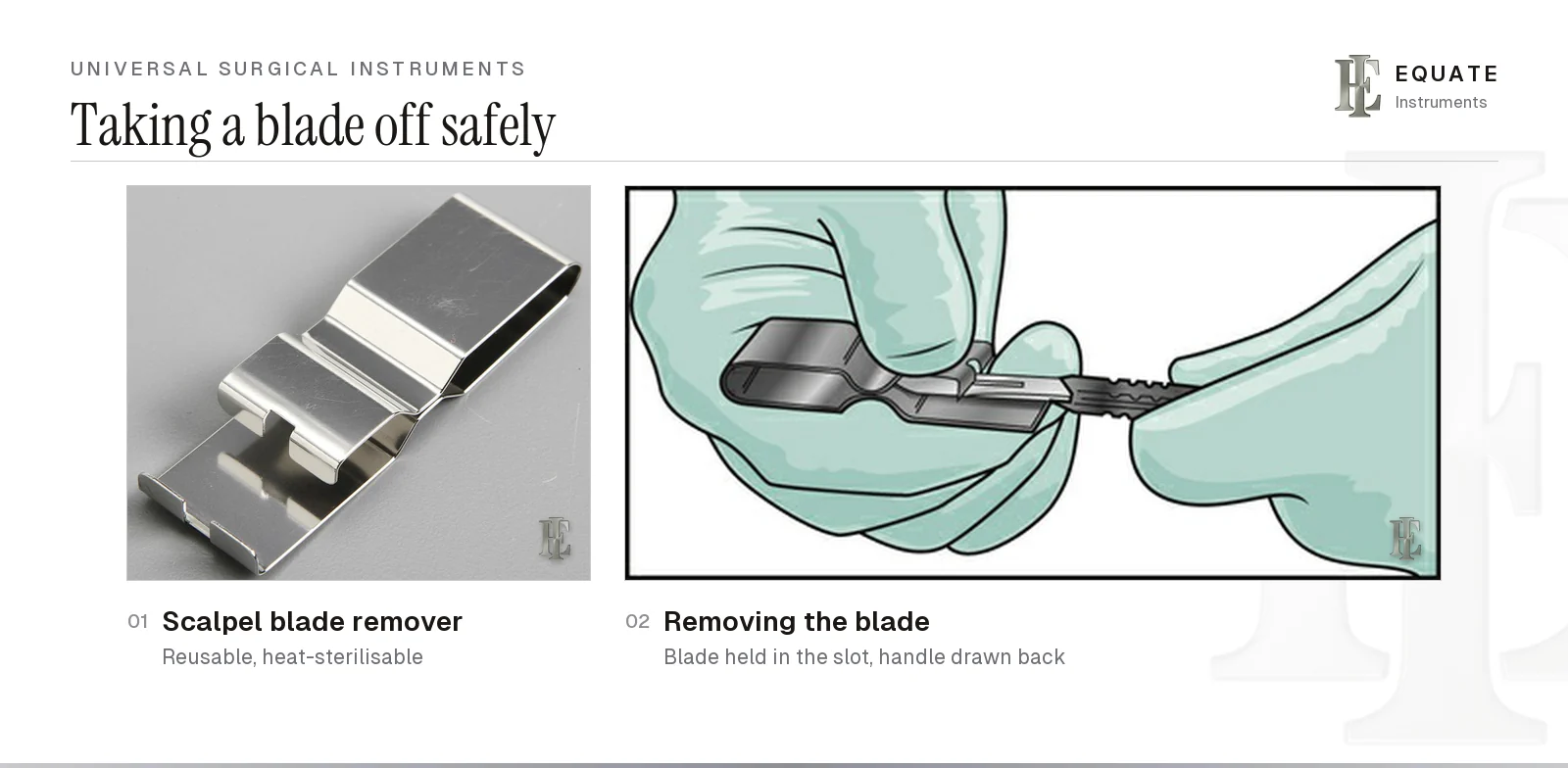
Scalpel blades and suture needles are the main sharps on a surgical tray, so blades are fitted and taken off with an instrument, never with the fingers. A scalpel blade remover holds the blade in a slot while the handle is drawn away, then the blade goes straight into a sharps container; if no remover is to hand, the blade is gripped with a needle holder or haemostat instead. Council Directive 2010/32/EU on sharps injuries in healthcare requires safe procedures for using and disposing of sharps, and some handles now include a built-in remover. In the UK, regulation 5 of the Health and Safety (Sharp Instruments in Healthcare) Regulations 2013 asks employers to avoid sharps where reasonably practicable and use safer sharps where they can't, forbids recapping needles unless a risk assessment and a suitable device control the risk, and calls for clearly marked, secure sharps containers close to where sharps are used.
Tissue forceps and haemostats
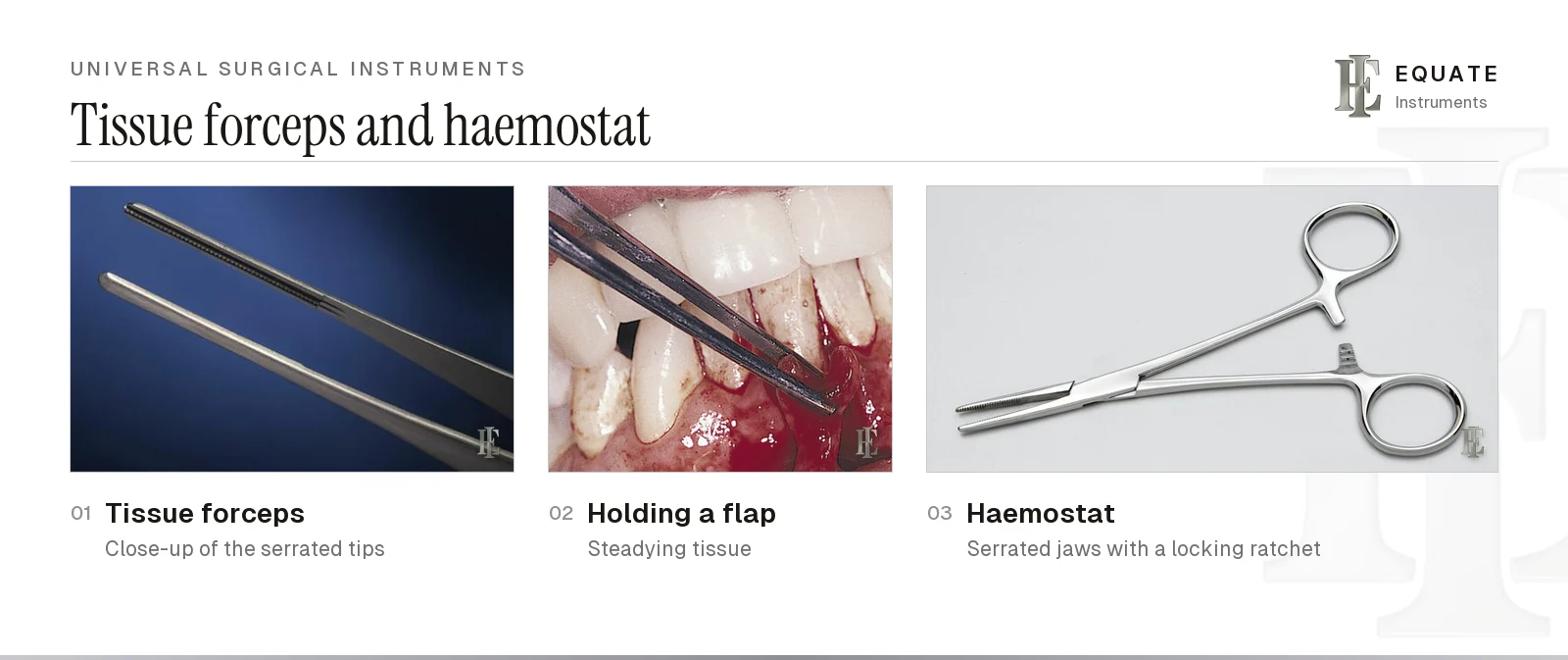
Tissue forceps are spring-handled tweezers for holding soft tissue steady while it's incised, trimmed or sutured. The tips are either serrated, which grip without piercing and suit delicate tissue, or toothed (rat-tooth, often 1×2 teeth), which interlock and hold a flap securely with less squeezing. Opinion is divided on which is gentler: toothed tips hold tough mucoperiosteum with a lighter grip, while Crumplin, writing in the British Journal of Surgery in 2023, judges non-toothed forceps less likely to injure tissue, and they are the usual choice for delicate tissue, grafts and membranes. In a 1×2 tip one tooth closes between two; whichever tip is used, take the flap at its margin or periosteal side and let go between needle passes. Adson and Gerald patterns are the usual thumb-type tissue forceps in dental surgery; Allis forceps are a ring-handled, ratcheted variant used when tissue needs a firmer hold.
A haemostat looks like scissors but has serrated jaws and a ratchet between the finger rings that locks them shut. In general surgery its main job is clamping bleeding vessels; in dentistry it's used far more to grasp granulation tissue, root tips and bone fragments, and to hold small items such as a loose crown or a cotton roll. Straight and curved jaws are available, and the small, fine-tipped mosquito pattern suits the mouth best (see haemostats and mosquito forceps). Kelly patterns are serrated over the front half of the jaws and Crile patterns along their whole length; towel clamps, perforating Backhaus or non-perforating Lorna, hold drapes; and Magill forceps, kept by many clinics that sedate, retrieve objects dropped towards the throat. Because it's useful on almost any tray, the haemostat also appears on restorative and endodontic setups.
Periosteal elevators
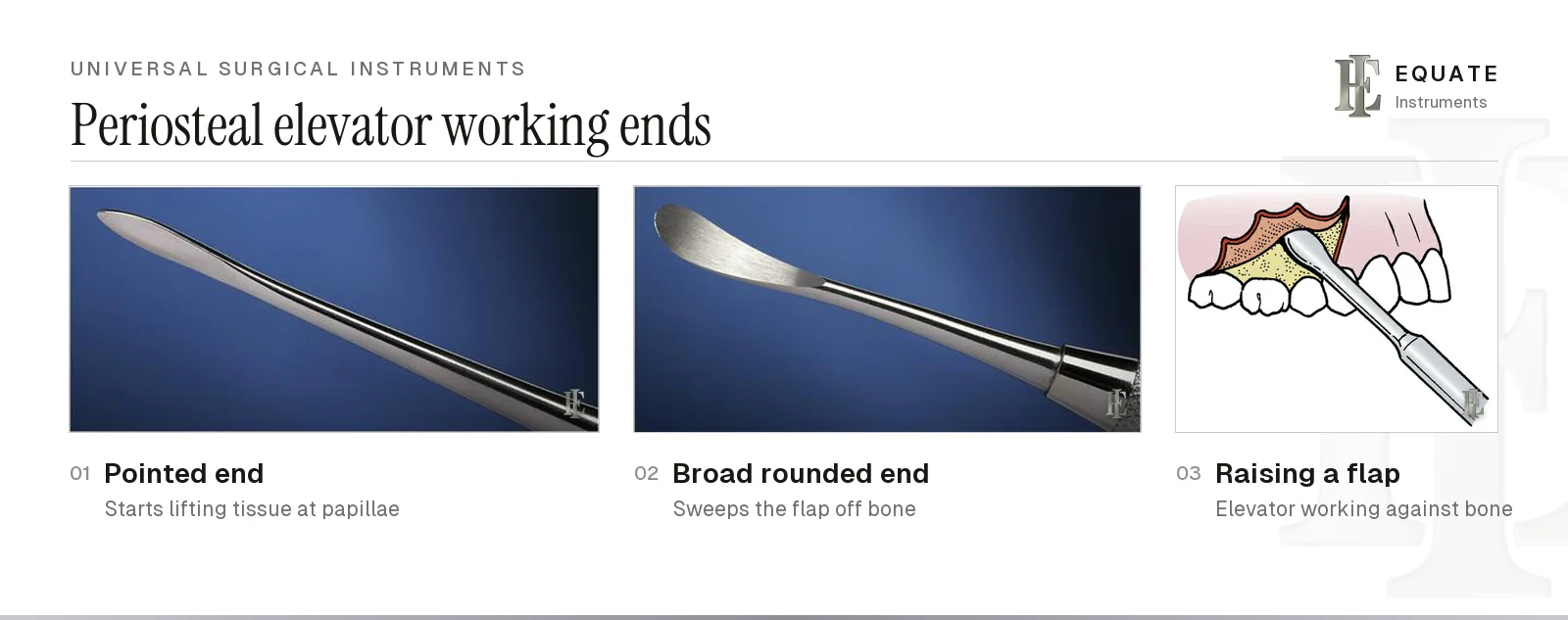
A periosteal elevator separates the gum and the periosteum beneath it from the bone, so the tissue can be lifted as one full-thickness flap. Once the flap is raised, the same instrument is held against the bone to retract it while the surgeon works. Most are double-ended: a pointed or narrow end starts the separation at the papillae and the gingival margin, and a broad rounded end sweeps the rest of the flap off the bone.
The Molt No. 9 is the standard pattern in oral surgery, and Freer, Prichard, Buser and Goldman-Fox designs offer thinner or differently shaped blades for implant and periodontal surgery. Standard oral surgery texts such as Contemporary Oral and Maxillofacial Surgery (Hupp, Tucker and Ellis, Elsevier) describe the Molt No. 9 in this two-ended way. Keeping the working edge against bone helps the flap lift cleanly instead of tearing. Check that the working edge stays smooth and free of nicks, because a damaged edge shreds periosteum. A periosteal elevator is not a tooth elevator: luxating and root elevators that loosen teeth are covered in the dental elevators guide.
Surgical curettes
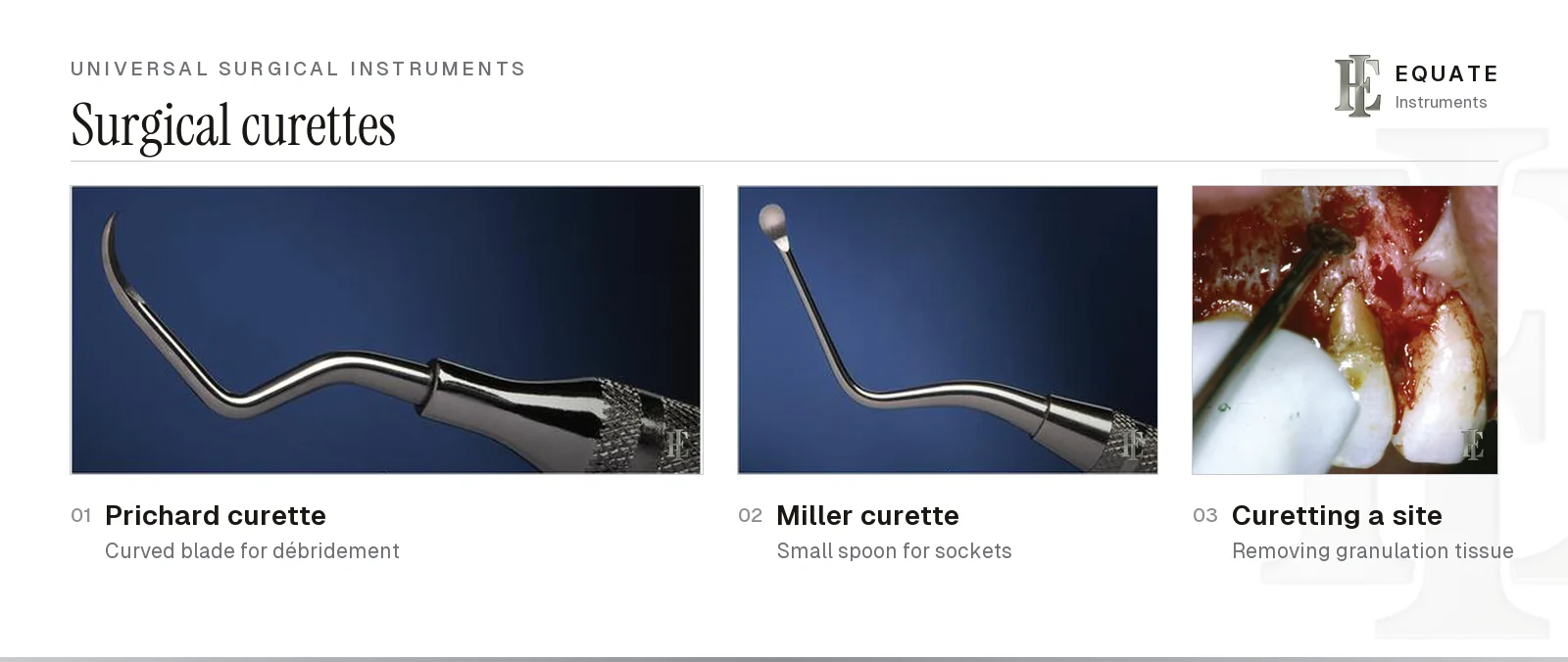
A surgical curette is a spoon- or blade-shaped instrument for scraping soft tissue out of bone. After an extraction it removes granulation tissue and debris from the socket; in a cyst or apical lesion it lifts out the lining; in periodontal surgery it débrides inflamed tissue from bony defects. Curettes are single or double-ended and come in a range of spoon sizes and angles. Boyd gives the Prichard and the Miller as typical examples.
Surgical curettes are larger and sturdier than the curettes among the dental hygiene instruments. A Gracey or universal curette is designed to scale root surfaces inside the periodontal pocket and shouldn't be used to scrape bone, which would blunt it; the differences are covered in the dental curettes guide. Molt, Lucas, Hemmingway, Williger and Miller bone curettes are the usual surgical choices, compared in the surgical curettes guide.
Surgical scissors: tissue and suture scissors
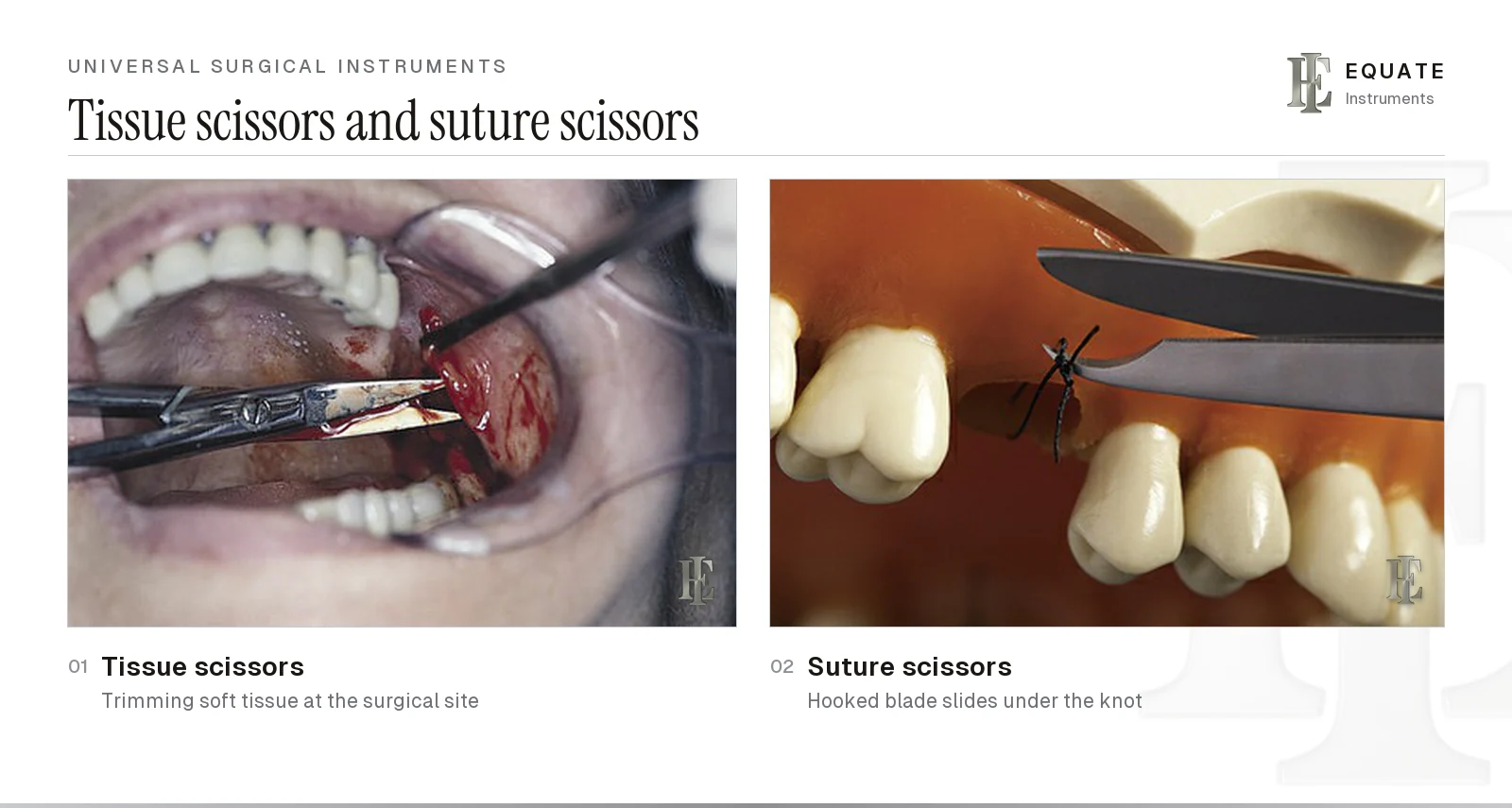
Tissue scissors trim tissue tags, contour flaps and release tissue during surgery. They're straight or curved, with blunt or sharp tips, and the common dental patterns include Goldman-Fox, Dean, Iris, Kelly and Metzenbaum. Curved blades let the surgeon see the tips while cutting deep in the mouth, and fine, short-bladed scissors give the control that gingival surgery needs. Sharp points start a precise cut in a small space, blunt tips are safer near the floor of the mouth and the palate, and double-curved gum scissors such as the La Grange follow the arch.
Suture scissors are kept separate. Their cutting edges are straight or angled, and many have a small hook or notch near the tip of one blade that slides under a stitch and holds it while it's cut, which is especially useful at suture removal. Cutting sutures, particularly the harder synthetic materials, blunts fine scissors quickly, so it's good practice not to use tissue scissors on sutures and to lay out a notched pair at a suture removal visit.
Needle holders and sutures
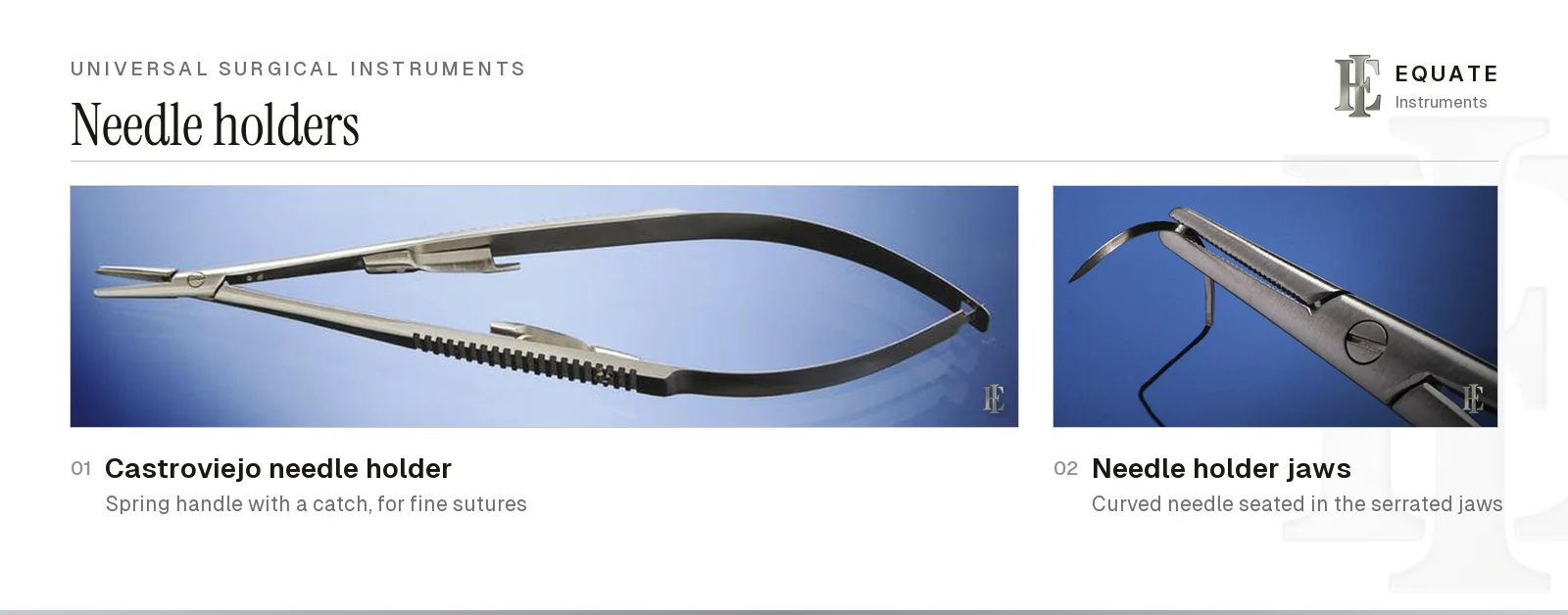
A needle holder looks like a haemostat but has short, heavy jaws, often with a cross-hatched tungsten carbide insert, that grip a curved needle without letting it rotate. Hupp, Tucker and Ellis point out that a haemostat's jaws have parallel grooves instead, which is why a needle swivels in one. The Mayo-Hegar is the general-purpose oral surgery pattern; the Castroviejo has spring handles with a catch and fine jaws for microsurgery and small sutures; the Mathieu locks with a ratchet at the end of the handles; and some patterns, such as the Olsen-Hegar, combine the needle holder with a pair of scissors. Jaws may be straight or curved, and notched tips help seat the needle.
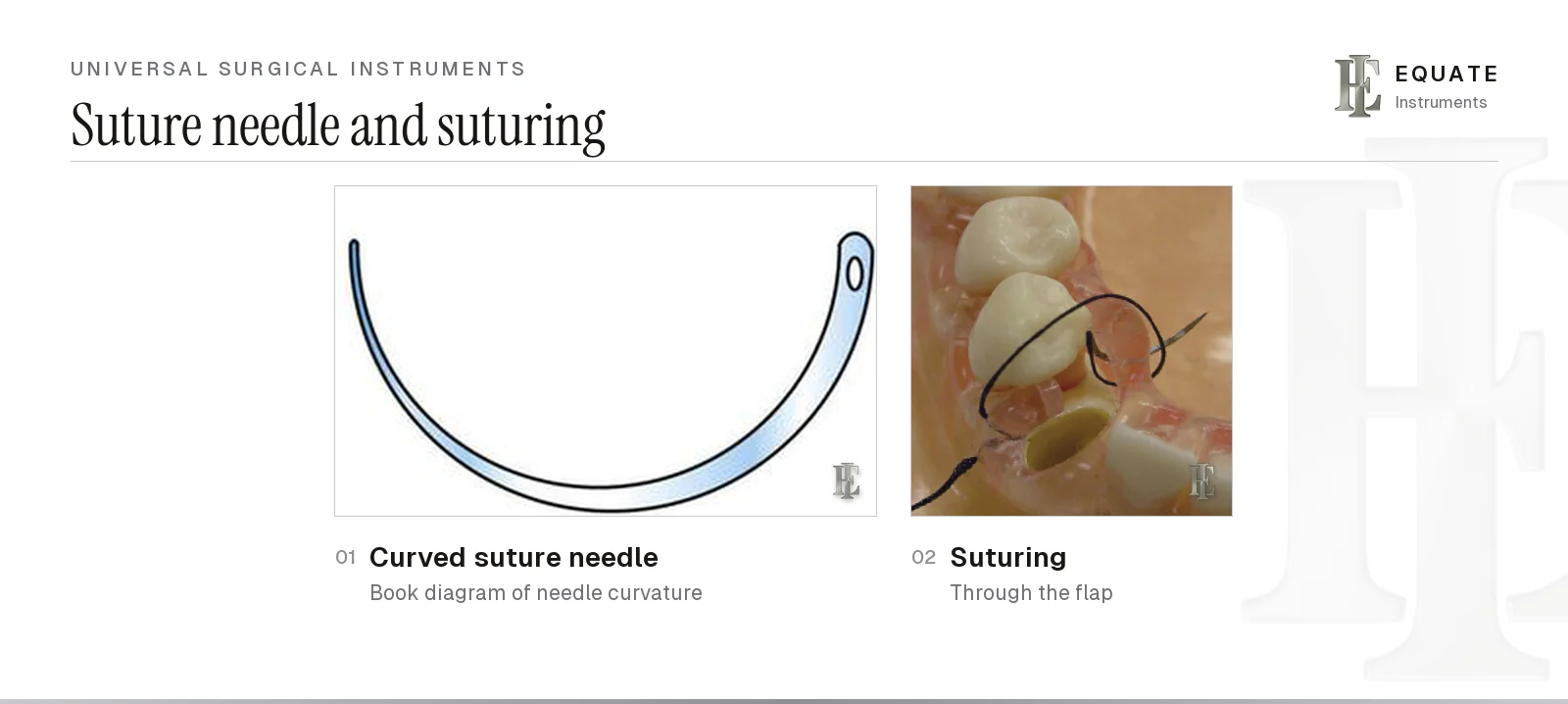
Grip the needle between its middle and about two-thirds of the way back from the point, never at the swaged end where the thread is attached: that is its weakest part, and clamping it can bend the needle or pull the thread free. Sutures are supplied sterile with the needle already swaged on. Synthetic resorbable materials such as polyglycolic acid and polyglactin 910 break down in the tissue; plain and chromic gut, made from animal intestine, are also resorbable, but EU rules introduced during the BSE crisis restricted them and they are uncommon or unavailable in many European countries. A 2022 systematic review by Faris and colleagues found that braided multifilament threads, silk especially, hold more bacteria than monofilament synthetics.
Non-resorbable materials such as silk, nylon, polyester and polypropylene have to come out, usually 7 to 14 days after surgery, once the clinician judges the wound has sealed. Each stitch is cut beside the knot against the mucosa, drawn out towards the wound line and counted against the operation note; see the suture removal tray. Dental sutures are typically 3-0 to 5-0, with finer sizes for microsurgery: Kurtzman and colleagues (Dentistry Today, 2005) describe 4-0 for most periodontal flaps and 5-0 for periodontal plastic surgery, with 3/8- and 1/2-circle reverse-cutting needles as the usual intra-oral choices, the half circle for tight sites, because a reverse-cutting needle is less likely to tear out through the papillae.
For patients taking anticoagulants, the Scottish Dental Clinical Effectiveness Programme (SDCEP, 2nd edition, 2022) advises limiting the first treatment area and strongly considering suturing and packing the socket, so a needle holder and suture should be ready even for a simple extraction in these patients.
Reprocessing surgical instruments and handling sharps
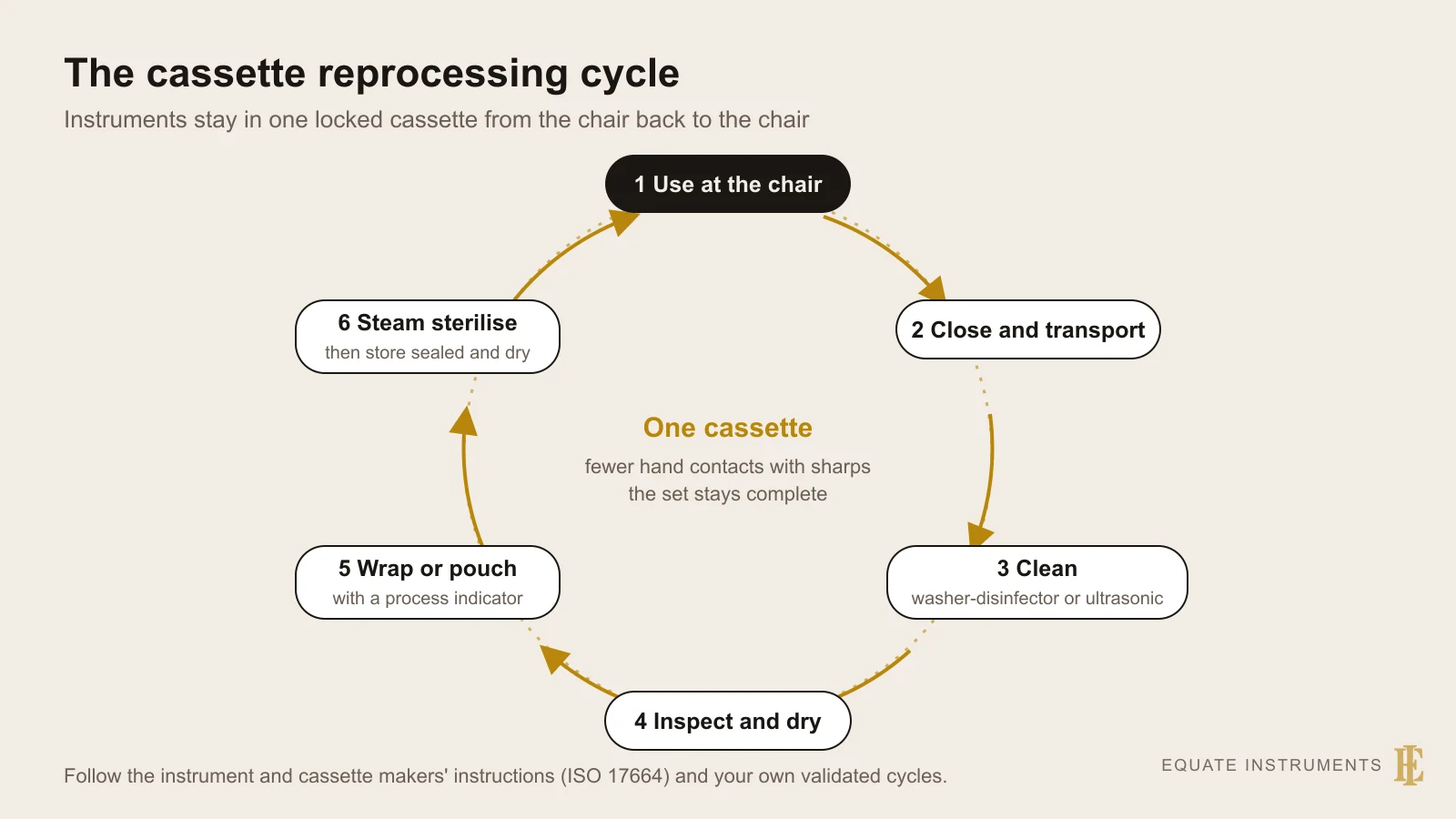
Under the Spaulding classification, anything that penetrates soft tissue or contacts bone is a critical item. The US Centers for Disease Control and Prevention guidelines (Kohn and colleagues, 2003, and the 2016 Summary of Infection Prevention Practices in Dental Settings) and HTM 01-05 for dental practices in England (originally published by the Department of Health, now maintained by NHS England) expect reusable surgical instruments to be cleaned and then heat sterilised before every patient, and single-use items never to be reprocessed. Follow the manufacturer's reprocessing instructions and your national regulations; ISO 17664-1, adopted in Europe as EN ISO 17664-1, sets out what those instructions must contain. The sterilisation and protective equipment guide covers the whole cycle.
- Sharps first: blades, suture needles and disposable scalpels go into a sharps container at the point of use; blades come off with a remover or forceps, never by hand.
- Clean before sterilising, by ultrasonic or washer-disinfector, which the CDC prefers to hand scrubbing because it is more efficient and handles sharp edges less, and don't let blood dry on serrations, ratchets and box joints.
- Process hinged instruments open and unlocked: haemostats, needle holders, scissors and mouth gags, so steam reaches the joint and jaws.
- Pack in a sealed pouch or a wrapped instrument cassette with an internal process indicator, and check both the external and internal indicators before use.
- Inspect after each cycle: tips that meet, ratchets that hold, scissors that cut cleanly, and elevator and curette edges free of nicks. Lubricate hinges only with a steam-permeable instrument lubricant if the manufacturer allows it.
- Disposable mouth props are thrown away after one use; reusable rubber props are cleaned and sterilised like the steel instruments.
Buying universal surgical instruments: what to check
- Scalpel handles: a No. 3 fitting for the 10–15 blade range, a graduated scale if you measure incisions, and a round or long handle if you need reach.
- Periosteal elevators: a thin, smooth working edge that sits flat on bone; a Molt No. 9 for general use and a finer pattern for implant or periodontal flaps.
- Tissue forceps: tips that close evenly along their length, with toothed tips that interlock without crossing.
- Haemostats and needle holders: a ratchet that engages positively at each step, jaws that don't slip, and tungsten carbide inserts on needle holders for longer life.
- Scissors: blades that cut to the very tip without catching; a separate notched suture scissor so tissue scissors stay sharp.
- Retractors and mouth gags: sizes for both adults and children, with smooth, rounded edges.
- Material: surgical-grade stainless steel that tolerates repeated steam sterilisation without pitting, and an instrument cassette or tray that keeps the kit together through reprocessing.
The Equate difference
Equate's catalogue lists 8 mouth gags (Jennings, Denhardt, Roser-König and Molt patterns), 9 scalpel handles including one with an automatic blade remover, 10 tissue forceps (69 counting dressing forceps, micro and membrane tweezers), 29 haemostatic and mosquito forceps (36 counting towel clamps and Magill forceps), 37 periosteal elevators, 25 surgical and bone curettes (plus 19 Lucas curettes listed with the periodontal instruments), 56 surgical scissors plus 20 suture scissors and 20 micro-surgical scissors (105 counting gum and utility scissors), 106 needle holders, 3 Minnesota and 5 tongue retractors, and 10 surgical suction tubes. Scalpel blades, sutures and mouth props are single-use consumables and are not in the catalogue.
Equate Universal Surgical Instruments for Oral and Periodontal Surgery options

Miller 8 Bone Curette - 3.5 mm
EI-0025
Round Scalpel Handle - Straight Standard
EI-0029
Round Scalpel Handle 170 mm - Adjustable Blade Mount
EI-0030
Scalpel Handle No.3 - 130mm
EI-0031
Scalpel Handle No.3 with Ruler Scale - 130mm
EI-0032
Hemingway Bone Curette 2.8 mm - Anatomical Hollow Handle
EI-0058
Hemingway Bone Curette 3.5 mm - Hollow Handle
EI-0059
Miller 8 Surgical Bone Curette - Titanium-Coated Hollow Handle
EI-0060
Molt 9 Periosteal Elevator, 4mm/7mm Ends, Hollow Handle
EI-0066
Periosteal Elevator 24G 4mm/4mm 17.5cm Hollow Handle Blue
EI-0067
Freer Periosteal Elevator - Titanium-Coated Hollow Handle
EI-0068
Freer Double-Ended Periosteal Elevator - Titanium Coated
EI-0069Browse all oral surgery instruments Browse all accessories & supplies instruments
Buying in your market
Frequently asked questions
Why are they called universal surgical instruments?
Because the same core set turns up on both oral surgery and periodontal surgery trays. Whatever the operation, the team has to incise, raise and hold a flap, clean the site and suture it, so these instruments stay constant and the procedure-specific ones are added on top.
Which universal surgical instruments are single-use?
Scalpel blades, disposable one-piece scalpels, suture needles with their thread, and disposable mouth props. Blades, needles and disposable scalpels go straight into a sharps container and disposable props into waste; none is reprocessed. Everything else on the set is reusable steel that is cleaned and heat-sterilised between patients.
Which instruments are added to the universal set for an extraction or periodontal flap?
For an extraction, forceps and elevators, often with rongeurs, bone files or chisels; the oral surgery and extraction instruments guide covers them. For a periodontal flap or gingivectomy, periodontal knives, finer elevators and periodontal files, covered in the periodontal instruments guide.
Which sutures are used in oral surgery?
Both resorbable sutures (synthetics such as polyglycolic acid and polyglactin 910, and in some countries plain or chromic gut, which is restricted or uncommon in much of Europe) and non-resorbable sutures (silk, nylon, polyester, polypropylene). Non-resorbable sutures are removed at a review visit; sizes 3-0 to 5-0 are common, with finer sizes for microsurgery.
Why are surgical instruments sterilised open and unlocked?
Steam has to reach every surface. If a haemostat, needle holder, scissors or mouth gag is locked, the jaws and hinge stay pressed together and may not be cleaned or sterilised properly, and the locked joint is under stress that can crack it.
References
- Boyd LRB. Dental Instruments: A Pocket Guide, 7th edition. Saunders/Elsevier, 2020 (photographs used under licence)
- Hupp JR, Tucker MR, Ellis E. Contemporary Oral and Maxillofacial Surgery, 7th edition. Elsevier, 2018
- Kohn WG, et al. Guidelines for Infection Control in Dental Health-Care Settings, 2003. MMWR 52(RR-17), Centers for Disease Control and Prevention
- Centers for Disease Control and Prevention. Summary of Infection Prevention Practices in Dental Settings: Basic Expectations for Safe Care, 2016
- NHS England. Health Technical Memorandum 01-05: Decontamination in primary care dental practices (2013 edition)
- Council Directive 2010/32/EU of 10 May 2010 implementing the Framework Agreement on prevention from sharp injuries in the hospital and healthcare sector
- ISO 17664-1:2021. Processing of health care products — Information to be provided by the medical device manufacturer for the processing of medical devices — Part 1: Critical and semi-critical medical devices
- The Health and Safety (Sharp Instruments in Healthcare) Regulations 2013 (SI 2013/645), regulation 5: use and disposal of medical sharps
- ISO 7740:1985 Instruments for surgery — Scalpels with detachable blades — Fitting dimensions
- Crumplin MKH. Dissecting, tissue, and grasping forceps. BJS 2023;110(3):310–312
- Faris A, Khalid L, Hashim M, et al. Characteristics of suture materials used in oral surgery: systematic review. International Dental Journal 2022;72(3):278–287
- Kurtzman GM, Silverstein LH, Shatz PC, Kurtzman D. Suturing for surgical success. Dentistry Today, 1 October 2005
- Brilliant N. Suture needle basics. AORN, 13 March 2024
- Scottish Dental Clinical Effectiveness Programme. Management of Dental Patients Taking Anticoagulants or Antiplatelet Drugs, 2nd edition, March 2022 (local haemostatic measures)
I am a…
Related
- Dental Needle Holders (Needle Drivers)
- Dental Hemostats (Haemostats) and Mosquito Forceps
- Dental Surgical Scissors
- Dental Tissue Forceps (Toothed and Non-Toothed)
- Dental Scalpel Handles and Blades
- Periosteal Elevators: Molt 9, Freer, Buser and Other Patterns
- Surgical Curettes (Bone Curettes) for Oral Surgery
- Oral Surgery Tray Setup
- Suture Removal Tray Setup
- Tooth Extraction Instruments
- Dental and Oral Surgery Retractors
- Dental Curettes
- Basic Dental Instruments: Mirror, Explorer, Cotton Forceps and Handles
- Periodontal Instruments Explained: Probes, Hoes, Knives and Files
- Oral Surgery and Extraction Instruments