Dental Needle Holders (Needle Drivers)
Written by the Equate Instruments Technical Team · Reviewed by the Medical & Dental Board, Equate Instruments · Updated ·
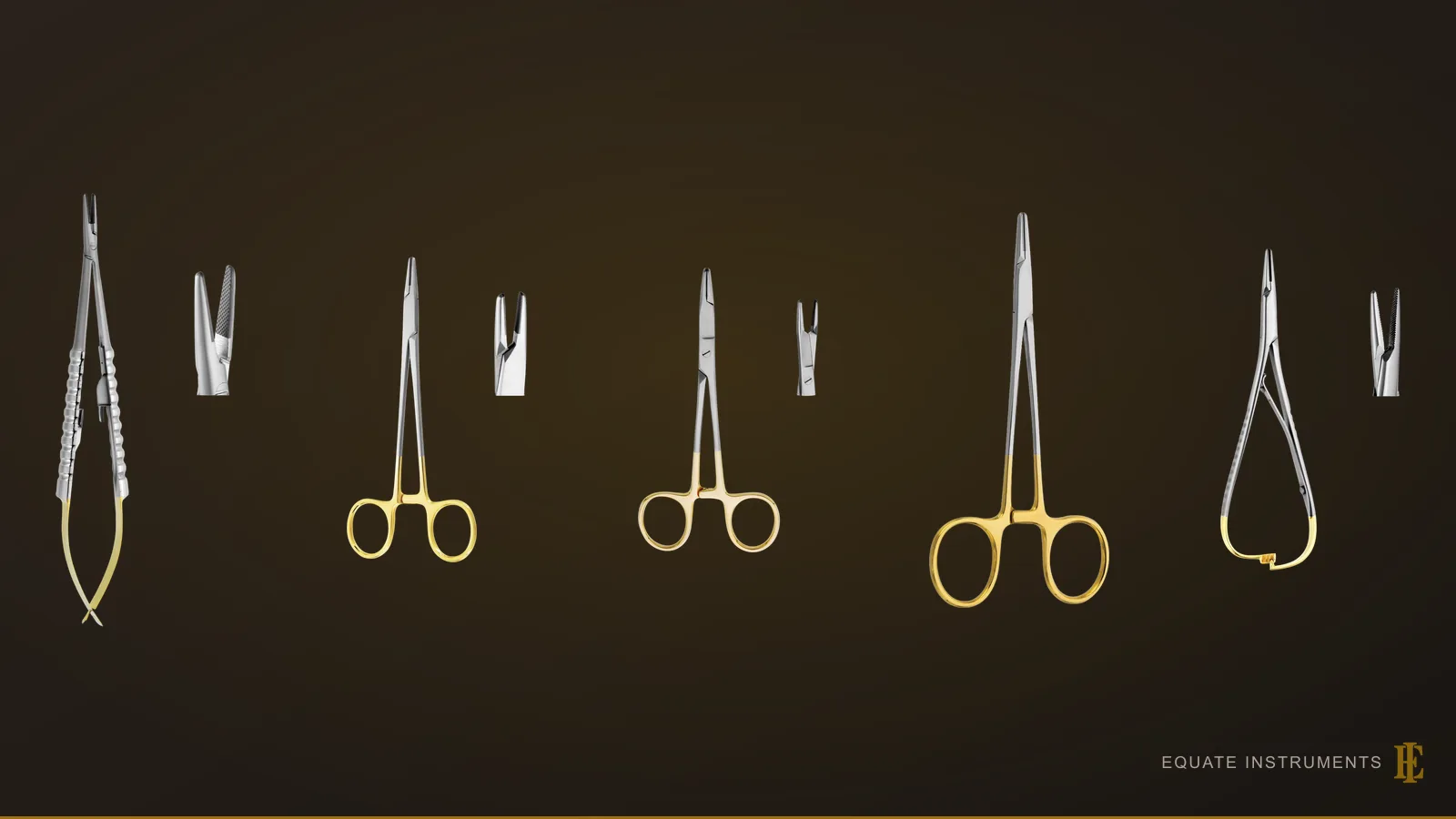
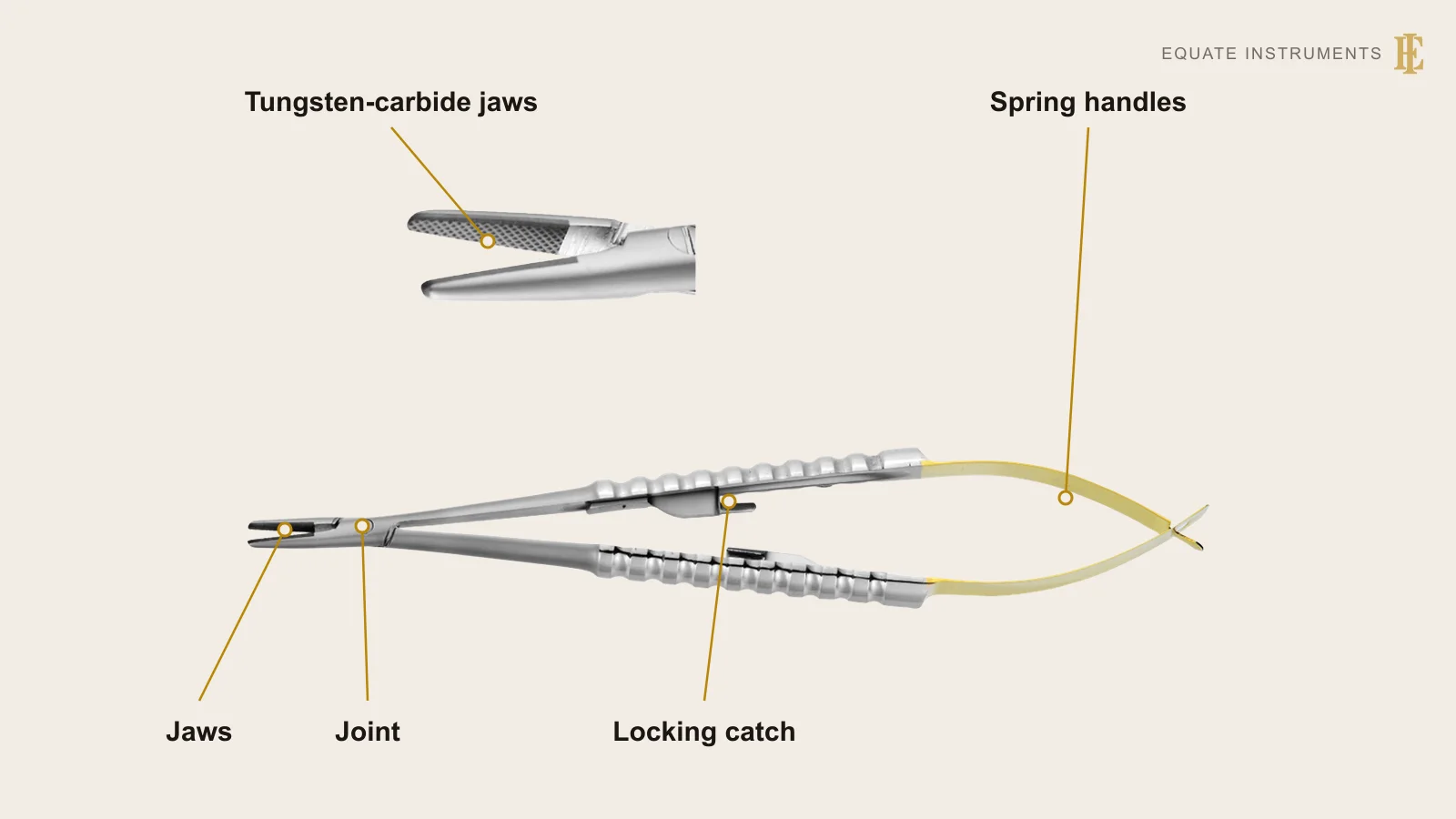
A dental needle holder is a locking surgical instrument that grips a curved suture needle firmly so it can be driven through the gum and tied. Short, cross-hatched jaws stop the needle turning, and a ratchet or spring lock holds it without hand pressure. Ring-handled Mayo-Hegar and Crile-Wood patterns suit heavier sutures such as 3-0 and 4-0; spring-handled Castroviejo holders suit 5-0 to 7-0 microsurgery.
Key points
- A needle holder has short, strong jaws with a cross-hatched or tungsten carbide face, so the needle doesn't rotate as it passes through tissue.
- Match the holder to the suture: heavier ring-handled patterns for 3-0 and 4-0, fine Castroviejo or micro holders for 5-0 to 7-0.
- The orthodontic Mathieu plier shares the Mathieu shape but is a different instrument, made for ligatures rather than suture needles.
What is a needle holder used for in dentistry?
A needle holder grips the suture needle so the clinician can pass it through a flap, tie the knot and close the wound. In dentistry that means closing extraction sockets, replacing mucoperiosteal flaps after surgical extractions and implant placement, and the fine suturing of periodontal and mucogingival surgery. The holder is usually the last instrument used on an oral surgery tray, after the periosteal elevator, retractors and extraction instruments have done their work, and it is one of the universal surgical instruments on every surgical tray.
It differs from a haemostat in its jaws. In Contemporary Oral and Maxillofacial Surgery, Hupp, Tucker and Ellis point out that a needle holder's beak is shorter and stronger than a haemostat's and is cross-hatched, where a haemostat has parallel grooves. Those features grip a curved needle without letting it swivel; a haemostat used in its place lets the needle rotate and its jaws are soon damaged.
What types of needle holder are there?
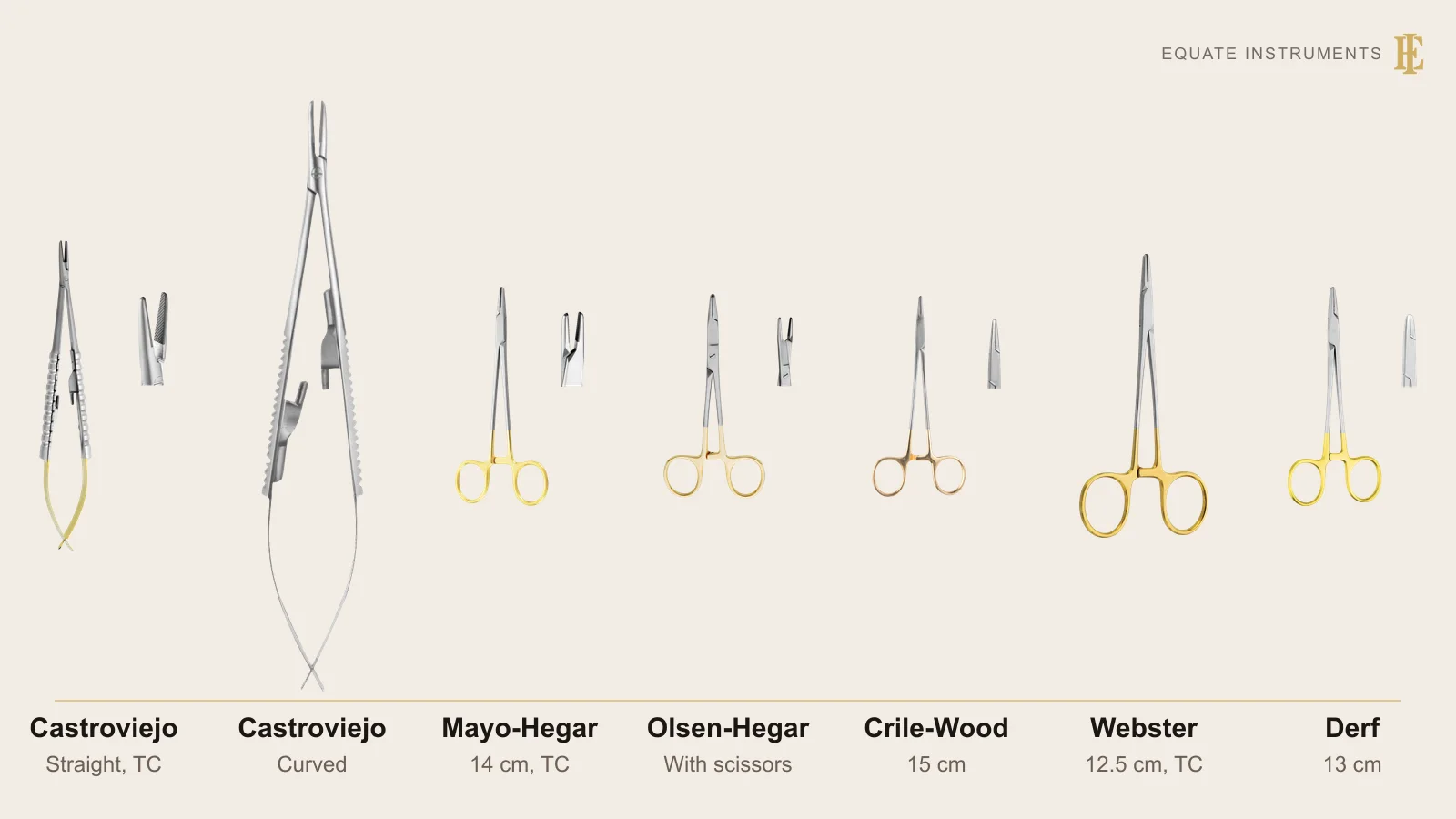
- Mayo-Hegar: the general-purpose ring-handled holder with a box joint and ratchet, typically 13 to 20 cm, for 3-0 to 6-0 sutures.
- Crile-Wood: a slimmer ring-handled holder with narrower jaws, for 2-0 to 4-0 sutures in tighter spaces.
- Olsen-Hegar and Gillies: holders with suture-cutting blades behind the jaws, so one instrument drives, ties and cuts.
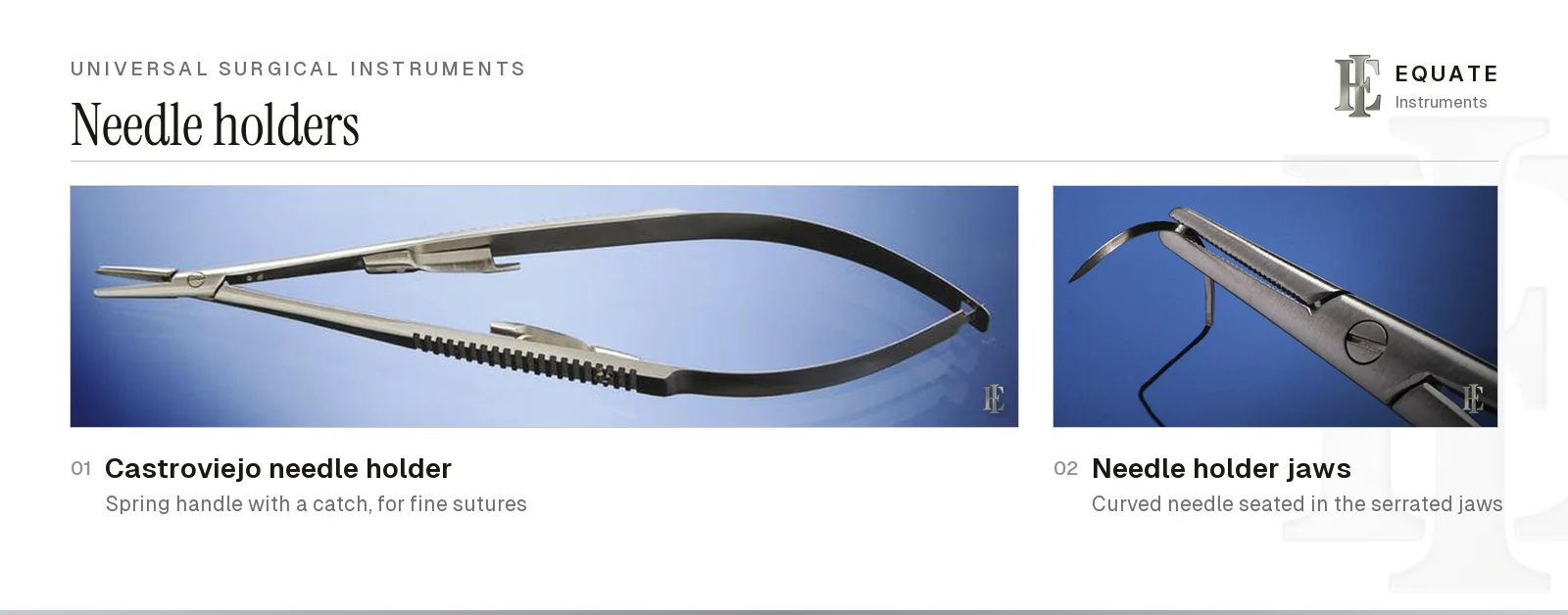
- Castroviejo: a spring-handled holder with a lock, held like a pen and rolled between the fingers, for 5-0 to 7-0 sutures in periodontal plastic and implant surgery.
- Webster and Derf: short, light ring-handled holders, around 12 to 13 cm, for fine sutures and small mouths.
- Mathieu: a spring-opened holder with the ratchet at the end of the handles, closed in the palm.
- Micro holders (Ryder, micro Castroviejo, Barraquer): slender jaws for fine needles under magnification.
Which needle holder for which suture size?
Suture size is the clearest guide, because jaw width has to suit needle wire diameter: a broad jaw slips on a fine needle, and a fine jaw bends or springs open on a heavy one. Suture sizes run in reverse, so 6-0 is finer than 3-0.
Periodontal microsurgery goes finer still. Yadav and colleagues (Journal of the Indian Society of Periodontology, 2018) report 6-0 to 9-0 sutures under magnification, with microsurgical instruments about 18 cm long and round in cross-section so they can be rolled in a pen grip. They advise a lock that needs no more than about 50 g (0.5 N), because a stiff lock causes tremor, and note that diamond-dusted jaws stop fine thread slipping while the knot is tied.
| Procedure | Typical suture | Holder |
|---|---|---|
| Extraction sockets and simple flaps | 3-0 or 4-0 | Mayo-Hegar or Crile-Wood, 14–16 cm |
| Third molar and posterior flaps | 3-0 or 4-0 | Mayo-Hegar or Mathieu, 16–18 cm for reach |
| Implant and bone graft closure | 4-0 to 6-0 | Castroviejo or a fine Mayo-Hegar |
| Periodontal plastic and mucogingival surgery | 5-0 to 7-0 | Castroviejo or micro holder, 14–18 cm |
| Single-operator closure | 3-0 or 4-0 | Olsen-Hegar or Gillies (holder and scissors) |
| Periodontal microsurgery under magnification | 6-0 to 9-0 | Round-bodied micro holder, about 18 cm, pen grip, light lock |
How do you hold a needle holder and load the needle?
Ring-handled holders are held with the thumb and ring finger in the rings and the index finger along the shank, which steadies the tip and lets the wrist do the turning. Castroviejo holders are held like a pen: the needle is driven by rolling the instrument between the thumb and fingers, and a light squeeze engages or releases the lock. Mathieu holders sit in the palm and lock when the handles are squeezed together.
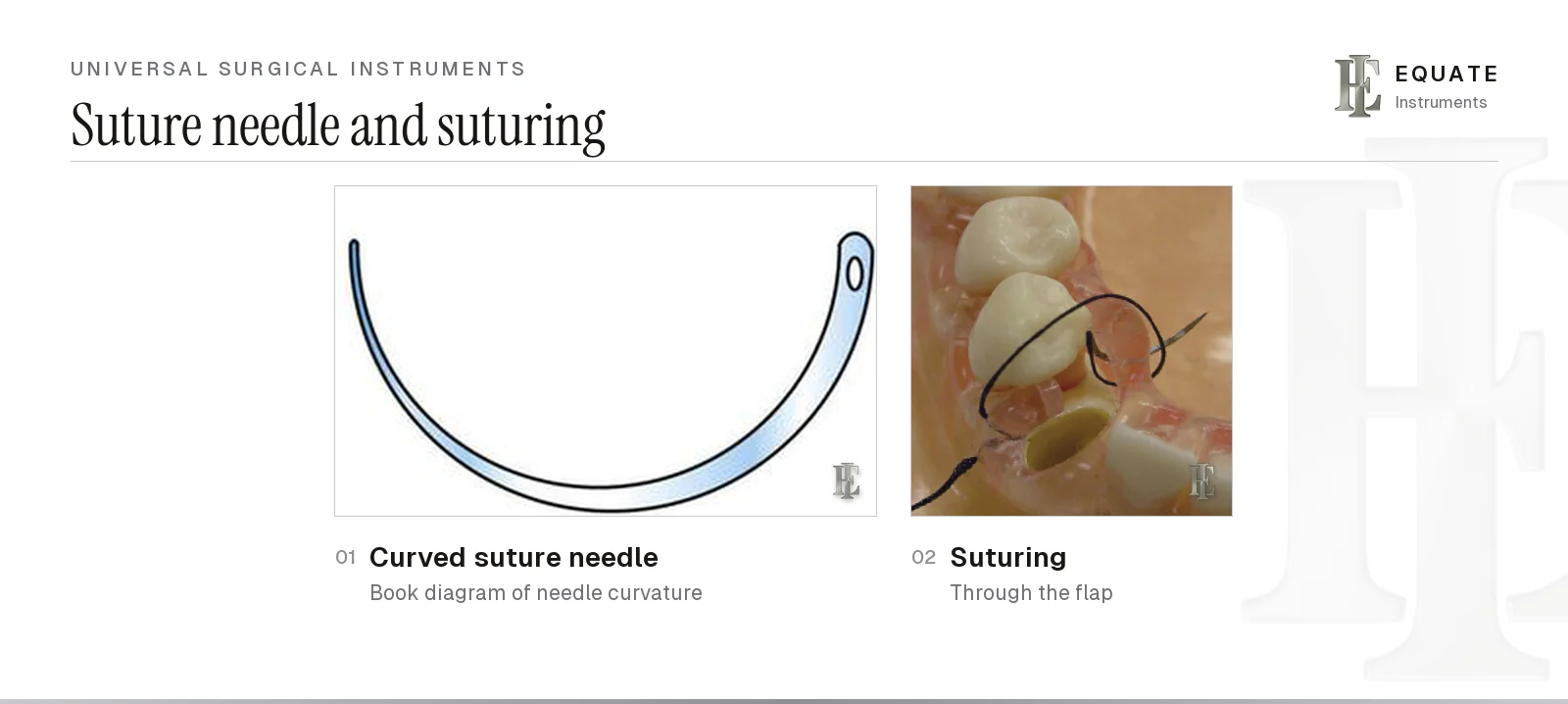
Grasp the needle near the tip of the jaws, at right angles to them, between its middle and about two-thirds of the way back from the point, never at the swage. AORN guidance (2024) puts the grip about one-third of the way from the swaged end, and Kurtzman and colleagues (Dentistry Today, 2005) advise the centre of the needle. Holding it at the swaged end, where the thread joins, can bend or break the needle; holding it too near the point leaves too little to pass through the tissue. Drive the needle along its own curve with a turn of the wrist rather than pushing, and take the minimum ratchet click that holds it.
How do suture materials affect the choice?
Oral sutures are either resorbable, such as polyglycolic acid, polyglactin and plain or chromic gut (restricted since the BSE era and uncommon in much of Europe), or non-resorbable, such as silk, nylon, polypropylene and PTFE, and they are built as monofilament or braided multifilament threads. A 2022 systematic review in the International Dental Journal by Faris and colleagues found that multifilament threads, silk in particular, held more bacteria and caused more tissue reaction, while non-resorbable monofilament synthetics showed the least. Monofilaments, though, are springy and can be weakened if crushed.
That affects the instrument. Fine monofilaments and 5-0 to 7-0 needles call for smooth-edged, fine jaws and a light lock, and they shouldn't be gripped by the thread when tying. Removing the sutures later needs suture scissors and tissue forceps, set out on a suture removal tray.
Which specifications matter?
| Feature | Options | Why it matters |
|---|---|---|
| Jaw face | Cross-serrated stainless or tungsten carbide insert | Carbide is harder, grips the needle better and wears more slowly; gold-finished handles conventionally mark it |
| Jaw width | Regular, fine, extra fine | Narrow jaws for fine needles; wide jaws for heavier needles |
| Lock | Box-joint ratchet, end ratchet (Mathieu) or spring lock (Castroviejo) | Holds the needle without hand pressure; should hold on the first click and release cleanly |
| Length | 12–20 cm | Longer holders reach posterior sites; shorter ones give finer control |
| Straight or curved | Straight or curved jaws | Curved jaws help reach behind molars and around the arch |
| Cutting blades | With or without (Olsen-Hegar, Gillies) | Saves a scissors change, but take care not to cut the suture while tying |
What does the Equate range include?
Equate's needle holders cover every pattern in this guide: Mathieu holders in 14, 17 and 20 cm with regular, fine, wide and hook-tipped jaws, offset and double-action versions and Ryder-type ratchets; straight and curved Castroviejo holders from 13 to 18 cm for 5-0 to 7-0 sutures; Mayo-Hegar holders from 13 to 20 cm for 3-0 to 6-0; Crile-Wood, Olsen-Hegar and Gillies holders; and Webster, Derf, Ryder, Halsey and Baumgartner patterns for fine work. 64 of the 106 have tungsten carbide jaws.
Each is made of passivated stainless steel, ultrasonically cleaned, shape-, boil- and performance-tested and individually packed, and designed in Finland. Clinics can request samples and a quote, and browse the full oral surgery range.
How do you clean and look after a needle holder?
Clean needle holders open and unlocked, so detergent and water reach the box joint and the jaw serrations, and package them for sterilisation the same way. The CDC's Guidelines for Infection Control in Dental Health-Care Settings ask for hinged instruments to be processed open and unlocked, and HTM 01-05 sets out the same decontamination cycle for UK practices. Follow the manufacturer's reprocessing instructions, which ISO 17664-1 requires them to supply.
After each cycle, check that the jaws meet along their length, that the serrations or carbide inserts aren't worn smooth, and that the ratchet holds on the first click. A quick test is to lock a needle in the jaws and try to turn it with your fingers. Lubricate the joint with an instrument lubricant suitable for steam sterilisation if the action is stiff, and retire a holder whose needle swivels or whose ratchet springs open.
The Equate difference
Equate lists 106 needle holders from 12 to 20 cm, 64 of them with tungsten carbide jaws: 32 Mathieu, 21 Castroviejo (including 4 micro and 4 Castroviejo-Barraquer), 12 Mayo-Hegar, 8 Ryder, 4 Crile-Wood and 4 Olsen-Hegar, plus Webster, Derf, Gillies, Adson, Boynton, Halsey, Baumgartner, Lichtenberg, Kalt, Langenbeck, Hosel and Toennis patterns.
Equate Dental Needle Holders (Needle Drivers) options

Mayo-Hegar Needle Holder 13 cm TC Gold
EI-0414
Mayo-Hegar Needle Holder 16 cm - Tungsten Carbide, Gold Rings
EI-0415
Mayo-Hegar Needle Holder 13 cm Curved TC
EI-0416
Mayo-Hegar Needle Holder 16 cm
EI-0417
Mayo-Hegar Needle Holder 18 cm TC Gold
EI-0418
Crile-Wood Needle Holder 15 cm - Tungsten Carbide Jaws with Gold Rings
EI-0419
Crile-Wood Needle Holder 15 cm
EI-0420
Fine Swedish Needle Holder TC
EI-0421
Ryder Needle Holder 15 cm TC Gold
EI-0426
Castroviejo Needle Holder Straight 14.5cm TC
EI-0428
Castroviejo Needle Holder Straight 18cm TC
EI-0430
Castroviejo-Barraquer Needle Holder, Straight, 15 cm (TC)
EI-0432Browse all oral surgery instruments
Buying in your market
Frequently asked questions
What is a Castroviejo needle holder used for in dentistry?
It holds fine 5-0 to 7-0 suture needles in periodontal plastic surgery, implant closure and other microsurgery. It's spring-handled, held like a pen and locked with a light squeeze. It's named after the Spanish-American eye surgeon Ramón Castroviejo.
What is the difference between a needle holder and a hemostat?
A needle holder has short, strong, cross-hatched jaws that stop a curved needle rotating. A haemostat has longer, finer jaws with parallel grooves for clamping vessels and grasping tissue, and using it to drive needles damages it.
What is a Webster needle holder?
A Webster is a short, light ring-handled needle holder, around 12 to 13 cm, with fine jaws for small needles and sutures. It suits anterior work and small mouths.
Is a Mathieu needle holder the same as an orthodontic Mathieu plier?
They share the spring-opened Mathieu shape with a ratchet at the end of the handles, but the surgical holder has jaws made to grip suture needles. The orthodontic Mathieu plier has narrow serrated tips for ligatures and elastics.
Why do some needle holders have gold handles?
Gold-finished handles conventionally mark tungsten carbide jaw inserts. Carbide is harder than stainless steel, so the jaws grip the needle better and keep their serrations for longer.
Where should you grip the suture needle?
Near the tip of the jaws, at right angles to them, between the middle of the needle and about two-thirds of the way back from the point; AORN guidance puts it about one-third from the swaged end. Never grip the swage, where the needle is weakest.
When are extraction sockets sutured?
Whenever a flap has been raised, it is sutured back over the bone. For patients taking anticoagulants, SDCEP's 2022 guidance also advises limiting the first treatment area and strongly considering suturing and packing the socket, so a needle holder and suture should be on the tray even for a simple extraction.
References
- Hupp JR, Tucker MR, Ellis E. Contemporary Oral and Maxillofacial Surgery, 7th edition. Elsevier, 2018 (instrumentation for basic oral surgery; suturing)
- Faris A, Khalid L, Hashim M, et al. Characteristics of suture materials used in oral surgery: systematic review. International Dental Journal 2022;72(3):278–287
- Kohn WG, et al. Guidelines for Infection Control in Dental Health-Care Settings, 2003. MMWR 52(RR-17), Centers for Disease Control and Prevention
- NHS England. Health Technical Memorandum 01-05: Decontamination in primary care dental practices (2013 edition)
- ISO 7151:2024 Surgical instruments — Non-cutting, articulated instruments — General requirements and test methods
- ISO 17664-1:2021 Processing of health care products: information to be provided by the medical device manufacturer for the processing of medical devices
- Boyd LRB. Dental Instruments: A Pocket Guide, 7th edition. Saunders/Elsevier, 2020. Chapter 15, Universal Surgical Instruments (photographs used under licence)
- Yadav VS, Salaria SK, Bhatia A, Yadav R. Periodontal microsurgery: reaching new heights of precision. J Indian Soc Periodontol 2018;22(1):5–11
- Brilliant N. Suture needle basics. AORN, 13 March 2024
- Kurtzman GM, Silverstein LH, Shatz PC, Kurtzman D. Suturing for surgical success. Dentistry Today, 1 October 2005
- Scottish Dental Clinical Effectiveness Programme. Management of Dental Patients Taking Anticoagulants or Antiplatelet Drugs, 2nd edition, March 2022 (local haemostatic measures)
I am a…