Dental Surgical Scissors
Written by the Equate Instruments Technical Team · Reviewed by the Medical & Dental Board, Equate Instruments · Updated ·
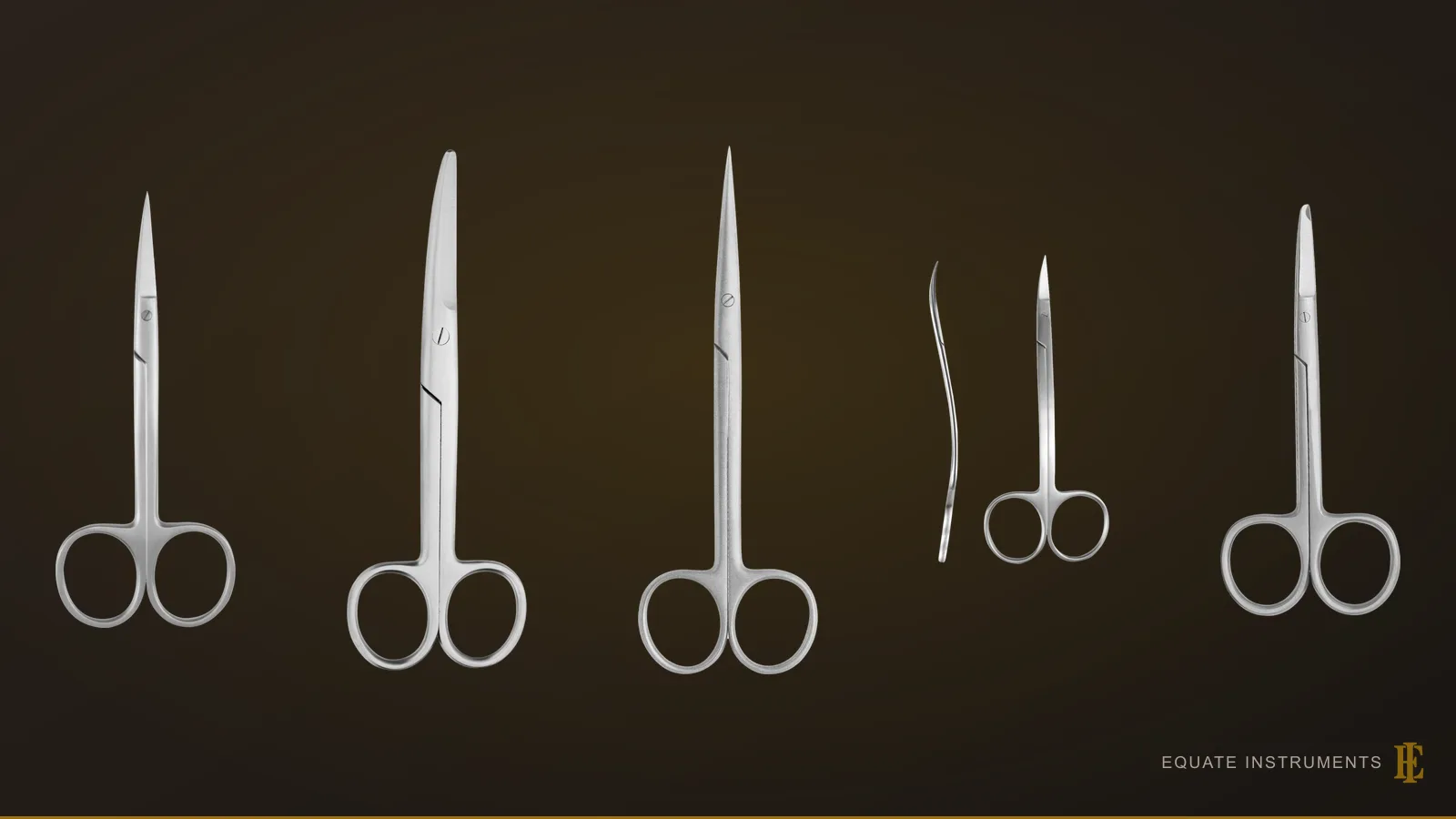
Dental surgical scissors are hinged cutting instruments used in oral and periodontal surgery to trim soft tissue and cut sutures. Tissue scissors such as the iris, Metzenbaum, La Grange and Goldman-Fox have fine, sharp blades for gingiva and flap margins. Suture scissors have shorter, sturdier blades, often with a hooked tip, for cutting thread. Curved blades reach around teeth; straight blades cut on flat surfaces.
Key points
- Keep tissue scissors for tissue: cutting sutures, wire or gauze with them dulls the fine edges quickly.
- Double-curved gum scissors such as the La Grange follow the arch and the necks of the teeth.
- Crown-trimming scissors belong to prosthodontics and are covered with the crown and bridge instruments.
What are surgical scissors used for in dentistry?
Scissors cut what a scalpel can't easily reach or shouldn't cut. In the mouth they trim tissue tags and the edges of flaps, remove inflamed or excess gingiva, release tight tissue, cut granulation tissue free after an extraction and cut sutures, both during closure and when they come out, usually 7 to 14 days later. They sit on the oral surgery tray and the periodontal surgery tray, next to the scalpel handle, tissue forceps and needle holder, as part of the universal surgical set.
The cut comes from two blades shearing past each other at the joint, so blade tension and alignment matter as much as sharpness. A well-set pair cuts cleanly right to the tips without chewing or folding the tissue.
What types of dental scissors are there?
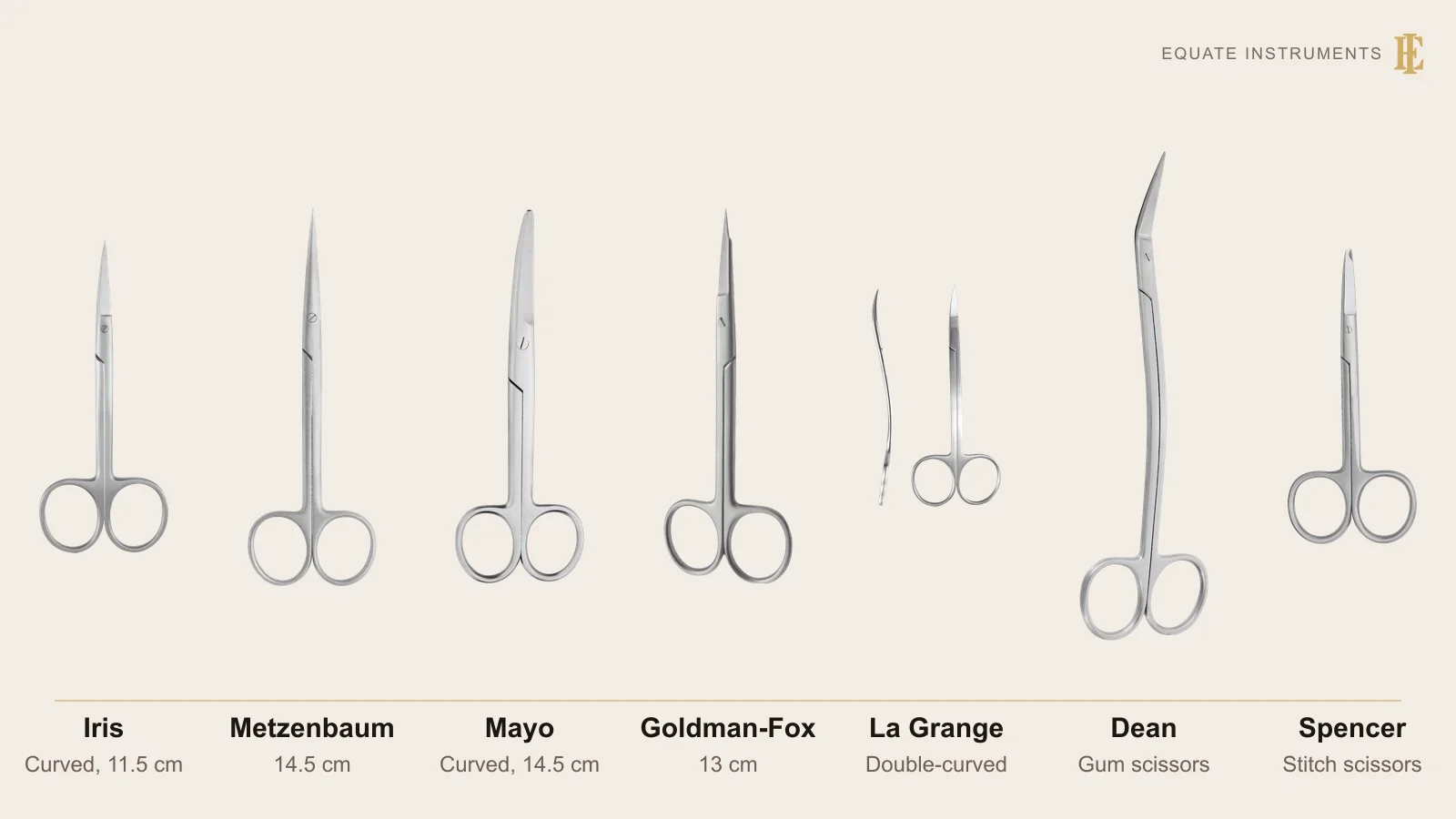
- Iris scissors: small, light scissors with fine sharp points, about 9 to 13 cm, straight or curved; first made for eye surgery, now a standard for trimming gingiva and tags.
- Metzenbaum scissors: long handles and comparatively short, blunt-tipped blades for fine cutting and blunt dissection; named after Myron Firth Metzenbaum (1876–1944), an American oral and reconstructive surgeon.
- Mayo scissors: heavier scissors, developed at the Mayo Clinic; straight Mayos cut near the surface and sutures, curved Mayos reach deeper tissue.
- Kelly scissors: sturdy curved or straight scissors, around 16 cm, for heavier tissue.
- La Grange and Dean scissors: double-curved or angled blades that follow the arch, for trimming gingiva around the necks of teeth.
- Goldman-Fox scissors: curved periodontal scissors for trimming tissue tags and flap margins.
- Micro scissors (Castroviejo, Noyes, Westcott, Jacobson): spring-handled scissors held like a pen, for microsurgery under magnification; Yadav and colleagues (2018) note that fine micro scissors remove small pieces of tissue more efficiently in periodontal microsurgery.
- Suture and stitch scissors: short, strong blades, often with a hooked or notched tip that slips under a stitch.
What is the difference between tissue scissors and suture scissors?
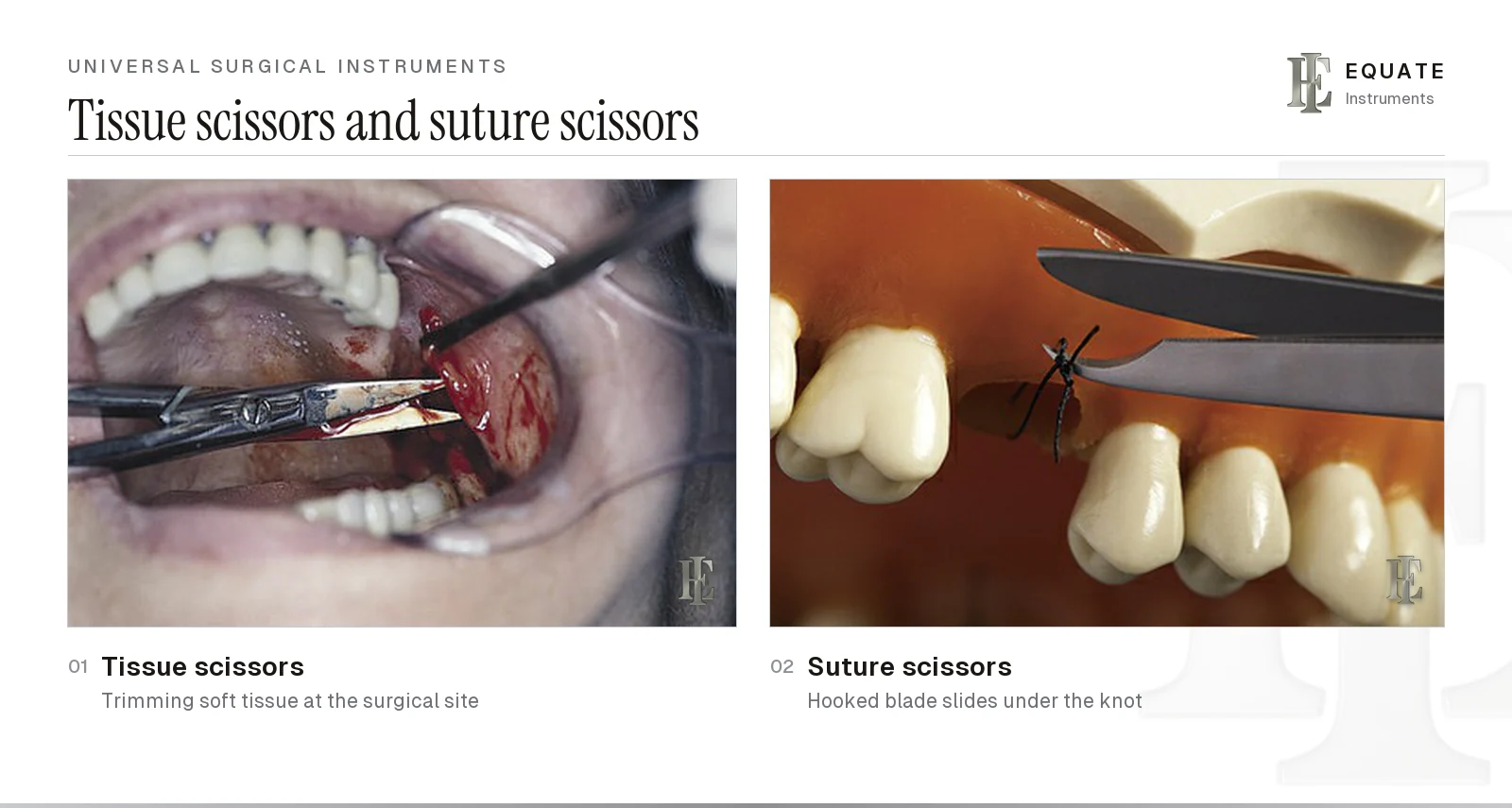
Tissue scissors have thin, finely ground blades that cut soft tissue cleanly with little crushing. Suture scissors have shorter, thicker blades made to cut thread without being blunted by it, and many have a small hook or notch at the tip of one blade. The hook slides under a stitch and lifts it off the tissue, which is why stitch scissors are standard for suture removal.
Using tissue scissors on sutures, gauze or wire nicks and dulls them, and a dull tissue scissor tears rather than cuts. Keep the two apart on the tray and lay out a dedicated pair for each job.
| Feature | Tissue scissors | Suture scissors |
|---|---|---|
| Blades | Thin, sharp, often fine-pointed | Short, strong, often with a hook or notch |
| Tips | Sharp/sharp, sharp/blunt or blunt/blunt | Usually blunt or hooked |
| Typical patterns | Iris, Metzenbaum, La Grange, Goldman-Fox, Dean | Spencer stitch, angled suture, straight Mayo |
| Main job | Trimming gingiva, tags and flap margins | Cutting suture during closure and removal |
Should you choose straight or curved scissors?
Curved scissors are the default for most intraoral tissue work, because the curve lets you cut around the convexity of a tooth or along the arch while your hand stays out of the line of sight. Straight scissors give a more predictable straight cut and suit sutures, gauze and flat surfaces. Double-curved patterns such as the La Grange add a second bend so the blades reach lingual and palatal tissue and the necks of posterior teeth.
Tip style matters too. Sharp points get into a small space and start a precise cut; blunt tips are safer near the floor of the mouth and the palate, where a point could catch tissue you didn't mean to cut.
How do you hold and use surgical scissors?
Hold ring-handled scissors with the thumb and ring finger in the bows and the index finger resting on the shanks near the joint. That tripod steadies the tips. Cut with the distal third of the blades, closing them smoothly, and keep the curve facing the tissue you want to keep. Spring-handled micro scissors are held like a pen and closed with a light squeeze.
Common errors are cutting with the back of the blades, where the leverage tears tissue; forcing the scissors through tissue that a scalpel should incise; and cutting sutures with fine tissue scissors. When removing sutures, lift the knot with tissue forceps, cut one side close to the tissue and pull the thread through so the contaminated outer part doesn't pass through the wound, as set out on the suture removal tray.
Which specifications matter?
| Feature | Options | Why it matters |
|---|---|---|
| Blade edge | Plain stainless, tungsten carbide insert, serrated | Carbide edges stay sharp longer; a serrated blade stops tissue slipping out of the cut |
| Coating | Uncoated, black or blue titanium-coated | Coated blades reduce glare under the light and are easy to identify on the tray |
| Shape | Straight, curved, double-curved, angled | Matches the access: arch, lingual or flat surfaces |
| Tips | Sharp, blunt, hooked | Sharp for precision, blunt for safety, hooked for sutures |
| Length | 9–19 cm | Short scissors for anterior work and control; longer for posterior reach |
| Handle type | Ring handles or spring handles | Spring handles give finer control in microsurgery |
What does the Equate range include?
Equate's scissors cover tissue, gum, suture and microsurgical work. The range includes 20 iris patterns (9 to 13 cm, straight, curved and serrated), 12 Metzenbaum, 8 Mayo, 8 Goldman-Fox and 5 La Grange scissors, Dean, Kelly, Kilner and Robin patterns, Spencer stitch and angled suture scissors, and Castroviejo, Noyes, Westcott and Jacobson micro scissors. 37 have tungsten carbide blades and 6 are titanium-coated in black or blue.
Clinics can request samples and a quote and see every pattern in the oral surgery range. Designed in Finland.
How do you clean and look after surgical scissors?
Clean scissors open, so the joint and the inner faces of the blades are reached, and package and sterilise them open and unlocked, as the CDC's Guidelines for Infection Control in Dental Health-Care Settings advise for hinged instruments. Automated cleaning in an ultrasonic bath or washer-disinfector is generally more efficient and safer than hand scrubbing, the CDC notes. In the UK, follow HTM 01-05, and always follow the manufacturer's instructions under ISO 17664-1.
After each cycle, check that the blades close smoothly with even tension, that the tips meet and that they cut cleanly to the points. ISO 7741:1986 covers the materials, heat treatment and hardness, corrosion resistance, workmanship and cutting ability of surgical scissors, with a test method for each. Lubricate the joint with an instrument lubricant suitable for steam sterilisation, store scissors so the tips aren't knocked, and send dull or loose pairs for sharpening and resetting or retire them.
The Equate difference
Equate lists 105 surgical scissors from 9 to 19 cm: 56 surgical, 8 gum, 20 suture and 20 microsurgical scissors and a utility scissor, covering iris, Metzenbaum, Mayo, Kelly, La Grange, Goldman-Fox, Dean, Kilner, Castroviejo, Noyes, Westcott and Jacobson patterns, 37 with tungsten carbide blades and 6 titanium-coated.
Equate Dental Surgical Scissors options

LaGrange TC Suture Scissors Curved - 11 cm
EI-0456
LaGrange Double-Curved Suture Scissors - 11.5 cm
EI-0457
LaGrange TC Suture Scissors - Black Coated
EI-0458
Iris TC Scissors Curved - 11.5 cm
EI-0459
Iris TC Scissors Straight - 11.5 cm
EI-0460
Iris Suture Scissors Straight
EI-0461
Metzenbaum Fine Straight Scissors - 13 cm
EI-0462
Classic Suture Scissors Straight 11.5cm
EI-0463
Metzenbaum Fine Curved Scissors - 14.5 cm
EI-0464
Classic Suture Scissors Curved 11.5cm
EI-0465
Iris Curved Surgical Scissors - 11.5 cm
EI-0466
Iris Suture Scissors Curved - Black-Coated 11.5cm
EI-0467Browse all oral surgery instruments
Buying in your market
Frequently asked questions
What are iris scissors used for in dentistry?
Iris scissors are small, sharp-pointed scissors used to trim gingiva, tissue tags and flap margins. They come straight or curved; curved iris scissors are among the most used scissors in oral surgery.
What is the difference between curved and straight Mayo scissors?
Straight Mayo scissors cut near the surface and are often used for sutures. Curved Mayo scissors reach deeper and are used for heavier tissue.
What are gum scissors?
Gum scissors are periodontal scissors with curved, double-curved or angled blades, such as the La Grange, Dean and Goldman-Fox, for trimming gingiva around the necks of teeth and along the arch.
Why do suture scissors have a hook?
The small hook or notch on one blade slides under a stitch and lifts it away from the tissue, so the suture can be cut cleanly without nicking the gum.
Can you sharpen dental scissors?
Yes. Stainless and tungsten carbide scissors can be professionally sharpened and reset. Retire a pair whose blades are loose, misaligned or chipped at the tips.
What scissors are used for crowns?
Crown and bridge scissors, with short curved blades for trimming metal matrix bands and temporary crown forms, are prosthodontic instruments covered with the crown and bridge instruments rather than with surgical scissors.
Can a scalpel be used instead of suture scissors?
For cutting a stitch at removal, yes: the Foundation for Oral Rehabilitation guideline allows either scissors or a blade. Hooked suture scissors are usually easier and safer, because the hook lifts the stitch off the mucosa before it is cut. Blades and handles are covered in the scalpel handles guide.
References
- Hupp JR, Tucker MR, Ellis E. Contemporary Oral and Maxillofacial Surgery, 7th edition. Elsevier, 2018 (instrumentation for basic oral surgery; suturing and suture removal)
- Newman MG, Takei HH, Klokkevold PR, Carranza FA (eds). Newman and Carranza's Clinical Periodontology. Elsevier (periodontal surgical instruments)
- Kohn WG, et al. Guidelines for Infection Control in Dental Health-Care Settings, 2003. MMWR 52(RR-17), Centers for Disease Control and Prevention
- Centers for Disease Control and Prevention. Best Practices for Sterilization in Dental Settings (Dental Infection Prevention and Control)
- ISO 7741:1986 Instruments for surgery — Scissors and shears — General requirements and test methods
- NHS England. Health Technical Memorandum 01-05: Decontamination in primary care dental practices (2013 edition)
- Boyd LRB. Dental Instruments: A Pocket Guide, 7th edition. Saunders/Elsevier, 2020. Chapter 15, Universal Surgical Instruments (photographs used under licence)
- Foundation for Oral Rehabilitation. Treatment guidelines, single tooth, surgical aftercare: suture removal
- Yadav VS, Salaria SK, Bhatia A, Yadav R. Periodontal microsurgery: reaching new heights of precision. J Indian Soc Periodontol 2018;22(1):5–11
I am a…
Related
- Dental Needle Holders (Needle Drivers)
- Dental Tissue Forceps (Toothed and Non-Toothed)
- Periodontal Knives (Gingivectomy and Interdental Knives)
- Crown and Bridge Scissors, Contouring and Holding Pliers
- Suture Removal Tray Setup
- Periodontal Surgery Tray Setup
- Universal Surgical Instruments for Oral and Periodontal Surgery
- Dental Hemostats (Haemostats) and Mosquito Forceps
- Dental Scalpel Handles and Blades