Dental Scalpel Handles and Blades
Written by the Equate Instruments Technical Team · Reviewed by the Medical & Dental Board, Equate Instruments · Updated ·
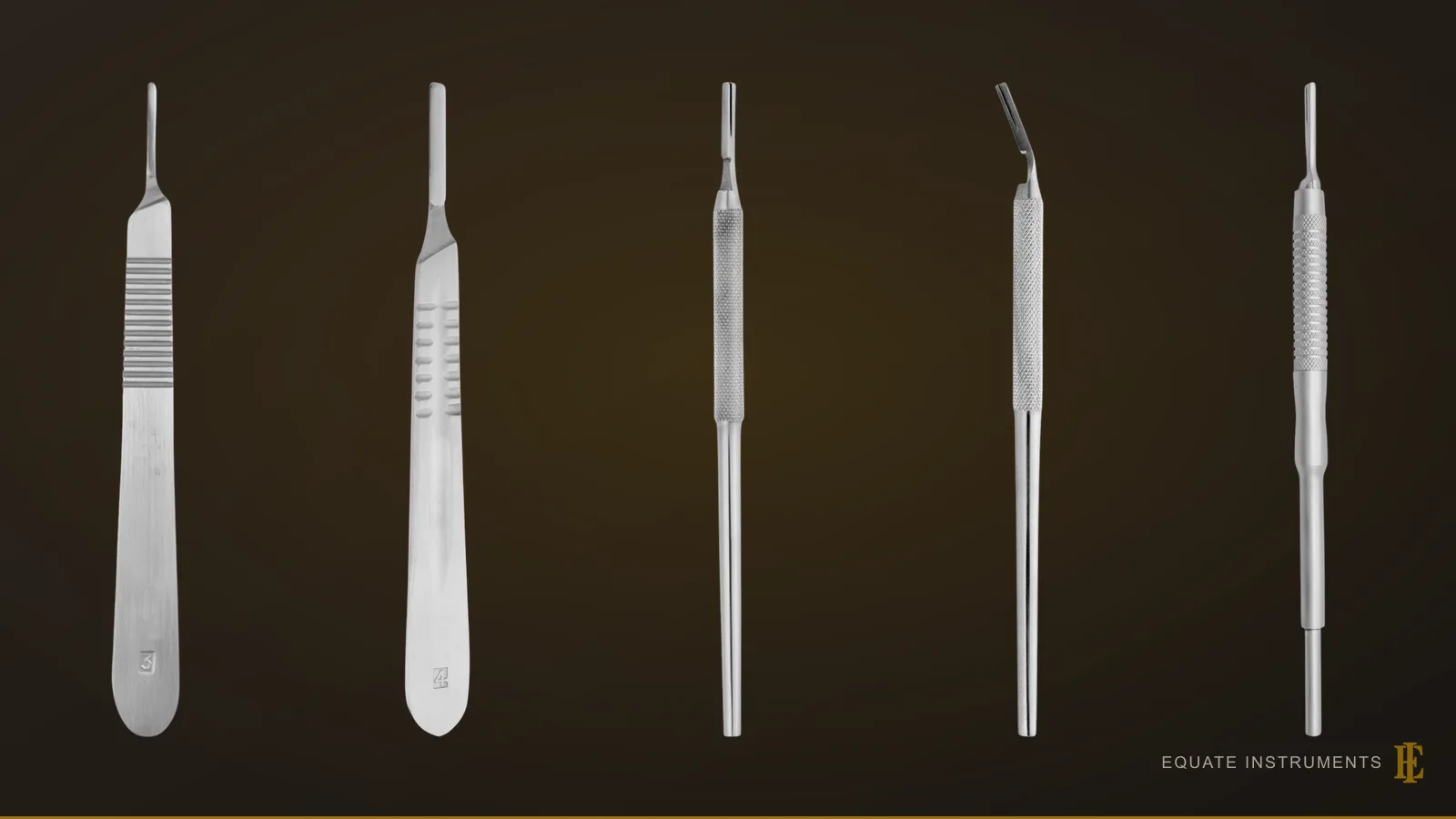
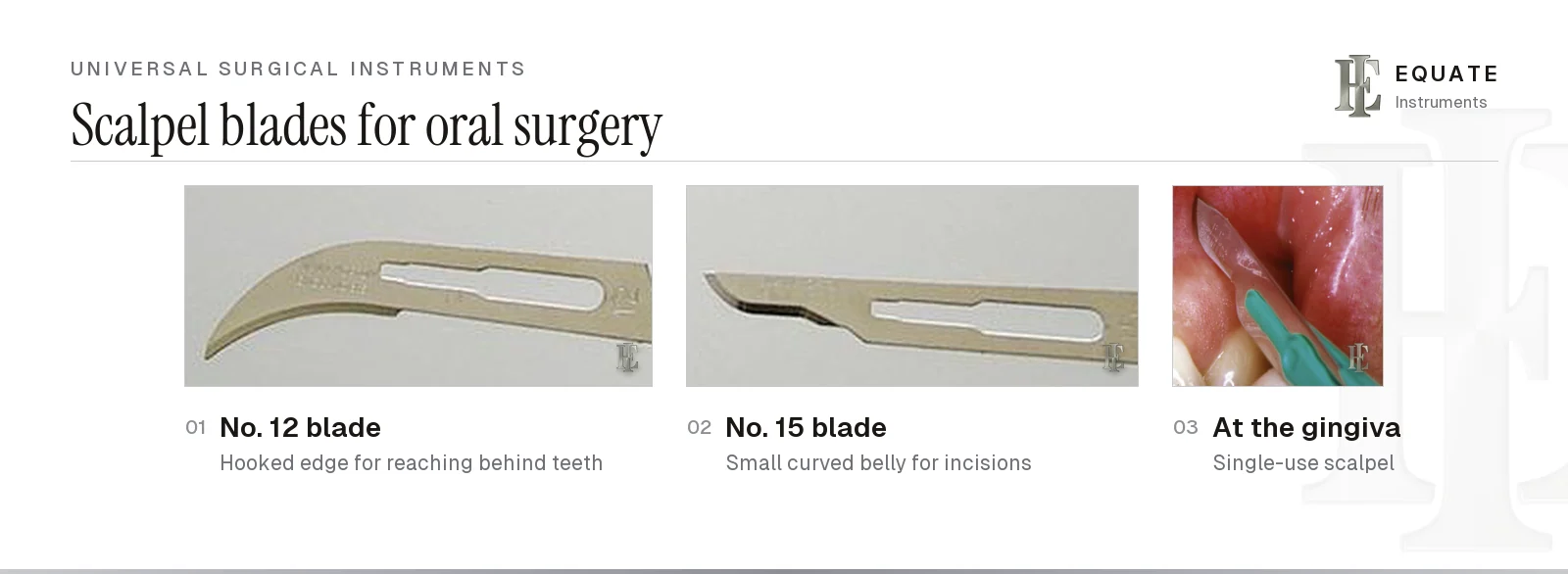
A dental scalpel is a reusable stainless steel handle that carries a disposable surgical blade for incising gum and mucosa. In dentistry the usual handle is a No. 3, flat or round, which takes the small blade fitting used by No. 11, 12, 12b, 15 and 15c blades. The No. 15 makes most flap incisions; the hooked No. 12 reaches behind molars and into sulci.
Key points
- A No. 3 handle takes the small blades used in the mouth; a No. 4 handle takes larger blades from No. 20 up, which are too big for intraoral work.
- Round handles roll between the fingers for scalloped and sulcular incisions; flat handles resist rotation for straight cuts.
- Mount and remove blades with a needle holder or a blade remover, never your fingers, and drop the used blade straight into a sharps container.
What is a scalpel handle used for in dentistry?
The scalpel makes the incisions that start most oral surgery: the outline of a mucoperiosteal flap for a surgical extraction or implant, sulcular incisions around teeth in periodontal surgery, releasing incisions, the excision of a soft-tissue lesion for biopsy and incision of an abscess for drainage. The handle is reusable and goes through the sterilisation cycle; the blade is single-use and is discarded after each patient. Away from surgery, a blade is occasionally used on a composite tray to trim flash and shape interproximal margins (see composite instruments).
It is usually the first of the universal surgical instruments used on the oral surgery tray and the periodontal surgery tray. The periosteal elevator follows it to raise the flap, and periodontal knives are the reusable alternative for gingivectomy incisions.
Which blades fit a No. 3 scalpel handle?
Detachable blades and handles come in two fitting sizes: ISO 7740:1985 defines a small fitting (No. 3) and a large one (No. 4), so blades and handles from different makers interchange. The smaller fitting is used by No. 3 handles and their long, round and angled variants, and takes blades No. 10 to 15, including the 12b and 15c. The larger fitting, on the No. 4 handle, takes No. 20 to 25 blades for skin and general surgery.
| Blade | Shape | Typical dental use |
|---|---|---|
| No. 15 | Small, curved cutting edge | The standard intraoral blade: flap outlines, releasing incisions, sulcular incisions |
| No. 15c | Narrower, more delicate version of the 15 | Periodontal and implant surgery, papillae, tight interdental spaces |
| No. 12 | Hooked, crescent blade sharpened on the inside of the curve | Distal of the last molar, the maxillary tuberosity, sulcular incisions on posterior teeth |
| No. 12b | Hooked blade sharpened on both edges | Cuts on the push and the pull stroke in posterior and sulcular incisions |
| No. 11 | Triangular, sharp-pointed blade with a straight edge | Stab incisions, such as draining an abscess, and releasing frenal attachments |
What is the difference between flat and round scalpel handles?
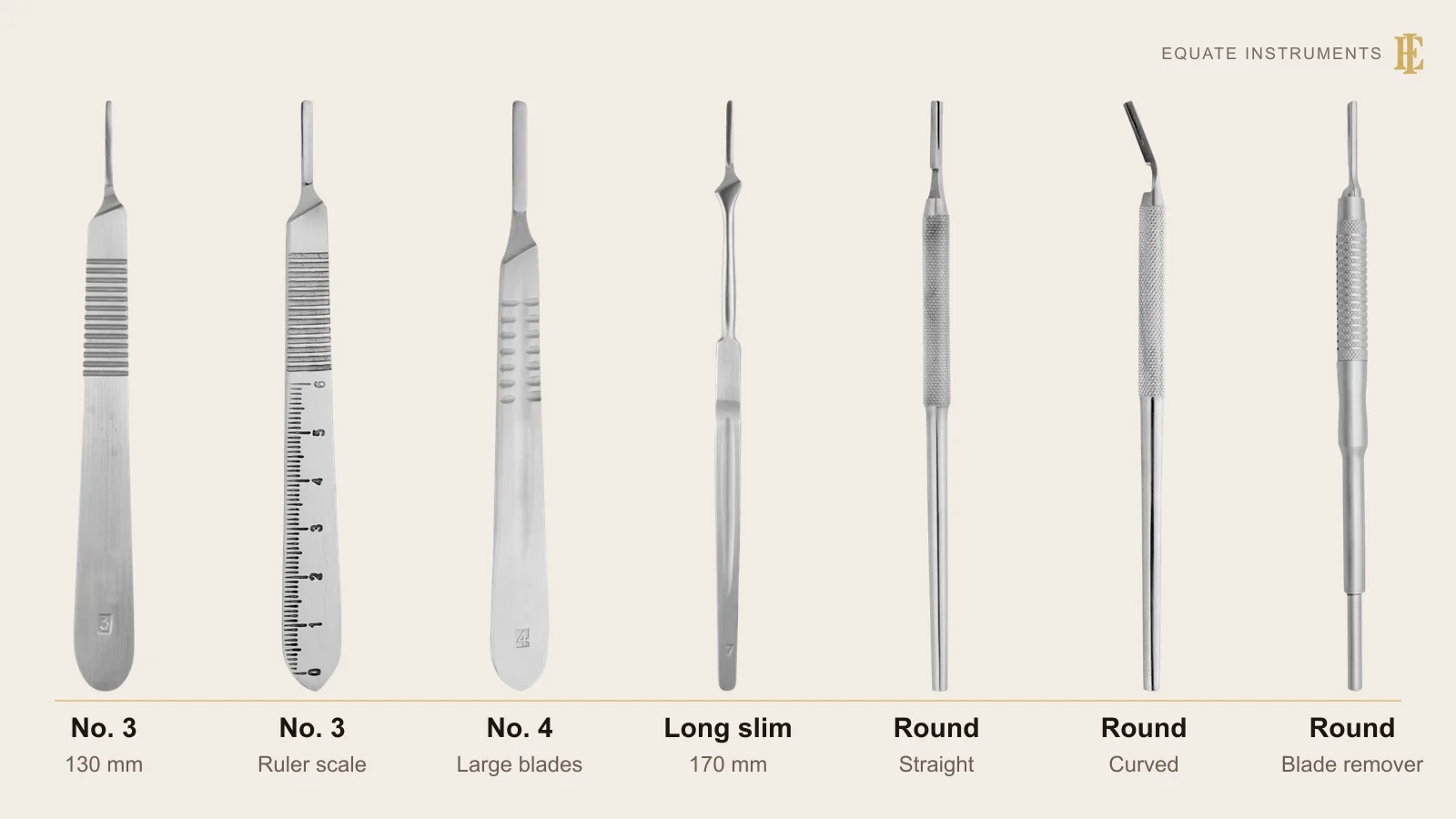
Flat No. 3 handles are the familiar pattern: the flat body resists turning in the fingers, which gives a controlled, straight incision, and versions with a ruler scale let you measure an incision or a lesion. Round handles are cylindrical, often knurled, and can be rolled between the thumb and fingers as the blade travels, which suits scalloped sulcular incisions around the curve of each tooth in periodontal and implant surgery.
Longer handles, such as 170 mm patterns, keep the hand out of the line of sight in the posterior mouth. Angled or curved round handles hold the blade at an angle for palatal and distal incisions, and some round handles have an adjustable mount that sets the blade at a chosen angle. For periodontal microsurgery, Yadav and colleagues (2018) describe microscalpel holders carrying small ophthalmic blades, whose size and sharpness give clean incisions that heal by primary intention.
| Handle | Blades | Best for |
|---|---|---|
| No. 3 flat, 130 mm | No. 10–15, 12b, 15c | General intraoral incisions with a stable, non-rotating grip |
| No. 3 with ruler scale | No. 10–15, 12b, 15c | Measuring an incision or a lesion as you cut |
| Long slim or round 170 mm | Small-fitting blades | Posterior and palatal reach |
| Round, straight or curved | Small-fitting blades | Scalloped sulcular incisions rolled around each tooth |
| No. 4 flat | No. 20–25 | Larger blades outside the mouth; not for intraoral work |
How do you mount and remove a scalpel blade safely?
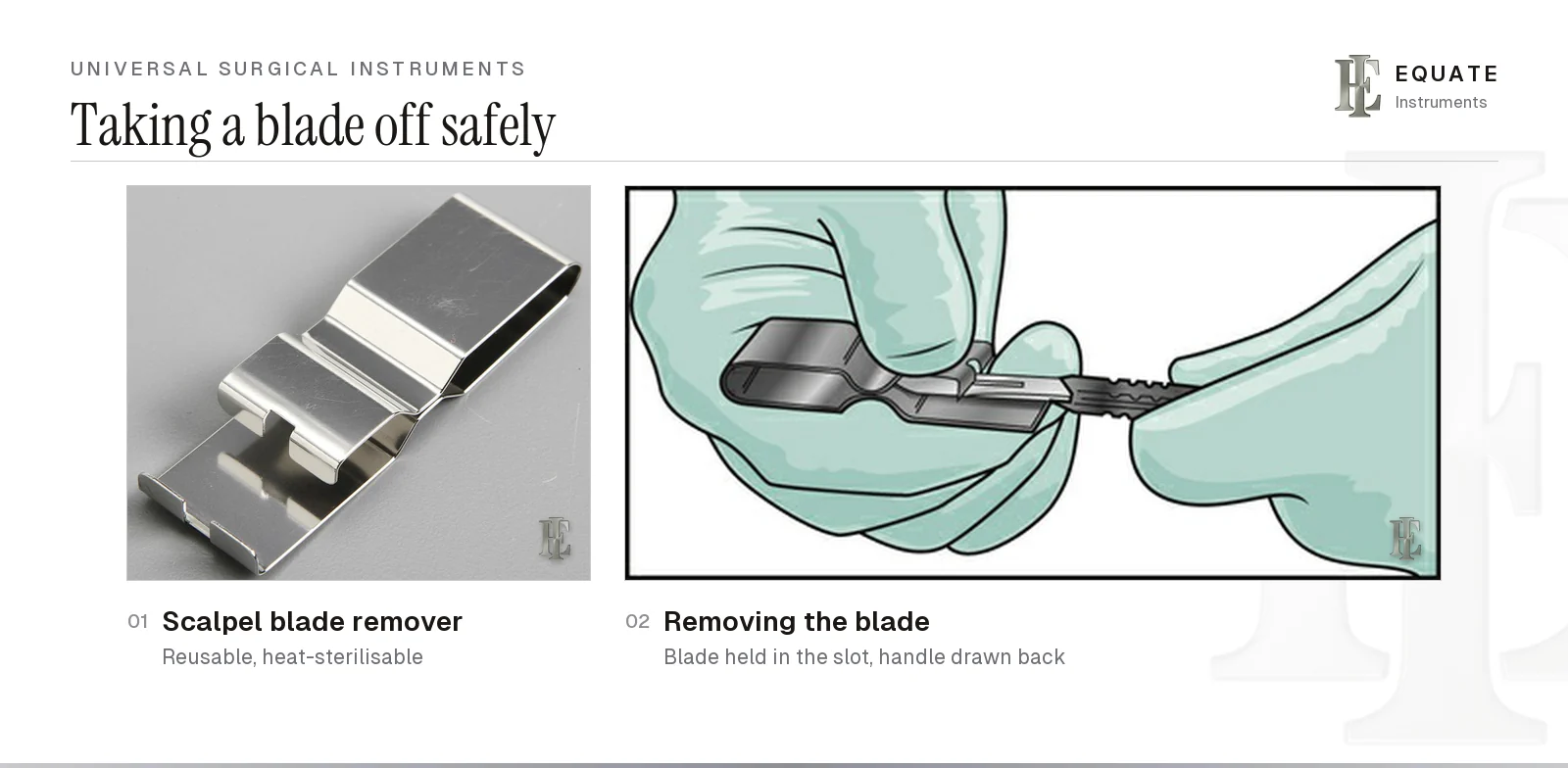
Hold the blade by its blunt back edge with a needle holder or haemostat, never with your fingers. Point it away from you and anyone near you, line the slot in the blade up with the grooved fitting on the handle, and slide it on until it clicks into the shoulder. To remove it, grasp the heel of the blade with the needle holder, lift it just clear of the fitting, and slide it forward off the handle, away from your body, straight into a sharps container.
A dedicated blade remover, or a handle with a built-in remover, takes the fingers out of the process entirely. Keep the mounted scalpel in a set place on the tray, blade facing away from the user, and say so when you pass it. Single-use blades must not be resharpened or reprocessed.
How should scalpel blades be disposed of?
Used blades go into a puncture-resistant sharps container placed as close as practical to where they are used. The CDC's Guidelines for Infection Control in Dental Health-Care Settings ask for used scalpel blades, needles and other sharp items to be placed in appropriate puncture-resistant containers close to the point of use, and recommend one-handed techniques or mechanical devices rather than handling sharps with both hands.
In Europe, Council Directive 2010/32/EU on preventing sharp injuries in the hospital and healthcare sector, which member states had to put into national law by May 2013, requires employers to assess sharps risks, set safe procedures for use and disposal, ban recapping, train staff and provide safety-engineered devices where appropriate. In the UK, regulation 5 of the Health and Safety (Sharp Instruments in Healthcare) Regulations 2013 likewise asks employers to avoid sharps where reasonably practicable, use safer sharps otherwise, and put clearly marked, secure sharps containers close to where they are used. A blade-remover handle and a sharps bin within reach of the chair meet all three.
How do you hold a scalpel for an intraoral incision?
Use a pen grasp, with the handle resting on the side of the middle finger and a firm finger rest on the teeth or jaw, so the cut is controlled by the fingers rather than the arm. For a full-thickness flap, take the blade through mucosa and periosteum to bone in one firm, continuous stroke; repeated short strokes leave ragged margins that heal poorly. Keep incisions over sound bone where possible, so the flap edges are supported when they are sutured.
Change the blade as soon as it drags. A blunt blade needs more force, which reduces control and crushes tissue, and bone dulls a blade quickly. Common errors are cutting with the tip instead of the belly of a No. 15, forcing a blade into a space where a periodontal knife or scissors would do better, and leaving a mounted blade loose on the tray.
What does the Equate range include?
Equate lists nine scalpel handles: No. 3 handles at 130 mm, plain or with a ruler scale; a No. 4 handle at 130 mm; a long slim 170 mm handle for posterior reach; a short mini handle; and round handles in straight and curved forms, a 170 mm round handle with an adjustable blade mount and a round handle with an automatic blade remover that ejects the blade into a sharps container without touching it.
The handles are made of passivated stainless steel, ultrasonically cleaned, shape-, boil- and performance-tested and individually packed, and designed in Finland. Equate supplies the handles; blades are bought separately as single-use items. See the oral surgery range and request samples and a quote.
How do you clean and look after scalpel handles?
Remove the blade first, then clean the handle with the rest of the surgical set, paying attention to the grooves of the blade fitting, the knurling and any blade-remover mechanism, where debris collects. Sterilise it in line with the CDC guidelines or, in UK practices, HTM 01-05, following the manufacturer's instructions under ISO 17664-1.
Check the fitting before each use: a bent or worn fitting lets the blade wobble or come loose during an incision. Retire a handle whose blade no longer clicks firmly into place.
The Equate difference
Equate lists 9 scalpel handles: 5 standard handles (two No. 3 at 130 mm, one with a ruler scale, a No. 4, a long slim 170 mm handle and a mini handle) and 4 round handles (straight, curved, 170 mm with an adjustable blade mount, and one with an automatic blade remover).
Equate Dental Scalpel Handles and Blades options

Round Scalpel Handle - Straight Standard
EI-0029
Round Scalpel Handle 170 mm - Adjustable Blade Mount
EI-0030
Scalpel Handle No.3 - 130mm
EI-0031
Scalpel Handle No.3 with Ruler Scale - 130mm
EI-0032
Long Slim Scalpel Handle - 170 mm
EI-2244
Scalpel Handle No.4 - 130mm
EI-2245
Round Scalpel Handle, Curved
EI-2768
Scalpel Handle with Automatic Blade Remover
EI-2769
Ace Mini Scalpel Blade Handle
EI-2770Browse all oral surgery instruments
Buying in your market
Frequently asked questions
What scalpel blade is used most in dentistry?
The No. 15 blade, on a No. 3 handle, makes most intraoral incisions. The narrower 15c suits periodontal work, and the hooked No. 12 reaches distal and sulcular areas.
Do No. 15 blades fit a No. 4 handle?
No. No. 10 to 15 blades fit the smaller fitting on No. 3 handles and their variants. No. 4 handles take larger blades, from No. 20 up.
What is a No. 12 blade used for in dentistry?
Its hooked, crescent shape reaches the distal surfaces of molars, the tuberosity and the gingival sulcus, where a straight blade can't be angled correctly. Compared with the No. 15, which has a small curved edge on the outside and makes most flap and releasing incisions, the No. 12 has its edge on the inner curve, so it cuts as it is drawn back around the tooth.
Can scalpel blades be reused?
No. Blades are single-use: discard each one in a sharps container after the patient. The handle is reusable and is cleaned and sterilised.
What is a round scalpel handle for?
A round handle can be rolled between the fingers as you cut, which helps with scalloped sulcular incisions around teeth in periodontal and implant surgery.
Is a scalpel used outside oral surgery?
Occasionally. Boyd's pocket guide notes blades on composite tray setups, where a blade trims excess cured composite (flash) and carves interproximal margins; the composite instruments guide covers that tray. Its main use is still oral and periodontal surgery.
References
- Hupp JR, Tucker MR, Ellis E. Contemporary Oral and Maxillofacial Surgery, 7th edition. Elsevier, 2018 (instrumentation for basic oral surgery; principles of flap design and incision)
- Kohn WG, et al. Guidelines for Infection Control in Dental Health-Care Settings, 2003. MMWR 52(RR-17), Centers for Disease Control and Prevention
- Council Directive 2010/32/EU of 10 May 2010 implementing the framework agreement on prevention from sharp injuries in the hospital and healthcare sector (summary by the European Agency for Safety and Health at Work)
- ISO 7740:1985 Instruments for surgery — Scalpels with detachable blades — Fitting dimensions
- NHS England. Health Technical Memorandum 01-05: Decontamination in primary care dental practices (2013 edition)
- ISO 17664-1:2021 Processing of health care products: information to be provided by the medical device manufacturer for the processing of medical devices
- Boyd LRB. Dental Instruments: A Pocket Guide, 7th edition. Saunders/Elsevier, 2020 (photographs used under licence)
- The Health and Safety (Sharp Instruments in Healthcare) Regulations 2013 (SI 2013/645), regulation 5: use and disposal of medical sharps
- Yadav VS, Salaria SK, Bhatia A, Yadav R. Periodontal microsurgery: reaching new heights of precision. J Indian Soc Periodontol 2018;22(1):5–11
- Foundation for Oral Rehabilitation. Treatment guidelines, single tooth, surgical aftercare: suture removal
I am a…
Related
- Periodontal Knives (Gingivectomy and Interdental Knives)
- Periosteal Elevators: Molt 9, Freer, Buser and Other Patterns
- Dental Surgical Scissors
- Dental Needle Holders (Needle Drivers)
- Oral Surgery Tray Setup
- Periodontal Surgery Tray Setup
- Universal Surgical Instruments for Oral and Periodontal Surgery
- Dental Tissue Forceps (Toothed and Non-Toothed)
- Suture Removal Tray Setup