Dental Hemostats (Haemostats) and Mosquito Forceps
Written by the Equate Instruments Technical Team · Reviewed by the Medical & Dental Board, Equate Instruments · Updated ·
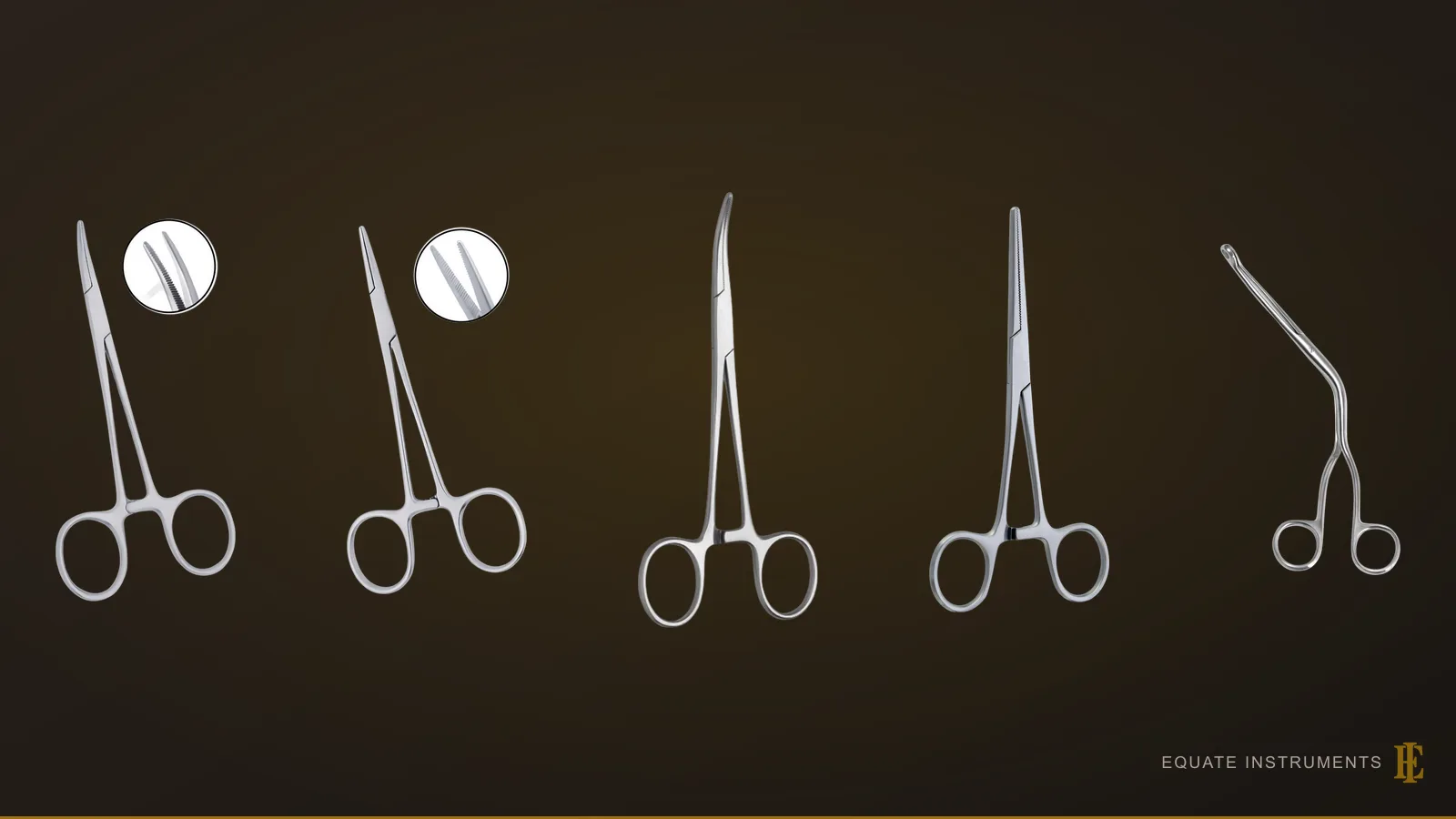
A dental haemostat (hemostat) is a ring-handled locking forceps with slender, serrated jaws. In oral surgery it clamps small bleeding vessels and grasps root tips, bone fragments and granulation tissue in a socket, and it retrieves small items from the mouth. The small, fine-tipped Halsted mosquito, straight or curved and 10 to 12.5 cm long, is the usual dental size.
Key points
- A haemostat's jaws are long and finely grooved for clamping, so don't use it to drive suture needles; that is the needle holder's job.
- Curved mosquito forceps reach into sockets and around teeth; straight ones grasp items in open view.
- The orthodontic haemostat used for ligatures is the Mathieu plier, a different instrument.
What is a hemostat used for in dentistry?
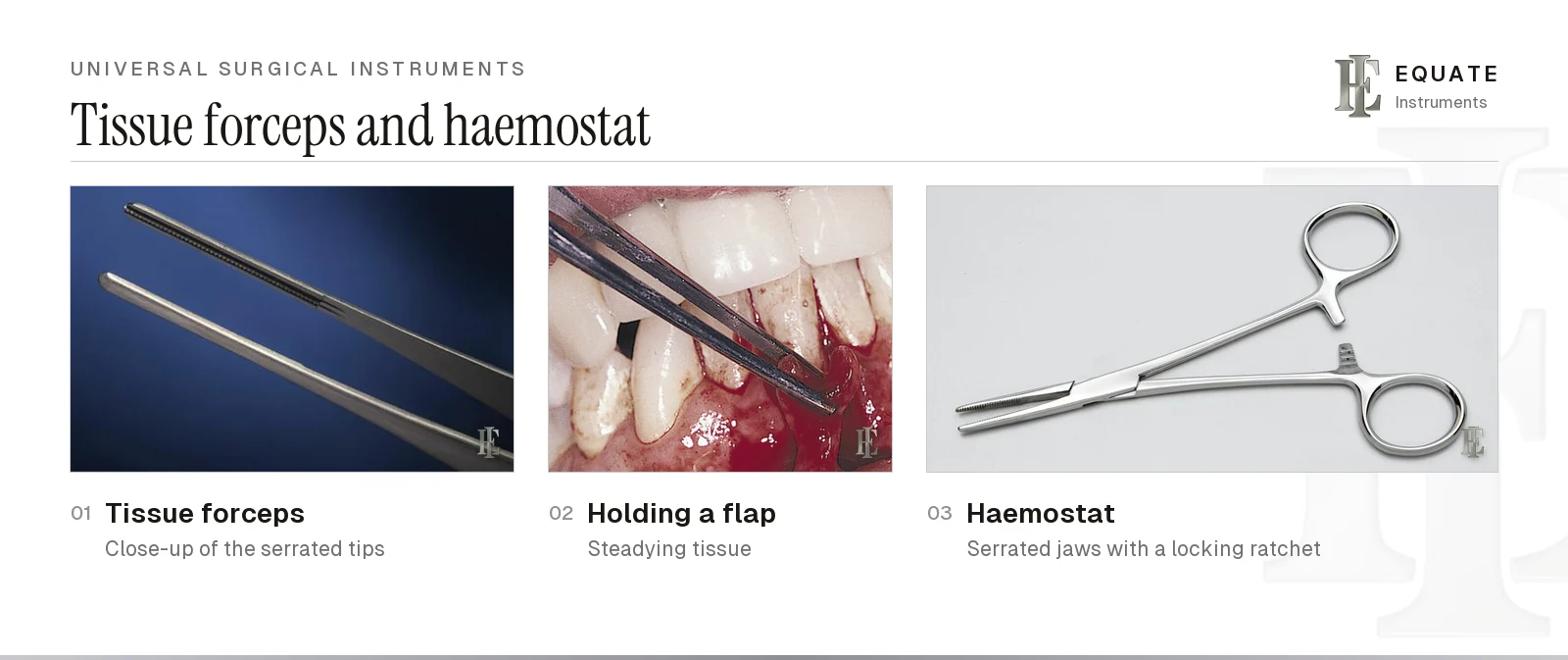
The haemostat's surgical job is to clamp a small bleeding vessel until it stops, is tied or is cauterised, and the ratchet means it stays closed without being held. In the mouth, most bleeding is controlled with pressure, so the dental haemostat is used more often as a fine locking grasper. In Contemporary Oral and Maxillofacial Surgery, Hupp, Tucker and Ellis describe it as handy for clearing granulation tissue out of sockets and for picking up root tips, calculus, pieces of old restorations and other debris that has fallen into the wound.
It also holds gauze, retrieves a fractured root tip once an elevator has loosened it, and grips small items outside the mouth. It belongs on the oral surgery tray and the surgical extraction tray, next to the extraction instruments and the surgical curettes that clean the socket, as one of the universal surgical instruments. Because a fine locking grasper is handy at almost any chair, Boyd's pocket guide places it on restorative and other setups too, not only on surgical trays, and it can lift a suture at a suture removal visit.
What types of hemostat are there?
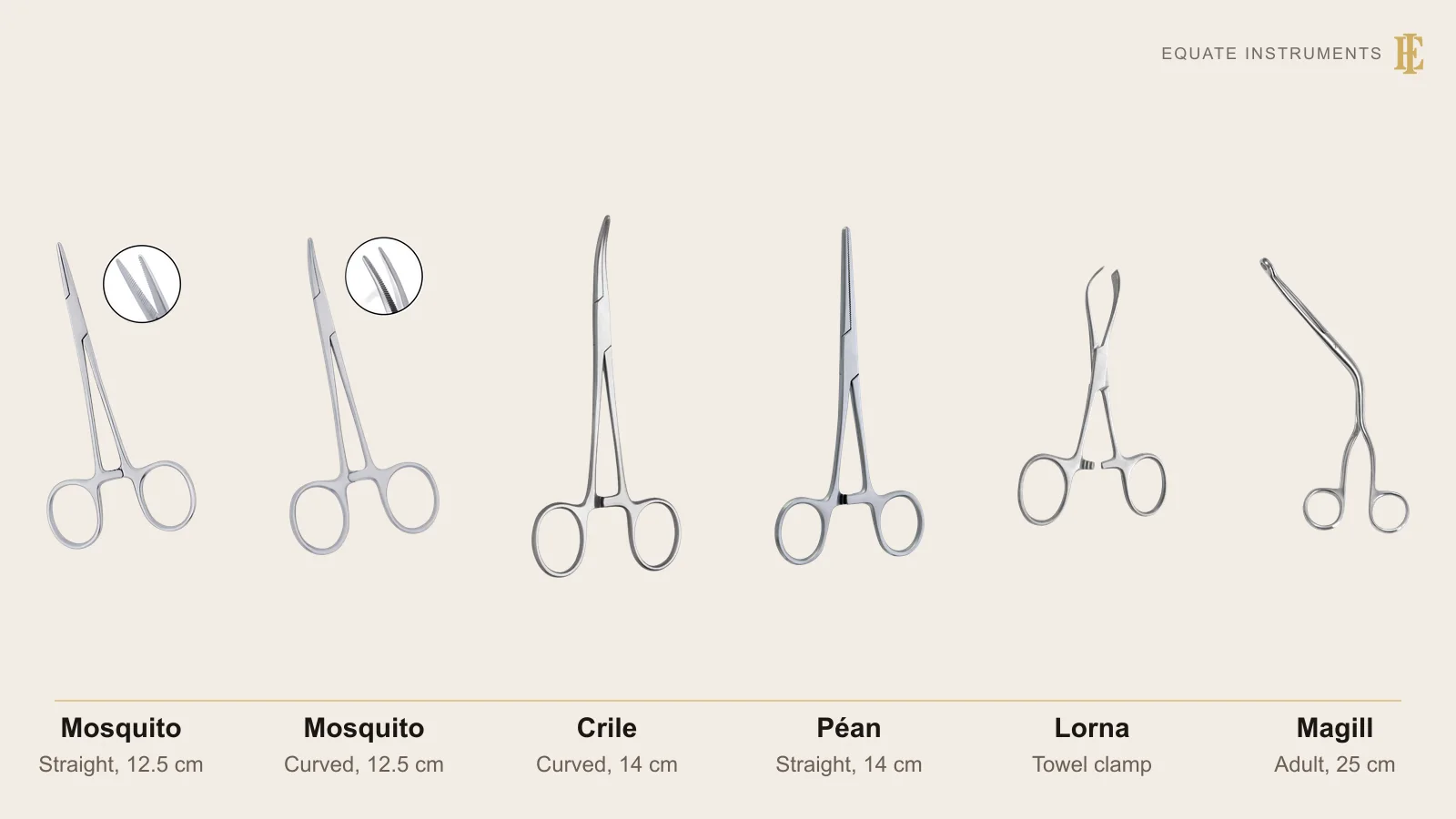
- Halsted mosquito: the smallest common haemostat, 10 to 12.5 cm, with fine, fully serrated jaws; the standard dental pattern.
- Kelly: a medium haemostat, around 14 cm, with transverse serrations on the front half of the jaws.
- Crile: similar in size to the Kelly, with serrations along the full length of the jaws.
- Péan: a larger, sturdier clamp with full-length serrations; the modern haemostat is credited to the French surgeon Jules-Émile Péan.
- Kocher: a heavy clamp with 1×2 teeth at the tip, for gripping tough tissue rather than vessels.
- Root fragment forceps (such as the Stieglitz): slender locking forceps with fine, straight, curved or angled jaws for picking out root tips and fragments.
- Mosquito tip variants: hole, hook, contact or toothed tips for holding sutures, wire or small items.
What is the difference between straight and curved mosquito forceps?
Curved mosquito forceps are the more useful in the mouth: the curve lets the tips reach into a socket or around a tooth while the rings stay out of the line of sight, and a curved clamp sits flatter against tissue. Straight mosquitoes grasp things in open view, such as gauze, sutures or a fragment on a tray, and give an even bite along the jaws.
| Pattern | Length | Jaw serrations | Typical dental use |
|---|---|---|---|
| Halsted mosquito, curved | 10–12.5 cm | Full length, fine | Root tips, granulation tissue, small vessels |
| Halsted mosquito, straight | 10–12.5 cm | Full length, fine | Gauze, sutures, retrieving small items |
| Kelly | About 14 cm | Front half | Larger vessels, gauze, deeper sites |
| Crile | About 14 cm | Full length | Firm grip along the whole jaw |
| Péan | 11.5–14 cm | Full length | Heavier tissue and dressings |
| Root fragment forceps | About 15 cm | Fine, at the tips | Root tips and fragments in a socket |
Which other locking forceps sit on a surgical tray?
Towel clamps hold drapes in place and secure suction tubing to them. The Backhaus pattern has sharp, curved points that pierce the drape; non-perforating patterns such as the Lorna grip without making holes, which keeps the drape intact as a barrier.
Magill forceps are long, angled forceps with ring handles set to one side, so the tips can work at the back of the mouth and throat while the hand stays clear. They're named after Sir Ivan Magill, the Irish anaesthetist who devised them in the early 1920s. Anaesthetists use them to guide nasal tubes and place throat packs, and many clinics that provide sedation or general anaesthesia keep them to hand to retrieve a dropped crown, tooth or other object from the oropharynx. Stocking them is a practice decision rather than a requirement: the Resuscitation Council UK minimum equipment list for primary dental care includes portable suction such as a Yankauer, airways, a self-inflating bag and oxygen, but not Magill forceps.
| Instrument | Design | Use |
|---|---|---|
| Backhaus towel clamp | Sharp, curved, perforating points | Holds drapes and tubing firmly |
| Lorna towel clamp | Blunt, non-perforating jaws | Holds drapes without piercing the barrier |
| Magill forceps | Long angled jaws, offset ring handles | Throat packs and retrieving dropped objects |
| Root fragment forceps | Fine locking jaws, straight, curved or angled | Root tips and fragments in a socket |
How do you use a hemostat safely?
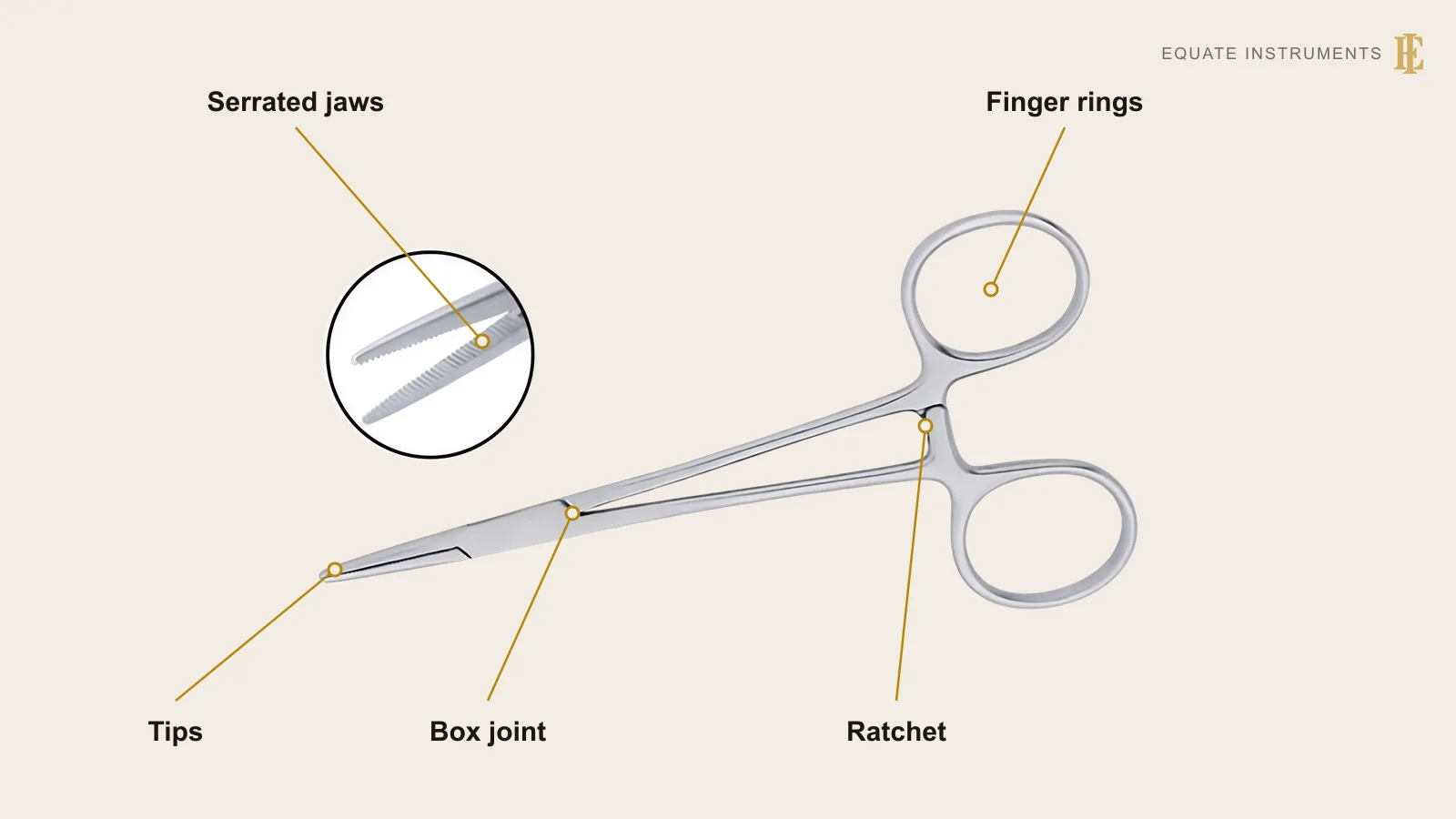
Hold the haemostat with the thumb and ring finger in the rings and the index finger along the shank. Close it only to the first or second ratchet click that holds the tissue; going further crushes tissue and strains the box joint. To release it, push one ring away and pull the other towards you so the ratchet teeth disengage. Practise releasing with both hands.
Don't use a haemostat as a needle holder, a wire cutter or a plier: its fine jaws spring and the serrations wear, and a needle gripped in parallel grooves swivels. When grasping a root tip, take it at its most accessible point under direct vision and good suction, and stop if it moves towards the sinus or the inferior alveolar canal.
What does the Equate range include?
Equate's haemostats and locking forceps cover dental and general surgical use: Halsted-mosquito forceps in 10 and 12 cm, straight and curved, and 12.5 cm mosquito forceps with straight, curved, hole, hook, contact and 1×2 tips; Péan forceps in 11.5 and 14 cm and classic patterns; Kelly, Kocher, Crile and 18 cm Gemini forceps; straight, curved and angled root fragment forceps including the Stieglitz; Backhaus perforating and Lorna non-perforating towel clamps from 9 to 13 cm; and paediatric (19 cm) and adult (25 cm) Magill forceps.
All are made of passivated stainless steel, ultrasonically cleaned, shape-, boil- and performance-tested and individually packed. Browse the oral surgery range and request samples and a quote.
How do you clean and look after hemostats?
Clean haemostats open and unlocked, and sterilise them the same way, as the CDC's Guidelines for Infection Control in Dental Health-Care Settings advise for hinged instruments; a haemostat sterilised locked keeps the joint and serrations hidden from steam and stresses the ratchet. In UK practices follow HTM 01-05, and always follow the manufacturer's instructions under ISO 17664-1. ISO 7151:2024 sets the general requirements and tests for non-cutting articulated instruments such as haemostats.
Inspect after each cycle: the jaws should meet tip to tip with no light between them when the first click is engaged, the serrations should mesh, and the ratchet shouldn't spring open when the instrument is tapped. Lubricate stiff joints with an instrument lubricant suitable for steam sterilisation, and retire haemostats that are misaligned, cracked at the box joint or whose ratchet slips.
The Equate difference
Equate lists 36 haemostats and locking forceps from 9 to 25 cm: 11 Halsted-mosquito and mosquito forceps (straight, curved and with hole, hook, contact or 1×2 tips), 5 Péan, 3 standard haemostatic forceps, 2 Kelly, 2 Kocher, a Crile and a Gemini, 4 root fragment forceps, 5 Backhaus and Lorna towel clamps and 2 Magill forceps.
Equate Dental Hemostats (Haemostats) and Mosquito Forceps options

Pean Hemostatic Forceps Straight 14 cm
EI-0422
Pean Hemostatic Forceps Curved 14 cm
EI-0423
Classic Pean Hemostatic Forceps Straight
EI-0424
Classic Pean Hemostatic Forceps Curved
EI-0425
Hemostatic Forceps
EI-0427
Backhaus Towel Clamp 11 cm
EI-0429
Backhaus Towel Clamp 9 cm
EI-0431
Halsted-Mosquito Hemostatic Forceps Straight 10 cm
EI-0434
Halsted-Mosquito Hemostatic Forceps Curved 10 cm
EI-0435
Halsted-Mosquito Hemostatic Forceps Straight 12 cm
EI-0436
Halsted-Mosquito Hemostatic Forceps Curved 12 cm
EI-0437
Hemostatic Forceps Straight 14cm
EI-0438Browse all oral surgery instruments
Buying in your market
Frequently asked questions
What are mosquito forceps used for in dentistry?
Mosquito forceps are small locking haemostats used to grasp root tips, bone fragments and granulation tissue in a socket, clamp small vessels and retrieve small items from the mouth.
How is a haemostat different from a needle holder?
A haemostat has long, fine jaws with parallel grooves for clamping and grasping. A needle holder has short, strong, cross-hatched jaws that stop a curved needle rotating, so use a needle holder for suturing.
Can a haemostat be used to remove sutures?
Yes, to lift them. The Foundation for Oral Rehabilitation's suture removal guideline allows a haemostat or cotton forceps to draw the suture towards the wound before it is cut with scissors or a blade. The cut itself still needs sharp suture scissors, as laid out on the suture removal tray.
Is a haemostat only used in surgery?
No. It is mainly a surgical instrument, but its locking grip is useful for holding gauze, a cotton roll or a loose crown, so Boyd's pocket guide lists it on restorative and other setups as well as on oral and periodontal surgery trays.
What is the difference between Kelly and Crile hemostats?
They are similar in size, but the Kelly has serrations on the front half of its jaws and the Crile has serrations along their full length.
Is an orthodontic hemostat the same as a surgical hemostat?
No. The orthodontic haemostat, usually a Mathieu plier, has narrow serrated tips for placing ligatures and elastics. Surgical haemostats are ring-handled clamps for tissue and vessels.
Why are Magill forceps kept in dental clinics?
Their offset handles and angled jaws reach the back of the mouth and throat, so they can retrieve a dropped object or place a throat pack, especially under sedation or general anaesthesia. They are not on the Resuscitation Council UK minimum list for primary dental care, so stocking them is each practice's decision.
References
- Hupp JR, Tucker MR, Ellis E. Contemporary Oral and Maxillofacial Surgery, 7th edition. Elsevier, 2018 (instrumentation for basic oral surgery: haemostats and needle holders)
- Kohn WG, et al. Guidelines for Infection Control in Dental Health-Care Settings, 2003. MMWR 52(RR-17), Centers for Disease Control and Prevention
- NHS England. Health Technical Memorandum 01-05: Decontamination in primary care dental practices (2013 edition)
- ISO 7151:2024 Surgical instruments — Non-cutting, articulated instruments — General requirements and test methods
- ISO 17664-1:2021 Processing of health care products: information to be provided by the medical device manufacturer for the processing of medical devices
- Boyd LRB. Dental Instruments: A Pocket Guide, 7th edition. Saunders/Elsevier, 2020 (photographs used under licence)
- Foundation for Oral Rehabilitation. Treatment guidelines, single tooth, surgical aftercare: suture removal
- Resuscitation Council UK. Quality standards: primary dental care equipment list
I am a…
Related
- Dental Needle Holders (Needle Drivers)
- Tooth Extraction Instruments
- Surgical Curettes (Bone Curettes) for Oral Surgery
- Mathieu Plier
- Oral Surgery Tray Setup
- Surgical Extraction Tray Setup
- Universal Surgical Instruments for Oral and Periodontal Surgery
- Dental Tissue Forceps (Toothed and Non-Toothed)
- Suture Removal Tray Setup