Sinus Lift Instruments
Written by the Equate Instruments Technical Team · Reviewed by the Medical & Dental Board, Equate Instruments · Updated ·
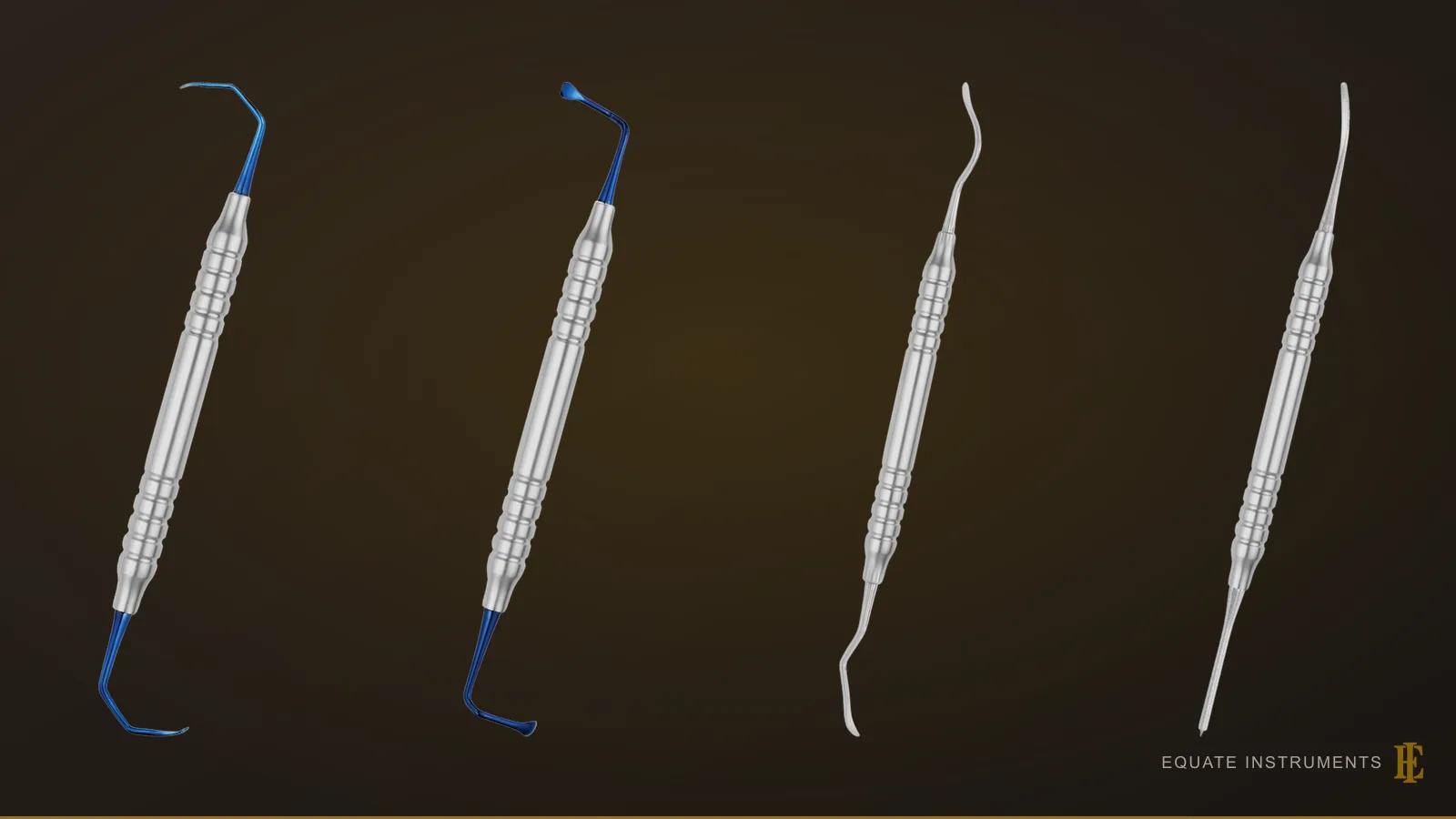
Sinus lift instruments are the hand elevators and curettes used to lift the Schneiderian membrane off the floor of the maxillary sinus, so bone graft can be placed beneath it and implants can go into the posterior maxilla. They have smooth, rounded, angled blades that stay against bone and don't tear the membrane, and are used with osteotomes, graft carriers and membrane placers.
Key points
- The lateral window approach opens the side wall of the sinus for direct elevation; the crestal approach lifts the floor through the implant site with osteotomes.
- Membrane perforation is the commonest complication, reported in about one in four lateral window lifts in a 2016 meta-analysis.
- A sinus lift set needs a fine release tip, a broad spoon curette and angled curettes for the floor and medial wall, all with smooth unworn edges.
What are sinus lift instruments used for?
Sinus lift instruments are used in maxillary sinus floor elevation, the operation that creates bone height in the posterior maxilla when the sinus has expanded downwards after tooth loss. The surgeon reaches the sinus floor, lifts its lining, the Schneiderian membrane, off the bone and fills the space beneath with graft, giving an implant enough bone to stand in.
The flap is raised with periosteal elevators, crestal lifts use dental osteotomes, and the graft is harvested, carried and packed with bone graft instruments. The surgical tray as a whole is on the oral surgery tray setup page.
Who developed the sinus lift?
The sinus lift entered the literature with work by P. J. Boyne and R. A. James, whose 1980 report in the Journal of Oral Surgery, one of the earliest published, grafted the maxillary sinus floor with the patient's own marrow and bone. H. Tatum's 1986 paper in Dental Clinics of North America, Maxillary and sinus implant reconstructions, described implant reconstruction of the posterior maxilla and sinus area.
The less invasive crestal route, in which tapered osteotomes are tapped up through the implant site to raise the sinus floor and condense the surrounding bone rather than drilling it away, came from R. B. Summers in 1994 and is covered on the dental osteotomes page.
What is the difference between the lateral window and crestal approaches?
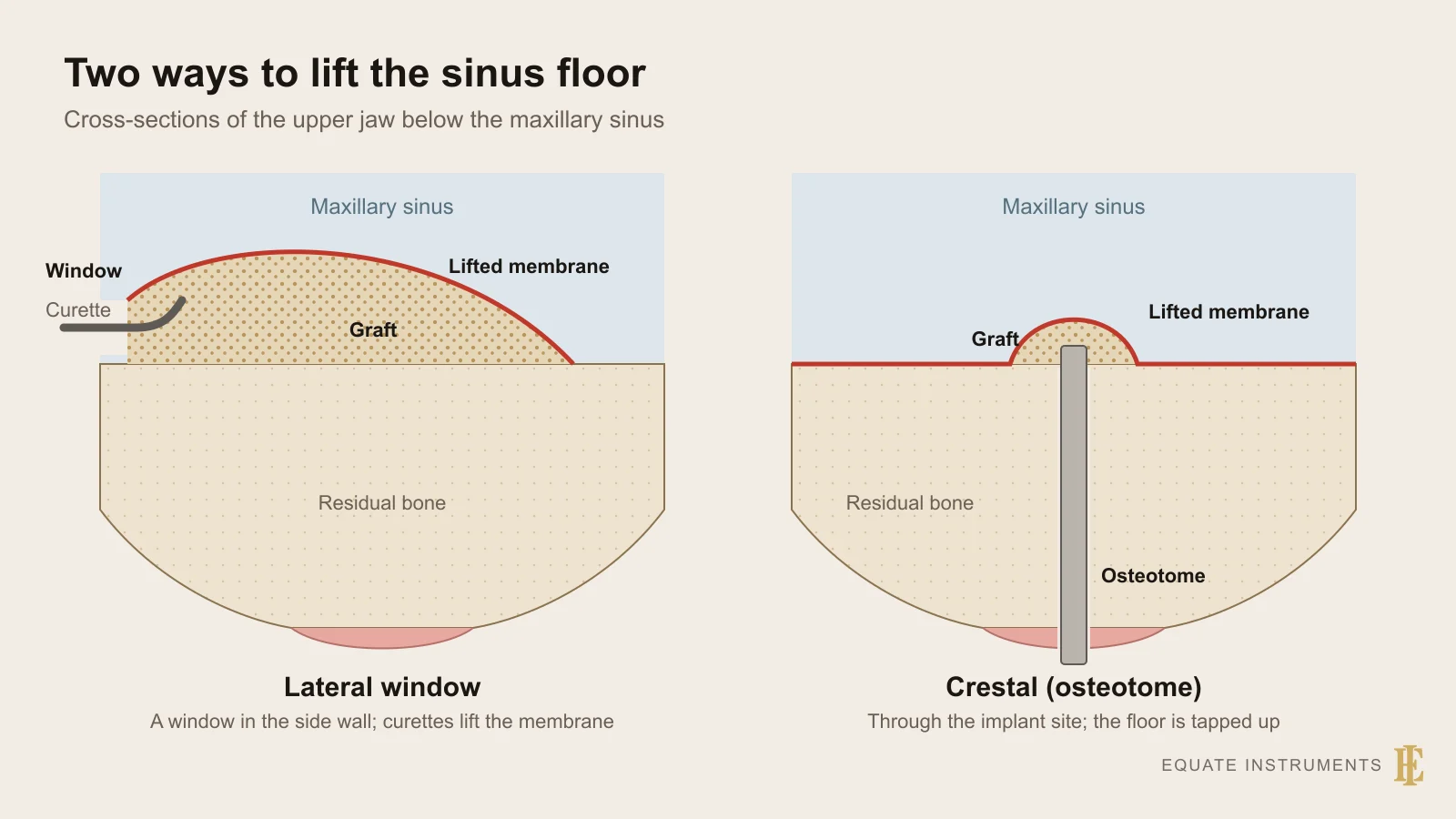
The lateral window approach reaches the membrane through a window cut in the side wall of the sinus, while the crestal approach lifts it from below through the implant osteotomy; the choice depends mostly on how much bone is left under the sinus and how much height is needed.
| Lateral window | Crestal (osteotome) | |
|---|---|---|
| Access | Buccal flap and a window in the lateral sinus wall | Through the implant osteotomy in the ridge |
| Membrane elevation | Direct, under vision, with sinus curettes | Indirect, lifted by the bone and graft pushed up by the osteotome |
| Typical case | Little residual bone and a large gain in height | More residual bone (roughly 5 mm or more) and a modest gain |
| Main hand instruments | Release elevators, spoon and angled curettes, graft carrier, membrane placer | Graded osteotomes and mallet, graft carrier |
| Implant timing | Same visit or staged, depending on primary stability | Usually placed at the same visit |
| Pooled 3-year implant survival | 90.1% (Pjetursson and colleagues, 2008) | 92.8% (Tan and colleagues, 2008) |
How is the Schneiderian membrane elevated?
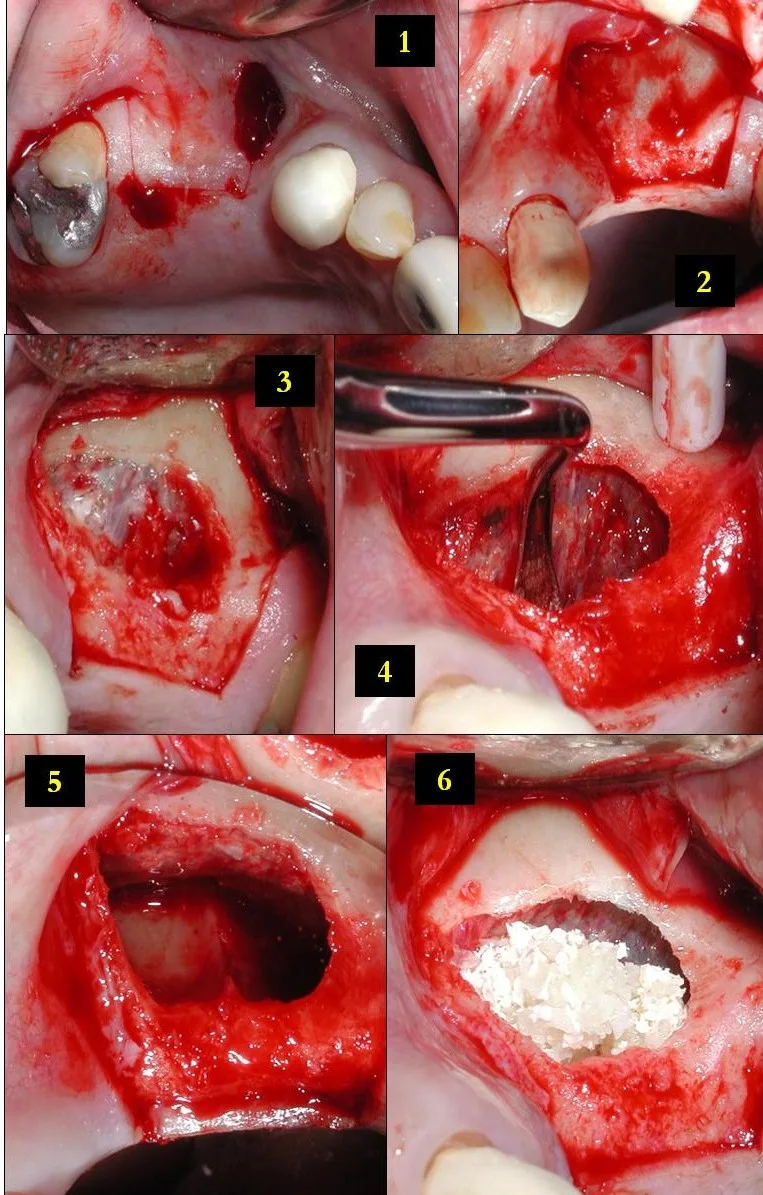
The membrane is lifted in stages, starting at the margins of the window and working down onto the floor and up the medial wall, with the instrument kept on bone at all times. Once the window is outlined, a fine, angled release elevator frees the membrane all round its edge. A broad spoon curette then sweeps under it along the floor, and angled curettes carry the elevation forward, back and up the medial wall until the planned space is open. The window bone is either removed or pushed in with the membrane like a hinged lid.
Membrane perforation is the commonest complication. A 2016 meta-analysis by Al-Dajani of 12 studies and 1,652 sinus lifts found perforation in 23.5%, ranging from 3.6% to 41.8% between studies, with thin membranes and sinus septa raising the risk; implant survival didn't differ significantly between perforated and intact sides, and piezoelectric instrumentation appeared to reduce the perforation risk. Work with light, steady pressure and lead with the convex back of the blade against the membrane. Movement of the membrane as the patient breathes confirms it's intact, and small tears are usually covered with a resorbable membrane before grafting.
What curette shapes are used for sinus lifts?
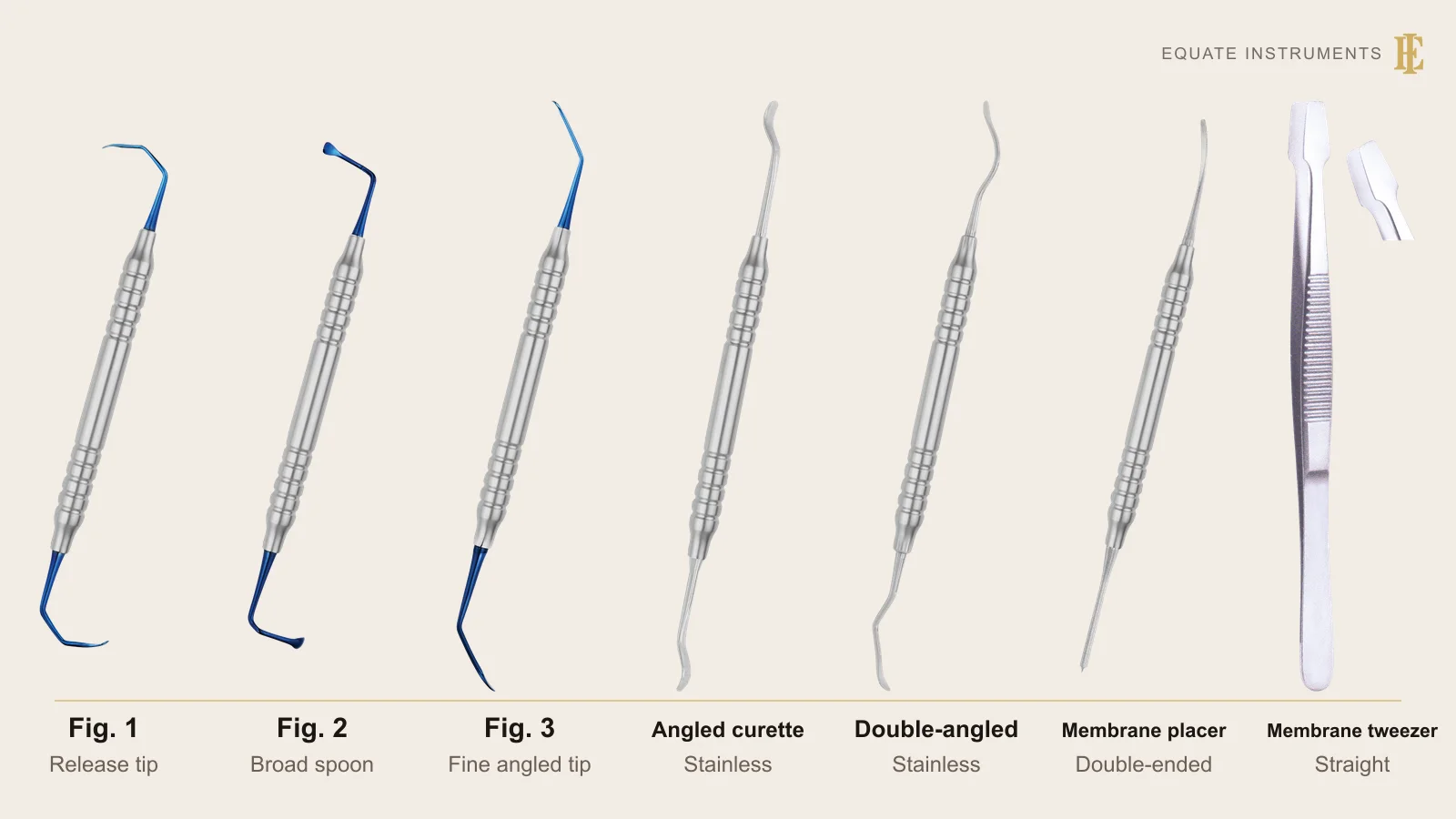
Sinus lift curettes come in a few standard shapes, each for one stage of the elevation, and all have rounded, polished edges rather than the cutting edges of periodontal curettes.
| Shape | Stage | What it does |
|---|---|---|
| Fine pointed or angled release tip | First | Frees the membrane at the edges of the window without lifting it far |
| Broad spoon | Floor | Sweeps under the membrane across the sinus floor |
| Offset or double-angled curette | Corners and medial wall | Reaches round the bony corners and up the medial wall |
| Membrane placer and paddle tweezers | Closure | Carry and tuck a barrier membrane over the window |
Why cover the window and what does the evidence show?
Covering the lateral window with a barrier membrane keeps graft in and soft tissue out, and the evidence links it with better implant survival. In their 2008 systematic review of the lateral approach, B. E. Pjetursson, N. P. Lang and colleagues pooled 48 studies and 12,020 implants and estimated 3-year implant survival at 90.1%; the best results, 98.3%, came with rough-surface implants and membrane coverage of the window.
Flat paddle-tipped tweezers hold a collagen membrane without creasing it, and a double-ended membrane placer tucks its edges under the flap margins and smooths it onto the bone round the window.
How do you choose and look after sinus lift instruments?
A working set needs at least one fine release elevator, a broad spoon curette and a pair of angled curettes for the floor and medial wall, plus osteotomes if you do crestal lifts. Double-ended instruments halve the number on the tray, and coloured or coated tips are easy to tell apart. Light hollow handles help with the long, careful strokes of membrane elevation. Match the shank angles to the access, because a window cut high on the lateral wall needs more strongly angled curettes than one close to the floor, and lay the set out in a cassette in order of use, from release tip to spoon to angled curettes, so the assistant can pass each one without searching.
Inspect every working end under magnification after cleaning. A nick or burr on a curette edge can tear the membrane, so retire or refinish damaged instruments rather than using them. Rinse graft particles and blood from the concave blades before they dry, clean ultrasonically, and sterilise in a cassette according to the manufacturer's ISO 17664 processing instructions and the CDC's 2003 guidelines.
What does the Equate sinus lift range include?
Equate lists 23 double-ended sinus lift elevators and curettes, with release tips, spoon curettes and angled patterns, including a Kramer-Nevins pattern. Four have titanium working ends with a blue coating (Fig. 1–4) and 19 are stainless steel, most on 10 mm anatomical hollow handles. There are three membrane placement instruments, a straight and a curved paddle tweezer and a double-ended placer.
Four implant sets complete the range: a bone splitting set from 4 to 18 mm in a cassette, a straight and offset bone spreader set with mallet, a 12-piece implantology set with sinus lift tips and bone chisels, and a 25-instrument implant surgery set in a sterilisation cassette. Implant drill kits are specific to each implant system and are not part of the range; the oral surgery and extraction instruments guide covers how implant kits are reprocessed. The instruments are designed in Finland; browse the oral surgery family or request samples and a quote.
The Equate difference
Equate lists 30 sinus lift and implant instruments: 23 double-ended sinus lift elevators and curettes, 19 in stainless steel and 4 with blue-coated titanium tips (Fig. 1–4), most on 10 mm anatomical hollow handles; 3 membrane placement instruments; and 4 implant sets, including bone splitting and bone spreading sets.
Equate Sinus Lift Instruments options

Sinus Lift Curette, Anatomical Hollow Handle 10 mm
EI-0569
Sinus Lift Curette 2, Anatomical Hollow Handle 10 mm
EI-0570
Sinus Lift Kramer-Nevins, Anatomical Hollow Handle 10 mm
EI-0571
Sinus Lift Instrument Fig.4 - Titanium Tips, Anatomical Hollow Handle 10mm
EI-0572
Sinus Lift Instrument - Double-Ended
EI-0573
Sinus Lift Anatomical Hollow Handle 10mm
EI-0574
Sinus Lift Instrument - Double-Ended
EI-0575
Sinus Lift Anatomical Hollow Handle 10mm
EI-0576
Sinus Lift Anatomical Hollow Handle 10mm
EI-0577
Sinus Lift Anatomical Hollow Handle 10mm
EI-0578
Membrane Placement Tweezer Straight
EI-2682
Membrane Placement Tweezer Curved
EI-2683Browse all oral surgery instruments Browse all implantology instruments
Buying in your market
Frequently asked questions
What instruments are used for a sinus lift?
Periosteal elevators for the flap, sinus lift elevators and curettes to lift the membrane, osteotomes for crestal lifts, graft carriers and compactors for the graft, and membrane tweezers and placers to cover the window.
What is the difference between a sinus lift curette and a periosteal elevator?
A periosteal elevator lifts gum and periosteum off the jaw. A sinus lift curette is finer and more angled, with polished, rounded edges, and works inside the sinus to lift the much thinner Schneiderian membrane.
What is a lateral window sinus lift?
A sinus lift in which a small window is cut in the side wall of the maxillary sinus, the membrane is lifted under direct vision and graft is packed beneath it. It's used when little bone remains under the sinus.
Is a crestal sinus lift done with osteotomes?
Yes. In the crestal technique R. B. Summers described in 1994, tapered osteotomes are tapped up through the implant site to raise the sinus floor and condense the surrounding bone, with no side window. The dental osteotomes page covers the instruments and their sizes.
What happens if the sinus membrane tears?
Small perforations are common and are usually covered with a resorbable membrane before grafting continues. A 2016 meta-analysis found no significant difference in implant survival between perforated and intact sides.
Do piezoelectric instruments reduce membrane tears?
They may. Al-Dajani's 2016 meta-analysis of sinus lifts found perforation in about one case in four overall, and reported that piezoelectric instrumentation appeared to reduce that risk.
Can sinus lift instruments be bought as a set?
Yes. Equate's 12-piece implantology set combines double-ended sinus lift elevators with bone chisels, and the single instruments can be ordered separately to build your own set.
References
- Boyne PJ, James RA. Grafting of the maxillary sinus floor with autogenous marrow and bone. Journal of Oral Surgery 1980;38(8):613–616
- Tatum H Jr. Maxillary and sinus implant reconstructions. Dental Clinics of North America 1986;30(2):207–229
- Summers RB. A new concept in maxillary implant surgery: the osteotome technique. Compendium 1994;15(2):152–162
- Pjetursson BE, Tan WC, Zwahlen M, Lang NP. A systematic review of the success of sinus floor elevation and survival of implants inserted in combination with sinus floor elevation. Part I: Lateral approach. Journal of Clinical Periodontology 2008;35(Suppl 8):216–240
- Al-Dajani M. Incidence, risk factors, and complications of Schneiderian membrane perforation in sinus lift surgery: a meta-analysis. Implant Dentistry 2016;25(3):409–415
- Hupp JR, Tucker MR, Ellis E. Contemporary Oral and Maxillofacial Surgery, 7th edition. Elsevier, 2018 (pre-prosthetic and implant surgery)
- Kohn WG, et al. Guidelines for Infection Control in Dental Health-Care Settings, 2003. MMWR 52(RR-17), Centers for Disease Control and Prevention
- Boyd LB. Dental Instruments: A Pocket Guide, 7th edition. Saunders/Elsevier, 2020. Chapter 17, Oral Surgery Extraction Instruments
- Tan WC, Lang NP, Zwahlen M, Pjetursson BE. A systematic review of the success of sinus floor elevation and survival of implants inserted in combination with sinus floor elevation. Part II: transalveolar technique. Journal of Clinical Periodontology 2008;35(8 Suppl):241–254
- Rosen PS, Summers R, Mellado JR, Salkin LM, Shanaman RH, Marks MH, Fugazzotto PA. The bone-added osteotome sinus floor elevation technique: multicenter retrospective report of consecutively treated patients. International Journal of Oral and Maxillofacial Implants 1999;14(6):853–858
I am a…