Bone Graft Instruments
Written by the Equate Instruments Technical Team · Reviewed by the Medical & Dental Board, Equate Instruments · Updated ·
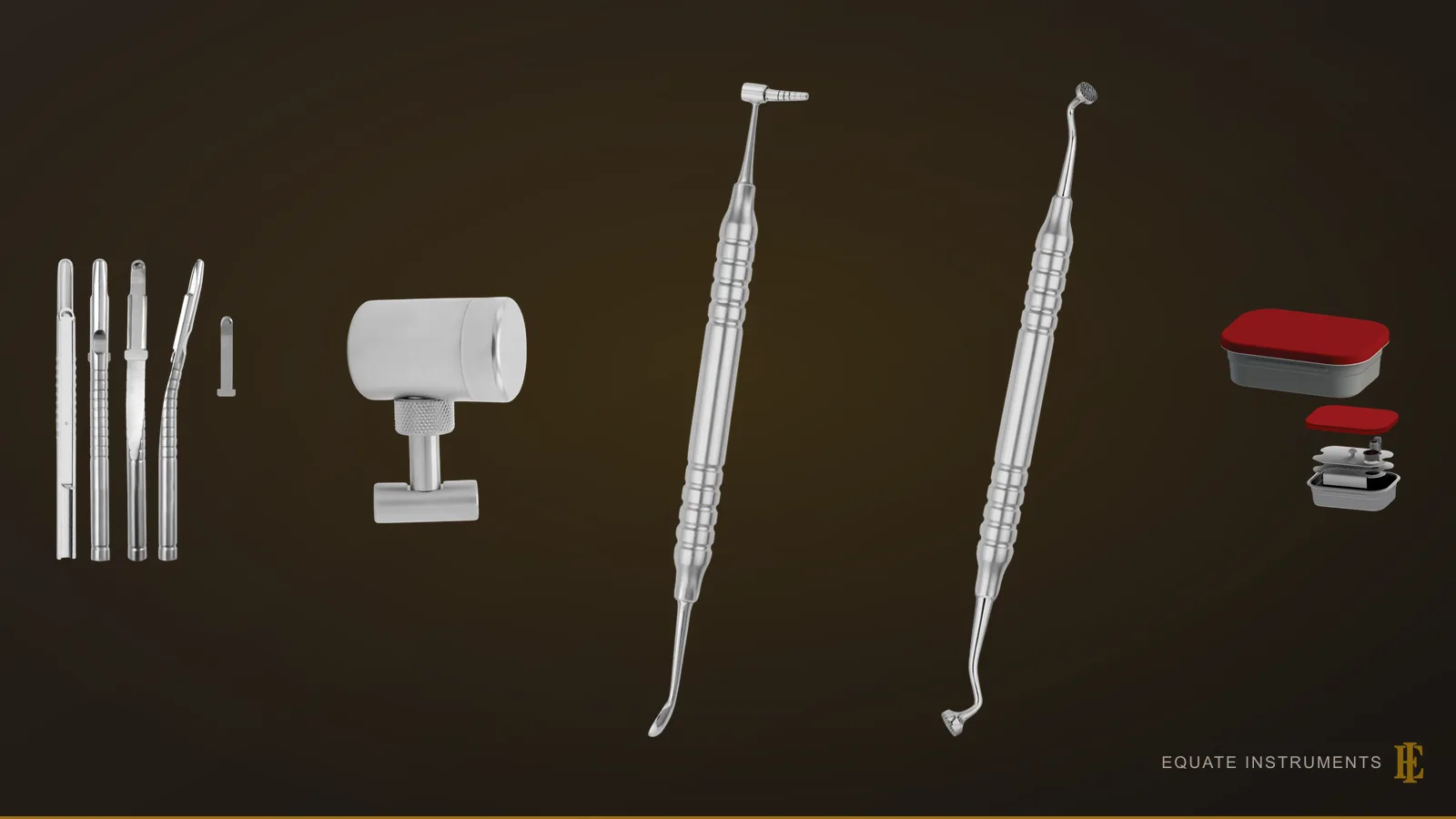
Bone graft instruments are the hand tools used to harvest, prepare, carry and pack bone graft in implant and ridge surgery. Bone scrapers shave autogenous bone from the jaw, bone mills and morselisers grind blocks into particles, suction bone collectors trap drilling debris, carriers and compactors deliver and pack the graft, and a PRF box presses platelet-rich fibrin clots into membranes.
Key points
- Scraped and milled autogenous bone keeps larger particles and, in laboratory work by Miron and colleagues, more osteogenic potential than drilling slurry.
- Pack graft firmly enough to fill the defect without crushing the particles or closing the spaces between them.
- Mills, collectors and PRF boxes come apart for cleaning, and every part has to be cleaned before it goes into the steriliser.
What are bone graft instruments used for?
Bone graft instruments move graft from where it comes from to where it's needed: harvesting the patient's own (autogenous) bone, turning it into particles, mixing it with substitute material or blood products, and packing it into a socket, ridge defect or sinus. They're used in socket preservation, where an atraumatic extraction with periotomes keeps the walls the graft relies on, in guided bone regeneration around implants and in sinus lifts. Sinus floor grafting goes back to P. J. Boyne and R. A. James, who in 1980 grafted the maxillary sinus floor with the patient's own marrow and bone.
Grafting the socket makes a measurable difference. In a 2014 meta-analysis, Avila-Ortiz, Elangovan, Kramer, Blanchette and Dawson found that ridge preservation kept, on average, 1.89 mm more buccolingual width, 2.07 mm more midbuccal height and 1.18 mm more midlingual height than extraction alone; raising a flap, using a membrane and grafting with xenograft or allograft were linked with better results, though those subgroups were small.
They work beside the instruments that open and shape the site: periosteal elevators for the flap, bone chisels and mallets and dental rongeurs for blocks and contouring, and dental osteotomes for crestal work. The full tray is on the oral surgery tray setup page.
How is autogenous bone harvested chairside?
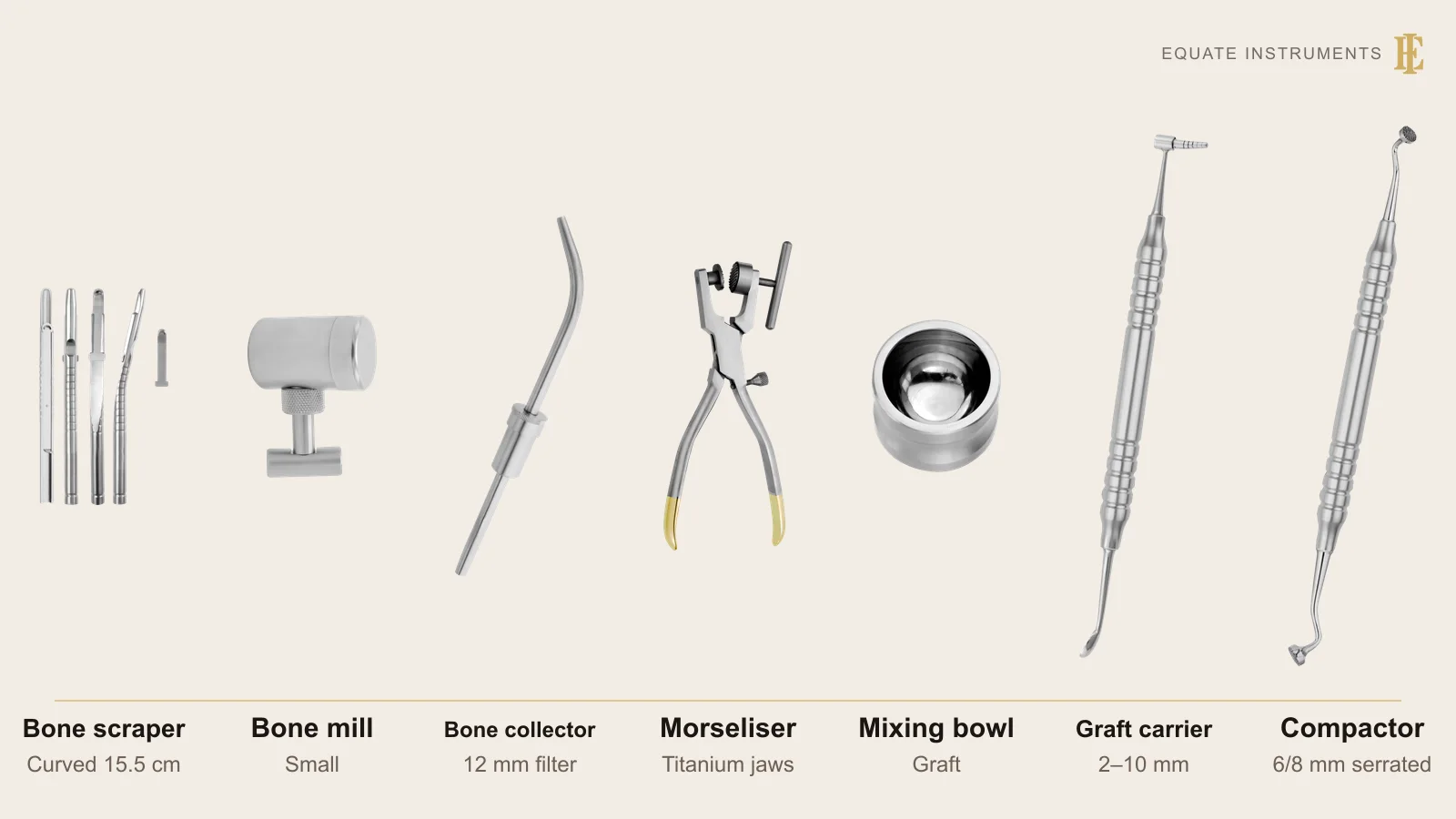
Autogenous bone is harvested chairside by scraping cortical bone near the operating site, by trapping the debris of implant drilling, or by removing a small block and grinding it. A bone scraper is drawn across a flat cortical surface such as the external oblique ridge or the area next to the implant site; its blade curls off thin shavings that collect in a chamber behind it, ready to use. A suction bone collector sits in line with the surgical aspirator and catches particles in a filter while the site is drilled. A block or larger fragments go into a bone mill or morseliser to be reduced to particles.
Particle size matters. In a 2011 laboratory study, R. J. Miron, D. Buser and colleagues compared bone harvested with a bone mill, a bone scraper, piezo-surgery and a drill. Osteoblasts attached in greater numbers to the mill and scraper particles and showed higher expression of bone-forming genes and more mineralisation than with drill slurry or piezo-surgery bone. The authors credited the larger particles, although the work was done on minipig bone in vitro rather than in patients.
What is the difference between a bone scraper, a bone mill and a bone collector?
A bone scraper harvests bone, a bone mill processes bone that's already been removed, and a bone collector catches bone that would otherwise go down the suction.
| Instrument | What it does | Best for |
|---|---|---|
| Bone scraper | A sharp blade shaves cortical chips into a built-in chamber; straight or curved shafts, with replaceable blades | Small volumes near the implant site; mixing with substitute |
| Bone collector (filter) | Fits in the suction line and traps drilling debris in a mesh filter | Collecting bone from osteotomy preparation that would otherwise be lost |
| Bone mill | A crank drives a cutting insert through a chamber, reducing blocks to particles of a set size | Blocks or tori removed during surgery |
| Bone morseliser | Plier-style jaws crush blocks and chips into small particles | Quick reduction of a few fragments at the chair |
How are bone graft particles carried and packed?
Graft is mixed and wetted in a small bowl, picked up with a carrier or spoon, delivered into the defect and then condensed with a compactor. Wet the particles with sterile saline, the patient's blood or PRF exudate so they hold together, and mix autogenous bone with substitute material in the bowl with a spatula. A carrier with a calibrated barrel delivers a measured amount into a socket or through a sinus window; a scoop-ended instrument, or a small Lucas surgical curette used as a scoop, suits small defects.
Compactors and tampers have flat or serrated round heads in graded sizes. Choose a head that fits inside the defect so it presses the graft rather than the bone edges, and pack in small increments. Pack firmly enough to fill the space and prevent voids, but not so hard that the particles crush and the spaces that blood vessels grow into close up. In guided bone regeneration the packed graft is then covered with a barrier membrane, placed with the membrane instruments described on the sinus lift page.
What is PRF and how is it prepared?
Platelet-rich fibrin (PRF) is a platelet-rich fibrin clot made from the patient's own blood and used to cover grafts, fill sockets and bind particulate graft. In their 2006 paper, D. M. Dohan, J. Choukroun and colleagues described PRF as a second-generation platelet concentrate made without biochemical handling of the blood: no anticoagulant and no bovine thrombin, so the fibrin polymerises slowly into a network close to a natural clot.
The chairside workflow is short. Blood is drawn into plain tubes and centrifuged straight away, before it starts to clot. The PRF clot that forms in the middle of the tube is lifted out with tweezers and the red cell layer trimmed off. In a PRF box, the clot is pressed under the lid into a flat membrane or a plug, and the exudate that collects in the tray is kept to wet the graft. Protocols vary widely: a 2021 systematic review by Herrera-Vizcaino found 29 centrifugation protocols on 16 machines across 121 studies, and recommends reporting rotor angle and radius, g-force, time and tube size and material rather than speed alone.
How do you choose bone graft instruments?
Choose by where your graft comes from and how much you use. A practice placing single implants with small defects gets most use from a bone scraper, a suction bone collector, a mixing bowl and two or three compactor sizes. Practices doing ridge augmentation or sinus lifts add a bone mill or morseliser for blocks, a calibrated carrier and a PRF box if they use PRF.
Look at the details that affect handling: scraper blades that can be replaced when they dull, collector filters fine enough to hold small particles, serrated compactor faces that don't slide on the graft, and hollow handles light enough for long procedures.
How do you clean and sterilise bone graft instruments?
Take every multi-part instrument apart and clean each part before heat sterilisation, because bone dust and blood trapped in a filter, mill chamber or box insert won't be sterilised reliably. Rinse straight after surgery so blood doesn't dry, brush the collector mesh and mill cutting insert, clean ultrasonically and dry thoroughly. The CDC's 2003 guidelines class instruments that penetrate soft tissue or bone as critical items that must be heat-sterilised.
Reassemble only after inspection, following the manufacturer's ISO 17664 processing instructions. Replace scraper blades that no longer cut cleanly, check mill threads and morseliser jaws for wear, and retire compactors with damaged faces.
What does the Equate bone graft range include?
Equate lists 30 bone graft and PRF instruments. For harvesting there are straight and curved 15.5 cm bone scrapers, a single scraper and a replacement blade, four bone collectors (two with 7 and 12 mm filters, one with a suction adaptor and a 15.5 cm collector), two small and one large bone mill with a selector turret, and two titanium bone morselisers. For carrying and packing there are a graft carrier calibrated at 2, 4, 6, 8 and 10 mm, a 3.3/4 mm packer, a 6.1 mm scoop with graduated probe, 4 and 7 mm tampers and serrated compactors from 3 to 8 mm.
Two mixing bowls, one with a cap, and a mixing and collector spatula complete the graft side. For PRF there's a PRF preparation box, a nine-piece PRF instrument set, a five-piece soft brush set and a five-piece tunnelling and graft-handling set in a cassette. The instruments are designed in Finland; browse the oral surgery family and the implantology family, or request samples and a quote.
The Equate difference
Equate lists 30 bone graft and PRF instruments: 3 bone scrapers with a replacement blade, 4 bone collectors, 4 bone mills and accessories, 2 titanium bone morselisers, 3 graft carriers, 6 tampers and compactors from 3 to 8 mm, 2 mixing bowls, a mixing spatula, a PRF preparation box and 3 PRF and graft-handling sets.
Equate Bone Graft Instruments options

Bone Graft Packer 3.3/4 mm - Anatomical Hollow Handle 10 mm
EI-2549
Bone Graft Carrier 2-4-6-8-10 mm - Anatomical Hollow Handle 10 mm
EI-2550
Stainless Steel Mixing Bowl with Cap
EI-2553
Mixing and Bone Collector Spatula - Anatomical Hollow Handle 10 mm
EI-2720
Bone Collector with Suction Tube Adapter
EI-2727
Bone Morselizer with Titanium Jaws
EI-2743
Bone Graft Mixing Bowl
EI-2744
Bone Tamper 4 mm
EI-2748
Bone Tamper 7 mm
EI-2749
Bone Compactor / Spoon, Ø3 mm and Ø6 mm
EI-2750
Serrated Bone Compactor, Ø6 mm and Ø8 mm
EI-2751
Serrated Bone Compactor, Ø3 mm and Ø4 mm
EI-2752Browse all oral surgery instruments Browse all implantology instruments
Buying in your market
Frequently asked questions
What is a bone scraper used for in dentistry?
A bone scraper shaves thin chips of the patient's own cortical bone from a site near the surgery and collects them in its chamber. The chips are used alone or mixed with substitute material to fill small defects.
What is a bone mill?
A hand-cranked grinder that reduces a block of harvested bone to particles of a consistent size for grafting. It's used when bone is removed as a block or larger fragments.
Is bone from a suction bone collector as good as scraped bone?
Collected bone is smaller and mixed with fluid. In laboratory work, larger particles from mills and scrapers showed more osteogenic potential than drilling slurry, so many surgeons prefer scraped or milled bone when they can get it.
What is a PRF box?
A lidded container with a perforated tray in which PRF clots are pressed into membranes or plugs. The exudate pressed out collects underneath and can be used to wet graft material.
Do you need a centrifuge to make PRF?
Yes. The blood is centrifuged without anticoagulant straight after it's drawn. Equate supplies the PRF box and handling instruments, not centrifuges or tubes.
Can bone graft instruments be reused?
The stainless steel and titanium instruments are reusable after cleaning and heat sterilisation, following the manufacturer's instructions. Scraper blades are replaced when they dull.
Does grafting a socket after extraction make a difference?
Yes. A 2014 meta-analysis found ridge preservation kept about 1.9 mm more ridge width and 2.1 mm more buccal height than leaving the socket to heal alone.
References
- Miron RJ, Hedbom E, Saulacic N, Zhang Y, Sculean A, Bosshardt DD, Buser D. Osteogenic potential of autogenous bone grafts harvested with four different surgical techniques. Journal of Dental Research 2011;90(12):1428–1433
- Dohan DM, Choukroun J, Diss A, Dohan SL, Dohan AJ, Mouhyi J, Gogly B. Platelet-rich fibrin (PRF): a second-generation platelet concentrate. Part I: technological concepts and evolution. Oral Surgery, Oral Medicine, Oral Pathology, Oral Radiology and Endodontics 2006;101(3):e37–44
- Herrera-Vizcaino C. Systematic review of platelet-rich fibrin (PRF) centrifugation protocols in oral and maxillofacial surgery and the introduction of AR2T3. Frontiers of Oral and Maxillofacial Medicine 2021 (vol. 5, 2023)
- Boyne PJ, James RA. Grafting of the maxillary sinus floor with autogenous marrow and bone. Journal of Oral Surgery 1980;38(8):613–616
- Hupp JR, Tucker MR, Ellis E. Contemporary Oral and Maxillofacial Surgery, 7th edition. Elsevier, 2018 (bone grafting and implant site development)
- Kohn WG, et al. Guidelines for Infection Control in Dental Health-Care Settings, 2003. MMWR 52(RR-17), Centers for Disease Control and Prevention
- Boyd LB. Dental Instruments: A Pocket Guide, 7th edition. Saunders/Elsevier, 2020. Chapter 17, Oral Surgery Extraction Instruments
- Avila-Ortiz G, Elangovan S, Kramer KWO, Blanchette D, Dawson DV. Effect of alveolar ridge preservation after tooth extraction: a systematic review and meta-analysis. Journal of Dental Research 2014;93(10):950–958
I am a…
Related
- Sinus Lift Instruments
- Dental Osteotomes for Implant Site Preparation
- Bone Chisels and Surgical Mallets in Dentistry
- Periosteal Elevators: Molt 9, Freer, Buser and Other Patterns
- Oral Surgery Tray Setup
- Dental Elevators and Luxators
- Oral Surgery and Extraction Instruments
- Surgical Curettes (Bone Curettes) for Oral Surgery