Bone Chisels and Surgical Mallets in Dentistry
Written by the Equate Instruments Technical Team · Reviewed by the Medical & Dental Board, Equate Instruments · Updated ·
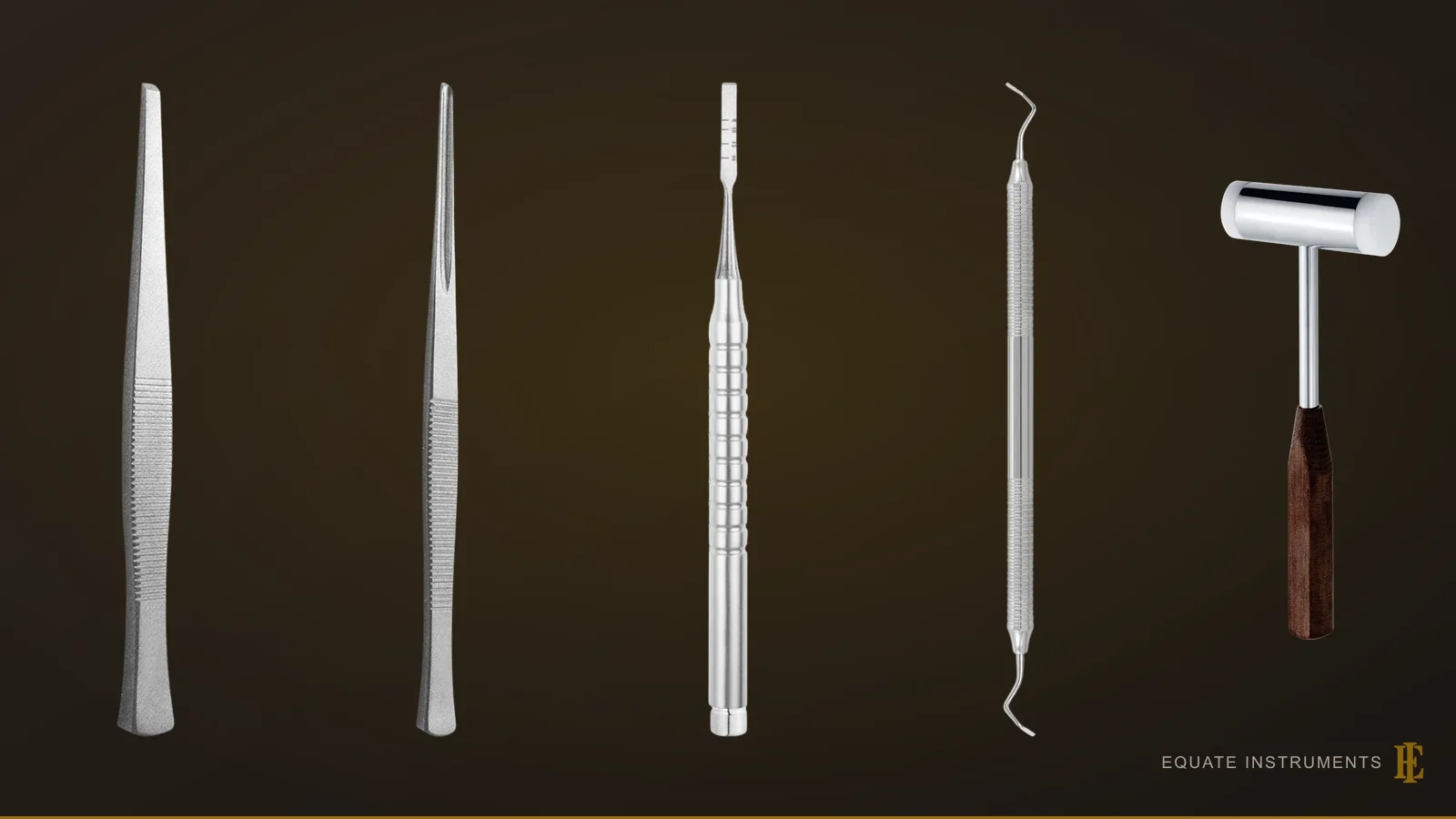
A bone chisel is a surgical hand instrument with a hardened, bevelled blade that cuts or splits bone and teeth, usually driven by light taps from a surgical mallet. In dentistry it removes and contours alveolar bone, splits impacted or multi-rooted teeth, reduces tori and reshapes bone in periodontal surgery. It is a different instrument from the enamel chisel used to plane cavity walls.
Key points
- Single-bevel chisels remove and shape bone; double-bevel chisels split teeth and bone along a line.
- The mallet gives short, controlled taps while the surgeon guides the blade and the mandible is supported.
- Enamel chisels for cavity preparation are restorative instruments, covered under hand cutting instruments.
What is a bone chisel used for in dentistry?
A bone chisel removes, shapes or splits hard tissue in oral surgery. Typical jobs are taking off bone over an impacted tooth, splitting a multi-rooted or impacted tooth so the pieces can be lifted out separately, reducing tori and exostoses, and flattening a ridge in an alveoloplasty before the rongeur and bone file finish it. Smaller hand chisels, pushed or pulled without a mallet, recontour interdental bone in periodontal osseous surgery. A grooved Partsch chisel can also shave off thin curls of bone for a small graft, which is then handled with the bone graft instruments.
Rotary burs in a surgical handpiece, and piezo-surgical units, now do much of this work, but a sharp chisel still removes bone quickly, without heat, and leaves a clean surface. That's why most surgical extraction trays still carry a chisel and mallet; the oral surgery and extraction instruments guide sets them beside the rongeurs, files and elevators.
What is the difference between a bone chisel and an enamel chisel?
Bone chisels are surgical instruments for bone and tooth sectioning; enamel chisels are restorative instruments for shaping cavity walls. The names overlap, so the table sets out which is which. Enamel chisels, hatchets and hoes have their own guide, dental hand cutting instruments, and this page covers only the surgical chisels.
| Chisel | Where it is used | How it is driven | Examples |
|---|---|---|---|
| Surgical bone chisel | Oral surgery: bone removal, tooth splitting, tori, alveoloplasty | Mallet taps, sometimes hand pressure | Partsch flat and grooved, single- and double-bevel chisels |
| Periodontal bone chisel | Osseous recontouring during periodontal flap surgery | Hand push or pull strokes | Ochsenbein, Fedi, Rhodes back-action |
| Enamel chisel | Restorative dentistry: planing enamel walls of a cavity | Hand pressure only | Straight, Wedelstaedt and binangle chisels |
What types of bone chisel are there?
| Type | Blade | Typical use |
|---|---|---|
| Single-bevel (single-cut) | Flat face on one side, bevel on the other | Removing and contouring bone in controlled layers |
| Double-bevel (double-cut) | Bevel on both sides, meeting in a central edge | Splitting teeth and sectioning bone along a line |
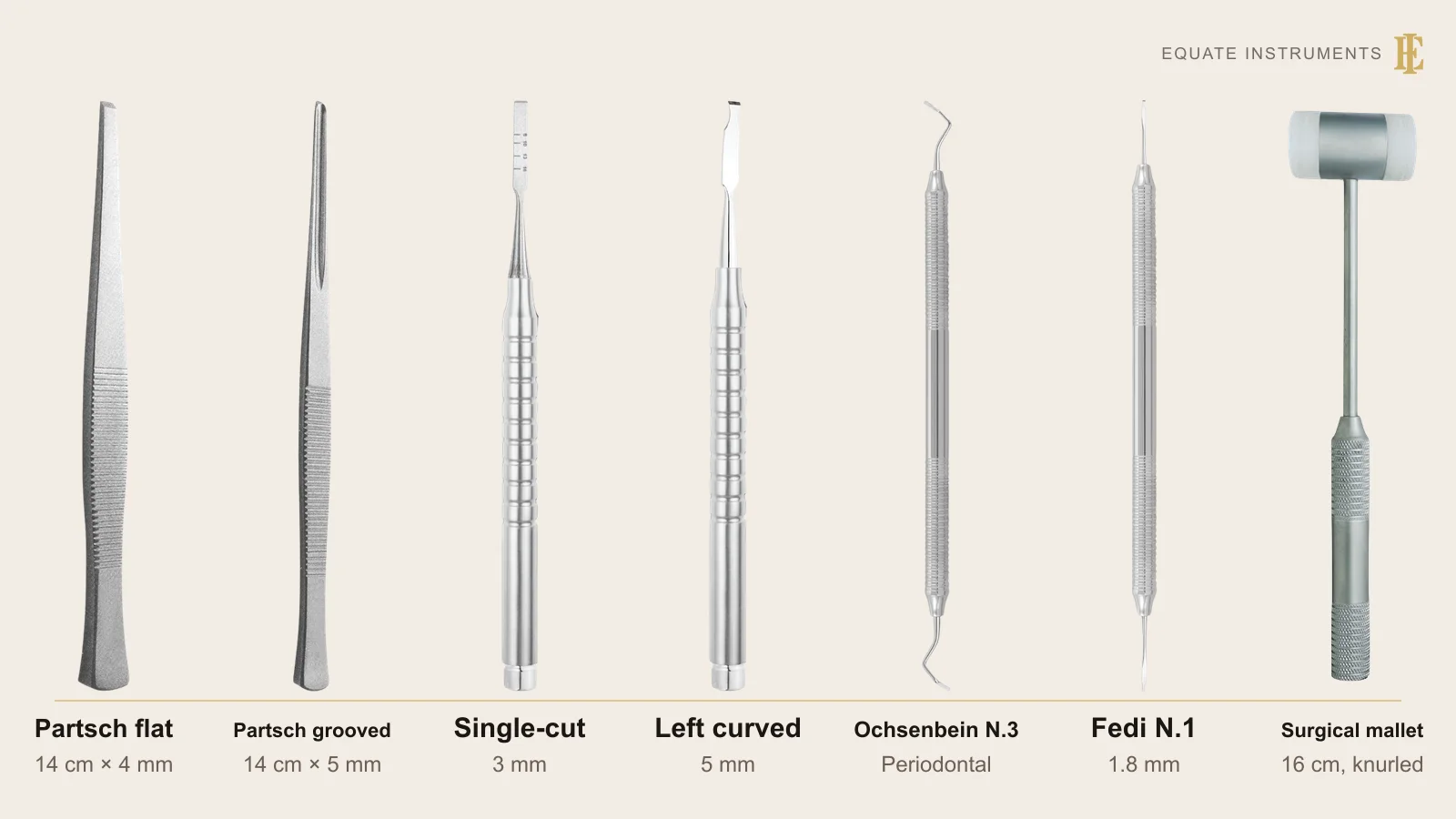
| Flat Partsch | Straight flat blade, about 3–5 mm, on a ribbed handle | General bone removal and alveoloplasty |
| Grooved Partsch (gouge) | Concave, trough-shaped blade | Scooping bone around roots and harvesting bone shavings |
| Curved and long-tip | Blade curved left or right, or extended for reach | Posterior and lingual sites the straight chisel can't reach |
| Periodontal hand chisels | Small offset or back-action blades | Removing interdental craters and ledges in osseous surgery |
How do you use a chisel and mallet?
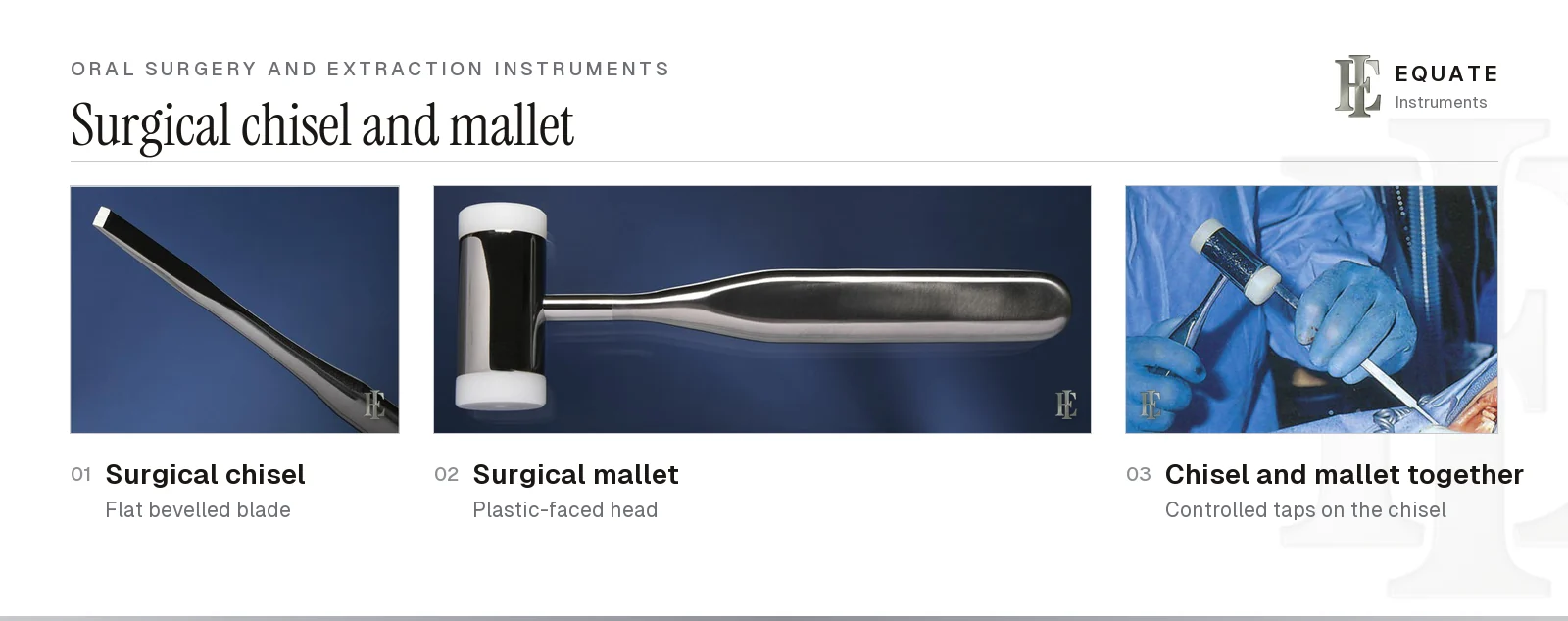
Reflect a full-thickness flap with a periosteal elevator and retract it so the blade only meets bone. The surgeon holds the chisel firmly, with the fingers close to the blade for control, and sets the edge where the cut should start; with a single-bevel chisel the flat face rides along the plane of bone that is to be kept. The assistant then taps the end of the handle with the mallet in short, light, square blows from the wrist, and the surgeon resets the angle between taps.
When a tooth is split, a double-bevel chisel is seated in a groove or furcation and one sharp tap is usually enough. Throughout, the surgeon or assistant supports the mandible from below so the force goes into the bone, not into the temporomandibular joints.
Warn the patient about the noise and the sensation. Peñarrocha and colleagues have reported benign paroxysmal positional vertigo after osteotome and mallet work in the maxilla, so heavy or repeated blows should be avoided and the patient asked about dizziness afterwards.
Which chisel for which procedure?
- Impacted third molars: a single-bevel chisel to remove bone over the crown and a double-bevel chisel to split the tooth, alongside elevators.
- Alveoloplasty and exostoses: a flat Partsch chisel for the bulk, then a rongeur and bone file to smooth the ridge.
- Mandibular and palatal tori: a bur to score the torus, then a chisel to lift off the segments.
- Periodontal osseous surgery: Ochsenbein, Fedi and Rhodes back-action chisels on the periodontal surgery tray.
- Ridge splitting for implants: a thin chisel to open the crest before osteotomes widen it.
What should you look for in a surgical mallet?
- Weight: about 150–200 g gives enough force for chisels and osteotomes without heavy blows.
- Faces: replaceable plastic or PTFE faces soften the impact and protect the handle ends of chisels and osteotomes from mushrooming; solid steel heads transmit more force.
- Handle: a wooden, knurled metal or solid steel handle; choose the grip that stays secure in wet gloves.
- Length: around 16–19 cm keeps the blow controlled from the wrist.
- Spare inserts: worn or cracked faces should be replaced, so check that inserts are available for the model.
What does the Equate range include?
Equate lists 37 surgical chisels. The 23 straight chisels include Partsch flat chisels in 14 cm and 17 cm with 3, 4 and 5 mm blades, Partsch grooved chisels, single-cut and double-cut chisels of 3, 6 and 9 mm, fine 1–2.5 mm chisels, a 5 mm straight-centre chisel and 3.8 mm and 7.5 mm long-tip chisels. The 9 curved designs include left and right curved 5 mm chisels, curved long-tip chisels, Partsch grooved 14 cm chisels, a Rhodes 36/37 back-action chisel, a 13KL surgical chisel and a scaler chisel. Periodontal hand chisels add the Fedi N.1 and N.2, the Zerfing, and the Ochsenbein N.3 and N.4.
For striking, there are 6 surgical mallets from 16 cm to 19 cm, with replaceable plastic inserts or solid steel heads and wooden, knurled or steel handles, a pack of replacement inserts, and 150 g and 190 g surgical hammers with PTFE faces. The chisels are made of passivated stainless steel, ultrasonically cleaned, shape-, boil- and performance-tested and individually packed, designed in Finland, and clinics can request samples and a quote through the oral surgery range.
How do you clean, sharpen and maintain bone chisels and mallets?
Chisels cut bone, so they are critical items: clean them promptly, process them in an ultrasonic bath or washer-disinfector and heat-sterilise them after each patient, as the CDC's 2003 dental guidelines require. Follow the manufacturer's reprocessing instructions for each material, which ISO 17664-1 requires manufacturers to provide; this matters for mallets with plastic inserts or wooden handles.
A dull chisel needs more blows and bruises bone, so check the edge under light before each use. Sharpen on a flat stone, keeping the original bevel angle and a straight edge, or send the instrument for professional regrinding. Retire a chisel whose blade is chipped, cracked or ground short, and replace mallet inserts that are split or deeply dented.
The Equate difference
Equate lists 37 surgical chisels (23 straight, 9 curved, 3 periodontal and 2 Ochsenbein) with blades from about 1 mm to 9 mm, including 12 Partsch flat and grooved chisels at 14 cm and 17 cm, plus 6 surgical mallets, a pack of replacement inserts and 2 surgical hammers of 150 g and 190 g.
Equate Bone Chisels and Surgical Mallets in Dentistry options

Curved Long-Tip Bone Chisel - 3.8mm
EI-0552
Curved Long-Tip Bone Chisel - 7.5mm
EI-0553
Bone Chisel Double Cut 3 mm
EI-0554
Bone Chisel Double Cut 6 mm
EI-0555
Fedi N.1 Periodontal Chisel 1.8mm - Solid Handle 6mm
EI-1895
Fedi N.2 Periodontal Chisel 2.0mm - Solid Handle 6mm
EI-1896
Ochsenbein N.3 Bone Chisel - Solid Handle 6mm
EI-1897
Ochsenbein N.4 Bone Chisel 2.2mm - Solid Handle 6mm
EI-1898
Rhodes Back-Action Chisel 36/37 - Solid Handle 6mm
EI-1899
Zerfing Solid Handle 6mm
EI-1903
Partsch Flat Bone Chisel 14 cm x 4 mm
EI-2415
Partsch Flat Bone Chisel 14 cm x 3 mm
EI-2416Browse all oral surgery instruments Browse all accessories & supplies instruments
Buying in your market
Frequently asked questions
What is a bone chisel used for in dentistry?
It removes and shapes alveolar bone, splits impacted or multi-rooted teeth, and reduces tori and exostoses. Small periodontal chisels also recontour bone during flap surgery.
What is a mallet used for in dentistry?
A surgical mallet taps bone chisels and osteotomes so they cut or condense bone in controlled steps. It is used in surgical extractions, alveoloplasty, ridge splitting and osteotome sinus lifts.
What is the difference between a single-bevel and a double-bevel bone chisel?
A single-bevel chisel has one flat face and removes bone in layers. A double-bevel chisel has bevels on both sides and splits teeth or bone along a straight line.
Is a bone chisel the same as an enamel chisel?
No. Bone chisels are heavier surgical instruments, usually driven with a mallet. Enamel chisels are restorative hand instruments that plane cavity walls by hand pressure.
Can a chisel and mallet cause dizziness?
Rarely. Case reports have linked osteotome and mallet use in the upper jaw to benign paroxysmal positional vertigo, so blows should be light and patients should be asked about dizziness afterwards.
How do you sharpen a bone chisel?
Hone it on a flat sharpening stone, keeping the original bevel angle and a straight edge, then clean and sterilise it. Chipped or cracked blades should be replaced.
Is a chisel or a bur better for wisdom teeth?
Neither is clearly better. A 2012 systematic review by Steel found five randomised trials comparing the lingual split chisel technique with the surgical bur and analysed four: pain and swelling showed no clear difference, there was some evidence of less trismus after lingual split, and the evidence on nerve injury was weak. The evidence is limited, so the choice mostly follows the surgeon's training.
References
- Hupp JR, Tucker MR, Ellis E. Contemporary Oral and Maxillofacial Surgery, 7th edition. Elsevier, 2018 (instrumentation for bone removal and tooth sectioning; management of impacted teeth)
- Newman MG, Takei HH, Klokkevold PR, Carranza FA. Newman and Carranza's Clinical Periodontology. Elsevier (resective osseous surgery and periodontal surgical instruments)
- Ochsenbein C. A primer for osseous surgery. International Journal of Periodontics and Restorative Dentistry 1986;6(1):8–47
- Peñarrocha M, Pérez H, García A, Guarinos J. Benign paroxysmal positional vertigo as a complication of osteotome expansion of the maxillary alveolar ridge. Journal of Oral and Maxillofacial Surgery 2001;59(1):106–107
- Peñarrocha M, García A. Benign paroxysmal positional vertigo as a complication of interventions with osteotome and mallet. Journal of Oral and Maxillofacial Surgery 2006;64(8):1324
- Kohn WG, Collins AS, Cleveland JL, et al. Guidelines for Infection Control in Dental Health-Care Settings, 2003. MMWR 52(RR-17), Centers for Disease Control and Prevention
- ISO 17664-1:2021 Processing of health care products: information to be provided by the medical device manufacturer for the processing of medical devices, Part 1: critical and semi-critical medical devices
- Boyd LB. Dental Instruments: A Pocket Guide, 7th edition. Saunders/Elsevier, 2020. Chapter 17, Oral Surgery Extraction Instruments (photographs used under licence)
- Steel B. Lingual split versus surgical bur technique in the extraction of impacted mandibular third molars: a systematic review. Oral Surgery, Oral Medicine, Oral Pathology and Oral Radiology 2012;114(3):294–302
I am a…
Related
- Dental Rongeurs and Bone Files
- Dental Osteotomes for Implant Site Preparation
- Dental Hand Cutting Instruments: How Hatchets, Hoes, Chisels and Trimmers Differ and How to Use Them
- Periosteal Elevators: Molt 9, Freer, Buser and Other Patterns
- Surgical Extraction Tray Setup
- Periodontal Surgery Tray Setup
- Oral Surgery and Extraction Instruments