Periosteal Elevators: Molt 9, Freer, Buser and Other Patterns
Written by the Equate Instruments Technical Team · Reviewed by the Medical & Dental Board, Equate Instruments · Updated ·
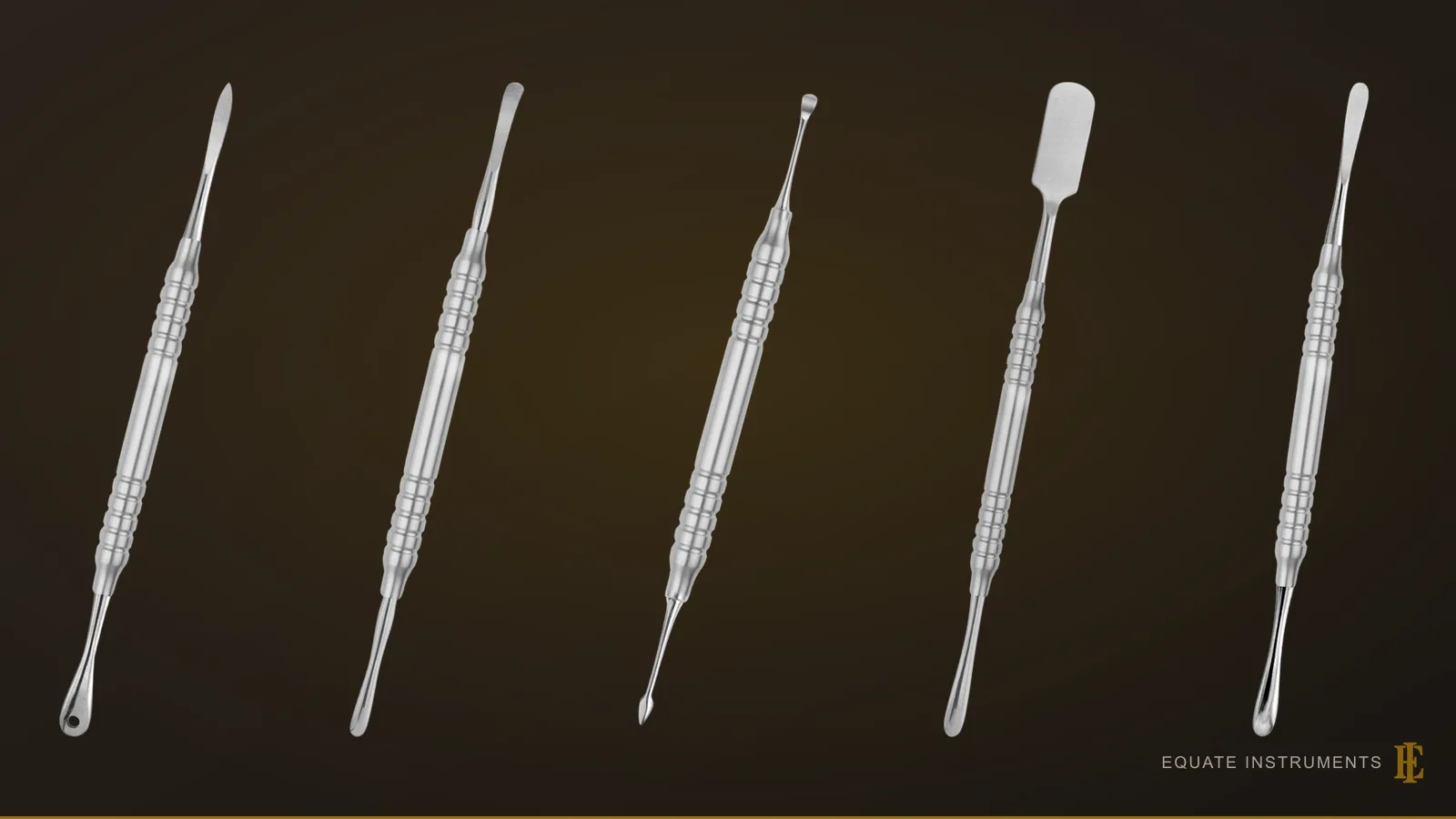
A periosteal elevator is a surgical hand instrument that lifts the gum and the periosteum beneath it off the bone in one full-thickness flap. Its thin, rounded or pointed blade is slipped under the tissue and pushed along the bone. Dentists use it in surgical extractions, implant placement and periodontal surgery. It never works on the tooth itself; that is the job of a dental elevator.
Key points
- A periosteal elevator reflects a mucoperiosteal flap; loosening the tooth is the job of dental elevators and luxators.
- The Molt 9 is the everyday pattern, while Freer, Buser and micro patterns are thinner for papillae, implant sites and thin tissue.
- Keep the blade on bone and push rather than pry, so the periosteum comes away in one piece without tearing.
What is a periosteal elevator used for?
A periosteal elevator separates a mucoperiosteal flap from the underlying bone so the surgeon can see and reach it. After the incision is made with a blade on a scalpel handle, the elevator's edge goes under the periosteum at the incision line and is worked along the bone until the flap is free. Because the periosteum carries much of the flap's blood supply, lifting it intact, rather than splitting it, helps the flap heal when it is sutured back.
The same instrument then often holds the flap away from the field while bone is removed or an implant is placed, either in the surgeon's hand or passed to the assistant alongside a surgical retractor. It sits on every surgical extraction, implant and periodontal flap tray, starting from the universal oral surgery tray; the oral surgery and extraction instruments guide shows where it fits among the extraction instruments.
What is the difference between a periosteal elevator and a dental elevator?
A periosteal elevator moves soft tissue, while a dental elevator moves the tooth. The two share a name and are often stored together, which is why they get confused. The Equate guide to dental elevators and luxators covers the instruments that loosen roots; this page covers the flap instruments.
| Periosteal elevator | Dental elevator or luxator | |
|---|---|---|
| Works on | Gingiva and periosteum | Tooth root and periodontal ligament |
| Goal | Reflect a flap and expose bone | Loosen and lift the tooth before forceps |
| Blade | Thin, flat or slightly curved, rounded or pointed | Concave or triangular blade with a stronger shank |
| Force | Light, controlled push along bone | Wedging, rotation or apical pressure |
| Typical patterns | Molt 9, Freer, Buser, Pritchard, Goldman-Fox | Bein, Cryer, Coupland, luxators |
What types of periosteal elevator are there?
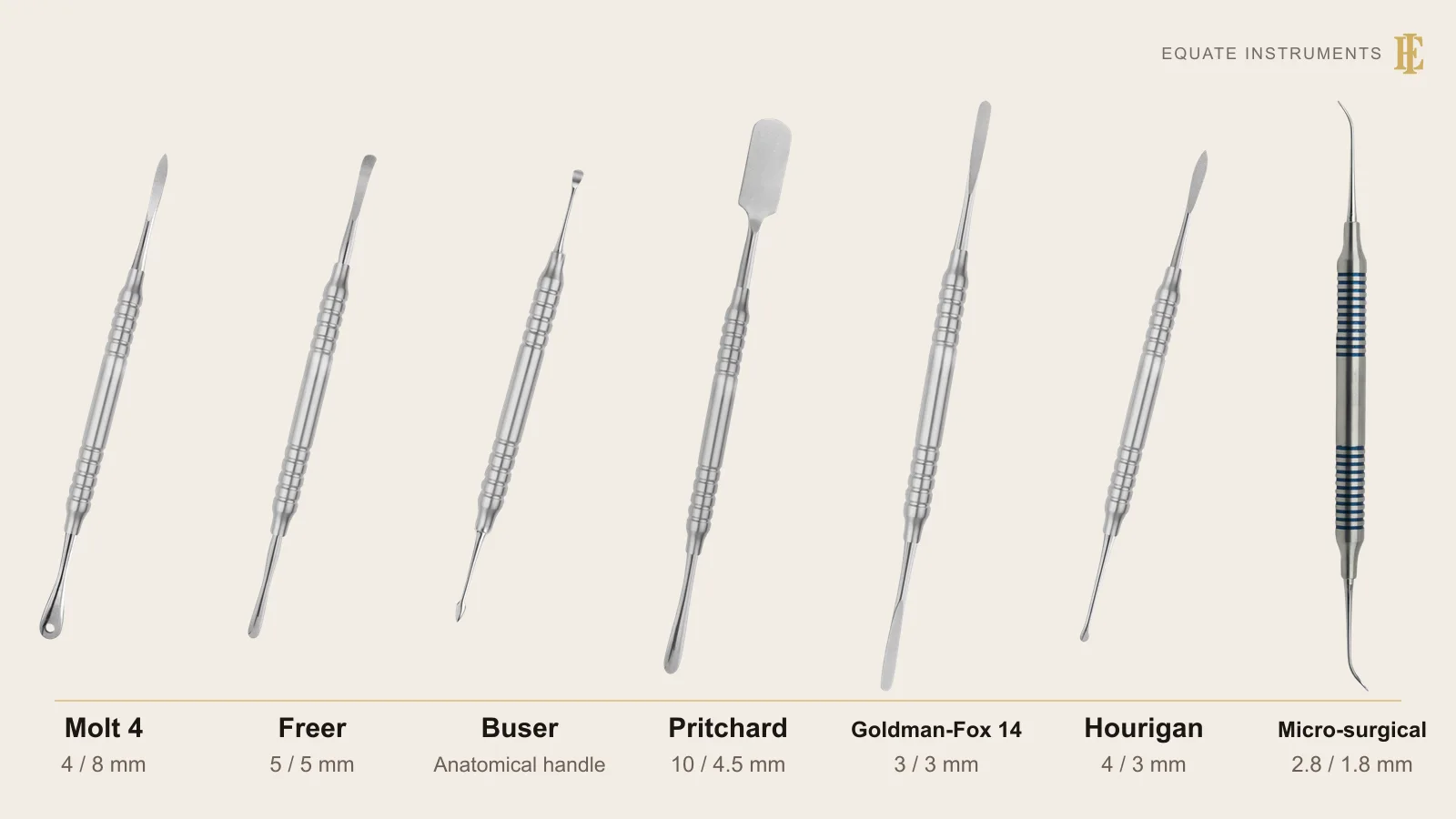
Most periosteal elevators are double-ended, with a narrow end to start the reflection and a broader end to continue it. The Freer pattern is named after Otto "Tiger" Freer, a Chicago laryngologist at the turn of the twentieth century who designed his thin, paddle-ended elevator to free the nasal mucosa from the septum; dentistry adopted it for delicate flaps. Many other patterns also carry the names of clinicians, but their origins aren't always documented, so the table describes them by shape.
| Pattern | Working ends | Typical use |
|---|---|---|
| Molt 9 | One pointed, one broad rounded end | General flap reflection in extraction and implant surgery |
| Molt 4 and small Molt sizes | Smaller rounded ends, for example 4 mm and 3.3/2.8 mm | Single-tooth sites and narrow flaps |
| Freer | Thin, flat, rounded blades, often 5 mm | Delicate flaps, papillae and lifting thin tissue |
| Buser | Fine pointed end and a broader curved end | Implant and guided bone regeneration flaps |
| Pritchard | Broad paddle and a narrower elevating end | Periodontal flaps; the paddle doubles as a retractor |
| Goldman-Fox, Glickman, Hourigan | Small flat or leaf-shaped blades, about 3–6 mm | Periodontal flap and osseous surgery |
| Zucchelli and micro patterns | Slender curved tips, under 3 mm | Mucogingival and microsurgical work, tunnelling |
How do you use a periosteal elevator?
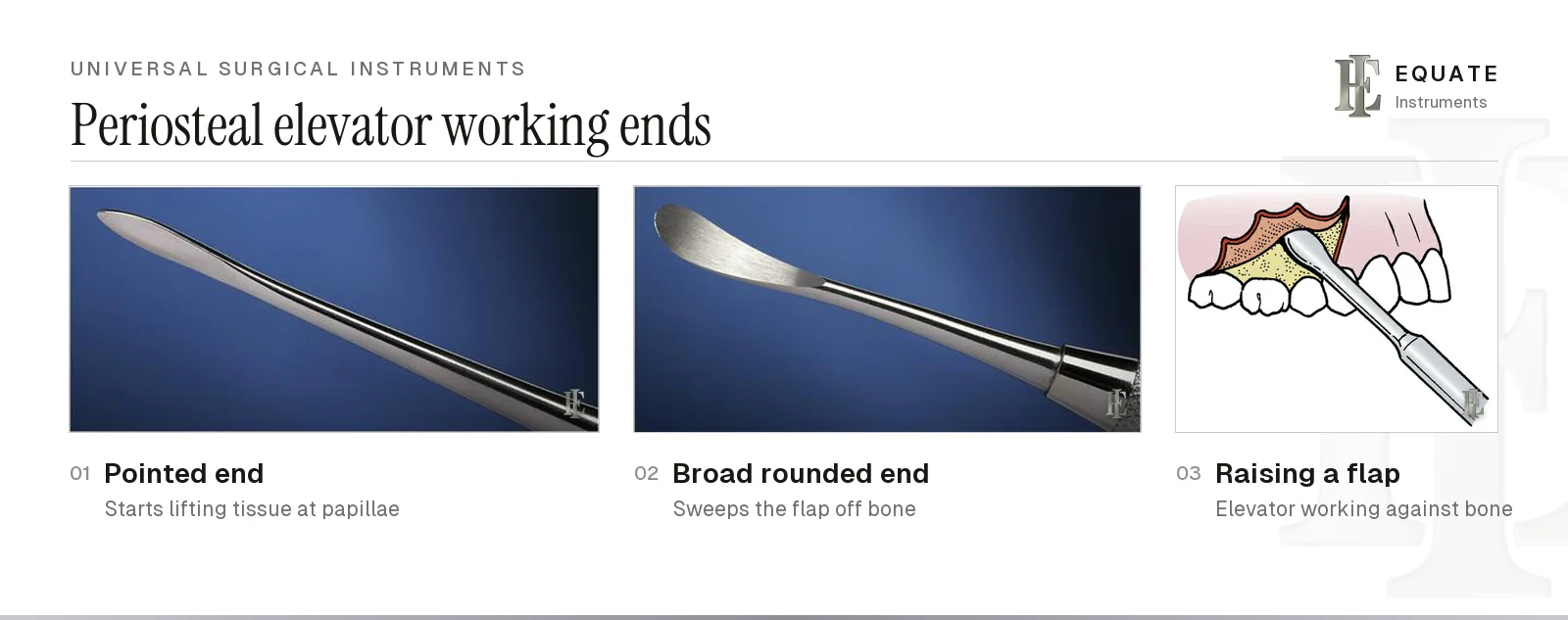
Reflection starts at a firm point, usually a papilla or the corner of a vertical release, with the narrow end of the instrument held in a modified pen grasp and a finger rest on the teeth. The edge is placed through the incision until it touches bone, then pushed along the bone surface in short strokes, keeping the blade angled towards the bone so it lifts the periosteum instead of cutting into the flap. Once a corner is free, the broad end takes over and sweeps the rest of the flap off in one layer.
Common errors are prying against the flap margin, which tears thin tissue, and letting the blade leave the bone, which splits the flap into partial thickness by accident. Under load an elevator can also slip into the floor of the mouth or the palate, so keep a supporting finger close to the working end and work towards, not away from, the guarding hand.
Which periosteal elevator for which procedure?
The right pattern depends on how thin the tissue is and how much of the ridge you need to see.
- Surgical extraction and third molars: a Molt 9, on the surgical extraction tray, with a fine root elevator or periotome for the tooth itself.
- Implant placement: a Buser or small Molt for the crestal flap, and a Freer for the papillae next to natural teeth; the same flap then gives access for osteotomes and bone graft instruments.
- Periodontal flaps and osseous surgery: Goldman-Fox, Glickman or Pritchard patterns on the periodontal surgery tray.
- Mucogingival and root-coverage surgery: Zucchelli or micro-surgical elevators, which lift thin tissue without perforating it.
- Lateral-window sinus access: a Freer or small Molt to expose the window before the sinus lift instruments take over.
Which specifications matter?
- Blade width: from under 2 mm for papillae to 7–10 mm for broad flaps; most surgeons want one narrow and one broad end on the same instrument.
- Edge: thin and smooth enough to slide under the periosteum. A nicked or burred edge snags and tears the tissue.
- Curvature: a slightly curved blade follows the convex ridge; a straight blade suits flat palatal and lingual bone.
- Handle: a 10 mm hollow handle reduces pinch force on long flaps; a 6 mm solid handle gives finer feel in periodontal work.
- Length: about 17.5–19.5 cm reaches posterior sites without the hand blocking the view.
- Coating: titanium-coloured or plasma-coated tips are easier to see against tissue and help tell patterns apart on the tray.
What does the Equate range include?
Equate lists 37 periosteal elevators. The Molt group has 13, including the Molt 9 (4 mm/7 mm ends), Molt 4 (4 mm/8 mm with a suture-hole hollow handle), Molt 7/5 mm, 4/4 mm and 3.3/2.8 mm, and Mead and Howard variants. There are 6 Goldman-Fox, 5 Freer, 4 Buser and 3 Pritchard elevators, plus Glickman, Hourigan, Widman, Zucchelli, a 2.8/1.8 mm micro-surgical elevator and a spoon-tipped elevator. Lengths run from 17.5 cm to 19.5 cm, and 24 come on hollow handles.
Each is made of passivated stainless steel, ultrasonically cleaned, shape-, boil- and performance-tested and individually packed. Equate instruments are designed in Finland, and clinics can request samples and a quote through the oral surgery range.
How do you clean, sterilise and maintain periosteal elevators?
Periosteal elevators touch bone, so they are critical items that must be cleaned and then heat-sterilised after every use, as the CDC's dental infection-control guidelines set out. Remove blood and tissue at the chair before it dries, clean them in an ultrasonic bath or washer-disinfector, and follow the manufacturer's reprocessing instructions, which ISO 17664-1 requires manufacturers to supply.
Raising a flap also sets the standard for the whole procedure. CDC dental guidance counts procedures involving incision, excision or reflection of tissue that exposes normally sterile areas of the mouth as oral surgery, naming surgical extractions that need a mucoperiosteal flap and implant surgery among its examples. That means surgical hand antisepsis, sterile surgeon's gloves and sterile irrigant delivered through a sterile bulb syringe, a single-use product or sterilisable tubing.
Check the edge under magnification at each cycle. A slightly dulled edge can be restored with a flat stone, following the original contour, but an elevator whose blade is bent, thinned or pitted should be retired, because it will tear flaps rather than lift them.
The Equate difference
Equate lists 37 periosteal elevators in 11 subcategories: 13 Molt-type (including the Molt 9, Molt 4, Mead and Howard), 6 Goldman-Fox, 5 Freer, 4 Buser and 3 Pritchard, plus single Glickman, Hourigan, Widman, Zucchelli, micro-surgical and spoon-tipped designs, with working ends from 1.8 mm to 10 mm and 24 on hollow handles.
Equate Periosteal Elevators: Molt 9, Freer, Buser and Other Patterns options

Micro Surgical Periosteal Elevator 2.8/1.8mm - Titanium-Coated
EI-0057
Molt 9 Periosteal Elevator, 4mm/7mm Ends, Hollow Handle
EI-0066
Periosteal Elevator 24G 4mm/4mm 17.5cm Hollow Handle Blue
EI-0067
Freer Periosteal Elevator - Titanium-Coated Hollow Handle
EI-0068
Freer Double-Ended Periosteal Elevator - Titanium Coated
EI-0069
Prichard Periosteal Elevator 10mm/4.5mm - 19cm Hollow Handle
EI-0070
Buser Periosteal Elevator 17.5cm - Anatomical Hollow Handle
EI-0138
Periosteal Molt 3.3/2.8mm
EI-0139
Periosteal Molt 7/5mm 18.5cm Hollow Handle 10mm
EI-0140
Periosteal Elevator 24G 4mm/4mm
EI-0201
Freer Periosteal Elevator 5mm/5mm - 19cm Hollow Handle
EI-0202
Prichard Periosteal Elevator - 6 mm Solid Handle
EI-0203Browse all oral surgery instruments
Buying in your market
Frequently asked questions
What is a periosteal elevator used for in dentistry?
It lifts the gum and periosteum off the bone as a full-thickness flap, so the surgeon can see the bone in surgical extractions, implant placement and periodontal surgery. It is also used to hold the flap back once it is raised.
What is the difference between a Molt 9 and a Freer elevator?
The Molt 9 has one pointed and one broad rounded end and suits general flap reflection. The Freer has thinner, flat, rounded blades for delicate tissue such as papillae and thin gingiva.
What is the difference between a periosteal elevator and a dental elevator?
A periosteal elevator moves soft tissue away from bone. A dental elevator or luxator works between the root and the bone to loosen the tooth before forceps are used.
Can a periosteal elevator be used to loosen a tooth?
It shouldn't be. Its thin blade isn't built for leverage and will bend or chip, and loosening teeth is the job of an elevator, luxator or periotome.
What is a Woodson periosteal elevator?
The Woodson is a small double-ended instrument with a flat paddle end that many catalogues list both as a plastic filling instrument and as a fine elevator for lifting gingiva around a single tooth. For full flaps, a Molt or Freer pattern is the usual choice.
Do periosteal elevators need sharpening?
They need a smooth, thin edge rather than a cutting one. Light honing with a flat stone can restore a dulled edge, but bent or pitted elevators should be replaced.
Do I need sterile gloves to raise a flap?
Yes. CDC guidance lists surgical extractions that need a mucoperiosteal flap among oral surgical procedures, because reflecting the flap exposes normally sterile tissue, so a flap raised with a periosteal elevator calls for surgical hand antisepsis, sterile surgeon's gloves and sterile irrigant.
References
- Hupp JR, Tucker MR, Ellis E. Contemporary Oral and Maxillofacial Surgery, 7th edition. Elsevier, 2018 (flap design, soft-tissue reflection and instrumentation for basic oral surgery)
- Newman MG, Takei HH, Klokkevold PR, Carranza FA. Newman and Carranza's Clinical Periodontology. Elsevier (periodontal flap surgery and surgical instruments)
- Chittiboina P, Connor DE Jr, Nanda A. Dr. Otto "Tiger" Freer: inventor and innovator. Neurosurgical Focus 2012;33(2):E12
- Sharma SD, Vidya B, Alexander M, Deshmukh S. Periotome as an aid to atraumatic extraction: a comparative double blind randomized controlled trial. Journal of Maxillofacial and Oral Surgery 2015;14(3):611–615
- Kohn WG, Collins AS, Cleveland JL, et al. Guidelines for Infection Control in Dental Health-Care Settings, 2003. MMWR 52(RR-17), Centers for Disease Control and Prevention
- ISO 17664-1:2021 Processing of health care products: information to be provided by the medical device manufacturer for the processing of medical devices, Part 1: critical and semi-critical medical devices
- Boyd LB. Dental Instruments: A Pocket Guide, 7th edition. Saunders/Elsevier, 2020. Chapter 15, Universal Surgical Instruments (photographs used under licence)
- Centers for Disease Control and Prevention. Best Practices for Oral Surgical Procedures. Dental infection prevention and control
I am a…