Oral Surgery Tray Setup
Written by the Equate Instruments Technical Team · Reviewed by the Medical & Dental Board, Equate Instruments · Updated ·
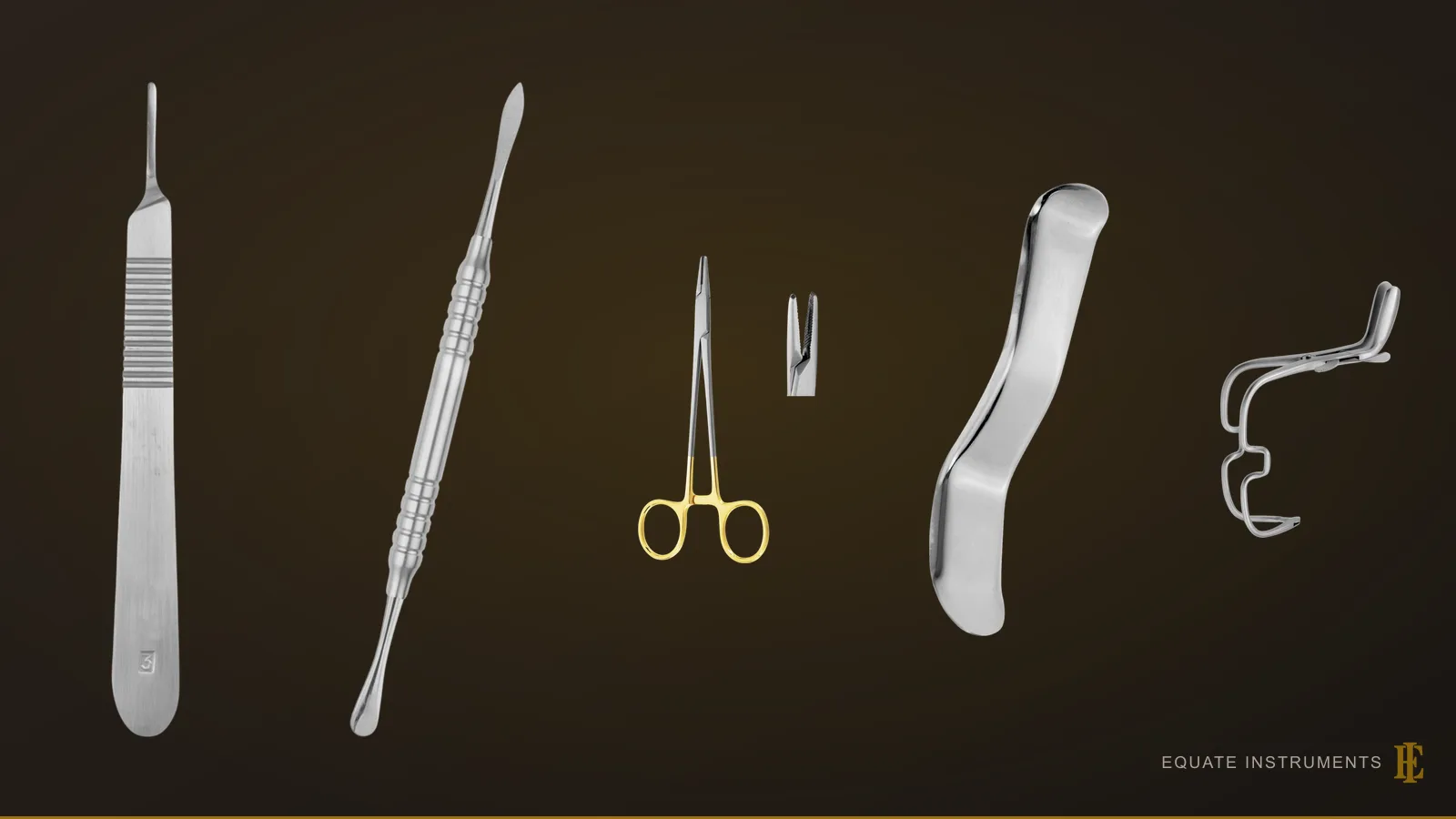
An oral surgery tray setup is the universal surgical tray for flaps, biopsies and minor oral surgery, laid out left to right in order of use. Built in stages from incision to closure, it holds a mirror, probe, scalpel, periosteal elevator, curette, tissue forceps, haemostat, scissors, retractors, mouth prop, needle holder and sutures, with surgical suction, sterile irrigant and sterile surgeon's gloves.
Key points
- The universal tray is the base that the extraction and periodontal surgery trays are built on.
- Any procedure that cuts, excises or reflects tissue counts as oral surgery under the CDC guidelines, so it needs sterile instruments, sterile irrigant and sterile gloves.
- Laying the set out in order of use lets the assistant pass the next instrument before it is asked for.
Step by step
- 1
Check the patient and the tray
Confirm the medical history, consent and radiographs, then count the instruments against the tray list. Open the sterile pack only once the patient is seated.
- 2
Anaesthetise and test
Give the local anaesthetic from its own tray and wait for it to take effect. Test the soft tissue with a probe or the tip of a periosteal elevator before the first incision.
Dental Aspirating Syringes (Dental Anaesthetic Syringes)Periosteal Elevators: Molt 9, Freer, Buser and Other Patterns
- 3
Place the mouth prop and incise
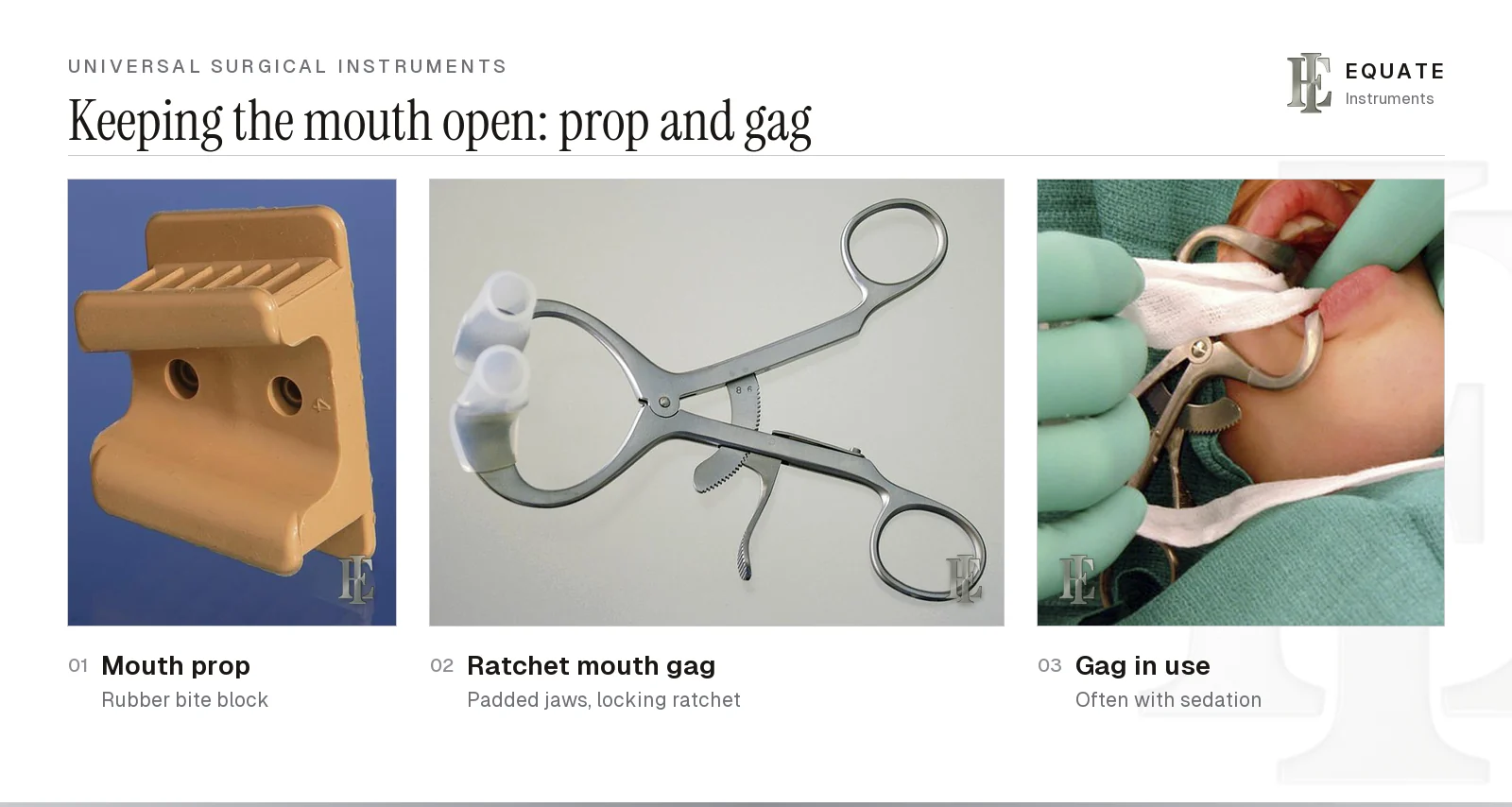
Seat the mouth prop on the opposite side so the jaw is supported. Make the incision in one firm stroke down to bone with a fresh blade.
- 4
Reflect and retract the flap
Lift a full-thickness flap with the periosteal elevator, keeping the instrument against bone. Hold the flap and cheek back with a retractor that rests on bone, not on the soft tissue edge.
Periosteal Elevators: Molt 9, Freer, Buser and Other PatternsDental and Oral Surgery Retractors
- 5
Carry out the procedure
Use the curette to remove granulation tissue or a lesion, the tissue forceps to steady soft tissue and the haemostat for tags and small bleeders. Keep the field clear with the surgical suction tip.
Surgical Curettes (Bone Curettes) for Oral SurgeryDental Tissue Forceps (Toothed and Non-Toothed)Dental Hemostats (Haemostats) and Mosquito ForcepsSurgical Suction Tips for Oral Surgery
- 6
Irrigate and inspect
Irrigate with sterile saline or sterile water, then check the site for debris, sharp bone edges and bleeding points.
- 7
Close the wound
Reposition the flap with tissue forceps, place the sutures with the needle holder and cut the tails with suture scissors, leaving enough length to grip at removal.
Dental Needle Holders (Needle Drivers)Dental Tissue Forceps (Toothed and Non-Toothed)Dental Surgical Scissors
- 8
Control bleeding and clear the tray
Have the patient bite on damp gauze and give written aftercare. Remove the blade with a blade remover or haemostat, discard sharps at the chair and return the set for cleaning.
Dental Scalpel Handles and BladesDental Hemostats (Haemostats) and Mosquito Forceps
What goes on an oral surgery tray?
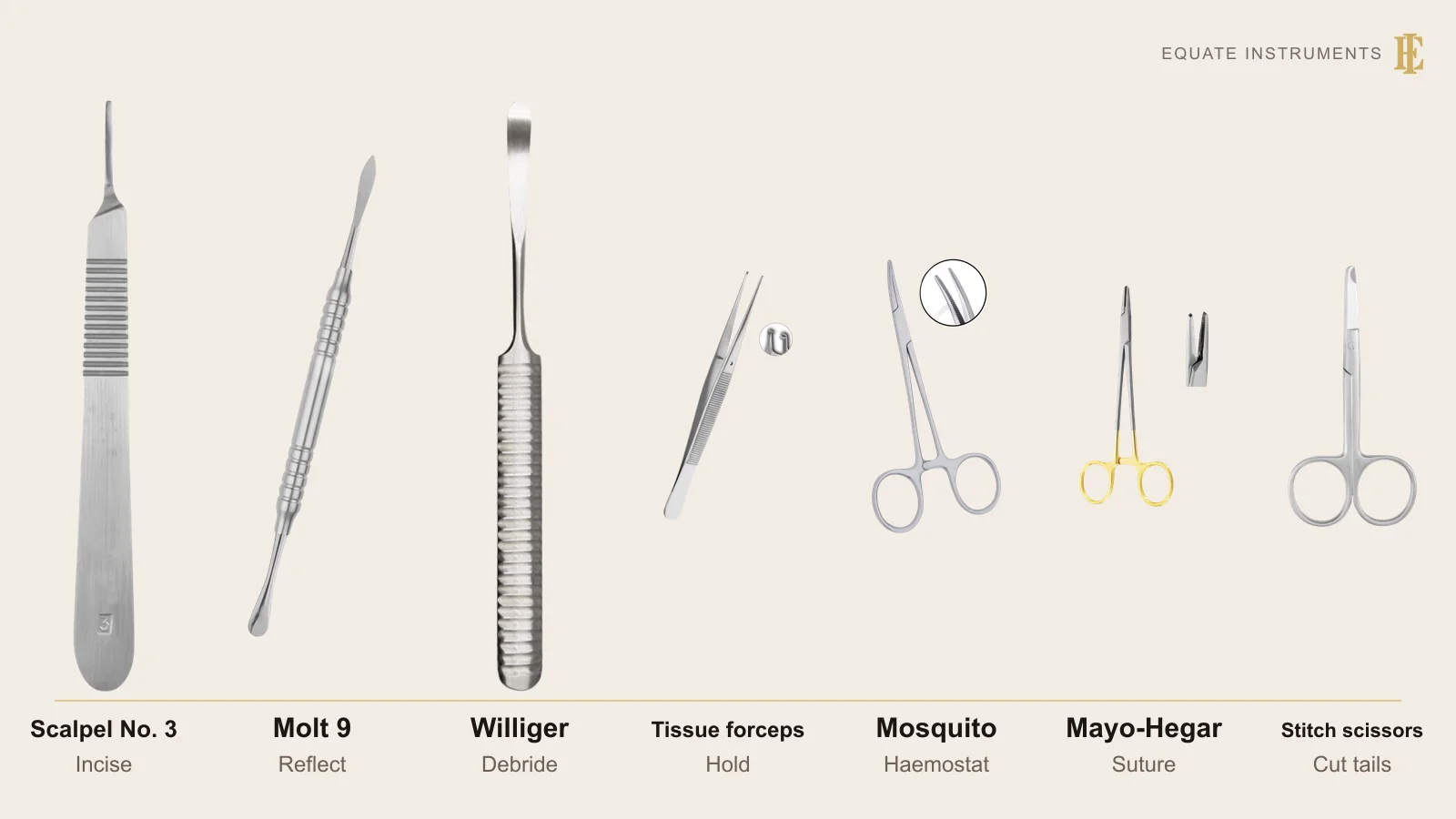
The universal tray holds about a dozen instruments that cover cutting, reflecting, holding and closing. James Hupp, Myron Tucker and Edward Ellis's Contemporary Oral and Maxillofacial Surgery groups basic surgical instruments by those same jobs, which is a useful way to check that nothing is missing. What each instrument does, and how the patterns differ, is covered in the universal surgical instruments guide.
| Instrument | What it is for | Guide |
|---|---|---|
| Mouth mirror, probe and cotton pliers | Examine the site, test anaesthesia, place and remove gauze | Mouth mirrors, cotton pliers |
| Scalpel handle with No. 12 or 15 blade | Incision through mucosa and periosteum | Scalpel handles |
| Periosteal elevator | Raise and hold a full-thickness flap | Periosteal elevators |
| Cheek and tongue retractor, mouth prop | Access, tissue protection and jaw support | Dental retractors |
| Surgical curette | Remove granulation tissue, cysts and debris | Surgical curettes |
| Tissue forceps | Steady the flap during dissection and suturing | Tissue forceps |
| Haemostat | Grip small vessels, tissue tags and fragments | Hemostats |
| Tissue scissors and suture scissors | Trim soft tissue; cut suture tails | Surgical scissors |
| Needle holder and sutures | Close the wound | Needle holders |
| Surgical suction tip | Clear blood and irrigant from the field | Surgical suction tips |
In what order is the tray laid out?
Set the instruments out left to right in the order they are picked up: examination instruments first, then the scalpel, periosteal elevator and retractors, then the working instruments, and the closing instruments last. The assistant then works along the tray as the procedure moves on, and anything left out of place stands out.
Keep the blade covered or mounted only when the surgeon is ready, with the sharp edge facing away from where hands reach in. Sutures stay in their sterile packet until closure. Local anaesthetic is usually given from its own small tray, with the aspirating syringe kept away from the surgical field.
How does the universal tray change for each procedure?
Most surgical trays start from this set and add or drop a few items. Keeping the core identical across trays makes stock checks and cassette layouts simpler.
| Procedure | Add to the universal tray | Tray guide |
|---|---|---|
| Simple molar extraction | Straight elevator and the forceps for the tooth | Surgical extraction tray |
| Impacted lower molar | Root elevators, rongeur and bone file, chisel and mallet, surgical handpiece | Surgical extraction tray |
| Periodontal flap or gingivectomy | Periodontal probe, Kirkland and Orban knives, scalers and curettes | Periodontal surgery tray |
| Soft tissue biopsy | Fine-toothed tissue forceps and a labelled specimen pot | This page |
| Suture removal | A separate small tray, no scalpel or elevator | Suture removal tray |
What else is needed besides the instruments?
- Local anaesthetic, needles and an aspirating syringe on their own tray.
- Sterile saline or sterile water for irrigation, delivered through a sterile bulb syringe, a single-use product or sterilisable tubing that bypasses the dental unit; the CDC notes that filling a unit's independent water reservoir with sterile solution does not deliver sterile irrigant.
- Sterile gauze and sutures of the chosen material and size. For patients taking anticoagulants or antiplatelet drugs, SDCEP's 2022 guidance asks practices to have absorbent gauze, haemostatic packing such as oxidised cellulose or collagen sponge, and a suture kit, with non-animal-based packing for patients who decline animal products; plan their treatment early in the day and limit the first treatment area.
- Personal protective equipment: sterile surgeon's gloves, mask, eye protection and a gown.
- Current radiographs, the medical history, signed consent and written aftercare instructions.
How should a surgical tray be cleaned and sterilised?
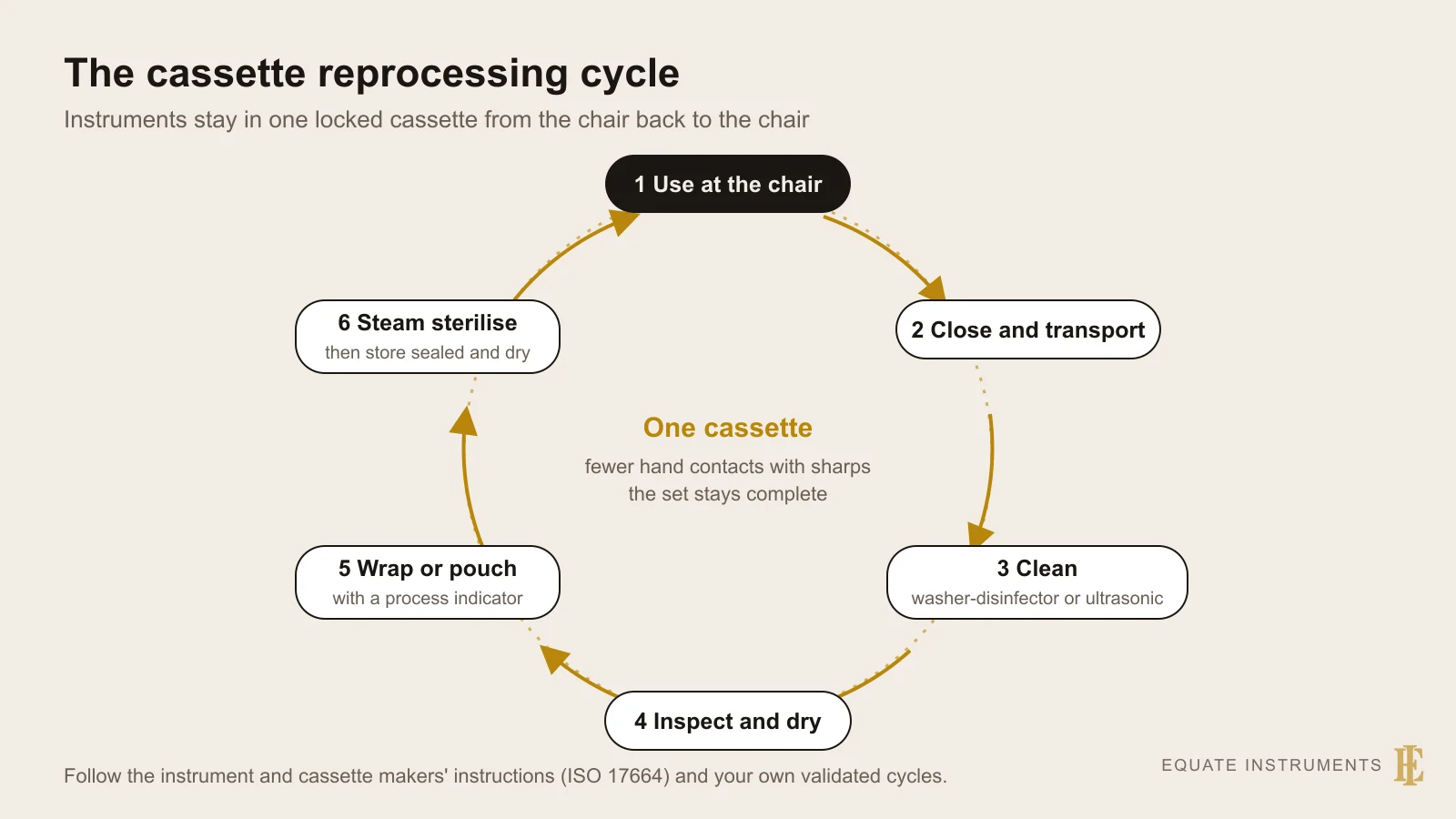
Every instrument on this tray is a critical item: it enters soft tissue or bone, so it must be cleaned and heat-sterilised after each patient. The CDC's 2003 Guidelines for Infection Control in Dental Health-Care Settings define oral surgical procedures as those that involve incision, excision or reflection of tissue, and call for sterile saline or sterile water as the coolant or irrigant, surgical hand antisepsis and sterile surgeon's gloves.
Cleaning comes first, because blood and tissue left on an instrument can stop sterilisation from working. Open hinged instruments such as needle holders, haemostats and scissors before ultrasonic or washer-disinfector cleaning, inspect jaws and tips, lubricate the joints, then pack the set, ideally in an instrument cassette, with a chemical indicator. The CDC also advises that critical instruments are not stored unwrapped. Follow each manufacturer's reprocessing instructions, the information ISO 17664-1 sets out, and in England work to HTM 01-05.
Remove blades with a blade remover or a haemostat, never with fingers, and put them in a puncture-resistant sharps container at the point of use.
What are the common mistakes with this tray?
- Retracting on the flap edge instead of on bone, which tears the flap and bruises the tissue.
- Using one blade for the whole procedure; a blunt blade drags and leaves ragged margins.
- Irrigating with tap water or a non-sterile bottle during surgery.
- Leaving out the mouth prop, so the jaw tires and the patient closes during the procedure.
- Cutting suture tails so short that the knot unties or can't be gripped at removal.
- Processing hinged instruments closed, which leaves debris in the box joint.
Build this tray with Equate
Equate's catalogue covers every hand instrument on the universal tray. It lists 5 standard scalpel handles (No. 3 and No. 4, one with a ruler scale and a 170 mm long slim handle) and 4 round handles, one with an automatic blade remover. There are 13 periosteal elevators in the Molt subcategory, 7 general surgical curettes (44 surgical curettes in all, including Lucas, Miller, Hemmingway and Williger patterns, see surgical curettes), 10 tissue forceps, including Allis and 1x2-toothed patterns, and 17 haemostatic forceps in Halsted-mosquito, Kelly, Kocher, Crile and Pean patterns.
For closure there are 12 Mayo-Hegar needle holders and 20 suture scissors, and the tray is finished with 8 mouth gags and 3 Minnesota retractors. Each instrument is passivated stainless steel, ultrasonically cleaned, shape-, boil- and performance-tested and individually packed, and designed in Finland. Clinics can request samples and a quote for a complete tray.
The Equate difference
Equate lists 103 instruments across the 10 subcategories on this tray, including 13 periosteal elevators in Molt, Mead and Howard patterns, 12 Mayo-Hegar needle holders from 13 to 20 cm (10 with tungsten carbide jaws), 20 suture scissors and 8 mouth gags in Jennings, Denhardt, Roser-Konig and Molt patterns.
Equate Oral Surgery Tray Setup options

Miller 8 Bone Curette - 3.5 mm
EI-0025
Scalpel Handle No.3 - 130mm
EI-0031
Scalpel Handle No.3 with Ruler Scale - 130mm
EI-0032
Molt 9 Periosteal Elevator, 4mm/7mm Ends, Hollow Handle
EI-0066
Periosteal Elevator 24G 4mm/4mm 17.5cm Hollow Handle Blue
EI-0067
Soft Tissue Curette - Right, Hollow Handle
EI-0104
Soft Tissue Curette - Left, Hollow Handle
EI-0105
Periosteal Molt 3.3/2.8mm
EI-0139
Periosteal Molt 7/5mm 18.5cm Hollow Handle 10mm
EI-0140
Soft Tissue Curette - Right, Solid Handle
EI-0173
Soft Tissue Curette - Left, Solid Handle
EI-0174
Periosteal Elevator 24G 4mm/4mm
EI-0201Browse all oral surgery instruments Browse all accessories & supplies instruments
Buying in your market
Frequently asked questions
What instruments are on a universal surgical tray?
A mirror, probe and cotton pliers, a scalpel, periosteal elevator, surgical curette, tissue forceps, haemostat, tissue scissors, retractor and mouth prop, needle holder, sutures, suture scissors and a surgical suction tip.
What is the difference between a tissue scissor and a suture scissor?
Tissue scissors have fine, sharp blades for trimming soft tissue and are kept for that job only. Suture scissors are sturdier and cut suture material, which would blunt fine tissue blades.
Why is a mouth prop used in oral surgery?
It holds the mouth open without the patient having to work at it, and it supports the jaw against the force of the instruments, which protects the jaw joint during longer procedures.
Do oral surgery instruments need to be sterile?
Yes. They penetrate soft tissue or bone, so the CDC classes them as critical items that must be cleaned and heat-sterilised, and stored wrapped until use.
Can the same tray be used for extractions and periodontal surgery?
The core instruments are shared, but each procedure adds its own: elevators and forceps for extractions, periodontal knives and probes for periodontal surgery. Many clinics keep the core in one cassette and add a procedure insert.
References
- Hupp JR, Tucker MR, Ellis E. Contemporary Oral and Maxillofacial Surgery, 7th edition. Elsevier, 2018 (instrumentation for basic oral surgery)
- Kohn WG, Collins AS, Cleveland JL, Harte JA, Eklund KJ, Malvitz DM. Guidelines for Infection Control in Dental Health-Care Settings, 2003. MMWR Recommendations and Reports 52(RR-17), Centers for Disease Control and Prevention, 2003
- Centers for Disease Control and Prevention. Dental infection prevention and control FAQs: sterilization of patient-care items
- Gadhia A, Pepper T. Oral Surgery, Extraction of Teeth. StatPearls, StatPearls Publishing, 2023
- Department of Health. Health Technical Memorandum 01-05: Decontamination in primary care dental practices, 2013 edition
- ISO 17664-1:2021 Processing of health care products: information to be provided by the medical device manufacturer for the processing of medical devices, Part 1: critical, semi-critical and non-critical medical devices
- Boyd LB. Dental Instruments: A Pocket Guide, 7th edition. Saunders/Elsevier, 2020. Chapter 15, Universal Surgical Instruments (photographs used under licence)
- Centers for Disease Control and Prevention. Best Practices for Oral Surgical Procedures. Dental infection prevention and control
- Scottish Dental Clinical Effectiveness Programme. Management of Dental Patients Taking Anticoagulants or Antiplatelet Drugs, 2nd edition, 2022
I am a…
Related
- Surgical Extraction Tray Setup
- Periodontal Surgery Tray Setup
- Suture Removal Tray Setup
- Tooth Extraction Instruments
- Periosteal Elevators: Molt 9, Freer, Buser and Other Patterns
- Dental Needle Holders (Needle Drivers)
- Oral Surgery and Extraction Instruments
- Universal Surgical Instruments for Oral and Periodontal Surgery