Dental Osteotomes for Implant Site Preparation
Written by the Equate Instruments Technical Team · Reviewed by the Medical & Dental Board, Equate Instruments · Updated ·
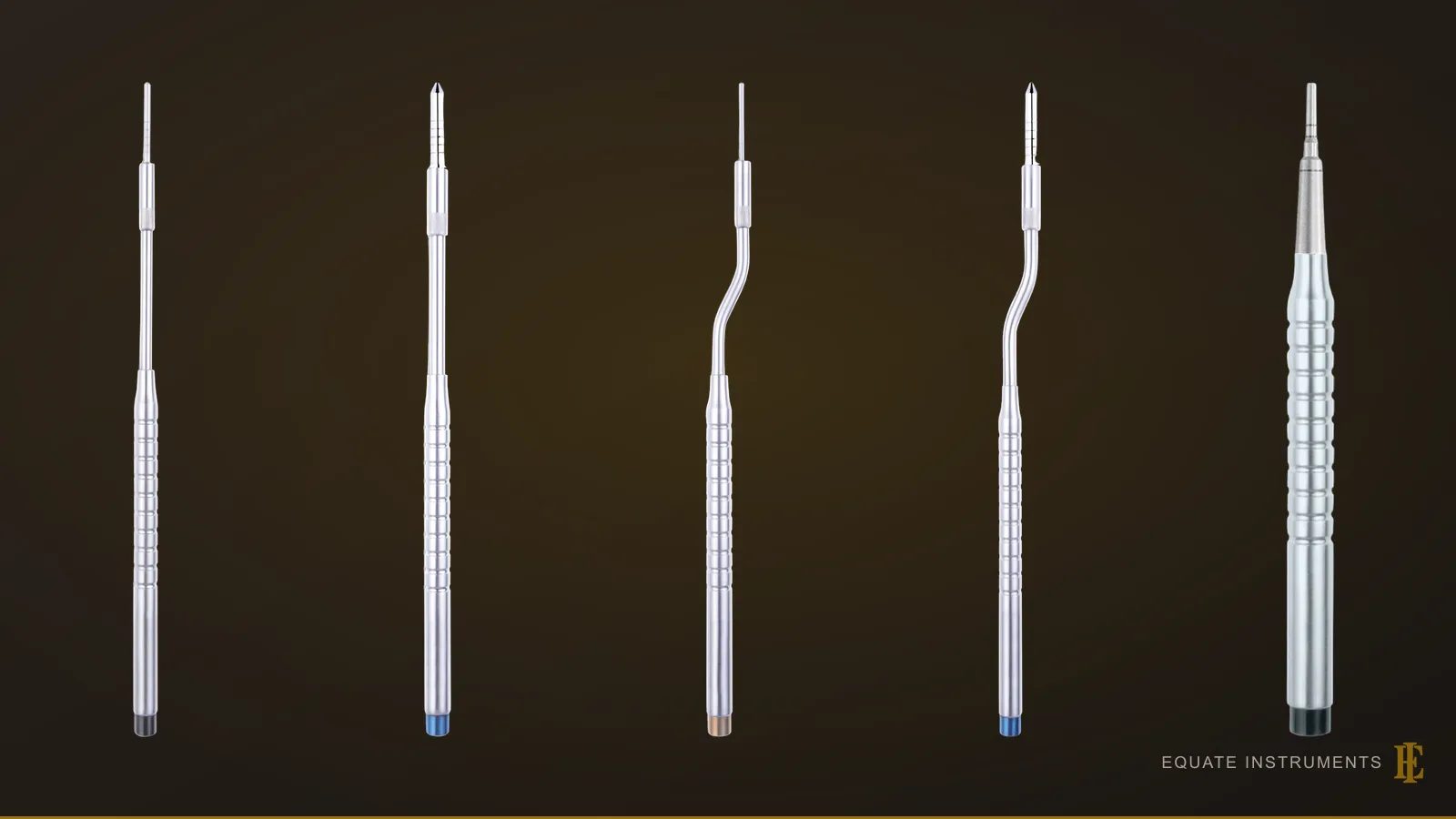
A dental osteotome is a tapered, blunt-ended hand instrument that is tapped into the jaw with a mallet to compress, widen or lift bone instead of drilling it away. Described for implant dentistry by R. B. Summers in 1994, osteotomes condense soft maxillary bone around an implant site, expand narrow ridges and raise the sinus floor through the crest of the ridge.
Key points
- Osteotomes condense and displace bone rather than remove it, which suits the soft bone of the posterior maxilla.
- Concave tips carry bone ahead of them to lift the sinus floor; convex tips push bone sideways to condense and expand the site.
- They are used in increasing diameters to marked depths, each one widening the site the previous one made.
What is a dental osteotome used for?
Osteotomes prepare implant sites by moving bone rather than cutting it out. Each instrument has a round or tapered working end of a set diameter; tapped with a surgical mallet, it is driven into a small pilot hole and pushes the surrounding cancellous bone outwards and ahead of the tip. In soft bone, such as the posterior maxilla, this packs the bone more densely around the future implant instead of turning it into drilling debris.
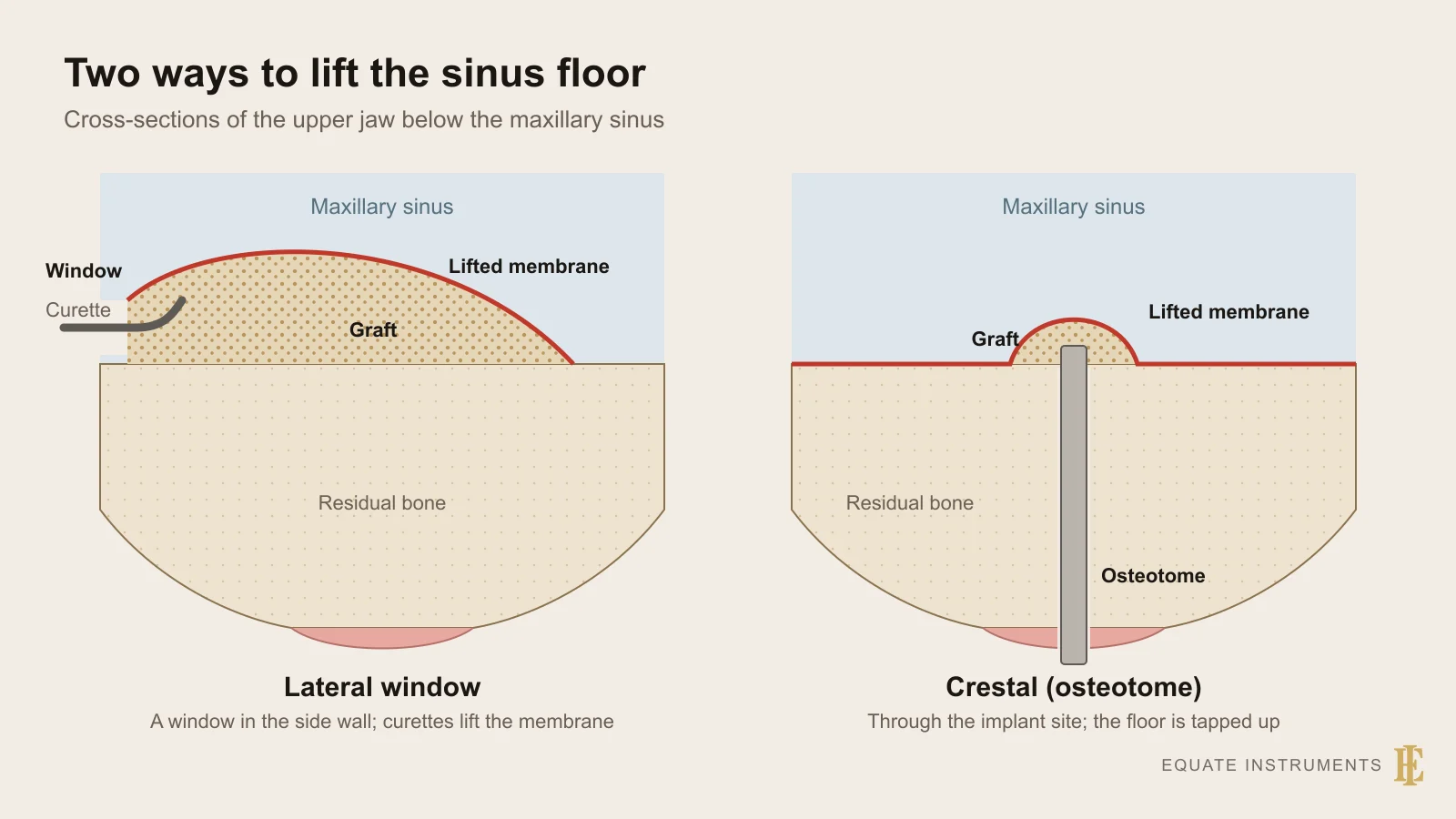
The same principle gives osteotomes three main jobs: condensing bone to improve the seat of an implant, expanding a narrow ridge so an implant fits within it, and lifting the floor of the maxillary sinus from below without a lateral window. They work alongside the sinus lift instruments and bone graft instruments on the implant side of the oral surgery tray; the oral surgery and extraction instruments guide sets them beside the implant kits.
What is the Summers osteotome technique?
The Summers technique is a way of placing implants in soft maxillary bone with a graded series of osteotomes instead of drills, described by R. B. Summers in a three-part series in Compendium in 1994. The first article presented osteotomes as an alternative to drilling that conserves bone and may improve its density around the implant. The second described the ridge expansion osteotomy, which uses tapered hand instruments to widen a thin ridge. The third described the osteotome sinus floor elevation and a bone-added version, which reshape the sinus floor so longer implants can be placed with less invasive surgery.
In the crestal sinus lift, the site is prepared to just short of the sinus floor, then osteotomes of increasing diameter are tapped up to that depth. The bone and any graft material pushed ahead of the tip lift the floor and the sinus membrane together, creating room for the implant. Because the membrane can't be seen, depth control and gentle malleting matter more than with any other osteotome use. Pooling 19 studies of this transalveolar lift, Tan, Lang, Zwahlen and Pjetursson estimated 3-year implant survival at 92.8% (95% CI 87.4–96.0%), an annual failure rate of 2.48%.
How are osteotomes used for ridge expansion?
Ridge expansion uses osteotomes, often after a thin bone chisel has split the crest, to push the buccal plate outwards so an implant fits in a ridge that was too narrow. Tapered instruments of increasing diameter are advanced into the split one after another, and the cancellous bone between the plates bends rather than breaks.
Scipioni, Bruschi and Calesini reported one of the early series in 1994: using a partial-thickness flap, crestal and vertical bone incisions and buccal displacement of the outer plate, they placed 329 implants in 170 patients and reported a 98.8% success rate. A periosteal elevator is used with care in these cases, because stripping the periosteum from the buccal plate reduces its blood supply.
What types of osteotome are there?
| Type | Working end or shaft | Typical use |
|---|---|---|
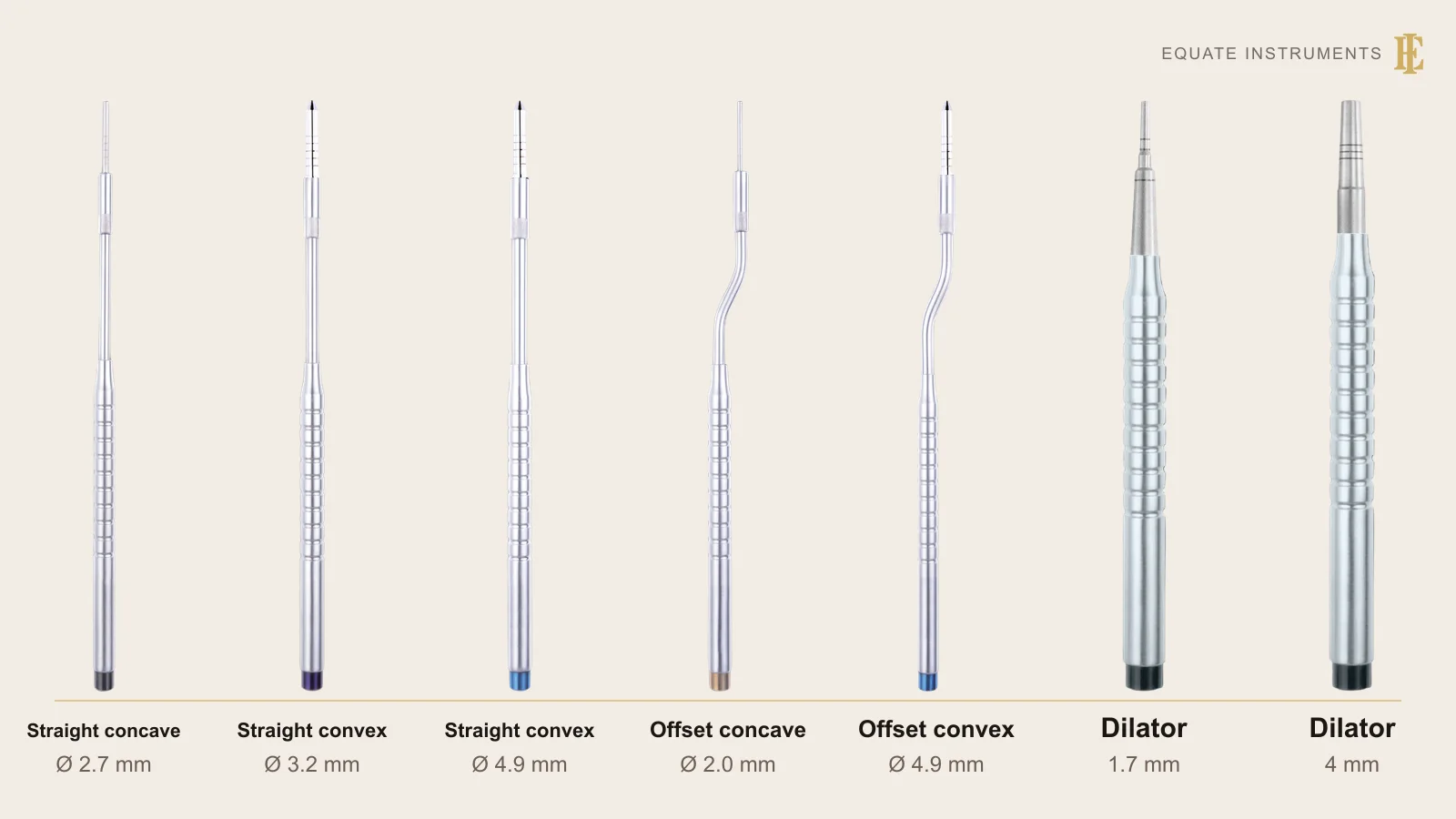
| Concave tip | Hollowed tip that gathers bone and graft | Crestal sinus floor elevation; pushing bone ahead of the tip |
| Convex tip | Domed or pointed tip | Condensing bone sideways and starting ridge expansion |
| Bone condenser | Stepped tapered tip in graded diameters | Widening and condensing the osteotomy before the implant |
| Osteotome dilator | Smooth cone with depth bands | Gradually dilating a narrow site to the implant diameter |
| Straight shaft | Tip in line with the handle | Anterior and premolar sites with direct access |
| Curved or offset shaft | Bayonet bend that keeps the handle clear of the opposing teeth | Molar and posterior maxillary sites |
Which specifications matter?
| Specification | What to look for | Why it matters |
|---|---|---|
| Diameter sequence | Graded steps, for example 2.0, 2.7, 3.2, 4.1 and 4.9 mm | The last osteotome should match the implant and drill system |
| Depth marks | Clear laser or groove marks, for example 10–18 mm | Controls how close the tip gets to the sinus floor |
| Tip shape | Concave for lifting, convex or tapered for condensing | The wrong tip can perforate the membrane or fracture the plate |
| Shaft | Straight or offset | Offset shafts reach molar sites in a limited mouth opening |
| Handle end | Flat striking surface or a damping end cap | Transfers mallet blows cleanly and protects the hand |
| Colour coding | Coloured caps or bands by diameter | Speeds selection and keeps the sequence in order |
What are the common mistakes and risks with osteotomes?
- Going past the planned depth in a crestal sinus lift, which can tear the sinus membrane; check the depth on the radiograph and on the shaft marks before every tap.
- Choosing a crestal lift where too little bone remains: in the 1999 multicentre series by Rosen, Summers and colleagues, 174 implants in 101 patients, survival was 96% or higher with at least 5 mm of bone before treatment but 85.7% with 4 mm or less, whatever graft was used.
- Skipping diameters, which overloads the bone and can crack a thin buccal plate during expansion.
- Using osteotomes in dense bone, such as the anterior mandible, where they condense poorly and the force needed is excessive; drills are the better choice there.
- Heavy or repeated mallet blows: Peñarrocha and colleagues reported benign paroxysmal positional vertigo after osteotome expansion of the maxillary ridge, so taps should be light and the patient's head supported.
- Mixing osteotomes from different systems, so the final diameter doesn't match the implant.
What does the Equate range include?
Equate lists 43 osteotome references. The 18 straight osteotomes include concave and convex tips in 2.0, 2.7, 3.2, 4.1 and 4.9 mm on 180 mm instruments with depth marks at 10, 12, 14, 16 and 18 mm, and 8 straight bone condensers from 2.0–2.7 mm to 5.0–5.7 mm. The 11 curved osteotomes have the same concave and convex sizes on an offset shaft, plus a 4.5 mm offset bone condenser. There are 6 osteotome dilators from 1.7 mm to 5.4 mm.
The 8 kits include straight and curved sets of 5 in concave or convex, an offset bone condenser set, and three complete sets supplied with a mallet and a sterilisation cassette. Each is made of passivated stainless steel, ultrasonically cleaned, shape-, boil- and performance-tested and individually packed. Equate instruments are designed in Finland, and clinics can request samples and a quote through the oral surgery range.
How do you clean and sterilise osteotomes?
Osteotomes enter bone, so they must be cleaned and heat-sterilised after every patient, as the CDC's 2003 dental guidelines require for critical instruments. Bone and graft material pack into concave tips and depth grooves, so brush the tips under water straight after surgery, clean the instruments in an ultrasonic bath or washer-disinfector and follow the manufacturer's reprocessing instructions, as ISO 17664-1 requires.
Process a set in its instrument cassette so the sequence stays in order and the tips don't knock together. At each cycle check that the depth marks are legible, the tips are round and undamaged, and the striking end isn't mushroomed; replace any osteotome whose tip is deformed, because it will no longer match the diameter on its label.
The Equate difference
Equate lists 43 osteotome references: 18 straight and 11 curved or offset osteotomes, including concave and convex tips from 2.0 mm to 4.9 mm on 180 mm instruments with depth marks at 10–18 mm, 6 osteotome dilators from 1.7 mm to 5.4 mm, and 8 kits, 3 of them with a mallet and cassette.
Equate Dental Osteotomes for Implant Site Preparation options

Straight Bone Condenser Set with Cassette and Mallet
EI-0542
Straight Bone Condenser 2.0-2.7 mm
EI-0543
Straight Bone Condenser 2.5-3.2 mm
EI-0544
Straight Bone Condenser 3.0-3.7 mm
EI-0545
Straight Bone Condenser 3.5-4.2 mm
EI-0546
Straight Bone Condenser Osteotome - 4.0-4.7 mm
EI-0547
Straight Bone Condenser Osteotome - 4.5-5.2 mm
EI-0548
Straight Bone Condenser Osteotome - 5.0-5.7 mm
EI-0549
Offset Bone Condenser Osteotome Set - 8, 10, 13, 15, 18 mm
EI-0550
Offset Osteotome Complete Universal Set with Mallet and Cassette
EI-0557
Osteotome Curved-Concave Ø2.7 mm - 180 mm
EI-0558
Osteotome Curved-Concave Ø3.2 mm - 180 mm
EI-0559Browse all oral surgery instruments
Buying in your market
Frequently asked questions
What is an osteotome used for in dentistry?
It condenses and displaces bone to prepare an implant site, expand a narrow ridge or lift the sinus floor through the crest. It is tapped with a mallet rather than rotated like a drill.
What is the Summers technique?
It is a method, described by R. B. Summers in 1994, of preparing implant sites in soft maxillary bone with graded osteotomes instead of drills. It includes ridge expansion and osteotome sinus floor elevation.
What is the difference between a concave and a convex osteotome?
A concave tip gathers bone and graft and pushes it ahead, which suits sinus floor elevation. A convex tip pushes bone sideways, which suits condensation and ridge expansion.
Why are some osteotomes offset or curved?
The bayonet bend keeps the handle and mallet clear of the opposing teeth, so the force can be applied along the implant axis in molar sites.
Can osteotomes be used in the mandible?
Rarely. Mandibular bone is usually too dense to condense, so drills are preferred there; osteotomes are mainly used in the softer maxilla.
How much bone do you need for an osteotome sinus lift?
Studies such as Rosen and colleagues' 1999 retrospective multicentre series suggest about 5 mm or more under the sinus. In that series, implants placed with the bone-added osteotome technique survived at 96% or more with at least 5 mm of starting bone, against 85.7% with 4 mm or less.
References
- Summers RB. A new concept in maxillary implant surgery: the osteotome technique. Compendium 1994;15(2):152–162
- Summers RB. The osteotome technique: Part 2, the ridge expansion osteotomy (REO) procedure. Compendium 1994;15(4):422–436
- Summers RB. The osteotome technique: Part 3, less invasive methods of elevating the sinus floor. Compendium 1994;15(6):698–710
- Scipioni A, Bruschi GB, Calesini G. The edentulous ridge expansion technique: a five-year study. International Journal of Periodontics and Restorative Dentistry 1994;14(5):451–459
- Peñarrocha M, Pérez H, García A, Guarinos J. Benign paroxysmal positional vertigo as a complication of osteotome expansion of the maxillary alveolar ridge. Journal of Oral and Maxillofacial Surgery 2001;59(1):106–107
- Kohn WG, Collins AS, Cleveland JL, et al. Guidelines for Infection Control in Dental Health-Care Settings, 2003. MMWR 52(RR-17), Centers for Disease Control and Prevention
- ISO 17664-1:2021 Processing of health care products: information to be provided by the medical device manufacturer for the processing of medical devices, Part 1: critical and semi-critical medical devices
- Boyd LB. Dental Instruments: A Pocket Guide, 7th edition. Saunders/Elsevier, 2020. Chapter 17, Oral Surgery Extraction Instruments
- Rosen PS, Summers R, Mellado JR, Salkin LM, Shanaman RH, Marks MH, Fugazzotto PA. The bone-added osteotome sinus floor elevation technique: multicenter retrospective report of consecutively treated patients. International Journal of Oral and Maxillofacial Implants 1999;14(6):853–858
- Tan WC, Lang NP, Zwahlen M, Pjetursson BE. A systematic review of the success of sinus floor elevation and survival of implants inserted in combination with sinus floor elevation. Part II: transalveolar technique. Journal of Clinical Periodontology 2008;35(8 Suppl):241–254
I am a…