Periotomes for Atraumatic Extraction
Written by the Equate Instruments Technical Team · Reviewed by the Medical & Dental Board, Equate Instruments · Updated ·
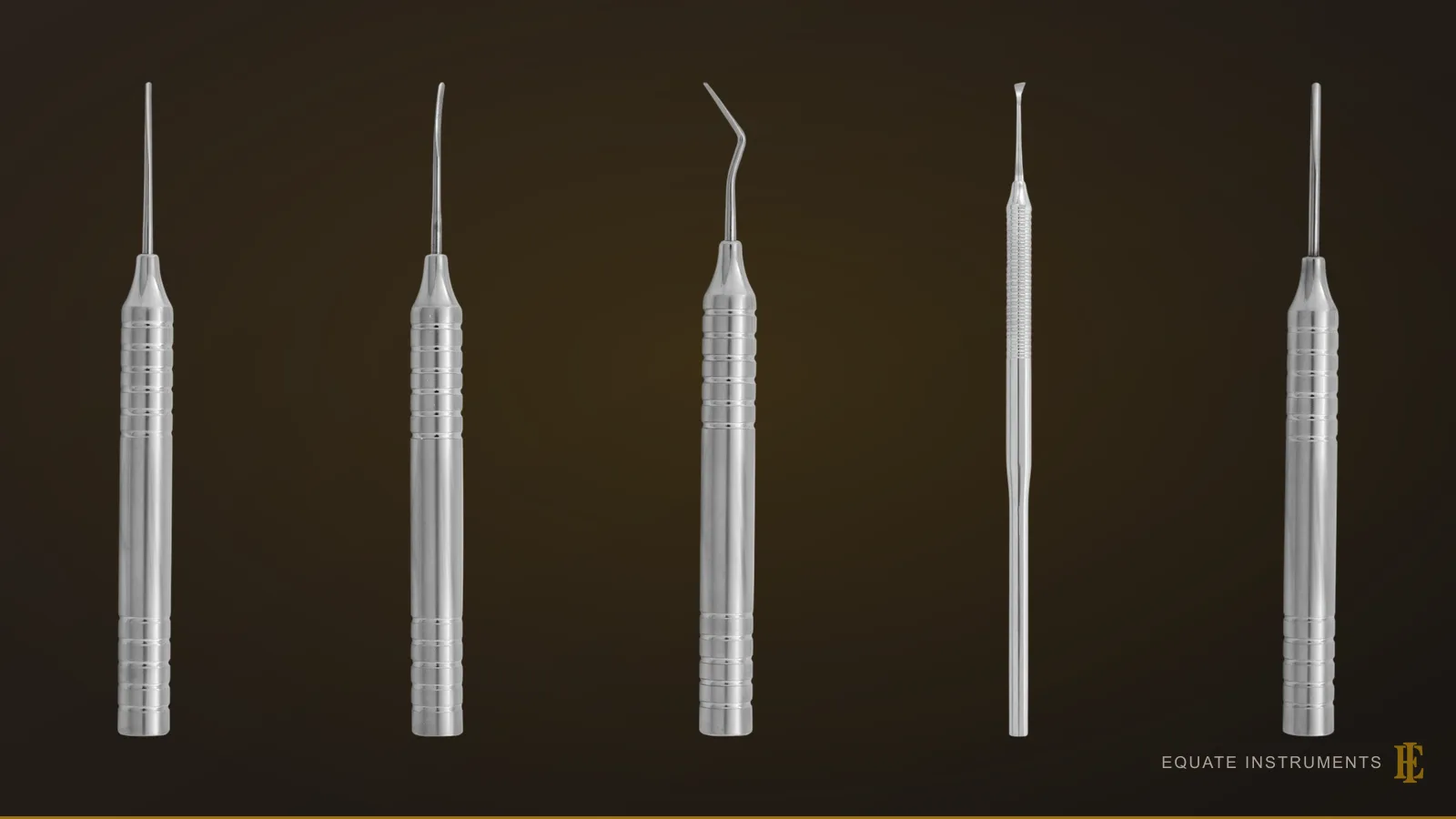
A periotome is a thin-bladed hand instrument that cuts the periodontal ligament fibres holding a tooth in its socket, so the tooth can be removed with little force and little damage to the surrounding bone. The blade is pushed down the root surface, parallel to its long axis, at several points around the tooth. Periotomes are used for atraumatic extraction, especially where an implant will follow.
Key points
- A periotome severs the periodontal ligament with apical pressure; unlike dental elevators, it isn't a lever.
- Sparing the thin buccal bone during extraction helps keep the ridge for an implant or socket preservation.
- Straight blades suit anterior teeth; curved, angled and flexible blades reach premolars, molar roots and line angles.
What is a periotome used for?
A periotome detaches a tooth from its socket by cutting the periodontal ligament, the band of collagen fibres that runs between the root cementum and the alveolar bone. Its blade is thin enough to enter the ligament space, which is only a fraction of a millimetre wide, and sharp enough to cut the fibres as it is advanced towards the apex. Once most of the fibres are cut, the tooth can usually be delivered with extraction forceps and light rotation, without levering against the socket walls.
The aim is to keep the bone intact: the buccal plate over the front teeth and premolars is often thin, and an elevator pivoting against it can fracture it. That is why periotomes sit on the atraumatic and implant side of the extraction instrument set; see the oral surgery and extraction instruments guide for where they sit beside elevators and forceps.
Why does atraumatic extraction matter for implants?
The ridge shrinks after any extraction, and damaging the socket walls makes the loss worse. In a 2005 experimental study, Araújo and Lindhe showed that the buccal crest, made largely of bundle bone that depends on the periodontal ligament, loses more height than the lingual wall in the first weeks of healing. Schropp and colleagues, following 46 patients for a year after single-tooth extraction, reported that the major changes in the extraction site happened during that first year.
A periotome can't stop this biological remodelling, but it avoids adding fractures and crushed bone to it. Keeping the walls intact gives the clinician the option of an immediate implant, a socket preservation graft with bone graft instruments once any granulation tissue has been cleared with a surgical curette, or a later implant in a ridge that is easier to restore.
Current implant guidance builds on this. The 7th ITI Consensus Conference (Lisbon, 2023), in statements by Hamilton, Gonzaga, Amorim, Wittneben, Morton, Martin, Gallucci and Wismeijer, lists an intact or minimally damaged facial bone plate among the criteria for immediate placement and immediate loading of a single implant in the upper aesthetic zone. Where the facial bone is thinner than 1 mm the protocol can still be considered, but the gap is grafted and a soft-tissue graft may be needed, so the state of the socket walls is checked once the tooth is out.
How do you use a periotome?
Hold the periotome in a modified pen grasp with a firm finger rest, and insert the blade into the gingival sulcus with the flat of the blade against the root, parallel to its long axis. Push it apically with steady, controlled pressure, a few millimetres at a time, and hold it there briefly so the ligament fibres yield. In a 2022 randomised trial, Alraqibah and colleagues pushed the blade to the maximum depth they could reach and held it for 10–15 seconds at each entry point before moving on.
Work around the tooth: interproximal surfaces first, where the bone is thickest, then the palatal or lingual surface, and the thin buccal side last and most gently. Repeat the circuit, going deeper each time, until the tooth is mobile. Multi-rooted teeth are usually sectioned first so each root can be treated as a single-rooted tooth.
- Don't lever or twist the blade: it is built to cut, and a periotome used as an elevator bends or snaps.
- Keep the blade on the root, not on the bone, so the cut stays in the ligament space.
- If the tooth won't move after several circuits, switch to a sectioning approach rather than forcing the instrument.
What is the difference between a periotome, a luxator and an elevator?
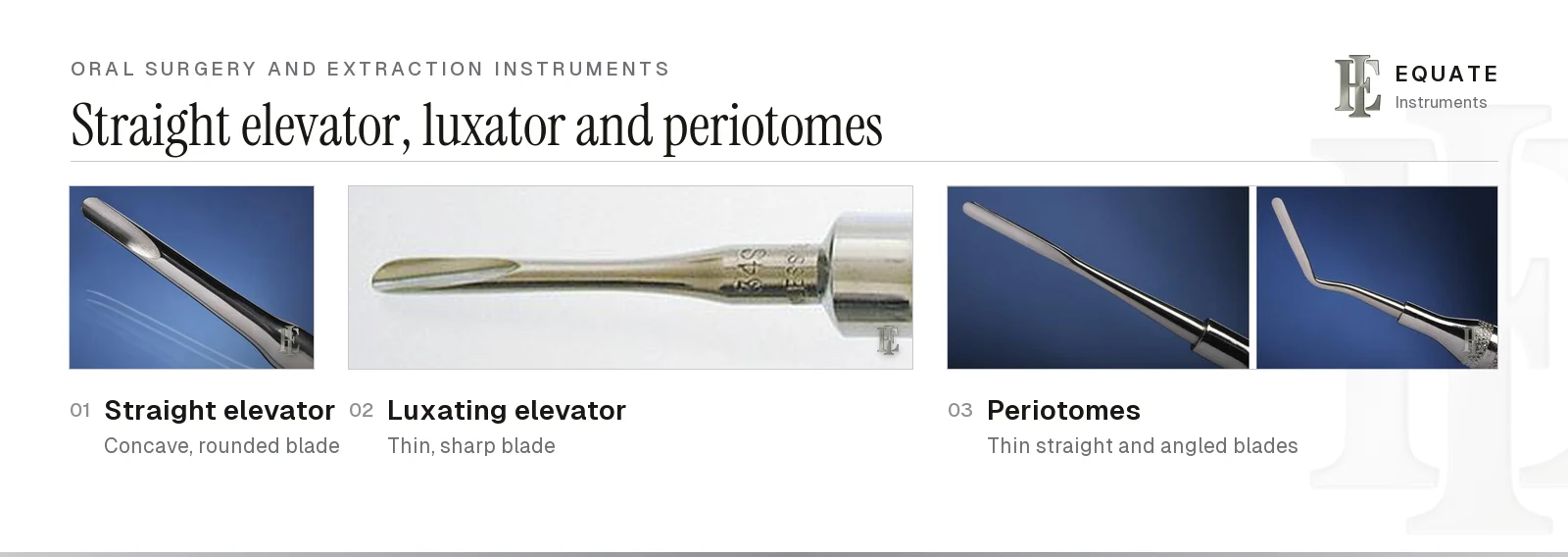
The three instruments sit on a scale from cutting to leverage. Luxators and elevators are covered in the dental elevators guide; flap reflection, which comes first in surgical cases, is the job of periosteal elevators.
| Instrument | Blade | Main action | Best for |
|---|---|---|---|
| Periotome | Very thin, flat or curved, often flexible | Cuts the ligament by apical pressure | Atraumatic extraction before implants, thin buccal bone |
| Luxator | Thin, sharp, concave | Cuts the ligament and wedges the root | Loosening roots and teeth with moderate access |
| Elevator | Thicker, concave or triangular | Wedging, rotation and leverage | Mobilising teeth and retained roots |
What types of periotome are there?
| Type | Blade | Typical use |
|---|---|---|
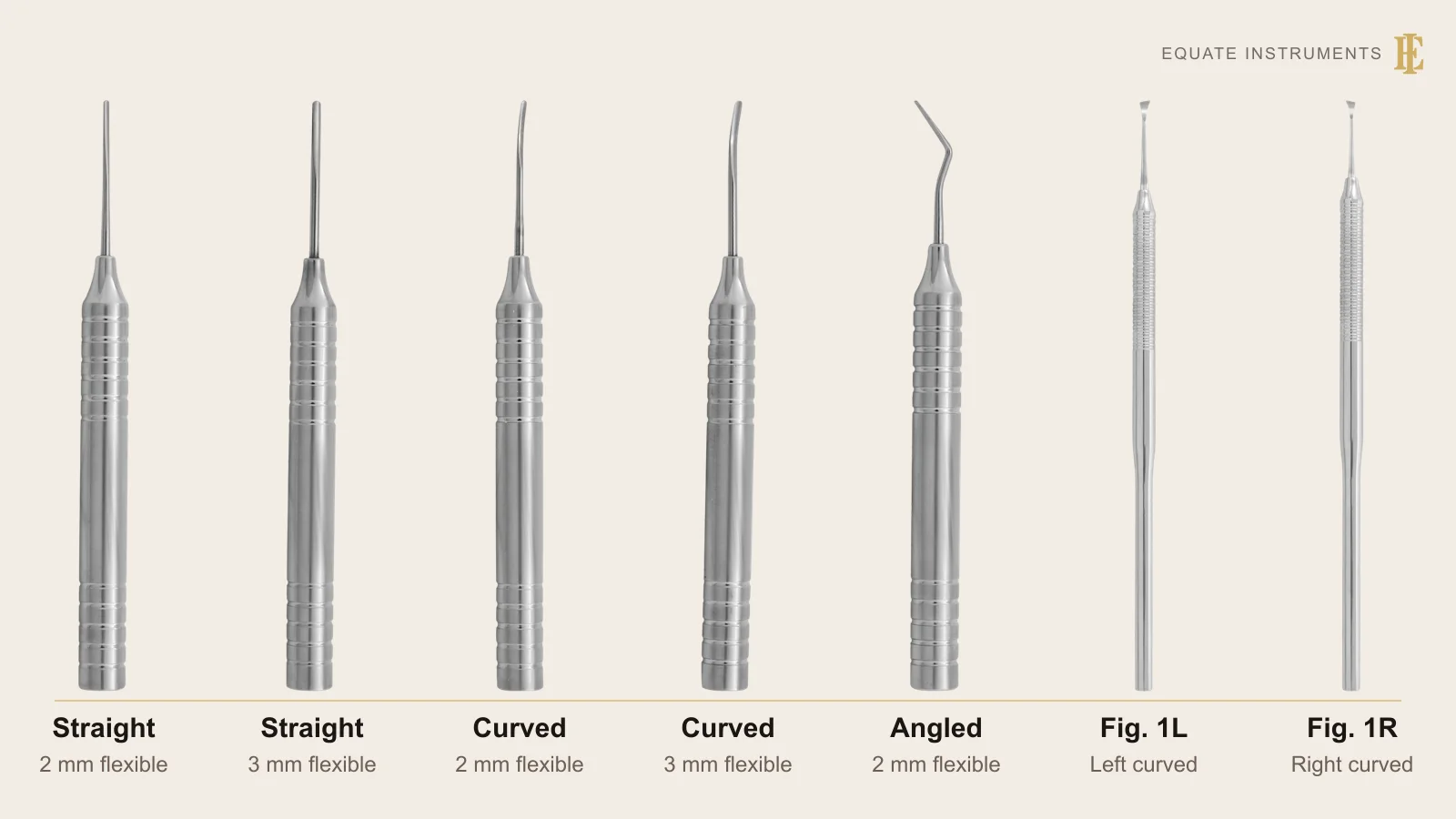
| Straight | Flat blade in line with the handle, often 2 mm or 3 mm | Incisors, canines and the buccal and lingual surfaces of premolars |
| Curved | Blade with a single curve away from the handle line | Interproximal surfaces and premolar roots |
| Angled or double-curved | Blade with a sharper bend near the tip | Posterior teeth and the distal surfaces of molar roots |
| Left and right curved | Mirror-image blades, for example Fig. 1L and 1R | Reaching mesial and distal line angles on either side of the arch |
| Flexible | Thin blade that bends slightly to follow the root contour | Tapered or curved roots, without gouging the socket wall |
| Replaceable-tip and double-ended | A handle that takes a new blade, or a different blade at each end | Replacing a worn tip without buying a new instrument; fewer instruments on the tray |
| Sets | Straight and curved blades in matched widths | Covering the whole arch, often supplied with a cassette |
Does the evidence support using periotomes?
Small randomised trials suggest periotomes make single-rooted extractions more comfortable. Sharma and colleagues, in a 2015 double-blind trial of 100 patients, compared a periotome with a periosteal elevator, each followed by forceps: pain in the periotome group fell by 52.8% between the preoperative and postoperative assessments, while it rose by 65% in the elevator group. In Alraqibah's 2022 trial of 48 teeth, periotome extractions were quicker than piezo-surgical ones, at about 5 minutes against 8, with lower pain during the procedure; the piezo-surgical group had slightly fewer gingival lacerations, but the difference wasn't significant.
Both trials were small and limited to single-rooted teeth, so they support periotomes as a gentle option rather than prove better long-term bone outcomes.
What does the Equate range include?
Equate lists 23 periotomes. The 14 curved designs include flexible 2 mm and 3 mm blades, angled 2 mm blades, a 2.2 mm curved/straight and a 2.2 mm double-curved periotome on hollow handles, the Periotome 1 and Periotome 2 patterns, and Fig. 1L and Fig. 1R left and right curved periotomes on 6 mm solid handles. The 4 straight periotomes have flexible 2 mm and 3 mm blades, each on a silver or a black handle. There are 5 sets: two sets of 2 with straight and curved tips and three sets of 6, two of them supplied with a sterilisation cassette.
Each is made of passivated stainless steel, ultrasonically cleaned, shape-, boil- and performance-tested and individually packed. Equate instruments are designed in Finland, and clinics can request samples and a quote through the periodontal and hygiene range.
How do you choose and care for periotomes?
A practice starting with periotomes needs at least one straight and one curved blade, usually 2 mm, and adds a 3 mm blade for larger roots and a mirrored left and right pair for posterior line angles. A set is the simplest way to cover the arch, and it keeps the blades in a fixed layout on the surgical extraction tray.
The fine tips are the weak point. Process periotomes in an instrument cassette or a tip-protecting rack so they don't knock against other instruments in the ultrasonic bath or washer-disinfector, then heat-sterilise them as critical items, as the CDC recommends for instruments that enter tissue or bone. Inspect each tip under magnification: a curled, bent or chipped blade will tear the gingiva and should be retired rather than straightened.
The Equate difference
Equate lists 23 periotomes: 14 curved, 4 straight and 5 sets, with 2 mm, 2.2 mm and 3 mm blades, flexible-blade designs on silver or black handles, Fig. 1L and 1R left and right curved periotomes on 6 mm solid handles, and sets of 2 or 6, two of them in a sterilisation cassette.
Equate Periotomes for Atraumatic Extraction options

Periotome Curved / Straight 2.2 mm - Hollow Handle
EI-0051
Periotome Curved / Curved 2.2 mm - Blue Plasma Hollow Handle
EI-0052
Periotome 1 - Curved and Straight
EI-1003
Periotome 2 - Double-Curved
EI-1004
Flexible Periotome Kit for Dental Extraction - Set of 2 Blue
EI-1894
Fig. 1L Curved Periotome - Left, 6mm Solid Handle
EI-2226
Fig. 1R Curved Periotome - Right, 6mm Solid Handle
EI-2227
Periotomes Set of 6 - Flexible Straight and Curved
EI-3010
Flexible Periotome Set of 6 with Black Textured Handles and Sterilisation Cassette
EI-3011
Periotomes Set of 6 with Cassette Tray
EI-3012
Flexible Periotome Set of 2 with Straight and Curved Tips
EI-3017
Periotome 2 mm Curved - Flexible Blade
EI-3110Browse all periodontal & hygiene instruments
Buying in your market
Frequently asked questions
What is a periotome used for?
It cuts the periodontal ligament around a tooth so the tooth can be extracted with little force, which protects the surrounding bone. It is mainly used where an implant or socket graft will follow.
Is a periotome the same as a luxator?
No. Both cut the ligament, but a periotome has a thinner blade and works only by apical pressure, while a luxator is sturdier and also wedges the root. Neither should be used as a lever.
Can periotomes be used on molars?
Yes, usually after the molar has been sectioned so each root can be loosened on its own. Curved, angled and mirrored left and right blades reach the posterior line angles.
Does a periotome reduce pain after extraction?
Small randomised trials suggest it can. In a 2015 trial of 100 patients, pain fell after periotome-assisted extraction but rose when a periosteal elevator was used before the forceps.
How do you stop a periotome tip from bending?
Keep the blade parallel to the root, push rather than lever, and process the instrument in a cassette that protects the tip. A bent tip should be retired, not straightened.
Can a periotome replace an elevator completely?
Not always. Single-rooted teeth often come out with a periotome and forceps alone, but multi-rooted or ankylosed teeth are usually sectioned first, and an elevator is still needed to lift roots that the periotome has loosened.
References
- Sharma SD, Vidya B, Alexander M, Deshmukh S. Periotome as an aid to atraumatic extraction: a comparative double blind randomized controlled trial. Journal of Maxillofacial and Oral Surgery 2015;14(3):611–615
- Alraqibah MA, Rao JKD, Alharbi BM. Periotome versus piezotome as an aid for atraumatic extraction: a randomized controlled trial. Journal of the Korean Association of Oral and Maxillofacial Surgeons 2022;48(6):356–362
- Araújo MG, Lindhe J. Dimensional ridge alterations following tooth extraction: an experimental study in the dog. Journal of Clinical Periodontology 2005;32(2):212–218
- Schropp L, Wenzel A, Kostopoulos L, Karring T. Bone healing and soft tissue contour changes following single-tooth extraction: a clinical and radiographic 12-month prospective study. International Journal of Periodontics and Restorative Dentistry 2003;23(4):313–323
- Hupp JR, Tucker MR, Ellis E. Contemporary Oral and Maxillofacial Surgery, 7th edition. Elsevier, 2018 (principles of routine and complicated exodontia)
- Kohn WG, Collins AS, Cleveland JL, et al. Guidelines for Infection Control in Dental Health-Care Settings, 2003. MMWR 52(RR-17), Centers for Disease Control and Prevention
- Boyd LB. Dental Instruments: A Pocket Guide, 7th edition. Saunders/Elsevier, 2020. Chapter 17, Oral Surgery Extraction Instruments (photographs used under licence)
- Hamilton A, Gonzaga LH, Amorim KG, Wittneben J-G, Morton D, Martin WC, Gallucci G, Wismeijer D. Selection criteria for immediate implant placement and immediate loading for single tooth replacement in the maxillary esthetic zone. 7th ITI Consensus Conference, Lisbon 2023. ITI Consensus Database
I am a…