Dental Carvers: Types of Carvers in Dentistry and the Lab
Written by the Equate Instruments Technical Team · Reviewed by the Medical & Dental Board, Equate Instruments · Updated ·
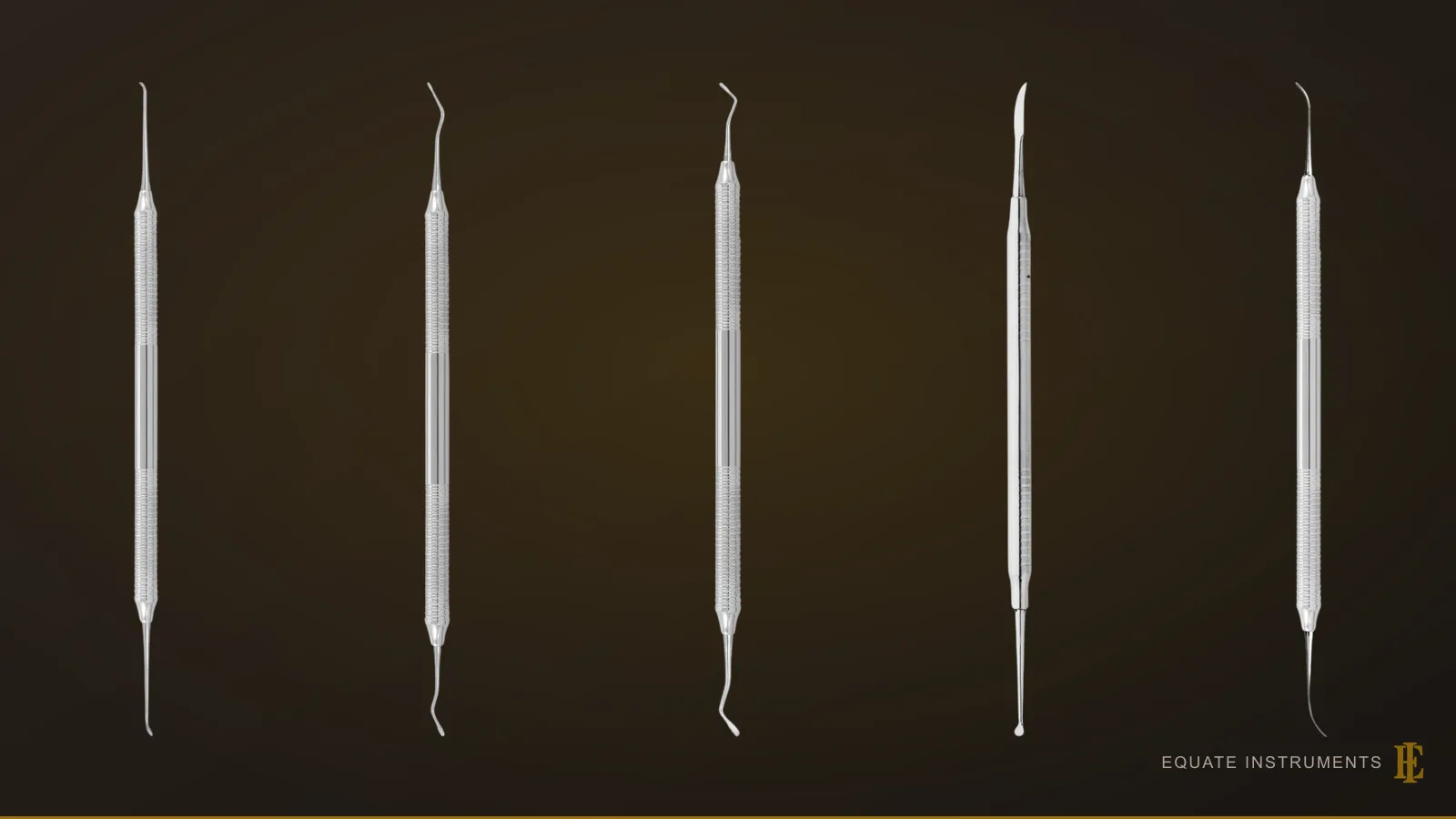
A dental carver is a sharp-bladed hand instrument used to sculpt the anatomy of a restoration and trim away excess material. In the surgery, discoid-cleoid, Hollenback, Tanner, Ward and interproximal carvers shape amalgam, temporary materials and composite. In the laboratory, Le Cron, Zahle and P. K. Thomas instruments carve and build up wax patterns for crowns, inlays and dentures.
Key points
- Carve amalgam once it resists the blade, with the blade resting partly on the tooth so the margin guides it and isn't ditched.
- The discoid and cleoid blades descend from G. V. Black's chisel family: once used to remove caries, they now carve amalgam and wax.
- P. K. Thomas waxing instruments build anatomy up in wax cone by cone, rather than carving it out of a solid block.
What is a carver used for in dentistry?
A carver restores the shape the tooth had before the cavity was cut. After amalgam has been condensed with condensers and pluggers and smoothed with a burnisher, the carver removes the excess and sculpts the cusps, fossae, grooves and marginal ridges, so the restoration meets the opposing tooth correctly and has no overhang or ledge at the margin. Carvers also trim temporary fillings and remove flash from composite, which is otherwise shaped with composite instruments, and in the laboratory they carve the wax patterns that become cast crowns, inlays and denture teeth.
Farhad Hadavi's notes on cavity preparation, published by Columbia University, trace the discoid and cleoid back to G. V. Black's chisel family: disc-shaped and claw-shaped blades that were once used to remove caries and are now used to carve amalgam and wax. The amalgam restorative instruments guide shows the carvers in the order they come out during a filling, and the restorative instruments hub shows where carvers sit among the other filling instruments.
What types of carvers are there in dentistry?
Carvers are named after the shape of the blade or the clinician whose pattern they follow, and most are double-ended with two different blades.
| Carver | Working ends | Main use |
|---|---|---|
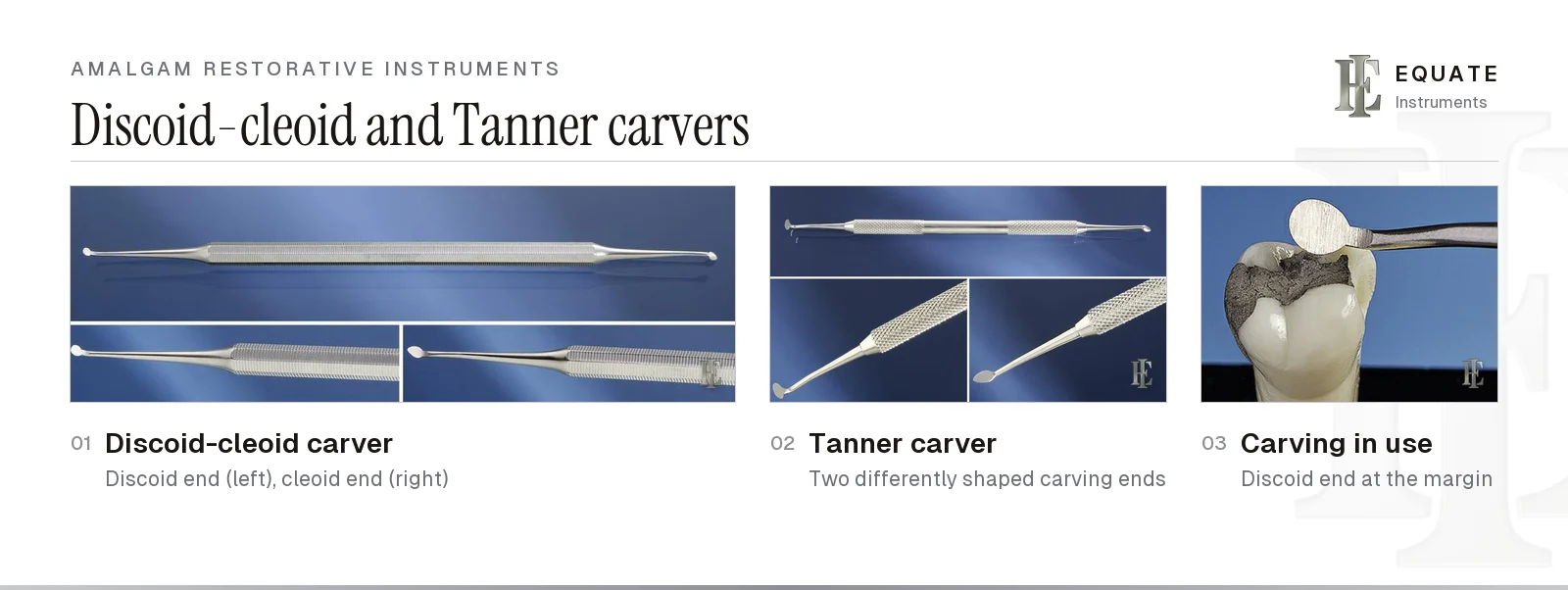
| Discoid-cleoid | A disc-shaped blade on one end and a pointed, claw-shaped blade on the other | Occlusal anatomy: the cleoid for grooves and fossae, the discoid for cusp slopes |
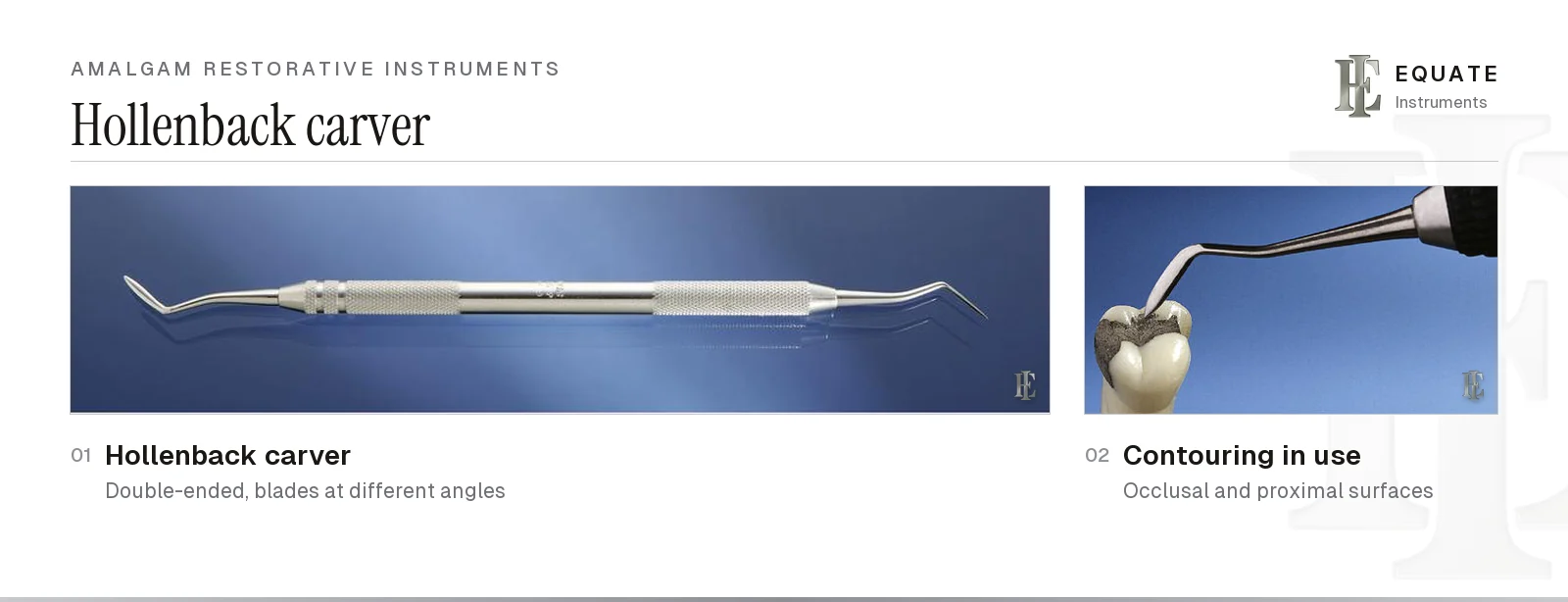
| Hollenback and half-Hollenback | Two thin, contra-angled blades facing opposite ways; the half-Hollenback is smaller | Occlusal and interproximal carving, especially near the margins |
| Tanner | Two differently shaped blades, distinct from the discoid-cleoid | Occlusal anatomy in amalgam and temporary materials |
| Ward's carver (Ward pattern) | Double-ended blades for amalgam and wax | General carving in amalgam, wax and temporary materials |
| Interproximal carver or knife | A thin, sharp blade | Trimming proximal surfaces and removing overhangs and flash |
| Gold carving knife | A thin, sharp knife blade, single- or double-ended in several designs | Trimming proximal flash on amalgam and composite and restoring the proximal contour |
| Le Cron (Hylin-LeCron) | A knife-like blade on one end and a small spoon on the other | Carving wax patterns in the laboratory |
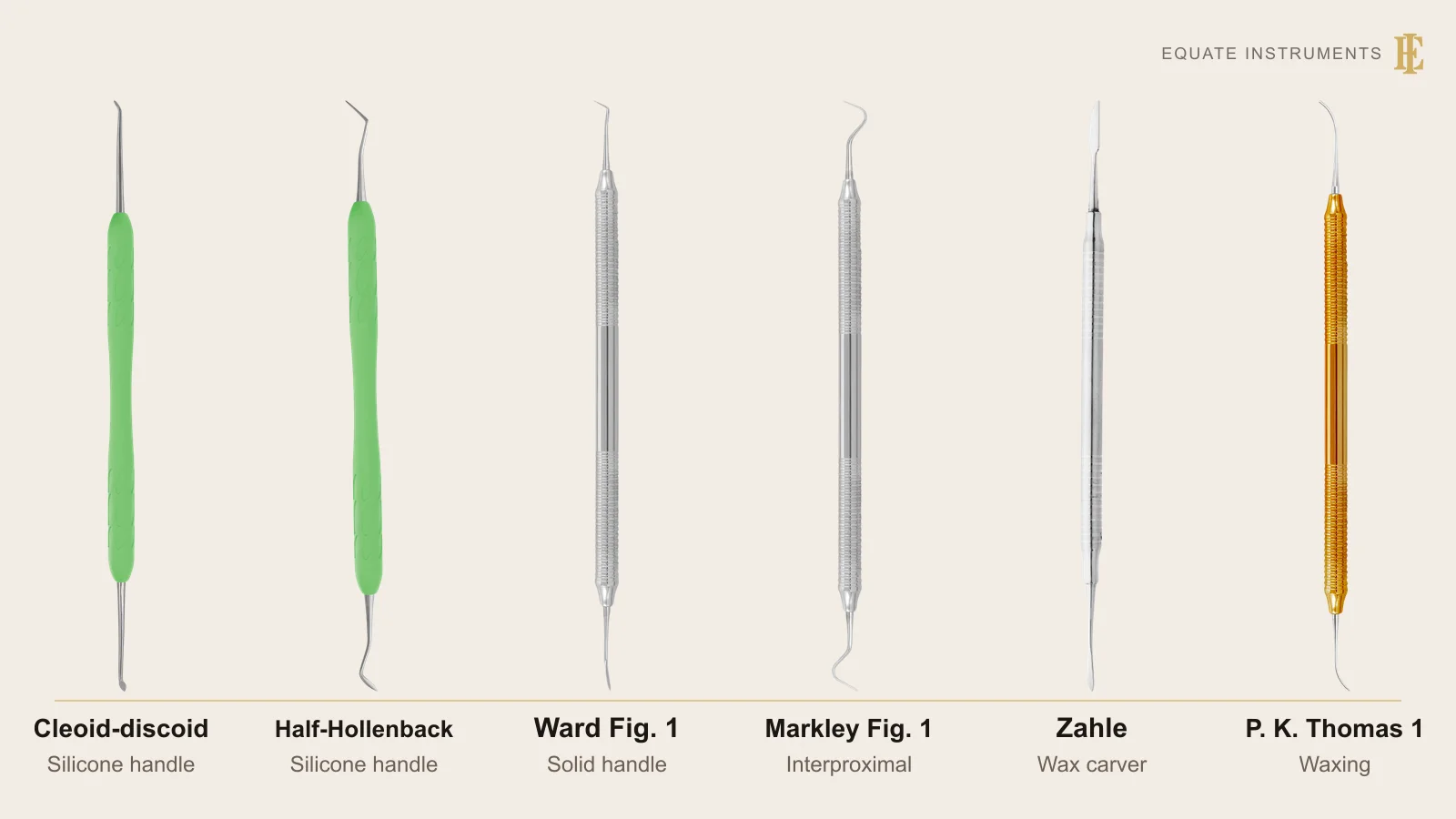
| P. K. Thomas waxing instruments | A numbered set of five fine instruments | Adding and refining wax anatomy in a wax-up |
How do you carve occlusal anatomy in amalgam?
Start straight after condensation with an explorer. Run its tip along the inside of the matrix band from the buccal and then the lingual side of the box towards the centre, so the amalgam is freed from the band, and define the marginal ridge at the same height as the neighbouring tooth's. Begin carving when the amalgam has set enough to resist the blade and make a faint scraping sound, but before it's hard. Too early and the material drags; too late and it chips.
Remove the occlusal excess first with the discoid side, keeping clear of the margins for now. Then use the cleoid side to blend the restoration into the enamel without a step and to form the grooves and pits; a small Tanner can stand in for the cleoid in the central fossa and developmental grooves. Shape each cusp slope with the discoid or a Hollenback, working from the cusp tip down towards the groove, and leave the fossae shallow and rounded, since sharp, deep fossae weaken amalgam. Rest part of the blade on the unprepared enamel and draw it parallel to the margin, so the tooth acts as a guide and the blade can't cut a ditch at the edge, and don't let the tip pass the centre of the cavity. Grooves should be distinct but not deep, because deep carving leaves thin, fragile edges of amalgam. Farhad Hadavi's carving steps for Columbia University follow this order.
For the proximal surface, take the retainer off but leave the matrix band wedged in place, and shave upwards from the gingival corners with a Hollenback, using the neighbouring tooth's contour as a guide. Once the band and wedge are out, clear any cervical excess with a Hollenback or interproximal carver, check the bite with articulating paper and adjust the high spots. Finish with a light postcarve burnish. The amalgam restoration tray setup shows the carvers in order of use.
What is the difference between a Hollenback and a discoid-cleoid carver?
A discoid-cleoid carver has two different blades, a round disc and a pointed claw, and is mainly an occlusal carver. A Hollenback carver has two slim blades set at opposing angles, which reach the proximal surfaces and the margins of a box, so it's the usual choice for interproximal carving and for blending a restoration into the tooth at the margin. Many amalgam trays carry both, with a half-Hollenback for small premolars and primary teeth.
Which carvers are used for wax in the laboratory?
Wax carvers shape inlay, crown and denture wax-ups, and they work in two ways: carving wax away and adding it on. Le Cron carvers pair a knife-like blade with a small spoon, and Zahle carvers pair two flat blades, for carving and smoothing wax. P. K. Thomas instruments are for the additive method, in which the technician builds each cusp as a cone of molten wax and then adds the ridges. Bench wax knives used for bite rims and wax patterns are covered in the dental materials equipment guide.
Writing in the Journal of Indian Prosthodontic Society in 2011, G. Mulay and R. Dugal credit P. K. Thomas with the waxing technique for a cusp-to-fossa occlusal scheme and describe a role for each instrument: No. 1 positions the cusp cones and adds the ridges, No. 2 fills remaining voids, No. 3 smooths the grooves, No. 4 smooths the axial surfaces and No. 5 refines the ridges. They credit E. V. Payne with the first wax-added technique. Heat waxing instruments evenly in the flame and don't overheat them, because repeated heating to a high temperature softens the steel and the fine tips can bend or break.
How do you choose carvers?
Choose carvers by procedure, and keep the surgery and laboratory sets separate.
| Situation | Usual carvers |
|---|---|
| Class I and II amalgam | Discoid-cleoid, half-Hollenback, interproximal carver |
| Small premolars and primary molars | Half-Hollenback, small Tanner or small cleoid |
| Composite flash and proximal finishing | Interproximal carver or a non-stick composite carver |
| Temporary fillings | Discoid-cleoid or Ward pattern |
| Wax patterns in the laboratory | Le Cron, Zahle and a P. K. Thomas set |
What does the Equate range include?
Equate's carvers cover the surgery and the laboratory. The Hollenback group includes figures H1 to H4, Fig. 1/2, 3 and 4 Hollenbacks, a half-Hollenback and Frahm and Maehlum carvers; the discoid-cleoid group runs from 1.7/1.7 to 3.0/2.7 mm; and the Ward group includes Tanner figures 1 to 4, Ward figures 1 to 3, a Wiland and a universal occlusal-proximal carver. The interproximal group includes Markley figures 1 to 6, Ladmore and Wedelstaedt patterns; the Wedelstaedt is a curved hand cutter covered on the hand cutting instruments page.
For the laboratory there are P. K. Thomas figures 1 to 5 on solid, slim silicone or colour-coded ergonomic handles and as a set of five in a case, plus Hylin-LeCron and Zahle wax carvers. Clinics can request samples and a quote.
How do you clean and maintain carvers?
Remove amalgam from the blade before it sets, then clean, inspect and sterilise carvers in line with the manufacturer's ISO 17664-1 instructions and the CDC's Guidelines for Infection Control in Dental Health-Care Settings or HTM 01-05. A carver must be sharp to cut amalgam cleanly instead of dragging it, so hone the blades on a fine stone, following their original shape, and replace a carver whose blade has thinned or lost its profile. Keep laboratory wax instruments, and the wax spatulas on the dental spatulas page, off the clinical tray.
The Equate difference
Equate lists 81 carver references: 19 Hollenback-group carvers (Hollenback H1 to H4, half-Hollenback, Frahm and Maehlum), 19 Ward-group carvers including Tanner figures 1 to 4 and Ward figures 1 to 3, six discoid-cleoid carvers from 1.7 to 3.0 mm, 14 interproximal instruments including Markley figures 1 to 6, and 22 wax instruments (16 P. K. Thomas, four Hylin-LeCron and two Zahle), plus one non-stick carver.
Equate Dental Carvers: Types of Carvers in Dentistry and the Lab options

Composite Knife / Carver - Non-Stick Double-Ended
EI-0022
Carver 5 - Double-Ended 2.0/2.5mm with Knurled Handle
EI-0091
Nystrom I Composite Instrument - Hollow Stainless Handle
EI-0093
Nystrom III Carver 2.0/2.5mm - Knurled Handle
EI-0094
Double-Ended Dental Carver - Knurled Handle
EI-0100
Restorative Carving Instrument Solid Handle 6 mm
EI-0160
Nystrom I Composite Carver 2.0 mm - 6 mm Solid Handle
EI-0162
Nystrom III Composite Carver 2.0/2.5 mm - 6 mm Solid Handle
EI-0163
Fig.2 Ladmore 1.3/1.9mm Solid Handle 6mm
EI-0170
P.K. Thomas Fig. 3 Waxing Instrument - Solid Handle 6mm
EI-0172
Nystrom III Carver 1.8 mm
EI-0921
Nystrom I 2.0 mm Composite Instrument
EI-0924Browse all restorative & operative instruments
Buying in your market
Frequently asked questions
What are the types of carvers in dentistry?
The main clinical carvers are the discoid-cleoid, Hollenback and half-Hollenback, Tanner, Ward and interproximal carvers. Laboratory wax carvers include the Le Cron, Zahle and P. K. Thomas instruments.
What is a discoid-cleoid carver used for?
It carves occlusal anatomy in amalgam and temporary materials. The pointed cleoid end defines grooves and fossae, and the disc-shaped discoid end shapes the cusp slopes.
What is a Le Cron carver used for?
A Le Cron carver is a wax carver with a knife-like blade on one end and a small spoon on the other. It's used to carve and smooth wax patterns for crowns, inlays and dentures.
What is an interproximal carver?
An interproximal carver, or carving knife, has a thin, sharp blade for trimming the proximal surface of a restoration. It removes overhangs at the gingival margin and flash between the teeth.
When should you start carving amalgam?
Start when the amalgam resists the blade and makes a faint scraping sound, but before it has hardened. Carving too early drags the material and carving too late chips it.
Why do new amalgam marginal ridges break?
Usually because the amalgam wasn't freed from the band before carving, the band sat below the neighbouring marginal ridge, the new ridge was left higher than its neighbour, the amalgam was poorly condensed or the band was loose.
References
- Mulay G, Dugal R. Waxing techniques to develop proper occlusal morphology in different occlusal schemes. Journal of Indian Prosthodontic Society 2011;11(4):205–209
- Hadavi F. Instruments and general instrumentation for cavity preparation. Teaching notes published by Columbia University
- Heymann HO, Swift EJ, Ritter AV (eds). Sturdevant's Art and Science of Operative Dentistry, 6th ed. Elsevier, 2013 (amalgam restorations: carving and finishing)
- Kohn WG, et al. Guidelines for Infection Control in Dental Health-Care Settings, 2003. MMWR 52(RR-17), Centers for Disease Control and Prevention
- ISO 17664-1:2021 Processing of health care products: information to be provided by the medical device manufacturer for the processing of medical devices, Part 1: critical and semi-critical medical devices
- Boyd LB. Dental Instruments: A Pocket Guide, 7th edition. Saunders/Elsevier, 2020. Chapter 8, Amalgam Restorative Instruments (photographs used under licence)
- Hadavi F. Steps in carving amalgam: class 2 cavity. Teaching notes published by Columbia University, 2004–2005
I am a…
Related
- Restorative Dental Hand Instruments
- Dental Burnishers: Ball, Football, Acorn, T-Ball and Beavertail
- Dental Pluggers and Condensers (Amalgam Condensers)
- Dental Hand Cutting Instruments: How Hatchets, Hoes, Chisels and Trimmers Differ and How to Use Them
- Amalgam Restoration Tray Setup
- Dental Spatulas (Cement, Plaster, Wax and Laboratory)
- Amalgam Restorative Instruments: What Each One Does
- Tofflemire and Other Matrix Band Retainers