Dental Composite Instruments: Placement, Sculpting and the Composite Gun
Written by the Equate Instruments Technical Team · Reviewed by the Medical & Dental Board, Equate Instruments · Updated ·
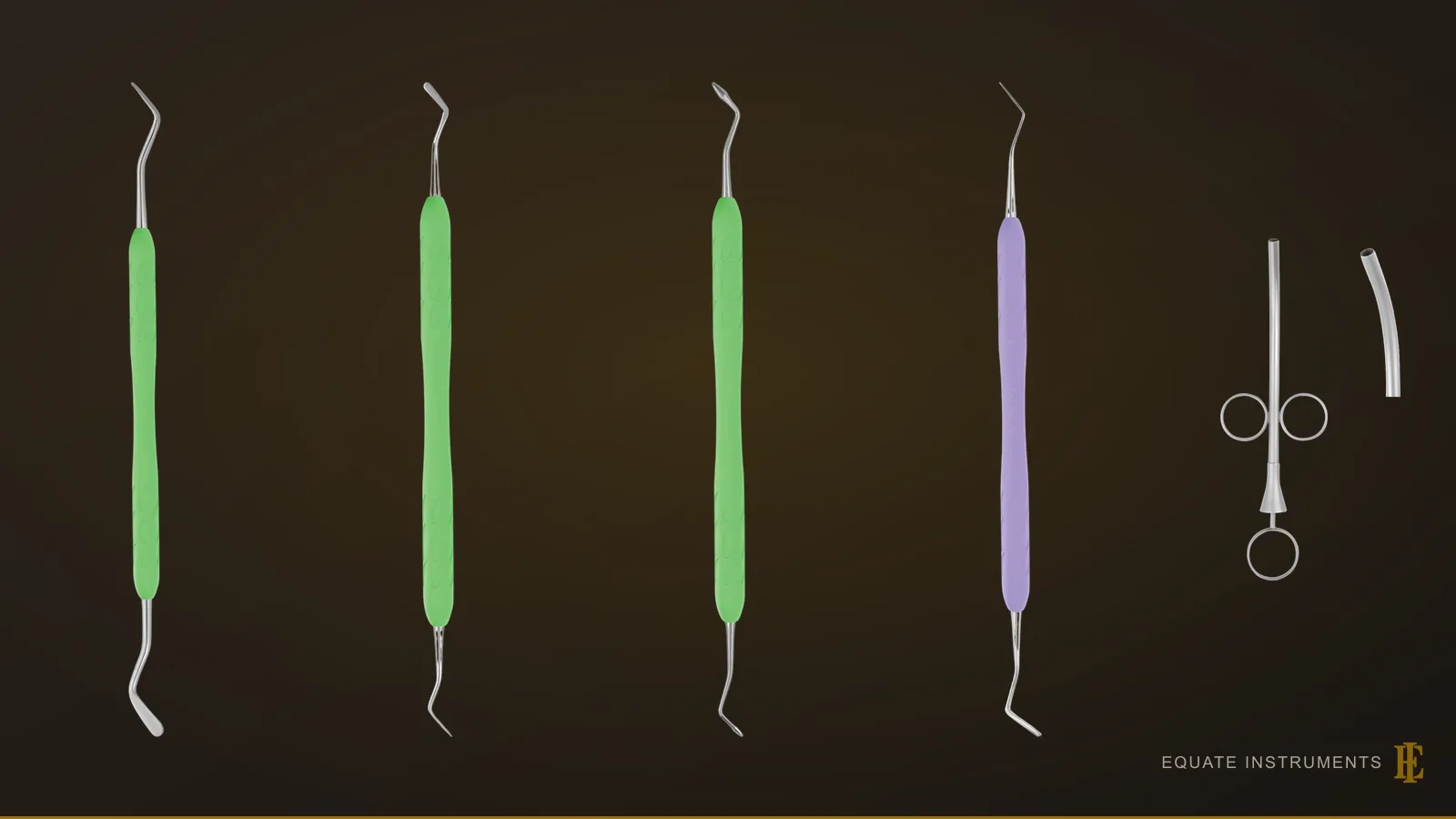
Composite instruments are the hand instruments used to carry, place, pack and sculpt resin composite before it's light-cured. They include placement instruments and spatulas, Heidemann and flow spatulas, pluggers and packer-modellers, composite burnishers and the composite gun that dispenses unit-dose capsules. Many have titanium nitride, gold-coloured or other hard coatings that resist scratching, so the tip stays smooth.
Key points
- Place composite in increments of about 2 mm and shape each one before curing, so less is left to remove with burs.
- A laboratory study found titanium nitride harder and smoother than steel but no less sticky than clean, highly polished steel.
- Stickiness depends on the composite as well as the instrument's diameter, shape and coating, so it pays to match the instrument to the material.
What are composite instruments used for?
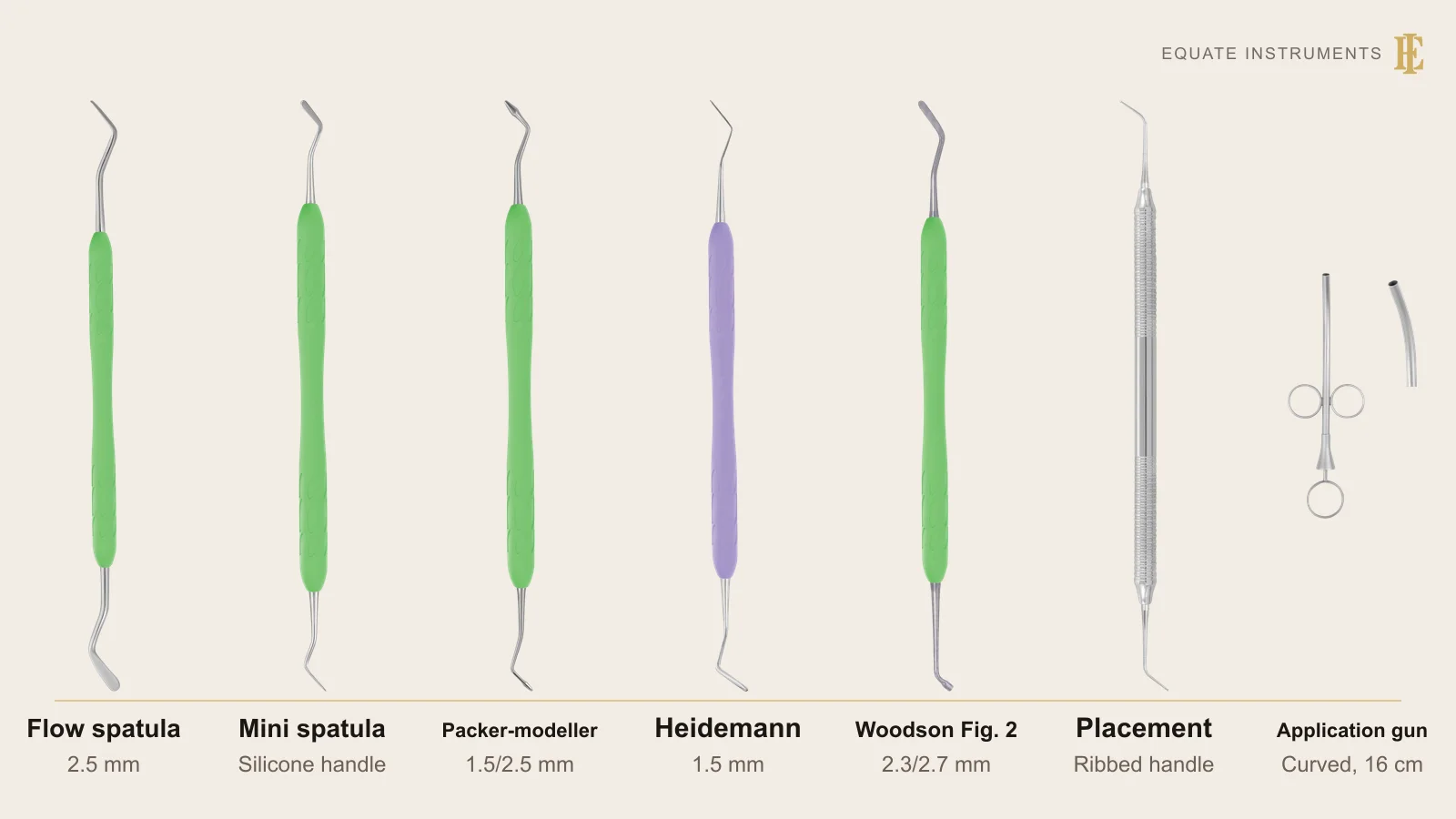
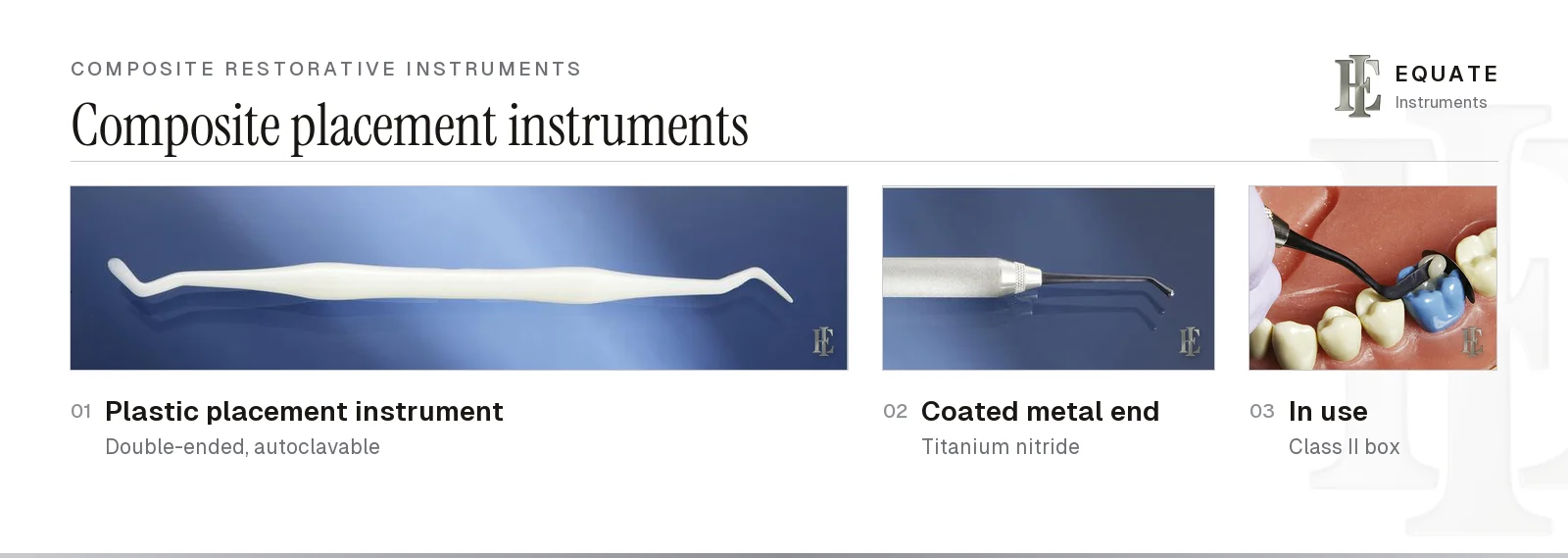
Composite instruments handle resin composite from the moment it leaves the capsule or syringe until it's cured. A placement instrument or paddle carries an increment to the cavity, a plugger or packer-modeller presses it against the walls and the matrix, a spatula or Heidemann blade spreads and adapts it, and a modeller or coated burnisher sculpts the anatomy. Composite is tacky and doesn't set until it's cured, so the instruments must release it cleanly and leave a smooth, void-free surface.
These are the composite-specific spokes of the restorative instruments hub, which covers plastic filling instruments in general. They work alongside the spoon excavator that prepares the cavity, a matrix band and retainer for Class II restorations, and the composite restoration tray setup. For the matrices, bonding applicators, curing lights and finishing strips used alongside them, see the composite restorative instruments guide.
What types of composite instrument are there?
Composite instruments are grouped by what the working end does to the material.
| Type | Working end | Use |
|---|---|---|
| Placement instrument or paddle | A small flat paddle, often paired with a condenser on the other end | Carrying increments to the cavity |
| Composite spatula | A thin, smooth blade in anterior, posterior or universal shapes | Spreading and adapting composite to walls and the matrix |
| Heidemann spatula | A flat blade on one end, a narrow blade on the other | Anterior layers, cervical restorations and cement |
| Flow and mini spatulas | Very thin, narrow blades | Small anterior restorations, flowable composite and fissures |
| Composite plugger or packer-modeller | A cylindrical, conical or flat face | Packing increments and shaping cusps |
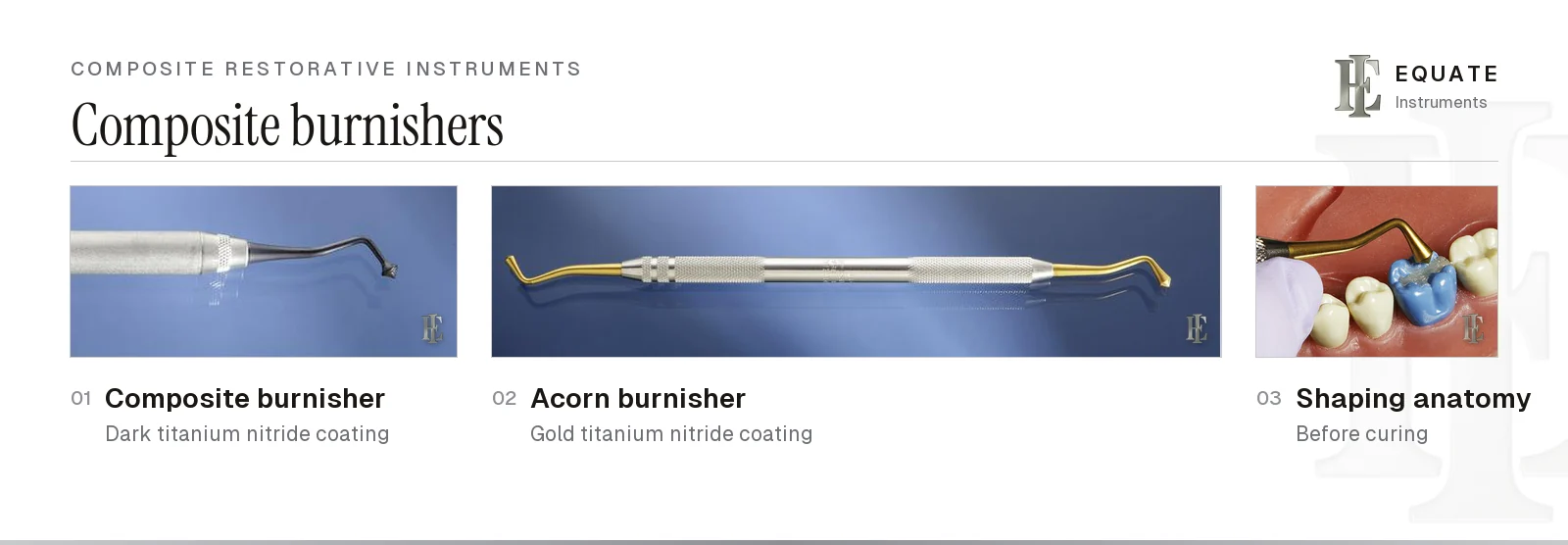
| Composite burnisher | An acorn or ball end, usually coated | Forming fissures and grooves before curing |
| Composite gun | A dispenser for unit-dose capsules or a tube applicator | Placing composite directly into the cavity |
| Restoration kit | A matched set of the above | A complete tray for direct composites |
Do non-stick coatings on composite instruments work?
Coatings make instruments harder and smoother, but they don't remove stickiness on their own. In a laboratory study in the Journal of Dentistry in 1991, J. G. Steele, J. F. McCabe and I. E. Barnes compared a 5-micron titanium nitride coating with polished stainless steel: the coating was much harder, had lower friction and resisted damage and discolouring the material, but it was slightly stickier to composite than highly polished steel. In 2019, M. Rosentritt and colleagues measured the force needed to pull instruments out of uncured composite and found that it depended on the composite itself and on the instrument's diameter, geometry and coating.
In practice, the benefit of titanium nitride, gold-coloured titanium and PTFE (polytetrafluoroethylene) coatings is that they keep a smooth, hard surface after many cycles, whereas bare steel scratches, and scratched steel drags composite. Resin (plastic) composite instruments are the other construction, useful for shade-sensitive anterior work because they can't grey the material, though they wear and bend over time. Whatever the instrument, keep it clean and dry between increments, and avoid lubricating it so heavily that the resin is diluted.
How do you layer and sculpt a composite restoration?
Build the restoration in increments of about 2 mm, curing each one for the time and light output the material needs, unless you're using a bulk-fill material made for thicker layers. Polymerisation shrinkage pulls the composite away from the walls, and in 1987 A. J. Feilzer, A. J. de Gee and C. L. Davidson showed in the Journal of Dental Research that the stress depends on the configuration of the cavity: the more bonded walls relative to free surface, the higher the stress. Small, oblique increments that touch only one or two walls keep each layer's ratio low.
In a Class II cavity, build the proximal wall first against the matrix with a spatula or thin plugger, turning the cavity into a Class I, then add the dentine body and finally the enamel layer cusp by cusp. Shape each cusp with a modeller or packer before curing, press fissures with a coated burnisher, whose acorn shape sits in molar fossae, and remove excess at the margins with a fine spatula or interproximal carver. Anterior restorations are layered from the palatal shell outwards with a Heidemann or thin flat spatula.
What is a composite gun and how is it used?
A composite gun is a dispenser that pushes composite out of a single-use capsule, or compule, straight into the cavity. The clinician loads a capsule into the head, places the nozzle in the deepest part of the preparation and squeezes the handle to extrude a measured increment, which reduces air trapped between layers and avoids handling the material. The capsule is used for one patient and discarded; the gun itself is cleaned and sterilised between patients. Tube-style application guns work the same way, with a plunger pushing material through a stainless-steel cannula.
Which composite instruments suit which restoration?
Choose by cavity class and material.
| Restoration | Useful instruments |
|---|---|
| Class I posterior | Packer-modeller, coated burnisher, posterior spatula |
| Class II posterior | Thin spatula or plugger for the proximal wall, matrix retainer, packer-modeller |
| Class III and IV anterior | Heidemann or flat spatula, mini spatula, anterior placement instrument |
| Class V cervical | Heidemann spatula, mini or flow spatula |
| Flowable liners and fissures | Flow spatula or a fine application gun nozzle |
What does the Equate range include?
Equate's composite range includes UP1, anterior, posterior and universal placement instruments and composite spatulas, Woodson figures 2 and 3, mini, flow and fissure spatulas, and Heidemann spatulas from 1.5 to 3.0 mm in standard, flexible and titanium gold-coated versions. Non-stick titanium-coated anterior, posterior, mini and universal spatulas sit beside uncoated equivalents, and the pluggers include 1.3 and 1.6 mm composite pluggers and packer-modellers in several shapes. Two curved stainless-steel application guns with 1.5/2.5 and 2.5/3.5 mm cannulas, 16 cm long, place flowable materials.
There are also seven restoration kits, including non-stick sets in a plastic tray or stainless-steel cassette and a six-piece set with gold plasma tips. Handles include solid 6 mm, hollow 10 mm and slim colour-coded silicone. Clinics can request samples and a quote.
How do you clean and care for composite instruments?
Wipe composite off with a gauze before it's cured on the blade, and never chip cured resin off with a scaler or bur, which scratches the surface. Clean, inspect and sterilise in line with the manufacturer's ISO 17664-1 instructions and the CDC's Guidelines for Infection Control in Dental Health-Care Settings or, in UK practices, HTM 01-05, and avoid abrasive pastes on coated tips. Replace an instrument once the coating has worn through or the blade is scratched, because composite starts to stick again.
The Equate difference
Equate lists 66 composite instrument references: 17 composite spatulas and placement instruments (including UP1, anterior and posterior patterns and Woodson figures 2 and 3), nine flow and mini spatulas, eight non-stick spatulas, 12 Heidemann spatulas from 1.5 to 3.0 mm, seven composite pluggers and packer-modellers, four placement instruments, two curved application guns and seven restoration kits, with ten coated or non-stick references.
Equate Dental Composite Instruments: Placement, Sculpting and the Composite Gun options

Heidemann Flex Composite Spatula 2.0 mm - Solid Handle
EI-0048
Heidemann Composite Spatula 2.5 mm - Solid Handle
EI-0049
Heidemann Flex Composite Spatula 3.0 mm - Solid Handle
EI-0050
Composite Instrument Anterior - Double-Ended Hollow Handle
EI-0097
Composite Spatula 2.5mm - Knurled Hollow Handle
EI-0098
Composite Plugger 1.6mm/1.3mm - Knurled Handle
EI-0101
Composite Plugger No. 2 Flat - Double-Ended Knurled Handle
EI-0102
Composite Trimmer - Hollow Handle
EI-0103
Anterior Composite Placement Instrument 1.7/1.2 mm, Solid Handle 6 mm
EI-0166
Heidemann Flexible Spatula 2.5 mm - 6 mm Solid Handle
EI-0167
Composite Instrument UP1 - Double-Ended Solid Handle
EI-0193
Plastic Filling Instrument - Posterior
EI-0922Browse all restorative & operative instruments
Buying in your market
Frequently asked questions
What instruments are used for composite fillings?
Usually a placement instrument or spatula to carry and spread the material, a plugger or packer-modeller to pack it, and a coated burnisher or modeller to sculpt it, with a composite gun often used to dispense it from a capsule. Class II cavities also need a matrix and a wedge.
What is the difference between a composite spatula, a plugger and a placement instrument?
A placement instrument carries an increment to the cavity on a small paddle, a spatula has a thin blade that spreads and adapts the composite against the walls and the matrix, and a plugger has a cylindrical or flat face that packs it down. Many double-ended instruments combine two of these ends.
What is a composite plugger?
A composite plugger is a hand instrument with a smooth, often coated, cylindrical or flat face that packs increments of composite against the walls and matrix. It's smoother than an amalgam condenser so it doesn't tear the uncured resin.
Why do composite instruments have a gold or titanium coating?
Mainly for durability. In a 1991 laboratory study a titanium nitride coating was harder, had lower friction and was unlikely to discolour composite, but it was slightly stickier than clean, highly polished steel, even after wear. Its value is that it stays smooth over many cycles, whereas bare steel scratches and scratched steel drags composite.
What is a PTFE-coated composite instrument?
It's an instrument with a polytetrafluoroethylene (PTFE) coating or tip, a low-friction plastic that composite doesn't bond to. Like other coatings, it must be kept free of scratches to keep working.
Can I wet my composite instrument with bonding agent or a modelling liquid?
Only with a trace, if at all. A 2022 scoping review of 16 laboratory studies found that modelling liquids and bonding agents used as lubricants can change the surface properties of composite, depending on the product, and a 2022 study found that composite mixed 1:1 with handling agents bonded less strongly to enamel and dentine. Wiping the tip clean between increments is usually enough.
How thick should composite increments be?
For conventional composites, about 2 mm, with each layer cured before the next is added. Bulk-fill composites are made for thicker layers, so follow the depth and curing time in the material's instructions.
What is the C-factor in a composite restoration?
It is the ratio of bonded to unbonded (free) surfaces in the cavity. Feilzer, de Gee and Davidson showed in 1987 that setting stress rises as the ratio rises, which is why composite is added in small, oblique increments that each touch only one or two walls.
References
- Steele JG, McCabe JF, Barnes IE. Properties of a titanium nitride coating for dental instruments. Journal of Dentistry 1991;19(4):226–229
- Rosentritt M, Hartung J, Preis V, Krifka S. Influence of placement instruments on handling of dental composite materials. Dental Materials 2019;35(2):e47–e52
- Feilzer AJ, de Gee AJ, Davidson CL. Setting stress in composite resin in relation to configuration of the restoration. Journal of Dental Research 1987;66(11):1636–1639
- Ferracane JL. Resin composite: state of the art. Dental Materials 2011;27(1):29–38
- Heymann HO, Swift EJ, Ritter AV (eds). Sturdevant's Art and Science of Operative Dentistry, 6th ed. Elsevier, 2013 (direct composite restorations)
- Kohn WG, et al. Guidelines for Infection Control in Dental Health-Care Settings, 2003. MMWR 52(RR-17), Centers for Disease Control and Prevention
- Boyd LB. Dental Instruments: A Pocket Guide, 7th edition. Saunders/Elsevier, 2020. Chapter 9, Composite Restorative Instruments (photographs used under licence)
- Paolone G, Mazzitelli C, Josic U, et al. Modeling liquids and resin-based dental composite materials: a scoping review. Materials 2022;15(11):3759
- Kim M, Jo DW, Khalifah SA, et al. Shear bond strength of composite diluted with composite-handling agents on dentin and enamel. Polymers 2022;14(13)
I am a…
Related
- Restorative Dental Hand Instruments
- Dental Burnishers: Ball, Football, Acorn, T-Ball and Beavertail
- Tofflemire and Other Matrix Band Retainers
- Dental Pluggers and Condensers (Amalgam Condensers)
- Composite Restoration Tray Setup (Class I to V)
- Composite Restorative Instruments, from Matrix Band to Finishing Strip
- Dental Spatulas (Cement, Plaster, Wax and Laboratory)
- Spoon Excavators (Dental Excavators)
- Dental Carvers: Types of Carvers in Dentistry and the Lab