Archwire Ligation Setup
Written by the Equate Instruments Technical Team · Reviewed by the Medical & Dental Board, Equate Instruments · Updated ·
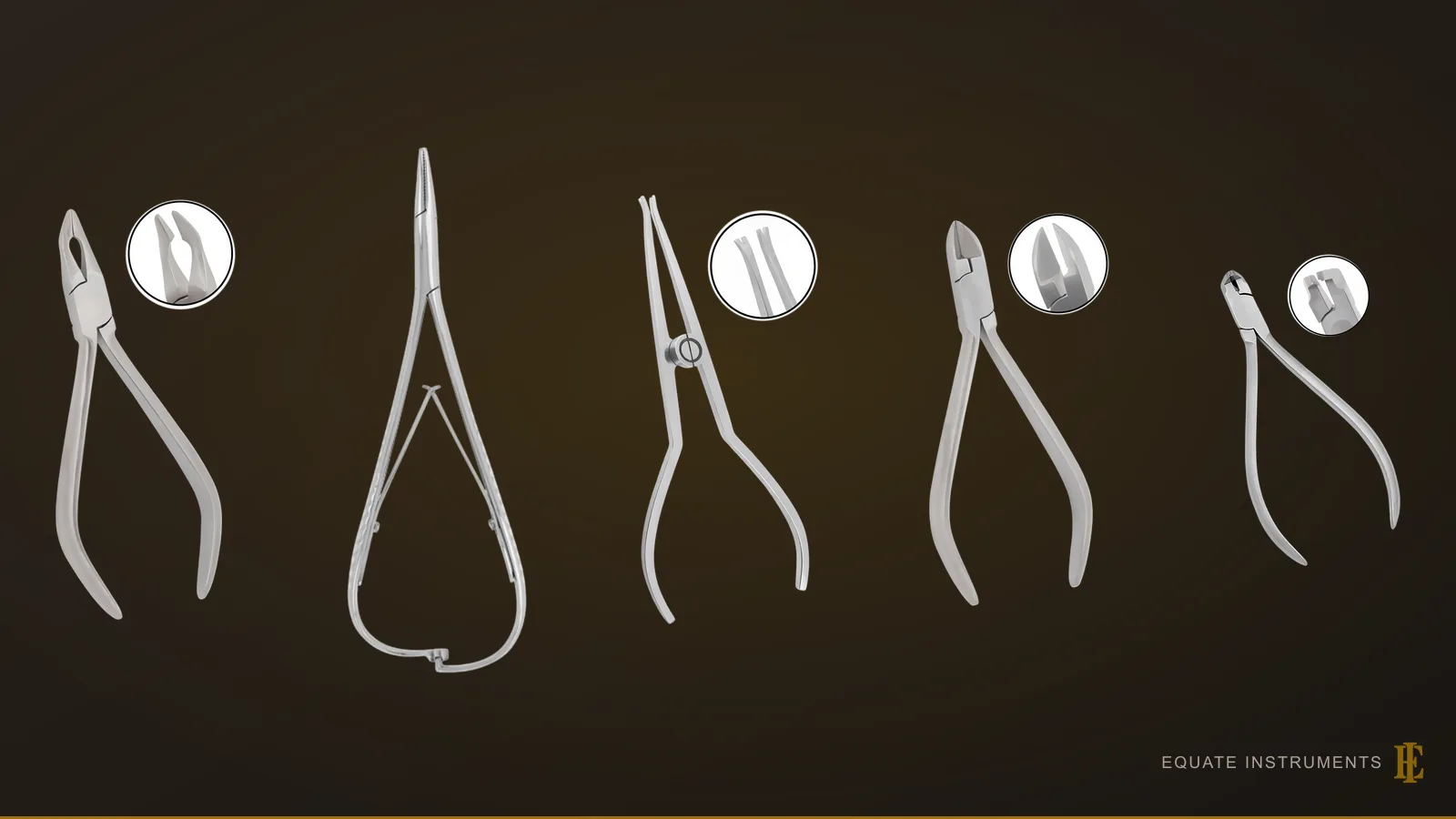
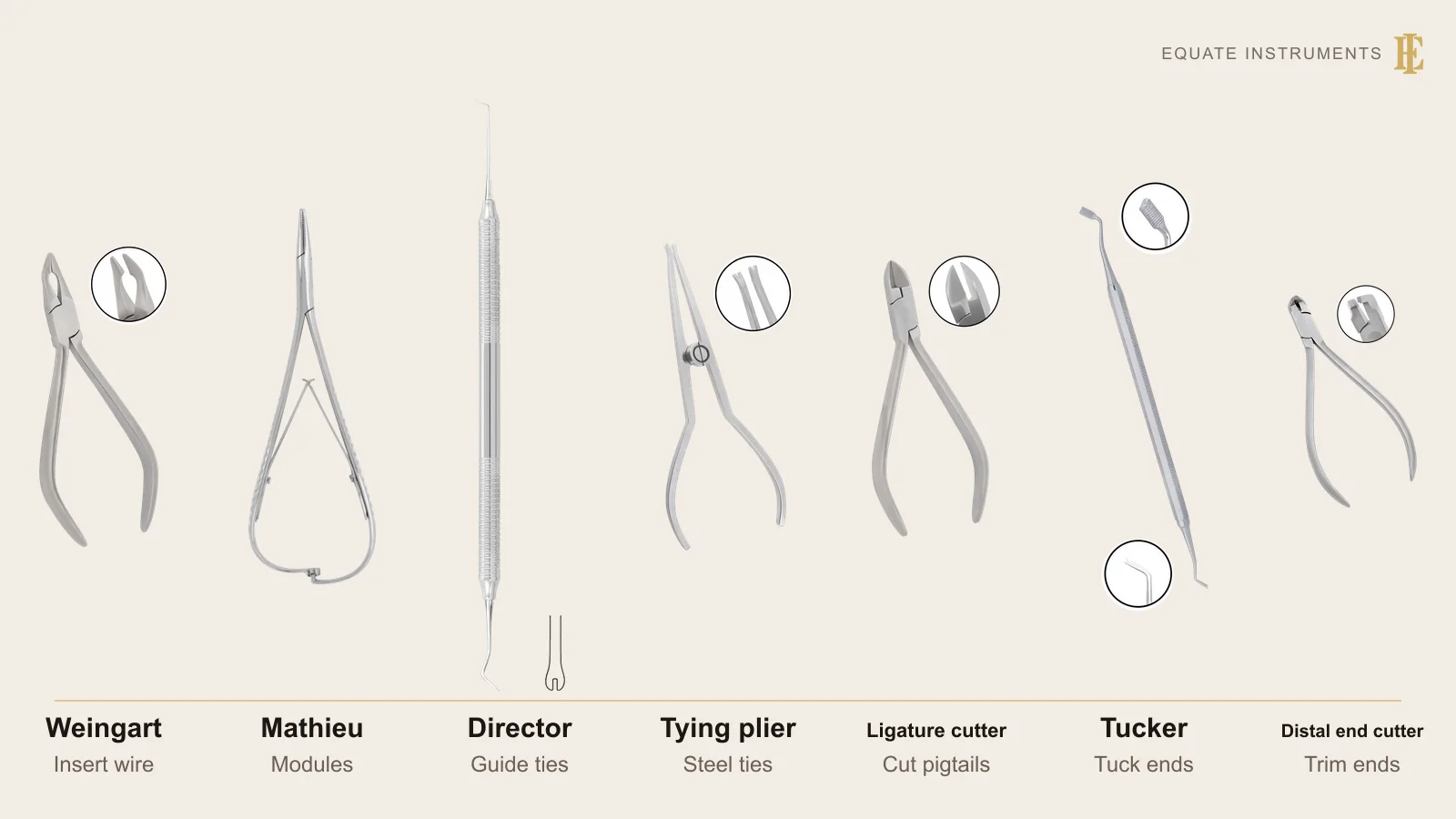
An archwire ligation setup is the tray for inserting an orthodontic archwire and tying it into the brackets. It holds a Weingart plier to place the wire, a Mathieu plier and ligature director for elastomeric modules, a ligature tying plier for steel ties, a ligature cutter and ligature tucker for the pigtails, and a distal end cutter to trim the wire behind the molar tubes.
Key points
- Insert the wire first, ligate second and cut the distal ends last, so the wire can't slide out of the tubes while you work.
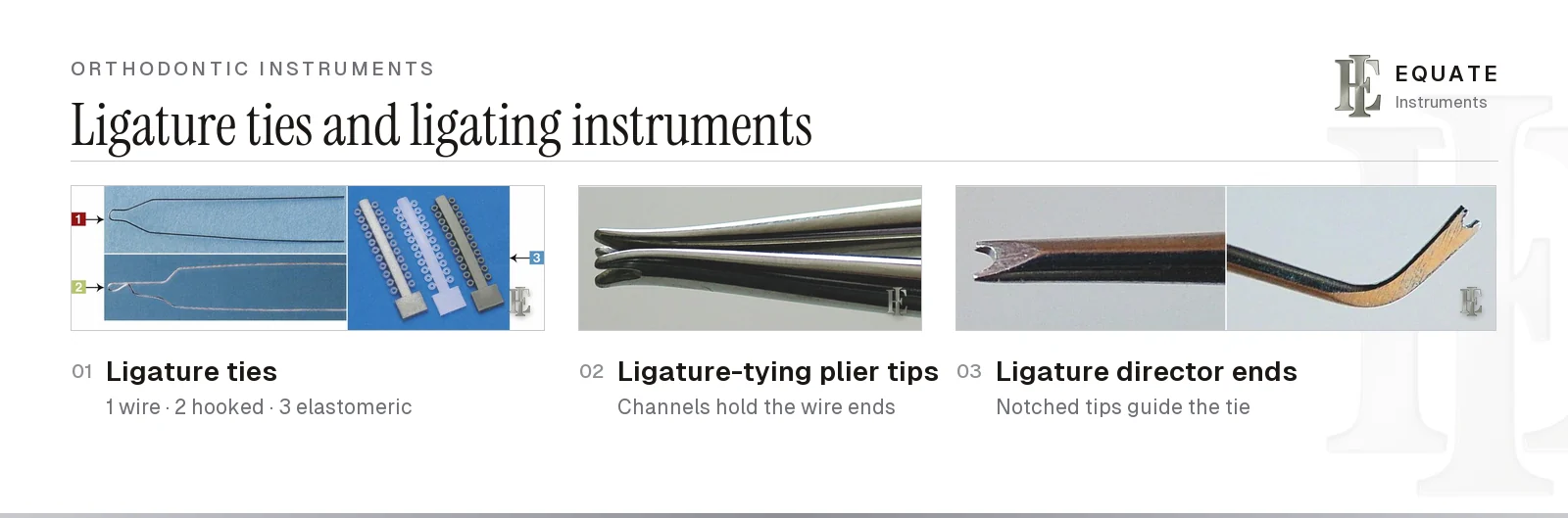
- Elastomeric modules are quicker; steel ligatures hold more securely and collect less plaque, but take longer to tie.
- Before the patient leaves, run a finger or explorer round the arch to check for loose ties, untucked pigtails and long wire ends.
Step by step
- 1
Remove the old wire
Cut steel ligatures with the ligature cutter, lift elastomeric modules off with an explorer, and ease the old archwire out of the slots and tubes with a Weingart plier.
- 2
Prepare the new archwire
Check the arch form against the patient's arch and mark the midline. Make any bends or stops needed with the wire-bending pliers before the wire goes in.
- 3
Insert the wire
Grip the wire near its end with the Weingart plier, feed it into one molar tube, then the other, and walk it forward into each bracket slot, centring it on the midline.
- 4
Place elastomeric modules
Load a module on the Mathieu plier, hook it under one pair of tie wings and stretch it over the archwire to the opposite wings. Use the ligature director to ease it under any wing it misses.
- 5
Or tie steel ligatures
Pass a steel ligature round the tie wings and over the wire. On a ligature tying (Coon) plier, lodge both ends in the beak channel, squeeze so the spreading tips tension the tie, then rotate the plier to twist a firm, not binding, pigtail. A Mathieu plier can twist it instead.
- 6
Cut and tuck the pigtails
Cut each pigtail to a few millimetres with the ligature cutter and tuck the end under the archwire or into the embrasure with the ligature tucker.
- 7
Trim the distal ends
Place a gauze pack distal to the last molar, seat the distal end cutter against the back of each molar tube and cut, then check the cutter has kept the fragment before withdrawing it. Cinch the end back with a cinch back plier if the plan calls for it.
- 8
Final check
Check every tie, tuck and wire end with the mirror and explorer, confirm the wire is fully seated in each slot, and give the patient wax and care advice.
Tray checklist
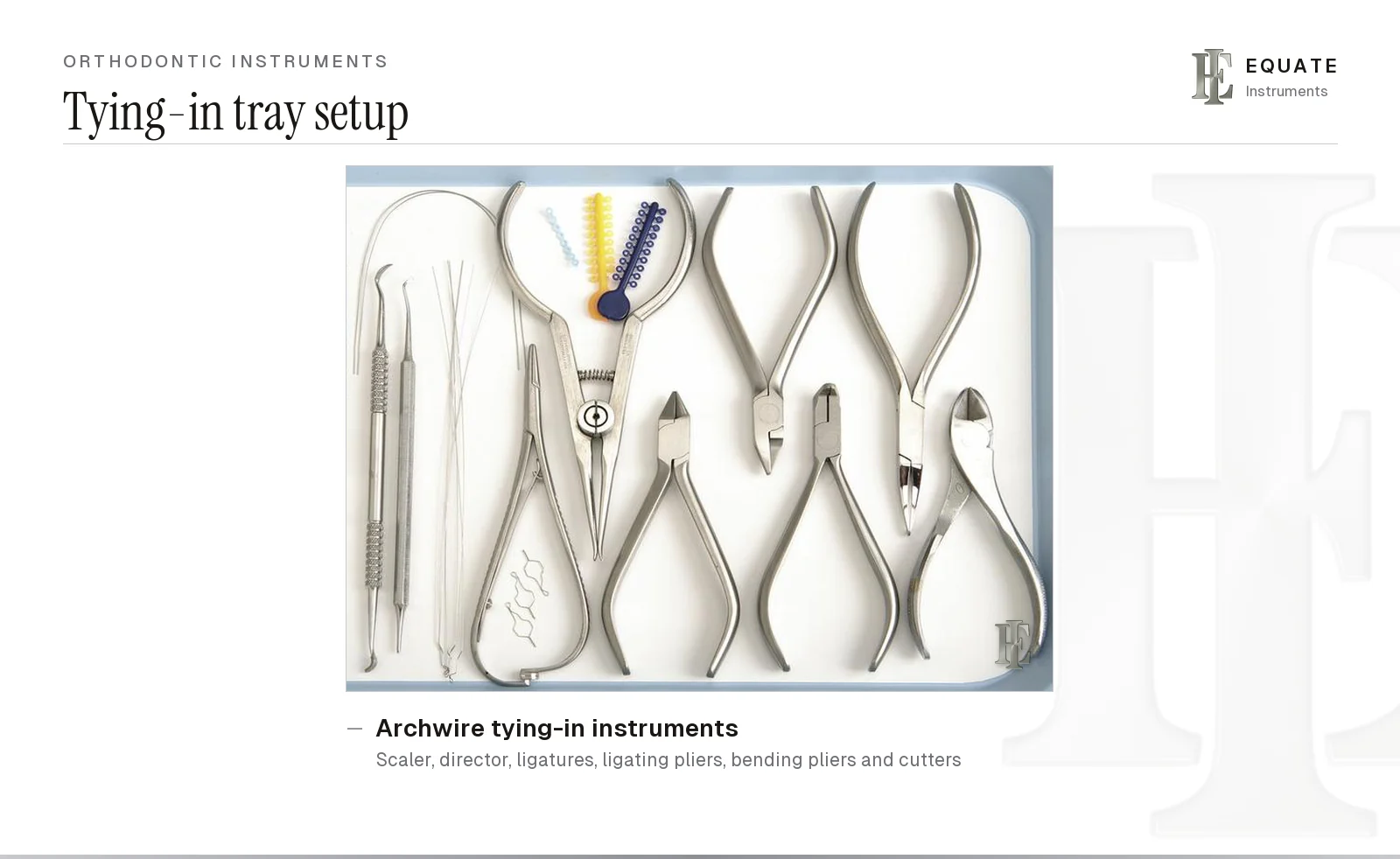
The preformed archwire and the modules or ligatures sit at the top of the tray, with the instruments below in the order they are used. The orthodontic instruments guide explains each instrument; Boyd's tying-in tray also carries the orthodontic scaler and bird beak and arch-bending pliers.
| Instrument | What it is for | Guide |
|---|---|---|
| Mouth mirror, explorer, cotton pliers | Inspect, remove modules, check ties | Mouth mirrors |
| Orthodontic scaler | Lift off modules, check for loose bands and brackets | Band pusher (scaler end) |
| Weingart plier | Remove the old wire and insert the new one | Weingart plier |
| Howe, bird beak and arch-bending pliers | Hold the wire, add bends and stops | Howe plier, bird beak plier, Weingart vs Howe, archwire bending |
| Mathieu plier | Place elastomeric modules; twist steel ties | Mathieu plier |
| Ligature director | Guide modules and ties under the tie wings | Ligature director |
| Ligature tying plier | Hold the tie ends in its beak channel, tension and twist steel ligatures | Ligature tying plier |
| Ligature cutter | Cut ligatures and pigtails | Ligature cutter |
| Ligature tucker | Tuck pigtail ends and seat the wire | Ligature tucker |
| Distal end cutter | Trim the wire flush behind the molar tube | Distal end cutter |
Elastomeric modules or steel ligatures?
Both hold the archwire in the slot; they differ in speed, hygiene and how well they keep their hold. William Proffit's Contemporary Orthodontics covers the choice between them for conventional twin brackets, and two older studies show the trade-offs. For how the two cutters differ, see distal end cutter vs pin and ligature cutter.
| Elastomeric module | Steel ligature | |
|---|---|---|
| Placed with | Mathieu plier or placing forceps, ligature director | Ligature tying plier or Mathieu, cutter and tucker |
| Chair time | Quick | Slower: tie, cut and tuck each one |
| Force over time | Greatest force loss in the first 24 hours (Taloumis et al., 1997, in vitro) | Tightness depends on how it is tied |
| Plaque | More microorganisms on incisors tied with rings (Forsberg et al., 1991, 12 patients) | Fewer microorganisms in the same patients |
| Typical use | Initial alignment and levelling, routine ligation | Rotations, sliding mechanics, where a secure tie matters |
What else is needed besides the instruments?
- The preformed archwire in the right size and material, and any auxiliaries such as stops or crimps.
- Elastomeric modules in the patient's chosen colour, or pre-formed steel ligatures.
- Orthodontic wax for the patient, cotton rolls and a saliva ejector.
- A gauze pack to sit distal to the last molar while the ends are cut, catching any piece the cutter fails to hold; a 2022 review of swallowed orthodontic parts by Karamani and colleagues recommends it.
- Gloves, mask and eye protection; eye protection matters because cut wire ends can fly.
- Old archwires, cut steel ligatures and pigtails go in a sharps container; used elastomeric modules are disposed of as healthcare waste according to national rules.
How is the ligation tray reprocessed?
The pliers and hand instruments touch saliva and mucosa, so they are semi-critical items that the CDC advises are cleaned and heat-sterilised when they tolerate heat. Clean the pliers open, brush wire fragments and elastomer residue out of serrations and safety-hold pads, lubricate the joints and inspect cutting edges for chips and tips for gaps, then pack and sterilise them still open and unlocked with an internal indicator. Check the external indicator when the load comes out and the internal one when the pack is opened at the chair. The CDC's 2003 guidelines call for cleaning before any sterilisation, ideally in an ultrasonic cleaner or washer-disinfector. Follow each manufacturer's ISO 17664-1 instructions and, in England, HTM 01-05.
What are the common mistakes?
- Cutting the distal ends before ligating, so the wire slips out of a tube.
- Using a ligature cutter on archwire or a distal end cutter on wire above its rating, which chips the blades; keep a hard wire cutter for heavy wire.
- Twisting steel ties so tight that they bind the wire or so loose that it lifts out of the slot.
- Leaving pigtails untucked or wire ends long enough to catch the cheek.
- Stretching modules with a damaged plier tip, which splits them.
- Cutting distal ends without gauze behind the molar or without checking the cutter has kept the piece.
Build this tray with Equate
Equate lists 27 distal end cutters, from mini-head and long-handle versions to flush-cut patterns with tungsten carbide inserts rated to .022 x .028 inch wire. It also lists 17 ligature and pin cutters in straight, 7-degree and 15-degree angled forms, and 19 Weingart pliers. For ligation there are 13 ligature directors and elastomeric placing instruments, including 12 and 14 cm placing forceps, 10 tuckers with Coon and Steiner tying forceps, a 17 cm ligature tying plier, a ligature forming plier for steel ties and 2 Mathieu pliers.
All are passivated stainless steel, ultrasonically cleaned, shape-, boil- and performance-tested and individually packed, and designed in Finland. Clinics can request samples and a quote.
The Equate difference
Equate lists 91 references across the 9 subcategories on this tray, including 27 distal end cutters with safety hold or flush cut, 17 ligature and pin cutters, 19 Weingart pliers, 13 ligature directors and elastomeric placing instruments, 10 tuckers and tying forceps in Coon and Steiner patterns, a 17 cm ligature tying plier and 2 Mathieu pliers.
Equate Archwire Ligation Setup options

Distal End Cutter with Safety Hold 0.56 x 0.71 mm (.022″ x .028″ Wire, TC)
EI-0700
Mathieu Orthodontic Ligature Pliers 14 cm
EI-0703
Mathieu Narrow-Tip Ligature Pliers 14 cm
EI-0705
Weingart Orthodontic Pliers TC (0.71mm / .028 in Wire)
EI-0722
Long Weingart Pliers - Max 0.71mm (.028") Wire
EI-0723
Mini Distal End Cutter with Safety Hold - Tungsten Carbide, 0.55 x 0.64 mm / .021 x .025 in Wire
EI-0793
Ortho Ligature Tucker
EI-1013
Ortho Archwire Tucker
EI-1014
Ortho Ligature Director 17C
EI-1015
Elastic Placement Applicator 16 cm - Hollow Handle 10 mm
EI-2561
Distal End Tucker & Bender 0.55/0.22 - 0.75/0.30
EI-2562
Ligature Utility Instrument - 17.5 cm Hollow Handle
EI-2570Browse all orthodontic instruments
Buying in your market
Frequently asked questions
What instruments are used to tie in an archwire?
A Weingart plier to insert the wire, a Mathieu plier and ligature director for modules, a ligature tying plier for steel ties, a ligature cutter, a ligature tucker and a distal end cutter.
What is the difference between a ligature cutter and a distal end cutter?
A ligature cutter has fine tips for thin steel ties and pigtails, while a distal end cutter has a right-angled head that trims the archwire behind the molar tube and holds the cut piece.
Why is the archwire cut last?
Once the wire is ligated it can't slide, so the distal ends can be cut to an exact length behind each tube.
Are elastomeric modules or steel ties better?
Neither is better for every case. Modules are faster but lose force quickly and collect more plaque; steel ties hold firmly but take longer.
What does a ligature tucker do?
It bends the cut end of a steel ligature under the archwire, away from the cheek and lips, and can push the wire fully into the slot.
Why put gauze behind the last molar when cutting distal ends?
A distal end cutter does not always keep the cut piece. A gauze pad distal to the archwire catches any fragment it misses, and a 2022 review of swallowed orthodontic parts advises both the gauze and checking the cutter after each cut. In one UK case report a fragment lost during upper archwire placement was swallowed and tracked by radiograph until it passed.
How often is the archwire changed or re-tied?
At routine adjustment visits, which the NHS puts at every 6 to 8 weeks and the British Orthodontic Society at 5 to 8 weeks. Patients can expect the teeth to be sore for about 3 to 5 days after each adjustment, so the final check includes wax and care advice.
References
- Proffit WR, Fields HW, Larson BE, Sarver DM. Contemporary Orthodontics, 6th edition. Elsevier, 2018 (archwire ligation)
- Taloumis LJ, Smith TM, Hondrum SO, Lorton L. Force decay and deformation of orthodontic elastomeric ligatures. American Journal of Orthodontics and Dentofacial Orthopedics 111(1):1-11, 1997
- Forsberg CM, Brattström V, Malmberg E, Nord CE. Ligature wires and elastomeric rings: two methods of ligation, and their association with microbial colonization of Streptococcus mutans and lactobacilli. European Journal of Orthodontics 13(5):416-420, 1991
- Kohn WG, Collins AS, Cleveland JL, Harte JA, Eklund KJ, Malvitz DM. Guidelines for Infection Control in Dental Health-Care Settings, 2003. MMWR Recommendations and Reports 52(RR-17), Centers for Disease Control and Prevention, 2003
- Centers for Disease Control and Prevention. Dental infection prevention and control FAQs: sterilization of patient-care items
- Department of Health. Health Technical Memorandum 01-05: Decontamination in primary care dental practices, 2013 edition
- Boyd LB. Dental Instruments: A Pocket Guide, 7th edition. Elsevier, 2020. Chapter 14, Orthodontic Instruments (photographs used under licence)
- Karamani II, Makrygiannakis MA, Bitsanis I, Tsolakis AI. Ingestion of orthodontic appliances: a literature review. Journal of Orthodontic Science 11:20, 2022
- Puryer J, McNamara C, Sandy J, Ireland T. An ingested orthodontic wire fragment: a case report. Dentistry Journal (Basel) 4(3):24, 2016
- NHS. Braces and orthodontics
- British Orthodontic Society. Fixed Appliances: patient information leaflet, 2019
I am a…