Amalgam Carriers (Dental Amalgam Carriers)
Written by the Equate Instruments Technical Team · Reviewed by the Medical & Dental Board, Equate Instruments · Updated ·
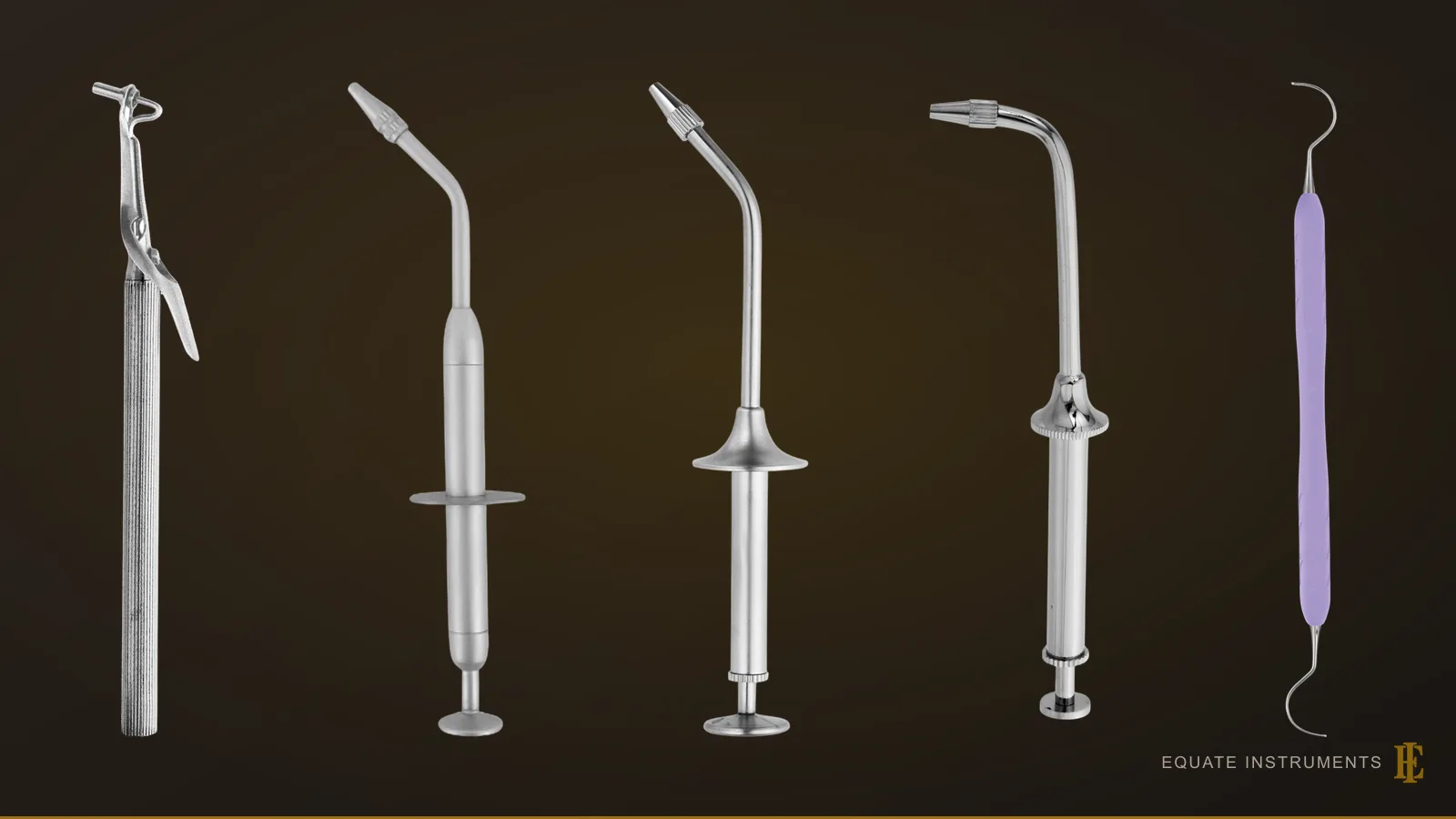
An amalgam carrier is a hand instrument with a hollow barrel and a plunger that picks up freshly mixed amalgam from a well and ejects it into the prepared cavity in small, measured pellets. Carriers are single- or double-ended, lever- or syringe-operated, and angled for access. The barrel is lined with metal or non-stick PTFE, and the instrument is kept for amalgam only.
Key points
- Empty the barrel straight after each load: amalgam left in a carrier sets and blocks it.
- Deliver each pellet into the proximal box first, against the matrix band, and condense it before the next one goes in.
- Amalgam carriers are kept for amalgam only; MTA and bone-graft carriers are separate instruments built on the same principle.
What is an amalgam carrier used for?
An amalgam carrier transfers triturated amalgam from the mixing well to the cavity without the clinician touching it. The barrel is pressed into the amalgam in the well until it's packed full, carried to the preparation, and the plunger pushes the pellet out into the deepest part of the cavity, usually the proximal box first. Each pellet is then packed with a condenser or plugger before the next is delivered, so the carrier and condenser alternate until the cavity is overfilled.
Carriers sit on the amalgam restoration tray setup beside the amalgam well, condensers, burnishers and carvers. The restorative instruments hub covers the wider group. The amalgam restorative instruments guide shows the carrier and amalgam well alongside the rest of the family.
What types of amalgam carrier are there?
Carriers differ in how many barrels they have, how the plunger is driven and the angle of the nozzle.
| Type | Design | Notes |
|---|---|---|
| Double-ended carrier | A small barrel on one end and a large barrel on the other, lever-operated | One instrument for small and large increments |
| Single-ended lever carrier | One barrel, a lever on the shank drives the plunger | Light and quick to reload |
| Syringe-style carrier (amalgam gun) | A barrel and nozzle with a thumb-driven plunger and a finger flange | Good control and reach in posterior teeth |
| Angled nozzles | Straight, 15°, 45° or 90° bends | Steeper angles reach distal boxes and lower molars |
| Base and liner carrier | Small ball or paddle ends that pick up a liner or base | Places calcium hydroxide or glass-ionomer liners under a filling |
| Micro or retrograde carrier | A very fine barrel, straight or curved | Root-end fillings in endodontic surgery |
What is the difference between a single- and a double-ended amalgam carrier?
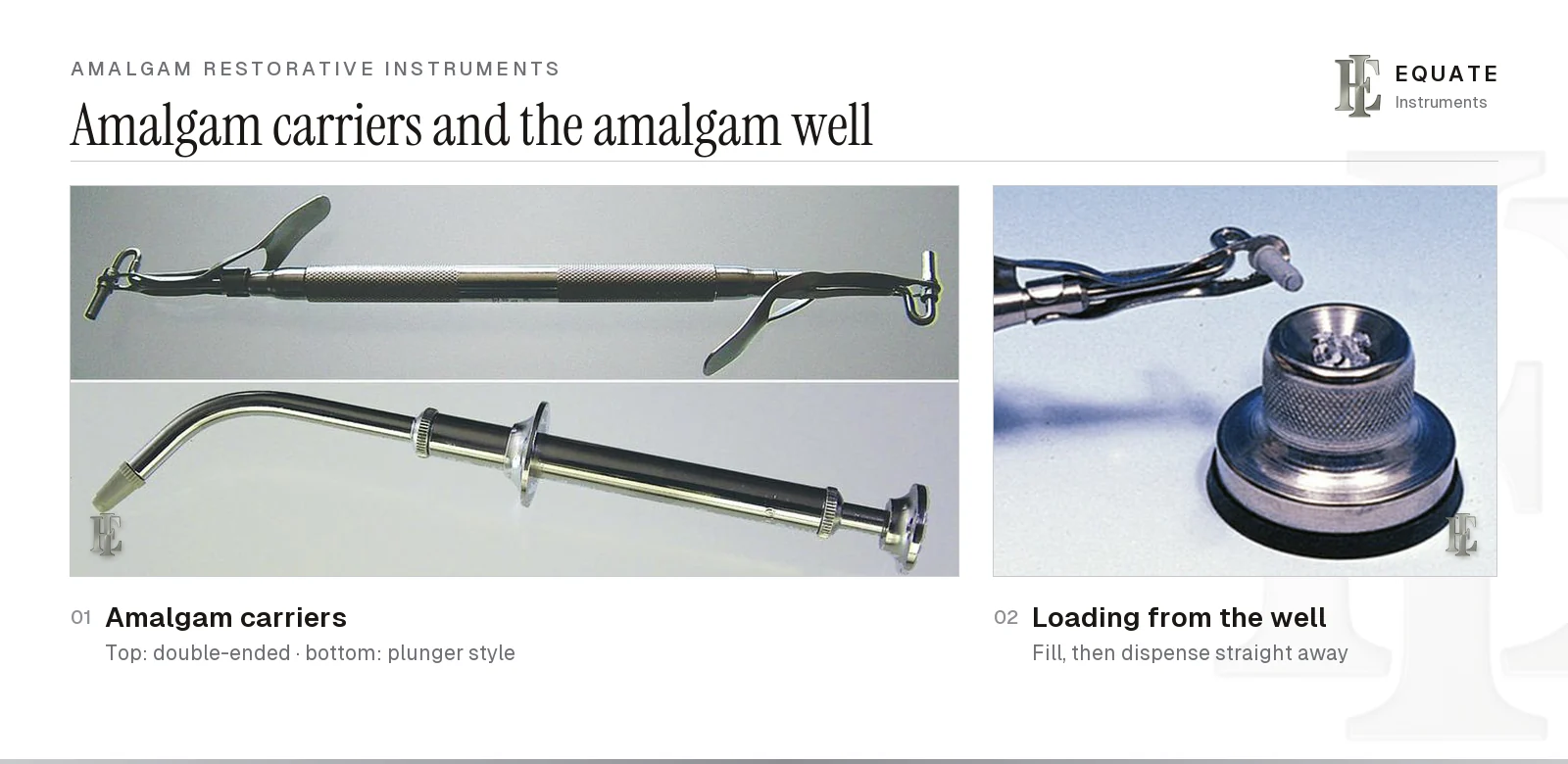
A double-ended amalgam carrier has two barrels of different diameter on one instrument, usually operated by a lever, so the clinician can switch between small pellets for the corners and larger pellets for the bulk without changing instruments. A single-ended carrier has one barrel and is often syringe-style, with the plunger driven by the thumb against a finger flange; its nozzle may be interchangeable or set at a fixed angle. Single-ended syringe carriers give a more direct line of sight down the nozzle, while double-ended lever carriers are compact and quick to reload. Equate's carriers are single-ended.
How do you load and use an amalgam carrier?
Press the open end of the barrel into the amalgam in the well two or three times until the barrel is packed, wipe any excess off the outside, and take the carrier to the tooth at once. Rest it on the tooth or a neighbouring tooth, place the nozzle into the proximal box against the matrix band and eject the pellet with one smooth push. Deliver small increments, so each can be condensed fully, and never leave amalgam in the barrel between loads.
The commonest problems are a blocked barrel, caused by amalgam left to set inside; overfilling the barrel so material falls on the soft tissue; and ejecting the pellet above the cavity rather than into it. If a carrier jams, disassemble it and remove the material before it hardens fully. Look at the mix, too. Phillips' Science of Dental Materials notes that a properly triturated mix comes out of the capsule warm but not hot, while a grainy mix is under-triturated and gives a weak, rough restoration; extra trituration time or speed shortens the working time, which is one reason a mix can crumble or set in the barrel.
Where does the amalgam phase-out leave carriers?
Carriers are only needed where amalgam is still placed: the EU has allowed it since 1 January 2025 only where a dentist judges it strictly necessary for a patient's specific medical needs, and the parties to the Minamata Convention agreed in November 2025 to end its use worldwide by 2034. The amalgam restorative instruments guide sets out the full EU, UK and global timeline.
Are carriers used for materials other than amalgam?
Yes. The barrel-and-plunger principle is used for several other materials. Base carriers place liners and bases such as calcium hydroxide and glass-ionomer under a restoration. Fine, straight or curved MTA carriers place mineral trioxide aggregate and other calcium-silicate cements for root-end fillings, perforation repairs and apexification; they're covered on the endodontic hand instruments page. In implant and oral surgery, bone graft carriers deliver graft particles to a socket or sinus, as described on the bone graft instruments page.
What does the Equate range include?
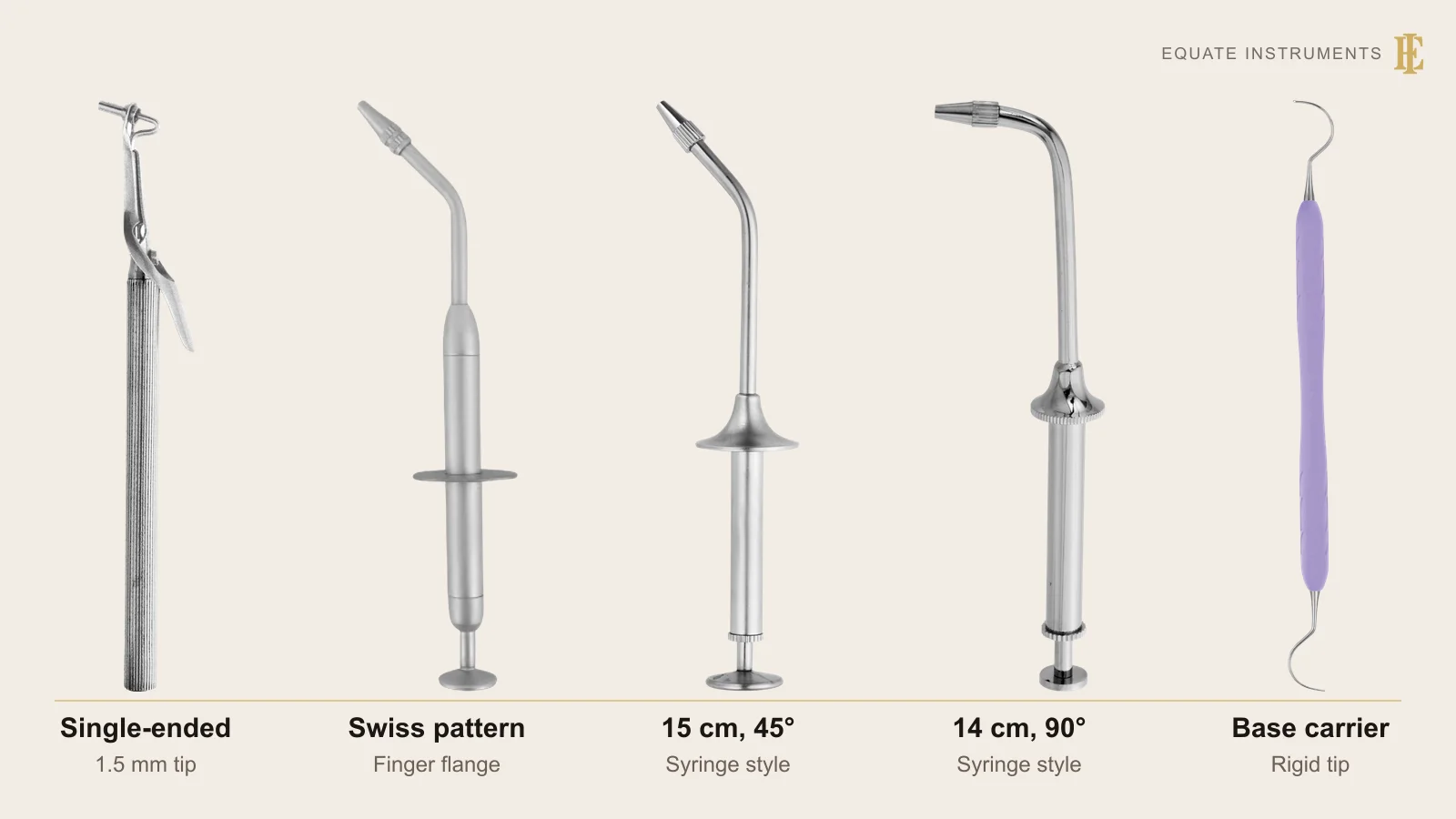
Equate lists six single-ended amalgam carriers: a carrier with a 1.5 mm tip, a Swiss-pattern syringe carrier with a finger flange, and 14 cm syringe carriers with 15°, 45° and 90° nozzles plus a 15 cm, 45° version. Two double-ended base carriers with rigid tips place liners, and four base carrier-condensers with rigid or malleable tips are listed with the condensers and pluggers. Six MTA carriers in 0.8, 1.2 and 1.8 mm, straight and curved, are covered with the endodontic instruments.
Every carrier is passivated stainless steel, ultrasonically cleaned, shape-, boil- and performance-tested and individually packed, and clinics can request samples and a quote.
How do you clean and maintain an amalgam carrier?
Clean the carrier straight after use. Eject any remaining material, take the carrier apart as the manufacturer's instructions allow, and remove residue from the barrel and plunger before it sets; collect the residue as amalgam waste and never rinse it down the sink. The US EPA's 2017 dental rule bars offices from discharging scrap amalgam to the drain, and CQC guidance for UK practices asks for amalgam waste to go into rigid containers with a mercury suppressant for a licensed or permitted waste facility. Then clean, inspect and sterilise it in line with the manufacturer's ISO 17664-1 instructions and the CDC's Guidelines for Infection Control in Dental Health-Care Settings or, in UK practices, HTM 01-05. Check that the plunger moves freely and the nozzle isn't bent, and replace the carrier if the barrel is scored or the plunger sticks.
The Equate difference
Equate lists eight carrier references: six single-ended amalgam carriers (a carrier with a 1.5 mm tip, a Swiss-pattern syringe carrier with a finger flange, and 14 cm and 15 cm syringe carriers with 15°, 45° and 90° nozzles) and two base carriers with rigid tips.
Equate Amalgam Carriers (Dental Amalgam Carriers) options

Base Carrier with Rigid Tip
EI-0944
Base Carrier with Rigid Tip - Light Purple Silicone Slim Handle
EI-1241
Single-End Amalgam Carrier with 1.5 mm Tip
EI-2399
Swiss Pattern Amalgam Carrier with Finger Flange
EI-2400
Amalgam Carrier 14cm 15° - Single-End
EI-2401
Amalgam Carrier 14cm 45° - Single-End
EI-2402
Amalgam Carrier 15cm 45° - Single-End
EI-2403
Amalgam Carrier 14cm 90° - Single-End
EI-2404Browse all restorative & operative instruments
Buying in your market
Frequently asked questions
What is an amalgam carrier used for?
It carries freshly mixed amalgam from the well to the prepared cavity and ejects it in small pellets with a plunger. Each pellet is then packed with a condenser.
What is a double-ended amalgam carrier?
A carrier with a small barrel on one end and a large barrel on the other, usually lever-operated. It lets the clinician deliver small or large increments with one instrument.
What is the inside of an amalgam carrier lined with?
The barrel is lined with metal or a non-stick polymer such as PTFE, so the packed pellet releases cleanly when the plunger is pushed. Replace a carrier whose barrel is scored, because amalgam then sticks inside it.
Why does amalgam stick in the carrier?
Amalgam starts to set within minutes, so material left in the barrel hardens and blocks it. Eject each load at once and clean the carrier straight after use.
What is an MTA carrier?
A fine carrier with a narrow straight or curved barrel for placing mineral trioxide aggregate in root-end fillings and perforation repairs. It works like a small amalgam carrier.
References
- Regulation (EU) 2024/1849 of the European Parliament and of the Council amending Regulation (EU) 2017/852 on mercury as regards dental amalgam and other mercury-added products
- European Parliament press release 20240408IPR20295. Mercury: Parliament adopts law to phase out the use of dental amalgam, 10 April 2024
- Minamata Convention on Mercury. Minamata Convention COP-6 agrees to end the use of dental amalgam by 2034, November 2025
- Minamata Convention on Mercury. Dental amalgam (topic page: Annex A amendments)
- Heymann HO, Swift EJ, Ritter AV (eds). Sturdevant's Art and Science of Operative Dentistry, 6th ed. Elsevier, 2013 (amalgam restorations)
- Kohn WG, et al. Guidelines for Infection Control in Dental Health-Care Settings, 2003. MMWR 52(RR-17), Centers for Disease Control and Prevention
- Boyd LB. Dental Instruments: A Pocket Guide, 7th edition. Saunders/Elsevier, 2020. Chapter 8, Amalgam Restorative Instruments (photographs used under licence)
- US Environmental Protection Agency. Dental effluent guidelines (40 CFR Part 441), final rule 14 June 2017
- Care Quality Commission. Dental mythbuster 1: Use and disposal of dental amalgam
- Sakaguchi RL, Ferracane JL, Powers JM (eds). Phillips' Science of Dental Materials. Elsevier (chapter 15, dental amalgams)
I am a…
Related
- Restorative Dental Hand Instruments
- Dental Pluggers and Condensers (Amalgam Condensers)
- Endodontic Hand Instruments
- Dental Carvers: Types of Carvers in Dentistry and the Lab
- Amalgam Restoration Tray Setup
- Amalgam Restorative Instruments: What Each One Does
- Tofflemire and Other Matrix Band Retainers
- Dental Burnishers: Ball, Football, Acorn, T-Ball and Beavertail