Amalgam Restoration Tray Setup
Written by the Equate Instruments Technical Team · Reviewed by the Medical & Dental Board, Equate Instruments · Updated ·
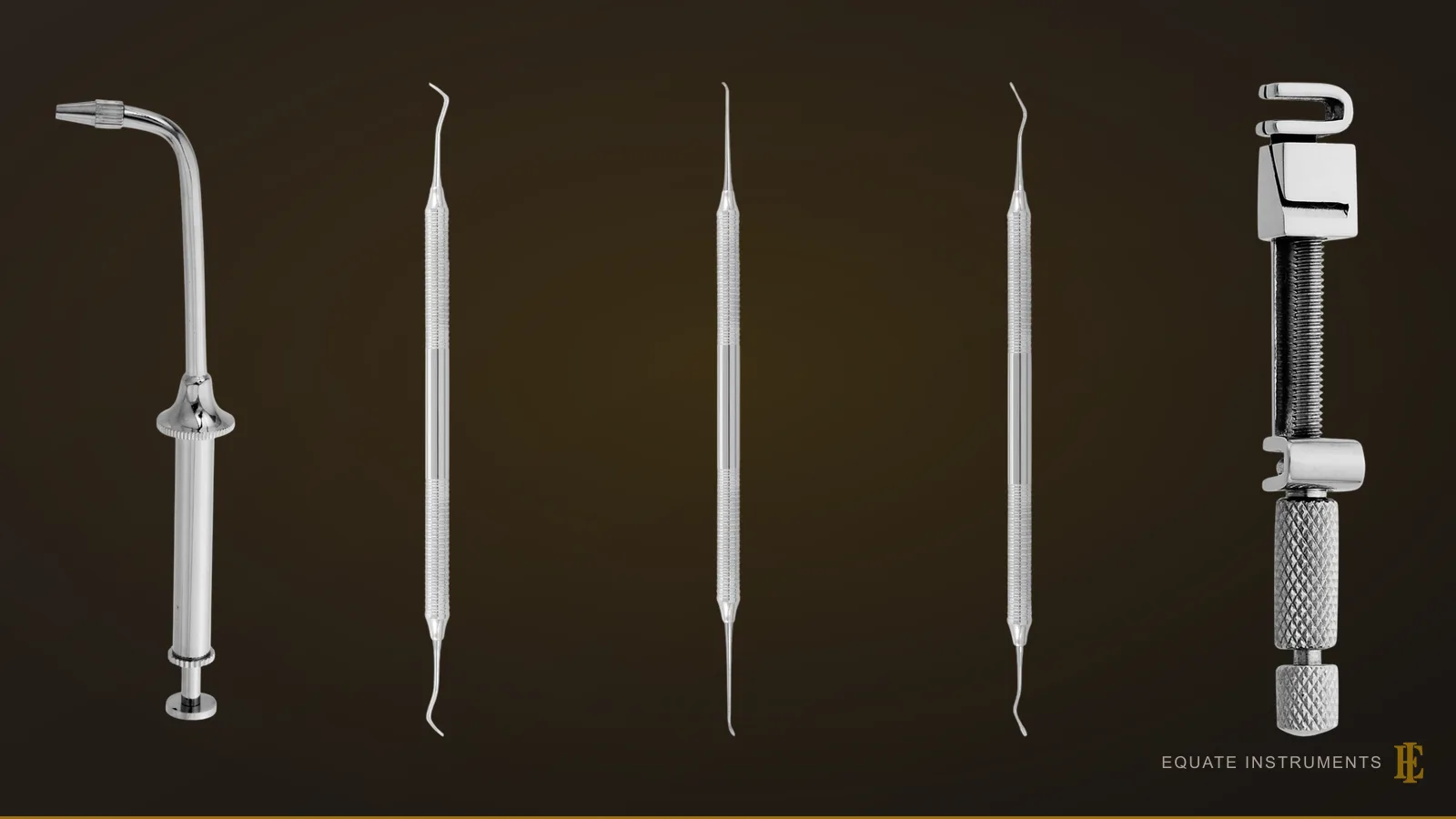
An amalgam restoration tray setup holds the basic exam instruments plus hand cutting instruments (a spoon excavator, enamel hatchet and gingival margin trimmers), a matrix retainer with bands and wedges, an amalgam carrier, small and large condensers, a burnisher, carvers, articulating paper forceps and floss, laid out left to right in the order used: examine, cut, matrix, carry, condense, burnish, carve, check the bite.
Key points
- A liner applicator, a gold carving knife and crown and bridge scissors complete the tray, with the amalgam well, suction tip and bur block along the top row.
- Take the retainer off first and leave the band wedged while the proximal surface is carved; the wedge and band come out last.
- Amalgam must be condensed and carved within its working time, so the carrier, condensers and carvers sit next to each other.
Step by step
- 1
Anaesthetise and isolate
Give local anaesthesia and isolate the tooth, ideally with a rubber dam, otherwise with cotton rolls and high-volume suction.
Dental Aspirating Syringes (Dental Anaesthetic Syringes)Rubber Dam Clamps, Forceps, Punches and Frames: Which to Choose
- 2
Prepare the cavity
Cut the outline with burs, then refine the walls and margins by hand: the excavator for soft dentine, the hatchet for walls and the margin trimmers for the gingival floor of a Class II box.
Spoon Excavators (Dental Excavators)Dental Hand Cutting Instruments: How Hatchets, Hoes, Chisels and Trimmers Differ and How to Use Them
- 3
Place a liner if needed
In a deep cavity, spot a thin calcium hydroxide or glass-ionomer liner on the deepest part of the floor with the liner applicator, keeping it off the enamel margins.
- 4
Place the matrix and wedge
For a proximal cavity, fit a band in the matrix retainer, tighten it round the tooth and wedge it firmly at the gingival margin so the band seals and the contact can be restored.
- 5
Load and carry the amalgam
Triturate the capsule, empty it into the amalgam well (dappen dish), and load the carrier. Deliver small increments into the deepest part of the cavity first, usually the proximal box.
- 6
Condense in increments
Condense each increment firmly with the small condenser into line angles and the box, then the larger condenser on the occlusal surface, overfilling slightly.
- 7
Burnish and carve
Pre-carve burnish to adapt the margins, then carve the occlusal anatomy with a discoid-cleoid or Tanner carver, keeping the blade partly on tooth so you don't undercut the margin.
Dental Burnishers: Ball, Football, Acorn, T-Ball and BeavertailDental Carvers: Types of Carvers in Dentistry and the Lab
- 8
Remove the matrix and finish the proximal
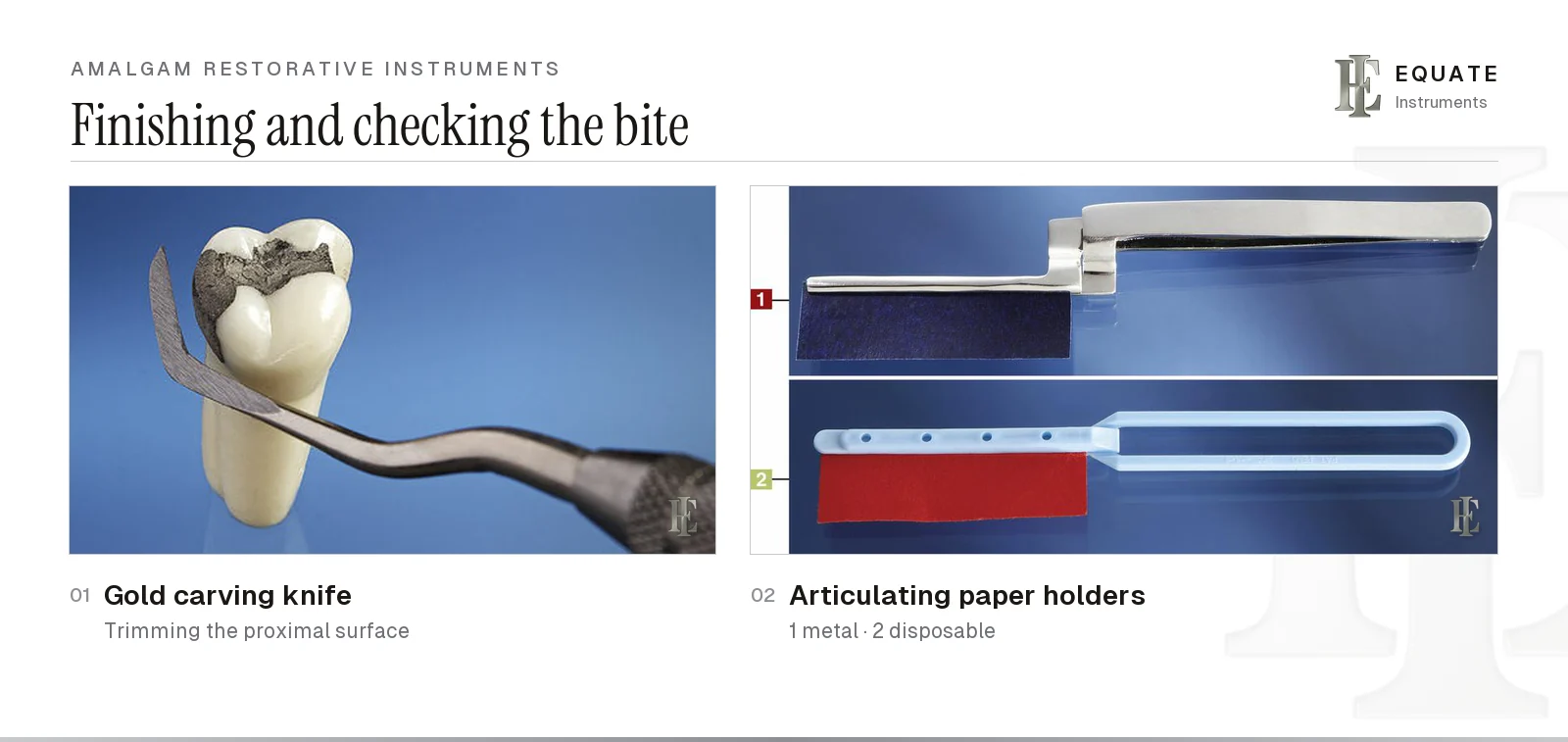
Take off the retainer but leave the band wedged while a Hollenback carver shapes the proximal surface and marginal ridge. Then remove the wedge and band, freeing the band from the side without a box first and tilting it out bucco- or linguo-occlusally with the marginal ridge supported. Check the contact with floss.
Tofflemire and Other Matrix Band RetainersDental Carvers: Types of Carvers in Dentistry and the Lab
- 9
Check the bite
Remove the dam and ask the patient to close lightly: a shiny spot shows a premature contact, which is reduced with a discoid or spoon before articulating paper checks the bite. Lightly burnish, then tell the patient not to chew on the filling for about two hours and to return after 24 hours for finishing and polishing.
Is amalgam still used, and where?
Amalgam is restricted in the European Union, where since 1 January 2025 it may be used only when the dentist judges it strictly necessary for a patient's specific medical needs under Regulation (EU) 2024/1849. The same regulation banned exports of dental amalgam from that date, and member states that needed longer had a temporary derogation that ran until 30 June 2026. The UK is phasing new amalgam fillings down while still allowing them where clinically justified. The parties to the Minamata Convention agreed in November 2025 to end its use worldwide by 2034, and the amalgam restorative instruments guide sets out the full timeline, including the restricted patient groups and Northern Ireland.
Where it is still allowed, amalgam keeps a place for practical reasons. A 2023 review based on an FDI World Dental Federation policy statement, by Schmalz, Schwendicke, Hickel and Platt, notes that most alternatives cost more, which keeps amalgam popular where oral health resources are limited, and that a cavity floor below the gum makes moisture control hard for the adhesives a composite depends on. The technique is still taught, too: in a 2011 survey of US predoctoral paediatric dentistry programmes, published by Kateeb and Warren in 2019, 74% of the 44 responding schools used amalgam in primary posterior teeth. National rules for children and pregnant patients differ, so check your own regulator's current guidance. Where amalgam isn't an option, the composite tray replaces this one, and the carvers and burnishers on it still serve glass-ionomer, bases and wax.
Tray checklist
| Instrument | What it is for | Guide |
|---|---|---|
| Mirror, explorer, cotton pliers | Examination and handling small items | Basic tray |
| Spoon excavator | Removing soft carious dentine | Spoon excavators |
| Enamel hatchet, mesial and distal gingival margin trimmers | Planing walls and bevelling the gingival floor of a box | Hand cutting instruments |
| Matrix retainer, bands, wooden wedges | Forming the missing proximal wall | Matrix band retainers |
| Liner applicator | Spotting a calcium hydroxide or glass-ionomer liner on the deepest floor | Amalgam instruments guide |
| Amalgam carrier and amalgam well (dappen dish) | Transferring amalgam into the cavity | Amalgam carriers |
| Small and large condensers | Packing amalgam into line angles and the occlusal surface | Condensers and pluggers |
| Ball or acorn burnisher | Adapting margins before and after carving | Burnishers |
| Discoid-cleoid, Tanner and Hollenback carvers, gold carving knife | Carving occlusal anatomy and proximal contours, trimming proximal flash | Carvers |
| Articulating paper forceps, floss, crown scissors | Checking the bite and contact, trimming bands | Restorative instruments |
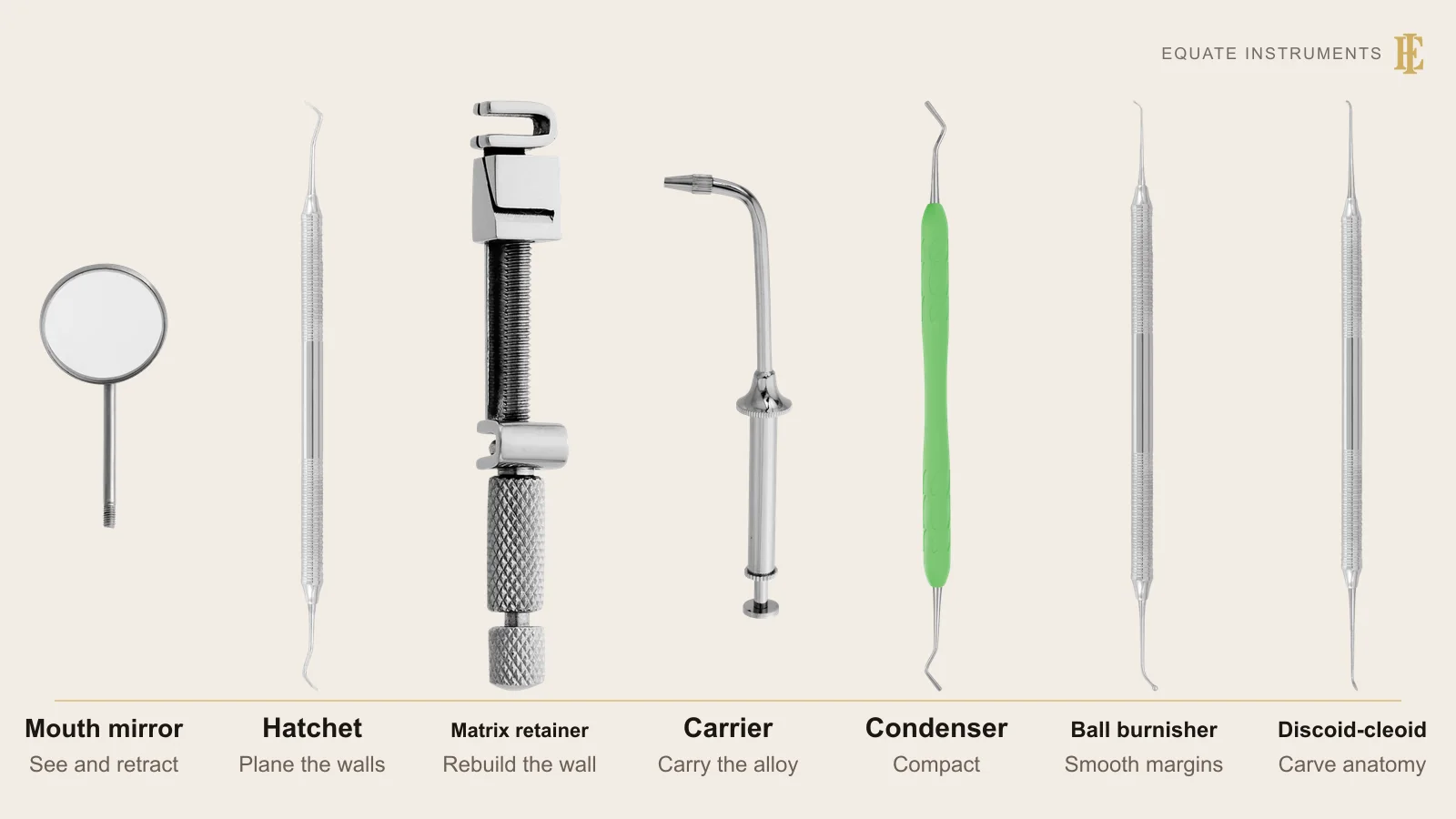
Which condenser, burnisher and carver for which stage?
Each stage of an amalgam restoration has its own instrument, and the working end should be matched to the size of the cavity as well as the job.
| Stage | Instrument | What to look for |
|---|---|---|
| Packing the proximal box | Small round or cylindrical condenser, about 1-1.5 mm | Fits into the box and line angles without binding on the band |
| Packing the occlusal surface | Larger condenser, about 2-2.5 mm | Flat or slightly serrated face; double-ended saves a change |
| Pre-carve burnishing | Ball or football burnisher | Smooth, polished end that won't drag soft amalgam |
| Occlusal anatomy | Discoid-cleoid or Tanner carver | Sharp edges; the discoid end removes excess and shapes broad slopes, the cleoid end defines grooves and pits |
| Proximal and marginal ridge | Hollenback or half-Hollenback carver | Thin, angled blade that reaches below the contact |
What else goes on an amalgam tray?
Besides the hand instruments, an amalgam tray needs local anaesthetic, isolation, burs in a bur block, pre-dosed amalgam capsules and an amalgamator, a liner or base and its applicator, wooden wedges, matrix bands, articulating paper, floss, cotton rolls and high-volume suction. The local anaesthetic tray and the rubber dam tray are usually set up alongside it.
Mercury hygiene is part of the setup. Use encapsulated amalgam rather than bulk mercury, keep the capsule closed until trituration, collect scrap amalgam in a sealed, labelled container, and use high-volume suction during placement and removal. Waste amalgam, used capsules and extracted teeth with amalgam go into a rigid container with a mercury suppressant for collection by an authorised waste contractor, as CQC guidance for UK practices sets out, and never into sharps, clinical waste or the drain. EU rules also require an amalgam separator that holds back at least 95% of amalgam particles, and in the United States the EPA's 2017 dental rule requires a separator in offices that place or remove amalgam.
How are amalgam instruments reprocessed?
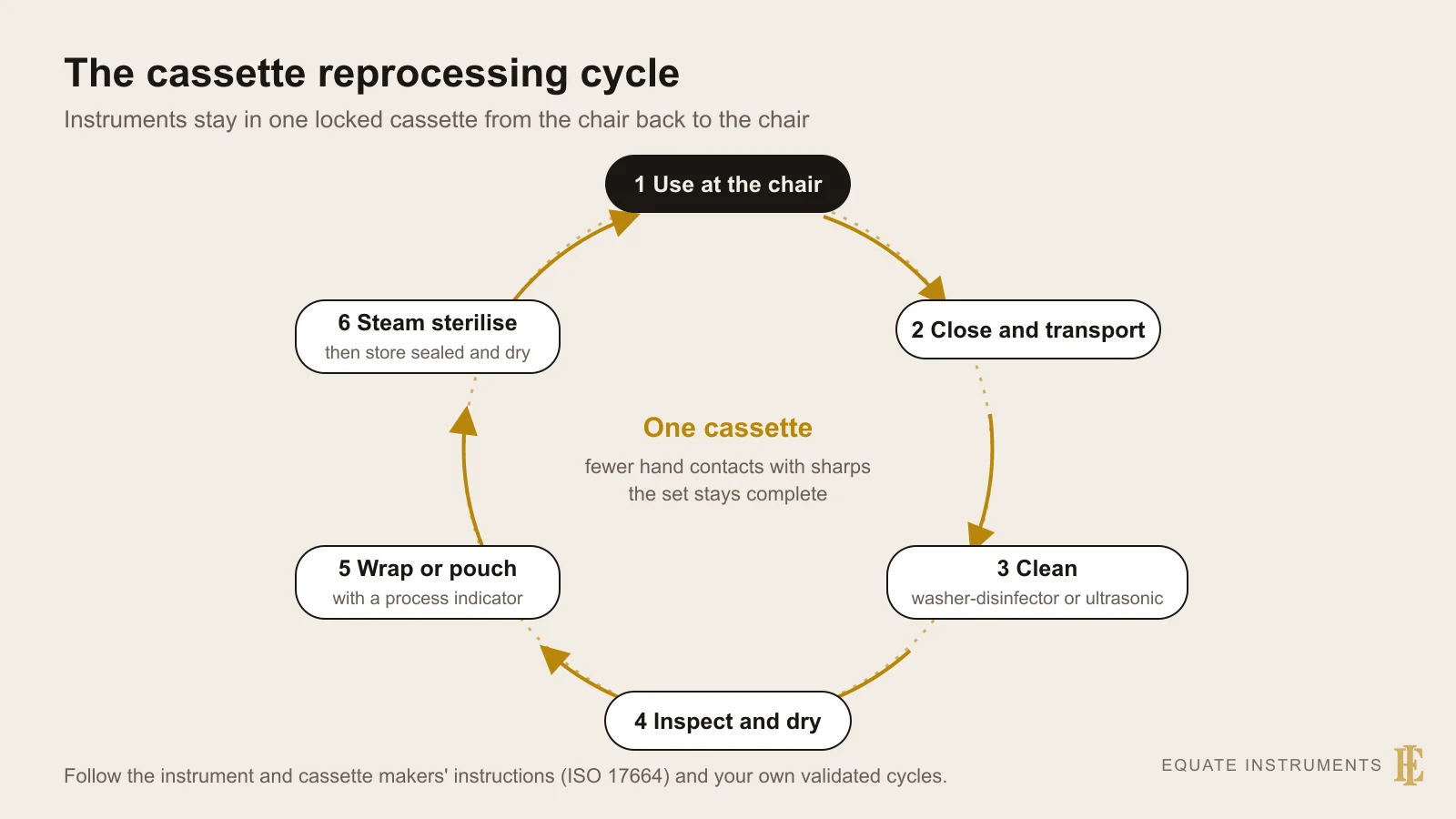
Clear amalgam from the carrier, condensers and carvers before it sets, wiping the working ends on gauze at the chair and running the carrier's plunger to empty the barrel; set amalgam in a carrier tip is very hard to remove later. All the hand instruments are semicritical items under the CDC's 2003 guidelines, so they're cleaned and heat sterilised between patients, preferably in a cassette that keeps the sequence intact.
HTM 01-05 recommends single-use matrix bands, because the narrow folds are hard to clean. Retainers are dismantled or opened for cleaning as the manufacturer's instructions (ISO 17664) describe. Inspect carvers and hatchets under an illuminated magnifier, and retire one whose blade is thin, chipped or bent.
What are the common mistakes on an amalgam tray?
- Setting out the carrier and condensers apart from each other, which wastes working time.
- Loose or unwedged bands, which leave an overhang at the gingival margin.
- Condensing too large an increment, which leaves voids at line angles.
- Carving with the blade entirely on the amalgam, which ditches the margin.
- Letting amalgam set in the carrier tip before it's cleaned.
Build this tray with Equate
The cutting, condensing, burnishing and carving instruments come from the Equate restorative range: Black-pattern hatchets and gingival margin trimmers, single-ended carriers at several angles, plain and cylindrical condensers on solid, hollow or silicone handles, ball and football burnishers including titanium-coated patterns, and Hollenback, discoid-cleoid, Tanner and Ward carvers. Universal, junior and senior Tofflemire and Siqveland retainers are in the prosthodontic and laboratory range.
The instruments are designed in Finland and made from passivated stainless steel, ultrasonically cleaned, shape-, boil- and performance-tested and individually packed. Clinics can request samples and a quote for a complete amalgam set.
The Equate difference
Across the 14 subcategories on this page Equate lists 150 references: 12 hatchets, gingival margin trimmers and enamel chisels, 6 single-ended amalgam carriers including 15°, 45° and 90° patterns, 24 condensers, compactors and stoppers, 54 ball and football burnishers, 44 Hollenback, discoid-cleoid, Tanner and Ward carvers, 9 matrix retainers and a stainless steel dappen dish.
Equate Amalgam Restoration Tray Setup options

Dental Plugger 1.8 / 2.5 mm Titanium
EI-0016
Double-Ended Filling Plugger 2.5 mm / 3.8 mm - Hollow Handle
EI-0017
Dental Plugger 1.3 / 1.8 mm Titanium
EI-0018
Dental Plugger 1.0 / 1.3 mm Titanium
EI-0019
Amalgam Stopper
EI-0087
Amalgam Stopper
EI-0088
Plugger 1.0mm/2.0mm - Double-Ended Knurled Handle
EI-0089
Carver 5 - Double-Ended 2.0/2.5mm with Knurled Handle
EI-0091
Nystrom III Carver 2.0/2.5mm - Knurled Handle
EI-0094
Plugger 2.0 / 2.5 mm Knurled Handle
EI-0095
Double-Ended Dental Carver - Knurled Handle
EI-0100
Cement Stopper - Solid Handle
EI-0158Browse all restorative & operative instruments Browse all prosthodontic & laboratory instruments Browse all oral surgery instruments
Buying in your market
Frequently asked questions
In what order are instruments laid out on an amalgam tray?
Broadly in the order of the work, but not strictly. The pocket guide's bottom row opens with the mirror, explorer and cotton pliers, then the spoon excavator, enamel hatchet and the mesial and distal margin trimmers. Next come the two condensers, an acorn burnisher, the Tanner and half-Hollenback carvers and the gold carving knife. The Tofflemire and wooden wedges follow, then crown and bridge scissors, the articulating paper holder, the liner applicator, floss, the anaesthetic syringe and an air/water tip. The amalgam well, suction tip, bur block and plunger carrier sit along the top row.
How long should a patient avoid chewing after an amalgam filling?
Columbia University's amalgam teaching notes advise no chewing on the new filling for two hours, and a return visit after 24 hours for finishing and polishing. Follow the material maker's instructions, because setting speed differs between alloys.
When is the matrix band removed during an amalgam filling?
After the occlusal anatomy is carved. The retainer comes off first while the wedge holds the band for proximal carving, then the wedge and band are removed, the band tilted out sideways and occlusally rather than pulled up through the contact.
What is a Tofflemire used for?
It is a matrix retainer. It clamps a thin stainless steel band round the tooth, and with a wooden wedge at the gingival margin the band stands in for the proximal wall a Class II cavity has lost, so the amalgam can be condensed against it. The matrix band retainers page covers the patterns.
Can amalgam instruments be used for other materials?
Yes. Condensers and carvers are also used for glass-ionomer, bases and wax, though composite is better handled with dedicated non-stick instruments.
References
- Regulation (EU) 2024/1849 of the European Parliament and of the Council amending Regulation (EU) 2017/852 on mercury as regards dental amalgam and other mercury-added products. Official Journal of the European Union, 2024
- European Commission, Directorate-General for Environment. Mercury: the revised EU Mercury Regulation and dental amalgam
- Ritter AV, Boushell LW, Walter R (eds). Sturdevant's Art and Science of Operative Dentistry. Elsevier (amalgam restorations and instruments)
- Kohn WG, Collins AS, Cleveland JL, Harte JA, Eklund KJ, Malvitz DM. Guidelines for Infection Control in Dental Health-Care Settings, 2003. MMWR 2003;52(RR-17). Centers for Disease Control and Prevention
- Department of Health (England). Health Technical Memorandum 01-05: Decontamination in primary care dental practices, 2013 edition
- Boyd LB. Dental Instruments: A Pocket Guide, 7th edition. Saunders/Elsevier, 2020. Chapter 8, Amalgam Restorative Instruments (photographs used under licence)
- Schmalz G, Schwendicke F, Hickel R, Platt JA. Alternative direct restorative materials for dental amalgam: a concise review based on an FDI policy statement. International Dental Journal 2024;74(4):661–668
- Kateeb ET, Warren JJ. The transition from amalgam to other restorative materials in the U.S. predoctoral pediatric dentistry clinics. Clinical and Experimental Dental Research 2019;5(4):413–419
- Bird DL, Robinson DS. Modern Dental Assisting. Elsevier (assisting with amalgam restorations)
- Hadavi F. Steps in carving amalgam: class 2 cavity. Teaching notes published by Columbia University, 2004–2005
- NHS Business Services Authority. Can I provide an amalgam filling? (knowledge base article KA-02021)
- Minamata Convention on Mercury. Minamata Convention COP-6 agrees to end the use of dental amalgam by 2034, November 2025
- Care Quality Commission. Dental mythbuster 1: Use and disposal of dental amalgam
- US Environmental Protection Agency. Dental effluent guidelines (40 CFR Part 441), final rule 14 June 2017
I am a…
Related
- Amalgam Carriers (Dental Amalgam Carriers)
- Dental Pluggers and Condensers (Amalgam Condensers)
- Dental Carvers: Types of Carvers in Dentistry and the Lab
- Dental Burnishers: Ball, Football, Acorn, T-Ball and Beavertail
- Composite Restoration Tray Setup (Class I to V)
- Rubber Dam (Dental Dam) Tray Setup and Placement
- Amalgam Restorative Instruments: What Each One Does
- Tofflemire and Other Matrix Band Retainers