Amalgam Restorative Instruments: What Each One Does
Written by the Equate Instruments Technical Team · Reviewed by the Medical & Dental Board, Equate Instruments · Updated ·
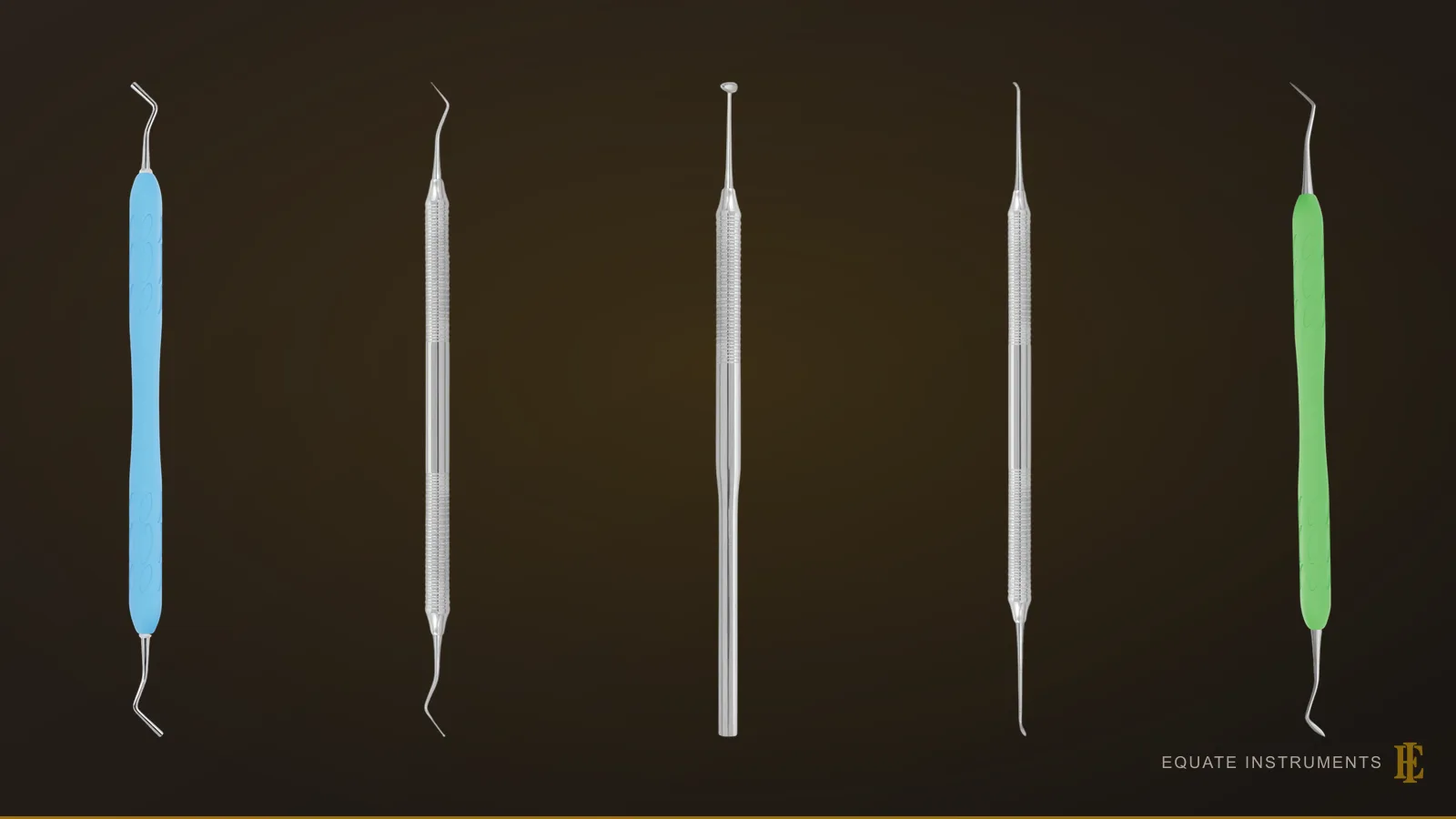
Amalgam restorative instruments are the hand instruments used to place, shape and finish an amalgam filling. A matrix retainer, band and wedge rebuild the missing tooth wall; a liner applicator protects the deep cavity floor; an amalgam carrier delivers the mix; condensers pack it; burnishers smooth it; carvers and a carving knife restore the tooth's anatomy; and articulating paper checks the bite.
Key points
- An amalgam filling usually follows the same sequence: preparation, a liner where needed, matrix and wedge, then carry, condense, burnish, carve and check the bite. The tray is laid out to match.
- Most condensers, burnishers and carvers also work with composite and temporary materials, but amalgam carriers are kept for amalgam only.
- Clean off every trace of amalgam before reprocessing, and send scrap amalgam to an authorised waste contractor. It must never go into sharps, clinical waste or the drain.
What are amalgam restorative instruments?
An amalgam restoration is placed in stages, and each stage has its own instruments. Linda Bartolomucci Boyd's Dental Instruments: A Pocket Guide (Elsevier) gives the amalgam family a chapter of its own. It covers the matrix system that stands in for a lost tooth wall, the liner applicator, the Woodson, the amalgam well and carrier, condensers, burnishers, carvers, the gold carving knife and the articulating paper holder. Cavity preparation comes first, so the tray also carries the enamel-cutting hand instruments and burs that shape the cavity.
Many of these instruments are not limited to amalgam. Condensers, burnishers and Hollenback carvers turn up on composite and temporary filling trays too. For the wider restorative family, see the restorative dental instruments overview.
On the tray they're laid out from left to right in the order they're used, and the amalgam restoration tray setup walks through that order step by step. Boyd's amalgam tray starts with the basic setup and ends with the instruments for checking the bite:
- Basic setup: mouth mirror, explorer and cotton forceps (see the basic dental instruments guide).
- Preparation: a spoon excavator, enamel hatchet and mesial and distal gingival margin trimmers, with burs in a bur block for the handpiece.
- Matrix: Tofflemire retainer with band, wooden wedges and crown and bridge scissors for trimming.
- Liner: liner applicator.
- Amalgam: amalgam well and amalgam carrier, small and large condensers.
- Shaping: acorn (or other) burnisher, Tanner carver, half-Hollenback carver and gold carving knife.
- Finishing: dental floss, articulating paper and holder.
- Support items: local anaesthetic aspirating syringe (see the local anaesthetic equipment guide), air/water syringe tip and high-volume evacuator tip (see dental evacuation and delivery systems).
| Instrument | What it does in an amalgam filling | Common variants |
|---|---|---|
| Matrix retainer and band | Rebuilds the missing proximal wall so amalgam can be packed against it | Tofflemire (universal) retainer; universal, premolar and molar bands; retainerless band systems |
| Wedge | Holds the band tight against the gingival margin and separates the teeth slightly | Wood or plastic; triangular, round or anatomical |
| Liner applicator | Places a thin protective liner on the deepest part of the cavity | Small ball tip; short or long handle; single or double-ended |
| Amalgam carrier | Picks up mixed amalgam and delivers it into the cavity | Double-ended lever type; single-ended plunger type |
| Condenser (plugger) | Packs amalgam firmly into every part of the cavity | Smooth or serrated; round, flat or diamond face; interproximal and back-action |
| Burnisher | Smooths and adapts amalgam to the margins; contours the band | Football, ball, acorn, T-ball, beavertail |
| Carver | Restores occlusal and proximal anatomy before the amalgam sets | Discoid-cleoid, Tanner, Hollenback, half-Hollenback |
| Gold carving knife | Trims excess (flash) from proximal surfaces | Single or double-ended; several blade designs |
| Articulating paper holder | Holds marking paper to check the bite on the new filling | Metal (reusable) or plastic (disposable) |
Matrix retainers, bands and wedges
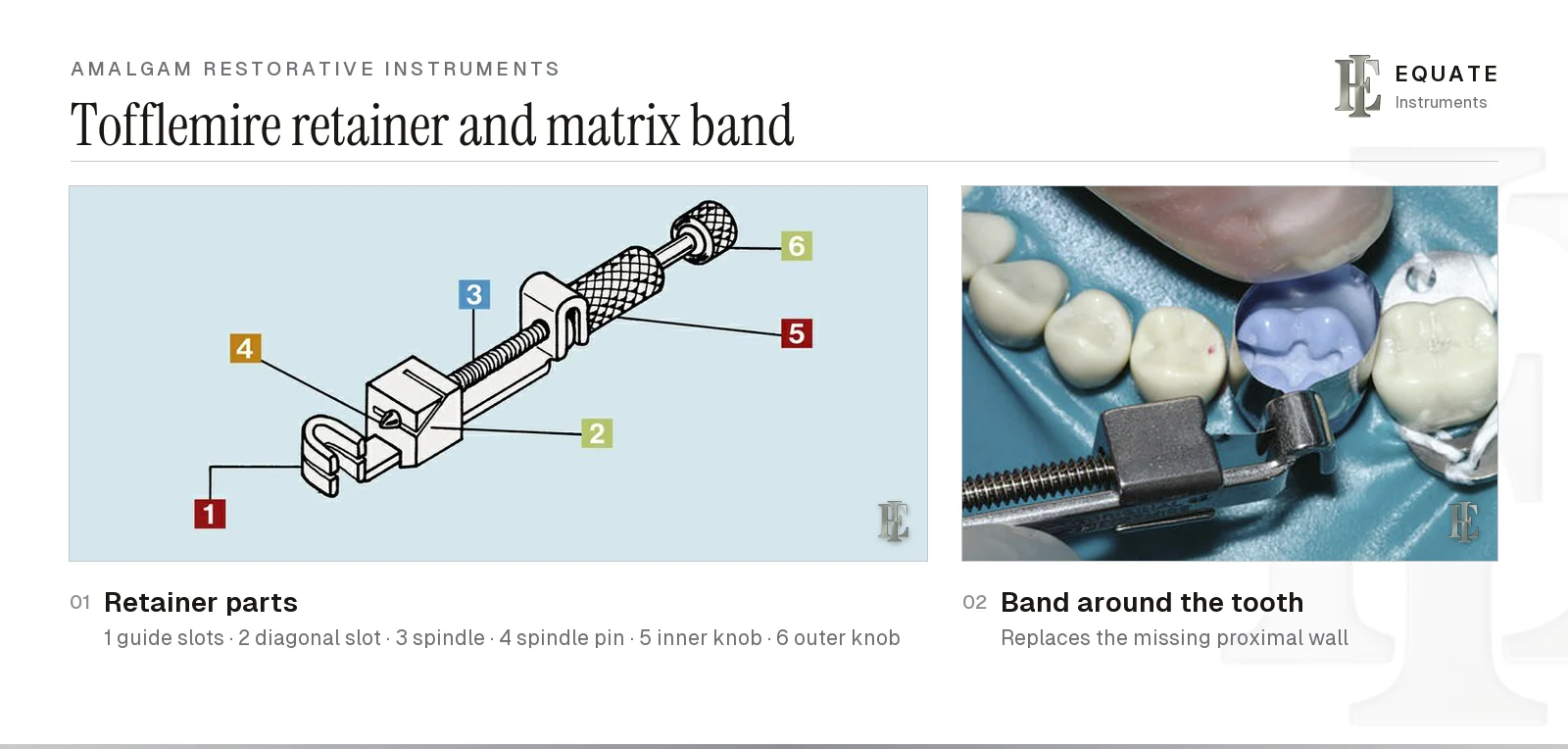
A class II cavity has lost at least one proximal wall, and amalgam can't be condensed against nothing. The matrix band is a thin strip of stainless steel wrapped around the tooth to act as a temporary wall, and the Tofflemire (universal) retainer holds it, a design Benjamin F. Tofflemire patented after filing in 1946. In practice the job has four steps. Load the band as a loop into the retainer head and lock its ends in place; size the loop so it slips over the crown; tighten it until it hugs the tooth below the cavity margin; and, once the occlusal anatomy is carved, take the retainer off first, leaving the band wedged while the proximal surface is shaped, before easing the band out sideways and occlusally. The open side of the head faces the gingiva so the retainer can be lifted off without dragging on the new filling, and the head's three slot directions let one retainer serve every quadrant. Some clinics prefer a loop-type retainer for single posterior teeth, or a Siqveland retainer, which works on the same tightening principle.
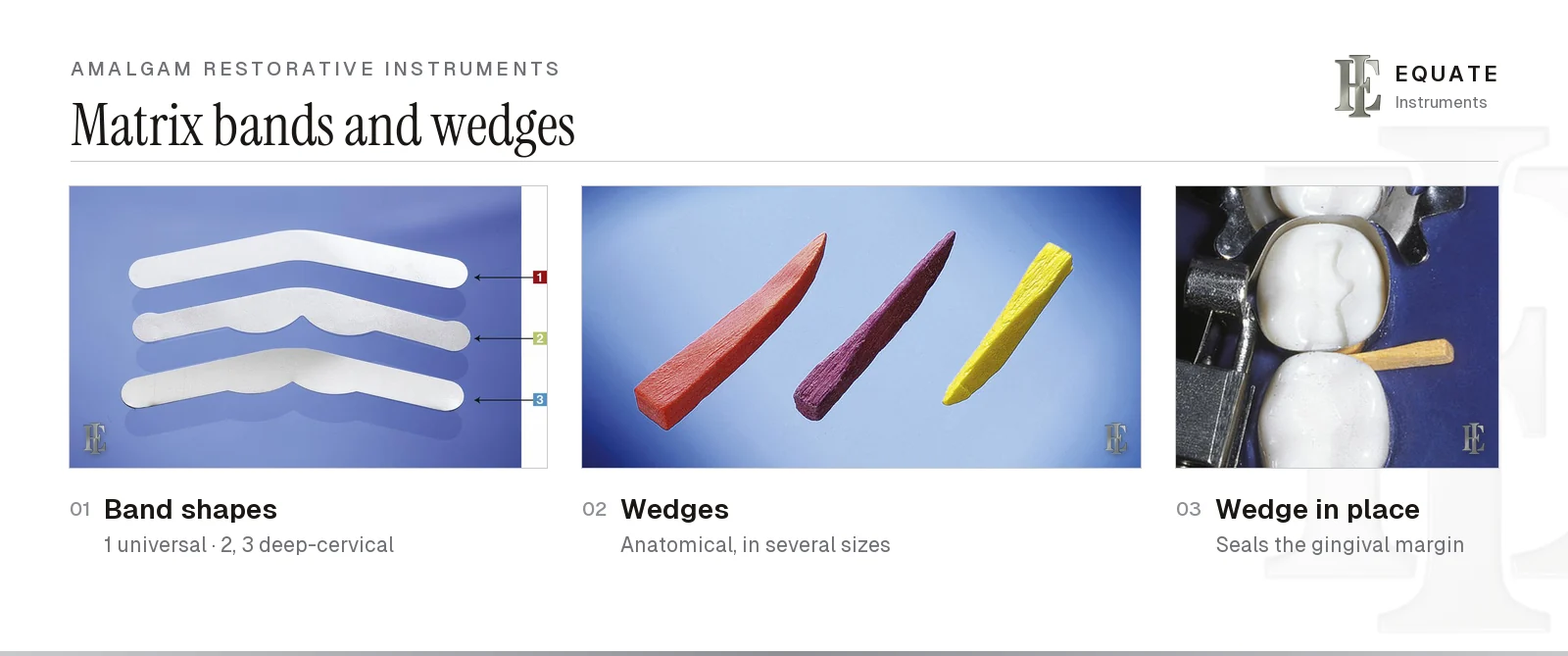
Bands come in different shapes. A universal band suits most premolar and molar restorations. Bands with a deeper extension on one edge reach further down a tooth whose box extends well below the contact point, and molar versions are wider again. Paediatric bands are smaller for primary teeth. Retainerless band systems tighten with a small key and are removed with dedicated pliers. All bands are single-use and go into the sharps container after use. Sectional matrices with separation rings, used mainly for composite, are the main alternative, and the matrix band retainers page weighs the trial evidence for each system.
A wedge goes into the gingival embrasure, usually from the lingual side where the embrasure is wider. It presses the band against the cervical margin so that amalgam can't squeeze out and leave an overhang, and it separates the teeth very slightly so the contact is tight once the band is removed. Wooden wedges swell a little when damp and hold well. Plastic wedges come in clear versions for curing composite. Choose a wedge size that fills the embrasure without pushing the band into the cavity, and throw it away after one use. Where dental dam is in place, the wedge goes in over the dam; see the dental dam instruments guide.
Liner applicator and Woodson: liners and bases
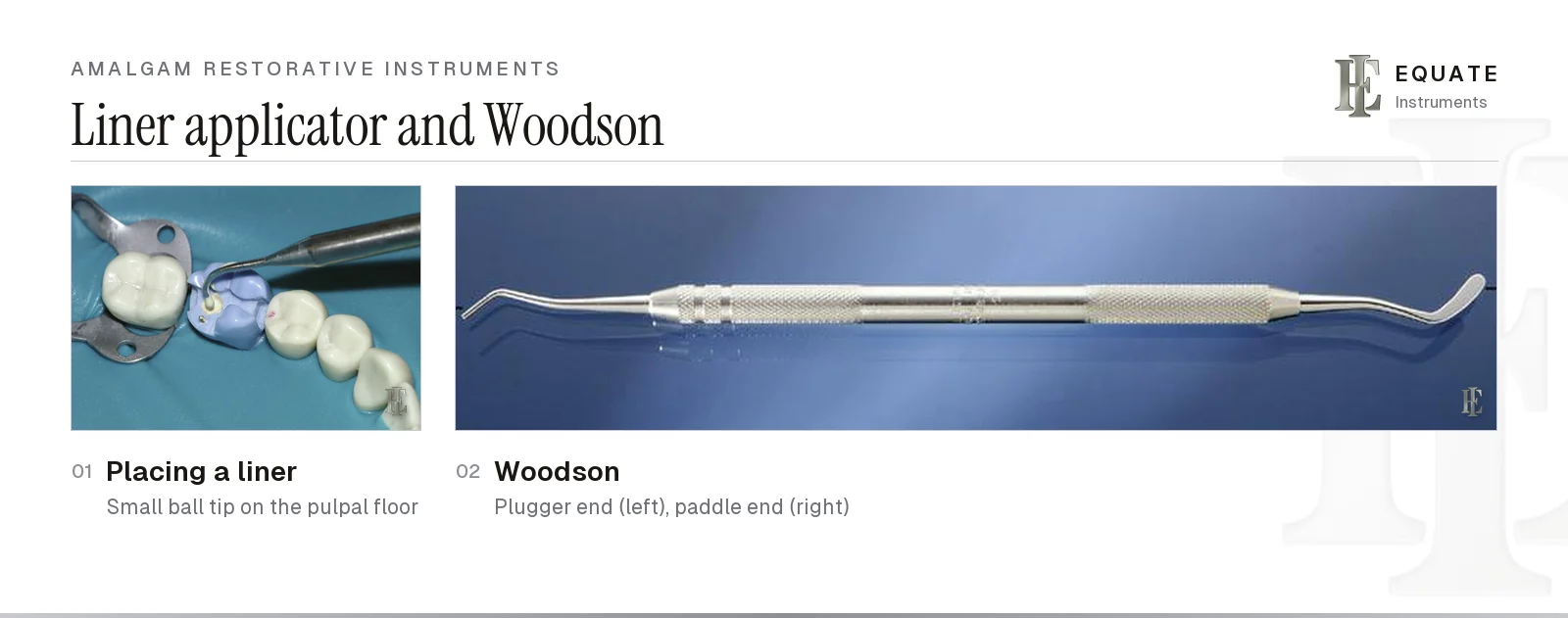
In a deep cavity a thin liner, such as calcium hydroxide or glass ionomer, may be placed over the area nearest the pulp before the amalgam. The liner applicator has a tiny ball on a fine angled shank. It picks up a small drop of liner and spots it exactly where it's needed without coating the cavity walls. Keep the liner off the enamel margins, where it would weaken the seal of the restoration. The instrument is sometimes called by the trade name of a popular calcium hydroxide liner, but the generic name is simply liner applicator.
The Woodson is a double-ended stainless steel "plastic" (filling) instrument, so called because it handles soft, unset materials, with a flat paddle at one end and a small plugger at the other. The paddle carries and spreads a base or temporary filling material, and the plugger end pats it down. It's a workhorse on amalgam, composite, crown and bridge and temporary filling trays, and the paddle comes in several angles and widths.
Mixing, holding and carrying amalgam
Modern dental amalgam comes in pre-dosed capsules. Each one holds the alloy powder and mercury, kept apart by a thin membrane, and often a small pestle. The capsule is activated by twisting or pressing, then shaken in an amalgamator (triturator) for the time and speed the material manufacturer specifies. Trituration for too short a time gives a dry, crumbly mix, and too long a time a hot, sloppy one. The same machine mixes other capsule materials, including some cements. The amalgamator itself isn't sterilised. It's covered with a barrier or cleaned and disinfected as its maker instructs.
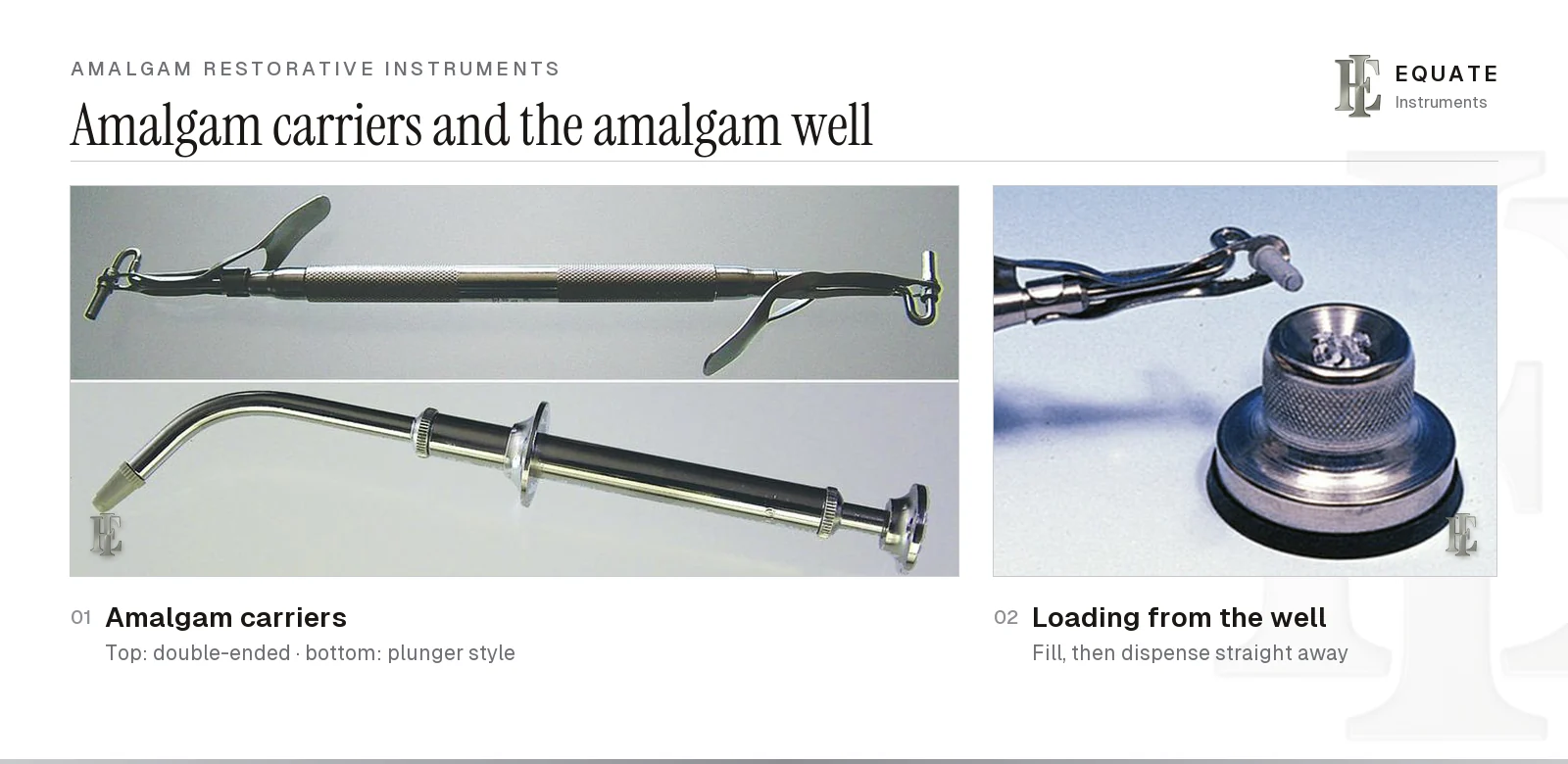
The mixed amalgam is tipped into an amalgam well, a small metal, glass or plastic dish, from which the carrier is loaded. An amalgam carrier is a hollow barrel with a plunger. The double-ended lever type has a small and a large barrel. The single-ended plunger type is pushed like a syringe. Barrels are lined with metal or a non-stick polymer such as PTFE, and the carrier is kept for amalgam alone; MTA and bone-graft carriers work on the same barrel-and-plunger idea but are separate instruments. Pack the barrel by pressing it into the mix, place the amalgam in the cavity in small increments, and empty and clean the carrier as soon as the last load is out. Amalgam starts setting within minutes, and a carrier left loaded will jam.
Is dental amalgam still used? EU, UK and global rules
Amalgam is being phased out, but at a different pace in each market. The Minamata Convention on Mercury, the UN treaty adopted in Kumamoto, Japan, in October 2013 and in force since 16 August 2017, began with a phase-down of dental amalgam, and a later change to its Annex A added a phase-out for children and pregnant women that took effect in 2023. At their sixth conference, held in Geneva from 3 to 7 November 2025, the parties agreed to end the use of dental amalgam worldwide by 2034.
The European Union moved first. The EU mercury regulation (EU) 2017/852 has allowed only pre-dosed capsules since 2019 and banned bulk mercury in dental practices. Its 2024 amendment, Regulation (EU) 2024/1849, ended the routine use of dental amalgam in the EU from 1 January 2025, with an exception where a dentist considers it strictly necessary for a patient's specific medical needs. Member states where amalgam was the only filling material publicly reimbursed at 90% or more could claim a transition period, to protect low-income patients who had no other reimbursed option, and that period ended on 30 June 2026, and the manufacture and import of dental amalgam in the EU have also been banned since 1 July 2026, again apart from specific medical needs.
The UK is phasing amalgam down rather than banning it. As the NHS Business Services Authority sets out, Article 10(2) of Regulation 2017/852 rules out amalgam for baby teeth, children under 15 and pregnant or breastfeeding women unless the dentist judges it strictly necessary, and new amalgam fillings can still be provided where they are clinically justified. Northern Ireland applies Regulation 2024/1849 under the Windsor Framework, but its phase-out was deferred to 31 December 2034, on condition of steady progress in phasing amalgam down, according to the British Dental Association. England, Scotland and Wales had no fixed end date until the 2034 Minamata decision.
In the United States, the FDA recommended in 2020 that certain higher-risk groups avoid amalgam where possible and appropriate, while advising against removing intact amalgam fillings that are in good condition. Clinics that still place or remove amalgam should check their national rules before stocking a tray.
| Date | Where | Measure |
|---|---|---|
| 16 August 2017 | Worldwide | Minamata Convention in force, with a phase-down of dental amalgam |
| 2018 | EU and UK | Amalgam restricted for baby teeth, under-15s and pregnant or breastfeeding women |
| 2019 | EU and UK | Only pre-dosed capsules allowed; bulk mercury banned in practices |
| 2023 | Worldwide | Minamata Annex A phase-out for children and pregnant women takes effect |
| 1 January 2025 | EU | Use ends except where strictly necessary for specific medical needs; export banned |
| 30 June 2026 | EU | Member-state transition period ends |
| 1 July 2026 | EU | Manufacture and import of dental amalgam banned |
| 2034 | Worldwide | Global phase-out agreed at Minamata COP-6 |
| 31 December 2034 | Northern Ireland | Deferred phase-out date, conditional on progress |
Condensers (pluggers): packing amalgam
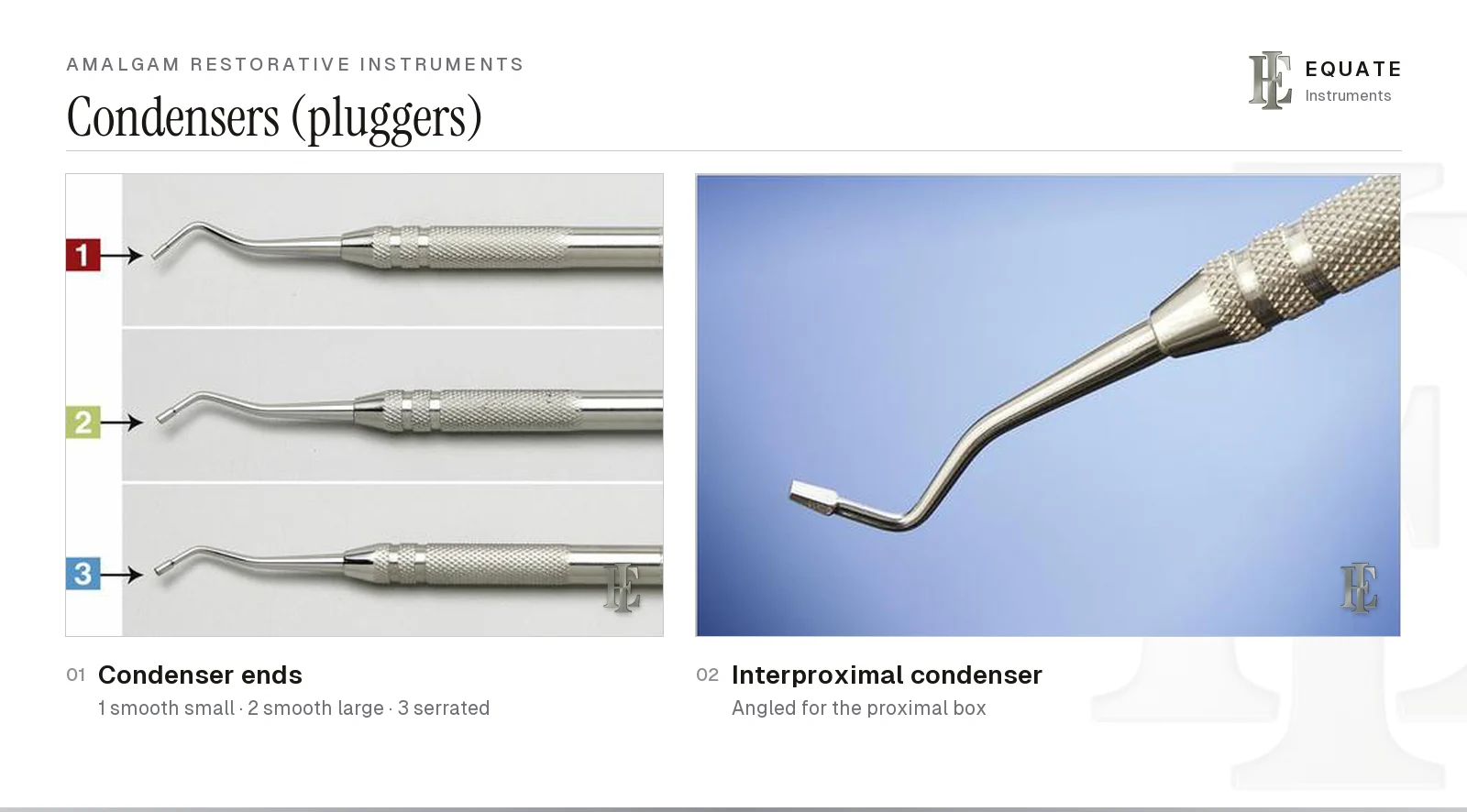
Condensers, also called pluggers, press each increment of amalgam firmly into the cavity. This removes voids, adapts the material to the walls and brings excess mercury to the surface, where it is carved away. Working ends are round, flat or diamond-shaped, and most condensers are double-ended with a small face at one end and a larger face at the other. Start with the small end in the proximal box and the line angles, then use the larger end for the occlusal part, overfilling slightly so there is material to carve. Face diameters run from under 1 mm for line angles to 3 mm or more for overfilling. A smaller face turns the same hand force into higher pressure, which A. Lussi and colleagues confirmed by measuring dentists at work in 1995; the condensers page gives their figures.
Smooth faces leave a clean surface and suit the final increments. Serrated faces grip the amalgam and help stop the condenser sliding across it, which is useful for the first increments. Interproximal condensers have narrow, angled ends shaped to reach the mesial or distal box. Back-action condensers have the working end turned back towards the handle for difficult distal areas. The same instruments pack composite and temporary materials, though for composite a non-stick coated plugger is usually easier to use.
Burnishers: smoothing and adapting amalgam
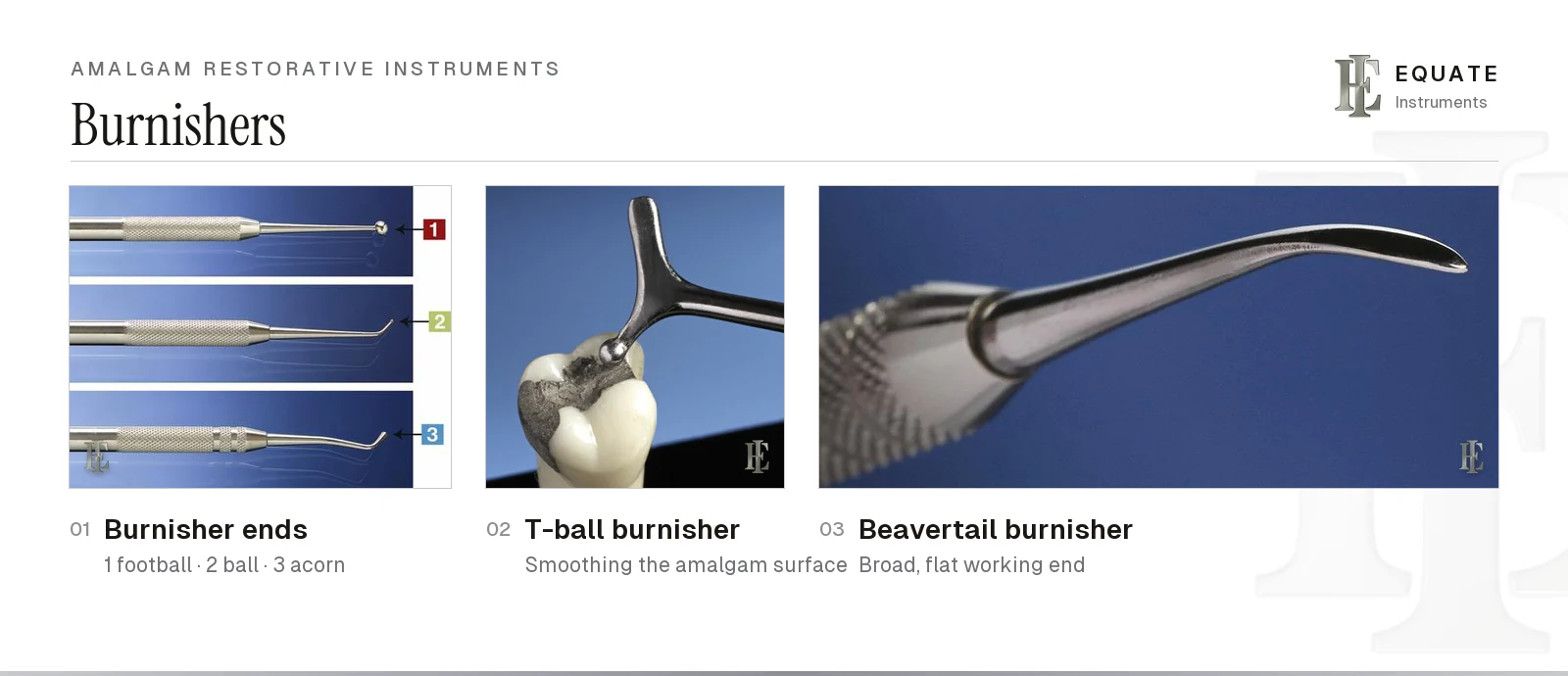
A burnisher is a smooth, polished working end rubbed over amalgam to close its surface and press it against the cavity margins. Burnishing right after condensing (pre-carve burnishing) adapts the material to the margins. A light burnish after carving smooths the surface. Burnishers have a second job before the filling starts. A ball burnisher rubbed on the inside of the matrix band before it goes on thins and curves it, and once the band is wedged the contact area can be pressed lightly against the neighbouring tooth, so the filling ends up with a convex wall and a proper contact. Burnishing both before and after carving came out best for margins in F. M. Kamel's 1995 laboratory study, which the burnishers page describes. Keep the pressure light and the strokes moving, because heavy, slow burnishing heats the amalgam.
The shape decides where each one works. The football (oval) burnisher suits occlusal surfaces and grooves, the ball burnisher fits pits and smaller restorations, and the pointed acorn burnisher reaches fissures and narrow areas. The T-ball burnisher has its ball on a bar set at right angles to the shank, which makes it easy to sweep along margins. The beavertail burnisher has a flat, paddle-shaped end. It smooths and starts shaping larger surfaces, and on dental dam trays it is used to tuck (invert) the dam around the necks of the teeth.
Carvers: restoring tooth anatomy
Carving gives the setting amalgam the shape of a tooth again: cusps, fossae, grooves and marginal ridges, with smooth margins that meet the enamel without a step. It's done while the amalgam is still firm but carvable, usually in the minutes after condensing. A good rule is to keep part of the blade resting on the enamel and move it parallel to the margin. Carving from tooth towards amalgam avoids gouging the filling below the cavosurface margin.
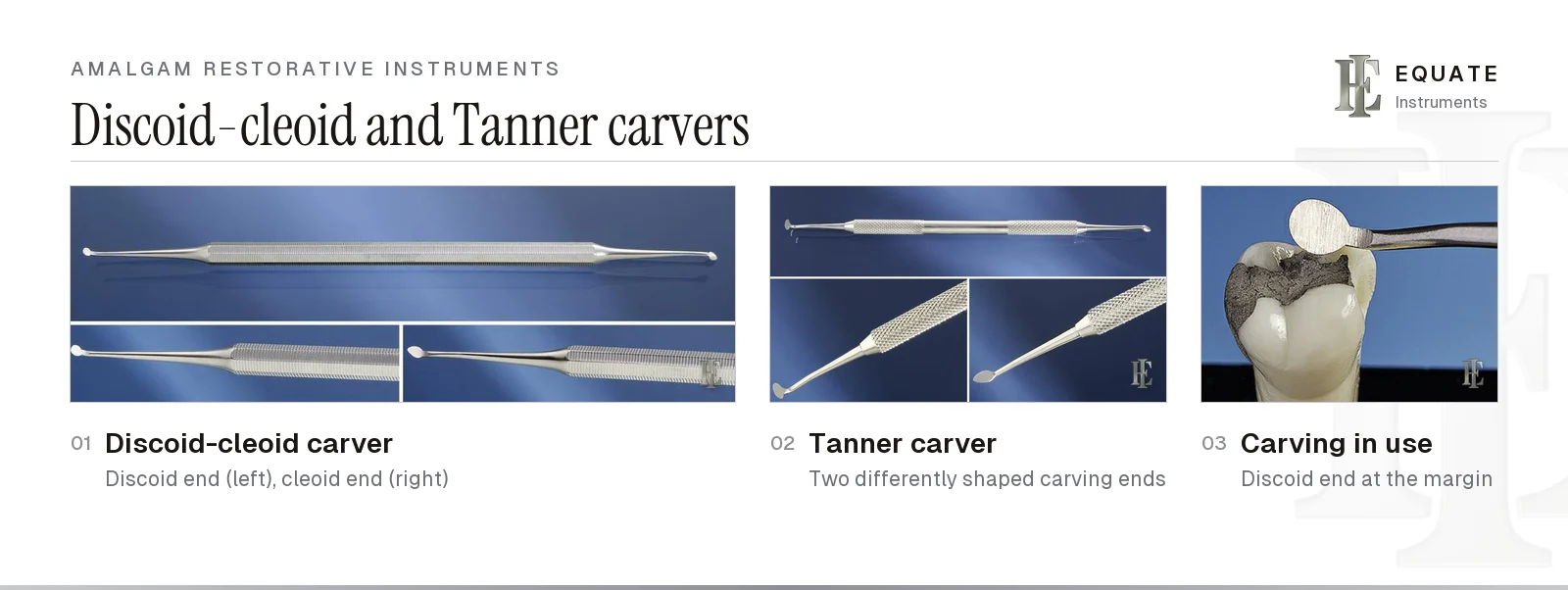
The discoid-cleoid carver has a disc-shaped end (discoid) and a pointed, claw-shaped end (cleoid). The discoid end shapes the occlusal anatomy and the cleoid end defines pits and grooves. The Tanner carver is also double-ended, but its two ends are shaped differently from the discoid-cleoid's: a small rounded paddle on a curved shank at one end and a narrow, almond-shaped blade at the other. Hollenback carvers have long, thin blades set at different angles, so they reach both occlusal and interproximal surfaces. The half-Hollenback is the same design at half the size, for small teeth and tight embrasures.
Both ends began in G. V. Black's chisel family, a history the dental carvers page traces. That page also covers laboratory wax carvers such as the Le Cron, Zahle and P. K. Thomas instruments, which aren't part of the amalgam tray.
| Carver | Working ends | Best for |
|---|---|---|
| Discoid-cleoid | Disc-shaped end and pointed claw-shaped end | Occlusal anatomy, pits and grooves on posterior amalgams |
| Tanner | Two differently shaped carving blades | Occlusal carving and marginal ridges |
| Hollenback | Long, thin blades angled differently at each end | Occlusal and interproximal contours, embrasures |
| Half-Hollenback | As Hollenback, at half the size | Premolars, small restorations, tight proximal areas |

Finishing and checking the bite
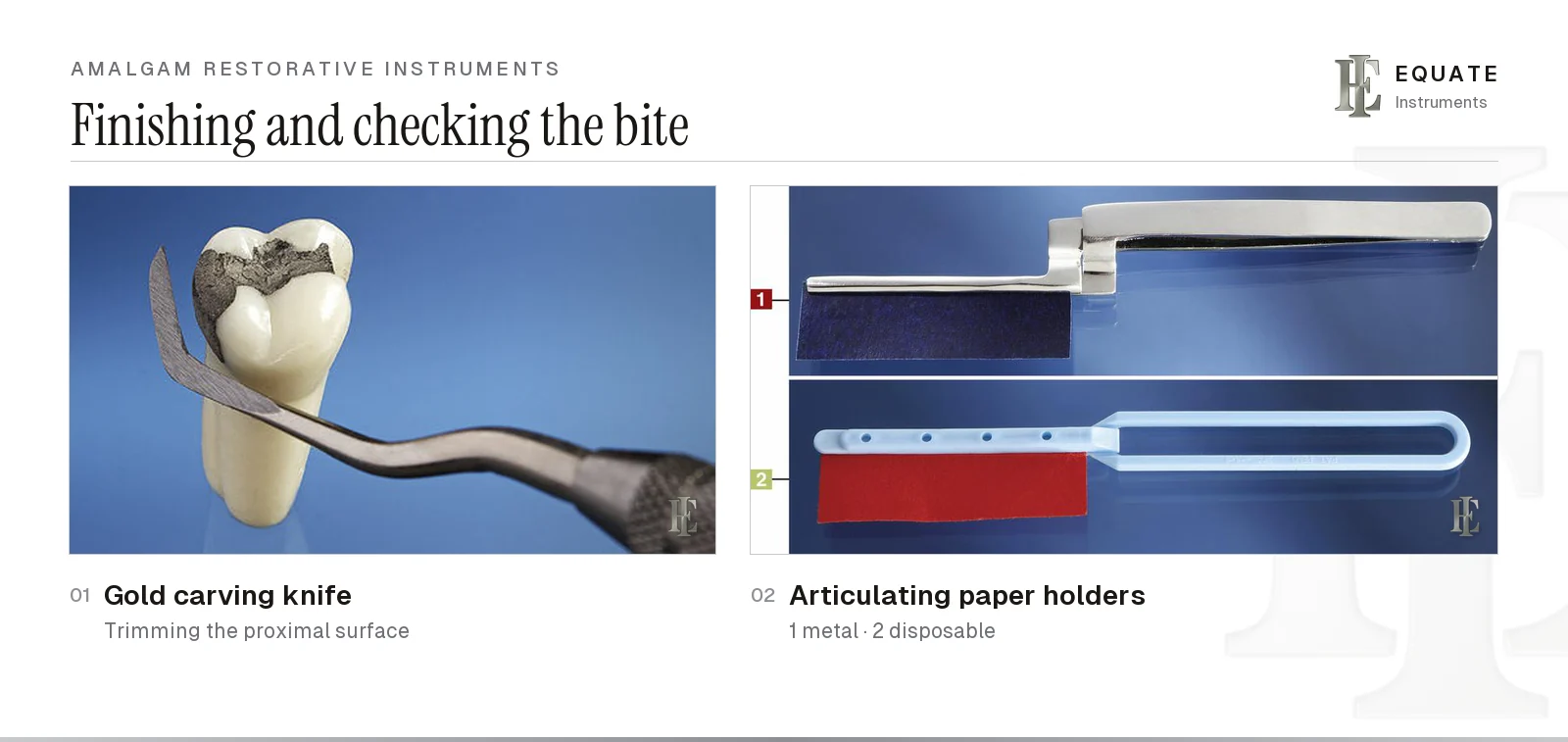
Once the band and wedge are out, the proximal surfaces are checked for overhangs and flash. The gold carving knife, despite its name, is used on amalgam and composite as well as gold. It has a thin, sharp blade that trims excess material from the proximal surface and restores the contour. Blades vary, and double-ended versions carry two different designs. Dental floss passed through the contact confirms that it is tight and free of excess.
The articulating paper holder keeps a strip of thin marking paper flat between the teeth while the patient closes and makes chewing and side-to-side movements. Coloured marks show high spots on the new filling, which are carved down before the amalgam gains strength. Reusable holders are metal, either forceps-style or full-arch frames. Disposable plastic holders and the paper itself are thrown away after one use. Paper comes in different colours and thicknesses, and two colours are often used together to tell closed-bite contacts from contacts made during side-to-side movement. Amalgam is weak for the first hours after placement, so patients are usually told to avoid chewing hard food on the new filling for a while, as the material's instructions advise.
Cleaning, sterilising and amalgam waste
Reusable amalgam instruments are semicritical items: they touch the mouth but don't penetrate tissue or bone. The CDC's Guideline for Disinfection and Sterilization in Healthcare Facilities uses the amalgam condenser as its example and recommends sterilising such instruments after each use when they are heat-tolerant. Both the US Centers for Disease Control and Prevention dental guidelines (Kohn and colleagues, 2003) and the Department of Health's HTM 01-05 for dental practices in England expect them to be cleaned and heat sterilised between patients. Amalgam adds one step. Remove every trace of it from carriers, condensers, burnishers, carvers and the well at the chair, before the instruments go into the washer or steriliser, ideally kept together in an instrument cassette so the set stays in order. Set amalgam is very hard to shift once it has hardened on steel, and heat drives mercury vapour out of amalgam, which is why CDC guidance also says extracted teeth containing amalgam must not be heat sterilised.
Under the EU mercury regulation, amalgam waste has to be collected by an authorised waste handler, and practices that work with amalgam need an amalgam separator that holds back at least 95% of amalgam particles. In the United States, the EPA's 2017 dental effluent rule requires offices that place or remove amalgam to run an amalgam separator and bars them from sending scrap amalgam down the drain. National rules elsewhere follow similar lines.
- Clean the amalgam off carriers and condensers straight away, and check the carrier plunger moves freely before it is packed.
- Set the carrier next to the condensers and clear its barrel after every load, because amalgam left in the tip sets hard. The tray setup lists other common slips, such as an unwedged band that leaves an overhang at the gingival margin.
- Back the retainer's spindle off fully and leave it unlocked, so steam can reach the threads and the band slots. Check the threads for wear while you are at it.
- Use a process indicator inside every pouch or wrap as well as on the outside, run a validated steam cycle, and look at both indicators before the pack is opened at the chair. The sterilisation and protective equipment guide covers cycles and indicators.
- Inspect carvers and other edged instruments under an illuminated magnifier and retire any that are blunt, chipped or bent, as paragraph 3.50 of HTM 01-05 asks. The same document (paragraph 2.17) lists matrix bands among the items to replace with single-use versions where possible.
- Single-use items go to the right waste stream: bands to sharps, and wedges, disposable articulating paper holders and paper to general or clinical waste.
- Used amalgam capsules, scrap and contact amalgam, and extracted teeth with amalgam fillings go into a sealed, rigid amalgam waste container with a mercury suppressant, for collection by your authorised waste contractor, as CQC guidance for dental practices sets out. Never put them in sharps, clinical waste or down the drain.
- Disinfect the amalgamator or cover it with a barrier, following its maker's instructions.
Buying amalgam instruments: what to check
- Condenser faces: crisp, even serrations or a flat, polished smooth face, with face diameters that match your cavity sizes (a small and a large end on each instrument).
- Burnishers: a mirror polish with no tool marks, since any roughness transfers to the filling surface.
- Carvers: thin, sharp blades that hold their edge and can be resharpened, with tips that line up with the handle axis for control.
- Amalgam carrier: a smooth plunger action, a non-stick barrel lining and a barrel size that suits the cavities you restore. Check that the barrel comes apart for cleaning.
- Matrix retainer: a smooth-running spindle and slots that grip the band without bending it; junior and senior sizes for small and large teeth.
- Material: passivated stainless steel that withstands repeated steam sterilisation. Coated (non-stick) ends make sense if the same instruments also place composite.
- Handles: a diameter and texture that suit the clinician's grip, ideally matching the rest of the restorative cassette.
The Equate difference
Equate's catalogue lists 3 Tofflemire matrix retainers (junior, universal and senior), 2 Siqveland retainers and 4 further posterior matrix retainers; 6 single-ended amalgam carriers; 19 products in its flat-condenser range (14 pluggers and condensers plus base carrier-condensers and a cement stopper), 4 cylindrical restorative pluggers, 3 compactors, 2 amalgam stoppers and a form condenser/burnisher; 43 ball burnishers and burnisher–plugger combinations, 11 football burnishers and 3 Bennet, NYU/B2 and modelling burnishers in its beavertail-burnisher range; 6 discoid-cleoid carvers, 4 Tanner carvers and 19 products in its Hollenback carver range (9 Hollenback and half-Hollenback carvers, with Frahm, Nystrom III and Maehlum carvers); 5 Woodson instruments; and 3 articulating paper forceps plus a full-arch articulating paper holder. It does not sell matrix bands, wedges or amalgamators.
Equate Amalgam Restorative Instruments: What Each One Does options

Dental Plugger 1.8 / 2.5 mm Titanium
EI-0016
Double-Ended Filling Plugger 2.5 mm / 3.8 mm - Hollow Handle
EI-0017
Dental Plugger 1.3 / 1.8 mm Titanium
EI-0018
Dental Plugger 1.0 / 1.3 mm Titanium
EI-0019
Amalgam Stopper
EI-0087
Amalgam Stopper
EI-0088
Plugger 1.0mm/2.0mm - Double-Ended Knurled Handle
EI-0089
Carver 5 - Double-Ended 2.0/2.5mm with Knurled Handle
EI-0091
Nystrom III Carver 2.0/2.5mm - Knurled Handle
EI-0094
Plugger 2.0 / 2.5 mm Knurled Handle
EI-0095
Fine Plugger 0.7mm/1.0mm - Knurled Handle
EI-0096
Composite Instrument Anterior - Double-Ended Hollow Handle
EI-0097Browse all restorative & operative instruments Browse all prosthodontic & laboratory instruments
Buying in your market
Frequently asked questions
What instruments are used for an amalgam filling?
After the basic setup and the preparation instruments, an amalgam tray holds a matrix retainer, band and wedges, a liner applicator, an amalgam well and carrier, small and large condensers, a burnisher, carvers such as the Tanner and half-Hollenback, a gold carving knife, dental floss and an articulating paper holder.
What is the difference between an amalgam condenser and a burnisher?
A condenser packs amalgam into the cavity under firm pressure to remove voids. Its face is flat and smooth or serrated. A burnisher has a rounded, highly polished end that smooths the surface and adapts the material to the margins after condensing and after carving.
Which matrix is used for an amalgam filling?
Usually a circumferential stainless steel band in a Tofflemire retainer, sealed at the gingival margin with a wooden wedge, because it supports firm condensation all round the tooth. Sectional matrices with separation rings are used mainly for composite; the matrix band retainers page compares the two.
Which carver should I use: discoid-cleoid, Tanner or Hollenback?
Use the discoid-cleoid or Tanner for occlusal anatomy, pits and grooves, and the Hollenback or half-Hollenback for interproximal contours and embrasures. The dental carvers page compares each pattern in detail.
Is dental amalgam still used in the EU?
Only in exceptional cases. Regulation (EU) 2024/1849 ended routine use of dental amalgam in the EU from 1 January 2025, and its manufacture and import have been banned since 1 July 2026. It may still be used where the dentist considers it strictly necessary for a patient's specific medical needs. Where it's used, it must come in pre-dosed capsules, and practices need an amalgam separator.
Can extracted teeth with amalgam fillings be autoclaved?
No. CDC guidance reserves heat sterilisation for extracted teeth without amalgam, because heating amalgam gives off mercury vapour, and it says teeth containing amalgam must not go into medical waste that will be incinerated. Collect them in the sealed amalgam waste container instead.
Should old amalgam fillings be removed?
Not routinely. The US FDA's 2020 recommendations say intact amalgam fillings in good condition should not be removed or replaced unless it is medically necessary, because removal can briefly raise mercury vapour exposure and take away healthy tooth structure. Any change of filling is a decision for the dentist and patient.
References
- Boyd LB. Dental Instruments: A Pocket Guide, 7th edition. Saunders/Elsevier, 2020 (photographs used under licence)
- Kohn WG, et al. Guidelines for Infection Control in Dental Health-Care Settings, 2003. MMWR 52(RR-17), Centers for Disease Control and Prevention
- Department of Health (now DHSC). Health Technical Memorandum 01-05: Decontamination in primary care dental practices, 2013 edition
- Regulation (EU) 2017/852 of the European Parliament and of the Council on mercury (Article 10, dental amalgam)
- Regulation (EU) 2024/1849 amending Regulation (EU) 2017/852 on mercury as regards dental amalgam and other mercury-added products
- US Food and Drug Administration. FDA issues recommendations for certain high-risk groups regarding mercury-containing dental amalgam, 24 September 2020
- Care Quality Commission. Dental mythbuster 1: Use and disposal of dental amalgam
- Centers for Disease Control and Prevention. Guideline for Disinfection and Sterilization in Healthcare Facilities (2008): disinfection of healthcare equipment
- US Environmental Protection Agency. Dental effluent guidelines (40 CFR Part 441), final rule 14 June 2017
- NHS Business Services Authority. Can I provide an amalgam filling? (knowledge base article KA-02021)
- British Dental Association. Minamata Convention decision on phasing out amalgam
- Minamata Convention on Mercury. Minamata Convention COP-6 agrees to end the use of dental amalgam by 2034, November 2025
- Minamata Convention on Mercury. Dental amalgam (topic page: Annex A amendments)
- European Parliament press release 20240408IPR20295. Mercury: Parliament adopts law to phase out the use of dental amalgam, 10 April 2024
- Lussi A, Brunner M, Portmann P, Buergin W. Condensation pressure during amalgam placement in patients. European Journal of Oral Sciences 1995;103(6):388–393
- Kamel FM. Effect of surface treatment on marginal integrity of amalgam restorations (in vitro study). Egyptian Dental Journal 1995;41(3):1313–1320
- Minamata Convention on Mercury. About us (adoption and entry into force)
- FEDCAR. Dental amalgams: a phasing-out starting on 1 January 2025 with some exceptions under the practitioner's decision, December 2024
- Tofflemire BF. Matrix retainer. US Patent 2,439,703, filed 18 June 1946, granted 13 April 1948
- Hadavi F. Instruments and general instrumentation for cavity preparation. Teaching notes published by Columbia University
I am a…
Related
- Restorative Dental Hand Instruments
- Enamel-Cutting Instruments and G.V. Black's Instrument Formula
- Dental Dam Instruments Explained, from Sheet to Frame
- Basic Dental Instruments: Mirror, Explorer, Cotton Forceps and Handles
- Dental Burs and Rotary Instruments: Types, Shanks and Uses
- Composite Restorative Instruments, from Matrix Band to Finishing Strip
- Tofflemire and Other Matrix Band Retainers
- Amalgam Carriers (Dental Amalgam Carriers)
- Dental Pluggers and Condensers (Amalgam Condensers)
- Dental Burnishers: Ball, Football, Acorn, T-Ball and Beavertail
- Dental Carvers: Types of Carvers in Dentistry and the Lab
- Amalgam Restoration Tray Setup