Tofflemire and Other Matrix Band Retainers
Written by the Equate Instruments Technical Team · Reviewed by the Medical & Dental Board, Equate Instruments · Updated ·
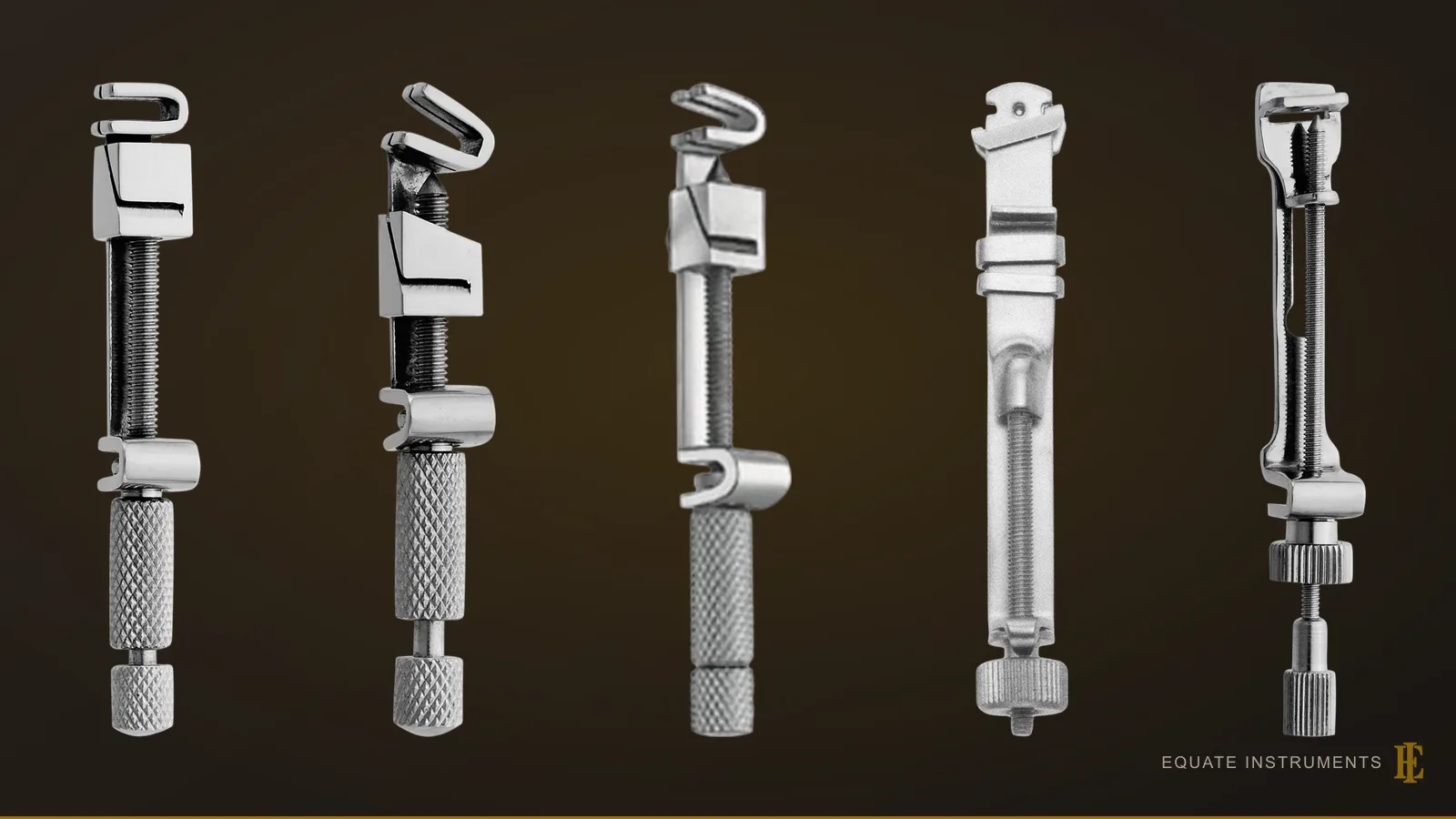
A Tofflemire retainer is a matrix band retainer: a small screw-driven clamp that holds a metal matrix band tightly around a tooth, so the band acts as the missing proximal wall while a Class II restoration is placed. Its frame, vise, guide slots, spindle and inner and outer knobs lock the band ends and tighten the loop. Benjamin F. Tofflemire patented the design in the 1940s.
Key points
- The outer knob turns the spindle to lock the band ends in the vise; the inner knob moves the vise to tighten or loosen the loop.
- A wedge at the gingival margin seals the band against the tooth and prevents an overhang.
- In a randomised trial, sectional matrices with a separation ring gave tighter contacts than a Tofflemire in two-surface cavities, but not in MOD cavities.
What is a matrix band retainer used for?
When decay reaches the side of a back tooth, the preparation loses its proximal wall, and the filling material has nothing to be packed against. A matrix band, a thin strip of stainless steel, is wrapped around the tooth to replace that wall, and the retainer holds the band tight while amalgam is condensed or composite is placed. The band gives the restoration its proximal contour and contact with the neighbouring tooth, and it stops material being pushed into the gum at the gingival margin.
The design takes its name from Benjamin F. Tofflemire of Lafayette, California, whose matrix retainer patent was filed in June 1946 and granted in April 1948 (US 2,439,703). It describes a retainer that clamps the band ends with a spindle and tightens the band with a sleeve, both turned from outside the mouth, so the band can be tightened and released without disturbing the contact. Retainers are part of the amalgam restoration tray setup and the Class II composite restoration tray setup. Owens and Phebus's 2016 review in General Dentistry describes the Tofflemire as a development of the earlier Ivory No. 8 and 9 retainers, and the amalgam restorative instruments guide shows the band shapes and wedges alongside the rest of the amalgam family.
What are the parts of a Tofflemire retainer?
A Tofflemire retainer has six working parts, and knowing each one makes assembly simple.
| Part | What it does |
|---|---|
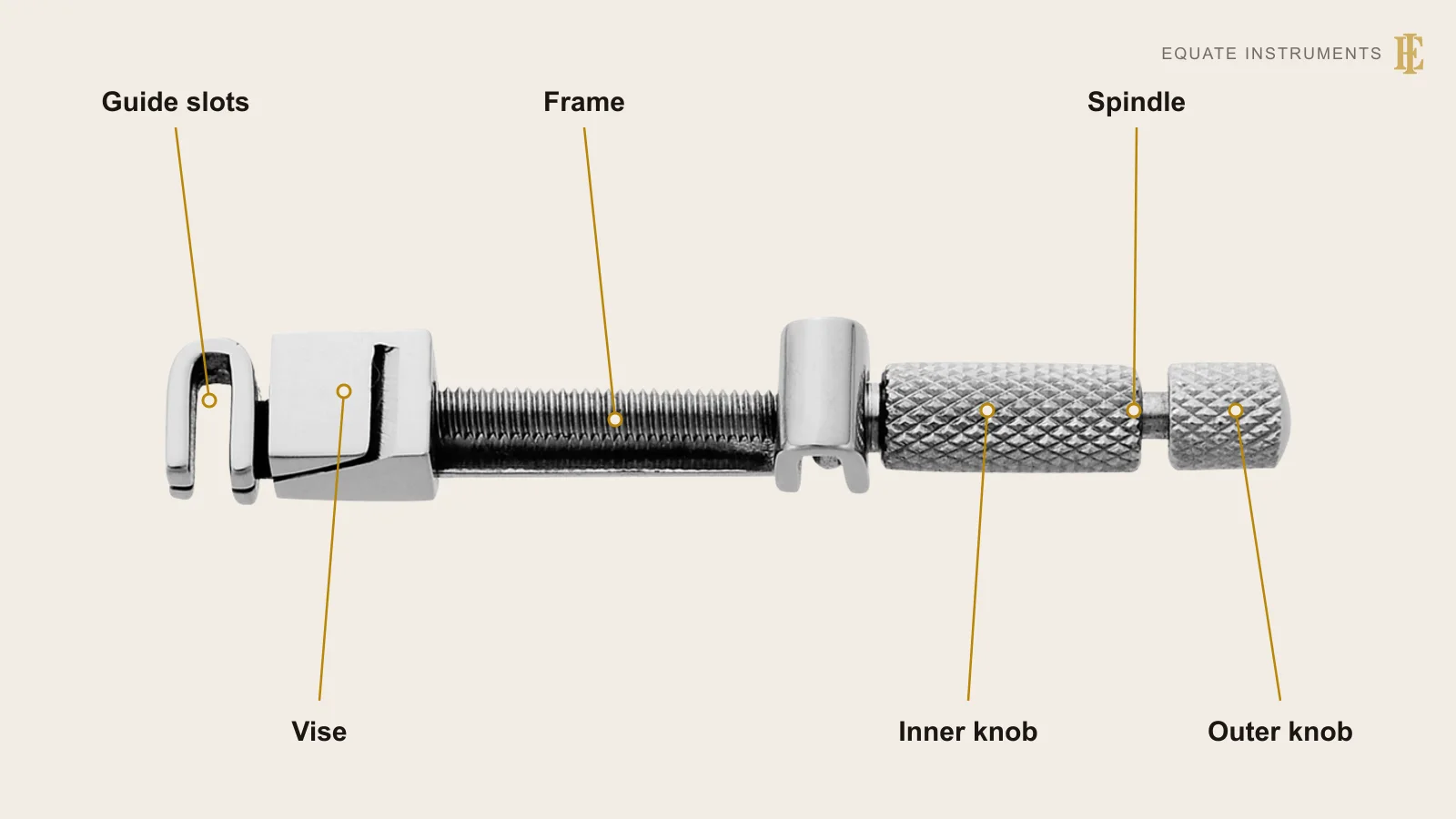
| Frame | The body of the retainer, along which the vise slides |
| Vise | The sliding block with a diagonal slot that grips the two ends of the band |
| Guide slots | The U-shaped head at the end of the frame, with a straight slot and right and left slots, that guides the loop of band |
| Spindle | The screw running through the frame; its tip presses the band ends into the vise |
| Outer knob | Turns the spindle to lock or release the band ends in the vise |
| Inner knob | Moves the vise along the frame to tighten or loosen the loop around the tooth |
How do you assemble a Tofflemire retainer?
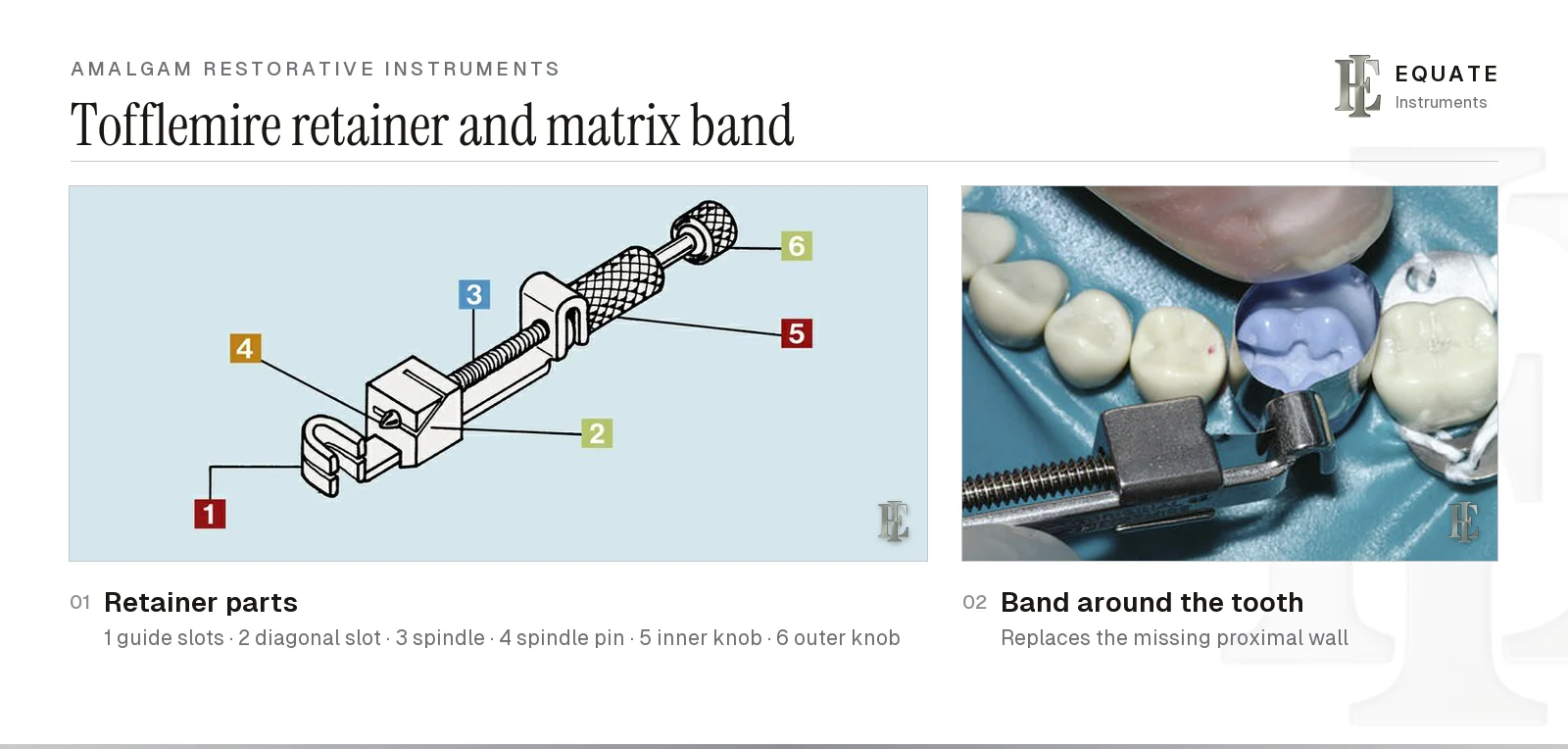
- Turn the outer knob anticlockwise until the spindle tip is clear of the diagonal slot, then turn the inner knob until the vise sits close to the guide slots.
- Hold the retainer with the diagonal slot facing you and the guide slots towards the gingiva, so the open side will sit towards the gum.
- Fold the band into a loop and check its edges: the edge with the larger circumference goes towards the occlusal surface, the smaller one towards the gingiva.
- Slide the joined ends of the band into the diagonal slot of the vise, and the loop into the guide slot that suits the quadrant: right or left for most posterior teeth, straight for some.
- Tighten the outer knob to lock the band ends, then shape the loop with a mirror handle or burnisher so it opens into a round shape.
- Place the band over the tooth from the occlusal, with the retainer on the buccal side and the handle parallel to the occlusal plane, and tighten the inner knob until the band is snug.
- Check with an explorer that the band extends about 1 mm past the gingival margin and sits just above the marginal ridge of the neighbouring tooth.
What are wedges for, and where do they go?
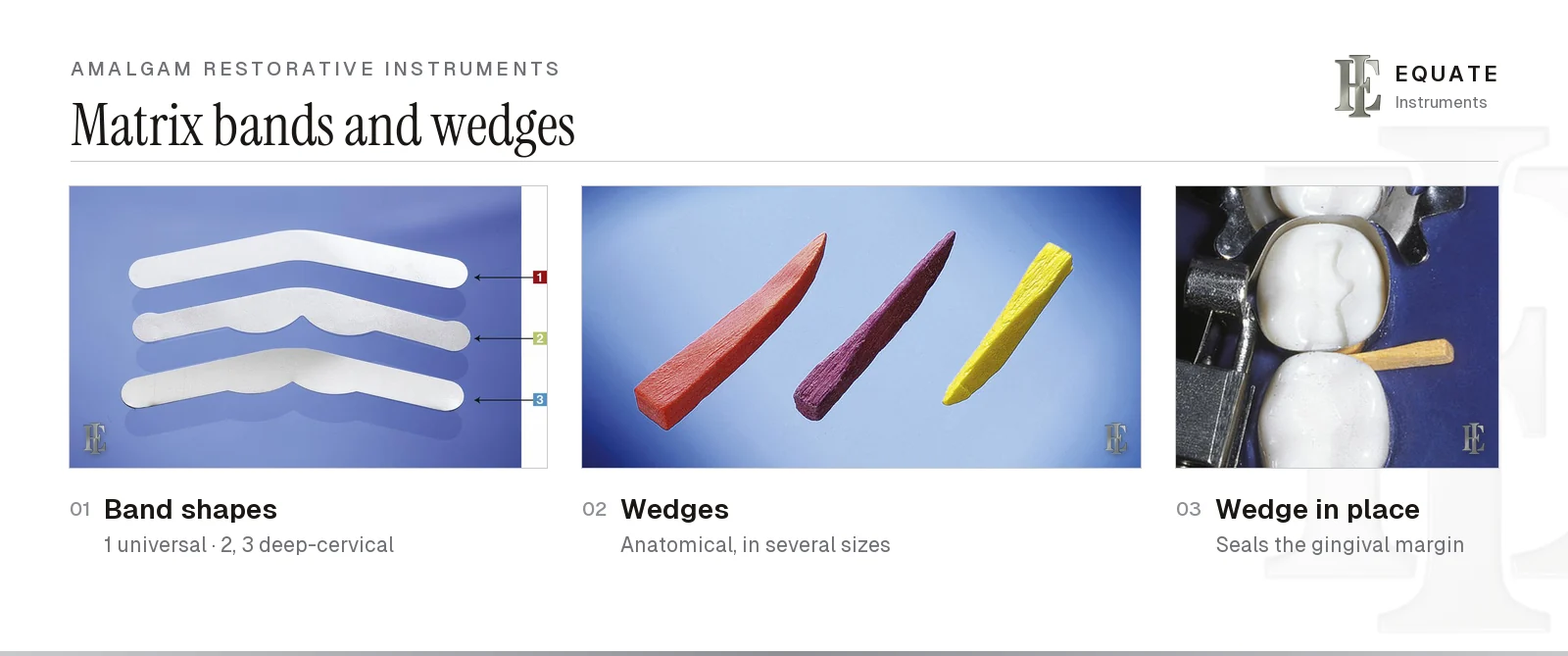
A wedge is pushed into the gingival embrasure, usually from the lingual or palatal side, to press the band tightly against the tooth below the gingival margin. That seals the margin so no material squeezes out to form an overhang, holds the band still during condensation and separates the teeth slightly, which makes up for the band's thickness when it's removed and helps leave a tight contact. Wooden and plastic wedges come in triangular, round and anatomical shapes and several sizes; choose one that fills the embrasure without crushing the papilla, and place it with cotton pliers. Wedges and bands are single-use: used bands go into the sharps container and wedges into general waste.
Contour the band before it goes on, by rubbing a ball or football burnisher on its inside to thin and curve it. Once the band is tightened and wedged, the contact area can be burnished lightly against the neighbouring tooth, before any material goes in, to give the restoration a convex proximal wall.
What is the difference between a sectional and a circumferential matrix?
A circumferential matrix, such as a Tofflemire band, wraps all the way round the tooth, while a sectional matrix covers only the proximal surface being restored and is held by a wedge and a separation ring that springs the teeth apart. Wirsching, Loomans, Klaiber and Dörfer randomised 85 patients needing posterior composites in a 2011 trial in the Journal of Dentistry: in two-surface cavities, sectional matrices with a ring gave significantly tighter contacts than a circumferential matrix with a Tofflemire retainer, but in three-surface MOD cavities there was no significant difference. A 2024 systematic review by K. Anantula and colleagues in the Journal of Conservative Dentistry and Endodontics also found that sectional matrices combined with separation rings gave tighter proximal contacts than other systems. Overhang is a different matter. In a 2009 laboratory study of 240 phantom-head molars restored with composite, which Owens and Phebus also cite, Loomans and colleagues found that circumferential matrices as a group, the Tofflemire among them, left less marginal overhang than sectional matrices.
Rings are placed with rubber dam clamp forceps, so the two systems need different instruments on the tray; sectional ring systems are covered in the composite instruments guide.
| Situation | Usual choice |
|---|---|
| MO or DO composite | Sectional matrix with a separation ring and wedge |
| MOD restoration | Circumferential band in a Tofflemire retainer, or two sectional matrices |
| Amalgam, large build-ups and cusp replacement | Circumferential band in a Tofflemire retainer |
| Primary molars and small teeth | Junior retainer with a narrow or paediatric band |
| Deep gingival boxes | Extended-depth circumferential band, well wedged |
How do you remove a matrix band without breaking the restoration?
Take the retainer off first: loosen the inner knob to open the loop, release the band ends with the outer knob and lift the retainer away occlusally, leaving the band on the tooth, still supported by the wedge, while a Hollenback or interproximal carver shapes the proximal surface. Then remove the wedge and the band together. For an MO or DO, free the band from the side without a box first, then tilt it and draw it out bucco-occlusally or linguo-occlusally while a cotton pledget supports the new marginal ridge, rather than pulling it straight up through the contact, which could snap the newly formed marginal ridge. Check the contact with floss, which should snap through, and the margin with an explorer, and trim any cervical excess. Farhad Hadavi's carving steps for Columbia University follow this sequence.
What does the Equate range include?
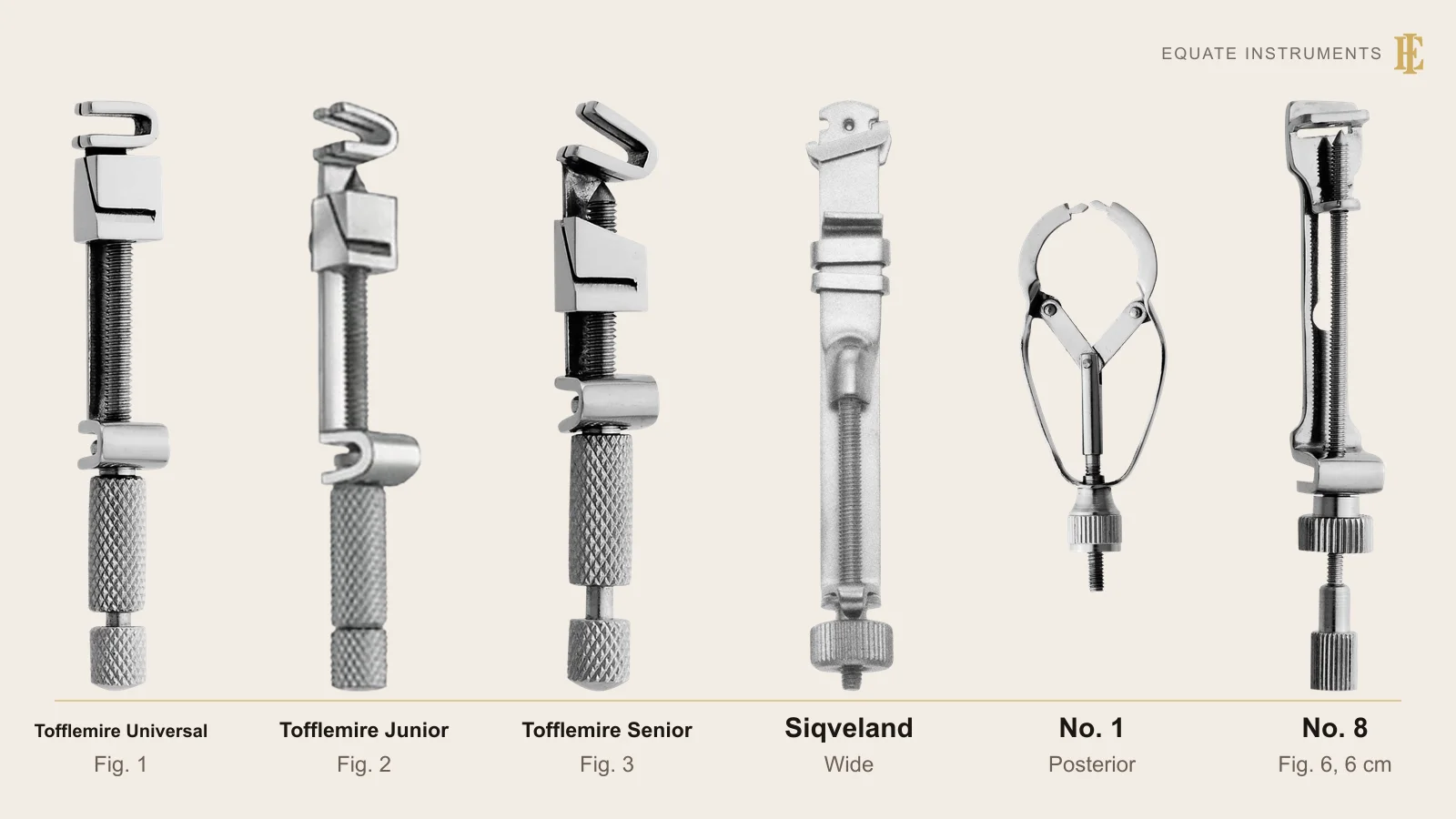
Equate's retainers cover adult and paediatric posterior teeth. There are Tofflemire Universal (Fig. 1), Junior (Fig. 2) and Senior (Fig. 3) retainers, wide and narrow Siqveland retainers, a No. 1 posterior retainer whose jaws engage the embrasures, a compact 6 cm No. 8 (Fig. 6) retainer, and side-specific right and left offset retainers for posterior teeth where a straight retainer is blocked by the opposing arch. Each is passivated stainless steel, ultrasonically cleaned, shape-, boil- and performance-tested and individually packed, and clinics can request samples and a quote. The restorative instruments hub lists the filling instruments used with them.
How do you clean and maintain a matrix retainer?
Discard the band and wedge, then process the retainer open and unwound, with the spindle backed off, so cleaning reaches the threads and the vise. Clean, inspect and sterilise in line with the manufacturer's ISO 17664-1 instructions and the CDC's Guidelines for Infection Control in Dental Health-Care Settings or, in UK practices, HTM 01-05, which ask for hinged and jointed instruments to be cleaned open. Check that both knobs turn smoothly and the vise grips; replace a retainer whose frame is bent or whose spindle slips under load.
The Equate difference
Equate lists nine matrix retainer references: Tofflemire Universal (Fig. 1), Junior (Fig. 2) and Senior (Fig. 3) retainers, wide and narrow Siqveland retainers, a No. 1 and a No. 8 (Fig. 6, 6 cm) posterior retainer, and a right- and a left-side offset posterior retainer.
Equate Tofflemire and Other Matrix Band Retainers options

Ivory Matrix Retainer No.8 Fig.6 - 6 cm
EI-0785
Tofflemire Junior Matrix Retainer Fig.2
EI-0786
Tofflemire Universal Matrix Retainer Fig.1
EI-0787
Tofflemire Senior Matrix Retainer Fig.3
EI-0788
Nystrom Matrix Retainer - Right
EI-0789
Nystrom Matrix Retainer - Left
EI-0790
Siqveland Matrix Retainer - Wide
EI-2412
Siqveland Matrix Retainer - Narrow
EI-2413
Ivory No.1 Matrix Retainer
EI-2414Browse all prosthodontic & laboratory instruments
Buying in your market
Frequently asked questions
What is a Tofflemire used for in dentistry?
A Tofflemire retainer holds a metal matrix band tightly around a tooth so it replaces the missing proximal wall during a Class II amalgam or composite restoration.
What does the inner knob on a Tofflemire do?
The inner knob moves the vise along the frame, which tightens or loosens the loop of band around the tooth. The outer knob locks and releases the band ends in the vise.
Which way does the matrix band go in a Tofflemire?
The edge with the larger circumference faces occlusally and the smaller edge gingivally, with the guide slots and open side of the retainer towards the gingiva.
What thickness are Tofflemire matrix bands?
Tofflemire bands are stainless steel, usually 0.0015 in or 0.0020 in thick (about 0.038 or 0.05 mm), and come straight or precontoured. Shapes include a universal band, bands with a deeper gingival extension for premolars and molars, and small paediatric bands.
Is a sectional matrix better than a Tofflemire?
For two-surface composites, sectional matrices with a separation ring give tighter contacts, according to a randomised trial and a 2024 systematic review. For MOD cavities and amalgam, a circumferential band is still widely used.
Can matrix bands be reused?
No. Matrix bands and wedges are single-use, and HTM 01-05 lists matrix bands among the items to replace with single-use versions because they are hard to clean. Used bands go into the sharps container; only the retainer is cleaned and sterilised for reuse.
References
- Tofflemire BF. Matrix retainer. US Patent 2,439,703, filed 18 June 1946, granted 13 April 1948
- Wirsching E, Loomans BA, Klaiber B, Dörfer CE. Influence of matrix systems on proximal contact tightness of 2- and 3-surface posterior composite restorations in vivo. Journal of Dentistry 2011;39(5):386–390
- Anantula K, Vankayala B, Yadav SS. Proximal contact tightness of direct Class II composite resin restorations with various matrix systems: a systematic review. Journal of Conservative Dentistry and Endodontics 2024;27(1):11–16
- Heymann HO, Swift EJ, Ritter AV (eds). Sturdevant's Art and Science of Operative Dentistry, 6th ed. Elsevier, 2013 (matrix placement for Class II restorations)
- Kohn WG, et al. Guidelines for Infection Control in Dental Health-Care Settings, 2003. MMWR 52(RR-17), Centers for Disease Control and Prevention
- Boyd LB. Dental Instruments: A Pocket Guide, 7th edition. Saunders/Elsevier, 2020. Chapters 8 and 9, Amalgam Restorative Instruments and Composite Restorative Instruments (photographs used under licence)
- Loomans BAC, Opdam NJM, Roeters FJM, Bronkhorst EM, Huysmans MCDNJM. Restoration techniques and marginal overhang in Class II composite resin restorations. Journal of Dentistry 2009;37(9):712–717
- Owens BM, Phebus JG. An evidence-based review of dental matrix systems. General Dentistry 2016;64(5):64–70
- Hadavi F. Steps in carving amalgam: class 2 cavity. Teaching notes published by Columbia University, 2004–2005
- Department of Health (England). Health Technical Memorandum 01-05: Decontamination in primary care dental practices, 2013 edition
I am a…
Related
- Restorative Dental Hand Instruments
- Dental Burnishers: Ball, Football, Acorn, T-Ball and Beavertail
- Rubber Dam Clamps, Forceps, Punches and Frames: Which to Choose
- Dental Composite Instruments: Placement, Sculpting and the Composite Gun
- Amalgam Restoration Tray Setup
- Composite Restoration Tray Setup (Class I to V)
- Amalgam Restorative Instruments: What Each One Does
- Dental Pluggers and Condensers (Amalgam Condensers)
- Dental Carvers: Types of Carvers in Dentistry and the Lab