Dental Pluggers and Condensers (Amalgam Condensers)
Written by the Equate Instruments Technical Team · Reviewed by the Medical & Dental Board, Equate Instruments · Updated ·
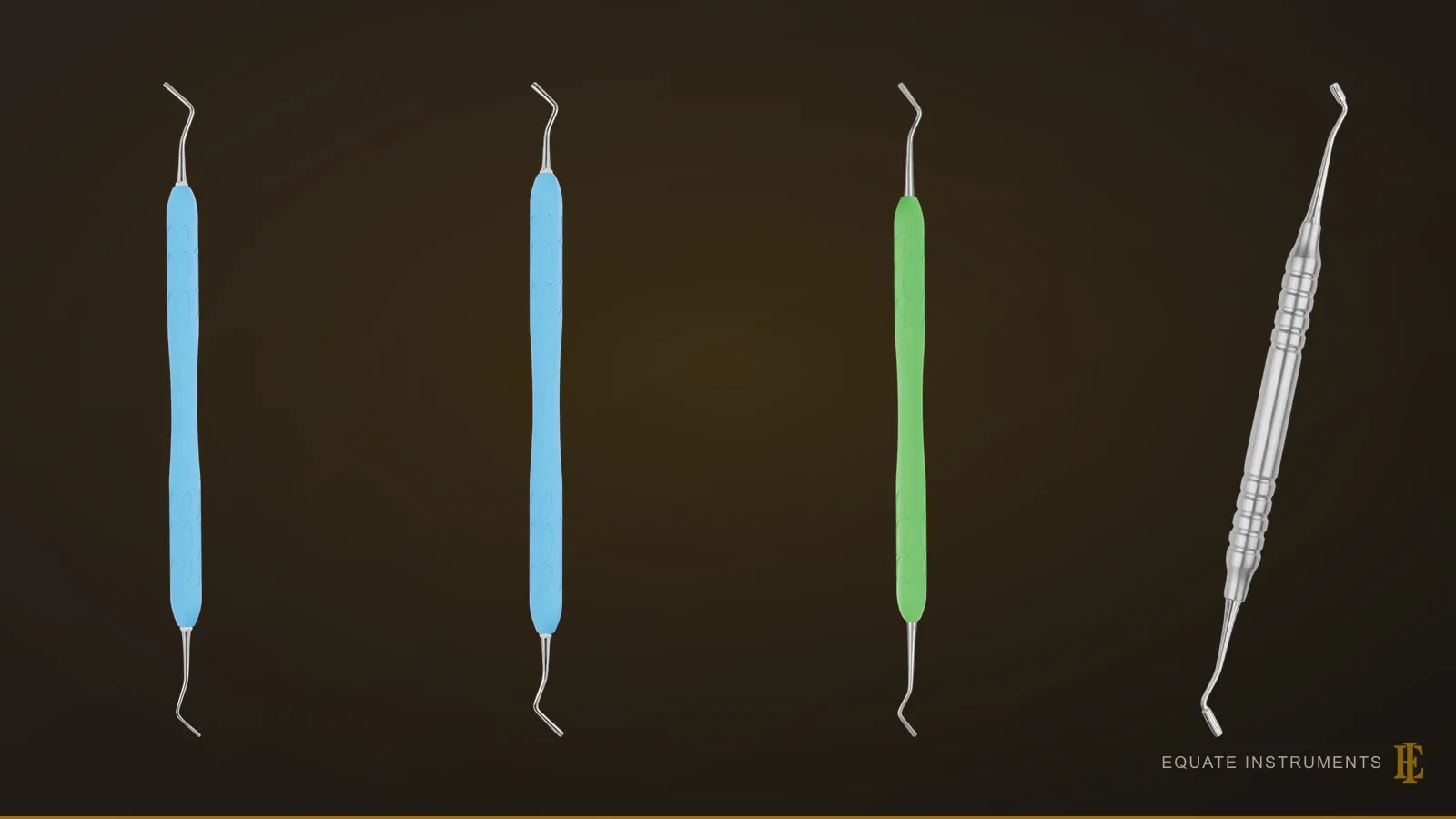
A plugger in dentistry, also called a condenser, is a hand instrument with a flat, blunt face that packs restorative material into a prepared cavity. It presses each increment of amalgam, or of packable composite, against the walls and into the corners so the filling is dense and free of voids. Pluggers come round, flat or shaped, smooth or serrated, usually double-ended in two sizes.
Key points
- Condenser and plugger mean the same instrument in restorative dentistry; endodontic pluggers are a separate, much finer group.
- A smaller face concentrates the same hand force into a higher pressure, which is why condensation starts with the small end.
- Serrated faces grip the amalgam and bring mercury-rich material to the surface, where it's carved away.
What is a plugger used for in dentistry?
A plugger packs a plastic restorative material into the cavity so it fills every corner, adapts to the walls and contains no air. With amalgam, condensation also does a second job: firm, overlapping strokes push the mercury-rich phase towards the surface of each increment, where it's removed when the cavity is overfilled and carved back, leaving a stronger, lower-mercury restoration. With packable composite and glass-ionomer, a condenser presses the material against the walls and the matrix, and with temporary materials it simply packs them down.
Pluggers follow the amalgam carrier, which delivers the material, and come before the burnisher and the carver. The amalgam restorative instruments guide shows the condenser alongside the rest of the amalgam family, and the restorative instruments hub gives an overview of the group.
What types of condenser and plugger are there?
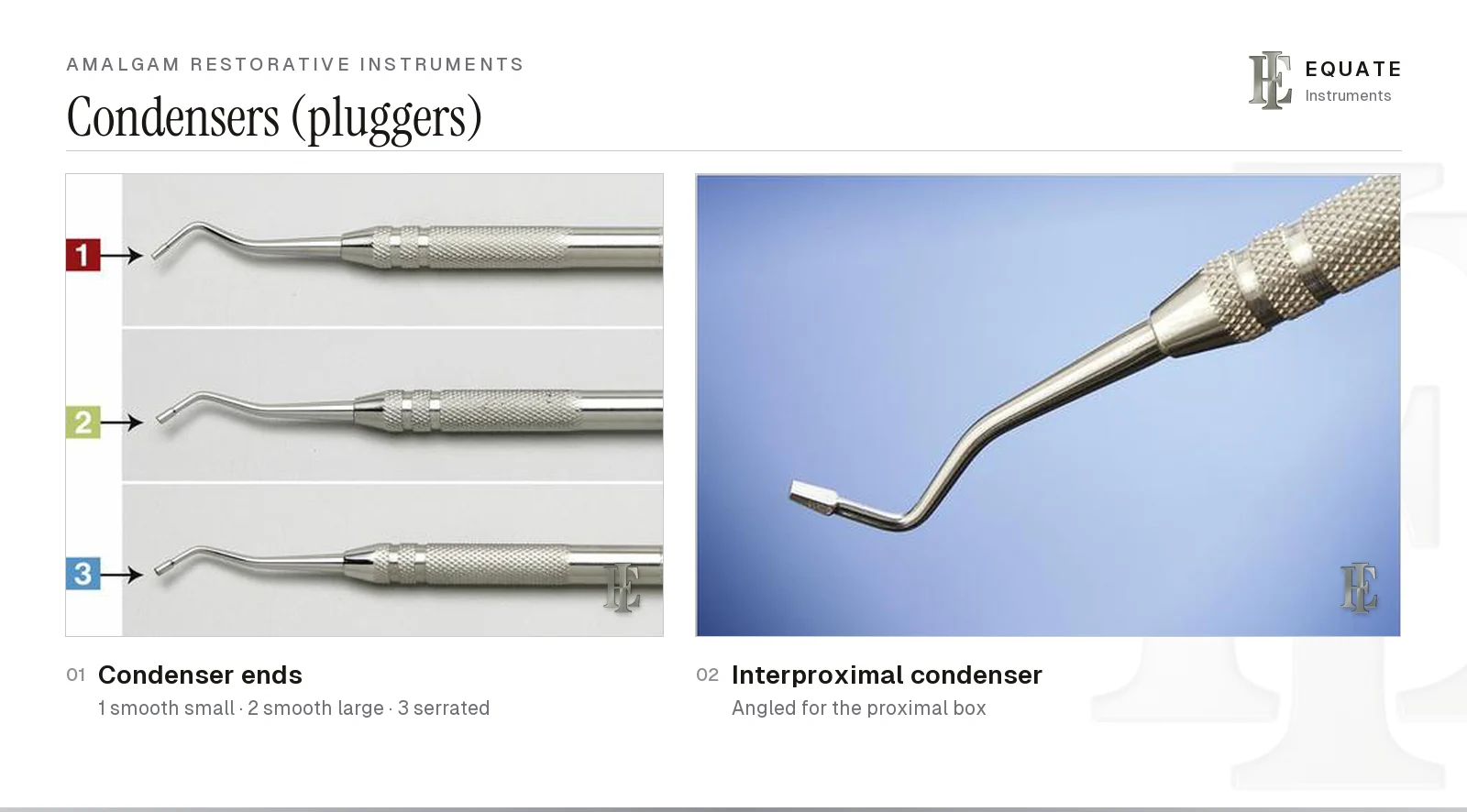
Condensers differ in the shape of the face, the texture of the face and the angle of the shank.
| Type | Working end | Best for |
|---|---|---|
| Round (cylindrical) plugger | A flat circular face on a cylinder, smooth or serrated | General condensation in Class I and II cavities |
| Flat or rectangular condenser | A flat face with straight sides | Corners, line angles and the gingival floor of a box |
| Diamond-shaped condenser | A face with angled, pointed corners rather than a round or square outline | Same jobs as round and flat faces; chosen to suit the cavity outline |
| Interproximal condenser | A narrow, angled face shaped for mesial or distal boxes | Packing against the matrix band in a proximal box |
| Form condenser | A shaped, often drop-shaped or angled, face | Adapting material to curved walls, with or without coating |
| Back-action condenser | A right-angled face turned back towards the handle | Walls that can't be reached with a forward stroke |
| Amalgam stopper or plain compactor | A broad flat face | Bulk packing and large restorations or bases |
| Combination instrument | A plugger on one end, a burnisher or spatula on the other | Placing and finishing without an instrument change |
What is the difference between a smooth and a serrated condenser?
A serrated face has a fine cross-hatched pattern that grips the amalgam, so the instrument doesn't skid over the increment and each stroke pulls a little of the soft, mercury-rich matrix to the surface. A smooth face slides more easily and leaves a flatter surface, which suits the last increments, the margins and materials such as composite and glass-ionomer that would tear on a serrated face. Many clinicians use a serrated condenser for the bulk of an amalgam and a smooth one, or a burnisher, to finish.
Which plugger size should you use?
Start with the smallest plugger that covers the area and work up. In a 1995 study in the European Journal of Oral Sciences, A. Lussi and colleagues measured how 44 dentists condensed amalgam in their own practices, using a force-sensing plugger: peak pressure was about 8.9 MPa with a small plugger and 5.5 MPa with a large one, and average pressures were 3.7 and 2.2 MPa. They also found that practitioners condensed with less pressure than is often recommended. The same hand force spread over a larger face simply packs less. The same study found that filling a cavity took about 131 seconds on average, of which only about 44 seconds were spent actually condensing, and the shape of the alloy particles made no significant difference to the pressure used.
The alloy still changes how the material feels under the plugger. Phillips' Science of Dental Materials notes that amalgams made from lathe-cut or admixed powders resist condensation more than all-spherical ones, and that freshly mixed spherical amalgam is so plastic that condensation pressure can't be relied on to build the proximal contour of a Class II filling, so a well-adapted, wedged matrix has to do that work.
| Face diameter | Typical use |
|---|---|
| 0.7–1.0 mm | Point and line angles, small pits, retention grooves |
| 1.2–1.5 mm | The gingival floor of a proximal box and small Class I cavities |
| 1.8–2.5 mm | The main body of Class I and II restorations |
| 3 mm and larger | Overfilling the occlusal surface, large restorations and bases |
How do you condense an amalgam restoration?
Condense in small increments, each one straight after it's carried in. Begin in the proximal box: press the first increment into the gingival corners with a small plugger, directing the force down onto the floor and sideways against the walls and the matrix band, so the contact area is filled before the occlusal part. Overlap each stroke with the last and use firm, steady pressure from a finger rest. Move to a larger plugger as the cavity fills, overfill slightly, and remove the mercury-rich top layer when you start to carve.
Work quickly, because amalgam that has started to set no longer bonds to the next increment and leaves layers and voids. Don't use a plugger that is too large to reach the corners, and don't let it rock on the margins, which can chip the enamel. For composite, use the coated pluggers on the composite instruments page; the amalgam restoration tray setup shows where condensers sit on the tray.
What is the difference between a restorative and an endodontic plugger?
A restorative plugger packs filling material into a cavity in the crown; an endodontic plugger compacts gutta-percha inside the root canal. Endodontic pluggers have long, slender working ends, often only a few tenths of a millimetre across and sometimes marked with depth rings, and they're used with vertical pressure on softened gutta-percha, while spreaders, which are tapered and pointed, are used for lateral compaction. They're covered on the endodontic hand instruments page and in the endodontic instruments guide. Bone condensers used to compact bone at implant sites are different again and belong with osteotomes.
What does the Equate range include?
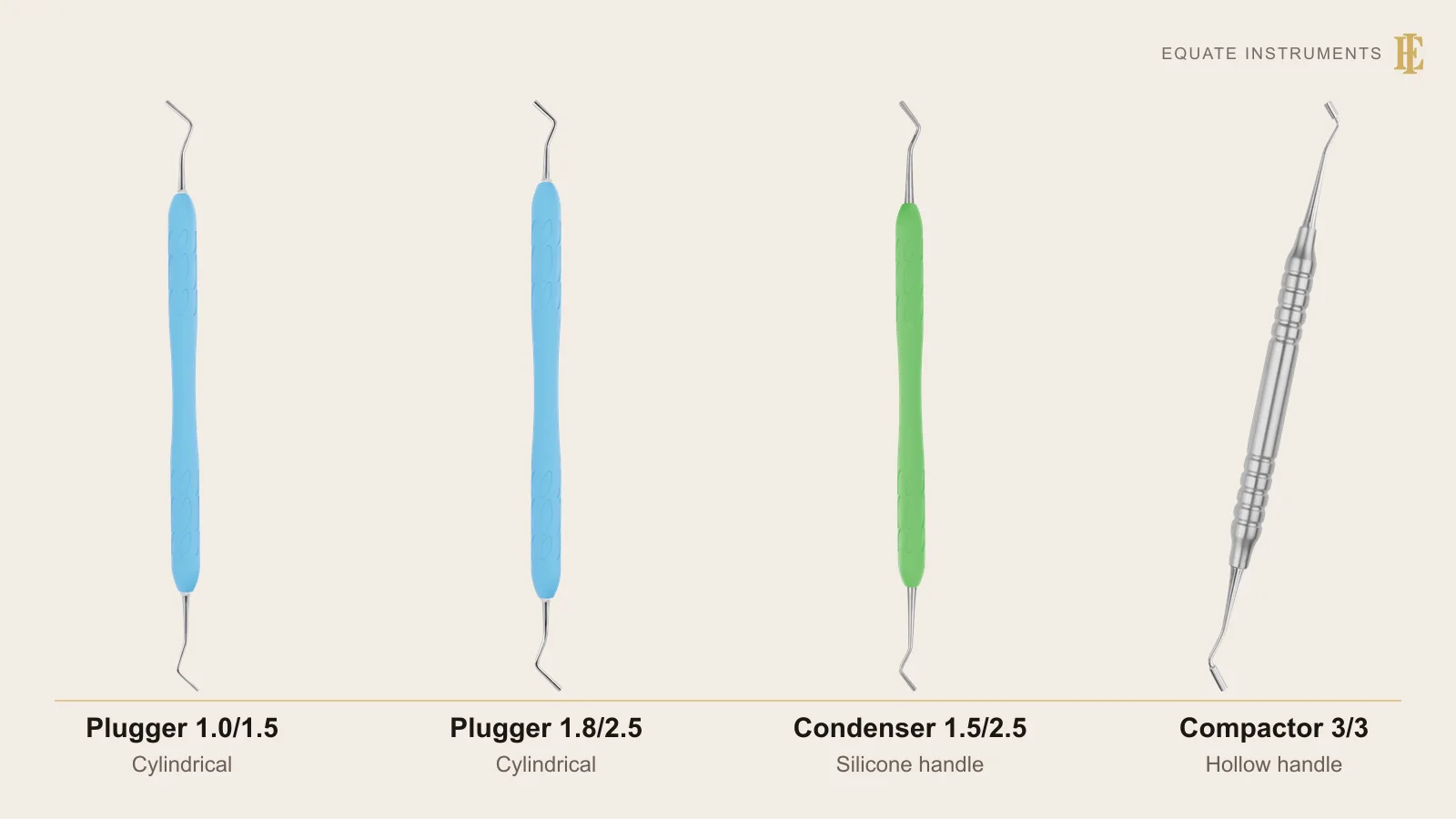
Equate's condensers run from fine 0.7/1.0 mm restorative pluggers to 2.5/3.8 mm double-ended pluggers. They include cylindrical pluggers in 1.0/1.5, 1.2/2.0 and 1.8/2.5 mm on light-blue silicone handles, three titanium pluggers from 1.0/1.3 to 1.8/2.5 mm, form condensers in 1.5/2.5 mm and a drop-shaped non-stick 1.3/1.8 mm form condenser, silicone-handled condensers, a cement stopper, four base carrier-condensers with rigid or malleable tips, two amalgam stoppers, three plain compactors on hollow handles, a form condenser-burnisher and a non-stick packer-modeller for composite.
Every instrument is passivated stainless steel, ultrasonically cleaned, shape-, boil- and performance-tested and individually packed. Clinics can request samples and a quote.
How do you clean and care for pluggers?
Remove amalgam from the face before it hardens, paying attention to serrations, which trap material; a soft brush during cleaning reaches into the pattern. Collect amalgam residue as amalgam waste. Amalgam condensers are the CDC's own example of a semicritical instrument, one that touches the mouth without penetrating tissue, and its disinfection guideline recommends sterilising them after each use when they are heat-tolerant. Then clean, inspect and sterilise in line with the manufacturer's ISO 17664-1 instructions and the CDC's Guidelines for Infection Control in Dental Health-Care Settings or, in UK practices, HTM 01-05. Replace a plugger whose face has become rounded, chipped or worn smooth, because a damaged face no longer packs evenly.
The Equate difference
Equate lists 30 condenser and plugger references: 19 flat and cylindrical condensers from 1.0 to 3.8 mm (including three titanium pluggers, form condensers, a cement stopper and four base carrier-condensers), four cylindrical restorative pluggers from 0.7 to 2.5 mm, three plain compactors, two amalgam stoppers, a form condenser-burnisher and a non-stick packer-modeller.
Equate Dental Pluggers and Condensers (Amalgam Condensers) options

Dental Plugger 1.8 / 2.5 mm Titanium
EI-0016
Double-Ended Filling Plugger 2.5 mm / 3.8 mm - Hollow Handle
EI-0017
Dental Plugger 1.3 / 1.8 mm Titanium
EI-0018
Dental Plugger 1.0 / 1.3 mm Titanium
EI-0019
Amalgam Stopper
EI-0087
Amalgam Stopper
EI-0088
Plugger 1.0mm/2.0mm - Double-Ended Knurled Handle
EI-0089
Plugger 2.0 / 2.5 mm Knurled Handle
EI-0095
Fine Plugger 0.7mm/1.0mm - Knurled Handle
EI-0096
Cement Stopper - Solid Handle
EI-0158
Form Condenser 1.5-2.5 mm
EI-0927
Non-Stick Packer-Modeller
EI-0936Browse all restorative & operative instruments
Buying in your market
Frequently asked questions
What is a plugger in dentistry?
A plugger, or condenser, is a hand instrument with a blunt, flat face that packs filling material into a prepared cavity. It removes voids and adapts the material to the walls and corners.
Is a condenser the same as a plugger?
Yes, in restorative dentistry the two words describe the same instrument. Endodontic pluggers are a separate group used to compact gutta-percha in root canals.
Why are some amalgam condensers serrated?
A serrated face grips the amalgam so the instrument doesn't slip, and it helps bring the mercury-rich phase to the surface. Smooth faces are used for the final increments and for composite.
What size amalgam condenser should I use first?
Start with a small plugger, around 1.0 to 1.5 mm, in the corners and the gingival floor of the box. Move to a larger one as the cavity fills.
Can you use amalgam condensers for composite?
Yes, for packable composite, but a smooth or non-stick face works better than serrated steel, which can tear or pull the uncured material.
References
- Lussi A, Brunner M, Portmann P, Buergin W. Condensation pressure during amalgam placement in patients. European Journal of Oral Sciences 1995;103(6):388–393
- Heymann HO, Swift EJ, Ritter AV (eds). Sturdevant's Art and Science of Operative Dentistry, 6th ed. Elsevier, 2013 (amalgam restorations: condensation)
- Hargreaves KM, Berman LH (eds). Cohen's Pathways of the Pulp. Elsevier (obturation instruments)
- Kohn WG, et al. Guidelines for Infection Control in Dental Health-Care Settings, 2003. MMWR 52(RR-17), Centers for Disease Control and Prevention
- ISO 17664-1:2021 Processing of health care products: information to be provided by the medical device manufacturer for the processing of medical devices, Part 1: critical and semi-critical medical devices
- Boyd LB. Dental Instruments: A Pocket Guide, 7th edition. Saunders/Elsevier, 2020. Chapter 8, Amalgam Restorative Instruments (photographs used under licence)
- Centers for Disease Control and Prevention. Guideline for Disinfection and Sterilization in Healthcare Facilities (2008): disinfection of healthcare equipment
- Sakaguchi RL, Ferracane JL, Powers JM (eds). Phillips' Science of Dental Materials. Elsevier (chapter 15, dental amalgams)
I am a…
Related
- Restorative Dental Hand Instruments
- Amalgam Carriers (Dental Amalgam Carriers)
- Dental Burnishers: Ball, Football, Acorn, T-Ball and Beavertail
- Endodontic Hand Instruments
- Dental Composite Instruments: Placement, Sculpting and the Composite Gun
- Amalgam Restoration Tray Setup
- Amalgam Restorative Instruments: What Each One Does
- Dental Carvers: Types of Carvers in Dentistry and the Lab
- Tofflemire and Other Matrix Band Retainers