Dental Burnishers: Ball, Football, Acorn, T-Ball and Beavertail
Written by the Equate Instruments Technical Team · Reviewed by the Medical & Dental Board, Equate Instruments · Updated ·
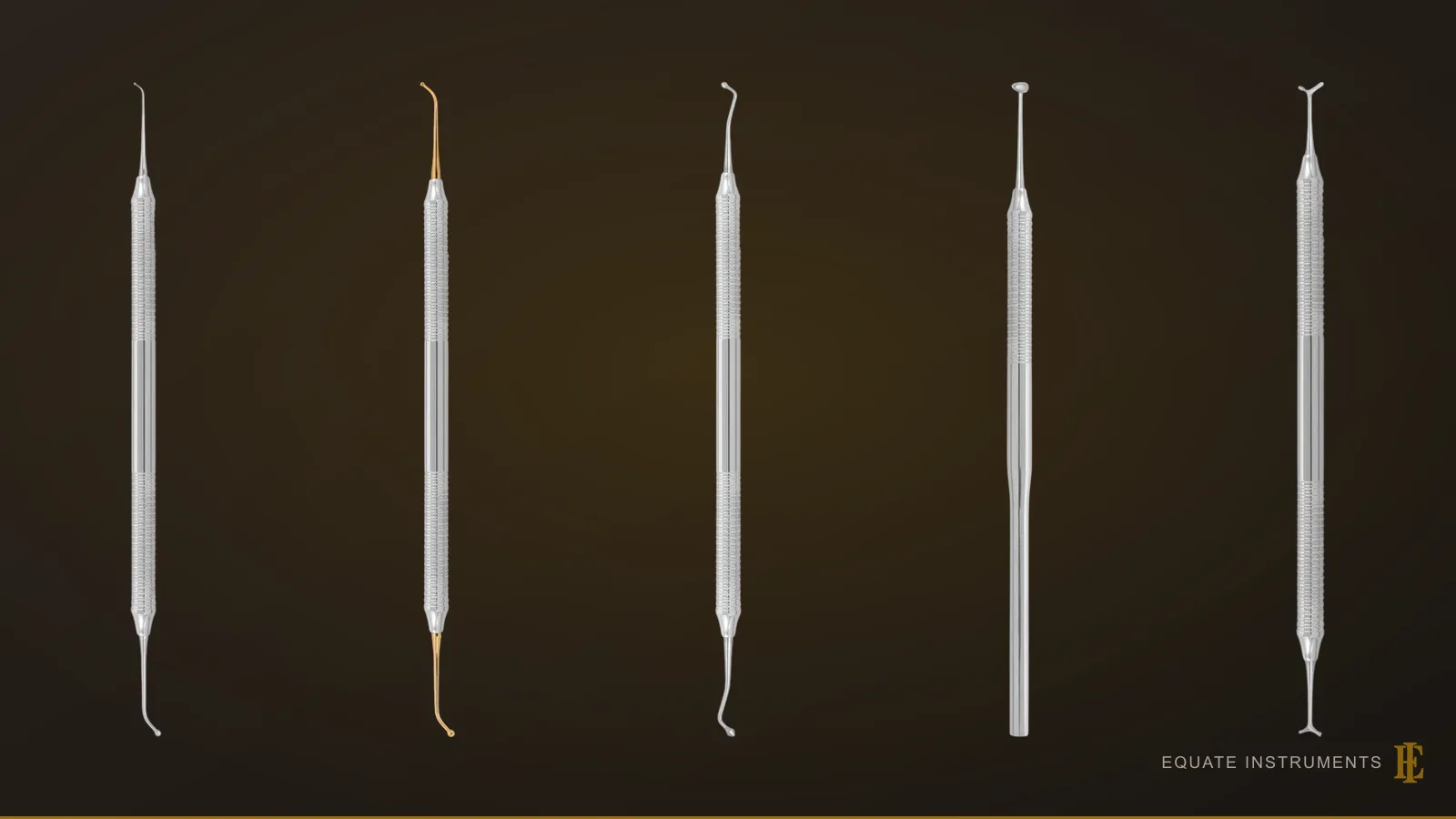
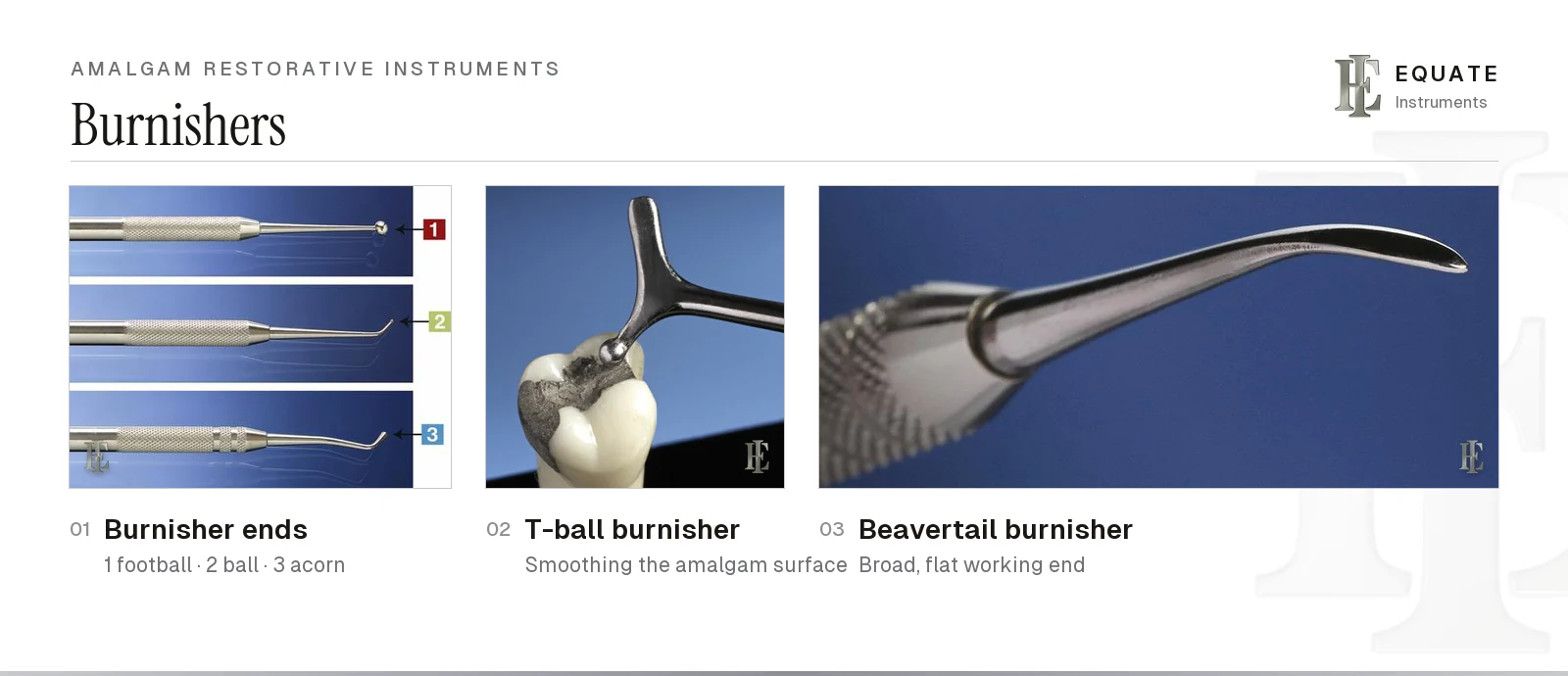
A burnisher in dentistry is a hand instrument with a smooth, hard, rounded working end that is rubbed over a restoration to smooth and adapt its surface. Ball, football, acorn, T-ball and beavertail shapes smooth amalgam before and after carving, shape occlusal anatomy in composite, contour matrix bands and, with the beavertail, help tuck rubber dam into the sulcus.
Key points
- A burnisher doesn't cut: it moves and compresses the surface of a soft material, so its working end must be polished and free of scratches.
- Burnishing amalgam just before and just after carving improves the margins of some alloys, according to laboratory studies.
- Coated or composite burnishers shape uncured composite, while bare steel ones are kept for amalgam, temporary materials and matrix bands.
What is a burnisher used for in dentistry?
A burnisher smooths and adapts a soft or plastic material by rubbing, not by cutting. On amalgam, a large burnisher passed over the condensed surface before carving firms the surface and pushes the material against the margins, and a lighter pass after carving smooths away the scratch marks the carver leaves. On composite, a coated burnisher presses fissures and pits into the uncured material before it's light-cured. Burnishers also shape a metal matrix band to the curve of the tooth, smooth temporary fillings and, in the case of the beavertail, help invert the edge of a rubber dam so it seals around the neck of the tooth (the dental dam guide shows inversion).
Burnishers sit on the amalgam and composite trays next to the condensers and pluggers that pack the material and the dental carvers that sculpt it. The amalgam restorative instruments guide shows where burnishing falls in the filling sequence, and the restorative instruments hub shows how the whole group fits together.
What types of burnisher are there?
Burnishers are named after the shape of the working end, and each shape suits a different surface.
| Type | Working end | Typical use |
|---|---|---|
| Ball burnisher | A sphere on an angled shank, usually double-ended in two sizes | Smoothing amalgam, rounding fossae, contouring matrix bands |
| Football (egg) burnisher | An elongated, egg-shaped end | Broad occlusal and buccal surfaces, smoothing after carving |
| Acorn burnisher | A cone with a rounded tip, like an acorn | Forming pits, fissures and the slopes of cusps |
| T-ball burnisher | A single-ended instrument with a ball set at right angles to a short shank, forming a T | Reaching lingual and proximal areas and contouring bands |
| Beavertail burnisher | A flat, paddle-like blade with a rounded end | Smoothing and first shaping of amalgam, broad and proximal surfaces, inverting rubber dam; used on amalgam, temporary filling and dam trays |
| Composite burnisher | Ball, acorn or blade end with a hard non-stick coating | Shaping occlusal anatomy in uncured composite |
| Burnisher-plugger or burnisher-spatula | A burnisher on one end and a condenser or spatula on the other | Placing and finishing without changing instruments |
When should you burnish an amalgam restoration?
There are two moments: precarve burnishing straight after condensation, and postcarve burnishing once the anatomy has been carved. Precarve burnishing uses a large ball or football burnisher with firm strokes across the surface and towards the margins, which continues the condensation at the surface and adapts the amalgam to the cavosurface edge. Postcarve burnishing uses light strokes with a smaller burnisher to smooth the carved surface and close fine gaps at the margin.
The laboratory evidence is mixed and depends on the alloy. In an in vitro study published in the Egyptian Dental Journal in 1995, F. M. Kamel found that occlusal amalgams that were burnished before carving, carved and then burnished again had the highest share of excellent margins under the scanning electron microscope, and that the high-copper alloy did better than the conventional one. Burnishing didn't help everywhere: in a 1978 study in the Journal of Prosthetic Dentistry, T. B. Cothren and colleagues found that burnishing once or twice made no significant difference to microleakage with the alloy they tested, while a cavity varnish did reduce it. Work within the amalgam's working time, use light pressure and keep strokes moving, because heavy, slow burnishing generates frictional heat.
Timing matters as much as technique. Farhad Hadavi's carving notes for Columbia University warn that burnishing too early thins the margins and burnishing too late can break a piece off the new filling, and that it never replaces proper condensation and carving.
How are burnishers used with composite and matrix bands?
With composite, the burnisher shapes rather than smooths. An acorn or small ball burnisher with a titanium-nitride or gold-coloured non-stick coating is pressed lightly into the last increment to form the central fossa, grooves and cusp slopes before curing, so less adjustment is needed with burs afterwards. Bare, scratched steel tends to drag uncured composite, which is why coated composite burnishers are preferred; the composite instruments page covers coatings and layering.
Contour a metal matrix band before it goes on: rub a ball or football burnisher over the inside of the band where it will meet the adjacent tooth, thinning and curving it so the restoration ends up with a convex proximal wall and a tight contact. Once the band is tightened and wedged in a Tofflemire or other matrix retainer, the contact area can be burnished lightly against the neighbouring tooth if needed, before any material goes in; the composite restoration tray setup lists the rest of the instruments.
Which burnisher size should you use?
Match the size of the ball to the curvature you want: small balls for fissures, pits and small cavities, larger ones for broad occlusal surfaces and band contouring.
| Ball diameter | Typical use |
|---|---|
| 0.8–1.2 mm | Fissures, pits and small Class I and V restorations |
| 1.4–1.8 mm | General posterior use and defining fossae |
| 2.0–2.5 mm | Precarve burnishing of medium restorations, contouring bands |
| 2.8–3.2 mm | Large occlusal surfaces and precarve burnishing of big restorations |
What are common burnishing mistakes?
The most common mistake is burnishing too hard or too long, which heats the restoration and can leave a thin, overextended flash of material beyond the margin. Others are burnishing amalgam once it has set, which can crack the surface; burnishing composite with bare steel, which pulls it away from the walls; using a scratched burnisher, which transfers its scratches to the surface; and resting the instrument on soft tissue instead of the tooth. Always keep a finger rest on a neighbouring tooth, as with any restorative instrument.
What does the Equate range include?
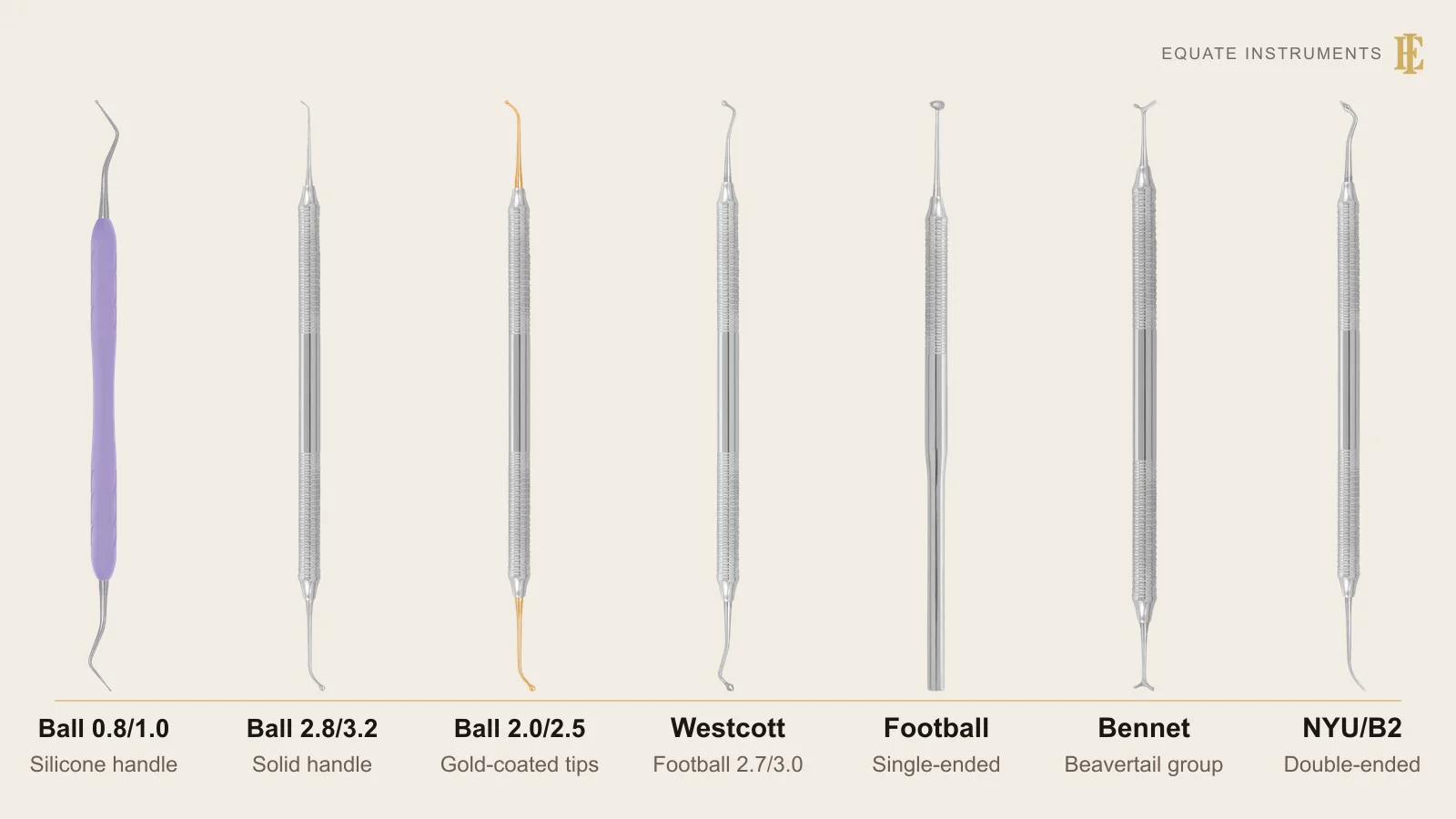
Equate's burnishers cover every common shape. The ball range runs from 0.8/1.0 mm to 2.8/3.2 mm in double-ended sizes, including Mortonson, Hopson, Ladmore and W3 patterns, a Fig. 2/31 combination, and burnisher-plugger and burnisher-spatula instruments that place and finish in one. Football burnishers include Westcott 1.6/2.0 and 2.7/3.0 mm and a Romerowski pattern, and the beavertail group lists Bennet, serrated modelling and NYU/B2 patterns. Eleven references carry titanium plasma-gold, titanium or non-stick coated tips for composite.
Handles come as 6 mm solid stainless steel, 10 mm hollow and light-purple silicone, with slim silicone versions for a lighter grip. All are passivated stainless steel, ultrasonically cleaned, shape-, boil- and performance-tested and individually packed. Clinics can request samples and a quote, or see the restorative family page.
How do you clean and care for burnishers?
Wipe amalgam and composite off the working end before they set, then clean, inspect and sterilise the burnishers in line with the manufacturer's instructions under ISO 17664-1 and the CDC's Guidelines for Infection Control in Dental Health-Care Settings or, in UK practices, HTM 01-05. Handle amalgam residue as amalgam waste. Check the working end under magnification: a burnisher only works if it's mirror-smooth, so retire one that is scratched or pitted, and avoid abrasive pastes or scouring pads on coated tips, which wear the coating through.
The Equate difference
Equate lists 59 burnisher references: 43 ball burnishers from 0.8 to 3.2 mm, including Mortonson, Hopson, Ladmore and W3 patterns and eight burnisher-plugger or burnisher-spatula combinations, 11 football burnishers including Westcott and Romerowski patterns, three Bennet, serrated modelling and NYU/B2 patterns listed as beavertail burnishers and two non-stick burnishers, with 11 titanium-, gold- or non-stick-coated references.
Equate Dental Burnishers: Ball, Football, Acorn, T-Ball and Beavertail options

Fig. 1 Ball Burnisher 0.8/1.0 mm - 6 mm Solid Handle
EI-0165
Burnisher 1.5 mm & Plugger 2.5 mm
EI-0915
Burnisher & Plugger 1.4 / 1.8 mm
EI-0916
Burnisher & Plugger 1.9 / 2.3 mm
EI-0917
Burnisher
EI-0918
Burnisher 1.5 mm + Spatula 2 mm
EI-0919
Burnisher-Plugger 1.5 / 2.5 mm Non-stick Ball End
EI-0932
Non-Stick Composite Modeller
EI-0937
Non-Stick Titanium-Coated Burnisher
EI-0938
Burnisher 1.75-2.25mm
EI-0948
Burnisher & Plugger 1.5-2.5mm
EI-1118
Burnisher
EI-1119Browse all restorative & operative instruments
Buying in your market
Frequently asked questions
What is a burnisher in dentistry?
A burnisher is a hand instrument with a smooth, rounded working end that is rubbed over a restoration to smooth it and adapt it to the margins. It doesn't cut; it compresses and moves the surface of the material.
What is a ball burnisher used for?
A ball burnisher smooths amalgam before and after carving, rounds out fossae and contours a matrix band against the adjacent tooth. Smaller balls suit fissures and small cavities, larger ones broad surfaces.
What is the difference between an acorn and a ball burnisher?
A ball burnisher has a spherical end, while an acorn burnisher is cone-shaped with a rounded tip. The acorn shape reaches into fissures and forms the slopes of cusps more easily.
What is a beavertail burnisher used for?
A beavertail burnisher has a flat, paddle-like blade with a rounded end. It smooths broad and proximal surfaces of a restoration and is often used to invert the edge of a rubber dam around the neck of the tooth.
Can you use the same burnisher for amalgam and composite?
It's better not to. Composite sticks to bare or scratched steel, so a coated composite burnisher gives cleaner anatomy, while plain burnishers stay on the amalgam tray.
References
- Kamel FM. Effect of surface treatment on marginal integrity of amalgam restorations (in vitro study). Egyptian Dental Journal 1995;41(3):1313–1320
- Heymann HO, Swift EJ, Ritter AV (eds). Sturdevant's Art and Science of Operative Dentistry, 6th ed. Elsevier, 2013 (amalgam restorations: condensation, carving and burnishing)
- Steele JG, McCabe JF, Barnes IE. Properties of a titanium nitride coating for dental instruments. Journal of Dentistry 1991;19(4):226–229
- Kohn WG, et al. Guidelines for Infection Control in Dental Health-Care Settings, 2003. MMWR 52(RR-17), Centers for Disease Control and Prevention
- ISO 17664-1:2021 Processing of health care products: information to be provided by the medical device manufacturer for the processing of medical devices, Part 1: critical and semi-critical medical devices
- Boyd LB. Dental Instruments: A Pocket Guide, 7th edition. Saunders/Elsevier, 2020. Chapters 8 and 9, Amalgam Restorative Instruments and Composite Restorative Instruments (photographs used under licence)
- Cothren TB, Eschete EF, Pelleu GB, Rudolph JJ. Effects of burnishing on microleakage in an amalgam system. Journal of Prosthetic Dentistry 1978;40(2):163–165
- Hadavi F. Steps in carving amalgam: class 2 cavity. Teaching notes published by Columbia University, 2004–2005
I am a…
Related
- Restorative Dental Hand Instruments
- Dental Carvers: Types of Carvers in Dentistry and the Lab
- Dental Pluggers and Condensers (Amalgam Condensers)
- Dental Composite Instruments: Placement, Sculpting and the Composite Gun
- Tofflemire and Other Matrix Band Retainers
- Amalgam Restoration Tray Setup
- Amalgam Restorative Instruments: What Each One Does
- Rubber Dam Clamps, Forceps, Punches and Frames: Which to Choose