Endodontic Tray Setup: Opening and Sealing a Tooth
Written by the Equate Instruments Technical Team · Reviewed by the Medical & Dental Board, Equate Instruments · Updated ·
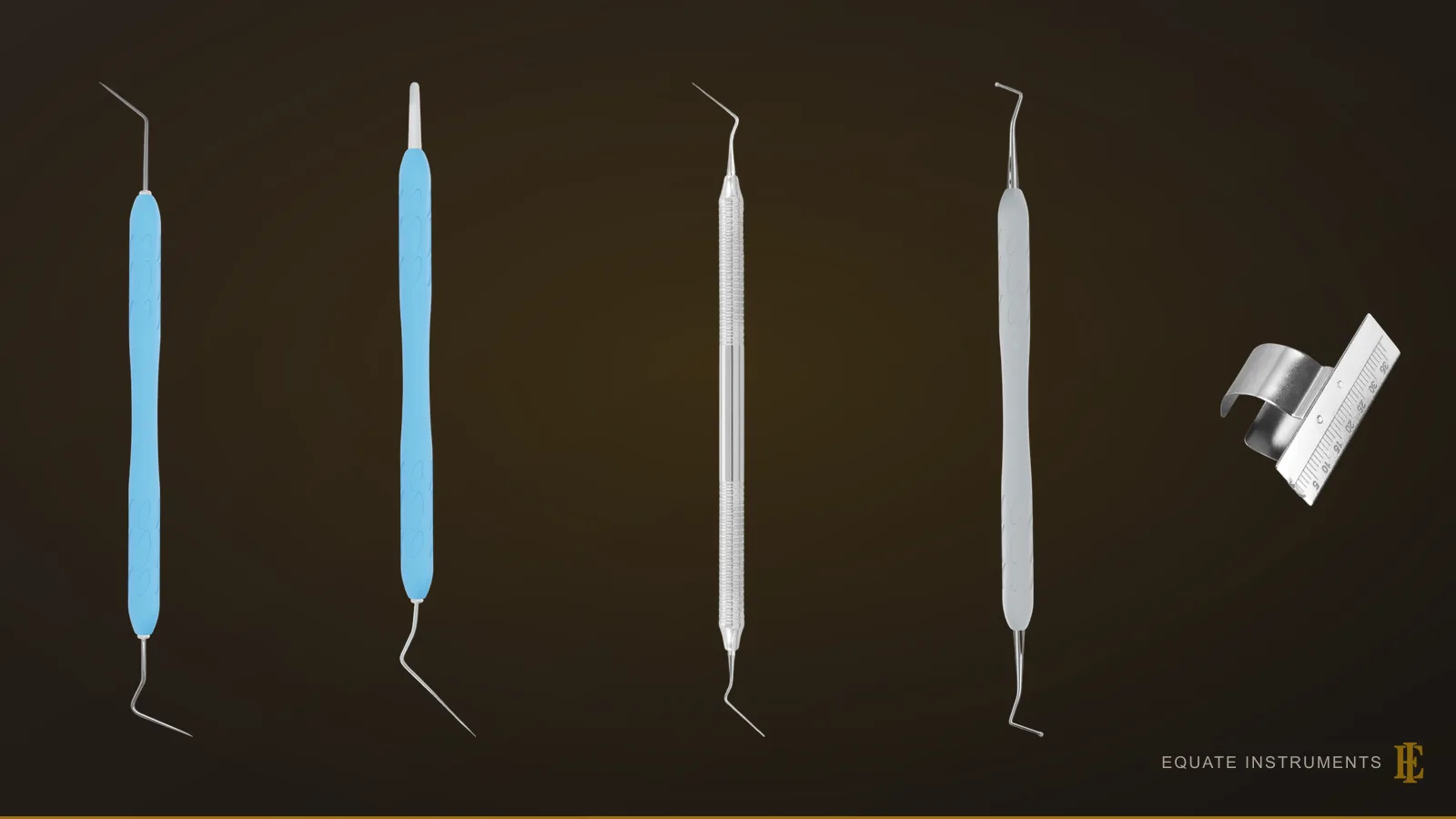
An endodontic tray setup comes in two versions. The opening tray holds a mouth mirror, an endodontic explorer, locking cotton pliers, a long-shank spoon excavator, a plastic instrument, a millimetre ruler with finger ring, files with stops, broaches, paper points and an irrigating syringe. The sealing tray adds gutta-percha points, a hand spreader and pluggers for lateral compaction.
Key points
- Treat every root canal tray as an aseptic procedure under rubber dam, as the European Society of Endodontology's 2023 guideline stresses.
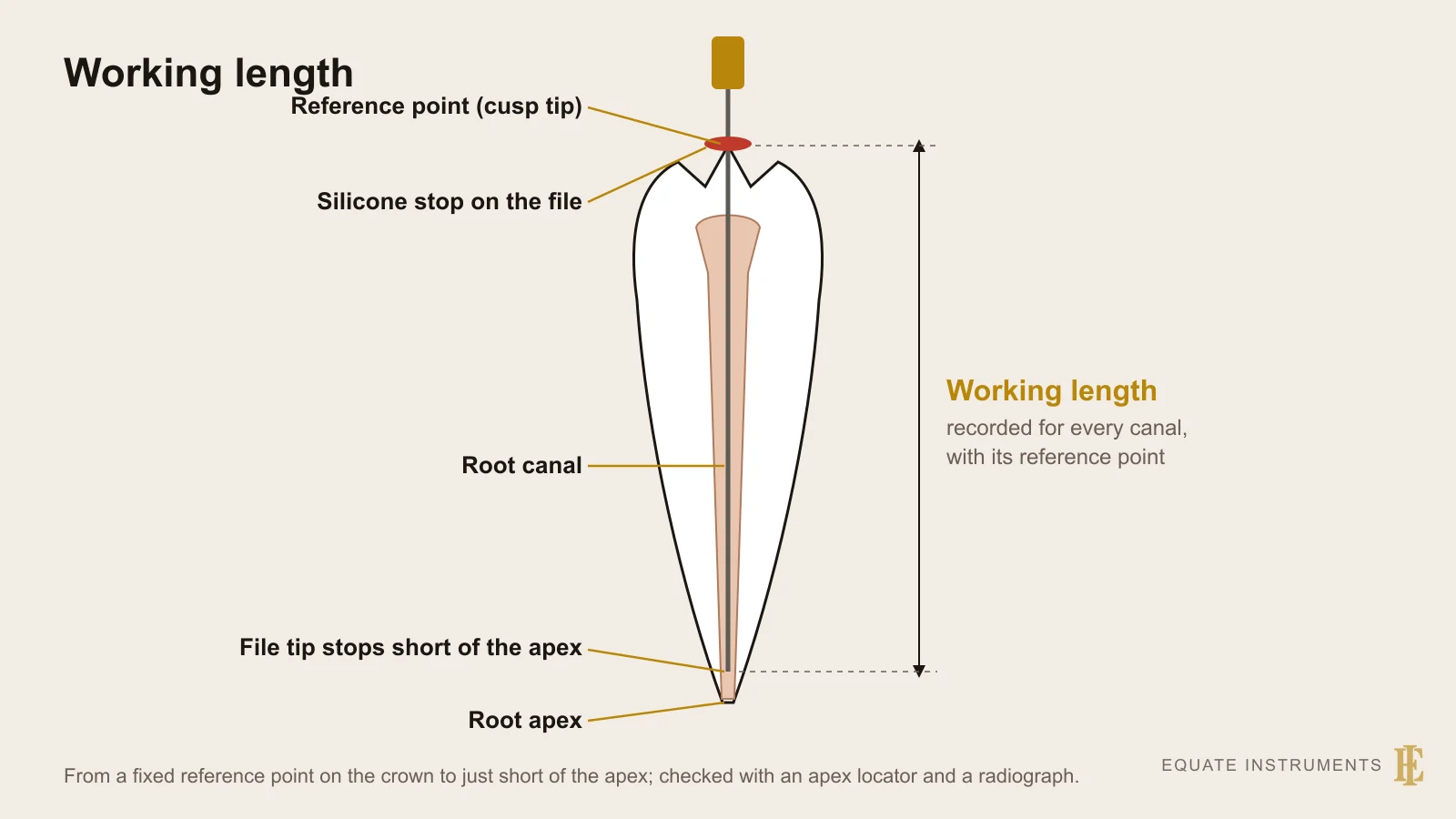
- Working length is measured to a fixed coronal reference point and marked on every file with a stop.
- Under HTM 01-05, endodontic files and reamers are single-use or single-patient-use, whatever the manufacturer's label says.
Step by step
- 1
Confirm the diagnosis
Test the tooth with an electric pulp tester against a healthy control tooth, read the result with cold testing and a radiograph, and only then open the endodontic tray.
- 2
Anaesthetise and isolate
Give local anaesthesia, then isolate the tooth with a rubber dam before the pulp chamber is opened.
Dental Aspirating Syringes (Dental Anaesthetic Syringes)Rubber Dam Clamps, Forceps, Punches and Frames: Which to Choose
- 3
Gain access
Cut the access cavity with burs, remove the roof of the pulp chamber, and clear caries and old restoration with a long-shank excavator.
Spoon Excavators (Dental Excavators)Endodontic Hand Instruments
- 4
Locate the canals
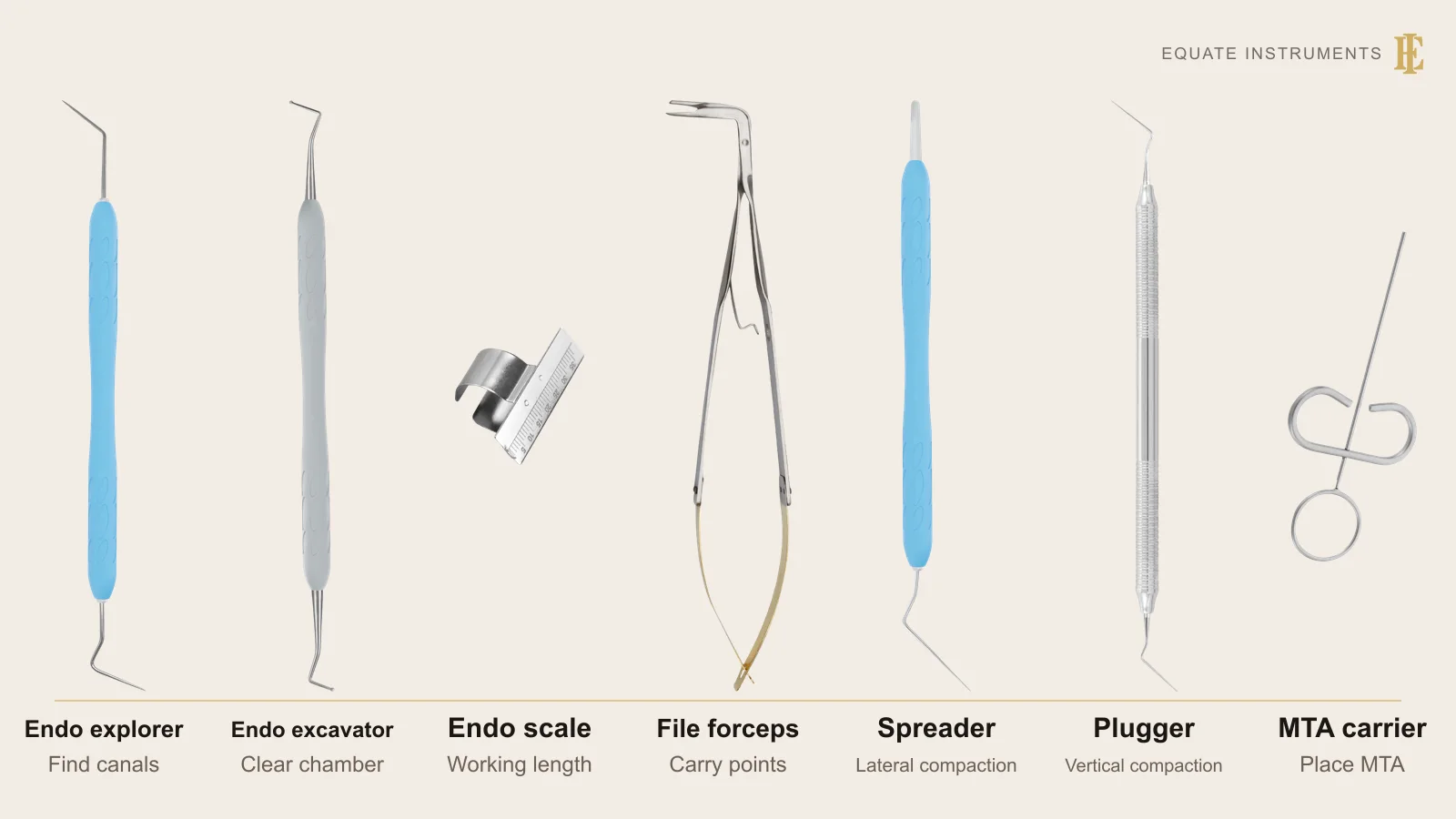
Find each canal orifice with the sharp, straight endodontic explorer, which reaches the floor of the chamber at the right angle.
- 5
Remove pulp tissue
Remove vital or necrotic pulp with a broach or small files, irrigating as you go so debris is flushed out of the canal.
- 6
Establish working length
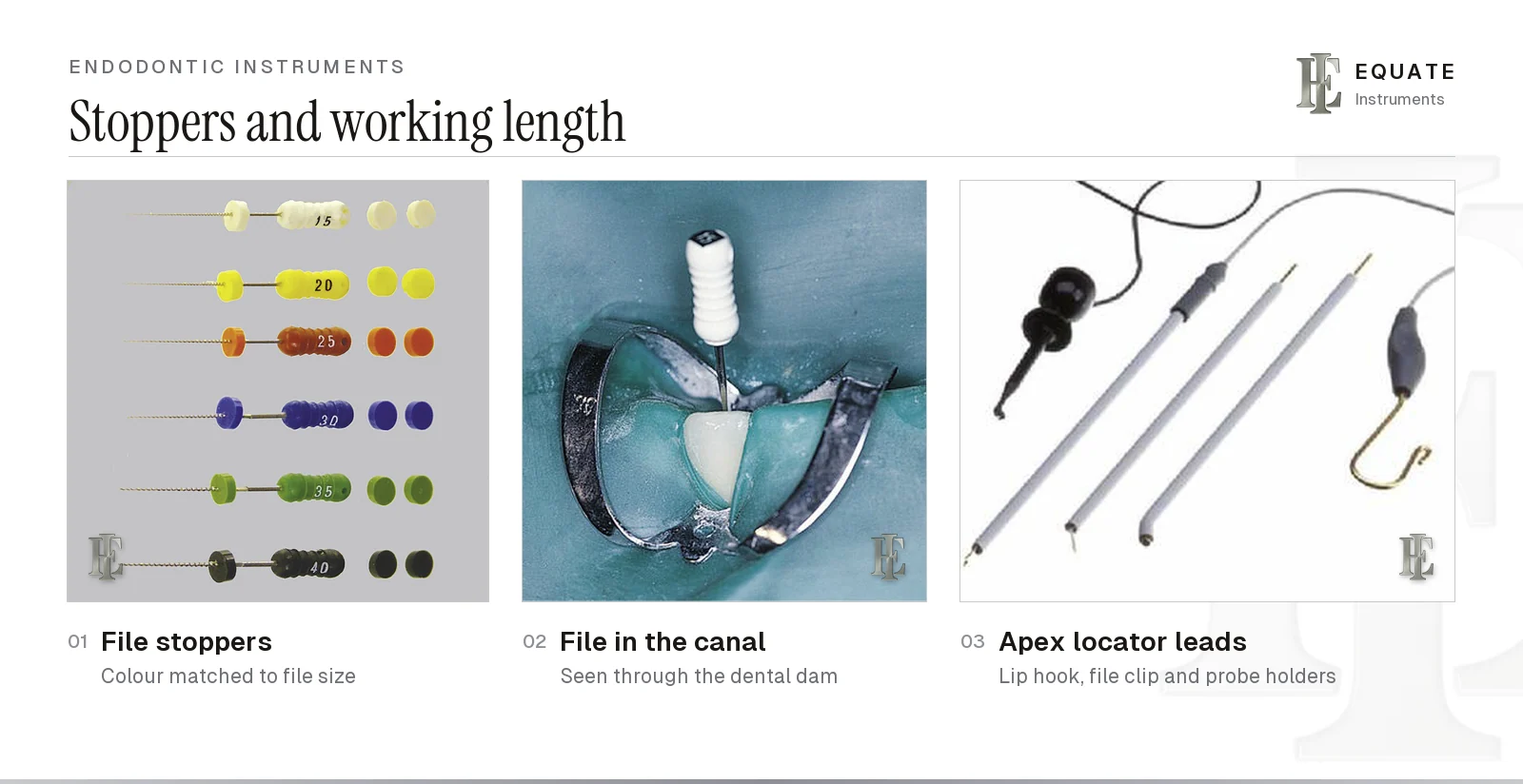
Advance a small file until the apex locator signals the end point, slide its stop to the coronal reference point, confirm the position on a radiograph, and record the length with that reference point.
- 7
Shape and irrigate
Enlarge the canal to the planned size with hand or rotary files, irrigating frequently and recapitulating with a small file to keep the canal open.
- 8
Dry the canal
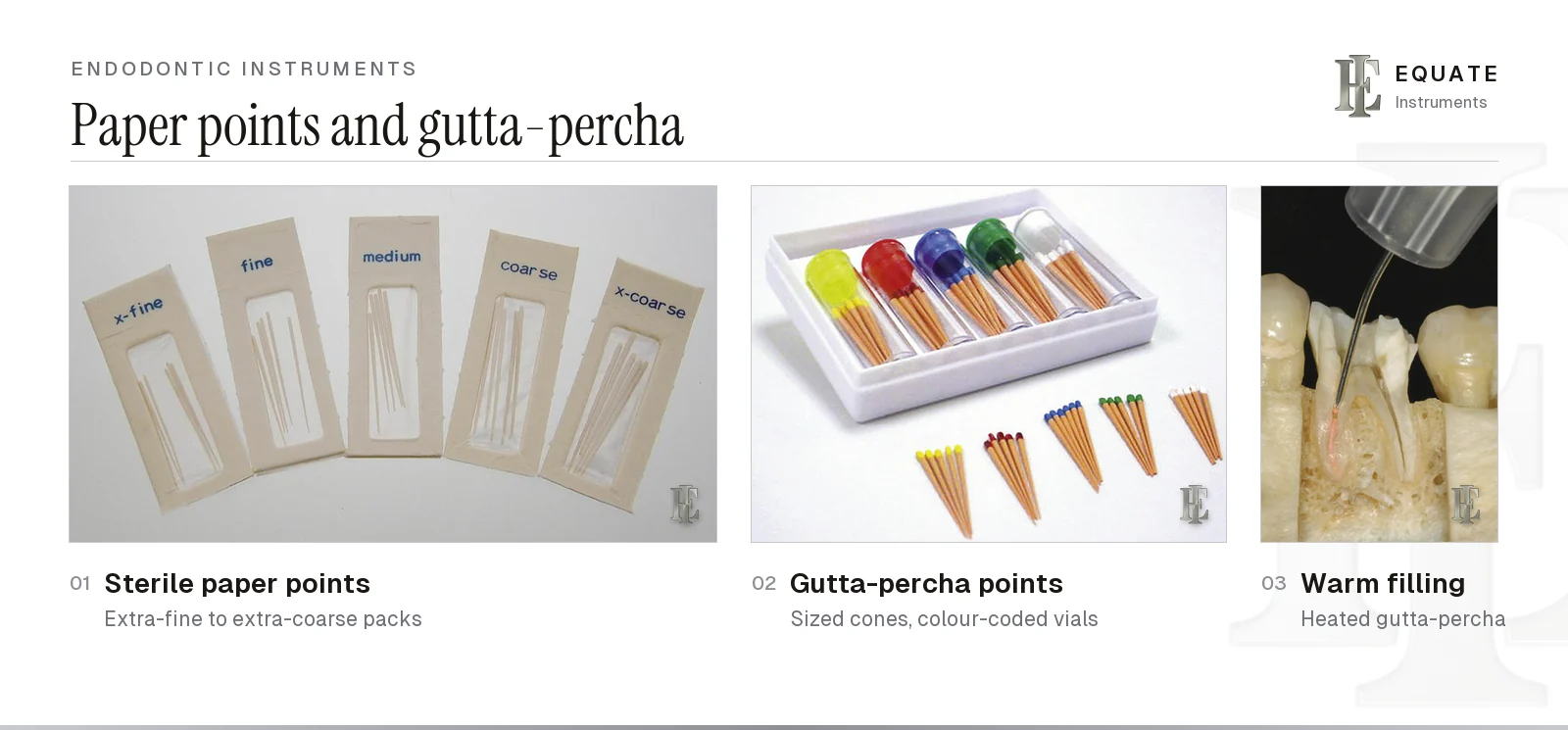
Dry the canal with sterile paper points of the matching size, carried with locking cotton pliers, until a point comes out dry.
- 9
Fit the master cone
Try in a gutta-percha master cone that reaches working length with slight resistance, and confirm its position on a radiograph if needed.
- 10
Compact laterally
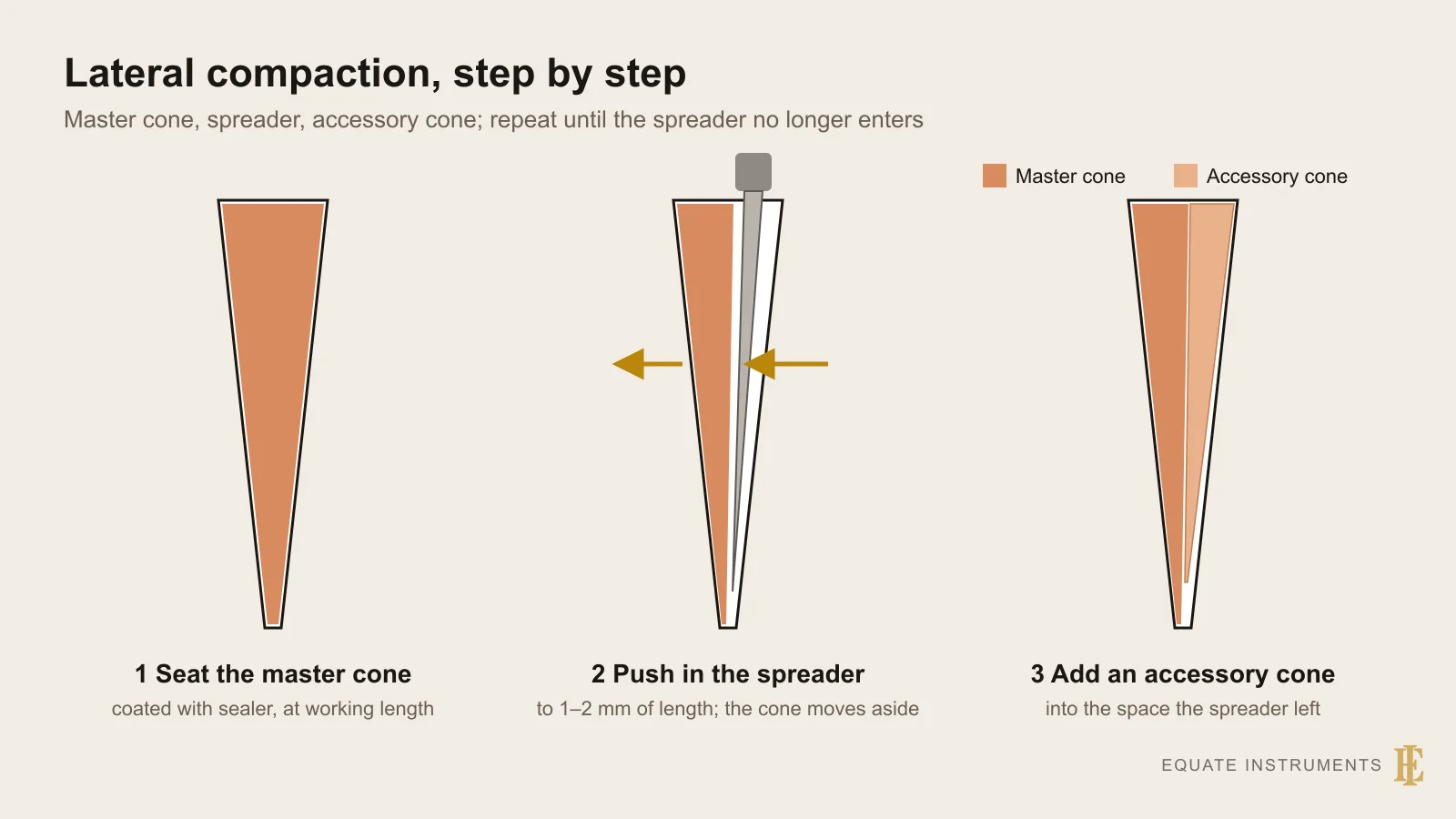
Coat the master cone with sealer and seat it, push a hand spreader alongside it to make room, and add accessory cones until the spreader no longer enters.
- 11
Sear, pack and seal
Sear off the excess gutta-percha at the orifice with the heated plugger end of a Glick instrument, pack it vertically with an endodontic plugger, and seal the access with a temporary or permanent restoration.
Endodontic Hand InstrumentsEndodontic Instruments for Root Canal Treatment
What is the difference between the opening and sealing trays?
The opening tray gets into the tooth, cleans and shapes the canals; the sealing tray dries and fills them. Many practices set out one tray with both, but separating them keeps the obturation instruments clean and dry until they're needed. Both start with the mouth mirror and locking cotton pliers.
Boyd's pocket guide lays out both trays with the same core: two pairs of locking forceps (one spare), scissors, a Glick instrument and a Woodson, burs in a bur block, an anaesthetic aspirating syringe, an air/water syringe tip and an HVE tip. The opening tray adds broaches; the sealing tray adds gutta-percha in vials, a spreader and a plugger. The endodontic instruments guide explains what each one does.
| Item | Opening the tooth | Sealing the tooth |
|---|---|---|
| Mirror, endodontic explorer, two pairs of locking cotton pliers, scissors | Yes | Yes |
| Long-shank spoon excavator, Glick instrument, Woodson plastic instrument | Yes | Yes |
| Millimetre ruler with finger ring, files with stops | Yes | Yes, to confirm length |
| Broaches | Yes | No |
| Irrigating syringe and irrigant | Yes | Yes, final rinse |
| Paper points (fine, medium and coarse) | Yes, for a dressing | Yes |
| Gutta-percha points, sealer | No | Yes |
| Hand spreader and pluggers | No | Yes |
| Burs in a bur block, anaesthetic aspirating syringe, air/water syringe tip, HVE tip | Yes | Yes |
Tray checklist
| Instrument | What it is for | Guide |
|---|---|---|
| Mouth mirror | Vision and light into the access cavity | Mouth mirrors |
| Endodontic explorer | Finding canal orifices on the chamber floor | Endodontic hand instruments |
| Locking cotton pliers (two pairs) | Carrying paper points and gutta-percha without dropping them; the second pair is a spare | Cotton pliers |
| Long-shank spoon excavator | Clearing the pulp chamber and removing caries | Spoon excavators |
| Glick instrument | Carrying temporary material; the heated plugger end sears gutta-percha at the orifice | Endodontic instruments guide |
| Woodson plastic instrument | Placing temporary filling material | Composite instruments |
| Millimetre ruler with finger ring | Measuring files and setting stops | Measuring rulers |
| Hand spreader and endodontic pluggers | Lateral compaction of gutta-percha, then vertical packing at the orifice | Spreaders and pluggers |
| Scissors | General cutting on both trays | Dental scissors |
| Files, broaches, paper points, irrigating syringe | Shaping, pulp removal, drying, irrigation | Endodontic instruments guide (single use) |
How is working length measured and recorded?
Working length is the distance from a fixed reference point on the crown, such as a cusp tip or incisal edge, to the point where shaping and filling should stop, just short of the root apex. Work through it in order: pass a small file with a silicone stop into the canal, advance it until the electronic apex locator signals the end point, slide the stop down to the reference point, confirm the file position on a radiograph, then record the length and reference point for that canal. Equate doesn't make apex locators, but the hand instruments around them are on this tray.
A 2025 systematic review of 16 studies by Alarifi and colleagues supports that apex-locator-first, radiograph-supported order: in randomised trials the locator gave an acceptable length in 87.0–92.1% of canals against 74.0–83.1% for radiographs, and overextension was less common.
A ruler on a finger ring keeps the measurement at the operator's hand, so each file can be set to length without putting it down. Record the length and the reference point for every canal, because a chipped cusp or a changed reference later leads to over- or under-instrumentation.
How does lateral compaction work?
Lateral compaction fills the canal with a master gutta-percha cone and accessory cones pressed together with a hand spreader. The master cone is chosen to reach working length with slight resistance, coated with sealer and seated. The hand spreader, a smooth, tapered, pointed instrument, is pushed alongside it to within a millimetre or two of length, which squeezes the cone sideways and leaves a space for an accessory cone.
The cycle is repeated until the spreader no longer enters the canal. Then the cones are seared off at the orifice and the warm gutta-percha is packed down with a flat-ended endodontic plugger. Choose a spreader that reaches near working length without binding, and pluggers that fit the coronal third. Warm vertical compaction and single-cone techniques use other instruments and are covered in endodontic textbooks such as Hargreaves and Berman's Cohen's Pathways of the Pulp.
What else is needed besides the hand instruments?
Root canal treatment also needs the local anaesthetic tray, the rubber dam tray, access and finishing burs, rotary or hand files, an endodontic motor and contra-angle if rotary files are used, an apex locator, radiographs or a sensor with a film holder, irrigants such as sodium hypochlorite with side-vented needles, sterile paper points, gutta-percha points, sealer, a heat source for searing and a temporary or permanent restorative material.
The European Society of Endodontology's 2023 S3-level clinical practice guideline, led by Henry Duncan, puts aseptic technique among the conditions for successful treatment. In practice that means a dam, a disinfected field, and sterile points and instruments handled only with sterile pliers.
How are endodontic instruments reprocessed?
HTM 01-05 says that endodontic files and reamers designated reusable should be treated as single-use or single-patient-use, regardless of the manufacturer's label, to reduce the risk of prion transmission, and that practices must be able to link any single-patient instruments to the right patient. Files cleaned by hand should be washed separately from other instruments.
Spreaders, pluggers, explorers and excavators are reusable critical instruments because they work inside the pulp space: AlBaghdadi and colleagues (2024) place endodontic instruments in Spaulding's critical class for their contact with the vascular tissue of the pulp, and the CDC's 2003 guidelines expect critical items (those that penetrate soft tissue or bone) to be heat sterilised. The ruler and locking pliers stay outside the canal, but they handle files and points that go in, so they are processed and sterilised with the rest of the tray. Clean everything, ideally in a washer-disinfector, inspect the fine tips under an illuminated magnifier, pack them in instrument cassettes or pouches and heat sterilise them; the sterilisation guide covers cycles and indicators. Discard a spreader or plugger whose tip is bent, because a bent spreader can fracture in the canal.
What are the common mistakes on an endodontic tray?
- Opening the tooth before the rubber dam is in place.
- Not recording the reference point with the working length.
- Using a spreader that binds short of length, which leaves voids apically.
- Reusing files across patients, against HTM 01-05.
- Leaving paper points and gutta-percha exposed on an open tray.
- Forcing a stiff long-handled spreader: in Lertchirakarn and colleagues' 1999 study, finger spreaders produced lower loads and root strain than a D11T hand spreader.
Build this tray with Equate
The Equate endodontic range holds the reusable hand instruments for both trays: double-ended root canal explorers, long-shank root canal excavators, hand spreaders in graded sizes, Luks-pattern and graded endodontic pluggers, root canal stoppers on solid or hollow handles (steel hand instruments for pre-setting and checking working length during filling, not the disposable stops that sit on files), a stainless finger-ring measuring scale and coloured rulers, file and point forceps at 45°, 75° and 90°, file boxes, MTA carriers and gutta-percha removers. The files themselves are single-use items from endodontic suppliers.
The instruments are designed in Finland and made from passivated stainless steel, ultrasonically cleaned, shape-, boil- and performance-tested and individually packed. Clinics can request samples and a quote for a full endodontic set.
The Equate difference
Equate lists 65 endodontic hand instruments and accessories in the 13 subcategories on this page: 5 root canal explorers, 3 long-shank root canal excavators from 1.0 to 2.0 mm, 9 hand spreaders, 26 endodontic pluggers and root canal stoppers from 0.3 mm, 4 measuring scales including a finger-ring scale, 4 file and point forceps, 6 file boxes, 6 MTA carriers and 2 gutta-percha removers.
Equate Endodontic Tray Setup: Opening and Sealing a Tooth options

Endo Plugger 0.5-1.0mm
EI-0894
Endo Plugger 0.5-1.0mm - Premium Textured Silicone Handle
EI-1109
Endo Plugger 0.5-1.0mm Light Blue
EI-1195
Luks Endodontic Plugger Fig.1 (ø0.4mm), Solid Handle
EI-2040
Luks Endodontic Plugger Fig.2 (ø0.5mm), Solid Handle
EI-2041
Luks Endodontic Plugger Fig.3 (ø0.7mm), Solid Handle
EI-2042
Luks Endodontic Plugger Fig.4 (ø1.0mm), Solid Handle
EI-2044
Endodontic Plugger 1/3 - 0.40/0.45mm Solid Handle 6mm
EI-2045
Endodontic Plugger 5/7 - 0.50/0.75mm Solid Handle 6mm
EI-2046
Endodontic Plugger 9/11 - 1.00/1.15mm Solid Handle 6mm
EI-2047
Endodontic Plugger 0.3mm - Solid Handle 6mm
EI-2048
Endodontic Plugger 0.4mm - Solid Handle 6mm
EI-2049Browse all endodontic instruments Browse all restorative & operative instruments
Buying in your market
Frequently asked questions
What is on an endodontic opening tray?
A mouth mirror, endodontic explorer, two pairs of locking cotton pliers, a long-shank spoon excavator, a Glick instrument and a Woodson, scissors, a finger-ring ruler, files with stops, broaches, paper points and an irrigating syringe. The sealing tray swaps the broaches for gutta-percha, a spreader and pluggers.
How far should the spreader go during lateral compaction?
To within a millimetre or two of working length without binding. A spreader that stops well short leaves room for voids near the apex, so choose a size that slides beside the master cone almost to length, and consider a finger spreader for lower load on the root.
What is the difference between an endodontic spreader and a plugger?
A spreader ends in a fine, tapered point and presses the gutta-percha sideways during lateral compaction, opening room for each accessory cone. A plugger has a flat tip and packs the softened gutta-percha downwards at the orifice once the cones are seared off. The endodontic instruments guide compares them in more detail.
Can endodontic files be reused?
In UK practice, HTM 01-05 says files and reamers should be single-use or single-patient-use, whatever the manufacturer's designation, because of the prion risk.
Why are locking cotton pliers used in endodontics?
The lock holds a paper point or gutta-percha cone without hand pressure, so it can be carried to the canal without being dropped or contaminated.
What is a millimetre ruler with a finger ring for?
It lets the operator measure files and set their stops to the working length at the chair, without putting the files down.
How many appointments does root canal treatment take, and why two trays?
Usually 2 or more appointments of 1 to 2 hours, with a temporary filling between them, according to NHS 111 Wales. The opening tray serves the first visit and the sealing tray the last. A 2022 Cochrane review found similar healing whether treatment took one visit or several, so some teeth are opened and sealed in a single sitting.
References
- Duncan HF, Kirkevang LL, Peters OA, et al. Treatment of pulpal and apical disease: the European Society of Endodontology (ESE) S3-level clinical practice guideline. International Endodontic Journal 2023;56(Suppl 3):238-295
- Hargreaves KM, Berman LH (eds). Cohen's Pathways of the Pulp. Elsevier (access, working length and obturation)
- Department of Health (England). Health Technical Memorandum 01-05: Decontamination in primary care dental practices, 2013 edition
- Kohn WG, Collins AS, Cleveland JL, Harte JA, Eklund KJ, Malvitz DM. Guidelines for Infection Control in Dental Health-Care Settings, 2003. MMWR 2003;52(RR-17). Centers for Disease Control and Prevention
- Boyd LRB. Dental Instruments: A Pocket Guide, 7th edition. St. Louis: Elsevier, 2020. Chapter 11, Endodontic Instruments (photographs used under licence)
- Bird DL, Robinson DS. Modern Dental Assisting. Elsevier (assisting in endodontics)
- AlBaghdadi M, Khaddam M, Zainab A. A comparative in-vitro study of the effectiveness of several methods of sterilizing endodontic files. Cureus 2024;16(11):e74473
- Alarifi NA, Alqahtani AM, Alharbi AZ, et al. Comparative accuracy of electronic apex locators and conventional radiography for working length determination in permanent teeth: a systematic review. Cureus 2025;17(10):e93997
- Lertchirakarn V, Palamara JE, Messer HH. Load and strain during lateral condensation and vertical root fracture. Journal of Endodontics 1999;25(2):99–104
- NHS 111 Wales. Root canal treatment (health A–Z encyclopaedia)
- Mergoni G, Ganim M, Lodi G, Figini L, Gagliani M, Manfredi M. Single versus multiple visits for endodontic treatment of permanent teeth. Cochrane Database of Systematic Reviews 2022;12:CD005296
I am a…
Related
- Endodontic Hand Instruments
- Rubber Dam Clamps, Forceps, Punches and Frames: Which to Choose
- Rubber Dam (Dental Dam) Tray Setup and Placement
- Local Anaesthetic (Anesthetic) Tray Setup and How to Load a Dental Syringe
- Endodontic Instruments for Root Canal Treatment
- Dental Cotton Pliers (Dental Tweezers)
- Dental Dam Instruments Explained, from Sheet to Frame
- Dental Instrument Cassettes, Trays and Boxes