Endodontic Instruments for Root Canal Treatment
Written by the Equate Instruments Technical Team · Reviewed by the Medical & Dental Board, Equate Instruments · Updated ·
Endodontic instruments are the tools used to diagnose, open, clean, shape, measure and fill the root canals of a tooth. They include the pulp tester, endodontic explorer and long-shank spoon for access; broaches, K-files, Hedström files and reamers for cleaning and shaping; stoppers, rulers and apex locators for working length; and paper points, spreaders and pluggers for drying and obturation.
Key points
- Root canal treatment runs in stages (diagnosis, access, shaping, measuring, irrigation and drying, filling), and each stage has its own instruments.
- Hand files and reamers follow ISO sizing: the size number is the tip diameter in hundredths of a millimetre, and handle colours repeat in a fixed sequence.
- Broaches, paper points, gutta-percha and irrigating syringes are single use; in England files and reamers are treated as single use too, while steel hand instruments are cleaned and steam sterilised.
What are endodontic instruments?
Endodontics treats the dental pulp and the tissues around the root tip. A root canal treatment removes inflamed or infected pulp, shapes and disinfects the canal space, then seals it so bacteria can't re-enter. Linda Bartolomucci Boyd's Dental Instruments: A Pocket Guide (Elsevier) groups the instruments for this work into one chapter because almost all of them are made only for endodontic trays.
It helps to sort them by the stage of treatment they serve. Most of the hand steel (mouth mirror, explorer, locking forceps, spoon excavator, spreader, plugger) is reused and sterilised, while the instruments that enter the canal space itself are increasingly treated as disposable. Opening and sealing visits share a basic setup; the sealing tray swaps the broaches for gutta-percha, a spreader and a plugger.
Every non-surgical root canal procedure is carried out under dental dam. The American Association of Endodontists' position statement on dental dams calls isolation with a dam the standard of care for non-surgical endodontic treatment: it keeps saliva and its bacteria out of the canal, keeps irrigants such as sodium hypochlorite away from the soft tissues and throat, and stops files and other small instruments from being swallowed or inhaled. The clamp, frame, punch and forceps are laid out next to the endodontic tray before the tooth is opened.
- Examination and access, both visits: mouth mirror, endodontic explorer, long-shank spoon excavator, two pairs of locking forceps, a Woodson plastic instrument, a Glick instrument and scissors.
- Canal work, both visits: K-files fitted with colour-coded stops, a millimetre ruler worn on a finger ring, sterile paper points in fine, medium and coarse grades, and a disposable irrigating syringe.
- Opening visit only: barbed broaches for removing pulp tissue.
- Sealing visit only: gutta-percha cones in assorted sizes, a spreader and a plugger.
- Support items, both visits: an anaesthetic aspirating syringe, access burs in a bur block, an air/water syringe tip and an HVE tip.
| Stage | Instruments | Reused or single use |
|---|---|---|
| Diagnosis | Electric pulp tester, mouth mirror, explorer | Tester unit barrier-protected; tips per manufacturer |
| Access and pulp removal | Endodontic explorer, long-shank spoon excavator, barbed broach, Gates Glidden drills | Explorer and spoon reused; broach single use |
| Cleaning and shaping | K-files, Hedström files, reamers (hand or engine-driven) | Single use in England; elsewhere per manufacturer and national rules |
| Working length | Stoppers, endodontic ruler, file stand, electronic apex locator | Stops disposable; ruler and stand sterilised |
| Irrigation and drying | Irrigating syringe and needle, sterile paper points, locking forceps | Syringe and points single use; forceps reused |
| Obturation | Gutta-percha, sealer, spiral filler, spreaders, pluggers, Glick instrument, warm gutta-percha unit | Materials single use; hand instruments reused |
| Post space and surgery | Peeso reamers, micro mirrors, micro retro filling carriers | Steel instruments reused if designated reusable |
Pulp testing and opening the tooth
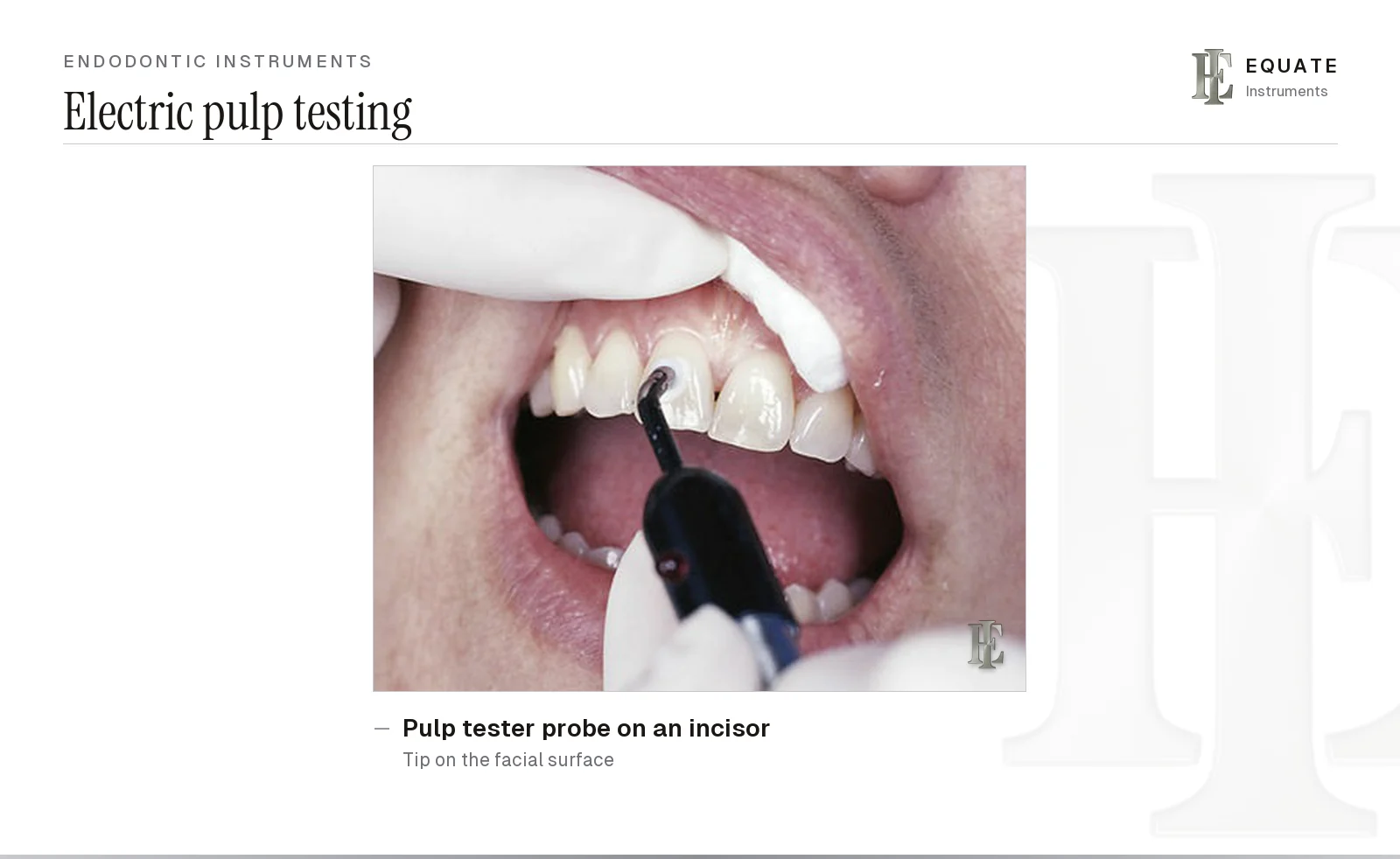
Before treatment, an electric pulp tester helps decide whether the nerve in a tooth still responds. A small probe touches the dried facial or lingual enamel, with a conducting medium such as toothpaste or gel between tip and tooth. Output starts at zero and is turned up slowly; the level at which the patient first notices tingling or warmth is noted and compared with a healthy control tooth. The result shows nerve response only, not blood supply, so it's read together with cold testing, radiographs and the clinical picture. Readings are less reliable in recently injured teeth, in young teeth whose roots are still forming, and where a crown or large restoration leaves little natural tooth to test. Multi-rooted teeth may need more than one reading.
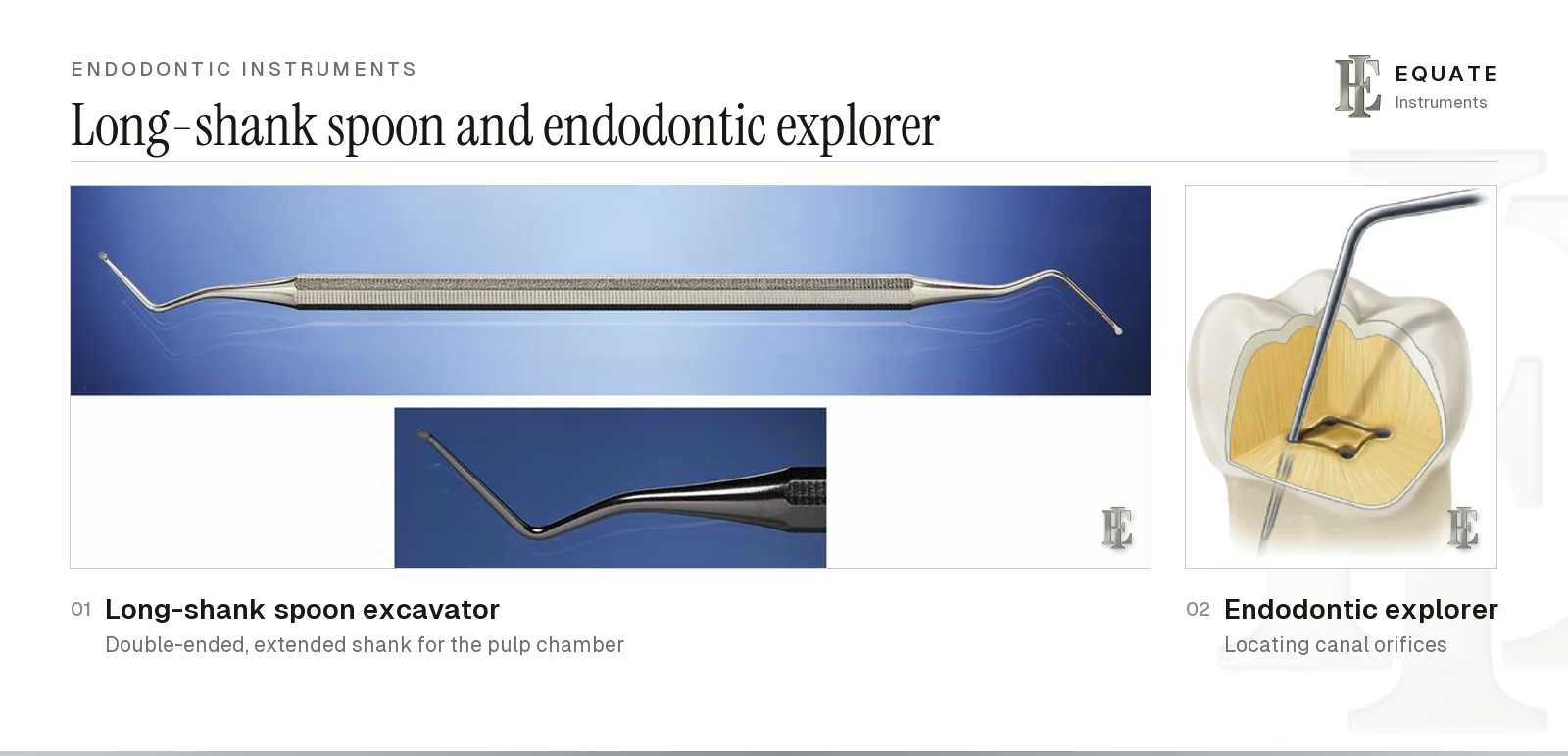
Once the pulp chamber is opened, two long-reach hand instruments take over. The endodontic explorer has a much longer, straighter tip than an ordinary dental explorer, so it can probe the floor of the chamber and catch the small openings of the canals; the DG-16 is the familiar double-ended pattern, and Equate's versions are on the endodontic hand instruments page. The long-shank spoon excavator is a spoon excavator with an extended shank that reaches the bottom of a deep access cavity to lift out coronal pulp, softened dentine and old temporary cement.
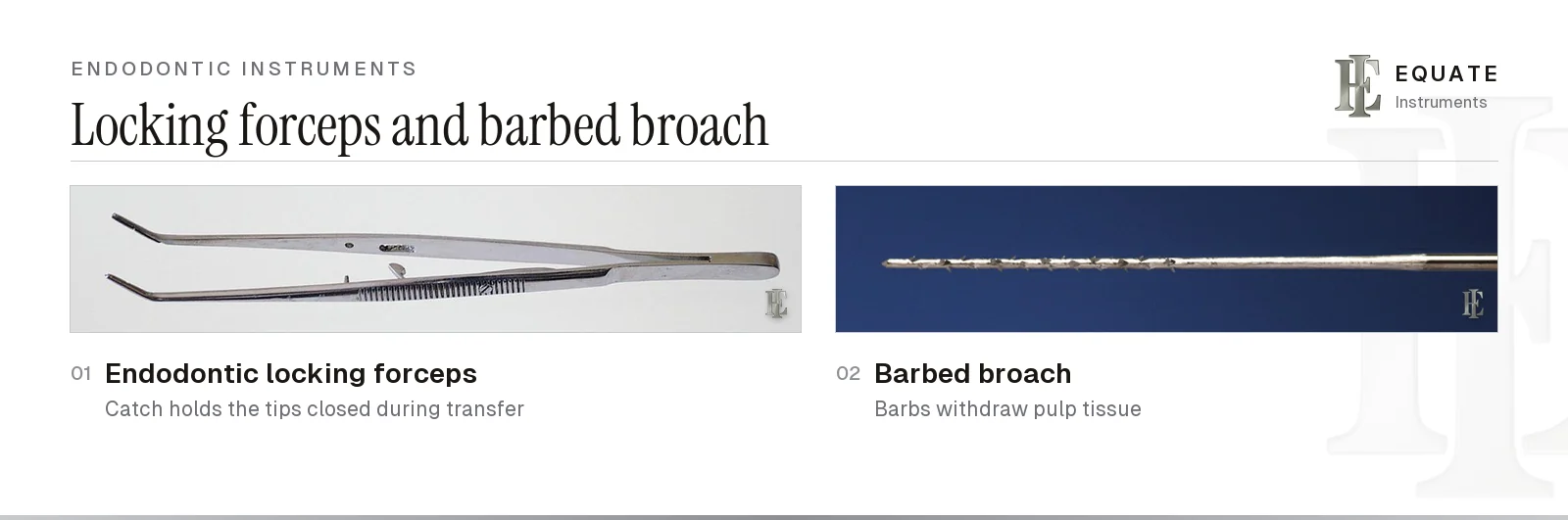
A barbed broach then removes pulp tissue from wider canals. Its fine shaft carries tiny barbs that catch the tissue as the broach is turned gently and withdrawn. Broaches are fragile and are not used to enlarge the canal; they are single-use and go straight into a sharps container. Endodontic locking forceps, cotton forceps with a catch that keeps the tips closed, carry paper points, cotton pellets and gutta-percha cones without dropping them.
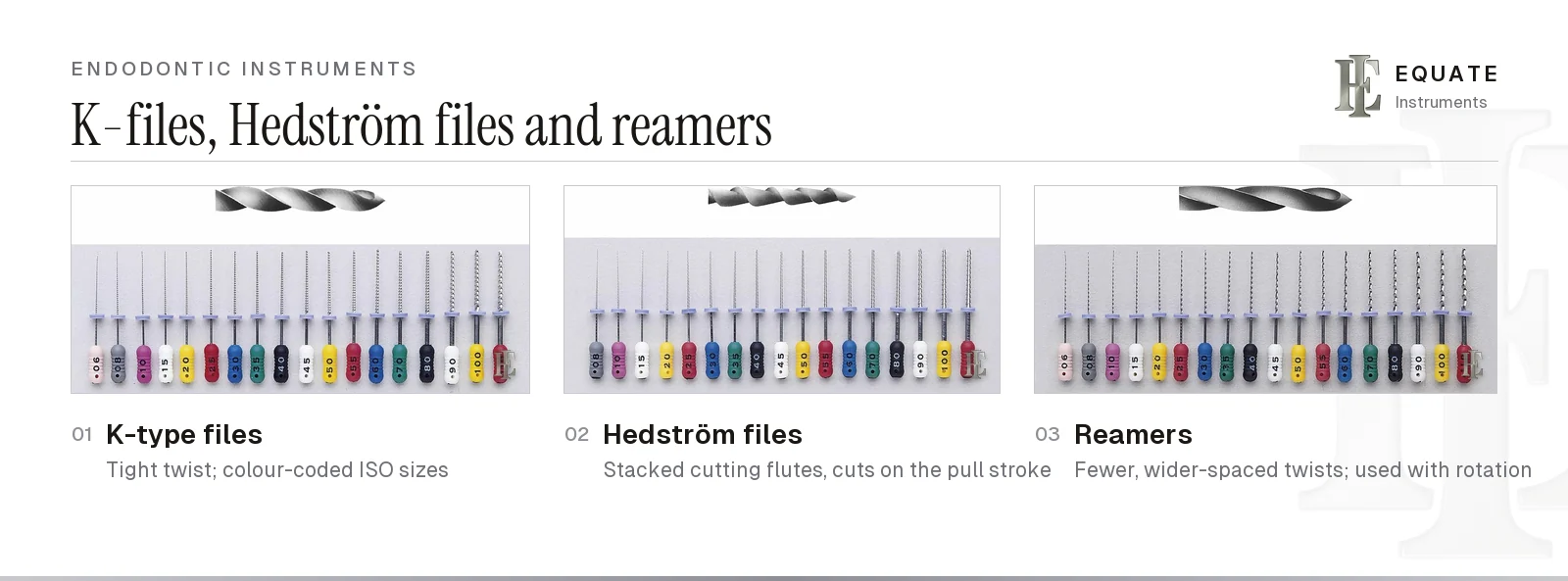
Hand files and reamers: K-file, Hedström file and reamer
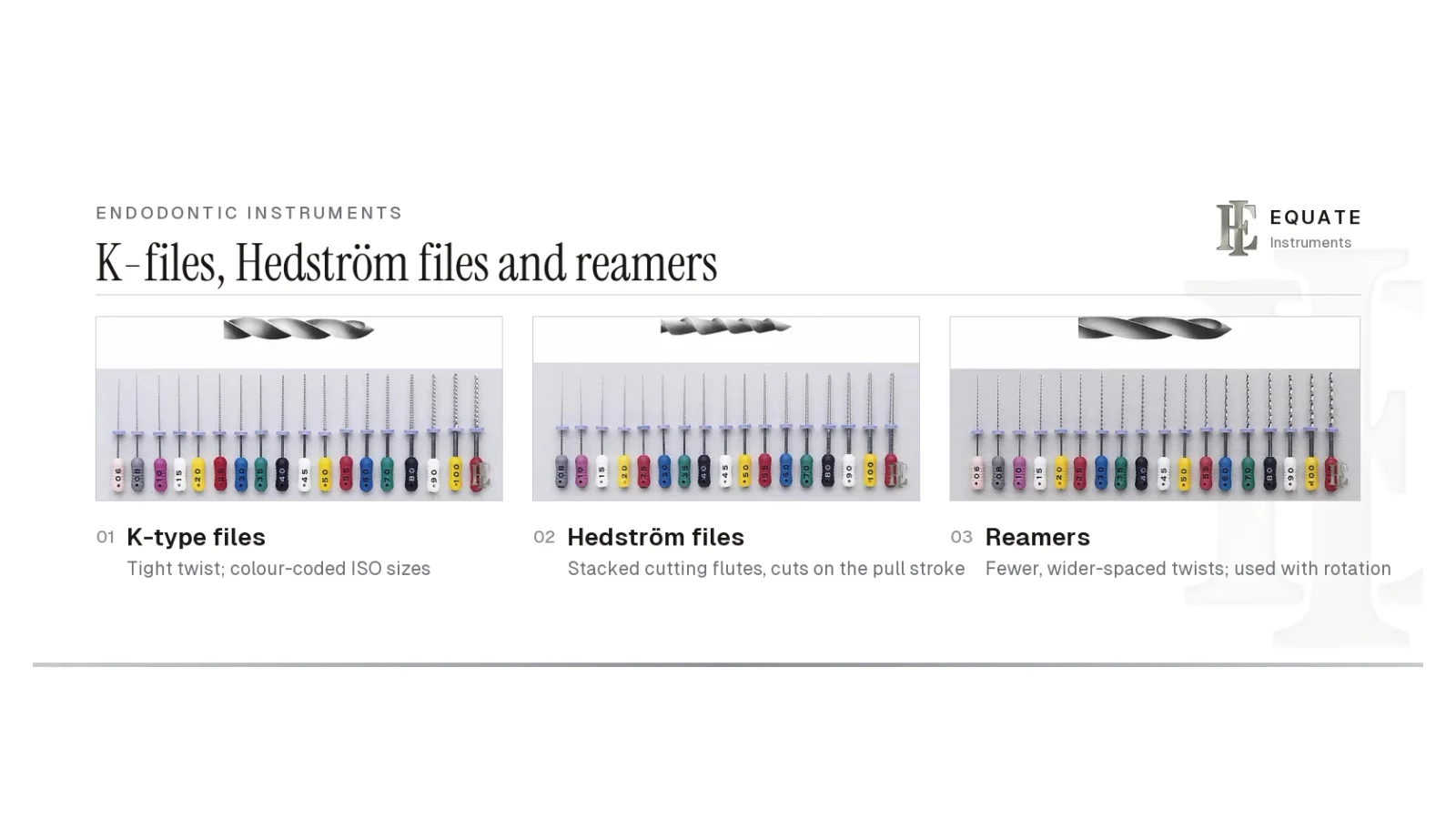
Three hand designs clean and shape the canal walls. They look alike from a distance, but the way the cutting edge is formed decides how each one should be moved.
A K-type file is twisted from a square or triangular blank with closely spaced spirals. It is the general-purpose instrument for negotiating and enlarging a canal, worked with short in-and-out strokes or a gentle quarter-turn and pull. A Hedström file is machined into a row of stacked cones whose edges face the handle, so it cuts strongly on withdrawal and smooths and widens the walls; it should not be rotated, because its narrow core fractures easily under twisting. A reamer has fewer, wider-spaced spirals and is turned clockwise a quarter to half turn and then withdrawn, carving dentine as it rotates.
Sizing is standardised under ISO 3630-1. The size number is the tip diameter in hundredths of a millimetre (size 25 is 0.25 mm), and handle colours run in a repeating sequence: pink 06, grey 08, purple 10, then white, yellow, red, blue, green and black from 15 to 40, starting again at 45. Common overall lengths are 21, 25 and 31 mm, chosen by tooth length and access. Standard hand files have a 0.02 taper, meaning the blade gains 0.02 mm in diameter for every millimetre back from the tip. Engine-driven nickel-titanium files used in a contra-angle handpiece follow the same tip sizing but often have larger tapers, such as 0.04 or 0.06.
- Pink, grey and purple: sizes 06, 08 and 10, the fine instruments for finding and opening a narrow canal.
- White: sizes 15, 45 and 90.
- Yellow: sizes 20, 50 and 100.
- Red: sizes 25, 55 and 110.
- Blue: sizes 30, 60 and 120.
- Green: sizes 35, 70 and 130.
- Black: sizes 40, 80 and 140.
| Instrument | Cutting edge | How it is used | Watch out for |
|---|---|---|---|
| K-type file | Tightly spaced spirals, more per millimetre than a reamer | Push–pull filing or quarter-turn and pull | Forcing a large file round a curve can ledge the canal |
| Hedström file | Stacked cones, edges facing the handle | Pull strokes against the canal wall | Never rotate it; the thin core snaps under torsion |
| Reamer | Fewer, wider-spaced spirals | Clockwise rotation, then withdraw | Turning too far in a curved canal raises fracture risk |
| Barbed broach | Small barbs on a fine shaft | Turn gently and withdraw to remove pulp | Not for enlarging; binding in a narrow canal can break it |
Working length: stoppers, rulers, stands and apex locators
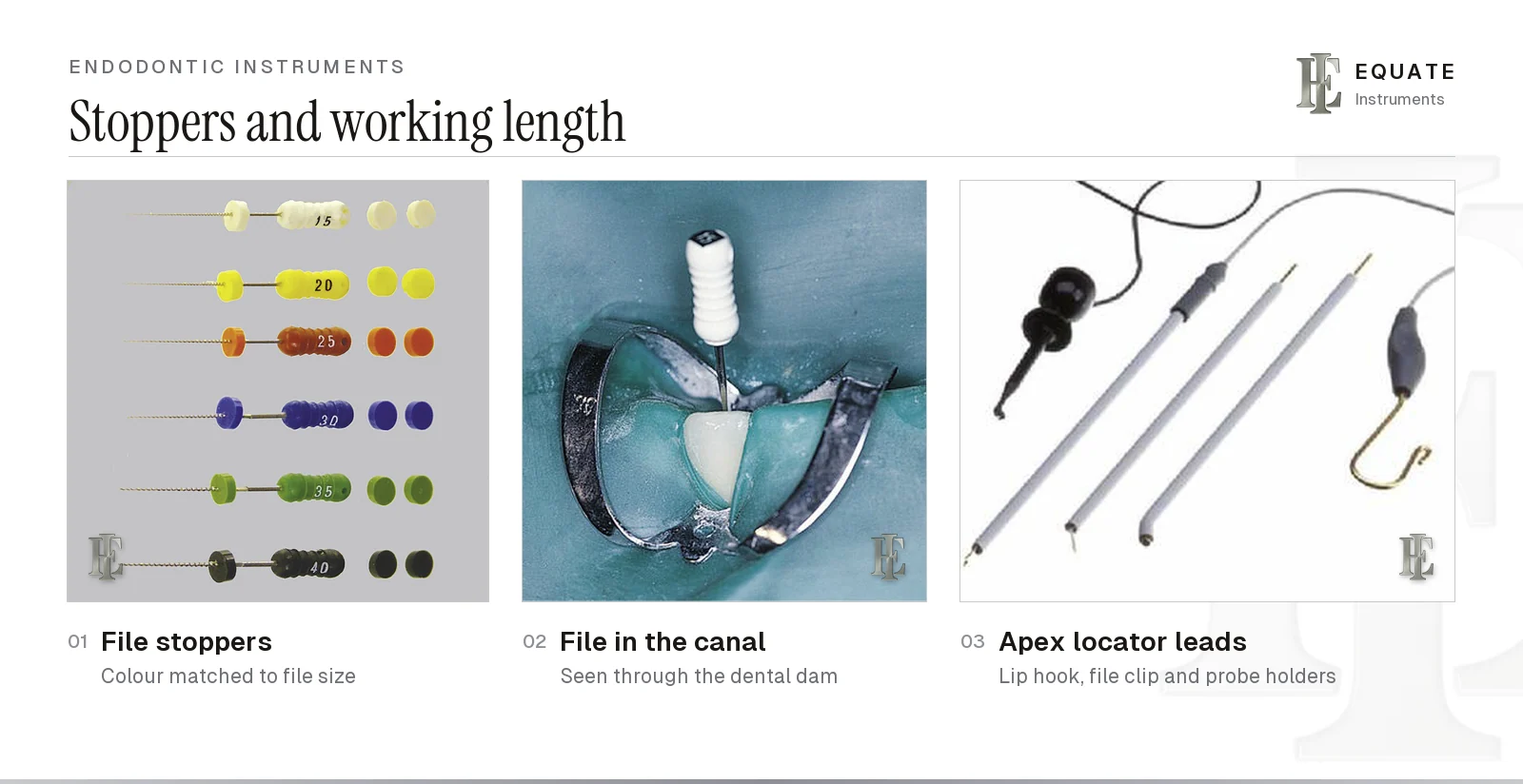
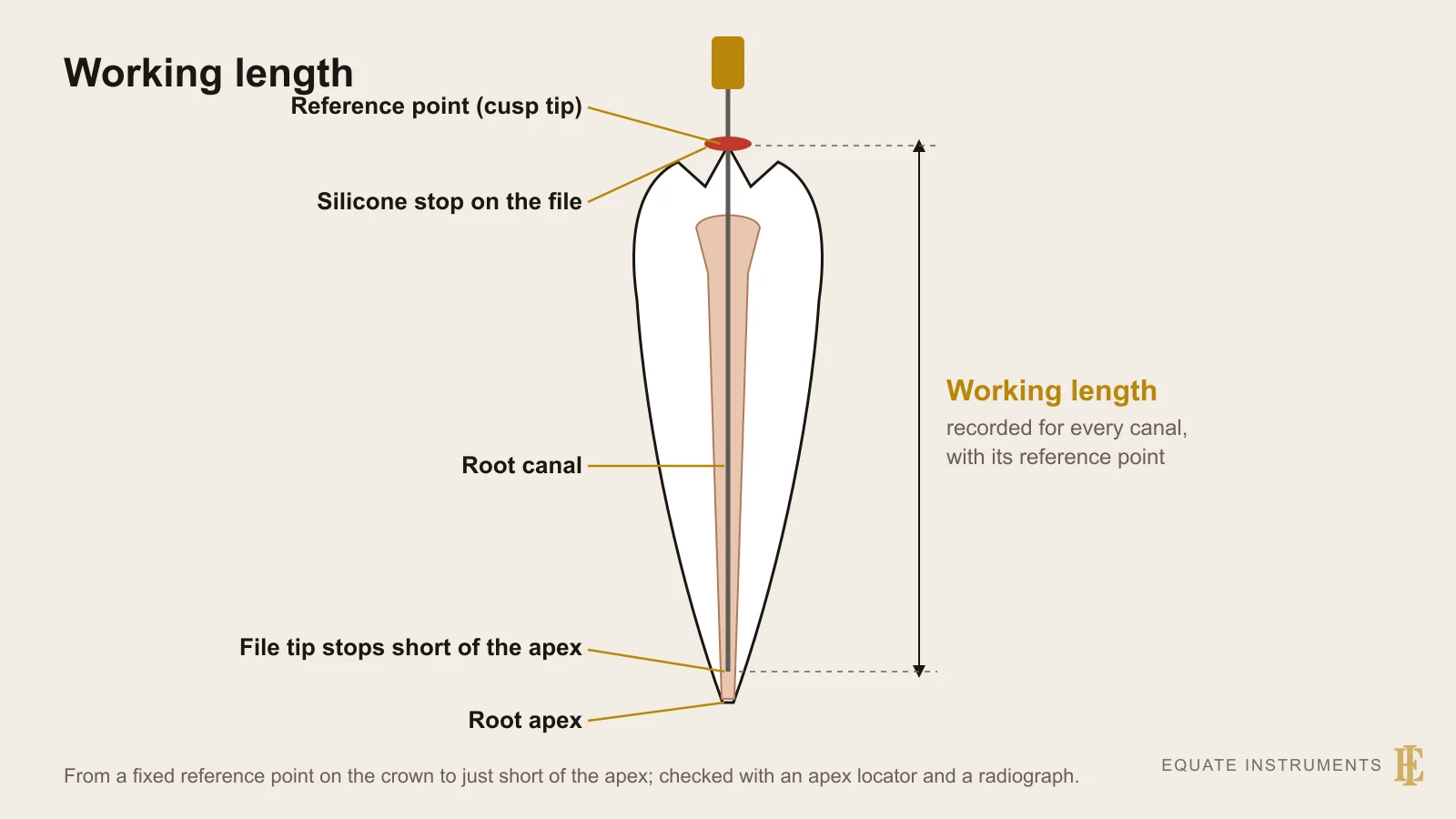
Every file has to stop just short of the root tip, so the length of each canal is measured and recorded. A small silicone, rubber or plastic stop is slid onto the file and set against a reference point on the crown, then the distance from the stop to the file tip is read off a millimetre ruler. Stops come in colours that match the file sizes, or in a single colour for everything; either way they are thrown away after use.
An endodontic ruler or measuring scale, often fitted with a finger ring so it stays on the hand, lets files, paper points and gutta-percha cones be set to the same length chairside. A file stand holds the instruments upright in size order, and some carry an etched scale for measuring; a closed stand or file box keeps a set together through cleaning and sterilisation. See the dental measuring ruler guide for scale designs.
An electronic apex locator measures length by passing a tiny current between a lip hook and a clip on the file. As the file tip approaches the apical foramen the electrical reading changes, and the unit shows this on a display or with a tone. It works in wet or dry canals and reduces the number of length radiographs, but most clinicians still confirm the result on a radiograph. The lip hook and file clip that contact the patient are cleaned and sterilised, and the unit itself is barrier-protected or disinfected as its manufacturer directs. A 2025 systematic review of 16 studies by Alarifi and colleagues found that, in randomised trials, apex locators gave an acceptable length in 87.0–92.1% of canals against 74.0–83.1% for radiographs, with fewer overextended canals, and the authors recommend reading the apex locator first and using radiographs in support.
The European Society of Endodontology's 2006 quality guidelines, since replaced by its 2023 S3-level guideline, put the end point at the apical constriction, which usually lies 0.5–2 mm from the radiographic apex, and asked for the coronal reference point to be written down with each canal length. The chairside order of file, stop, apex locator, radiograph and record is set out on the endodontic tray setup page.
Gates Glidden drills and Peeso reamers
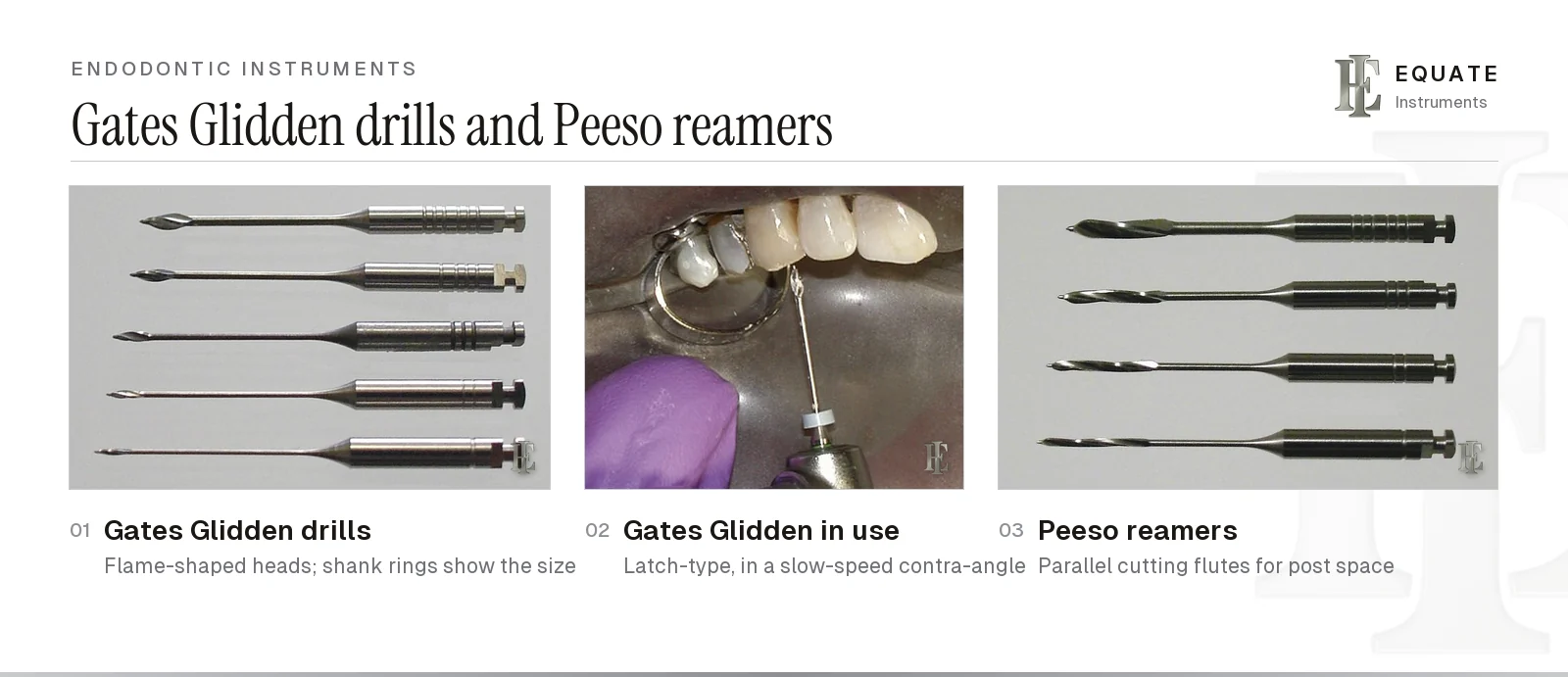
Two latch-type instruments for a slow-speed contra-angle work at the top and in the middle of the canal. A Gates Glidden drill has a small flame-shaped cutting head on a long, thin shank. It widens the canal orifice and the straight coronal part of the canal so files have a smoother path to the apex. Sizes run from 1 to 6 and are read from the number of rings on the shank; a longer version suits anterior teeth and a shorter one helps where mouth opening is limited in posterior teeth. The shank is deliberately the weakest point, so if the instrument jams it tends to break near the handpiece where the piece can be retrieved.
A Peeso reamer (also spelled Peso) has longer, parallel cutting flutes and is used after obturation to remove part of the root filling and form a post space. Like Gates Glidden drills, the size is marked by shank rings, and many designs have a non-cutting tip to follow the gutta-percha rather than cut a new path. Both are used at low speed with light pressure, and both are discarded once worn. The burs and rotary instruments guide covers latch-type shanks in more detail.
Irrigation, drying and filling materials
Files cut dentine, but irrigation does much of the disinfection. A disposable syringe, usually 3 ml or larger, delivers the irrigating solution through a fine needle; side-vented needles that sit loosely in the canal lower the chance of pushing solution beyond the apex. Syringe and needle are single use and go into the sharps container.
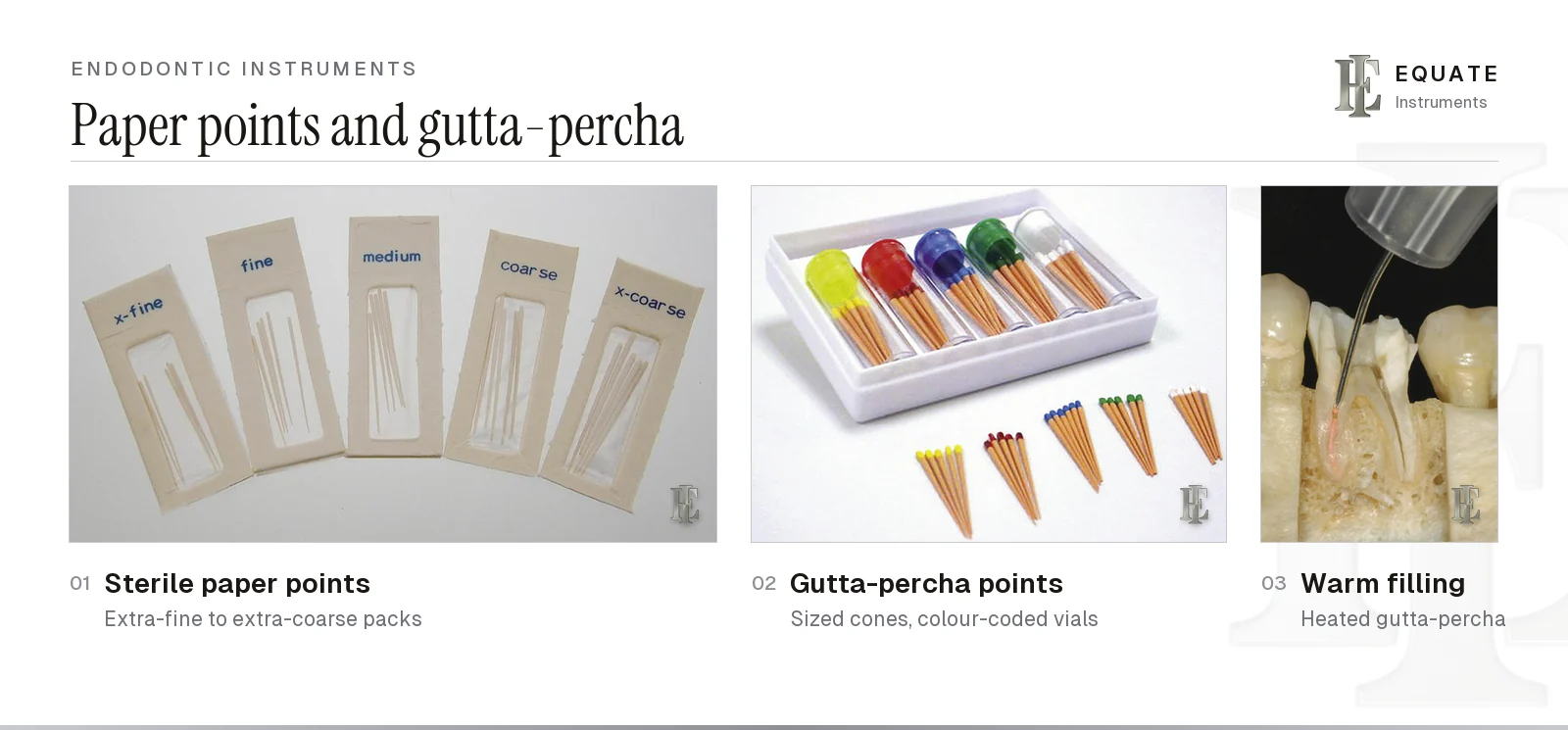
Sterile absorbent paper points then dry the canal. They are sized to match the files, from extra fine to extra coarse, and are measured to the working length so they don't extend past the apex. Keep using new points until the last one is dry along its whole length; a tinged tip suggests exudate or bleeding is still present. Each point goes in once and is then thrown away. Locking forceps or a cross-hold tweezer carry them in.
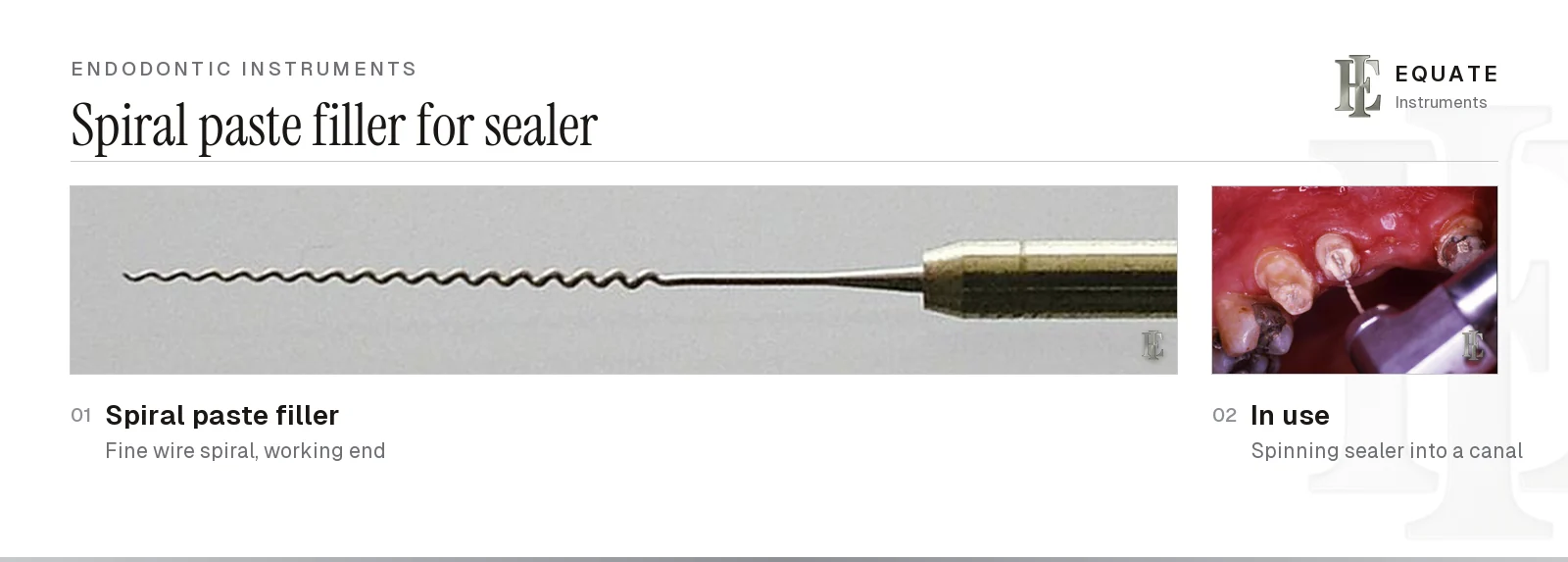
The canal is filled (obturated) with gutta-percha, a natural trans-polyisoprene latex that turns thermoplastic when heated, used together with an endodontic sealer that fills the small gaps between cone and dentine. Gutta-percha points come in sizes matching the files. Sealer can be spun into the canal with a spiral paste filler in a slow-speed contra-angle, run at low speed so the fine wire doesn't snap. In warm techniques, a heated delivery gun softens gutta-percha pellets and injects the material through a fine needle, with the temperature chosen to suit the technique and the canal. Gutta-percha and sealer are single-use materials.
Condensing gutta-percha: spreaders, pluggers and the Glick instrument
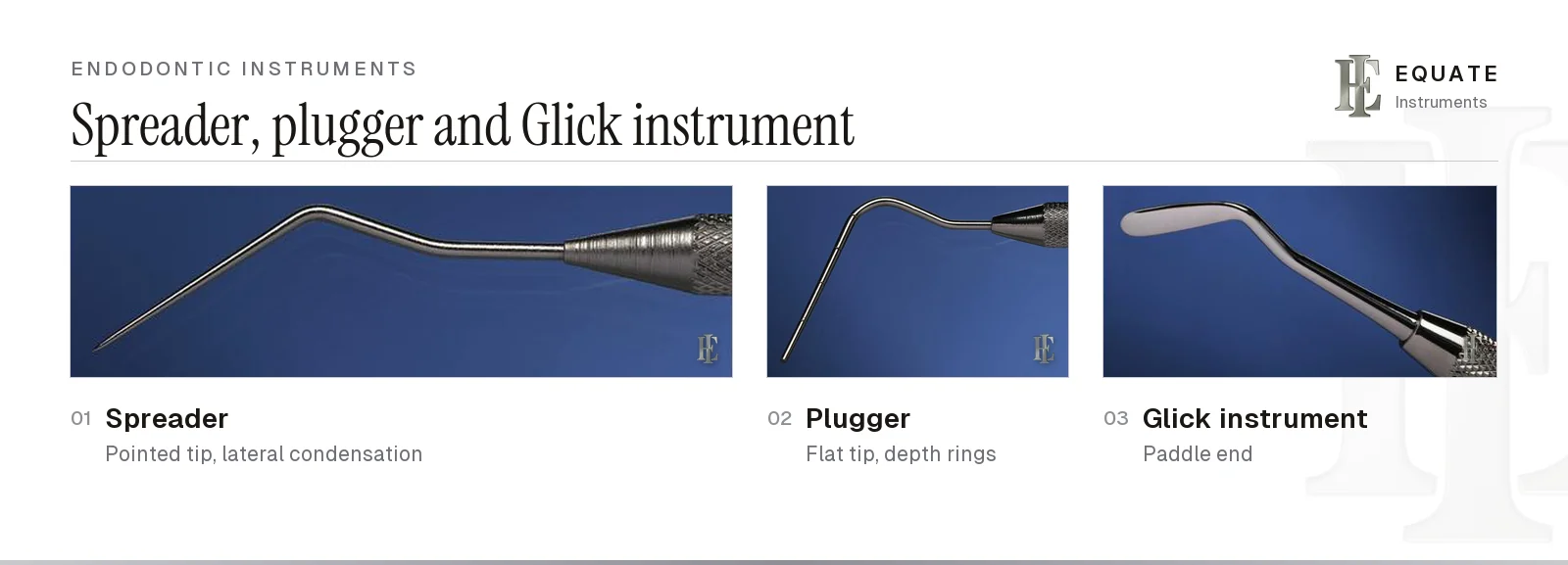
Hand condensers press gutta-percha against the canal walls so the filling has no voids. A spreader has a long, pointed, tapered tip. In lateral condensation it is pushed alongside the master cone to open space for extra accessory cones, then the process repeats until the canal is full. A plugger has a flat, blunt tip and pushes softened gutta-percha downwards, which is the basis of vertical condensation and warm techniques.
Both come with conventional long handles or as short finger instruments held between the fingertips, which give more tactile feel in narrow canals. Many have rings or etched lines at millimetre intervals so the depth of penetration can be controlled. Tip sizes are matched to the canal: a spreader or plugger that binds too high up won't condense the apical part, and one forced too deep can split a thin root.
The Glick instrument is a double-ended carrier and condenser. The paddle end carries temporary filling material into the access cavity, while the narrow plugger end, often ringed, condenses gutta-percha; heated, it also sears off the excess at the canal orifice. Equate lists 9 hand spreaders and 16 endodontic pluggers, single-sized and double-ended, on its endodontic hand instruments page; they are far finer than the larger restorative condensers and pluggers used for amalgam. Equate's root canal stoppers are also fine steel hand instruments, with 0.5–1.2 mm tips for obturation and paste placement; they are not the disposable silicone stops that sit on files. For retreatment and post-space work, a fine hooked gutta-percha remover lifts old filling material out of the canal.
Warm vertical compaction goes back to Herbert Schilder's 1967 paper on filling root canals in three dimensions, and a 2024 systematic review by Jaha found it about as successful as single-cone filling, with closer adaptation to the canal wall where the anatomy is complex. Pluggers are tried in the shaped canal before filling so each one stops a few millimetres short of working length without binding.
Root-end surgery: micro instruments
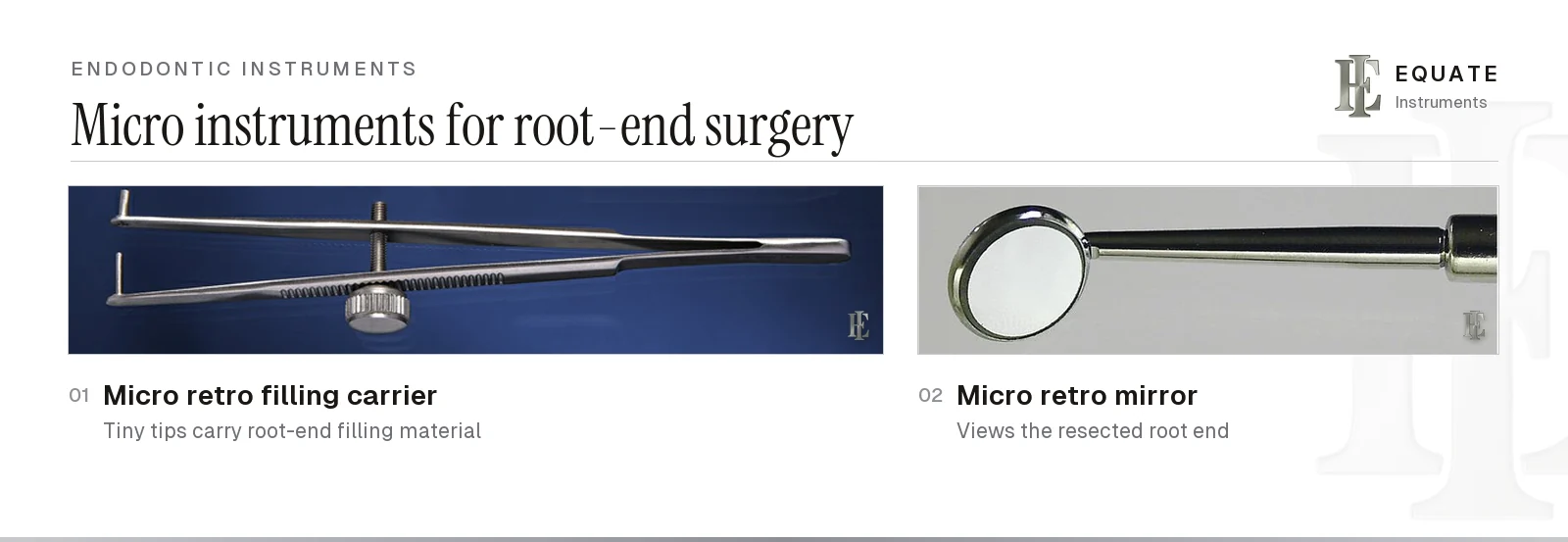
When apical periodontitis persists after root canal treatment and retreatment through the crown is not suitable or has failed, apical surgery may be considered: the root tip is removed and the canal sealed from its end (an apicoectomy with a root-end filling). The European Society of Endodontology's S3-level clinical practice guideline (2023) covers this surgical route alongside non-surgical retreatment, with the choice made case by case. The site is only a few millimetres across, so the instruments are miniaturised. A micro mouth mirror, much smaller than a No. 4 head, shows the cut root face, and a micro retro filling carrier delivers a tiny increment of filling material into the root-end cavity.
Boyd illustrates a micro carrier for amalgam; today calcium silicate cements such as mineral trioxide aggregate (MTA) are widely used for root-end fillings and are placed with a dedicated MTA carrier. In their 2010 review, Parirokh and Torabinejad list MTA's uses as pulp capping, pulpotomy, apical barriers in open apices, perforation repair and root canal filling. Cement left in the cannula would harden there, so the carrier is flushed with water as soon as it has been used. These sit on a surgical tray alongside the elevators, curettes and sutures described in the universal surgical instruments guide.
Cleaning, sterilising and single-use items
Endodontic instruments enter the pulp space or touch tissue beyond it, so they are treated as critical items (the sterilisation guide explains the classes). AlBaghdadi and colleagues, writing in Cureus in 2024, place endodontic instruments in Spaulding's critical class because they reach the vascular tissue of the pulp. The US Centers for Disease Control and Prevention guidelines (Kohn and colleagues, 2003) and England's HTM 01-05 for dental practices both expect reusable critical instruments to be cleaned and heat sterilised between patients. HTM 01-05 goes further for files and reamers: after Department of Health advice in 2007 on the theoretical risk of prion transmission, they are treated as single use (or single-patient use) regardless of how the manufacturer labels them. Elsewhere, follow the manufacturer's ISO 17664 reprocessing instructions and your national regulations.
HTM 01-05 also expects a practice to be able to trace any single-patient instrument back to its patient, and asks for files cleaned by hand to be washed apart from other instruments. The European Society of Endodontology's 2023 guideline counts aseptic technique among the conditions for success, which in practice means a dam, a disinfected field and sterile points handled only with sterile pliers. Step-by-step reprocessing is on the endodontic tray setup page.
- Discard after one use: broaches, paper points, gutta-percha, irrigating syringes and needles, and file stops.
- Files, reamers, Gates Glidden drills, Peeso reamers and spiral fillers: discard in a sharps container, or, where national rules allow reuse, clean them separately from other instruments, inspect for unwinding or bent flutes and sterilise.
- Clean first: debris in flutes and serrations survives sterilisation, so ultrasonic or washer-disinfector cleaning comes before packing.
- Process locking forceps open and unlocked so steam reaches the joint and tips.
- Pack in a sealed pouch or wrapped instrument cassette with an internal process indicator, check the external indicator after the cycle and the internal one when the pack is opened.
- Electronic units (pulp tester, apex locator, warm gutta-percha unit): sterilise parts that touch the patient if they are designed for it, and barrier-protect or disinfect the body as the manufacturer directs.
Buying endodontic hand instruments: what to check
- Explorer tips: long, fine and stiff enough to feel a calcified orifice, ground to a true point and identical at both ends of a DG-16 pattern.
- Spoon excavators: a shank long enough to reach the pulp chamber floor of a molar, with spoons that are sharp and sized to the access cavity (1.0–2.0 mm is a common range).
- Spreaders and pluggers: tip diameters and tapers that match the files you use, with depth rings that are clearly visible under magnification.
- Handle style: long handles for leverage and control, finger instruments for tactile feel in fine canals.
- Locking forceps and tweezers: tips that close evenly along their length and a catch that holds a paper point without crushing it.
- Material and finish: passivated stainless steel that withstands repeated steam sterilisation, with laser-etched size marks that don't wear off.
- Organisation: a file box, stand or cassette that keeps a set together through cleaning, sterilisation and storage.
The Equate difference
Equate supplies the steel hand instruments of an endodontic tray rather than files or materials: 5 root canal explorers (2 endodontic explorers and 3 in the DG-16 pattern), 3 long-shank root canal excavators, 9 hand spreaders, 16 endodontic pluggers, 10 root canal stoppers (fine steel hand instruments with 0.5–1.2 mm tips, not disposable file stops), 2 gutta-percha removal hooks, 6 MTA carriers, 4 endodontic measuring scales, 6 endodontic file boxes, 5 file-holding and fragment-retrieval forceps, and 3 endodontic tweezers (an angled-tip locking tweezer and a cross-hold tweezer from a range of 9 locking tweezers, plus a non-locking angled tweezer). Equate does not list files, reamers, broaches, rotary drills, paper points, gutta-percha or electronic devices.
Equate Endodontic Instruments for Root Canal Treatment options

Endo Plugger 0.5-1.0mm
EI-0894
Endo Plugger 0.5-1.0mm - Premium Textured Silicone Handle
EI-1109
Endo Plugger 0.5-1.0mm Light Blue
EI-1195
Luks Endodontic Plugger Fig.1 (ø0.4mm), Solid Handle
EI-2040
Luks Endodontic Plugger Fig.2 (ø0.5mm), Solid Handle
EI-2041
Luks Endodontic Plugger Fig.3 (ø0.7mm), Solid Handle
EI-2042
Luks Endodontic Plugger Fig.4 (ø1.0mm), Solid Handle
EI-2044
Endodontic Plugger 1/3 - 0.40/0.45mm Solid Handle 6mm
EI-2045
Endodontic Plugger 5/7 - 0.50/0.75mm Solid Handle 6mm
EI-2046
Endodontic Plugger 9/11 - 1.00/1.15mm Solid Handle 6mm
EI-2047
Endodontic Plugger 0.3mm - Solid Handle 6mm
EI-2048
Endodontic Plugger 0.4mm - Solid Handle 6mm
EI-2049Browse all endodontic instruments
Buying in your market
Frequently asked questions
What instruments are used in a root canal treatment?
A typical tray has a mouth mirror, endodontic explorer, long-shank spoon excavator, locking forceps, broaches, hand files or reamers with stops, a millimetre ruler, an irrigating syringe, paper points and, for the filling visit, gutta-percha, sealer, spreaders and pluggers. An apex locator and a slow-speed handpiece with Gates Glidden drills are often added.
What is the difference between a K-file, a Hedström file and a reamer?
A K-file has tightly spaced spirals and is used with push–pull or quarter-turn strokes. A Hedström file has stacked cone-shaped edges that cut on the pull stroke and must not be rotated. A reamer has fewer, wider spirals and cuts as it is turned clockwise and withdrawn.
What do the colours on endodontic files mean?
They show the ISO size, which is the tip diameter in hundredths of a millimetre. Sizes 06, 08 and 10 are pink, grey and purple; from 15 the colours run white, yellow, red, blue, green and black, then repeat from 45.
Can endodontic files be sterilised and reused?
It depends on where you practise. In England, HTM 01-05 treats files and reamers as single use regardless of the manufacturer's labelling. Elsewhere, reusable files may be cleaned and sterilised following the manufacturer's instructions and national regulations, and discarded at any sign of unwinding or bending.
References
- Boyd LRB. Dental Instruments: A Pocket Guide, 7th edition. Saunders/Elsevier, 2020 (photographs used under licence)
- Duncan HF, et al. Treatment of pulpal and apical disease: The European Society of Endodontology (ESE) S3-level clinical practice guideline. International Endodontic Journal 2023;56(Suppl 3):238–295
- American Association of Endodontists. AAE Position Statement: Dental Dams
- ISO 3630-1:2019 Dentistry — Endodontic instruments — Part 1: General requirements
- Kohn WG, et al. Guidelines for Infection Control in Dental Health-Care Settings, 2003. MMWR 52(RR-17), Centers for Disease Control and Prevention
- Department of Health. Health Technical Memorandum 01-05: Decontamination in primary care dental practices, 2013 edition
- ISO 17664-1:2021 Processing of health care products — Information to be provided by the medical device manufacturer for the processing of medical devices — Part 1: Critical and semi-critical medical devices
- European Society of Endodontology. Quality guidelines for endodontic treatment: consensus report of the European Society of Endodontology. International Endodontic Journal 2006;39(12):921–930 (since replaced by the ESE 2023 S3-level guideline)
- Schilder H. Filling root canals in three dimensions. Dental Clinics of North America 1967;11:723–744 (reprinted in Journal of Endodontics 2006;32(4):281–290)
- Jaha HS. Hydraulic (single cone) versus thermogenic (warm vertical compaction) obturation techniques: a systematic review. Cureus 2024;16(6):e62925
- Parirokh M, Torabinejad M. Mineral trioxide aggregate: a comprehensive literature review. Part I: chemical, physical, and antibacterial properties. Journal of Endodontics 2010;36(1):16–27
- AlBaghdadi M, Khaddam M, Zainab A. A comparative in-vitro study of the effectiveness of several methods of sterilizing endodontic files. Cureus 2024;16(11):e74473
- Alarifi NA, Alqahtani AM, Alharbi AZ, et al. Comparative accuracy of electronic apex locators and conventional radiography for working length determination in permanent teeth: a systematic review. Cureus 2025;17(10):e93997
I am a…
Related
- Endodontic Hand Instruments
- Endodontic Tray Setup: Opening and Sealing a Tooth
- Rubber Dam Clamps, Forceps, Punches and Frames: Which to Choose
- Dental Cotton Pliers (Dental Tweezers)
- Dental Pluggers and Condensers (Amalgam Condensers)
- Dental Instrument Cassettes, Trays and Boxes
- Spoon Excavators (Dental Excavators)
- Dental Explorers
- Dental Measuring Ruler
- Dental Dam Instruments Explained, from Sheet to Frame
- Dental Handpieces: Types, Attachments and Reprocessing
- Basic Dental Instruments: Mirror, Explorer, Cotton Forceps and Handles
- Dental Imaging and Diagnostic Equipment