Dental Rongeurs and Bone Files
Written by the Equate Instruments Technical Team · Reviewed by the Medical & Dental Board, Equate Instruments · Updated ·
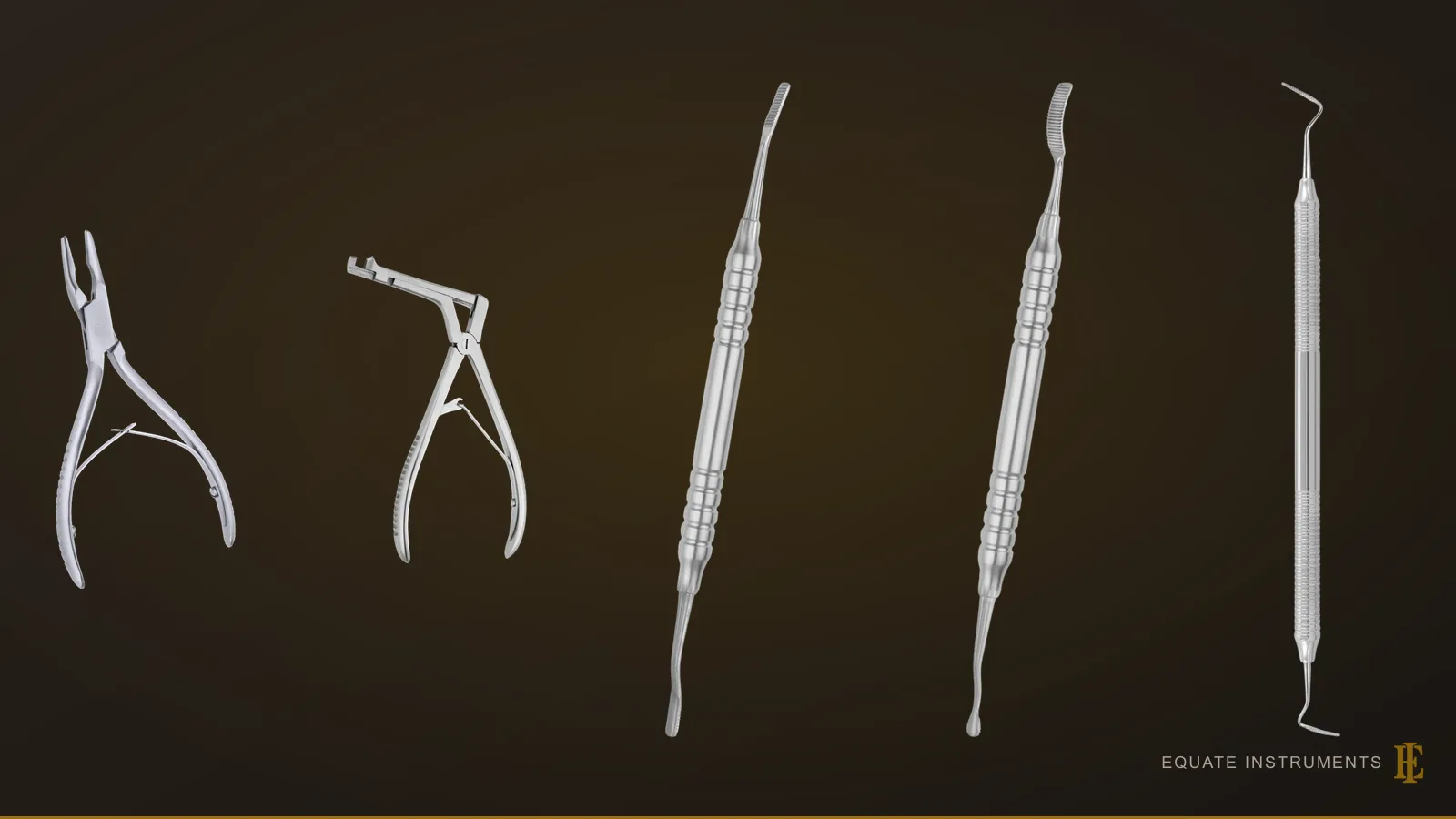
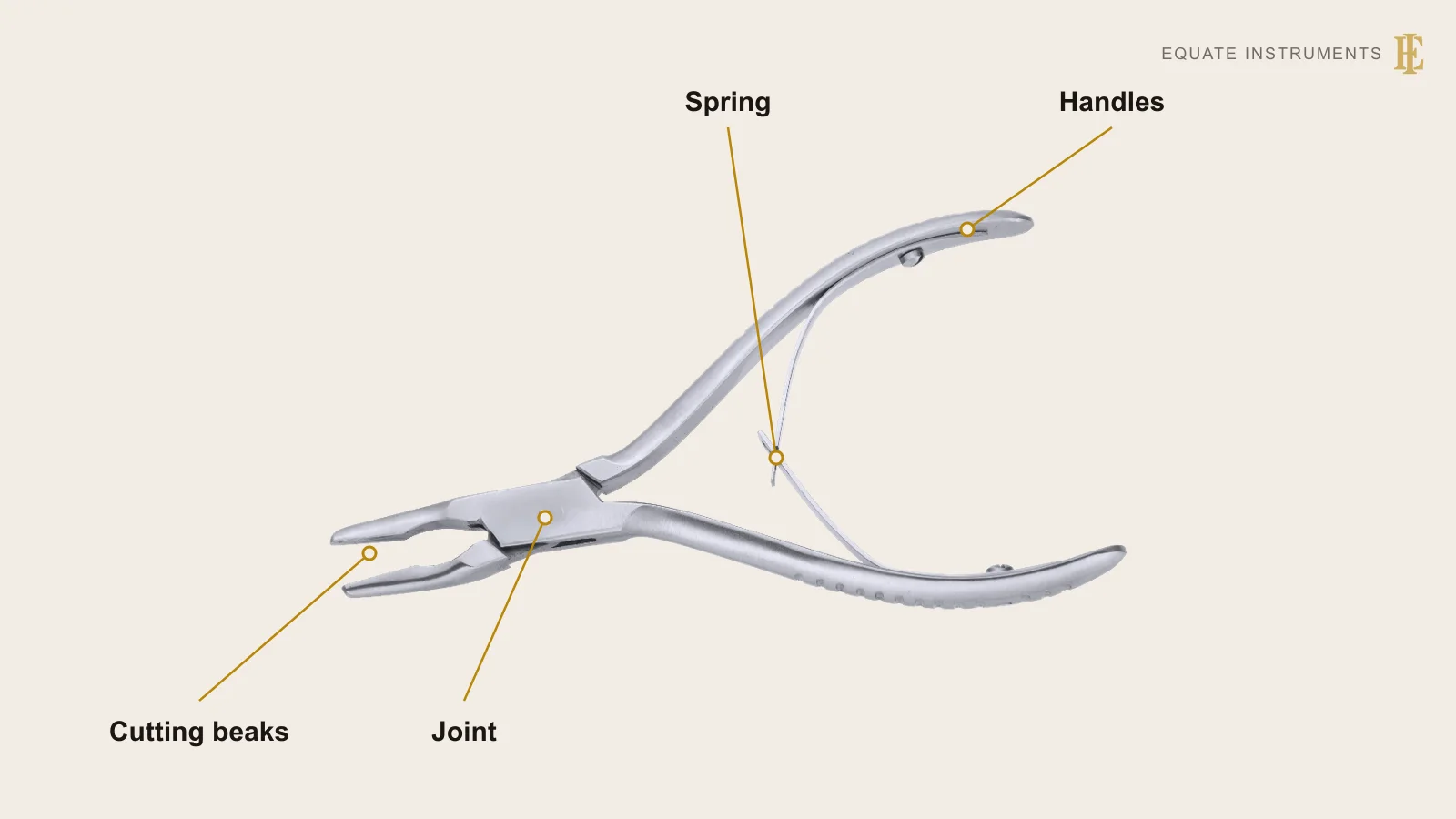
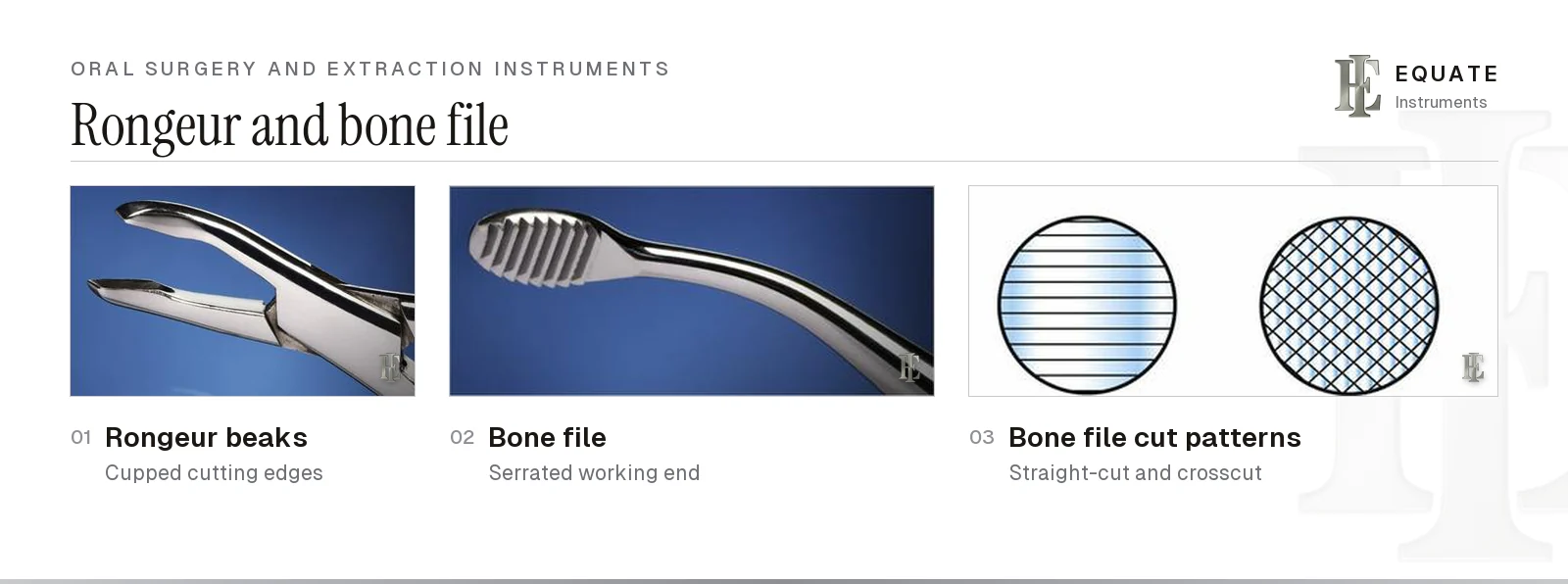
A dental rongeur is a spring-loaded, plier-like surgical instrument with sharp, cupped beaks that nibble bone away in small bites. Dentists use it to trim sharp socket walls after extractions, to reshape the ridge before dentures or implants (alveoloplasty) and to harvest small bone chips. It comes in side-cutting, end-cutting and double-action designs, and a bone file smooths what it leaves.
Key points
- Rongeurs cut bone in small bites; they should never pull teeth or roots, which is the job of extraction forceps.
- Side-cutting beaks trim ridges, end-cutting beaks reach into sockets and septa, and double-action joints multiply force for dense bone.
- A bone file finishes the ridge with short pull strokes once the rongeur has removed the bulk.
What is a dental rongeur used for?
The name is French for a gnawer or rodent, after the nibbling way the beaks take bone. A rongeur removes small amounts of bone where a bur would be slower or harder to control. After an extraction it trims sharp crests and spicules of socket wall that would otherwise poke through the healing mucosa; in an alveoloplasty it reduces bony undercuts and evens out the ridge so a denture seats comfortably or an implant has a flat platform. It is also used to take down interdental septa after multiple extractions and to remove small exostoses.
Rongeurs also harvest autogenous bone. Hashemi and Beshkar, sampling bone from 30 implant patients, found that fragments taken with a rongeur, mainly from the tuberosity, carried significantly fewer micro-organisms than bone debris collected with a suction filter. That makes the rongeur a useful companion to the bone graft instruments when a small graft is needed.
What types of rongeur are there?
Rongeurs are grouped by where the beaks cut and how the joint transmits force. The bone file is included in the table because it finishes the same job by hand.
| Type | Beaks or working end | Typical use | Patterns in the Equate range |
|---|---|---|---|
| Side-cutting | Cutting edges along the sides of angled beaks, for example 45° or 90° | Trimming the ridge crest and buccal or lingual socket walls | Blumenthal 45° and 90°, Micro-Friedman S-shaped |
| End-cutting | Cutting edges at the tips of narrow beaks | Reaching into sockets, interdental septa and tight spaces | Friedman, Friedman-Pearson, Micro-Friedman, Cleveland, Blumenthal 30° |
| Double-action | Compound joint that multiplies hand force | Dense cortical bone and larger reductions with less fatigue | Beyer, Ruskin mini |
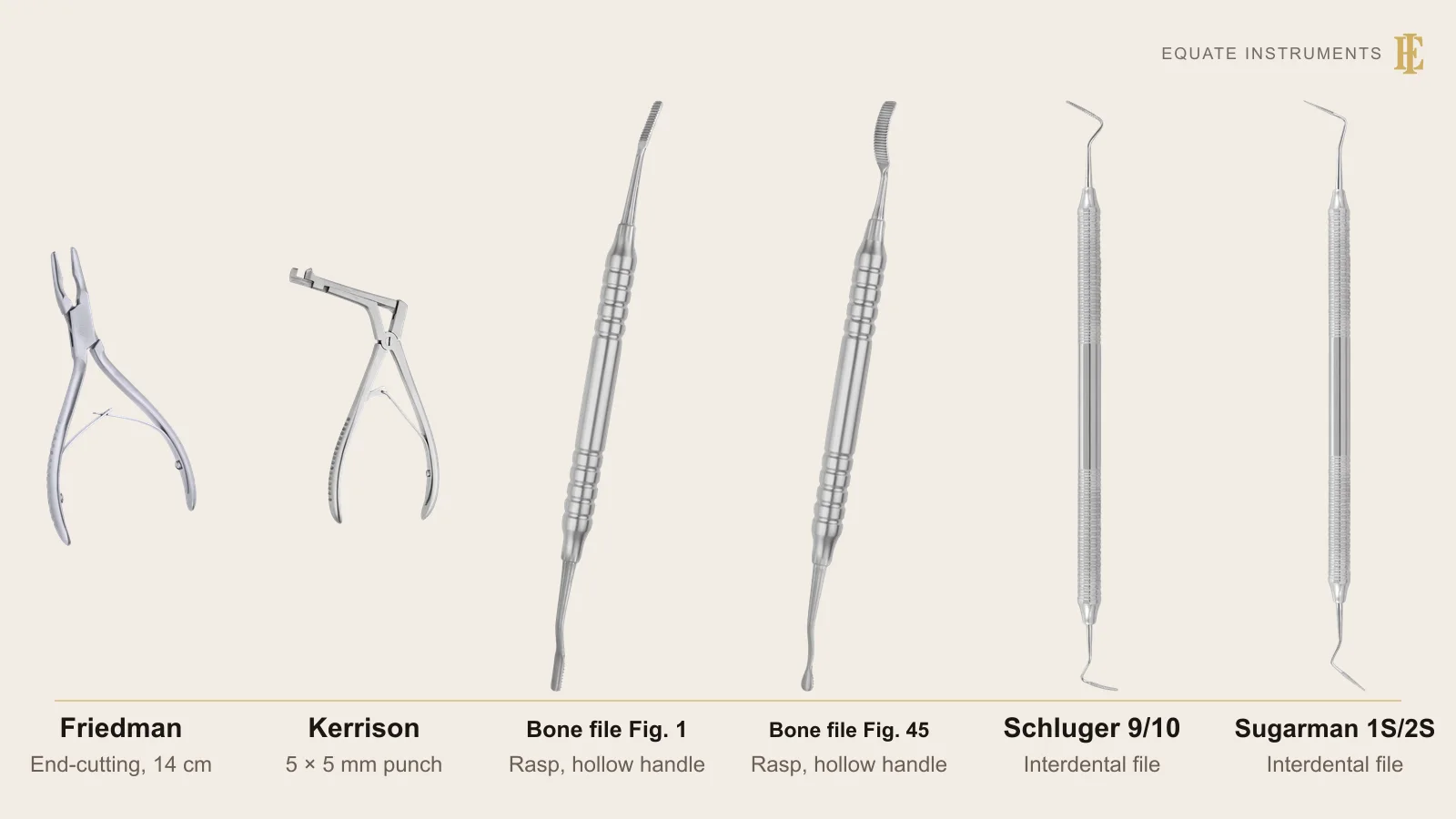
| Punch-style | Footplate under the bone and a sliding upper jaw | Removing bone in small, square bites from an edge | Kerrison 3 × 3, 4 × 4 and 5 × 5 mm |
| Bone file | Rasp of fine, directional cutting teeth | Smoothing the ridge after the rongeur, before closure | Rasp-type files, Schluger and Sugarman interdental files |
Which rongeur for which procedure?
- Routine extraction with a sharp socket crest: a side-cutting rongeur such as a Blumenthal, taking one or two light bites, on the surgical extraction tray.
- Multiple extractions and alveoloplasty: a side-cutting rongeur for the crest, an end-cutting rongeur for the septa, then a bone file, all on the oral surgery tray.
- Dense mandibular bone or tori reduction after sectioning: a double-action rongeur, or the bone chisel and mallet for the initial cut.
- Implant sites and periodontal osseous surgery: micro patterns such as the Micro-Friedman, which take very small bites in confined spaces.
- Harvesting a small autogenous graft: an end-cutting rongeur at the tuberosity or ramus, collecting the chips in a sterile dish.
How do you use a rongeur safely?
Raise and protect the flap first: a rongeur needs a clear view of bone, so the mucoperiosteum is reflected with a periosteal elevator and held back so no soft tissue sits between the beaks. Hold the rongeur in the palm, with the thumb and fingers on the handles, and place the beaks so they cut the bone you want to remove and nothing beyond it.
Take small bites and close the handles fully, without twisting or levering. Large bites or rotation strain the joint, dull the edges and can fracture more bone than intended, especially at the thin buccal plate. Wipe the bone out of the beaks with damp gauze between bites, irrigate, and run a gloved finger over the ridge through the flap to check for remaining sharp points before smoothing with a file. If granulation tissue or debris is left in the socket, clear it with a surgical curette before filing.
What is a bone file and when is it used?
A bone file is a hand instrument with a rasp-like working end that smooths bone surfaces after a rongeur or bur has removed the bulk. Its teeth are cut to remove bone in one direction, so it is drawn across the bone in short, controlled pull strokes; pushing it back mostly burnishes and crushes the surface. Boyd's pocket guide describes a push-and-pull motion, so check which way the teeth face before you start. The teeth come in two cut patterns: straight-cut, with parallel rows, and crosscut, with rows that cross each other. The oral surgery and extraction instruments guide sets the file beside the other bone instruments. Double-ended files carry two blade shapes, for example a flat rasp for the crest and a curved one for the buccal contour.
Pandey and colleagues compared rongeur-and-file alveoloplasty with piezosurgery in a split-mouth study of 10 patients. The hand instruments were faster, at about 25 minutes against 32, but the piezosurgery side had less pain on day 3 and better healing on day 7.
The same catalogue group holds periodontal files: Schluger and Sugarman files recontour interdental bone in osseous surgery, while Hirschfeld files are used to break up heavy calculus during scaling, a job closer to the dental scalers.
Which specifications matter?
Beak angle, beak size and the type of joint decide where a rongeur can cut and how much force it needs.
| Specification | Options | Why it matters |
|---|---|---|
| Beak angle | Straight, 30°, 45°, 90° or S-shaped | Matches the angle of approach to the ridge or socket |
| Beak size | Micro or standard | Micro beaks take tiny bites at implant and periodontal sites |
| Action | Single-action or double-action | Double-action needs less hand force in dense bone |
| Length | About 14–18.5 cm | Longer reaches posterior sites; shorter gives more feel |
| Return spring | Leaf spring | Reopens the beaks between bites for a steady rhythm |
| File teeth | Coarse or fine rasp, single or double-ended | Coarse removes bone faster; fine leaves a smoother ridge |
What does the Equate range include?
Equate lists 17 bone rongeurs. The 9 side-cutting rongeurs are the Blumenthal 15 cm at 45° and 90°, the Micro-Friedman S-shaped 15 cm and six Kerrison punch rongeurs in 3 × 3, 4 × 4 and 5 × 5 mm. The 6 end-cutting rongeurs are the Friedman 14 cm, Friedman-Pearson, Blumenthal 15 cm at 30°, Micro-Friedman 16 cm and 14 cm at 90°, and Cleveland 14 cm. The 2 double-action rongeurs are the Beyer 18.5 cm and the Ruskin mini 15 cm.
The file group has 17 instruments: 10 rasp-type bone files (Fig. 1, 2, 10, 12, 12A, 33, 45 and 64, and two unnumbered double-ended rasps) on 10 mm hollow handles, and 7 periodontal files on 6 mm solid handles: Schluger 9/10, Sugarman 1S/2S and 3S/4S, Hirschfeld 3/7, 5/11 and No. 9, and Back 11/12. All are stainless steel, designed in Finland, and clinics can request samples and a quote through the oral surgery range.
How do you clean and maintain rongeurs and bone files?
Rongeurs must be cleaned and sterilised with the joint open and unlocked, as the CDC's 2003 dental guidelines require for hinged instruments, because bone and blood pack into the beaks and the box joint. Rinse or wipe debris off at the chair, scrub the beaks and joint with a soft brush, and clean the instrument open in an ultrasonic bath or washer-disinfector before heat sterilisation. Brush bone files along the direction of the teeth, not across them.
After cleaning, apply a steam-permeable instrument lubricant to the joint and spring, then follow the manufacturer's reprocessing instructions, which ISO 17664-1 requires them to supply. Check that the beaks meet along their whole cutting edge and still cut cleanly; a rongeur that crushes rather than cuts needs professional resharpening, and a file whose teeth are worn smooth should be retired.
The Equate difference
Equate lists 17 bone rongeurs, 9 side-cutting, 6 end-cutting and 2 double-action, in Blumenthal, Friedman, Micro-Friedman, Friedman-Pearson, Cleveland, Kerrison, Beyer and Ruskin patterns from 14 cm to 18.5 cm, plus 17 files: 10 rasp-type bone files on 10 mm hollow handles and Schluger, Sugarman, Hirschfeld and Back periodontal files.
Equate Dental Rongeurs and Bone Files options

Hirschfeld File 3/7 - Anatomical Solid Handle 6 mm
EI-1958
Hirschfeld File 5/11 - Anatomical Solid Handle 6 mm
EI-1959
Hirschfeld File No. 9 - Solid Handle 6mm
EI-1960
Sugarman File 1S/2S - Solid Handle 6 mm
EI-2159
Sugarman File 3S/4S - Solid Handle 6 mm
EI-2160
Schluger File 9/10 - Solid Handle 6 mm
EI-2161
Back File 11/12 - Solid Handle 6 mm
EI-2162
Friedman-Pearson Bone Rongeur
EI-0719
Friedman Bone Rongeur 14cm
EI-0720
Blumenthal Bone Rongeur 90-Degree 15 cm
EI-1449
Blumenthal Bone Rongeur 45-Degree 15 cm
EI-1450
Blumenthal Bone Rongeur 15 cm 30°
EI-1451Browse all oral surgery instruments Browse all endodontic instruments Browse all restorative & operative instruments
Buying in your market
Frequently asked questions
What is a rongeur used for in dentistry?
It trims and removes small pieces of bone, for example sharp socket walls after an extraction, bony undercuts during alveoloplasty and septa after multiple extractions. It can also harvest small bone chips for grafting.
What is the difference between a rongeur and a bone file?
A rongeur cuts bone away in bites with its sharp beaks. A bone file only smooths the surface afterwards, removing fine irregularities with a rasp-like edge.
Can you use a rongeur to remove a tooth or root?
No. Using a rongeur as a forceps damages its cutting edges and joint and can fracture the bone. Roots are removed with elevators, periotomes or forceps.
What is a double-action rongeur?
It has a compound joint with extra pivots that multiply the force from the handles, so dense bone can be cut with less hand effort. The Beyer and Ruskin are double-action patterns.
Which way do you use a bone file?
Draw it across the bone in short pull strokes, in the direction its teeth cut. Pushing it back and forth crushes and burnishes the bone instead of smoothing it.
How do you clean a rongeur?
Wipe bone out of the beaks during surgery, then clean and sterilise the rongeur open and unlocked, brushing the joint. Lubricate the joint before sterilisation as the manufacturer instructs.
References
- Hupp JR, Tucker MR, Ellis E. Contemporary Oral and Maxillofacial Surgery, 7th edition. Elsevier, 2018 (instrumentation for basic oral surgery; preprosthetic surgery and alveoloplasty)
- Hashemi HM, Beshkar M. Bacterial contamination of autogenous bone collected by rongeur compared with that collected by bone filter during implant surgery. British Journal of Oral and Maxillofacial Surgery 2011;49(6):474–477
- Pandey V, Chandra J, Sequeira J. Piezosurgery versus conventional method alveoloplasty: a comparative study. Journal of Maxillofacial and Oral Surgery 2022;21(3):1032–1037
- Newman MG, Takei HH, Klokkevold PR, Carranza FA. Newman and Carranza's Clinical Periodontology. Elsevier (resective osseous surgery and periodontal surgical instruments)
- Kohn WG, Collins AS, Cleveland JL, et al. Guidelines for Infection Control in Dental Health-Care Settings, 2003. MMWR 52(RR-17), Centers for Disease Control and Prevention
- Centers for Disease Control and Prevention. Best Practices for Sterilization in Dental Settings
- ISO 17664-1:2021 Processing of health care products: information to be provided by the medical device manufacturer for the processing of medical devices, Part 1: critical and semi-critical medical devices
- Boyd LB. Dental Instruments: A Pocket Guide, 7th edition. Saunders/Elsevier, 2020. Chapter 17, Oral Surgery Extraction Instruments (photographs used under licence)
I am a…
Related
- Bone Chisels and Surgical Mallets in Dentistry
- Periosteal Elevators: Molt 9, Freer, Buser and Other Patterns
- Bone Graft Instruments
- Surgical Extraction Tray Setup
- Oral Surgery Tray Setup
- Dental Extraction Forceps
- Oral Surgery and Extraction Instruments
- Surgical Curettes (Bone Curettes) for Oral Surgery